Wednesday, February 27, 2013

Icon Exhibit this Weekend

Sacred Art, Sacred Music

March 1–3, 2013

An Exhibition of Russian Orthodox Icons From the 18th and 19th Centuries
and a Celebration of Orthodox Christian Liturgical Music


Click above to view an event brochure in PDF format containing a detailed schedule, speaker bios, and more.
Print it out and share it with your friends!

What

Come see more than 50 icons depicting Christ, the Virgin Mary, saints, and other subjects:
exquisite examples of Orthodox Christian art in the traditional style of the Russian schools.
These will include new icons not displayed previously.
Each day, we will offer several presentations, including lectures from special guests
Archimandrite Luke Murianka, abbot of Holy Trinity Monastery in Jordanville, NY,
and Northern Kentucky University music department chair, composer Kurt Sander.
Please also join us for an extended choral performance on Sunday afternoon.
Our book and icon store will be open for business all weekend.
In addition, ethnic foods, pastries, and beverages will be offered for sale.

Where

St. Jonah Orthodox Church
2910 Spring Cypress Rd.
Spring, TX 77388
(281) 467-0264
Admission is open to the public and free of charge.

When

Friday, March 1, 2013 3:00 PM – 9:00 PM
Archimandrite Luke Murianka 7:30 PM
"The Knowledge of Icons that Leads to God - Part I"
Saturday, March 2, 2013 11:00 AM – 5:00 PM
Archimandrite Luke Murianka 11:00 AM
"The Knowledge of Icons that Leads to God - Part II"
Followed by Q&A
Kurt Sander 2:00 PM
"Ineffable Beauty: An Introduction to the Aesthetics of Orthodox Liturgical Art and Music"
Sunday, March 3, 2013 12:00 PM – 5:00 PM
Choral Performance 3:30 PM
With commentary by Kurt Sander and John Lickwar 

Download a detailed schedule of presentations
with information about our speakers.

Past Exhibitions


Wednesday, February 20, 2013

An Orthodox Look at English Translations of the Bible


I posted an article on English Translations of the Bible some time back, but the HTML formatting of it was messed up. I had been using Word for web pages, which usually works well enough, but what I have discovered is that if you have too many links, it is prone to these sort of formatting problems. So here is the cleaned up, and slightly revised text:

 http://www.saintjonah.org/articles/translations.html

Wednesday, February 13, 2013

A Pilgrim's Podvig


Someone suggested I write about why I became Orthodox in 750 words or less. Well, this is just about 18,000 words over that limit:

A Pilgrim's Podvig

I had made a few attempts at this in the past, but I always felt like those attempts only told part of the story, so this time I went big, and began David Copperfield style with "I am born", and went from there.

This article is peppered with hyperlinks, because unless someone followed a very similar path to mine, there would be too many references that would not be understood.

Saturday, February 02, 2013

The Westboro Baptist Chipmunks


Teaching theology by making fun of stupidity...

Watch till the end.

Saturday, January 12, 2013

An Ode to Thomas Oden


I was raised in the Nazarene Church, and so when I felt a "call" to the ministry, I went to study theology at the nearest Nazarene University, which was Southern Nazarene University, in Bethany, Oklahoma, and attended there from 1986 to 1990. While, at that time, the Nazarene Church was still a very conservative evangelical denomination, the professors who taught in their Religion and Philosophy Department were not so much. My elder brother had attended the same school earlier in the 80's and the liberal professors he had were the conservative professors that I had... and they hadn't really changed. However the conservative professors had generally been replaced by professors who were even more liberal than the previous liberals. Much of the material I studied during that time was a labor to be endured -- authors that had little that inspired or edified -- but there were a few exceptions, and prominently among those exceptions were the books by the Methodist theologian Thomas Oden. Oden had been a student of the extremely liberal German biblical scholar Rudolph Bultmann, and so was very much a part of the skeptical intellectual environment that I found so unattractive. However, at some point in the 70's he began to apply the skeptical criteria of liberal scholarship back upon liberal scholarship, and ended up affirming that the "Ecumenical Consensus" of the first millennium of Christian history was "normative". I was introduced to his work in my systematic Theology class. He had at that time written the first two volumes of a systematic theology that followed the outline of the Nicene Creed. In that class, we used volume 2, "The Word of Life", which focused on those parts of the Creed that related to Christ. That book was so refreshing that I got me a copy of Volume 1, "The Living God", and read it as well. And I found that our library had his book "Agenda for Theology", which was I think then out of print, but was his theological manifesto, and explained how he had moved from being a Bultmanian to one who affirmed the authority of the Tradition of the Church. That book was later reprinted in a significantly revised form, under the title "After Modernity... What?" In my pastoral theology class, they also used his "Pastoral Theology" as a textbook, which went to the Tradition of the Church for guidance on how to deal with the practical issues of pastoral theology. Reading his works were not the only reason I eventually became Orthodox, but they were a part of a convergence of things that pointed me in that direction.

The third volume of his systematic theology was not published until 1992, and by that time I had been Orthodox awhile, and so was less eager to purchase a copy, though I always had the intention of eventually doing so, in order to complete the set. Just recently, I finally got around to it, and reading it has been a walk down memory lane. Reading the preface reminded me of what a radically different spirit I found in his writings in comparison with most of the material I had studied at SNU.

In the second paragraph of his preface, he wrote:

"At the end of this journey I reaffirm solemn commitments made at its beginning:
  • To make no new contribution to theology
  • to resist the temptation to quote modern writers less schooled in the whole counsel of God than the best ancient classic exegetes
  • To seek quite simply to express the one mind of the believing church that has been ever attentive to the apostolic teaching to which consent has been given by Christian believers everywhere, always, and by all -- this what I mean by the Vincentian method (Vincent of Lerins, comm., LCC [Library of Christian Classics] VII, pp. 37-39,65-74; for an accounting of this method see LG [The Living God (volume 1 of his systematic theology)], pp. 322-25,341-51)
     I am dedicated to unoriginality. I am pledged to irrelevance if relevance means indebtedness to corrupt modernity. What is deemed relevant in theology is likely to be moldy in a few days. I take to heart Paul's admonition: "But even if we or an angel from heaven should preach a gospel other than the one we preached to you, let him be eternally condemned! As we [from the earliest apostolic kerygma] had already said, so now I say again: If anybody is preaching to you a gospel other than what you accepted [par o parelabete, other than what you received from the apostles], let him be eternally condemned [anathema esto]!" (Gal. 1:8, 9, NIV, italics added) (Life in the Spirit, p vii).

I can't remember in which of his books he said this, but I remember him echoing the above sentiments, and saying that he wanted the epitaph on his tombstone to say "He added nothing new to theology."

Thomas Oden is still a Protestant, and so one should not assume that I would agree with him entirely, but his devastating critique of Protestant liberalism and modernity in general, combined with his affirmation of the Tradition of the Church was an oasis in a spiritual and intellectual desert, and it pointed me in the direction of the Orthodox Church.

Tuesday, January 01, 2013

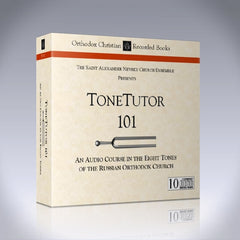
Tone Tutor


For those who are unable to go to the Summer Liturgical School in Jordanville, the Tone Tutor is an excellent set of CDs that will teach you the 8 tones according to the common usage of the Russian Church, and uses the methods taught at Jordanville. There are 10 CDs: one for each of the 8 tones. One for "mid term" and "final" tests, and one for refreshing your memory. This tone teaches each variation of the 8 tones: the troparion, sticheron, sticheron refrains, prokimenon, and irmos melodies. The program is completely audio based... you need only pop in the first CD, and follow the instructions from there.

This fills an important need. In the 90's there was a cassette tape available, but it was not nearly as user friendly, and the translation used for the text was not the most commonly used ones in ROCOR.

Choir members who have not yet memorized the tones will greatly benefit from this, and especially those who are thrust into the position of manning the cliros, and have no one else to prompt them when a particular tone is called for, and they have no one to get them started. Many years ago, I was in that situation, and I used some cassette tapes that were available, and worked on the tone of the week each week, until I had them all down. But this is a much more thorough program. I highly recommend it.

It can be purchased by clicking here.

Friday, December 28, 2012

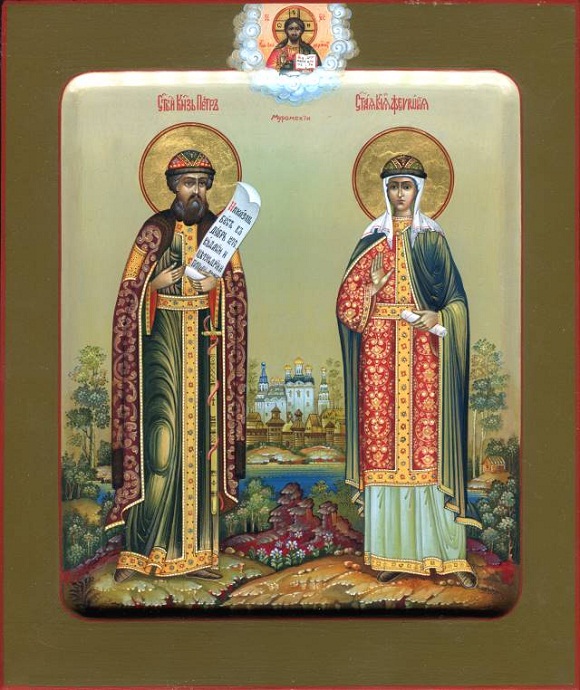
The Russian Church establishes a new commemoration of Ss. Peter and Febronia of Murom


What follows is a Google translation that I have cleaned up as best as I could, but there may be some minor errors. Fr. Michael van Opstall kindly provided a translation of the petitions.

JOURNAL № 129

CONSIDERED the establishment of an additional day to commemorate the wonder workers Holy Prince Peter (in monasticism, David) and Princess Fevronia (in monasticism, Euphrosyne), of Murom.

Information:

The celebration of the Holy Prince Peter and Princess Fevronia of Murom on July 8 (June 25 by the Julian calendar), falls during the Fast of Ss. Peter and Paul . In this regard, the Council of Bishops on February 4th, 2011, instructed the liturgical commission "to consider an additional date for the commemoration of the Holy Prince Peter and Princess Fevronia of Murom, referring to the desire of many Christians to be married on the day honoring these patrons of marriage" (paragraph 17, of the "On matters of internal life and external activities of the Russian Orthodox Church").In examining the issue, it was noted that an additional day of commemoration of Saints Peter and Fevronia could be installed on the 20th of January (the transfer of the relics of the saints from the Murom Museum of the Annunciation Monastery in Murom) or September 19th (transfer of the relics from the Annunciation Monastery to the Holy Trinity convent Murom.). The Commission of the Inter-Council on worship and religious art, with the blessing of His Holiness Patriarch Kirill, discussed the issue, and recommended that in conjunction with the celebration of the memory of St. Peter and Fevronia, there also be additional petitions to be done at the augmented litany of Divine Liturgy, and that preaching on this day be devoted to the Christian doctrine of family and marriage.

RESOLVED:

1. To establish an additional day for the commemoration of the Holy wonder workers Prince Peter (in monasticism, David) and Princess Fevronia (in monasticism Euphrosyne) of Murom on the Sunday preceding the September 19 (September 6 by the Julian calendar), in remembrance of transferring their fair bodies in the year 1992.

2. In conjunction with the commemoration of Saints Peter and Fevronia, clergy preach on the subject of pious Christian family values.

3. Also on this occasion, to add to the augmented litany of the Divine Liturgy the following petitions:

Again we pray that Thy people would keep this commandment: what God has joined, let not man put asunder, and that He would give their home churches indestructible strength and increase in love unfeigned;

Again we pray for the preservation of the marriages of Thy servants, in peace and concord, piety and purity;

Again we pray that Thy people may rejoice to see sons and daughters, and that our people would multiply and inherit Thy blessing from generation to generation.

4. That the Synodal liturgical commission submit to the Holy Synod by April 1, 2013 a prayer to be read at the end of the Divine Liturgy in memory of the days of Ss. Peter and Fevronia, for the multiplication of love, strengthening of families, and the faithful preservation of the gift of chastity in those not married and to help them prepare for their entry into family life.

Saturday, December 22, 2012

Hammer Control?


Many are arguing that Wayne LaPierre argued that violent movies and violent video games share some of the blame for the recent school shooting in Connecticut, that he was undercutting the traditional argument that "Gun's don't kill people, people kill people". The problem with that observation is that guns are tools, just like hammers are tools. Movies and Video Games are mediums, and mediums communicate information. If we have lots of video games in which people went around cracking people's skulls with hammers, and we had movies that glorified killing people with hammers, we would probably see a rise in murders committed with hammers. If we did, hammers would not share equal blame with those movies and video games.... hammers are tools, which can be put to either good or bad uses. The answer is not hammer control, or limiting the size and weight of hammers.

Human beings have a natural aversion to killing other human beings. You have to train a person to kill another person. Guns cannot train anyone, and neither can hammers. Movies and video games can train people.

As Lt. Col. Dave Grossman observed in his article "Trained to Kill", without training, human beings are very ineffective killers:

"In more modern times, the average firing rate was incredibly low in Civil War battles. Paddy Griffith demonstrates that the killing potential of the average Civil War regiment was anywhere from five hundred to a thousand men per minute. The actual killing rate was only one or two men per minute per regiment (The Battle Tactics of the American Civil War). At the Battle of Gettysburg, of the 27,000 muskets picked up from the dead and dying after the battle, 90 percent were loaded. This is an anomaly, because it took 95 percent of their time to load muskets and only 5 percent to fire. But even more amazingly, of the thousands of loaded muskets, over half had multiple loads in the barrel--one with 23 loads in the barrel. In reality, the average man would load his musket and bring it to his shoulder, but he could not bring himself to kill. He would be brave, he would stand shoulder to shoulder, he would do what he was trained to do; but at the moment of truth, he could not bring himself to pull the trigger. So, he lowered the weapon and loaded it again. Of those who did fire, only a tiny percentage fired to hit. The vast majority fired over the enemy's head."

However, with training, people can become killing machines:

The Japanese were masters at using classical conditioning with their soldiers. Early in World War II, Chinese prisoners were placed in a ditch on their knees with their hands bound behind them. And one by one, a select few Japanese soldiers would go into the ditch and bayonet "their" prisoner to death. This is a horrific way to kill another human being. Up on the bank, countless other young soldiers would cheer them on in their violence. Comparatively few soldiers actually killed in these situations, but by making the others watch and cheer, the Japanese were able to use these kinds of atrocities to classically condition a very large audience to associate pleasure with human death and suffering. Immediately afterwards, the soldiers who had been spectators were treated to sake, the best meal they had had in months, and to so-called comfort girls. The result? They learned to associate committing violent acts with pleasure. The Japanese found these kinds of techniques to be extraordinarily effective at quickly enabling very large numbers of soldiers to commit atrocities in the years to come. Operant conditioning (which we will look at shortly) teaches you to kill, but classical conditioning is a subtle but powerful mechanism that teaches you to like it.

Violent movies and video games train people to kill. That doesn't mean that everyone who watches violent movies or plays Halo is going to kille 20 little kids, but those things do make you capable of shooting another human being in a way that people in the Civil War were not, even though they all had access to guns.


Tuesday, December 18, 2012

Computer Based Bible Study... for Free

For those who may not have a good library of Biblical Reference texts, there is actually quite a bit of useful resources that are available for free, online.

1. The Bible Gateway is a very useful website. It has numerous English translations available. To get the best use of that site, you will want to go to the preferences link on the left hand menu, select the default translation that you would like to use, and you can choose to include translations that have the deuterocanonical books (which Orthodox Christians would want to do). I would recommend using the New King James Version as your default translation, but if you are wanting to search the deuterocanonical books, you can switch to the Douay-Rheims translation.

Some of the additional features of this website include the ability to listen to recordings of the Bible being read. The option will only appear if you are using a translation that has such a recording on the website, which in English would be the ESV, KJV, or NIV, but they also have Spanish, Chinese, and a few other languages available. Once you have pulled up a text, there are two other options worth using. One is to pull up a parallel translation. For example, you could compare two English translations. You could have the English on one side, and the Greek or Hebrew text on the other. You could also have the English and just about any other language up for comparison, such as Russian, or Arabic. There is also a "Show Resources" hyperlink on the right, and that will pull up some commentaries and Bible Dictionary entries that apply to the passage you are looking at.

2. The Christian Classics Ethereal Library is also a great resource. It has the Ante-Nicene, and Nicene, Post-Nicene Fathers collection, which include a number of Patristic commentaries, especially those of St. John Chrysostom and St. Augustine. But if you go to their main page, one of the options at the bottom of the page is "Study a Bible Passage." If you click on that link, and on the left side, select the book of the Bible you want to study, and then select the chapter, it will pull up Matthew Henry's commentary on the right side, but if you click on the "MHC Commentary" link, you will see that it is a drop down menu. If you then select "References", if will then pull up a list of references to every text that they have on their site, which will include links to the Church Fathers, including those that are not commentaries per se, but which in many cases will have comments on the passage you are looking at (you will at least see that the Father in question made some reference to that text). In many cases those references may not be helpful, because the reference to your passage was only a brief allusion... but in other cases you will find very useful commentary. You will also occasionally see St. John of Kronstadt's "My Life in Christ" among the references.

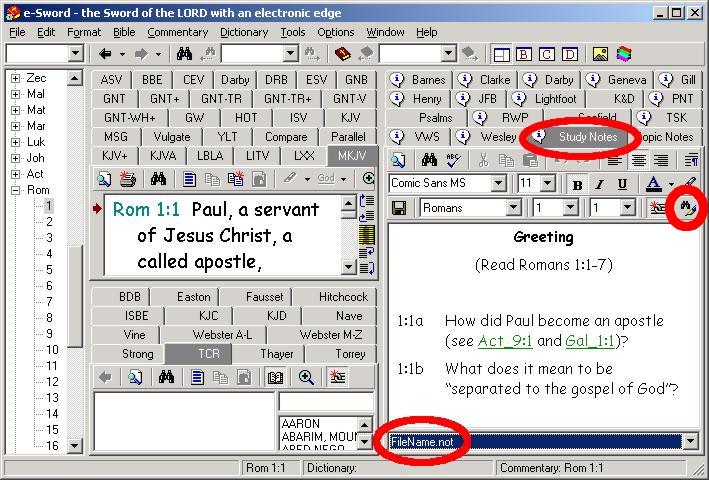
3. The E-Sword is a free downloadable program that I have been finding very useful. Once you download the program itself, you can then select the reference material that you also want to download. There is a huge amount of this material that is free, because the texts are public domain. Here is what I would recommend you download:

Translations:

The American Standard Version
The Brenton Septuagint
The Douay-Rheims Bible
The English Majority Text Version
The English Standard Version
The King James Version
The King James Version (w/ Strongs Numbers)
The Literal Translation of the Holy Bible
The Revised Version
The World English Bible with Apocrypha
Young's Literal Translation

If you know Greek and/or Hebrew, you can download the Hebrew Old Testament, the Septuagint Greek text, and the Greek New Testament (which has several options, but I would recommend the Robinson/Pierpont Byzantine Greek New Testament).

Commentaries:

Adam Clarke's Commentary
Keil & Delitzch Commentary on the Old Testament
Matthew Henry's Commentary on the Whole Bible
George Haydock's Catholic Bible Commentary
Vincent Word Studies
The Pulpit Commentary
Treasury of David
Alexander MacLaren's Commentary
Albert Barnes' Notes on the Whole Bible
Treasury of Scriptural Knowledge
Cambridge Bible for Schools and Colleges

Dictionaries:

Brown-Driver-Brigg's Hebrew Definitions
Nave's Topical Bible
Smith's Bible Dictionary
Strong's Bible Dictionary
Thayer's Greek Definitions

Among many other things you can do with this program, is if you switch the text you are looking at to the King James Version with the Strong's reference numbers, you can then look at the Hebrew or Greek word that is behind the translation, and get a detailed definition of the word and comments on its various uses in Scripture.

You can also download some E-Sword compatible reference material at a cost, but a cost far less than buying the hard copy versions -- most notably the Ancient Christian Commentary Series.

4. The Blue Letter Bible is a web site that has some of the same content as the Bible Gateway and E-Sword, but is not one that I have personally used a lot. There is also a Blue Letter Bible App that has much the same content.

5. There are also some useful Smart Phone Apps:

The best single Bible App I have found so far is the You Version, from LifeChurch.tv. You can read the Bible in just about any English translation, or in most other languages. You can also listen to audio files of many of the translations. The Bible Gateway App is also worth considering. The Blue Letter Bible App provides a lot more in the way of study helps, but if your primary interest in having a Bible App is in reading or listening to the text, I think the YouVersion is better.

6. A new app which provides a great deal of Patristic commentary is the "Catena Bible & Commentaries" provides verse by verse commentary. This is a smart phone app.

There are many other reference books worth getting, but free is hard to beat.

Monday, December 17, 2012

Torah! Torah! Torah!


The Torah Scroll

The Fathers say that the two tables of the the Law of Moses were divided according to the two great commandments: 1) To love God; and 2) To love your neighbor.

Here are sermons on the first table of the Law:

1st Commandment: Thou shalt have no other gods before Me. (12/11/2011)

2nd Commandment: Thou shalt not make unto thee any idols. For this commandment, there are two sermons: one on what it does not mean (3/4/2012), and one on what it does mean (10/21/2012).

3rd commandment: Thou shalt not take the name of the Lord thy God in vain (8/26/2012).

4th Commandment: Remember the Sabbath day to keep it holy (9/16/2012).

Friday, December 14, 2012

Mass Shootings and Cultural Decay


This is a sermon reflecting on the shootings in Aurora, Colorado, but the comments are applicable to the shootings of today as well:

Click here to listen

Delivered on 7/22/2012.

Update: The shooter was allegedly a "Goth" who suffered from some personality disorder. This disorder is becoming an epidemic: Spiritual-Deficiency-Disorder.

You should also read "Trained to Kill", by military psychologist Lt. Col. Dave Grossman.

Thursday, December 13, 2012

Seek ye first the Kingdom of God


A homily on Matthew 6:33, on the subject of putting God first in your life:

Click here to listen.

Delivered on 7/3/2011.

Saturday, December 08, 2012

Friday, December 07, 2012

What remains from a persons life?


A sermon reflecting on the legacy we leave when we die, given on 8/5/2012, and reflecting on the repose of my mother.

Click here to listen.

Thursday, December 06, 2012

The Gospel of the Virgin Mary


The Wedding at Cana

St. Nikolai Velimirovic has uncovered the Gospel of the Virgin Mary. Listen for details by clicking here.

Tuesday, December 04, 2012

Search the Scriptures: Excellence in Podcasting


One of the best podcasts on Ancient Faith Radio is without a doubt "Search the Scriptures", and in her last 4 posts, Dr. Eugenia Constantinou illustrates why.

Recently there was some buzz in the media about some ancient manuscript that allegedly gave evidence that Christ was married. Presbytera Eugenia  nukes this in two podcasts:

Was Jesus Married, Part 1

Was Jesus Married, Part 2

And her most recent 2 podcasts, she thoroughly deals with the question of the Virgin Birth, and Isaiah 7:14:

Isaiah 7, part 1

Isaiah 7, part 2

And she's not done with Isaiah 7 yet.

There is so much misinformation that is circulated by people who generally don't know what they are talking about -- especially people in the media -- and when people hear things like this that challenge the integrity of the Scriptures and the Christian Faith, but don't know how to answer them, many people are seriously shaken. We are very fortunate to have a scholar like Dr. Eugenia Constantinou that not only knows what she's talking about, but is generous enough to do these podcasts and share  that knowledge with the rest of the Church.


Thursday, November 29, 2012

What should Orthodox Christians do, when there is no parish nearby?

 
The Holy New Martyr Lydia of Russia

Towards the end of the inaugural show of Ancient Faith Radio's Orthodoxy Live, Fr. Evan Armetas was asked a question: what should Orthodox Christians do, if they live in an area where there are no Orthodox Churches nearby? Is it OK to go to a heterodox Church in such a case, when you are not able to go to an Orthodox parish?

Fr. Evan's answer indicated that he knew his answer would be controversial, but he said that his own pastoral response was that it was OK. He said that they should go to those churches in order to hear "the liturgy of the word" and for fellowship. You can hear the question and his answer by clicking this link, beginning at about the 55 minute mark: http://ancientfaith.com/podcasts/orthodoxylive/november_18_2012

I have no doubts that Fr. Evan's answer was sincere, and I am sure that he thinks it is better than any alternative. And since he was raised in the Church, I think it is partly due to a lack of time spent actually attending such heterodox churches.

I strongly disagree with Fr. Evan's answer, and for a number of reasons. First and foremost, the canons forbid us to go to Non-Orthodox houses of worship or to pray with non-Orthodox Christians or schismatics:

Canon LXV of the Apostles says: "If any clergymen, or laymen, enter a synagogue of Jews, or of heretics, to pray, let him be both deposed and excommunicated."

Canon IX of Laodicia says: "Concerning the fact that those belonging to the Church must not be allowed to go visiting the cemeteries or the so called martyria of any heretics, for the purpose of prayer or of cure, but, on the contrary, those who do so, if they be among the faithful, shall be excluded from communion for a time until they repent and confess their having made a mistake, when they may be readmitted to communion." 

And Canon XXXIII of Laodicia says: "One must not join in prayer with heretics or schismatics."

All of these canons have Ecumenical authority, having been approved by the Sixth and Seventh Ecumenical Councils.

Sometimes the counter argument that one hears to this is that the heretics at the time of these canons were much worse than the average Protestant and Roman Catholic, but the last canon referenced says were are not to pray with heretics or schismatics. Schismatics differ from us in no theological way at all, at least in the beginning, and so any schismatic group would be a thousand times closer to the Orthodox than any Protestant or Roman Catholic.

To cite a relatively recent example from the lives of the Saints, one should consider the Holy New Martyr Lydia of Russia (you can hear a sermon on her life by clicking here). She lived during the time of the so-called "Living Church" which was a renovationist schism that was established by the Soviets, and for a time it was the "official" Church -- and the only Church allowed by the Soviets to function openly. St. Lydia's own father joined the Living Church, not out of conviction, but out of fear of persecution. St. Lydia departed from her father, and we are told that she only rarely went to Church during that time, because she would not attend the "Official Church", and the Catacomb Churches did not hold regular services. So unless she was able to attend services in a legitimate Orthodox Church she stayed home and prayed. As bad as the Living Church was, it was far closer to Orthodoxy than any Protestant or Roman Catholic church. One would be far more likely to hear something approximating the "Liturgy of the word" in such a Church. But St. Lydia refused to go.

St. Cyril of Jerusalem, in the oldest recorded Catechism of the Church, stated:

"And if ever thou art sojourning in cities, inquire not simply where the Lord’s House is (for the other sects of the profane also attempt to call their own dens houses of the Lord), nor merely where the Church is, but where is the Catholic Church.  For this is the peculiar name of this Holy Church, the mother of us all, which is the spouse of our Lord Jesus Christ, the Only-begotten Son of God (for it is written, As Christ also loved the Church and gave Himself for it, and all the rest,) and is a figure and copy of Jerusalem which is above, which is free, and the mother of us all; which before was barren, but now has many children" (Catechetical Lectures 18:26).

We do not refrain from praying with heretics or schismatics because we are condemning them to hell. We refuse to pray with them because praying together implies a unity of faith that does not exist. As the Prophet Amos observed: "Can two walk together, except they be agreed?" (Amos 3:3).

Aside from the canons, there are two practical reasons why I think that Fr. Evan's advice should not be followed:

1). One would not hear anything close to the "Liturgy of the word" in most Protestant or Catholic churches. What one would likely encounter would range from the absolutely heretical to the mildly heretical. If one knows what to reject and what to pay attention to, there are many heterodox clergy who have edifying things to say, but the problem is that the average Orthodox layman does not have the knowledge to know what to reject and what to listen to, and so would almost certainly be led astray by regular exposure to such preaching.

2). In the history of Orthodoxy in the United States there have been many Orthodox who did exactly what Fr. Evan suggested. Some, if they eventually found their way to an Orthodox Church remained in the Church. But in most cases, such people lost their connection with the Church... and this is all the more true of their children, who in most cases grew up thinking of themselves as belonging to the group that they were raised in.

So what should an Orthodox Christian do if there are no Orthodox Churches in their area?

First of all, they should figure out which parish is the closest, and they should try to attend there as often as they can. In our time, this is made very simple by the internet. There is a very good website called "Orthodoxy in America", where you can simply enter your zip code and find any parish that is within a certain radius: http://orthodoxyinamerica.org/   The Assembly of Canonical Orthodox Bishops in North America also have a similar directory: http://assemblyofbishops.org/directories/parishes

Secondly, when they are not able to go to the nearest parish, they should pray at home. Every Orthodox home is a little Church, and if there are no other Orthodox parishes near enough for you to attend, then this is the Church you should be attending.

You can hear the "Liturgy of the word" by serving Typika (or Obednitsa, as it is sometimes called). I regularly update this page, where one can find the text of Typika (when served in the absence of a priest) and the variable portions of Typika for Sundays and Feast days by clicking here: http://www.saintjonah.org/typ/ You can find instructions on how to do lay services, as well as other texts for that purpose by clicking here: http://www.saintjonah.org/services/horologion.htm

With the blessing of their bishop, they may also want to advertize their services. They could do so at no cost, by setting a blog and posting information about their services. They may find that there are some other Orthodox Christians in their area, and their house Church may be the beginnings of a future parish.

As Archbishop Averky (of blessed memory) observed, many Orthodox Christians have the mistaken notion that they are almost unable to pray at all without a priest; but short of the sacraments, any Orthodox Christian can -- and, in the instances we are discussing, should, to the best of their ability -- do the full cycle of services for Sundays and Feast days. See: Comments on Reader Services by Archbishop Averky,of blessed memory.

With all that is available for free on the internet these days, it is not difficult for an Orthodox Christian to at least do some regular services in their own homes, when they cannot attend a parish. And instead of setting your children up to drift into heterodoxy, you will provide them with a vivid example of the effort that one should put forth to maintain their faith in a largely non-Orthodox culture.

Update: Someone reminded me of St. Raphael (Hawaweeny)'s Pastoral Epistle to his flock, at a time when travel was much more difficult, Orthodox Churches were much fewer and farther between. Here is the most pertinent portion to this question:

"Therefore, as the official head of the Syrian Holy Orthodox Catholic Apostolic Church in North America and as one who must give account (Heb. 13:17) before the judgment seat of the Shepherd and Bishop of our souls (I Pet. 2:25), that I have fed the flock of God (I Pet. 5:2), as I have been commissioned by the Holy Orthodox Church, and inasmuch as the Anglican Communion (Protestant Episcopal Church in the USA) does not differ in things vital to the well-being of the Holy Orthodox Church from some of the most errant Protestant sects, I direct all Orthodox people residing in any community not to seek or to accept the ministrations of the Sacraments and rites from any clergy excepting those of the Holy Orthodox Catholic and Apostolic Church, for the Apostolic command that the Orthodox should not commune in ecclesiastical matters with those who are not of the same household of faith (Gal. 6:10), is clear: "Any bishop, or presbyter or deacon who will pray with heretics, let him be anathematized; and if he allows them as clergymen to perform any service, let him be deposed." (Apostolic Canon 45) "Any bishop, or presbyter who accepts Baptism or the Holy Sacrifice from heretics, we order such to be deposed, for what concord hath Christ with Belial, or what part hath he that believeth with an infidel?" (Apostolic Canon 46)

As to members of the Holy Orthodox Church living in areas beyond the reach of Orthodox clergy, I direct that the ancient custom of our Holy Church be observed, namely, in cases of extreme necessity, that is, danger of death, children may be baptized by some pious Orthodox layman, or even by the parent of the child, by immersion three times in the names of the (Persons of the) Holy Trinity, and in case of death such baptism is valid; but, if the child should live, he must be brought to an Orthodox priest for the Sacrament of Chrismation.

In the case of the death of an Orthodox person where no priest of the Holy Orthodox Church can be had, a pious layman may read over the corpse, for the comfort of the relatives and the instruction of the persons present, Psalm 90 and Psalm 118, and add thereto the Trisagion ("Holy God, Holy Mighty," etc.). But let it be noted that as soon as possible the relative must notify some Orthodox bishop or priest and request him to serve the Liturgy and Funeral for the repose of the soul of the departed in his cathedral or parish Church.

As to Holy Matrimony, if there be any parties united in wedlock outside the pale of the holy Orthodox Church because of the remoteness of Orthodox centers from their home, I direct that as soon as possible they either invite an Orthodox priest or go to where he resides and receive from his hands the Holy Sacrament of Matrimony; otherwise they will be considered excommunicated until they submit to the Orthodox Church's rule.

I further direct that Orthodox Christians should not make it a practice to attend the services of other religious bodies, so that there be no confusion concerning the teaching or doctrines. Instead, I order that the head of each household, or a member, may read the special prayers which can be found in the Hours in the Holy Orthodox Service Book, and such other devotional books as have been set forth by the authority of the Holy Orthodox Church."