Thursday, January 17, 2008

Jerusalem Post 2500 year old Seal from First Temple Period Found

First Temple seal found in Jerusalem
By ETGAR LEFKOVITS


A stone seal bearing the name of one of the families who acted as servants in the First Temple and then returned to Jerusalem after being exiled to Babylonia has been uncovered in an archeological excavation in Jerusalem's City of David, a prominent Israeli archeologist said Wednesday.

Photo: Edwin Trebels courtesy of Dr. Eilat Mazar

The 2,500-year-old black stone seal, which has the name "Temech" engraved on it, was found earlier this week amid stratified debris in the excavation under way just outside the Old City walls near the Dung Gate, said archeologist Dr. Eilat Mazar, who is leading the dig.

According to the Book of Nehemiah, the Temech family were servants of the First Temple and were sent into exile to Babylon following its destruction by the Babylonians in 586 BCE.

The family was among those who later returned to Jerusalem, the Bible recounts.


The seal, which was bought in Babylon and dates to 538-445 BCE, portrays a common and popular cultic scene, Mazar said.

The 2.1 x 1.8-cm. elliptical seal is engraved with two bearded priests standing on either side of an incense altar with their hands raised forward in a position of worship.

A crescent moon, the symbol of the chief Babylonian god Sin, appears on the top of the altar.

Under this scene are three Hebrew letters spelling Temech, Mazar said.

The Bible refers to the Temech family: "These are the children of the province, that went up out of the captivity, of those that had been carried away, whom Nebuchadnezzar the king of Babylon had carried away, and came again to Jerusalem and to Judah, every one unto his city." [Nehemiah 7:6]... "The Nethinim [7:46]"... The children of Temech." [7:55].

The fact that this cultic scene relates to the Babylonian chief god seemed not to have disturbed the Jews who used it on their own seal, she added.

The seal of one of the members of the Temech family was discovered just dozens of meters away from the Opel area, where the servants of the Temple, or "Nethinim," lived in the time of Nehemiah, Mazar said.

"The seal of the Temech family gives us a direct connection between archeology and the biblical sources and serves as actual evidence of a family mentioned in the Bible," she said. "One cannot help being astonished by the credibility of the biblical source as seen by the archaeological find."

The find will be announced by Mazar at the 8th annual Herzliya Conference on Sunday.

The archeologist, who rose to international prominence for her recent excavation that may have uncovered King David's palace, most recently uncovered the remnants of a wall from Nehemiah.

The dig is being sponsored by the Shalem Center, a Jerusalem research institute where Mazar serves as a senior fellow, and the City of David Foundation, which promotes Jewish settlement throughout east Jerusalem.

Friday, December 07, 2007

The Fall Pastoral Retreat of the Western American Diocese in Los Angeles Concludes


The Transfiguration Cathedral in Los Angeles


You can read what I was up to last month in Los Angeles last month by clicking here.

You can see photos by clicking here.

Saturday, November 03, 2007

Friday, November 02, 2007

The Orthodox Study Bible


The complete Orthodox Study Bible can now be pre-ordered, for shipment in February 2008. There is also a web site that has sample pages that can be viewed. Judging from these sample pages, the commentary notes seem to be a huge improvement over the earlier New Testament only edition. I just hope that they re-did the New Testament with the same kind of patristic commentary as is shown in the Old Testament samples.

Click here to listen to an interview with Fr. Peter Gilquist, in which he gives an update on the publication schedule, as well as details about the contents.

Wednesday, October 03, 2007

Patriarch Alexei refuses to bow to political correctness.


Russian Orthodox Patriarch Explains Stand on Homosexuality to Council of Europe "Love the Sinner, Hate the Sin"
By John-Henry Westen

STRASBOURG, October 3, 2007 (LifeSiteNews.com) - In his first visit to the Council of Europe on a mission to discuss inter-religious dialogue, the head of the Russian Orthodox Church, Patriarch Alexy II, gave a spirited defence of Christian morality. He noted that the notion of human rights in Europe stems, at least in part from Christian morality. "Yet today there occurs a break between human rights and morality, and this break threatens the European civilization," he warned.

"We can see it in a new generation of rights that contradict morality, and in how human rights are used to justify immoral behavior," he stated.

The remarks prompted British Liberal Democrat council member David Russell-Johnston to demand an explanation of the Russian Orthodox leader's opposition to the Moscow "gay pride" march.

"When persistent attempts were made to hold a homosexual parade in Moscow, we believed that that meant propaganda and advertisement of sin," Alexy replied before the Council. The Patriarch compared homosexual sex acts to kleptomania and asked, "Why then (does) no one advertise kleptomania while homosexuality gets advertised via gay parades?"

"It is advertisement that is being forced on people who are a very long way from it," Alexy added.

The Patriarch stressed that persons who have such temptations and engage in homosexual acts are nonetheless loved by Christians. They are he said, "sinners whom we love while we hate their sin."

"But at the same time we Orthodox Christians cannot depart from what is taught by the Bible and by the apostolic tradition of the church," he added. "Nobody must try to force me or my brothers and sisters in faith to be silent and [to prevent us from] using the word sin for something that is called sin in God's Word."

Several Council of Europe members including the Russian representative applauded these remarks by the Patriarch, much to the chagrin of Mr. Russell-Johnston. The irate councilman called the Patriarch's analogy between kleptomania and homosexuality "ridiculous" and dismissed the Patriarch's remarks as merely having "repeated his aggressively intolerant position."

"What was regrettable was that a lot of people applauded him," Russell-Johnston told the International Herald Tribune.

During his speech the Patriarch warned of just such intolerance of morality leading to Europe's demise. "If we ignore moral norms, we ultimately ignore freedom too," said Alexy. "Morality is freedom in action. It is a freedom brought into reality as a result of responsible choice, in which human person restricts his or her self for the good of that very person and broader society."

"Moral principles secure societal vitality and growth, as well as unity of society," he added. "And whenever moral norms are trespassed and declared to be relative, it may undermine the whole worldview of the Europeans. They may draw nigh to a disastrous moment when European nations risk losing their spiritual and cultural identity and ultimately their own place in history."

See the full speech (which did not contain the replies to questions):
http://www.coe.int/t/dc/files/pa_session/sept_2007/20071002_disc_patriarche_en.asp

Thursday, September 20, 2007

From Wittenberg to Antioch


Luther nailing his 95 theses to the door of the Wittenberg Chapel


There is a very interesting Podcast that is posted on the Ancient Faith Radio web site, that contains an interview of Fr. Gregory Hogg by the Illumined Heart show, in which he discusses his conversion to Orthodoxy from Lutheranism. Click here to listen.

Thursday, September 13, 2007

The Complete Hymn "O Virgin Pure", by St. Nectarios


You can hear this hymn in Greek by clicking on the video above. You can read about St. Nectarios, by clicking here.

O Virgin Pure
by St. Nectarios
Plagal First Tone (Tone 5)

Refrain: O Rejoice, Bride Unwedded.

O Virgin pure, immaculate/ O Lady Theotokos
O Virgin Mother, Queen of all/ and fleece which is all dewy
More radiant than the rays of sun/ and higher than the heavens
Delight of virgin choruses/ superior to Angels.
Much brighter than the firmament/ and pure than the sun's light
More holy than the multitude/ of all the heav'nly armies.
O Rejoice, Bride Unwedded.

O Ever Virgin Mary/ of all the world, the Lady
O bride all pure, immaculate/ O Lady Panagia
O Mary bride and queen of all/ our cause of jubilation
Majestic maiden, Queen of all/ O our most holy Mother
More hon'rable than Cherubim/ beyond compare more glorious
than immaterial Seraphim/ and greater than angelic thrones.

O Rejoice, Bride Unwedded.

Rejoice, O song of Cherubim/ Rejoice, O hymn of angels
Rejoice, O ode of Seraphim/ the joy of the archangels
Rejoice, O peace and happiness/ the harbor of salvation
O sacred chamber of the Word/ flower of incorruption
Rejoice, delightful paradise/ of blessed life eternal
Rejoice, O wood and tree of life/ the fount of immortality

O Rejoice, Bride Unwedded.

I supplicate you, Lady/ now do I call upon you
And I beseech you, Queen of all/ I beg of you your favor
Majestic maiden, spotless one/ O Lady Panagia
I call upon you fervently/ O sacred, hallowed temple
Assist me and deliver me/ protect me from the enemy
And make me an inheritor/ of blessed life eternal.

O Rejoice, Bride Unwedded.


You can read the text of this hymn in Greek at:

http://agrino.org/cyberdesert/agni.htm

For more Byzantine Chant on Youtube, check out the following:

Byzantine Chant #1

Byzantine Chant #2

Byzantine Chant #3

Byzantine Chant #4

Thursday, September 06, 2007

Video of the Moscow Delegation in Boston

Video of the delegation from Moscow at the Boston ROCOR Cathedral, singing "memory eternal" to Fr. Roman Lukianov, the departed rector of that cathedral.

Tuesday, July 24, 2007

Der Spiegel Interview with Alexander Solzhenitsyn


There is an interview that Der Spiegel has just posted with Alexander Solzhenitsyn that gives a lot of insight into how this former Soviet dissident views current trends in Russia. He is asked a number of questions that reflect common western rejudices about what is good or bad in Russia today, and Solzhenitsyn more than once sets the reporter back on his rear end with his answers.

Saturday, June 09, 2007

Fr. Elia Wen, Memory Eternal


From Orthodox.cn, slightly modified.

Protopresbyter Elias ( Wén Zǐzhèng in Chinese) was a priest under the Archbishop of Shanghai, St John the Wonderworker. He became rector of the Cathedral there in 1946 but have fled to Hong Kong when the Communists took power in 1949.

Fr Elias was the oldest living Orthodox priest, who turned 110 on November 19th, 2006. He had been living in San Francisco with his son Michael, an active member of the parish council at the Holy Virgin Cathedral on Geary Blvd.

Memory eternal for the servant of God Protopresbyter Elias Wen who has fallen asleep in the Lord shortly before 3PM PDT on Saturday, June 9, 2007 at age of 110 years old. The first panikhida will be held Sunday night.

A Few New Photos

Here are some additional photos that have been e-mailed to me:

Here is a photo of me greeting a priest at the St. Sergius Trinity-Lavra, when we first got off the bus.

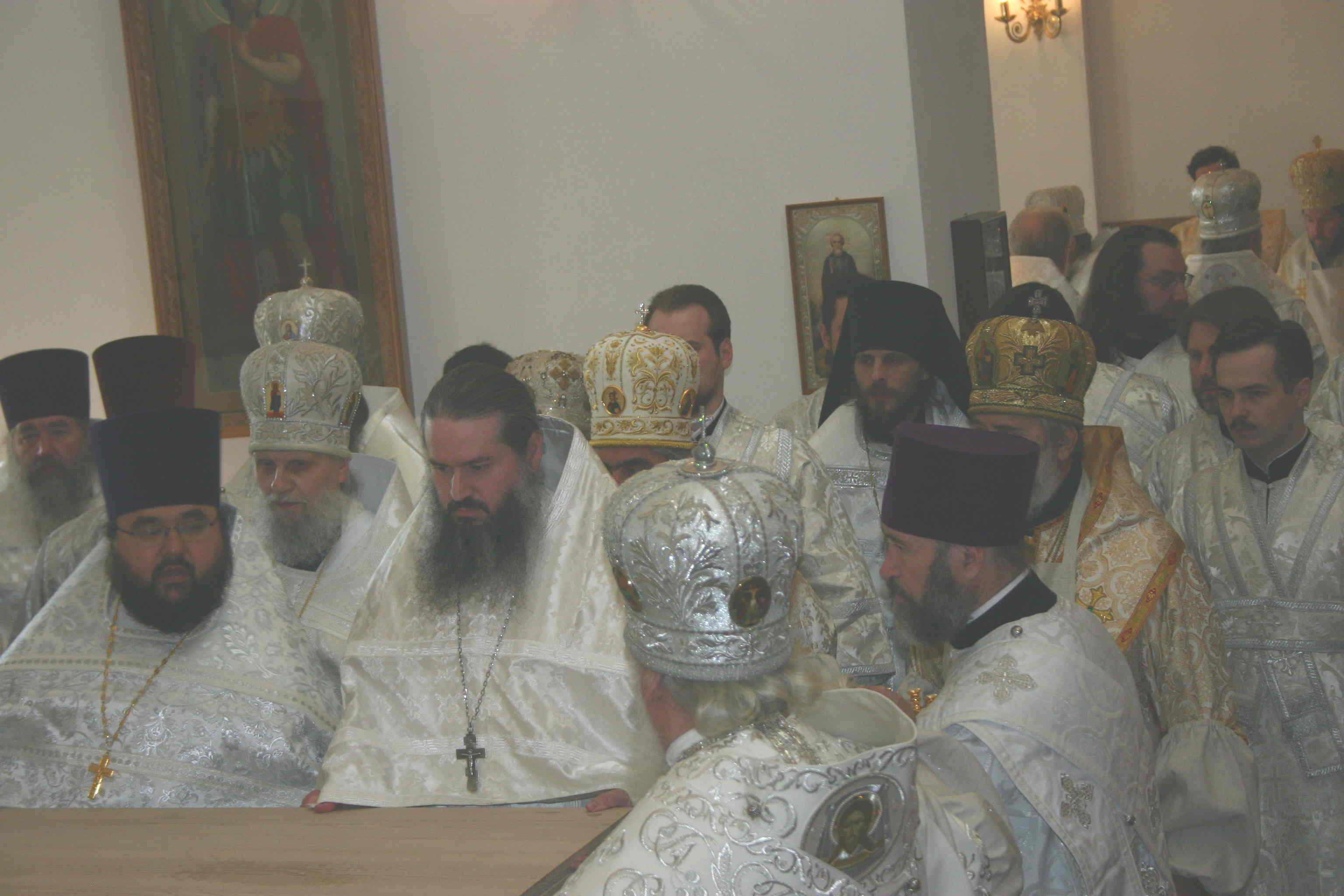
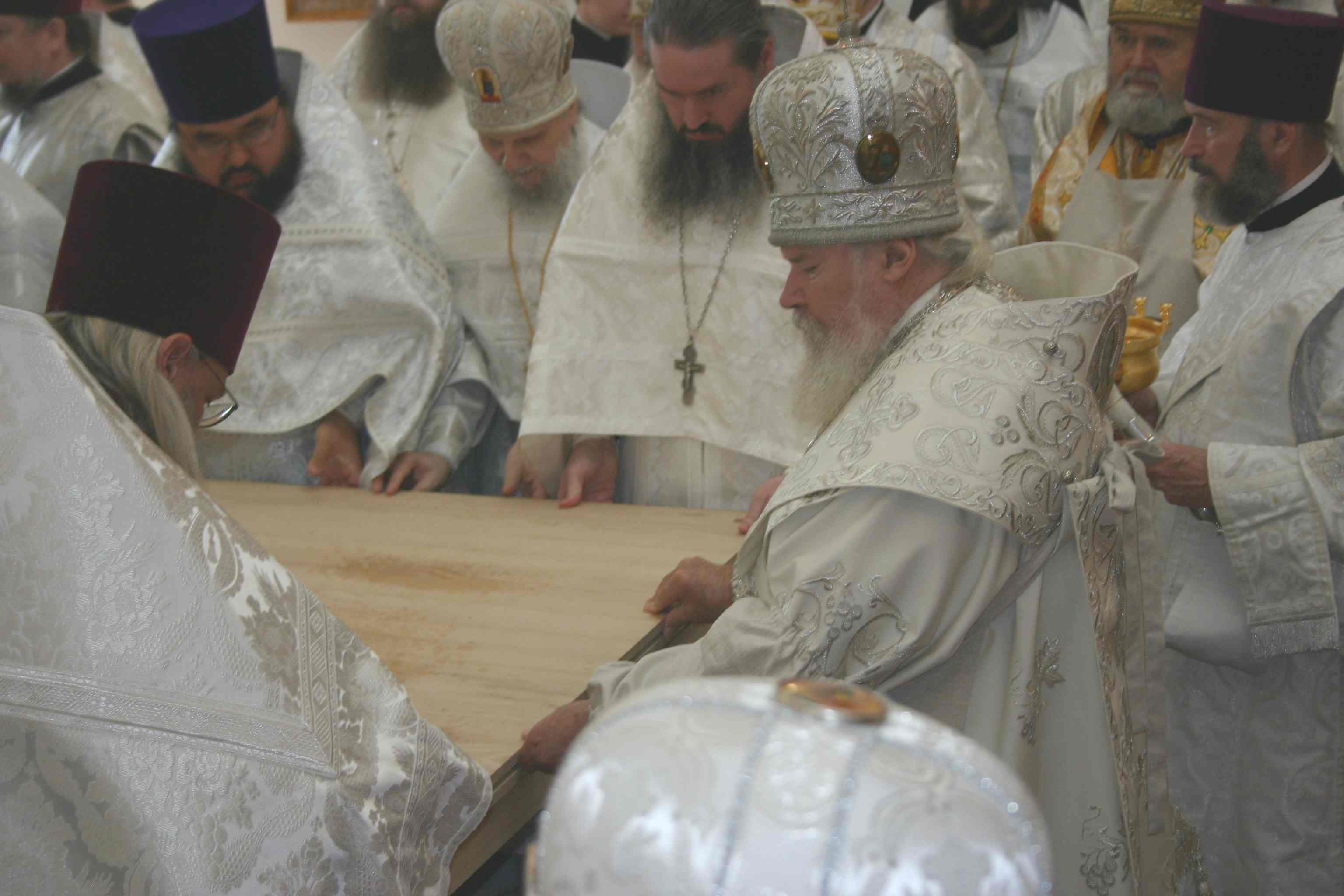
Here is a photo of when we were holding the top of the holy Table at Butovo.

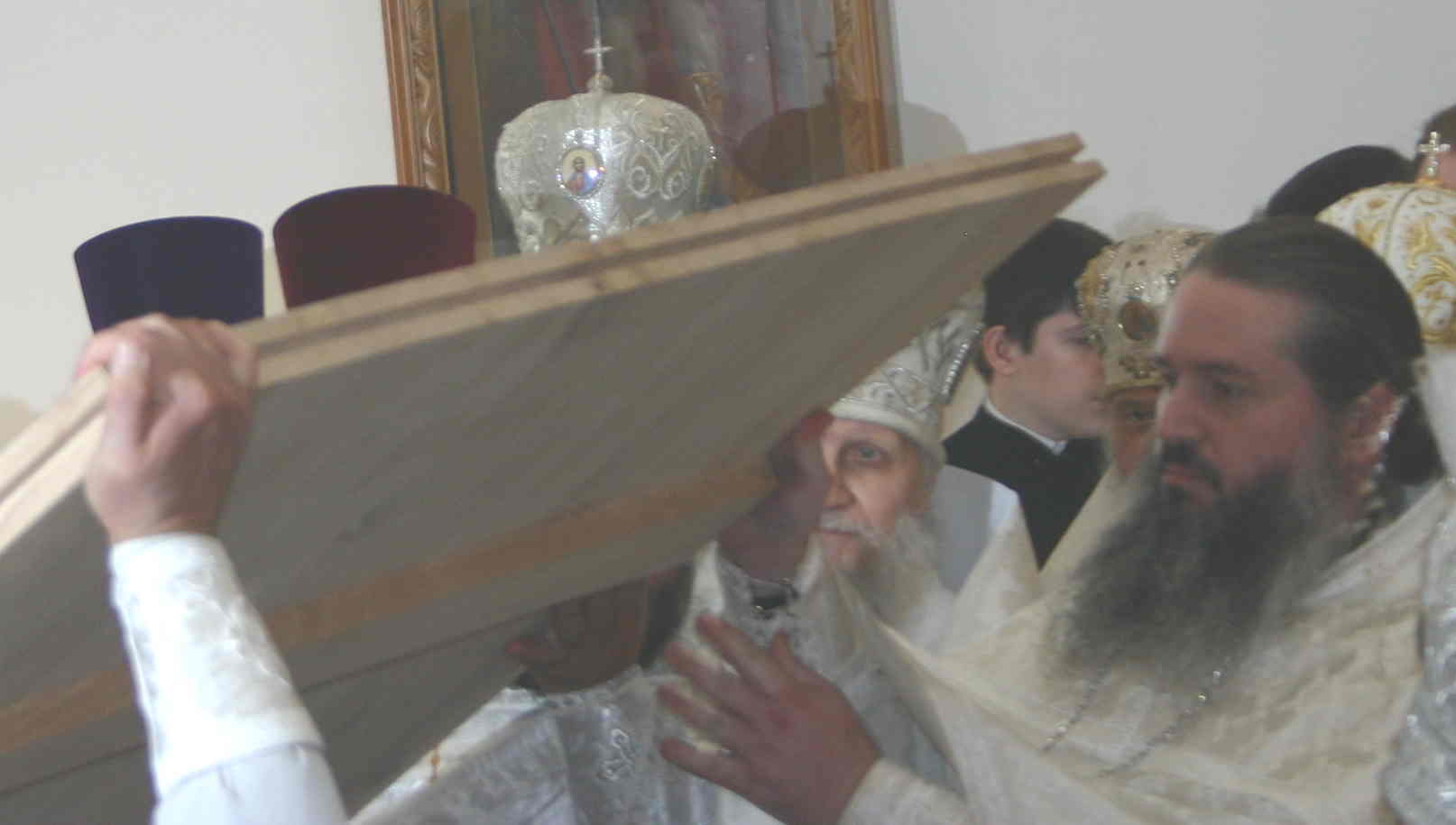
Here, we were raising it to be blessed by the Patriarch on both sides.

A photo, as we put the table top into place.

And one more.

Wednesday, June 06, 2007

Interfax: Some English saints may be included in Russian church calendar


St. Alfred the Great of England


Some English saints may be included in Russian church calendar

London, June 6, Interfax - The need to include the names of some early Christian English saints in the Russian Orthodox church calendar was voiced during a conference at Diocese of Sourozh, Archpriest Mikhail Dudko of the Russian Cathedral of the Dormition in London, has told Interfax.

Rev. Andrew Phillips, an expert in hagiography well known in the Orthodox England and rector of the church of St. John of Shanghai, noted in his remarks that Great Britain was not normally seen as 'a country of sainthood', while it was the native land for over 300 glorified enlighteners, martyrs and ascetics who dedicated their lives to God and the Church.

Father Andrew reminded the conference of the forgotten pages of history which link Russia and England and of the fact that Yury Dolgoruky, the founder of Moscow, was half English and his mother was a daughter of an English king.

The priest also recalled the English roots of the Holy Protomartyr Elizabeth Fyodorovna, a granddaughter Queen Victoria. Sts. Martha and Mary's Convent founded by Princess Elizabeth could in due course become an English church representation in Moscow.

Bishop Yelisey of Bogorodsk, in his turn, reported that the Diocese of Sourozh had already initiated the inclusion of nine English saints in the Russian Orthodox church calendar and that they can be included in the lists of saints for church-wide veneration in the nearest future.

Monday, May 28, 2007

Moscow Trip, Part 5

Day 7, Sunday, May 20th.


The Kremlin


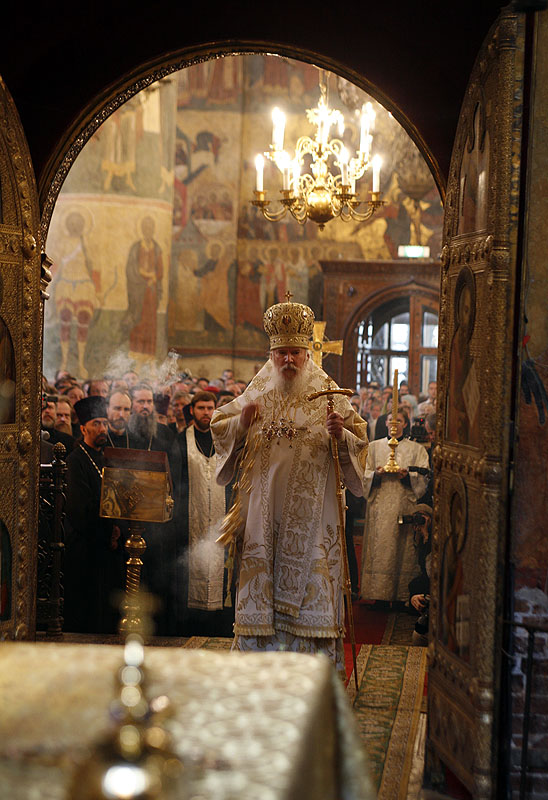
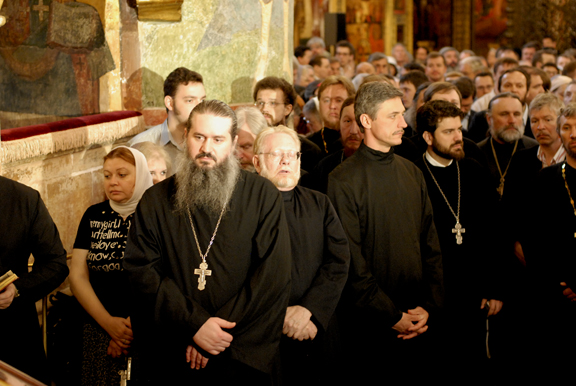
We headed out early again to the Kremlin for the final service of our vist at the Uspensky (Dormition) Cathedral.


The Uspensky Cathedral


This Church was where the Tsars, beginning with Ivan the Terrible, were crown, and where the Tsars often went to Church. The frescoes on the inside of the Church are very old, and beautiful. I wasn't serving this time, and so I just stood with the people. Initially I was in the middle of the Church with some other clergy, but an MP priest saw us and waved for us to move to the front of the Church, and so we had a very good view of the rest of the service.

You can see photos of this service by clicking here.

You can see a photo showing where I was (just behind the analogion to the left) by clicking here.

Here is a more close up shot of where I was.

You can see a high resolution photo of one of the walls of the Cathedral by clicking here.

And you can see a high resolution photo of more of the interior here.

As I said the place were I stood for most of the service afforded a good view, however, when it came time for the communion of the faithful, there was a press of people trying to get in position to receive communion from the patriarch that was a bit more than I was used to. I was knocked off balance a few times, but didn't fall because I was sandwiched in fairly well. I started to inch my way to a stone booth to my right, which I think was probably where the Tsar used to sit for the service. I figured I wouldn't be crushed there... and after a lot of squeezing, I made it there.

At the end of the service, I was able to go into the altar and venerate the relics of the holy hierarchs Phillip and Peter of Moscow. I later found out that I had missed the opportunity to venerate the relics of the holy hierarchs Hermogenes and Jonah of Moscow, whose relics are in other parts of the Church.

You can see more photos of this service by clicking here.

After the service, there was some confusion about how much time we would have to tour the Kremlin. Originally, we were supposed to have about 3 hours after the liturgy. However, in the morning we were told that the buses would be leaving much earlier than originally planned. After the service, I caught one of the organizers of the trip, and before he could explain, he just said "go to the buses", and then was whisked away with the official delegation. I wasn't happy about it, but I went to were the buses were supposed to be, but they were no where to be seen. Fr. Nicholas Manduke and I decided that we were going to make a run to Red Square, because the one landmark in Russia that everyone knows is St. Basil's Cathedral, and I did not want to come this close to it without being able to see it.

St. Basil's Cathedral

We figured the buses would not be able to load before we would be back, and in a worse case scenario, we would take a cab. So off we went, at a brisk pace. Red Square is amazing all by itself, but it is not as big as you might think from having watched the parades of ICBM's during the Soviet period. And by the way, Red Square's name has nothing to do with the Communists. It was called Red Square long before they came and went. The Russian word for "red" also means beautiful.

On the way to St. Basil's, we had to walk past Lenin's tomb. Fr. Leonid Mickle told me two interesting things about it. First, he cited a Russian saying that "A saint is known by his myrrh". And then told of how once a sewer line broke in the Kremlin, which resulted in Lenin floating in sewage. He then told me that a writer (whose name escapes me) from the Soviet period, who always danced close to the edge of acceptability to the Soviets once suggested that since Lenin had requested to be buried next to his mother, that his wish should be granted, and that this would free up a wonderful location for a restroom, of which there is a notable lack in the Red Square area.

The closer we got to St. Basil's, the more beautiful it appeared. It is more beautiful than the pictures I had seen led me to expect. We would have had to buy tickets to go inside. I am told that it is not as impressive on the inside as the outside might suggest, and it is not a big Church, but rather a series of small chapels. However, had I known we had the time, I would have gone inside. As it was, we just walked around it to get a good look at it from the outside. It was more than worth the trip.

We then headed back. On the way, we stopped at a Sbarro's Pizza, and for not too many rubles, I had a slice of pizza that hit the spot.

When we we got back, we discovered that we actually had about 30 more minutes before the buses would be there. Oh well.

While waiting for the bus a man came up to me and said that he was from Mexico, and wanted to know if he could have his picture taken with me. I obliged, but thought it was funny that he had come all the way to Moscow to have his picture taken with a Tejano in front of the Kremlin.

At some point, Fr. Leonid Mickle, who had been to Moscow during the Soviet period commented on how happy it made him to see the Russian Flag flying over the Kremlin, rather than the Hammer and Sickle. Flying over the presidential palace is the presidential flag, which has the double-headed eagle of the Russian Empire.

We went back to the hotel, and then that evening we went to a banquet that was hosted by some members of ROCOR who were living in Moscow. It was a very impressive meal... probably the best one we had, although since there were not many MP clergy present, the toasts seemed to lack some of the zip I had gotten used to. I spent the evening visiting with people whom I would soon be missing until the next big shindig would bring us together again.

Click here for a photo of Steve Pennings and myself at the banquet.

Around 9:30, I took the earlier bus back to the hotel to rest, and prepare for the trip home.

Day 8, Monday, May 21st.

This day happened to be my name's day, the feast of St. John the Theologian, and while travelling is not what I normally would have picked to be doing on this day, I took some consolation from the fact that it would be the longest name's day I would probably ever have, since we would be flying with the rotation of the earth, and so the day would be 33 hours long. We had a long bus ride back to the airport, but for some reason -- guilt perhaps -- the bus driver had the A/C on at last.

We had to go through Russian customs... Russia being one of the few countries that does this on the way out, because they want to make sure you are not smuggling out historical artifacts. We had a long wait for our plane, and so we were able to do some last minute shopping in the duty free area.

Click here for one of many group photos taken while we waited.

As the plane lifted off, we sang the troparion of the feast of the Ascension. Yet another Aeroflot crew was in for an experience. It was daylight the entire flight back to New York, and there was an even more festive atmosphere than there was on the way to Moscow. The flight went by relatively quickly thanks to the wonderful conversations we were all having on the way.

When we finally made it to JFK airport, and got in line to go through American customs, there was a joy that Americans were finally organizing a line for us again. It went so smoothly, that we were all quite happy to be back in America. All too quickly, we went our separate ways, but all with a lot of joyous memories of what we had seen and done, and of each other.

I still had my two parishioners with me on the flight to Houston. Click here for a photo of the weary tres hombres, Steve Pennings, George Nahlous, and myself. I was calling my wife for the first time in a week, having been absent on her birthday. George was checking on the status of his chickens and garden, and Steve was busy capturing the moment.

To my surprise, on the flight back I was able to catch the season finale of 24. We made it into Houston at 11:00 p.m., and I finally made it home at 1:00 a.m. the following day, very tired, but happy to have been blessed to be on this historic trip.