Tuesday, December 11, 2007
Friday, December 07, 2007
The Fall Pastoral Retreat of the Western American Diocese in Los Angeles Concludes

The Transfiguration Cathedral in Los Angeles
You can read what I was up to last month in Los Angeles last month by clicking here.
You can see photos by clicking here.


Saturday, November 03, 2007
Illumined Heart: Interview with John Maddex

John Maddex
The Illumined Heart Podcast has a very interesting interview, which discusses the process of conversion that led John Maddex into the Orthodox Church. He is the founder of Ancient Faith Radio, and previously worked for the Moody Bible Institute Radio Network, and for Focus on the Family.
You can click here to listen
Friday, November 02, 2007
The Orthodox Study Bible

The complete Orthodox Study Bible can now be pre-ordered, for shipment in February 2008. There is also a web site that has sample pages that can be viewed. Judging from these sample pages, the commentary notes seem to be a huge improvement over the earlier New Testament only edition. I just hope that they re-did the New Testament with the same kind of patristic commentary as is shown in the Old Testament samples.
Click here to listen to an interview with Fr. Peter Gilquist, in which he gives an update on the publication schedule, as well as details about the contents.
Wednesday, October 03, 2007
Patriarch Alexei refuses to bow to political correctness.

Russian Orthodox Patriarch Explains Stand on Homosexuality to Council of Europe "Love the Sinner, Hate the Sin"
By John-Henry Westen
STRASBOURG, October 3, 2007 (LifeSiteNews.com) - In his first visit to the Council of Europe on a mission to discuss inter-religious dialogue, the head of the Russian Orthodox Church, Patriarch Alexy II, gave a spirited defence of Christian morality. He noted that the notion of human rights in Europe stems, at least in part from Christian morality. "Yet today there occurs a break between human rights and morality, and this break threatens the European civilization," he warned.
"We can see it in a new generation of rights that contradict morality, and in how human rights are used to justify immoral behavior," he stated.
The remarks prompted British Liberal Democrat council member David Russell-Johnston to demand an explanation of the Russian Orthodox leader's opposition to the Moscow "gay pride" march.
"When persistent attempts were made to hold a homosexual parade in Moscow, we believed that that meant propaganda and advertisement of sin," Alexy replied before the Council. The Patriarch compared homosexual sex acts to kleptomania and asked, "Why then (does) no one advertise kleptomania while homosexuality gets advertised via gay parades?"
"It is advertisement that is being forced on people who are a very long way from it," Alexy added.
The Patriarch stressed that persons who have such temptations and engage in homosexual acts are nonetheless loved by Christians. They are he said, "sinners whom we love while we hate their sin."
"But at the same time we Orthodox Christians cannot depart from what is taught by the Bible and by the apostolic tradition of the church," he added. "Nobody must try to force me or my brothers and sisters in faith to be silent and [to prevent us from] using the word sin for something that is called sin in God's Word."
Several Council of Europe members including the Russian representative applauded these remarks by the Patriarch, much to the chagrin of Mr. Russell-Johnston. The irate councilman called the Patriarch's analogy between kleptomania and homosexuality "ridiculous" and dismissed the Patriarch's remarks as merely having "repeated his aggressively intolerant position."
"What was regrettable was that a lot of people applauded him," Russell-Johnston told the International Herald Tribune.
During his speech the Patriarch warned of just such intolerance of morality leading to Europe's demise. "If we ignore moral norms, we ultimately ignore freedom too," said Alexy. "Morality is freedom in action. It is a freedom brought into reality as a result of responsible choice, in which human person restricts his or her self for the good of that very person and broader society."
"Moral principles secure societal vitality and growth, as well as unity of society," he added. "And whenever moral norms are trespassed and declared to be relative, it may undermine the whole worldview of the Europeans. They may draw nigh to a disastrous moment when European nations risk losing their spiritual and cultural identity and ultimately their own place in history."
See the full speech (which did not contain the replies to questions):
http://www.coe.int/t/dc/files/pa_session/sept_2007/20071002_disc_patriarche_en.asp
Thursday, September 20, 2007
From Wittenberg to Antioch

Luther nailing his 95 theses to the door of the Wittenberg Chapel
There is a very interesting Podcast that is posted on the Ancient Faith Radio web site, that contains an interview of Fr. Gregory Hogg by the Illumined Heart show, in which he discusses his conversion to Orthodoxy from Lutheranism. Click here to listen.
Thursday, September 13, 2007
The Complete Hymn "O Virgin Pure", by St. Nectarios
You can hear this hymn in Greek by clicking on the video above. You can read about St. Nectarios, by clicking here.
O Virgin Pure
by St. Nectarios
Plagal First Tone (Tone 5)
Refrain: O Rejoice, Bride Unwedded.
O Virgin pure, immaculate/ O Lady Theotokos
O Virgin Mother, Queen of all/ and fleece which is all dewy
More radiant than the rays of sun/ and higher than the heavens
Delight of virgin choruses/ superior to Angels.
Much brighter than the firmament/ and pure than the sun's light
More holy than the multitude/ of all the heav'nly armies.
O Rejoice, Bride Unwedded.
O Ever Virgin Mary/ of all the world, the Lady
O bride all pure, immaculate/ O Lady Panagia
O Mary bride and queen of all/ our cause of jubilation
Majestic maiden, Queen of all/ O our most holy Mother
More hon'rable than Cherubim/ beyond compare more glorious
than immaterial Seraphim/ and greater than angelic thrones.
O Rejoice, Bride Unwedded.
Rejoice, O song of Cherubim/ Rejoice, O hymn of angels
Rejoice, O ode of Seraphim/ the joy of the archangels
Rejoice, O peace and happiness/ the harbor of salvation
O sacred chamber of the Word/ flower of incorruption
Rejoice, delightful paradise/ of blessed life eternal
Rejoice, O wood and tree of life/ the fount of immortality
O Rejoice, Bride Unwedded.
I supplicate you, Lady/ now do I call upon you
And I beseech you, Queen of all/ I beg of you your favor
Majestic maiden, spotless one/ O Lady Panagia
I call upon you fervently/ O sacred, hallowed temple
Assist me and deliver me/ protect me from the enemy
And make me an inheritor/ of blessed life eternal.
O Rejoice, Bride Unwedded.
You can read the text of this hymn in Greek at:
http://agrino.org/cyberdesert/agni.htm
For more Byzantine Chant on Youtube, check out the following:
Byzantine Chant #1
Byzantine Chant #2
Byzantine Chant #3
Byzantine Chant #4
Thursday, September 06, 2007
Video of the Moscow Delegation in Boston
Video of the delegation from Moscow at the Boston ROCOR Cathedral, singing "memory eternal" to Fr. Roman Lukianov, the departed rector of that cathedral.
Wednesday, September 05, 2007
The Visit to Jordanville of the Reigning Icon of the Theotokos
The following is a news clip in Russian about the visit to Holy Trinity Monastery of the Reigning Icon of the Theotokos.
Tuesday, August 14, 2007
Baptism
On this page you can see photo's of the baptism of the Bryant family, which took place this past weekend.
Tuesday, July 24, 2007
Der Spiegel Interview with Alexander Solzhenitsyn

There is an interview that Der Spiegel has just posted with Alexander Solzhenitsyn that gives a lot of insight into how this former Soviet dissident views current trends in Russia. He is asked a number of questions that reflect common western rejudices about what is good or bad in Russia today, and Solzhenitsyn more than once sets the reporter back on his rear end with his answers.
Wednesday, July 04, 2007
Sunday, July 01, 2007
Thursday, June 14, 2007
Boulialog: The view from the choir continues
More installments from Elizabeth Ledkovsky. All of the following detail the events of May 17th:
Part 7: Warming up
Part 8: Peace be unto thee
Part 9: History
Part 10: On Being Overwhelmed
Part 7: Warming up
Part 8: Peace be unto thee
Part 9: History
Part 10: On Being Overwhelmed
Saturday, June 09, 2007
Fr. Elia Wen, Memory Eternal

From Orthodox.cn, slightly modified.
Protopresbyter Elias ( Wén Zǐzhèng in Chinese) was a priest under the Archbishop of Shanghai, St John the Wonderworker. He became rector of the Cathedral there in 1946 but have fled to Hong Kong when the Communists took power in 1949.
Fr Elias was the oldest living Orthodox priest, who turned 110 on November 19th, 2006. He had been living in San Francisco with his son Michael, an active member of the parish council at the Holy Virgin Cathedral on Geary Blvd.
Memory eternal for the servant of God Protopresbyter Elias Wen who has fallen asleep in the Lord shortly before 3PM PDT on Saturday, June 9, 2007 at age of 110 years old. The first panikhida will be held Sunday night.
A Few New Photos
Here are some additional photos that have been e-mailed to me:
Here is a photo of me greeting a priest at the St. Sergius Trinity-Lavra, when we first got off the bus.
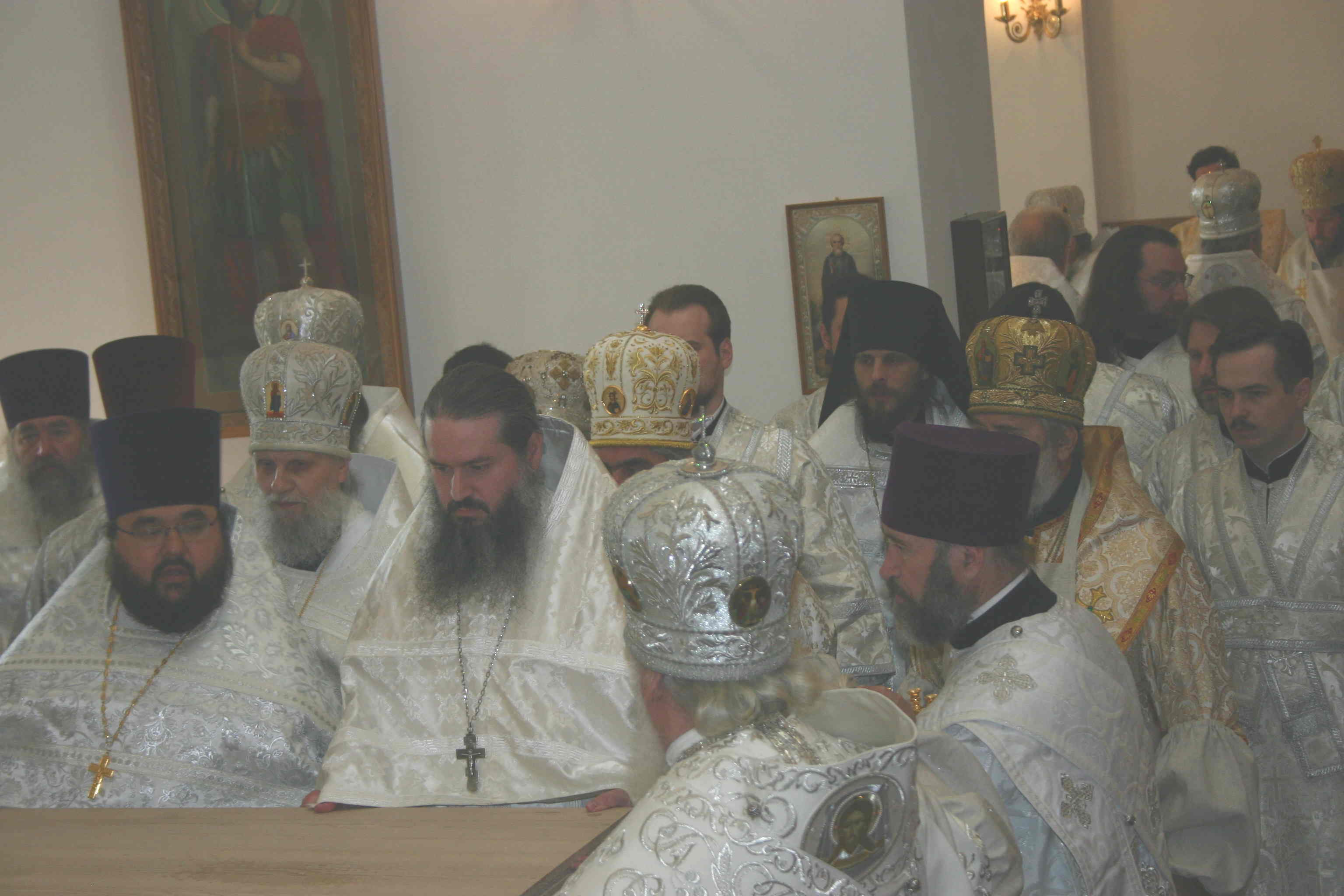
Here is a photo of when we were holding the top of the holy Table at Butovo.
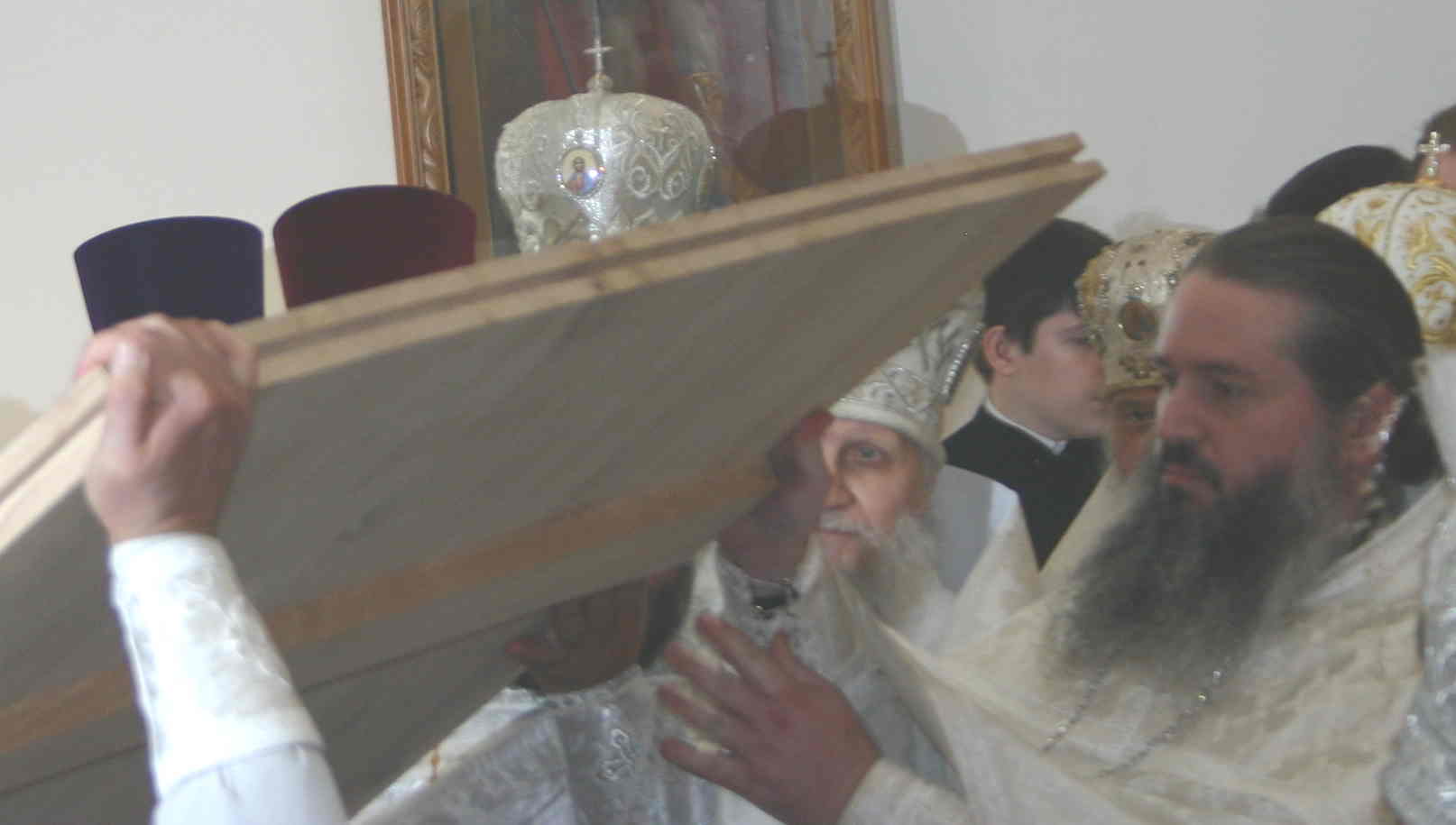
Here, we were raising it to be blessed by the Patriarch on both sides.
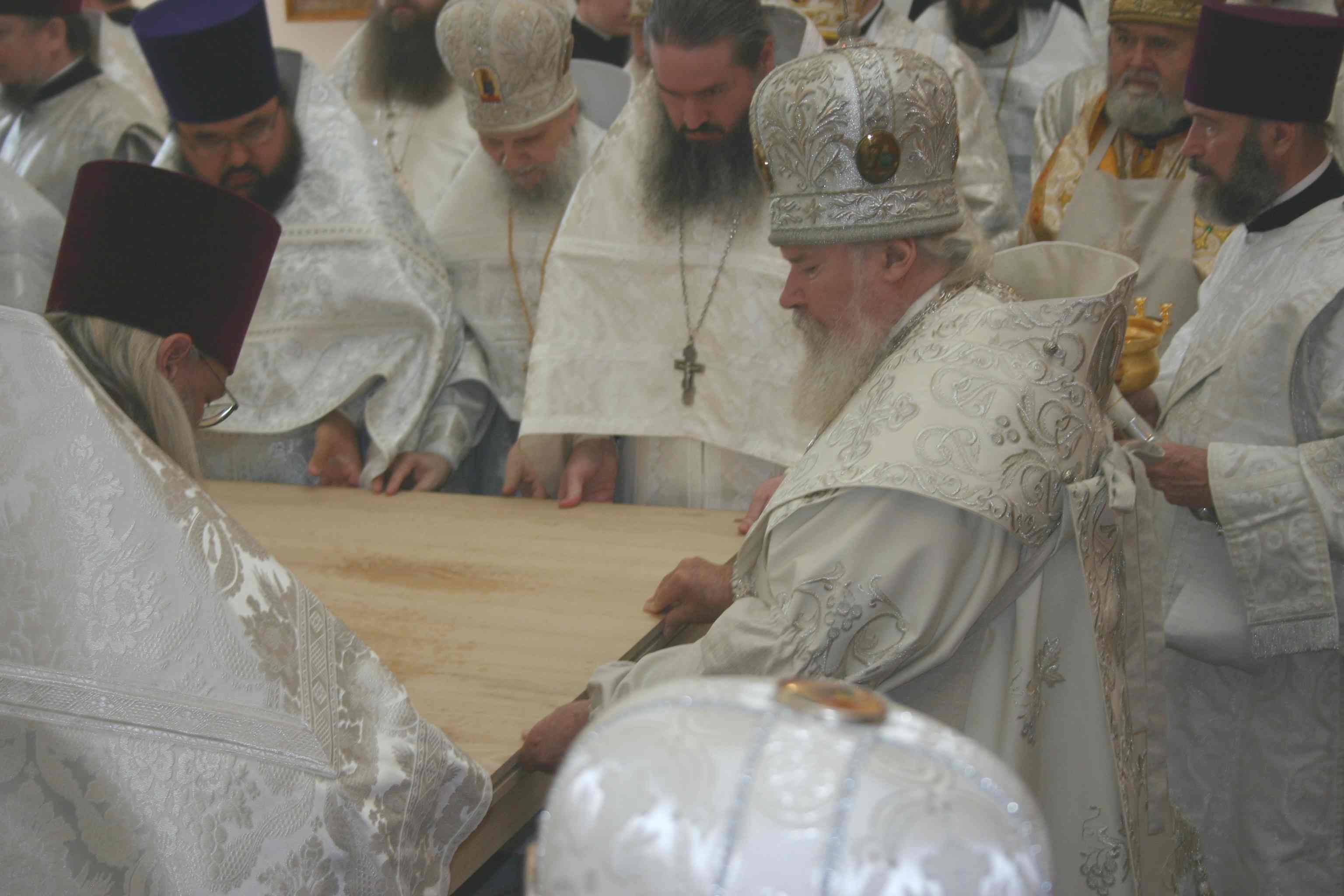
A photo, as we put the table top into place.
And one more.
Here is a photo of me greeting a priest at the St. Sergius Trinity-Lavra, when we first got off the bus.

Here is a photo of when we were holding the top of the holy Table at Butovo.
Here, we were raising it to be blessed by the Patriarch on both sides.
A photo, as we put the table top into place.
And one more.

Thursday, June 07, 2007
Moscow Trip: A View From the Choir
Elizabeth Ledkovsky has started a blog to post her reflections on the trip. So far, you can read part 1 here, part 2 here, part 3 here, part 4 here, part 5 here, and part 6 here.
Wednesday, June 06, 2007
Interfax: Some English saints may be included in Russian church calendar

St. Alfred the Great of England
Some English saints may be included in Russian church calendar
London, June 6, Interfax - The need to include the names of some early Christian English saints in the Russian Orthodox church calendar was voiced during a conference at Diocese of Sourozh, Archpriest Mikhail Dudko of the Russian Cathedral of the Dormition in London, has told Interfax.
Rev. Andrew Phillips, an expert in hagiography well known in the Orthodox England and rector of the church of St. John of Shanghai, noted in his remarks that Great Britain was not normally seen as 'a country of sainthood', while it was the native land for over 300 glorified enlighteners, martyrs and ascetics who dedicated their lives to God and the Church.
Father Andrew reminded the conference of the forgotten pages of history which link Russia and England and of the fact that Yury Dolgoruky, the founder of Moscow, was half English and his mother was a daughter of an English king.
The priest also recalled the English roots of the Holy Protomartyr Elizabeth Fyodorovna, a granddaughter Queen Victoria. Sts. Martha and Mary's Convent founded by Princess Elizabeth could in due course become an English church representation in Moscow.
Bishop Yelisey of Bogorodsk, in his turn, reported that the Diocese of Sourozh had already initiated the inclusion of nine English saints in the Russian Orthodox church calendar and that they can be included in the lists of saints for church-wide veneration in the nearest future.
Monday, May 28, 2007
Moscow Trip, Part 5
Day 7, Sunday, May 20th.

The Kremlin
We headed out early again to the Kremlin for the final service of our vist at the Uspensky (Dormition) Cathedral.

The Uspensky Cathedral
This Church was where the Tsars, beginning with Ivan the Terrible, were crown, and where the Tsars often went to Church. The frescoes on the inside of the Church are very old, and beautiful. I wasn't serving this time, and so I just stood with the people. Initially I was in the middle of the Church with some other clergy, but an MP priest saw us and waved for us to move to the front of the Church, and so we had a very good view of the rest of the service.
You can see photos of this service by clicking here.
You can see a photo showing where I was (just behind the analogion to the left) by clicking here.
Here is a more close up shot of where I was.
You can see a high resolution photo of one of the walls of the Cathedral by clicking here.
And you can see a high resolution photo of more of the interior here.
As I said the place were I stood for most of the service afforded a good view, however, when it came time for the communion of the faithful, there was a press of people trying to get in position to receive communion from the patriarch that was a bit more than I was used to. I was knocked off balance a few times, but didn't fall because I was sandwiched in fairly well. I started to inch my way to a stone booth to my right, which I think was probably where the Tsar used to sit for the service. I figured I wouldn't be crushed there... and after a lot of squeezing, I made it there.
At the end of the service, I was able to go into the altar and venerate the relics of the holy hierarchs Phillip and Peter of Moscow. I later found out that I had missed the opportunity to venerate the relics of the holy hierarchs Hermogenes and Jonah of Moscow, whose relics are in other parts of the Church.
You can see more photos of this service by clicking here.
After the service, there was some confusion about how much time we would have to tour the Kremlin. Originally, we were supposed to have about 3 hours after the liturgy. However, in the morning we were told that the buses would be leaving much earlier than originally planned. After the service, I caught one of the organizers of the trip, and before he could explain, he just said "go to the buses", and then was whisked away with the official delegation. I wasn't happy about it, but I went to were the buses were supposed to be, but they were no where to be seen. Fr. Nicholas Manduke and I decided that we were going to make a run to Red Square, because the one landmark in Russia that everyone knows is St. Basil's Cathedral, and I did not want to come this close to it without being able to see it.

St. Basil's Cathedral
We figured the buses would not be able to load before we would be back, and in a worse case scenario, we would take a cab. So off we went, at a brisk pace. Red Square is amazing all by itself, but it is not as big as you might think from having watched the parades of ICBM's during the Soviet period. And by the way, Red Square's name has nothing to do with the Communists. It was called Red Square long before they came and went. The Russian word for "red" also means beautiful.
On the way to St. Basil's, we had to walk past Lenin's tomb. Fr. Leonid Mickle told me two interesting things about it. First, he cited a Russian saying that "A saint is known by his myrrh". And then told of how once a sewer line broke in the Kremlin, which resulted in Lenin floating in sewage. He then told me that a writer (whose name escapes me) from the Soviet period, who always danced close to the edge of acceptability to the Soviets once suggested that since Lenin had requested to be buried next to his mother, that his wish should be granted, and that this would free up a wonderful location for a restroom, of which there is a notable lack in the Red Square area.
The closer we got to St. Basil's, the more beautiful it appeared. It is more beautiful than the pictures I had seen led me to expect. We would have had to buy tickets to go inside. I am told that it is not as impressive on the inside as the outside might suggest, and it is not a big Church, but rather a series of small chapels. However, had I known we had the time, I would have gone inside. As it was, we just walked around it to get a good look at it from the outside. It was more than worth the trip.
We then headed back. On the way, we stopped at a Sbarro's Pizza, and for not too many rubles, I had a slice of pizza that hit the spot.
When we we got back, we discovered that we actually had about 30 more minutes before the buses would be there. Oh well.
While waiting for the bus a man came up to me and said that he was from Mexico, and wanted to know if he could have his picture taken with me. I obliged, but thought it was funny that he had come all the way to Moscow to have his picture taken with a Tejano in front of the Kremlin.
At some point, Fr. Leonid Mickle, who had been to Moscow during the Soviet period commented on how happy it made him to see the Russian Flag flying over the Kremlin, rather than the Hammer and Sickle. Flying over the presidential palace is the presidential flag, which has the double-headed eagle of the Russian Empire.
We went back to the hotel, and then that evening we went to a banquet that was hosted by some members of ROCOR who were living in Moscow. It was a very impressive meal... probably the best one we had, although since there were not many MP clergy present, the toasts seemed to lack some of the zip I had gotten used to. I spent the evening visiting with people whom I would soon be missing until the next big shindig would bring us together again.
Click here for a photo of Steve Pennings and myself at the banquet.
Around 9:30, I took the earlier bus back to the hotel to rest, and prepare for the trip home.
Day 8, Monday, May 21st.
This day happened to be my name's day, the feast of St. John the Theologian, and while travelling is not what I normally would have picked to be doing on this day, I took some consolation from the fact that it would be the longest name's day I would probably ever have, since we would be flying with the rotation of the earth, and so the day would be 33 hours long. We had a long bus ride back to the airport, but for some reason -- guilt perhaps -- the bus driver had the A/C on at last.
We had to go through Russian customs... Russia being one of the few countries that does this on the way out, because they want to make sure you are not smuggling out historical artifacts. We had a long wait for our plane, and so we were able to do some last minute shopping in the duty free area.
Click here for one of many group photos taken while we waited.
As the plane lifted off, we sang the troparion of the feast of the Ascension. Yet another Aeroflot crew was in for an experience. It was daylight the entire flight back to New York, and there was an even more festive atmosphere than there was on the way to Moscow. The flight went by relatively quickly thanks to the wonderful conversations we were all having on the way.
When we finally made it to JFK airport, and got in line to go through American customs, there was a joy that Americans were finally organizing a line for us again. It went so smoothly, that we were all quite happy to be back in America. All too quickly, we went our separate ways, but all with a lot of joyous memories of what we had seen and done, and of each other.
I still had my two parishioners with me on the flight to Houston. Click here for a photo of the weary tres hombres, Steve Pennings, George Nahlous, and myself. I was calling my wife for the first time in a week, having been absent on her birthday. George was checking on the status of his chickens and garden, and Steve was busy capturing the moment.
To my surprise, on the flight back I was able to catch the season finale of 24. We made it into Houston at 11:00 p.m., and I finally made it home at 1:00 a.m. the following day, very tired, but happy to have been blessed to be on this historic trip.
The Kremlin
We headed out early again to the Kremlin for the final service of our vist at the Uspensky (Dormition) Cathedral.
This Church was where the Tsars, beginning with Ivan the Terrible, were crown, and where the Tsars often went to Church. The frescoes on the inside of the Church are very old, and beautiful. I wasn't serving this time, and so I just stood with the people. Initially I was in the middle of the Church with some other clergy, but an MP priest saw us and waved for us to move to the front of the Church, and so we had a very good view of the rest of the service.
You can see photos of this service by clicking here.
You can see a photo showing where I was (just behind the analogion to the left) by clicking here.
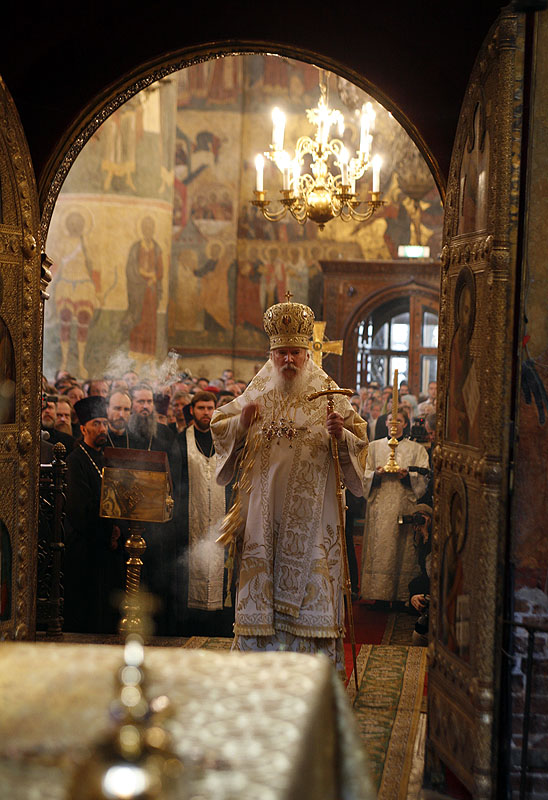
Here is a more close up shot of where I was.
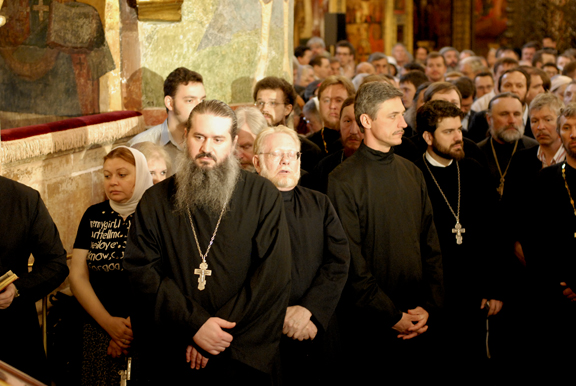
You can see a high resolution photo of one of the walls of the Cathedral by clicking here.

And you can see a high resolution photo of more of the interior here.

As I said the place were I stood for most of the service afforded a good view, however, when it came time for the communion of the faithful, there was a press of people trying to get in position to receive communion from the patriarch that was a bit more than I was used to. I was knocked off balance a few times, but didn't fall because I was sandwiched in fairly well. I started to inch my way to a stone booth to my right, which I think was probably where the Tsar used to sit for the service. I figured I wouldn't be crushed there... and after a lot of squeezing, I made it there.
At the end of the service, I was able to go into the altar and venerate the relics of the holy hierarchs Phillip and Peter of Moscow. I later found out that I had missed the opportunity to venerate the relics of the holy hierarchs Hermogenes and Jonah of Moscow, whose relics are in other parts of the Church.
You can see more photos of this service by clicking here.
After the service, there was some confusion about how much time we would have to tour the Kremlin. Originally, we were supposed to have about 3 hours after the liturgy. However, in the morning we were told that the buses would be leaving much earlier than originally planned. After the service, I caught one of the organizers of the trip, and before he could explain, he just said "go to the buses", and then was whisked away with the official delegation. I wasn't happy about it, but I went to were the buses were supposed to be, but they were no where to be seen. Fr. Nicholas Manduke and I decided that we were going to make a run to Red Square, because the one landmark in Russia that everyone knows is St. Basil's Cathedral, and I did not want to come this close to it without being able to see it.

We figured the buses would not be able to load before we would be back, and in a worse case scenario, we would take a cab. So off we went, at a brisk pace. Red Square is amazing all by itself, but it is not as big as you might think from having watched the parades of ICBM's during the Soviet period. And by the way, Red Square's name has nothing to do with the Communists. It was called Red Square long before they came and went. The Russian word for "red" also means beautiful.
On the way to St. Basil's, we had to walk past Lenin's tomb. Fr. Leonid Mickle told me two interesting things about it. First, he cited a Russian saying that "A saint is known by his myrrh". And then told of how once a sewer line broke in the Kremlin, which resulted in Lenin floating in sewage. He then told me that a writer (whose name escapes me) from the Soviet period, who always danced close to the edge of acceptability to the Soviets once suggested that since Lenin had requested to be buried next to his mother, that his wish should be granted, and that this would free up a wonderful location for a restroom, of which there is a notable lack in the Red Square area.
The closer we got to St. Basil's, the more beautiful it appeared. It is more beautiful than the pictures I had seen led me to expect. We would have had to buy tickets to go inside. I am told that it is not as impressive on the inside as the outside might suggest, and it is not a big Church, but rather a series of small chapels. However, had I known we had the time, I would have gone inside. As it was, we just walked around it to get a good look at it from the outside. It was more than worth the trip.
We then headed back. On the way, we stopped at a Sbarro's Pizza, and for not too many rubles, I had a slice of pizza that hit the spot.
When we we got back, we discovered that we actually had about 30 more minutes before the buses would be there. Oh well.
While waiting for the bus a man came up to me and said that he was from Mexico, and wanted to know if he could have his picture taken with me. I obliged, but thought it was funny that he had come all the way to Moscow to have his picture taken with a Tejano in front of the Kremlin.
At some point, Fr. Leonid Mickle, who had been to Moscow during the Soviet period commented on how happy it made him to see the Russian Flag flying over the Kremlin, rather than the Hammer and Sickle. Flying over the presidential palace is the presidential flag, which has the double-headed eagle of the Russian Empire.

We went back to the hotel, and then that evening we went to a banquet that was hosted by some members of ROCOR who were living in Moscow. It was a very impressive meal... probably the best one we had, although since there were not many MP clergy present, the toasts seemed to lack some of the zip I had gotten used to. I spent the evening visiting with people whom I would soon be missing until the next big shindig would bring us together again.
Click here for a photo of Steve Pennings and myself at the banquet.

Around 9:30, I took the earlier bus back to the hotel to rest, and prepare for the trip home.
Day 8, Monday, May 21st.
This day happened to be my name's day, the feast of St. John the Theologian, and while travelling is not what I normally would have picked to be doing on this day, I took some consolation from the fact that it would be the longest name's day I would probably ever have, since we would be flying with the rotation of the earth, and so the day would be 33 hours long. We had a long bus ride back to the airport, but for some reason -- guilt perhaps -- the bus driver had the A/C on at last.
We had to go through Russian customs... Russia being one of the few countries that does this on the way out, because they want to make sure you are not smuggling out historical artifacts. We had a long wait for our plane, and so we were able to do some last minute shopping in the duty free area.
Click here for one of many group photos taken while we waited.

As the plane lifted off, we sang the troparion of the feast of the Ascension. Yet another Aeroflot crew was in for an experience. It was daylight the entire flight back to New York, and there was an even more festive atmosphere than there was on the way to Moscow. The flight went by relatively quickly thanks to the wonderful conversations we were all having on the way.
When we finally made it to JFK airport, and got in line to go through American customs, there was a joy that Americans were finally organizing a line for us again. It went so smoothly, that we were all quite happy to be back in America. All too quickly, we went our separate ways, but all with a lot of joyous memories of what we had seen and done, and of each other.
I still had my two parishioners with me on the flight to Houston. Click here for a photo of the weary tres hombres, Steve Pennings, George Nahlous, and myself. I was calling my wife for the first time in a week, having been absent on her birthday. George was checking on the status of his chickens and garden, and Steve was busy capturing the moment.

To my surprise, on the flight back I was able to catch the season finale of 24. We made it into Houston at 11:00 p.m., and I finally made it home at 1:00 a.m. the following day, very tired, but happy to have been blessed to be on this historic trip.
Sunday, May 27, 2007
Moscow Trip, Part 4

An icon of the Martyrs of Butovo
Day 6, Saturday, May 19th.
We left the hotel early again, I think it was about 7:30 a.m., and again we had a police escort to help us get through the traffic. We were headed to the south of Moscow to a place called Butovo, for the consecration of a Church dedicated to the New Martyrs and Confessors of Russia, and this would be the second occasion in which we would be serving with the Patriarch.

The Church of the New Martyrs at Butovo
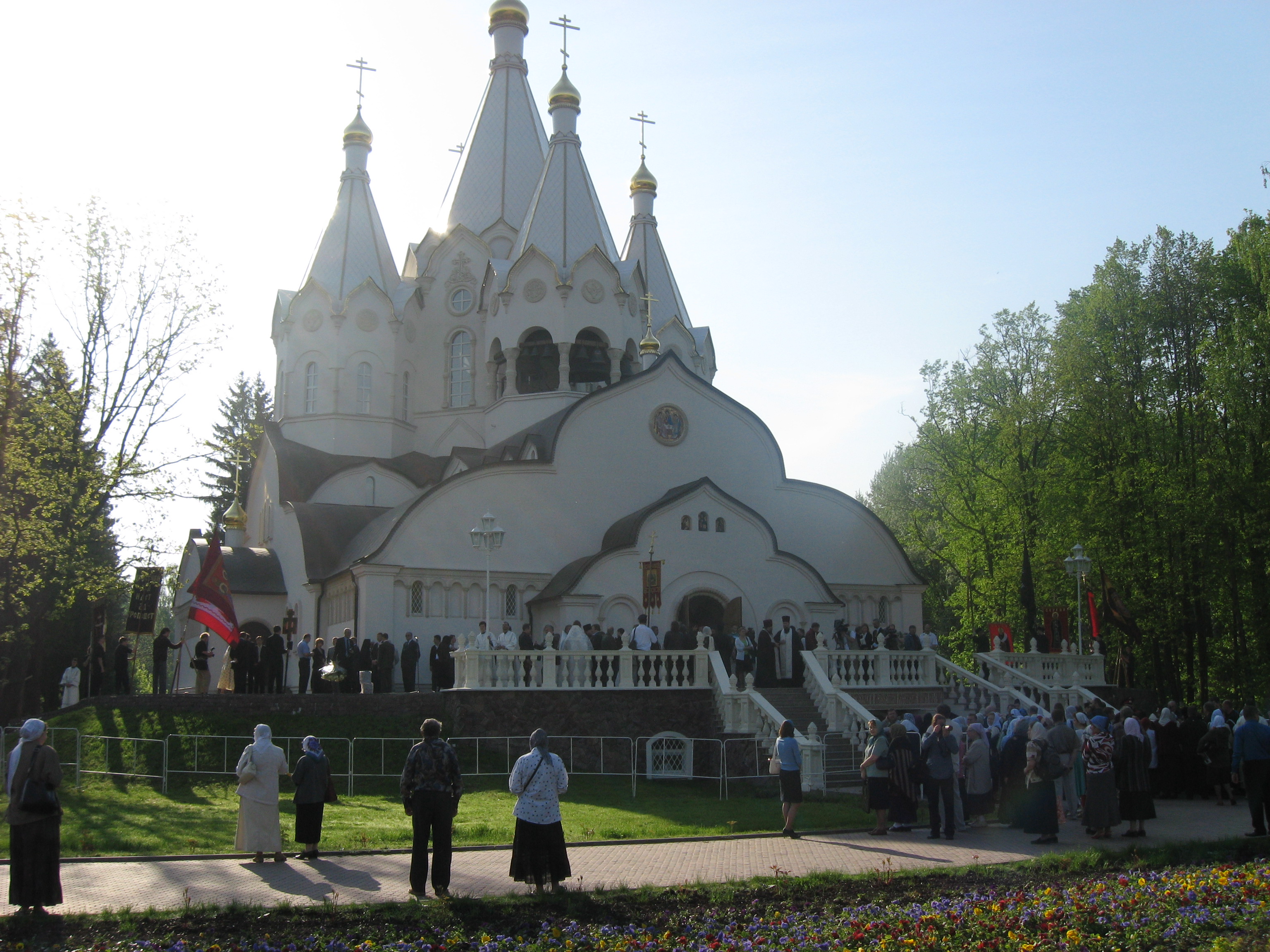
Three years ago, Metropolitan Laurus and Patriarch Alexei laid the cornerstone for this Church. Now we were back to complete the work which they began. You can see pictures of that service in 2004 by clicking here.
Because the Church was not nearly as large as Christ the Savior Cathedral, the only ROCOR clergy serving aside from the Bishops and some deacons, were supposed to be clergy who were official representatives of the various dioceses of ROCOR. I was one of two representatives of the Chicago and Mid-American diocese, and so I was able to serve. However, some clergy who were supposed to serve on this day did some horse trading with the clergy who were suppose to serve at the Uspensky Cathedral the next day, and so while the number serving stayed about the same, it was not just the diocesan representatives who actually did serve. Fr. Vladimir Boikov was also serving, since he was a representative of the diocese of Australia and New Zealand, and so I tried to stay close to him, since I could count on him to translate for me.
After going through security (for the same reasons they had security at Christ the Savior, except that Vladimir Putin was not going to be in attendance), we went into the lower Church to vest. I noticed that the walls had very nice icons all the way around the Church, but didn't pay attention to what they depicted, assuming that it would be the usual mix of icons you see in a Church -- but then Fr. Vladimir pointed out that these icons were all icons of the various known martyrs of Butovo, who had been killed at this very place by the Communists. When the Church was being constructed, family members of the martyrs of Butovo commissioned these icons. This realization brought home the full impact of where we were, and what we were here to do. These were not just any icons, this was not just any Church, and this would not be just any service either.
We went up to the main Church, which has three altars, all of which would be consecrated on this day, and stood there, waiting for the Patriarch to arrive.
You can see a Youtube video that someone took of the Patriarch's arrival from outside the Church here (not professional footage, but you can hear the bells, and see some things of interest).
After the greeting of the Patriarch, we began the service of the Great Consecration of the Church. The altars were just wooden frames, with the table top set aside. At the beginning of the service, the first thing that is done is that the bishops put on white carpenters' aprons, and the Holy table is constructed. My one part in this service was to help lift the top of the holy table, and hold it so that the Patriarch could bless the top and bottom of it with holy water, and then to place it onto the frame. While the Patriarch was doing this with the main altar, other bishops, including Metropolitan Laurus were doing the same things with the two side altars. The table top was nailed to the frame, and wax was poured over the nails to seal it. The top of the table was washed with hot water, then with wine, and then anointed with holy chrism. Then the holy table was vested with it's cover. Then a bishop went around the Church and anointed the four walls with chrism.
There was a MP priest, who was one of the ones whose job it was to make sure that the services went off smoothly, who was standing nearby. At one point he was telling me to do something, but I can't now remember what it was. Fr. Vladimir explained that I did not speak Russian, and that I was from Texas -- he seemed to take a particular delight in pointing that out to people. This priest commented to Fr. Vladimir that it must be difficult for me to be in a service that was all in Slavonic. Fr. Vladimir explained that I knew what was going on, and was happy to be there. In any case, I thought it was nice that he expressed such concern.
At some point, the rector of the parish in Butovo was nearby, and Fr. Vladimir asked him if he did daily services. He said that he didn't, but that there were more than 50 days in the year in which there were individual commemorations of the Martyrs at Butovo, a feast for the Synaxis of the Martyrs at Butovo, plus the usual schedule of Sundays and feast days, and so they had lots of Church in a given year.
Towards the end of the service of the consecration, we went in a procession around the Church, being preceded by the relics that would be finally placed in the altars. While going around the Church, I noticed that there were people holding icon banners all around the Church. I also noticed that there was a line of soldiers around the perimeter of the Church at the tree line -- which was no doubt a precaution against a terrorist attack.
Once back inside the Church, the service of the Great Consecration ended, and the Liturgy began.
You can see pictures of the service by clicking here.
And you can see more pictures by clicking here.
You can see one of the pictures in which I can be seen by clicking here.

Generally, I tried to stay out of the way. I am used to being in services that are all or mostly in Slavonic, having served as a deacon for a few years in a mostly Russian parish, and this generally being the language used in ROCOR when we have a really big service with lots of clergy... however, back in the US, most everyone speaks English and the directions given to the clergy in the altar are usually in English, or if not, when it is clear you didn't get it the first time in Russian, you get it the second time in English. But it was all in Russian here, and so again, I tried to stay close to Fr. Vladimir.
At some point, Fr. Nikolai Balashov (the Secretary of the MP delegation to the joint commission that worked out the issues to bring about the reconciliation between ROCOR and the MP) came and stood between Fr. Vladimir and me. When the troparia and kontakia were sung, Fr. Vladimir leaned over, behind Fr. Nikolai, and pointed out that the text that was used was the ROCOR text (the MP composed its own service to the New Martyrs). I figured at the time that this was a nice concession on the part of the MP for them to have chosen our text. I found out later that this was not really planned, but just happened, because it was the ROCOR choir that was doing the singing at that point. I also found out later, from talking to Matushka Elena Perekrestov, that the ROCOR troparion to the New Martyrs had been composed by Archbishop Anthony of San Francisco, who did not live to see this day in the flesh, but was no doubt pleased to see it with the saints.
Here is the text of that troparion in English:
"O ye holy hierarchs, royal passion-bearers and pastors, monks and laymen, men, women and children, ye countless new-martyrs, confessors, blossoms of the spiritual meadow of Russia, who blossomed forth wondrously in time of grievous persecutions bearing good fruit for Christ in your endurance: Entreat Him, as the One that planted you, that He deliver His people from godless and evil men, and that the Church of Russia be made steadfast through your blood and suffering, unto the salvation of our souls."
In this very service, we were witnessing the fulfillment of the prayer of this hymn.
I remember as a relatively new convert when communism in Russia finally collapsed on the feast of the Transfiguration in 1991, and being struck by the fact that this was the answer to all of our prayers for the salvation of Russia, and that it be delivered from the yoke of the Soviets. Of course, all was not made right in a day, but from that time on, we have seen how God has been restoring the Russian Church to health and strength, and today the contrast was undeniable.
After the clergy had communed, Fr. Vladimir turned to me and said with his Aussie accent, "So have you met the Patriarch yet?" I responded that I had received communion from him twice now, but that I couldn't say we had been properly introduced. So he grabbed me by the sleeve, and said, "Come on, mate." He had threatened earlier that he would introduce me to the Patriarch and lift up my sticharion to show him my cowboy boots as he did so. I was fairly certain that he was about to make good on that threat, but he didn't. After we both had received his blessing, Fr. Vladimir told him who I was, that I was from Texas, and that although I could not speak Russian I was an advocate for the reconciliation of the Russian Church. The patriarch thanked me, and said that he hoped I would continue to be an advocate for unity in the Church. It was a brief exchange, but he had a very warm expression on his face. I was already impressed by him, but I came away all the more impressed by him.
After the service, we all headed for a large tent in which there was another banquet. Fr. Vladimir and I sat across from some Russian dignitaries. One of them was Sergei Baburin, who is a member of the Russian Duma -- I wouldn't remember that, except that we exchanged cards. Next to him was a man whose name I can't remember, but he was wearing a medal which indicated that he was a hero of the Soviet Union, which is something like the Congressional Medal of Honor. Fr. Vladimir introduced me, and again explained my inability to converse in Russian, and that I was an advocate of the reconciliation of the Russian Church. The man with the medal commented that I had been spending so much time defending the unity of the Russian Church that I had acquired the face of a Russian.
It was interesting to ponder that there was a time when the only thing I knew about Russia was that they were the enemy, and I thought that the only way I would ever have visited Russia was the way Slim Pickens did in Dr. Strangelove... riding a hydrogen bomb.

And yet, here I was with a hero of the Soviet Union, having just consecrated a Church dedicated to the New Martyrs of Russia, and we were praying together, eating together, and drinking vodka together too. You just never know.
When I first encountered a Russian Orthodox priest at a pro-life rally before I converted, I turned to my wife and said, "Can you imagine me dressed like that?"

You just never know.
In any case, one thing about this banquet I was looking forward to was a good meal. After awhile a server came to me and ask if I wanted meat or fish. I said I would take the meat dish. But maybe I should have settled for fish, because after some time had passed, and we had shared some Russian toasts and singing, the Patriarch got up to leave. Then other bishops left, then the clergy started to leave. Then someone said we needed to hurry to our buses... and still no meat dish. Oh well, when dealing with Russians, one thing I have learned is you should never assume anything is in the bag, until it is safely in the bag.
On the bus ride back, I got to finally meet in person Fr. Andrew Phillips of England, whose writings I have long enjoyed. We were having a nice conversation, but as time went on the heat began to get the best of me.
When I checked the weather reports in Russia before the trip, I expected it would be cold. It actually turned out to be very nice, mostly sunny, and cool. However, when you are on a bus with no windows that can be opened, and a bus driver who doesn't believe in air conditioning, it can get quite warm. In fact, back in the states, had we been a bus load of animals, the bus driver would have been arrested. We were in stop and go traffic for what seemed like an hour and a half. As time went on, I unbuttoned my riassa and cassock, took off my cross, and tried not to die of heat exhaustion. Finally, we made it to our hotel, and I dragged myself along with an arm full of books and icons that we had just been given, and made my way to my room. The plan was that in about 45 minutes we were supposed to be back on that bus, and heading to the Danilov Monastery for Saturday evening vigil. When my elevator made it to the 6th floor, where my room was, as I was getting off, my cross slipped from my arms, and right down the crack between the elevator and the floor. I would not have even noticed it at that point had not another priest told me what happened. My heart sank. That was the cross I was given at my ordination to the priesthood, and the one I had been touching to the relics of all the saints I had been venerating in the past week.
Before I did anything else about it, I went on to my room, to recover from the bus ride. I decided that I was not going to survive the ride to the vigil, and so drank water, and took a bath. I prayed that my cross would be recovered, and particularly asked for the prayers of St. Sergius of Radonezh, whose relics I had just touched that cross to yesterday... though I was inclined to think that I would be shopping for a new cross tomorrow. I waited until people made it back from the vigil, because the people at the hotel didn't speak English. I bumped into Fr. Elias Gorsky, who kindly explained my situation to the lady at the front desk. I fully expected to be blown off, because I knew it would be a hassle to retrieve my cross from the elevator on a Saturday evening. However, the lady was quite nice, and told me it would be about an hour. Sure enough, in one hour there were people there trying to figure out where my cross had fallen to and how to get it. I kept having to detain people who happened to be handy to translate for me, but finally, after a great deal of effort on the part of several Russians, my Cross was back in hand.
So from triumph to minor tragedy, and back to triumph, I settled down for the evening, and prepared for our final full day in Russia, and in particular for our trip to the Kremlin.
To be continued.
Subscribe to:
Posts (Atom)