Thursday, March 17, 2022

Sister Vassa and Public Orthodoxy on Ukraine, Part 2


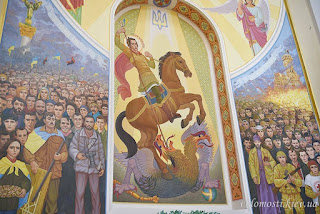
A wall in Cathedral of the Schismatic Church in Ukraine, which has been recognized by the Ecumenical Patriarchate. In it you see St. George slaying the Russian Double-Headed Eagle, people literally draped in the Ukrainian flag, and you also see the Neo-Nazi Right Sector Flag in the background.

The people at Public Orthodoxy have issued a declaration against the Russian Church in which they accuse the Russian Church of heresy -- which they assert is the idea of "Русский мир" or "The Russian World." They included accusations against the Russian Church for failing to condemn one of the three major parties in the war in Ukraine (which includes Russia, the post-coup Ukrainian government, and the United States). They also allude to the controversy over the Ecumenical Patriarchate's recognition of the schismatics in Ukraine. I won't repeat what I have said about the complexities of the war, in part 1. And I have written fairly extensively on the Ukrainian schism -- which you can read in full here, but if you only want to read one article, see "An American Perspective on the Ukraine Crisis." In this article, I will focus specifically on the merits of the claim that there is a heresy called "The Russian World."

What Public Orthodoxy has Not Felt a Need to Condemn

Before getting into the merits of their claims in this declaration, I think it is interesting to consider that while Public Orthodoxy has posted numerous articles condemning the Russian Church and its position on the Ukrainian schism, as well as numerous articles condemning Russia for the war in Ukraine (which has been going on for 8 years, and began with a coup sponsored by the United States), but they have not felt any need to condemn the United States' regime change war in Syria which has raged for 10 years. Far more people have been killed in that war (the current estimates range between 500,000 and 610,000), and this war represents an existential threat to the Orthodox Christians in Syria (which was about 10% of the Syrian population before the war). If the United States had succeeded in installing an Islamic jihadist government in Syria, this would have meant the end of Christianity in Syria, for all practical purposes, and likely the same fate would have befallen Lebanon. Russian military intervention has thus far prevented that from happening, but the United States continues to occupy 10% of Syria, denying Syria access to its own oil resources, and it has imposed crippling sanctions on Syria that are causing immeasurable suffering among the people of Syria -- both Christian and Moslem. So this is an issue that Orthodox Christians ought to be concerned about -- and yet not only has Public Orthodoxy not issued a statement condemning the actions of the American government in Syria, it has hardly said anything about it at all. Perhaps some big money might dry up, if they chose to take such a stand, but one would think anyone who was a believer, and had an ounce of courage would take the right stand regardless. Why the silence? 

See "The Immoral Policy of the United States Government in Syria," for more information, though the article is from 2016, it nevertheless lays out the reasons why US policy in Syria is undeniably evil.

Public Orthodoxy not only fails to condemn those who oppose Christian morality -- they are one of the chief purveyors of these heretical teachings. So Public Orthodoxy is hardly a reliable guide on the subject of what is, or is not heretical.

"Ethno-Phyletism" for Me, but Not for Thee

One telling fact of this declaration is that it does not include a single quote of a specific statement that it might have cited as an example of the errors they claim the Russian Church is teaching. They also do not reference any document in which one might look to find this heresy espoused. 

In a search of the official website of the Moscow Patriarchate, I found an article in which Patriarch Kirill summarized what he understands the concept of "The Russian World" to refer to: "Святейший Патриарх Кирилл: Русский мир — особая цивилизация, которую необходимо сберечь," which in English means "His Holiness Patriarch Kirill: The Russian world is a special civilization that must be preserved."

Patriarch Kirill notes that the Orthodox Culture of the Kievan Rus', which is the common heritage of the Russians, Belarusians, Ukrainians, and Carpatho-Russians, is not defined by political boundaries, and he has does not see it as promoting the building or rebuilding of any empire. He does see it has something worth preserving, which if lost, would be a loss to humanity. He does not see this as ethnic or racial, but cultural. He also does not assert that this culture is superior to all others, only that it is their culture, and it is worth preserving.

In the official conciliar documents of the Russian Church, the question of the Church's relationship to culture has been addressed in detail. "The Basis of the Social Concept of the Russian Orthodox Church," which was approved in 2000, includes in section II, a statement entitled "Church and Nation." I would defy anyone to point to anything in this statement, and to lay out a reasoned and supported argument for why it is heretical.

It is especially curious to hear this charge from an organization which is headed by two members of the Greek Archdiocese, because one hears a very similar concept to "The Russian World" fairly frequently, only it is called "Hellenism." A Google search of the official website of the Greek Archdiocese for the word "Hellenism" turns up "About 13,900" hits. One of the first articles to come up is entitled "New Program to Promote Hellenism in the United States." And the subtitle of that article is, interestingly enough "The Greek Orthodox Archdiocese and the Foundation for the Hellenic World Announce New Program to Promote Hellenism in the United States" [emphasis added]. In that article, you will see that Archbishop Elpidophoros himself was involved in the promotion of this new program. It certainly seems like Archbishop Elpidophoros thinks that there is a Greek Orthodox culture that is not limited by political boundaries, which is the heritage of all Greek people, and is worth preserving.

So is there a heresy of "The Hellenic World"? If not, it seems like members of a Church that considers the promotion of Hellenism to be a key part of their mission, might want to lay out exactly how this concept is not heretical, before they accuse the Russian Church of heresy for essentially having the same idea with regard to their own culture.

As a non-Russian who has been in the Russian Orthodox Church for close to 32 years now, I can tell you that I never felt pressured to become a Russian, nor have I been made to feel like I was a second class member of the Russian Church because I was not a Russian. For more on that, see "Converts and Culture," and "The Colors of the Russian Church."

In short, this declaration consists of a series of assertions that the Russian Church teaches things that they provide no evidence of anyone actually teaching, and they should perhaps examine their own views of Orthodoxy and culture, before they attack those of others.

Reader Services through the Sunday of St. Mary of Egypt


This installment covers the Sundays and Feasts of Old Calendar March, which on the civil Calendar runs from March 14th through April 13th. I intend to keep these texts posted as long as there are states or English speaking countries that are still under lockdown due to the Coronavirus.

The Eves

For the Eves of the upcoming Sundays and Feasts, you could ideally do the Vigil. The fixed portions can be downloaded here:

http://www.saintjonah.org/services/reader_vigil.doc

or viewed in HTML, here:

http://www.saintjonah.org/services/vigil.htm

For the Rubrics, see: http://www.saintjonah.org/rub/

The variable portions of the service can be downloaded here (all of these would be served on the eve of their respective days). The Sunday services prior to Pascha require two files, because these combinations do not repeat annually. Beginning with Pascha, all the variable material is included in one file. On Sundays, there are some hymns that are appointed according to which Matins Gospel is read. To find out which one is read, you also need to look at the Rubrics. For those texts, you will find them here: http://www.saintjonah.org/services/matinsgospel.doc Those hymns are usually done at the Exapostilaria and then at the Doxasticon at the Praises.

For the Sunday of the St. Gregory Palamas (March 20th n.s. / March 7th o.s.):

http://www.saintjonah.org/services/lent2.doc 

http://www.saintjonah.org/services/tone6.doc

For the Sunday of the Cross (March 27th n.s. / March 14th o.s.):

http://www.saintjonah.org/services/lent3.doc

http://www.saintjonah.org/services/tone7.doc

For the Sunday of St. John Climacus (April 3rd n.s. / March 21st o.s.):

http://www.saintjonah.org/services/lent4.doc

http://www.saintjonah.org/services/tone8.doc

For the Great Canon, (which this year is on Tuesday of the 5th Week of Lent, due to Annunciation), for those who are not use to doing services, I would recommend that you use the text of Small Compline: http://www.saintjonah.org/services/compline.htm and then, right after the Creed, you would do the Great Canon. This text has the text has the text for the Great Canon on the 5th week of Lent, beginning on page 42:

http://www.saintjonah.org/services/greatcanon_sts.pdf

For the Feast of Annunciation (April 7th n.s. / March 25th o.s.):

Annunciation is one of the more complicated services in the Liturgy Year. If anyone wants to try to put it together, the rubrics and texts are posted here:

https://saintjonah.org/services/annunciation_index.htm

But for most people, I would suggest that if you are unable to go to Church, on the eve of the feast (Monday night) use this text for Small Compline, which has the Annunciation Canon in it, laid out for lay use:

http://www.saintjonah.org/services/smallcompline_annunciation.doc

For the Fifth Friday of Great Lent, we do the service of the Akathist Hymn. For those not use to doing services, I would recommend using this text, which follows the more simple Greek order of service, but is arranged as a Reader Service:

http://www.saintjonah.org/services/smallcompline_akathist.doc

For the Sunday of St. Mary of Egypt (April 10th n.s. / March 28th o.s.):

http://www.saintjonah.org/services/lent5.doc 

http://www.saintjonah.org/services/tone1.doc

Typika

In place of the Liturgies, you would do Typika:

For the Sunday of the St. Gregory Palamas (March 20th n.s. / March 7th o.s.):

http://www.saintjonah.org/services/typika_lent2_t6.doc

For the Sunday of the Cross (March 27th n.s. / March 14th o.s.):

http://www.saintjonah.org/services/typika_lent3_t7.doc

For the Sunday of St. John Climacus (April 3rd n.s. / March 21st o.s.):

http://www.saintjonah.org/services/typika_lent4_t8.doc

For the Feast of Annunciation (April 7th n.s. / March 25th o.s.):

http://www.saintjonah.org/services/typika_annunciation.doc

For the Sunday of St. Mary of Egypt (April 10th n.s. / March 28th o.s.):

http://www.saintjonah.org/services/typika_lent5_t1.doc

Wednesday, March 16, 2022

Sister Vassa and Public Orthodoxy on Ukraine, Part 1


Once again, Sister Vassa and Public Orthodoxy have boldly staked out positions, which just happens to coincide with the fashionable opinion of the moment. In a video by Sister Vassa, and then in a declaration published by Public Orthodoxy (which Sister Vassa signed), they express their belief that Russia's invasion of Ukraine is evil, that Putin is solely to blame, and that the Russian Church should condemn Putin for it. And the declaration goes on to accuse the Russian Church of outright heresy. In this response, I will focus my attention on Sister Vassa's video. In part 2, I will address the Public Orthodoxy declaration.

The Intentional Fog of War Propaganda

Before getting into Sister Vassa's specific assertions, I would like to remind those who are old enough to remember the lead up to the first Gulf War -- and to inform those who were too young or not yet born -- of the lies our government propaganda machine churned out to talk us into going to war. I remember it well, and enlisted in the United States Marine Corps because I believed the things we were told. Iraq had invaded Kuwait, and we were told horror stories of how the Iraqi soldiers treated Kuwaitis. One of the more memorable things we were told was that Iraqi soldiers burst into hospitals, took babies out of incubators, left them on the floors to die, and then carted those incubators off to Iraq. There was testimony to this effect before the United States Congress, from a young woman who claimed to have been an eye witness to these barbarous acts. George H. W. Bush alluded to this frequently as he beat the war drums. This could not stand. Something had to be done. The only problem was, it was a lie. The young woman who testified before Congress happened to be the daughter of the Kuwaiti ambassador to the United States, and had not been in Kuwait at all during or after the Iraqi invasion. Of course, this only came to light long after the war was over. In 1990 and in 2003, the vast majority of Americans supported going to war with Iraq. Today, the vast majority of Americans believe it was a mistake.


Then under Bill Clinton we launched a war against Serbia, in which we bombed them back to the stone age, killed thousands of civilians, and carved off Kosovo from Serbia, where we still have American troops stationed to this day. This also happened due to the stenographers in the mainstream media, which dutifully presented a one-sided story of a complicated civil war, along with countless fabrications and lies which were designed to inflame the emotions of the American people... and then the United States did exactly what we are accusing Russia of doing right now.

In the lead up to the second Gulf War we were assured that there were weapons of mass destruction being amassed by Sadam Hussein, and this also turned out to be a lie. We invaded Iraq, and a country that was 10% Christian now has few remaining Christians because we unleashed Islamic Jihadists that Sadam Hussein had kept on a short leash, and the country has been a wreck ever since. I think there are few people left who would not gladly turn back the clock, and put Sadam Hussein back in charge of Iraq. As bad as he was, the world was a far safer place, and Iraq was a far better and safer place too.

More recently we launched regime change wars in Syria and Libya in which our military played direct roles, which have resulted in the deaths of hundreds of thousands of civilians, and millions of refugees. What we did in Libya caused further Islamic terror in other parts of Africa, as Libyan weapons made their way into the hands of Islamic terrorists, like Boko Haram. We have seen open slave markets, and human misery increased exponentially all because we wanted to take out the latest Hitler of the Month. If when we embarked on these regime change wars, we were creating paradises in their stead, perhaps one could justify this as a foreign policy theme, but instead, we consistently make bad situations into hell holes.

I could go on, but we have been repeatedly lied into going to war in country after country, and in almost every case, the situation has been made far worse by our actions. But the point here is that the media willfully presented propaganda to the American people, designed to whip up public opinion and get them to support American foreign policy based on lies.

The Complexities of the War in Ukraine

In Sister Vassa's comments, she repeats a great deal of the spin we are hearing in the western media, as if it were all true, and there was nothing more to it. Her arguments amount to appeals to emotion based on the media narrative, and appeals to majority opinion, rather than on reason, evidence, or logical argument. The problem here is we should know by now that we cannot put a lot of faith in what our government or the media tells us when our government is trying to push public opinion to support a war. And make no mistake, that is what is happening. We are being asked to support an economic war, which will have huge repercussions on our own economy, as well as every economy in the world -- which will disproportionately affect the poor throughout the world, and put them in positions in which keeping body and soul together will be extremely difficult. We are being asked to supply weapons to one side, and there is the very real prospect that we could soon be drawn into the fighting on the ground before all is said and done, if we are not careful.

Anyone who is presenting this war in simple terms is either ignorant of the facts, or is trying to deceive you, and they are certainly not advancing the cause of peace. This war has an extremely complicated background. For one thing, Ukraine was never an independent country prior to the 1990's. For most of the last 3 centuries it has been united with Russia, and so there are strong ties to Russia, particularly with the Eastern and Southern regions of Ukraine. Ukraine has had two "revolutions" since it became independent, both of which the United States had more than a small role in. In 2014, we had a blatant coup d'etat in which our country sponsored the violent overthrow of the lawfully elected government of the country. As a result there was unrest throughout Eastern and Southern Ukraine. The Russian government seized Crimea, which has been the base for the Russian Black Sea fleet since Catherine the Great, and whose population overwhelming supported the action. In most of the South, unrest was violently squelched, but in Eastern Ukraine, two regions declared their independence, and with Russian support, were able to keep from being crushed by the new Ukrainian government, but the people in those regions have been subjected to continuous shelling by the Ukrainian military for the past 8 years, and about 14,000 people have been killed... but CNN didn't bother stoking anyone into being outraged about those deaths -- and in fact, most people are unaware of this aspect of the present conflict entirely. 

For more on the 2014 Coup, see the documentary Ukraine on Fire, the follow up documentary Ukraine Revealed, as well as How US-backed Maidan coup, Russiagate led to war in Ukraine.

Since 2014, there have been two peace agreements that have been signed which would have ended the war in Eastern Ukraine, and in both cases, nothing came of them, because the president of Ukraine was either unable, or unwilling to implement them. I am sure the politics of this is very difficult to navigate, but while the last two Ukrainian presidents both ran on a platform of bringing peace to Eastern Ukraine, and they may both have been very sincere in their intentions, neither was able to accomplish their stated intentions... for whatever reason. Zelensky even went to Eastern Ukraine and personally ordered the overtly Nazi Azov Battalion to withdraw... and they simply refused to do so. So it is unclear who has really been running the show in Ukraine.

On top of the 8 year war against Russian speaking people in Eastern Ukraine, Zelensky suggested in February of this year that Ukraine would be seeking to acquire Nuclear weapons, and Ukraine has stated its intention to join NATO, and to retake Crimea from Russia... by force if necessary. Russia had laid out to the US a list of its "Red Lines," the biggest of which is Ukraine entering NATO, and the US refused to accommodate Russia on any of its concerns. Countless experts have been warning that this policy of NATO expansion would eventually lead to a military response from Russia:

And so given that this was entirely predictable, one has to wonder why the Biden administration chose to continue to press ahead with NATO expansion, rather than to press Ukraine to actually implement the Minsk agreements, and end the 8 year war in Eastern Ukraine.

Sister Vassa notes that even Fox and CNN agree that this is all Russia's fault. The problem is that war is the one remaining bi-partisan issue in America. The establishments of both parties generally support going to war. Fox News has generally taken the same stance.

Sister Vassa dismisses concerns about Nazis in Ukraine because Israel sides with the US, Zelensky is Jewish, Ukraine fought against the Nazis in World War II, and she suggests that like any other country, Ukraine simply has people with various political leanings. But Israel has little choice but to side with the US, given that the US is Israel's only ally in the world, and heavily funds and supplies its military. Zelensky is Jewish, but that doesn't prove that there are not Nazis throughout Ukraine's military and security forces, and when you have overtly Nazi Battalions that are part of the Ukrainian Army, that is not just having some kooks in your country. Yes, 8 million Ukrainians died fighting the Nazis, but many of those from Western Ukraine died fighting for the Nazis. You had Ukrainian divisions of the SS. And they have a Nazi war criminal that is celebrated as a National hero -- Stepan Bandera. Obviously the average Ukrainian is not a Nazi, and one could argue that the Russian government makes more of this than is warranted, but pretending that this is not a real issue is either ignorant or dishonest.

The BBC has reported on the heavy role played by Nazis in Ukrainian politics as well:

A good case can be made that the primary reason why the Minsk Agreements have never been implemented is that the Ukrainian government has a legitimate fear of being overthrown by these Nazi forces.

You cannot honestly discuss the current war in Ukraine without addressing the 2014 coup, the last 8 years of war in Eastern Ukraine and the 14,000 people (mostly Russian speaking Ukrainians) who have been killed under nearly constant shelling, and dealing with the role of various Nazi groups in both the coup and the war, and you certainly cannot discuss this without mentioning the United States' role in all of the aforementioned. And yet Sister Vassa almost completely ignored all of this.

To say that this war is all Putin's fault is, at the very least, simplistic. If you say it is all his fault, you are in effect saying it is not the United States' fault, or the fault of the post-coup Ukrainian government. But it is quite possible that there is some blame that is due to each party here. And while God knows exactly how much everyone responsible is to blame, I don't believe we do, at this point. It certainly simplifies things if you can paint one side as heartless people who take babies out of incubators and throw them on the floor, but it probably is better to wait until you have a better idea of what has actually happened before you jump to simplistic conclusions.

Furthermore, laying all the blame on Putin takes off any pressure for the US or Ukraine to seek a compromise solution, and at this point, a compromise solution is the only way the fighting will end in the short term. So while people who take this position have the self satisfaction of virtue signaling, and can claim that they are for peace, they actually are making it less likely that peace will be restored any time soon.

The Pastoral Issues for the Russian Church

Aside from the problem with pinning the blame on only one side when we don't have sufficient evidence to really reach that conclusion, the Russian Church has the very real problem of having people who are on the various sides, and everywhere in between -- and this is true just among the Ukrainians in the Russian Church. In my parish alone I have Ukrainian people who believe Russia is coming to the rescue, and people who think Putin is evil, and then people who have mixed opinions. I don't want to alienate any of those people. They all have family and friends who are suffering, and many who have been killed or will be killed. The Church has to rise above such things, and appeal to all sides to find a way towards peace.

Conclusion

We can all agree that war is evil. We are praying for a swift end to the war. And in the meantime we are doing what we can to raise money to help those who have been displaced by the war. No one in the Russian Church wanted to see things come to this point. All sides should do what they can to end this war as soon as possible. We can certainly say that anyone who contributed to causing this war will have a lot to answer for before God. Anyone who chooses war when they have other viable options is committing a great sin. God knows the truth. At this point, I don't believe we do.

This war was certainly preventable. I believe the US government could have prevented it, and so if I was going to condemn anyone, I would have to start with the government that at least theoretically answers to the American people.

For more information:

Sermon; The War in Ukraine

Sermon: God is on the Throne

Update: Let me clarify one point so that no one is confused. It is not my place or the place of the Church to tell Ukrainians that they should not want to have an independent country, nor would it be to say that they should. Ukrainians themselves are not of one mind on this question, and so obviously everyone cannot have their way when people disagree. They should find a peaceful way to resolve such disputes, but this really should be a matter that they settle without outside interference.

Furthermore, war is always an evil thing, and there is always at least one side that is in the wrong. Sometimes both sides are in the wrong. Reasonable people can disagree about such things, because we all have limited knowledge, and we come from our own perspective. God, however, knows exactly who is to blame, and it would be a horrible thing to have to answer for on the day of judgment.

Update 2: One other point, just to be clear. Anyone has the right to think or say whatever they believe to be true about the current war in Ukraine. If Sister Vassa had simply voiced her opposition to it, I wouldn't have responded. It is the accusation that the Church has to condemn one of the three major parties to this war, but not condemn either of the other two, that I take issue with. War is horrible. Everyone with any compassion would rather it not have happened, and would want it to end as soon as possible. But the reasons for why we are where we are at this point in history are not simple, and demanding that the Church pretend otherwise, and exonerate the US and the post-coup government of Ukraine, while laying the blame only on the Russian government, is not a reasonable position to take. If Russia had invaded Ukraine out of the blue, that would be a different matter, but there has been a war going on for 8 years, and so it is not nearly so clear cut. More facts will hopefully come out, and as they do I hope everyone will revise their opinions accordingly, but that is how I see it at this point.

Also, one commentator mentioned that a lot of other people collaborated with the Nazis, including Russians. I can understand why people living under Stalin, knowing only what they knew at the time, might have thought that Hitler was the lesser of the two evils. However, when you have groups of Ukrainians in 2022, who choose to identify with this particular chapter of their history, and identify themselves as Nazis, they have a lot less of an excuse then their grandfathers had. And furthermore, when you have those people functioning openly in the Ukraine military, in Nazi units, it is a far more problematic matter. Every country has its share of kooks. Most don't have Kook Battalions in their military.


Saturday, February 12, 2022

Reader Services through the First Sunday of Lent

This installment covers the Sundays and Feasts of Old Calendar February, which on the civil Calendar runs from February 14th through March 13th. I intend to keep these texts posted as long as there are states or English-speaking countries that are still under lockdown due to the Coronavirus.

The Eves

For the Eves of the upcoming Sundays and Feasts, you could ideally do the Vigil. The fixed portions can be downloaded here:

http://www.saintjonah.org/services/reader_vigil.doc

or viewed in HTML, here:

http://www.saintjonah.org/services/vigil.htm

For the Rubrics, see: http://www.saintjonah.org/rub/

The variable portions of the service can be downloaded here (all of these would be served on the eve of their respective days). The Sunday services require two files, because these combinations do not repeat annually. In addition to the files linked for the Sundays below, you will need to use the appropriate Katavasia, which for this time period is the Katavasia of  the Presentation, and then various Katavasiae from the Triodion  -- the respective Rubrics will tell you which. Also, on Sundays, there are some hymns that are appointed according to which Matins Gospel is read. To find out which one is read, you also need to look at the Rubrics. For those texts, you will find them here: http://www.saintjonah.org/services/matinsgospel.doc Those hymns are usually done at the Exapostilaria and then at the Doxasticon at the Praises.

Vigil for the Feast of the Meeting of the Lord (February 15th n.s. / February 2nd o.s.):

http://www.saintjonah.org/services/vigil_presentation.doc

For the Sunday of the Prodigal Son / Afterfeast of the Meeting of the Lord (February 20th n.s. / February 7th o.s.):

http://www.saintjonah.org/services/triod2_february07.doc 

http://www.saintjonah.org/services/tone2.doc

For the Sunday of the Last Judgment (February 27th n.s. / February 14th o.s.):

http://www.saintjonah.org/services/triod3.doc

http://www.saintjonah.org/services/tone3.doc

For the Cheesefare Sunday (March 6th n.s. / February 21st o.s.):

http://www.saintjonah.org/services/triod4_forerunner.doc

http://www.saintjonah.org/services/tone4.doc

For Forgiveness Sunday Vespers (done on Sunday Evening), this text has everything laid out exactly as it would be done, with nothing omitted:

http://www.saintjonah.org/services/forgivenessvespers_rs.doc

First Week of Lent: for Monday (March 7 / February 22) through Thursday (March 10 / February 25), the Great Canon of St. Andrew of Crete is done. 

http://stjonah.org/wp-content/uploads/2019/06/greatcanon_sts.pdf

Ideally, this is done as a part of Great Compline, but if that is too much, you can do it as part of Small Compline.

On the Fridays of Great Lent, you can do the Akathist with Small Compline:

http://www.saintjonah.org/services/akathistforlent.htm

For the First Sunday of Lent (March 13th n.s. / February 28th o.s.):

http://www.saintjonah.org/services/lent1.doc

http://www.saintjonah.org/services/tone5.doc


Typika

In place of the Liturgies, you would do Typika:

For the Feast of the Meeting of the Lord (February 15th n.s. / February 2nd o.s.):

http://www.saintjonah.org/services/typika_presentation.doc

For the Sunday of the Prodigal Son / Afterfeast of the Meeting of the Lord (February 20th n.s. / February 7th o.s.):

http://www.saintjonah.org/services/typika_triod2_february07.doc 

For the Sunday of the Last Judgment (February 27th n.s. / February 14th o.s.):

http://www.saintjonah.org/services/typika_triod3_t3.doc

For the Cheesefare Sunday (March 6th n.s. / February 21st o.s.):

http://www.saintjonah.org/services/typika_triod4_forerunner.doc

For the First Sunday of Lent (March 13th n.s. / February 28th o.s.):

http://www.saintjonah.org/services/typika_lent1_t5.doc

Saturday, February 05, 2022

What Happens When "Scholars" Fail to Address Arguments and Evidence Presented to Them

The Lynching of 17 Chinese in California 1871

Aram Sarkisian has posted another hit piece in "Public Orthodoxy" that attacks the Ludwell Orthodox Fellowship, as well as myself and others.

He begins by complaining about some of the online harassment he has received as a result of his previous essay. I truly I am sorry to hear that. However, this is not something unique to him or people of his political or religious views. My parish had a credible terrorist threat in June 2020 that I had to get the FBI, as well as state and local authorities, and my parish had to spend thousands of dollars to increase security. Mean tweets are far more easily handled. If you have someone saying stupid things to you online, blocking them is usually the best and quickest solution. The anonymity of the internet, and the fact that most social media platforms let people use pseudonyms create the environment that promotes that sort of behavior. Pointing out things that Aram Sarkisian has posted in the past, however, is not harassment, and it is certainly something that he feels free to do too.

Aram Sarkisian again plays the game of guilt by association, and he also didn't quote a single thing I actually said in my response to his first essay (nor did he provide a link to my article, so people could read it for themselves and come to their own conclusions). Instead, he mischaracterized what I said, and put his own twist on it. He also failed to address any of the contemporary moral issues that I pointed out -- nor did he explain his strange silence about them. The only contemporary moral issues he does talk about are abortion and the LGBTQP agenda, and on those issues, he promotes baby killing and sexual immorality. We cannot change the past, but we can do something about genocide in China, the genocide against Christians in Africa and the Middle East, the killing of a million babies a year in this country, the promotion of sexual immorality, and the rise of Marxism (the most evil and murderous ideology in human history) -- particularly in the academic environment that Sarkisian lives and works in. But saying something against those things might actually cost Dr. Sarkisian something professionally and personally.

He wrote, with regard to my response to him:

"Co-founder Fr. John Whiteford explained on the Michael Sisco Show in October, after all, that racial harmony in the antebellum South was such that the concept of segregation did not exist there—until it was exported from the North. Fr. John too asserted that post-Reconstruction Jim Crow segregation wasn’t all that bad for Black southerners—just misunderstood and misremembered."

I of course said no such thing, and in fact stated pretty much the opposite. The problem here is that it is unfair to compare the South at any point in its history with an ideal society, and to find it wanting. What is fair is to compare it with other societies at the same time. And as a matter of fact, it is true that there was no segregation in the South prior to the late 19th century -- there was subordination, but not segregation. In the North at that same time, blacks were excluded from society, pushed to the margins, and allowed not even the most basic of rights. As Alexis de Tocqueville put it, in his book Democracy in America

“So the Negro [in the North] is free, but he cannot share the rights, pleasures, labors, griefs, or even the tomb of him whose equal he has been declared; there is nowhere where he can meet him, neither in life nor in death.”

Northerners, in fact, often criticized Southerners for living in too close proximity to black people. For example, David Wilmot (of Pennsylvania) wrote:

“By God, sir, men born and nursed of white women are not going to be ruled by men who were brought up on the milk of some damn Negro wench!” (Brion McClanahan "Is “White Supremacy” an Exclusively “Southern” Ideology?")

There also were free blacks in the antebellum South, many of whom became prosperous. Many became slave owners themselves. Some even became very wealthy (e.g. Horace King). 

It is also true that Jim Crow laws originated in the North, and only came to the South with the New South Movement (which was a progressive movement, by the way -- for more information, see the book "The Strange Career of Jim Crow," by C. Vann Woodward (Oxford University Press, 1955). I never suggested that the Jim Crow period was a good time for black people. The fact people put laws in place to force segregation is evidence that there were many people who were doing the opposite. The same is also true of laws against interracial marriage. I believe that government-imposed segregation is wrong, and while I also think it is not a good thing even when voluntary, there have been many black scholars that have argued that black people were better off under segregation (economically especially), and you have many who are now pushing Critical Race Theory, that are promoting segregation today. I am glad legal segregation is a thing of the past (at least outside of American Universities). But here again, Dr. Sarkisian wants to compare the South with perfection, but fails to compare it with other contemporary examples. Segregation was very common in the North and West of the United States, and still is, in practice today. And the point is that even after segregation ceased to be legally enforced in the North, it remained a more pervasive and absolute reality than it ever was in the South.

I happen to have the ability to see this from both a Northern and Southern perspective, because while my father was from Texas, and came from a deeply rooted Southern family, my mother was from Chicago, and her family was mostly Northern in origin. I wouldn't throw either side of my family under the bus, but let's just say that I didn't hear much racist talk from the folks who were from the South. Chicago remains one of the most segregated cities to this day, but it is not particularly unique among large northern cities.

A black minister I know of pointed out what he saw as the difference between life in the South and life in the North in the post World War II era. He said white people in the South didn't mind living next to black people, but didn't want them to have more than they did. White people in the North, didn't care what black people had, but didn't want to live anywhere near them. That is of course a somewhat exaggerated generalization, but I think it has a lot of truth to it, if we are talking about life prior to about 1980.

Aram Sarkisian wrote: 

"There is little I could do in this brief essay that might even begin to dismantle such staggering historical falsehoods, nor do I think Fr. Whiteford would care to hear it."

I would actually love to see Dr. Sarkisian reply to the substance of my essay, but I am not holding my breath. I suspect he will continue to reply to his straw man characterizations of things I have said, rather than what I actually said.

"They were never dehumanized to the status of property, never barred from schools and universities on account of their race, were never asked to count bubbles on a bar of soap so they could vote, never had to hold their bladder until they found a “colored” bathroom, and knew they would never experience the terror of the lynching tree."

I have addressed the issues of slavery, and how this was an American problem, and a world wide problem, and not a specifically Southern Problem in "Orthodox America Has a Cultural Marxist Problem," Lynching was also an American problem. It was worse in the South in the wake of Reconstruction, because of the divide and conquer policies of Radical Reconstruction, which sought to cement Republican political control, rather than to bring about racial reconciliation in the South. The largest single incident of lynching happened in California in 1871, and the people lynched were actually Chinese. Chinese laborers were routinely abused and killed in the American West. The Chinese who worked on the railroad were paid slave labor wages, asked to do the most dangerous work, and little concern for their safety was given... which is the origin of the phrase "a Chinaman's chance," which was usually used in the form of "He hasn't got a Chinamen's chance," which given the slim odds Chinese people were usually given in America, basically means whoever is being spoken off hasn't even got those slim chances. And there would no doubt have been a lot more lynchings of Chinese, except Western politicians managed to pass the Chinese Exclusion Act, and effectively made it impossible for Chinese to immigrate to the United States prior to 1943, when it was finally repealed. Blacks were lynched in nearly every state in the Union. They were lynched more frequently in the South, because there were a lot more black people in the South, but of the lower 48 states, 44 of them had incidents of blacks being lynched, and while the numbers are lower, white people were lynched frequently too. Lynching is of course a horrible crime, and it is of course a good thing that we do not see it very much anymore.

"To be clear, no one is saying that racist ideas are held by all Orthodox Christians in the American South, or that American racism has been, or is now limited only to that region. And there is nothing wrong with Orthodox evangelism to the South. But if evangelism draws on racist Lost Cause mythology and iconography of the failed Confederate rebellion, especially at a moment of renewed Confederate nostalgia, it is important that these ideas are stopped from becoming mainstream. When a group bears witness to Orthodoxy using an image of Stonewall Jackson in uniform with his hand upon a Bible, as is found on the Ludwell Fellowship website, could the message be any clearer?" 

I addressed the question of the Lost Cause and Righteous Cause myths, but Dr. Sarkisian didn't bother to address any of my arguments or the evidence I presented, but instead simply repeats the accusation. Booker T. Washington was an actual slave, and yet he had this to say of Stonewall Jackson and Lee:

"The first white people in America, certainly the first in the South to exhibit their interest in the reaching of the Negro and saving his soul through the medium of the Sunday-school were Robert E. Lee and 'Stonewall Jackson.' ... Where Robert E. Lee and 'Stonewall’ Jackson have led in the redemption of the Negro through the Sunday-school, the rest of us can afford to follow.”

Stained glass window in the historically black 5th Avenue Presbyterian Church in Roanoke, Virginia. The scene is of an army camped by a river, and the text contains Stonewall Jackson's last words. It says, "In Memory of Stonewall Jackson. Let us cross the river and rest in the shade of the trees."

Stonewall Jackson taught a black Sunday School class, (which taught children how to read and write -- not just about the faith) and supplied its needs out of his own pocket, and out of that Sunday School class came four black churches, and several Black clergymen, who held him in high regard. There is even a stained-glass window dedicated to Stonewall Jackson in one the churches founded by these clergymen. In dismissing Stonewall Jackson as some sort of cartoonish evil character, Dr. Sarkisian is also dismissing the memory of these black people who knew and admired him. Stonewall Jackson is a good example of the deep religious piety that you find in the South. It has not normally been an Orthodox piety up until now, but it does provide us with something to work with. In my experience, I have seen this kind of piety especially found among the black folks I have worked with over the nearly three decades that I worked for the State of Texas.

"And it’s just as alarming that one of its primary voices is Fr. Whiteford, who has appeared on the “Dissident Mama” podcast, and who promoted the Fellowship alongside another co-founder, Dr. Clark Carlton, on the Michael Sisco Show. One loses plausible deniability when they repeatedly seek and out and accept these kinds of platforms to spread harmful historical falsehoods, especially when they wear a cassock."

I firmly believe, have written, and have preached, that hating someone on the basis of race, or mistreating someone on the basis of race is a sin. I don't believe Michael Sisco or Rebecca Dillingham disagree with that at all. Michael often makes fun of his critics by tweaking them in sarcastic ways, but that is a different matter. Rebecca pushes back against Cultural Marxists, but this is because of what she loves (her children, thus the moniker "Dissident Mama'), not what she hates. I am sure that they have said many things I wouldn't agree with, or said things in ways that I wouldn't say them, but having gotten to know them personally, I don't believe that they hate people, based on race or for any other reason. I believe that the Golden Rule applies to everyone, regardless of race, and I believe that they do too.

And by the way, I have also appeared on Roman Catholic podcasts, and Protestant podcasts, and I would even appear on a podcast by someone like Aram Sarkisian, so long as I thought the format would be fair. 

What Aram Sarkisian wants us to do is to hold Southerners to standards that no other group is held too. Do you hear any scholars lecturing Africans, Arabs, Indians, Chinese, or Latin Americans about how they should be ashamed of their own history because it included slavery? No, you do not. You also don't hear them talk very much about slavery in the United States that involved anyone other than Southerners, even though New Englanders ran the Slave Trade, which was the most brutal and inhumane aspect of American slavery. I am not a great student of Armenian history, but I suspect it included slavery too, and I also suspect that Armenians do not have a long history of embracing cultural and racial diversity. However, I would not expect Aram Sarkisian to denounce his ancestors, because that would be evil. The Golden Rule suggests that one should not expect other people to do what they would not want to do themselves.

Monday, January 10, 2022

Reader Services through the Sunday of the Publican and the Pharisee


This installment covers the Sundays and Feasts of Old Calendar January, which on the civil Calendar runs from January 14th through February 13th. I intend to keep these texts posted as long as there are states or English-speaking countries that are still under lockdown due to the Coronavirus.

The Eves

For the Eves of the upcoming Sundays and Feasts, you could ideally do the Vigil. The fixed portions can be downloaded here:

http://www.saintjonah.org/services/reader_vigil.doc

or viewed in HTML, here:

http://www.saintjonah.org/services/vigil.htm

For the Rubrics, see: http://www.saintjonah.org/rub/

The variable portions of the service can be downloaded here (all of these would be served on the eve of their respective days). The Sunday services require two files, because these combinations do not repeat annually. In addition to the files linked for the Sundays below, you will need to use the appropriate Katavasia, which for this time period is the Katavasia of the Theophany and then that of the Presentation -- the respective Rubrics will tell you which. Also, on Sundays, there are some hymns that are appointed according to which Matins Gospel is read. To find out which one is read, you also need to look at the Rubrics. For those texts, you will find them here: http://www.saintjonah.org/services/matinsgospel.doc Those hymns are usually done at the Exapostilaria and then at the Doxasticon at the Praises.

Also, the texts below do not always have the full canon for the Menaion, but you can find that here:

https://www.ponomar.net/maktabah/MenaionLambertsenJanuary2000/index.html (you will need to look up the service according to the Old Calendar (o.s.) date).

For the Feast of the Circumcision of the Lord & St. Basil (January 14th n.s. / January 1st o.s.):

http://www.saintjonah.org/services/stbasil_circumcision_weekday.doc

For the 30th Sunday after Pentecost / Prophet Malachi, Forefeast of Theophany (January 16th n.s. / January 3rd o.s.):

http://www.saintjonah.org/services/1-03_prmalachi_ff_theophany.doc

http://www.saintjonah.org/services/tone5.doc

Vigil for the Eve of Theophany (January 18th n.s. / January 5th o.s.):

http://www.saintjonah.org/services/vigil_theophany_eve.doc

(This service is not set up as a reader service, but by following the usual modifications, you could easily use this text to do it as a reader service)

Vespers for Theophany (January 19th n.s. / January 6th o.s.):

http://www.saintjonah.org/services/theophany_vespers_rs.doc

Vigil for Theophany (January 19th n.s. / January 6th o.s.):

http://www.saintjonah.org/services/theophany_vigil_rs.doc

For the 31st Sunday after Pentecost / St. Theophan the Recluse / 31st Sunday after Pentecost (January 23rd n.s. / January 10th o.s.):

http://www.saintjonah.org/services/1-10_af_theophany&sttheophan.doc

http://www.saintjonah.org/services/tone6.doc

For the 32nd Sunday after Pentecost / St. Anthony the Great (January 30th n.s. / January 17th o.s.):

http://www.saintjonah.org/services/1-17_stanthonythegreat.doc

http://www.saintjonah.org/services/tone7.doc

For the 33rd Sunday after Pentecost / Sunday of the New Martyrs and Confessors of Russia (February 6th n.s. / January 24th o.s.):

http://www.saintjonah.org/services/vigil_nmmrussia.doc

http://www.saintjonah.org/services/tone8.doc

For the Sunday of the Publican and Pharisee (February 13th n.s. / January 31st o.s.):

http://www.saintjonah.org/services/triod1.doc

http://www.saintjonah.org/services/tone1.doc

Typika

In place of the Liturgies, you would do Typika:

For the Feast of the Circumcision of the Lord & St. Basil (January 14th n.s. / January 1st o.s.):

http://www.saintjonah.org/services/typika_circumcision_wk.doc

For the 30th Sunday after Pentecost / Prophet Malachi, Forefeast of Theophany (January 16th n.s. / January 3rd o.s.):

http://www.saintjonah.org/services/typika_pent30.doc

Royal Hours and Typika for the Eve of Theophany (January 18th n.s. / January 5th o.s.):

http://www.saintjonah.org/services/royalhours_theophany_rs.doc

Typika for Theophany (January 19th n.s. / January 6th o.s.):

http://www.saintjonah.org/services/typika_theophany.doc

For the 31st Sunday after Pentecost / St. Theophan the Recluse / 31st Sunday after Pentecost (January 23rd n.s. / January 10th o.s.):

http://www.saintjonah.org/services/typika_pent31.doc

For the 32nd Sunday after Pentecost / St. Anthony the Great (January 30th n.s. / January 17th o.s.):

http://www.saintjonah.org/services/typika_pent32.doc

For the 33rd Sunday after Pentecost / Sunday of the New Martyrs and Confessors of Russia (February 6th n.s. / January 24th o.s.):

http://www.saintjonah.org/services/typika_pent33.doc

For the Sunday of the Publican and Pharisee (February 13th n.s. / January 31st o.s.):

http://www.saintjonah.org/services/typika_triod1.doc


Monday, December 13, 2021

Reader Services through the 29th Sunday after Pentecost


This installment covers the Sundays of Old Calendar December, which on the civil Calendar runs from December 14th through January 13th. I intend to keep these texts posted as long as there are states or English speaking countries that are still under lockdown due to the Coronavirus.

The Eves

For the Eves of the upcoming Sundays and Feasts, you could ideally do the Vigil. The fixed portions can be downloaded here:

http://www.saintjonah.org/services/reader_vigil.doc

or viewed in HTML, here:

http://www.saintjonah.org/services/vigil.htm

For the Rubrics, see: http://www.saintjonah.org/rub/

The variable portions of the service can be downloaded here (all of these would be served on the eve of their respective days). The Sunday services require two files, because these combinations do not repeat annually. In addition to the files linked for the Sundays below, you will need to use the appropriate Katavasia, which for this time period is the Katavasia of the Nativity -- the respective Rubrics will tell you which. Also, on Sundays, there are some hymns that are appointed according to which Matins Gospel is read. To find out which one is read, you also need to look at the Rubrics. For those texts, you will find them here: http://www.saintjonah.org/services/matinsgospel.doc Those hymns are usually done at the Exapostilaria and then at the Doxasticon at the Praises.

Also, the texts below do not always have the full canon for the Menaion, but you can find that here:

https://www.ponomar.net/maktabah/MenaionLambertsenDecember2000/index.html (you will need to look up the service according to the Old Calendar (o.s.) date).

For the 26th Sunday After Pentecost / St. Nicholas the Wonderworker (December 19th n.s. / December 6th o.s.):

http://www.saintjonah.org/services/vigil_stnicholas_sun.doc

http://www.saintjonah.org/services/tone1.doc

For the 27th Sunday after Pentecost / The Sunday of the Holy Forefathers / Martyr Eustratius & Comp. (December 26th n.s. / December 13th o.s.):

http://www.saintjonah.org/services/12-13_holyforefathers&five_martyrs.doc 

http://www.saintjonah.org/services/tone2.doc

For the 28th Sunday After Pentecost / The Sunday of the Holy Fathers & St. John of Kronstadt (January 2nd n.s. / December 20th o.s.):

http://www.saintjonah.org/services/12-20_sun_holyfathers&stjohnofkronstadt.doc 

http://www.saintjonah.org/services/tone3.doc

Christmas Eve Vigil (January 6th n.s. / December 24th o.s.)

http://www.saintjonah.org/services/vigil_christmas_eve.doc

(This service is not set up as a reader service, but by following the usual modifications, you could easily use this text to do it as a reader service)

Vespers for Nativity (the eve of January 7th n.s. / December 25th o.s.):

http://www.saintjonah.org/services/nativity_vespers_rs.doc

Vigil for Nativity (January 7th n.s. / December 25th o.s.):

http://www.saintjonah.org/services/nativity_vigil_rs.doc

For the 29th Sunday after Pentecost / Commemoration of the Holy & Righteous Joseph the Betrothed, David the King, & James the Brother of the Lord (January 9th n.s. / December 27th o.s.):

http://www.saintjonah.org/services/12-27or29_sun_after_nativity.doc

http://www.saintjonah.org/services/tone4.doc

Typika

In place of the Liturgies, you would do Typika:

For the 26th Sunday After Pentecost / St. Nicholas the Wonderworker (December 19th n.s. / December 6th o.s.):

http://www.saintjonah.org/services/typika_pent26.doc

For the 27th Sunday after Pentecost / The Sunday of the Holy Forefathers / Martyr Eustratius & Comp. (December 26th n.s. / December 13th o.s.):

http://www.saintjonah.org/services/typika_pent27.doc

For the 28th Sunday After Pentecost / The Sunday of the Holy Fathers & St. John of Kronstadt (January 2nd n.s. / December 20th o.s.):

http://www.saintjonah.org/services/typika_pent28.doc

The Royal Hours & Typika of Nativity (January 6th n.s. / December 24th o.s.):

http://www.saintjonah.org/services/royalhours_nativity_rs.doc

For Nativity (January 7th n.s. / December 25th o.s.):

http://www.saintjonah.org/services/typika_nativity.doc

For the 29th Sunday after Pentecost / Commemoration of the Holy & Righteous Joseph the Betrothed, David the King, & James the Brother of the Lord (January 9th n.s. / December 27th o.s.):

http://www.saintjonah.org/services/typika_pent29.doc

Saturday, December 11, 2021

Orthodox America Has a Cultural Marxist Problem

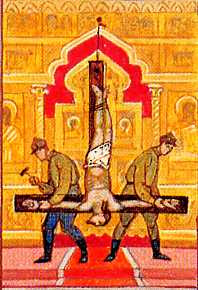
Martyrdom of Archbishop Joachim of Nizhny Novgorod - he was crucified by the Communists upside down, on the Royal Doors of the Cathedral in Sebastopol in 1920

Dr. Aram G. Sarkisian recently wrote an article for the misnamed website “Public Orthodoxy” (which promotes pretty much everything except Orthodoxy) entitled “Orthodox America Has a Lost Cause Problem,” which was written in response to the launch of the Ludwell Orthodox Fellowship website, which is a website dedicated to the spread of the Orthodox Faith in the South, and also to discussing those aspects of Southern culture which are good, conducive to living an Orthodox life, and worth preserving. Apparently, Dr. Sarkisian thinks that this is not only a threat to the Orthodox Church (which is a Church he is not a member of, being an Armenian Monophysite), but also a threat to our democracy. 

Social Justice Warrior Hypocrisy

Dr. Sarkisian, like many contemporary “social justice” advocates, congratulates himself that 156 years after slavery was banned in the United States, he too is opposed to slavery; and that 57 years after the passage of the Civil Right Act, he too thinks black people should be treated equally. Such virtue signaling is popular these days because it gives people the false sense of being virtuous, and also, so they hope, gives them the appearance of being virtuous. But to be truly morally virtuous, one has to take actions that actually cost them something. Such virtue signaling costs nothing, any more than does coming out against wife-beating or foot-binding. 

But let us, for the moment, leave behind the moral questions of the past, and talk about some of the moral questions of the present. In American universities today, symbols of the Confederacy are railed against, and even statues of our founding fathers are no longer considered to be acceptable. However, Marxist symbols are chic, and Marxist ideology is regularly and openly promoted. And yet there is no ideology in the history of the human race that has produced more bloodshed and misery than Marxism – nor one that even comes close. Marxists are the moral superiors of no one, and those who enable them with their silence or complicity are not much better. 

Communist China is ruled by one the most brutal and bloody regimes of any nation in history. They intentionally starved and murdered tens of millions of their own people (some estimates go as high as 100 million), they have brutal concentration camps, which are up and running even as we speak, they are engaged in an ongoing genocide against the Uyghurs, and have only been slightly less severe in their treatment of Tibetans, only because Buddhists tend to be less violent in their resistance than Muslims. And much of what Communist China exports is produced by actual slave labor, or in near slave labor conditions. Apple products are produced in factories with conditions that are so bad that they had to put nets under the windows of the upper floors of their buildings to prevent workers from jumping to their deaths – so instead of improving conditions, so that workers wouldn’t want to kill themselves rather than to go on living, they simply made sure they couldn’t easily kill themselves, so that they would be forced to continue working in such conditions... so that social justice warriors in the west could get their latest iPhones at a reasonable price. But since Communist China has purchased a great deal of influence in academia, the media, and the government, criticizing their ongoing atrocities might actually cost someone who wants to be a career academic.

I scrolled through Dr. Sarkisian’s Twitter and Facebook feeds to see what kind of issues he thinks are important enough to comment on, and he is pro-abortion, supports Planned Parenthood – the #1 organization in the world that kills babies for money – and he thinks Biden should pack the Supreme Court to ensure that unfettered abortion remains the law of the land. He supports gay marriage, and the “LGBTQIA” agenda. He supports critical race theory – as he also does in his Public Orthodoxy essay – and CRT is rooted in Marxist theory. I found no expression of concern about slave labor or genocide in Communist China, nor the slaughter of Christians in Nigeria. No concern is expressed about the human trafficking that is allowed free passage across our border with Mexico, or the sexual slavery in the United States that it supplies with fresh victims. In short, Dr. Sarkisian does not take any public positions that would be out of fashion with the leftists that now dominate American academia. I would be interested in hearing of any position on any issue that he has taken that actually involved any personal cost or risk to his career. Perhaps he has, but if he has, one has to look pretty hard to find it.

Tossing Around Labels 

Most of his comments about the Ludwell Orthodox Fellowship have very little to do with anything actually posted on the website. He engages in guilt by association, by artificially linking this website with white supremacists (whom I have written extensively against) and the “January 6th insurrection,” (which after nearly a year, no one has been charged with insurrection, treason, or any other charge that an actual insurrection would have resulted in), by mentioning a priest who happened to be at the rally, but who took no part in anything illegal, and who also has no connection to the Ludwell Orthodox Fellowship. He finds it odd that this website dedicated to promoting the Orthodox Faith in the South would be named after the first convert to Orthodoxy in America, who also happened to be a Southerner. I find it odd that he would find that odd. Philip Ludwell III happens to be a cousin of mine, whom I am related to by multiple family connections, and he was the first person to bring Orthodoxy to the South, and so is therefore a perfect person to name this fellowship after.

He pointed out an article written by Rebecca Dillingham (on her own blog) that complained about the “deification” of Martin Luther King jr., in contrast with the attempts to erase the memory of Stonewall Jackson. I personally have no problem with celebrating the good things that MLK helped to accomplish, but we do know that there are FBI recordings of him participating in a rape, and so there are actual reasons one might have for being concerned about the degree to which he is held up as a hero, and if we are going to cancel historical figures in whom we can find any flaws, this certainly seems like a pretty big one. Stonewall Jackson was a man of his times, whose views on race would not coincide with those most of us hold today (though the same could be said of almost everyone of that time period), but he was a military genius, a man of courage, and he actually did care about black people. He taught a black Sunday school class (which taught children how to read and write -- not just about the faith) and supplied its needs out of his own pocket, and out of that Sunday School class came  four black churches, and several Black clergymen, who held him in high regard. Booker T. Washington wrote in 1910: 

"The first white people in America, certainly the first in the South to exhibit their interest in the reaching of the Negro and saving his soul through the medium of the Sunday-school were Robert E. Lee and 'Stonewall Jackson.' ... Where Robert E. Lee and 'Stonewall’ Jackson have led in the redemption of the Negro through the Sunday-school, the rest of us can afford to follow.”

Dr. Sarkisian freely tosses around the label of "white supremacist," but he ought to back up such claims with actual evidence that this is the case, rather than by begging the question, and assuming that any sympathy with Southern history makes one a racist. Such things are serious charges, and when they are made without any real basis, those who make them are violating the commandment against bearing false witness against your neighbor. 

Knee-Jerk Responses to Anything Southern

I suspect much of Dr. Sarkisian’s reaction to this website is a knee-jerk response that assumes when we are speaking of Southern culture, that we are speaking exclusively of white Southern culture, despite the fact that one of the articles he linked to is part of a series highlighting saints that are connected to the primary populations of the South, which include British, Western European, and African saints. As a matter of fact, when I think about the deeply religious culture of the South, some of the primary examples that come to my mind are the many pious Southern black co-workers I worked with over the 27 years that I worked for the State of Texas. Most of my co-workers were black females, and most of my supervisors over those years were also black females, and while I am sure that they often voted differently than I did, when we spoke about what was right or wrong, I generally felt a stronger kinship with them, then I did with most of my less religious white co-workers. Obviously, none of those people were Orthodox Christians, but there are many things about their culture and faith that would help them to connect to it more easily.

When I first began working for the State of Texas, I was part of a training group for six months that consisted of about eight black women, two white women, one black man, and one Hispanic man, and myself. We were also trained by a team of three black women. I remember one day when we were eating lunch together, we somehow got on the topic of abortion, and it was me and the eight black women, against the two liberal white women, with the other two men staying out of it. Over the years that I worked for the State of Texas, I discovered that black people generally are far more socially conservative than most white people, at least in the urban context that I have lived and worked in. This was also evident in California which had a constitutional amendment on the ballot to ban same-sex marriage. Had only white people voted, the amendment would not have passed. It was Blacks and Hispanics that swung that vote. Here in Houston, when they had an ordinance that would have allowed men who think they are women to use women's restrooms, the ordinance was voted down... and this is in a city where white people are about a third of the population. It was black and Hispanic Churches that led the push to overturn this ordinance, and it was voted down by an overwhelming majority of voters.

The South has long been portrayed as either the swarthy villain of American history, or a place filled with rubes and buffoons. If you hear a Southern accent in a film, you can usually be sure that the person is either evil, or the object of the film's ridicule. Christians are often treated the same way, and if you have a Southerner and a Christian, they are the ultimate "other," being members of two of the few groups of people we are still allowed to mock, ridicule, and hate. 

The Lost Cause, the Righteous Cause, or Complex Causes?

The Ludwell Orthodox Fellowship was not established to defend the Confederacy, but rather to focus on what is good, true, and beautiful in Southern culture, and to highlight how these things can help us to continue to grow the Orthodox Church in this region. However, if the “Lost Cause” is a myth, it is certainly not more so than the myth of the "Righteous Cause" – the claim that the North fought the war to free black people from slavery – because nothing could be further from the truth. But after more than a million people died, and many more were maimed and scarred for life during the course of the war, it made many feel better to believe it was true

In Lincoln’s first inaugural address he advocated for a constitutional amendment (the Corwin amendment, which many scholars think he was actually the author of) which would have protected slavery forever, and made it impossible ever to amend the Constitution to give Congress authority over slavery. 

“I understand a proposed amendment to the Constitution, which amendment, however, I have not seen, has passed Congress, to the effect that the federal government shall never interfere with the domestic institutions of the States, including that of persons held to service. To avoid misconstruction of what I have said, I depart from my purpose not to speak of particular amendments, so far as to say that holding such a provision to now be implied constitutional law, I have no objection to its being made express and irrevocable” (First Inaugural Address, March 4, 1861, Washington, D.C.).

I have had an above average interest in history all of my life, and yet I don't recall this amendment being discussed in any treatment of the Civil War that I had come across until just a few years ago, and when I have discussed this topic with many others, I have found that people generally have never heard of this. It is far easier to run with the cartoon version of history that the North were the good guys, who invaded the South to set black people free, Lincoln was the saint who led them, and that Southerners were fighting only to thwart this righteous crusade -- but this was the most important speech Lincoln had ever given up to this point in his life, and he was offering to keep slavery in place forever, if only the South would not secede from the Union. T. S. Eliot observed that mankind can take just so much reality. Better to run with the myth of the Great Emancipator than to face the loss of a million lives merely to avoid a negotiated division of the Union.

The US Congress also passed a nearly unanimous resolution on July 25, 1861, which stated that the war was being fought only to preserve the Union, and not to end slavery.

Aside from the desire to preserve the Union, the North was also concerned about the loss of tariffs, which at that time was the primary means of support for the federal government, and the bulk of those tariffs came from Southern ports. They were concerned about losing control of the Mississippi river, which was vital to northern and midwestern trade, even though the Confederacy had given assurances that they would allow for the free navigation of the Mississippi. And in the beginning, there was concern that the Confederacy might snowball, and that even northern and western states might join it.

If the original seven Confederate States were only concerned with protecting slavery, Lincoln's offer to protect slavery forever with an irrevocable amendment should have ended the entire matter, but it did not because it was not the only issue. It is true that in the articles of secession in these seven states, slavery was cited as an issue, along with abolitionist terrorism, and a failure on the part of northern states to abide by the Constitution, which required that they extradite those involved in John Brown’s raid on Harpers Ferry, so that they could be tried for the crime. John Brown was attempting to spark a Haitian style slave revolt that had the potential to engulf the South in a bloodbath. If you were a white person living in the South at that time, you did not have to be a defender of slavery to be concerned with that kind of a solution to the problem. And the fact that many in the North celebrated John Brown as a hero caused real concern among Southerners for what the future would hold under a Republican administration. For more on that, see the lecture “What we have to Expect," Harper's Ferry: Abolitionism, Extradition, and Secession” by Jonathan White.

Some may mention that Southerners were complaining that they were not being allowed to take their slaves into western territories. Had these seven states been allowed to secede, the territories would no longer have been an issue. Furthermore, the fugitive slave act would no longer have applied to them, and like it or not, this act was called for by the Constitution as it was originally framed. The fugitive slave act did amount to a government subsidy of slavery, and this subsidy being removed would have made being a slave owner a lot less profitable and sped up the process of slavery eventually coming to an end. This is in fact how slavery was peacefully ended in Brazil. Some states ended slavery. Slaves from neighboring states would escape to those states. This led to more states ending slavery, until finally it was ended completely.

It should also be noted that secession does not cause war. Trying to forcefully prevent it does, but secession itself is not an act of war. When Britain signed the peace treaty that ended the Revolutionary War, they actually made peace with each of the 13 colonies, not with a single entity called "the United States." When it was decided to scrap the Articles of Confederation, the new Constitution was set to go into effect if only 9 of the 13 states ratified it, and it would have only been in effect for those that ratified it. The other states would have been independent. The right of secession was explicitly asserted in the acts ratifying the Constitution in Virginia and in New York. New England states often threatened secession in the years after the Constitution was ratified, and so it was understood to be an option available to the states. The EU has not gone to war with the UK over Brexit. There was not a war when the various states of the Soviet Union seceded from it. And so even if we grant that the original seven states did secede over slavery alone, there was nothing in the Constitution which prevented them from doing so, nor was it a reason for there to be a war rather than a negotiated separation.

It is also incorrect to assume that those who did want to maintain slavery in the South all supported secession, or that all who supported secession wanted to maintain slavery. There were many slave owners who correctly believed that slavery was far safer in the Union, than in the proposed Confederacy. Sam Houston, who was a slave owner and a staunch Unionist, as the governor of the state of Texas did everything he could to prevent, or at least to stall secession. He even accurately predicted the outcome of the war. However, like many in the South who had opposed secession, he began to support the Confederate war effort when Lincoln called for troops to invade the South without consulting Congress and in defiance of the ruling of President James Buchanan and his attorney general that the central government had no constitutional authority to use the army to force a sovereign state back in the Union. This is also why the next four Southern states seceded. Virginia, for example, had voted against secession, and those opposing secession were led by no less than Jubal Early, who later became a Confederate general, and is often credited with being the father of the “Lost Cause.” But in the face of Lincoln’s call for troops to invade the seceding states, Virginia, North Carolina, Tennessee and Arkansas reversed their earlier decision and voted to secede. Like President Buchanan, they believed Lincoln’s invasion was unconstitutional. They do not present protecting slavery as their reason for secession.

Prior to the actual invasion, many Southerners continued to support the Union, but most (though certainly not all) switched sides when they were faced with the conduct of Union troops on their soil. One such example is Jack Hinson, who was a slave owner from Tennessee, who had even hosted Grant at his home at one point early in the war. One day his sons were out hunting, and a patrol of Union cavalry came along, assumed that they were “bushwhackers,” shot them, beheaded them, and mounted their heads on the posts of Jack Hinson’s gate. Hinson kept his calm. He freed all of his slaves, because he actually was concerned about their welfare, provided them with a share of his land, had a specially designed sniper rifle made, and then went on a one-man war against the Union Army.

It is a serious mistake to assume that slavery was something the South chose or was solely responsible for. At the time of the American Revolution, slavery was legal in every colony. The colony of Georgia had outlawed slavery, but this was overruled by the King, because the slave trade was very lucrative to the Crown. Other southern colonies had petitioned the Crown to stop the slave trade, because there were growing concerns about the risk of having such a sizeable population of slaves. In the original draft of the Declaration of Independence, Thomas Jefferson had proposed to cite the importation of slaves to America as one of the grievances against England:

“he [the King] has waged cruel war against human nature itself, violating it's most sacred rights of life & liberty in the persons of a distant people who never offended him, captivating & carrying them into slavery in another hemisphere, or to incur miserable death in their transportation thither.”

Slavery is a result of the Fall, however, it has been a reality throughout human history, even up to the present day, because man is still fallen. Almost every human society has had slavery in one form or another. It was always a bad thing, but it was often a less bad option when the alternatives were slaughtering captured enemies or turning them loose so that they could come back and slaughter you. The African slave trade would have been impossible without the Africans who ran it. Only a small portion of the slaves exported from Africa ended up in North America, and slavery as it existed in the United States was certainly not the worst place such slaves ended up. For most of human history, slavery was accepted as a fact of life. For more information, see the Just Thinking Podcast, Episode 63 "Slavery Reparations" (which begins by citing some horrible examples of abuse from Slave Narratives in the South, but goes on to talk about the bigger picture of slavery and the African slave trade). Also, listen to this recorded account of George Johnson, who was one of Jefferson Davis' former slaves.

After independence, gradual emancipation began to be enacted in the North, and it was moving towards the South. About half of the blacks in Maryland were already free at the time of the Civil War, and Virginia had been heading in the same direction. Much of this was due to the industrial revolution, which was likewise making its way south. The slave trade was almost entirely run by New Englanders, and this was without a doubt one of the most inhumane aspects of slavery. It was banned in 1808, but even so, no voice was raised in the North on behalf of emancipation until the 1830s, and that only by a few highly vocal abolitionists. But much of the wealth in the North had been built upon the slave trade, and much of it continued to be based on the exploitation of slave produced goods. So slavery was a national problem, not just a southern problem. But there was never any serious effort on the part of the North to advance a workable plan for emancipation. The model that should have been followed was that of Great Britain, which ended slavery peacefully, and by sharing the costs of doing so as a nation. Had there been a serious proposal along those lines, had the South rejected it, and had the North threatened to invade for the purpose of ending slavery, then there would actually be a basis to the claims that the invasion was justified.

With the exception of a very small minority even among the Abolitionists, slavery was not opposed out of concern for the welfare of black people. Slavery was simply used as a bludgeon against the South, which had been politically dominant, but with the addition of new states in the West, was no longer so. Most Northern states had laws which prevented free black people from settling there. Lincoln’s Illinois, for example, with his approval, prohibited free blacks from entering the state:

“The general assembly shall, at its first session under the amended constitution, pass such laws as will effectually prohibit free persons of color from immigrating to and settling in this state; and to effectually prevent the owners of slaves from bringing them into this state for the purpose of setting them free” (Article 14 of the Constitution of Illinois, which was ratified in 1848). 

It seems to me, that if you really opposed slavery, you would be happy to have slave owners bring slaves to your state for the purpose of setting them free. 

Many abolitionists in the North believed that if black people were emancipated, they would be pushed to the margins of society, and wither away. And this is because that is how emancipation generally happened in the North when those states ended slavery. Ralph Waldo Emerson, for example wrote:

“The dark man, the black man declines, it will happen by and by that the black man will only be destined for museums like the Dodo” (The Journals and Miscellaneous Notebooks of Ralph Waldo Emerson, ed. William H. Gillman, et al. (Cambridge: Harvard University Press, Belknap Press (1960-92), 3:286., Qtd in Joanne Pope Melish, Disowning Slavery: Gradual Emancipation and “Race” in New England, 1780-1860, (Ithaca, NY: Cornell University Press, 2000) p. 218).

There is no moral merit in people who held such views. They opposed slavery because it conflicted with their economic and political interests and because they did not want to live with blacks, slave or free. For more, see Anti-Slavery and Northern Racism and Anti-Slavery, Secession and New England Cultural Imperialism, by Donald Livingston, as well as Disowning Slavery: Gradual Emancipation and “Race” in New England, 1780-1860, by Joanne Pope Melish.

Lincoln's Emancipation Proclamation intended to use emancipation as a threat, which he hoped would cause at least parts of the South to surrender before it went into effect. It also had the potential for sparking slave revolts in the South – though interestingly, this did not happen, though many farms had only white old men, women, and children left to defend against such revolts. However, at the Hampton Roads peace conference in February of 1865, Lincoln said that if the South ended the war, he would allow slavery to continue for decades longer, even after this proclamation.

We see how emancipation was used first as a threat, and then as a punishment for the South – without any mention of the welfare of black people – in one of Gen. William T. Sherman’s letters during the war:

“Three years ago, by a little reflection and patience, they could have had a hundred years of peace and prosperity, but they preferred war; very well. Last year they could have saved their slaves, but now it is too late. All the powers of earth cannot restore to them their slaves, any more than their dead grandfathers. Next year their lands will be taken, for in war we can take them, and rightfully, too, and in another year they may beg in vain for their lives. A people who will persevere in war beyond a certain limit ought to know the consequences. Many, many peoples with less pertinacity have been wiped out of national existence” (Letter to Major R.M. Sawyer, January 1864).

If Napoleon had issued an emancipation proclamation in Russia, when his invasion was failing to achieve the goals he originally had in mind when he launched it, his proclamation would not have made that war about ending serfdom. The emancipation of slaves in the South was only raised as an issue because the North was not winning the war on the battlefield, and there was the serious prospect of Britain and France intervening to help the South. The Emancipation Proclamation failed to induce the South to surrender, and it failed to inspire slave revolts, but it did succeed in preventing foreign intervention. So it was useful for winning the war. The South likewise was moving towards emancipation as a war measure. It was moving slower, however, only because it was a lot easier to proclaim someone else’s slaves to be free, than it was to come up with a workable plan to do it yourself, when you had to live with the consequences of it. The North never considered the consequences of emancipation. Consequently, slavery was ended in pretty much the worst possible way. Slaves were set free, but in the context of a devastated South, and with very little provision made for the former slaves, or for anyone else. For more information see the book "Sick from Freedom: African-American Illness and Suffering during the Civil War and Reconstruction," by Jim Downs (Oxford University Press, 2015).

So the Union was not waging a righteous crusade for selfless motives. Neither side consisted of angels, but Northerners were not more virtuous than Southerners. People don't choose the place or time of their birth. Northerners who didn't want to be around black people and spoke openly of their extinction as a race were not morally superior, simply because they were born in a region that was less conducive to the kind of agriculture that made slavery profitable and not in a region where the industrial revolution developed more slowly. The causes of the war were complicated, and while ending slavery was one good thing that came out the war, it was done in such a horrible way that it condemned most freedmen to a life of extreme poverty, in the midst of a region that had been devastated.

It should also be noted that the Union Army adopted a policy of making war on the civilian population of the South, and that this was a departure from the norms of warfare that had existed in the Christian west up to that time. There is a direct line from Sherman's march to the sea and his laying waste to South Carolina, and Sheridan's scorched earth devastation of the Shenandoah Valley, to the horrors of the First and Second World Wars, and our government dropping atomic bombs on Japan. Making war in this manner is effective, but the world is certainly not a better place as a result.

Everyone is free to come to their own conclusions on questions of history, but given the evidence I have seen, my conclusions seem reasonable to me. I would also add that I think one benefit of debunking the Righteous Cause myth would be that perhaps Americans would be more inclined to be skeptical, the next time our government tries to talk us into a war by painting one side as evil, and our motives as only unselfish and noble.

Reconstruction, Segregation, and Racial Violence

When you hear about Reconstruction, you might be tempted to think that this was sort of an earlier version of the Marshall Plan, but it was not. There was no effort to aid the South to rebuild, or even to prevent starvation. Rather, Southerners were subjected to punitive taxes that they were generally in no position to pay. Also, instead of encouraging racial harmony, radical Republicans sought to use freed Blacks as a means of keeping political power. Southern states which had helped to ratify the 13th Amendment, which ended slavery after the war, were then declared to be no longer states at all, but parts of military districts. The 14th Amendment granted black men the right to vote, while taking the right to vote away from the vast majority of Southern men who had supported the Confederacy during the war. Emancipation would have been a difficult transition to manage under the best of circumstances, but this made it far worse than necessary.

Dr. Sarkisian mentions Jim Crow laws but fails to mention that Jim Crow laws actually began in the North and were only adopted in the South in the late 19th century, as those who had grown up in the antebellum period passed from power, and the New South movement began to gain dominance, which was part of the Progressive movement. They wanted the South to be more like the North, and so adopted the Northern way of handling race relations. Granted, the North repealed these laws before they were ended in the South, but segregation did not end in the North when legal segregation ended. Today, cities like Chicago are still far more segregated than most Southern cities. For more information, see the book "The Strange Career of Jim Crow," by C. Vann Woodward (Oxford University Press, 1955).

The Houston area, where I live, is one of the most integrated metro areas in the United States. Just this past weekend a neighbor we had known since we moved to our neighborhood in 1995 passed away, unexpectedly. She was half Mexican and half German. Her husband is part Japanese and Caucasian. My wife (who is from the deep south of China) and I went over to comfort him and found him sitting on the bed of his pickup truck, while he was waiting for the coroner to arrive, and he was already being comforted by a black woman who lives next door, and a Mexican woman who lives across the street. This was a sad occasion, but this kind of interaction is fairly typical.

As for extrajudicial racial terror, I am sure Dr. Sarkisian is not unaware of the fact that this has also not been a unique feature of the South. In the century following the Civil War, there were many parts of the US outside of the South where there were very few black people, and so the fact that there was less violence there was not due to any excess of virtue on the part of the people there. Alexis de Tocqueville noted in his antebellum book Democracy in America, that hatred of black people was far more pronounced in those areas where there had never been slavery, than it was in those areas where it existed. During Reconstruction there was a lot of extrajudicial violence, because in some places you had what amounted to a low-grade guerrilla war, and there were paramilitary elements on both sides. Blacks who voted Democrat were often targeted by those who supported Republicans, and Blacks who supported Republicans were often targeted by those who supported Democrats. But these kinds of groups were fairly effectively squashed. The KKK was “reborn” with the first full length motion picture “The Birth of a Nation,” which had a huge cultural impact, and inspired many people to want to reestablish such organizations. These groups came to the South too, but they were actually more popular in the North and Midwest, and their ideology was more based on New England Know Nothingism, than on anything particularly Southern. For example, they were staunchly anti-Catholic, and antisemitic, while the Confederacy had many prominent Roman Catholics and Jews (including a Jewish Secretary of State), and the largest Jewish military cemetery outside of Israel in the world is a Jewish Confederate cemetery in Richmond, Virginia. Indiana was actually controlled at one time by the KKK. When the KKK marched through Washington, D.C. in 1925, they were holding American flags, not Confederate flags. Racial violence is horrible. The South certainly went through a period where this was a big problem, and as a result of this, along with the crushing poverty which persisted after the Civil War, between World War I and 1970, there was a big migration of black people out of the South, resulting in only 52% of the black population remaining in the South at its lowest point. It should also be noted, however, that there was a big migration of white people out of the South during the same period, and for the same economic reasons (my father's family being among them). Since the 1970’s, the trend in black migration has been reversing, and with ever increasing momentum. Obviously, we are not suggesting that everything about the South or Southern history is good, or that there are no problems that remain, but these were not uniquely Southern problems. And these are problems that are generally things of the past in the South.

And to leave no room for misunderstanding -- any group that espouses racial hatred is evil. Any group that encourages violence against people based on their race, religion, or their political views is evil. And that goes for the KKK, Neo-Nazis, Antifa, the Black Panthers, those who promote Critical Race Theory, or any other similar groups or ideologies.

Is Dixie Racist?

Black people in the South have generally not been in favor of removing Southern symbols from public spaces. They have not historically been offended by the word “Dixie,” or even the song “Dixie.” I remember my 5th Grade teacher, who was a black woman, leading our class in singing Dixie, and no one found it odd. Ella Fitzgerald produced the song “Strictly from Dixie,” in which she proudly identified herself as being from there. There is a black Gospel group that is fairly well known, called “The Dixie Hummingbirds.” The Dukes of Hazard was a popular TV show that regularly featured a car known as "the General Lee," which played Dixie every time they beeped their horn, and had a big Confederate flag on it, and black people were not generally offended by it, and enjoyed watching it in very large numbers. I don't think we should allow Cultural Marxists to continue to dictate what we can say, or what we can think, and Dixie is not racist just because they say so. It is simply a term of endearment for the region, and the song is simply a song about loving it, and there is nothing wrong with that. 

Going South

I’m not at all sure why Dr. Sarkisian finds the prospect of St. Vladimir Seminary moving to the South problematic. It is a growing part of the country, and clearly the center of gravity in Orthodox America is shifting from the Northeast to the South. Churches in the North are often closing, while Churches in the South are growing and multiplying. When I was a relatively new convert, and returned to live in Texas in 1992, there was only one ROCOR parish in the state, and there were not more than a handful of parishes in the Houston area. Now there are nine ROCOR parishes in Texas, and more than 20 parishes in the greater Houston area.

It is not racist to notice that New York is a very expensive state to live in, with very burdensome regulations. It is not racist to prefer small government, low taxes, and an affordable cost of living. I am glad that I live in a state that now has a constitutional ban on any state or local official shutting down worship services, for any reason. We have relatively low crime, and most of the people are nice. And that is why so many people are moving here. I just hope that they keep in mind why they are moving here, and don't vote for people who want to recreate the problems that they are fleeing from.

It is not the contention of anyone associated with the Ludwell Orthodox Fellowship that Orthodoxy is only suited for those in red states, or for any particular ethnic group. But we live here, and we want to see it spread here. The suggestion that we are giving a safe harbor to white supremacy is a lie. I have written and preached fairly extensively against racism. I suspect my parish is in the higher percentile when it comes to the ratio of “people of color” (several of whom are my family members) to white people. I am happy to see that there are groups that are trying to specifically reach black people with the faith. I do what I can to do that myself too, along with anyone else whom I can reach. I don’t think skin color is especially important. For the Church, there are only two races: the fallen race of Adam, and the Christian race. But culture is important, and it is important that people have a sense of rootedness. Rootless people are what Marxists try to create, so that they can mold them into what they think they ought to be. People with roots have the ability to resist.

There are reasons why the South is generally more religious than the rest of the country. It is true that this is being lost in some areas, partly due to people from outside of the South moving here, and partly because of the general cultural rot. There is a trend away from more conservative theology and practice in many non-Orthodox denominations too -- but that is one of the reasons why Orthodoxy is growing, because people who feel like their church has abandoned them are open to Orthodoxy now in a way that they would not have been 20 or 30 years ago.

Cultural Marxism and Critical Race Theory

I am aware that people on the left try to argue that Cultural Marxism is just a conspiracy theory, but this is simply not true. Cultural Marxism comes out of the work of several Marxist philosophers who began to realize that Marx's theory that the proletariat would eventually rise and overthrow their societies and establish Communism was not panning out. They came to realize that even the poor identified with the cultural institutions that supported the established order, and so they began to work on ways to separate people from their loyalty to these institutions. Critical Race Theory is but one expression of Critical Theory. Critical Theory generally seeks to analyze what it studies in terms of Marxist theories, but instead of focusing on economic issues primarily, they focus on issues of race, or gender, and then seek to identify who the oppressors are, and who are the oppressed in any given context, and to interpret their subject matter in ways that liberate the oppressed. It promotes activist scholarship, that throws off any effort at objectivity, in favor of an approach that advocates for certain groups and agendas favored by the radical left. For more information, see the Stanford Encyclopedia of Philosophy, s.v. Critical Theory; In Our Time (from BBC4): S12/16 The Frankfurt School (Jan 14 2010); and Cynical Theories: How Activist Scholarship Made Everything about Race, Gender, and Identity -- and Why this Harms Everybody, by Helen Pluckrose & James Lindsay (Pitchstone Publishing, 2020).

Marxist theories are not developed for nothing. Marxist theories are designed to bring about Marxism. Marxism is inherently coercive, and its history in actual practice shows that it is not just wrong -- it is evil. It's not just that it doesn't work – it's that it results in death and misery on a massive scale. It ostensibly is designed to bring about liberation, but in actual practice it brings about slavery of the mind and body. It attempts to destroy human society as it actually is, and to replace it with one based on an inhuman ideology. 

Dr. Sarkisian mocks parents who do not want their children taught Critical Race Theory, but CRT is not designed to bring about racial harmony. CRT is designed to stoke racial animosity, and to use it as a wedge to overthrow the system we have, in favor of the system that they want to replace it with. I suppose that there may be a lot of ignorant people who promote CRT without realizing its actual purpose, but you don't have to look very hard to discover who developed it, and why. CRT is not against racism -- it is racism. It teaches some children to feel virtuous because of their status as victims because of their race, and it teaches other children to feel ashamed because of their status as "oppressors" because of their race. We should teach history, but we should do so accurately and with balance, and we should focus on things that bring us together, rather than on things that divide us. We should be encouraging reconciliation. We should be teaching our children about real virtue and inspiring them to strive to be virtuous in reality, rather than to virtue signal, and then bask in fake warm fuzzy feelings. No society is perfect, but instead of trying to burn it all down, because there are flaws, we should work on the flaws. Marxists don't want to fix the problems – they want to intensify the problems, in order to impose their evil ideology on everyone else.

I think few would suggest that we should teach Mexican students that their culture is evil, because their ancestors practiced slavery, and engaged in human sacrifice. Few would say to Arabs that their ancestors were evil because their ancestors practiced slavery (and some still do). Few would say that West African children should be taught that their tribal culture is evil, because their ancestors sold other West Africans into slavery. In each of those cases we would think it perfectly legitimate for them to celebrate the good things their ancestors did, and the good things in the culture. Why should Americans in general, or Southerners in particular be treated any differently? Teaching people to hate their culture or to hate their ancestors is evil. We are taught to honor our parents, but that obligation doesn't stop at the immediate generation of ancestors prior to our own. That doesn't mean that we don't talk about bad things from the past, but we shouldn't fixate only on the bad things, and ignore all the good things either.

I am married to someone who was born during the cultural revolution in China. Her mother had to be raised by relatives, because the Communist murdered most of her family, because her father was guilty of being a successful merchant. My father-in-law was nearly worked to death as part of a forced labor policy -- which was slavery, but one of the worst examples of it the world has seen. He was malnourished, witnessed horrible summary executions, and he was only released from forced labor because he was at the point of death. Fortunately, my mother-in-law felt sorry for him, and nursed him back to health. Mao intentionally starved millions of his own people, because a terrorized population is a more compliant population. My wife's family had relatives who had made it to Hong Kong, and somehow, they were allowed to go to Hong Kong to join them, and then, not long before I met her in High School, they were able to immigrate to the US. 

Should China ever free itself from Communist control, future generations will not only lament the massive costs in human lives and suffering the Communists have inflicted on them, but they will bemoan what was lost to their history, and culture. They will condemn those who senselessly burned historical texts, and destroyed countless works of art, monuments, and historical buildings, because they did not comport to Marxist ideology. Were there things in Chinese culture that needed to be fixed? Yes. Were there many abuses throughout Chinese history? Yes. However, Chinese civilization is one of the great treasures of the world, and you don't burn it all down, simply to fix some problems... you work on the problems, while embracing the good. We should learn from their mistakes, rather than following down the same road.

Since becoming Orthodox, I have gotten to know many other people who experienced Marxism in real life rather than just in theory, and have heard many similarly horrible stories of life in the hands of Marxist utopians. I have never met anyone who actually experienced Marxism that would recommend it, but unfortunately for us, academics love utopian theories, and don't care that they have never accomplished anything good in the real world.

I don't know whether Dr. Sarkisian is a true believer in Marxism, or if he is merely willing to go along with it for the ride because in American academia today it helps one to fit in. But promoting an evil ideology is evil, whether you are doing it out of cowardice, or doing it out of conviction. Among the Orthodox in America, many of those whose parents or grandparents suffered at the hands of Marxists have apparently not been taught about how evil it is. We need to educate our people and be on guard against this growing problem -- which is a real danger and "threat to the integrity of democracy in the United States, and also to the moral integrity of the Orthodox jurisdictions found in this country."

See also Part II: What Happens When "Scholars" Fail to Address Arguments and Evidence Presented to Them

For more information see: 

Sermon: Cultural Marxism (November 26, 2018)

Sermon: Burning Down the House (June 7, 2020)