Showing posts with label Fasting. Show all posts

Thursday, July 28, 2016

Stump the Priest: Tree of Knowledge


Question: "Why did God create the Tree of Knowledge?"
"And the Lord God planted a garden eastward in Eden; and there he put the man whom he had formed. And out of the ground made the Lord God to grow every tree that is pleasant to the sight, and good for food; the tree of life also in the midst of the garden, and the tree of knowledge of good and evil.... And the Lord God took the man, and put him into the garden of Eden to dress it and to keep it. And the Lord God commanded the man, saying, Of every tree of the garden thou mayest freely eat: But of the tree of the knowledge of good and evil, thou shalt not eat of it: for in the day that thou eatest thereof thou shalt surely die" (Genesis 2:8-9;15-17).
God created the Tree of Knowledge, and then commanded that out of all the trees of the Garden of Eden Adam and Eve not eat from that one tree, because for man to grow and mature, they had to be able to exercise their free will.

St. Gregory the Theologian said: "He gave Him a Law, as material for his free will to act upon. This Law was a commandment as to what plants he might partake of, and which one he might not touch. This latter was the Tree of Knowledge; not, however, because it was evil from the beginning when planted; nor was it forbidden because God grudged it to men -- let not the enemies of God wag their tongues in that direction, or imitate the serpent." In fact, St. Gregory says that had Adam and Eve obeyed the commandment, they would have been permitted to eat of it, and that the fruit "would have been good if partaken of at the proper time" (Second Oration on Easter 8).

St. Ephrem the Syrian wrote that God made man neither mortal, no immortal. He created man with the potential for both. "Even though God, in His goodness, had given them everything else, He wanted, in His justice, to give them immortal life that was to be conferred by their eating from the tree of life. Therefore, God set down for them a commandment. It was not a great commandment relative to the great reward that He had prepared form them; He withheld from them one tree, only enough for them to be under a commandment. God gave them all of Paradise so that they could be under no constraint to transgress the law.... If [Eve] had been victorious in that momentary battle, in that brief contest [the temptation of the serpent to eat of that tree], the serpent and that one who was in the serpent would [still] have received the punishment that they received, while she, together with her husband, would have eaten of the tree of life and would have lived for ever. Along with this promised life that [Adam and Eve] would have acquired, they would also have had by Justice all that had previously been given to them by Grace" (Commentary on Genesis 17:5, 18:4 The Fathers of the Church: St. Ephrem the Syrian, Selected Prose Works, trans. Edward G. Matthews, Jr, and Joseph P. Amar (Washington, D.C.: Catholic University of America Press, 1994), p. 109f).

Likewise, St. John of Damascus explains it similarly:
"When therefore He had furnished his nature with free-will, He imposed a law on him, not to taste of the tree of knowledge. Concerning this tree, we have said as much as is necessary in the chapter about Paradise, at least as much as it was in our power to say. And with this command He gave the promise that, if he should preserve the dignity of the soul by giving the victory to reason, and acknowledging his Creator and observing His command, he should share eternal blessedness and live to all eternity, proving mightier than death: but if forsooth he should subject the soul to the body, and prefer the delights of the body, comparing himself in ignorance of his true dignity to the senseless beasts, and shaking off His Creator’s yoke, and neglecting His divine injunction, he will be liable to death and corruption, and will be compelled to labor throughout a miserable life. For it was no profit to man to obtain incorruption while still untried and unproved, lest he should fall into pride and under the judgment of the devil. For through his incorruption the devil, when he had fallen as the result of his own free choice, was firmly established in wickedness, so that there was no room for repentance and no hope of change: just as, moreover, the angels also, when they had made free choice of virtue became through grace immovably rooted in goodness" (Concerning Foreknowledge and Predestination (Book 2, Chapter 30 of Exposition of the Orthodox Faith).
See Also:

Concerning Paradise (Book 2, Chapter 11 of Exposition of the Orthodox Faith), by St. John of Damascus

Friday, March 11, 2016

Stump the Priest: When does a Fast Begin and End?


Question: "Does a fast begin and end at the time of Vespers, or at midnight?"

While the liturgical day begins and ends at Vespers, we begin fasting no later than midnight, and we end the fast at some point after midnight, depending on whether or not there is a liturgy at which we will receive communion.

There are some who argue that we can break a fast after Vespers rather than at midnight, but consider what this would mean for Pascha. It is true that at the Vesperal Liturgy on Holy Saturday, we begin to enter into the celebration of Pascha in an anticipatory way (e.g., the liturgical colors are changed from black (or purple) to white at this service); but we do not break the fast. In fact the ecumenical canons specifically forbid breaking the fast before midnight:
"The faithful celebrating the days of the saving Passion with fasting and prayer and contrition must cease their fast about the middle hours of the night after Great Saturday, the divine Evangelists Matthew and Luke having signaled us the lateness of night, the one by adding the words “at the end of the sabbath” (Matt. 28:1) and the other by saying “very early in the morning” (Luke 24:1)" (Canon 89 of the Quinisext Council).
Also, except for infants, or those with health issues, we begin a complete fast from all food and drink from the midnight before the day of the Liturgy at which we will receive communion.

See also: 

The Importance of Fasting and its Observance Today (Draft document of the Pan-Orthodox Council, adopted by the 5th Pan-Orthodox Pre-Council Conference in Chambésy on October 10-17, 2015)

On the Participation of the Faithful in the Eucharist (Document approved at the Hierarchal Consultation of the Russian Orthodox Church, February 2–3, 2015 in the Cathedral of Christ the Savior in Moscow)

Living an Orthodox Life: Fasting

Saturday, December 12, 2015

Stump the Priest: The Nativity Fast and Christmas Parties


Question: "Now that the Christmas season has begun — in our secular society called the “holiday season” — there are parties held at workplaces. But we are fasting, and the celebration of the Lord’s Nativity does not comes until December 25/January 7. How would you counsel Orthodox Christians on this subject?"

In the past 50 years, American culture has gone from the older practice of putting up Christmas decorations on Christmas eve, and then celebrating Christmas on the actual day (albeit New Calendar), and continuing that celebration through either New Year's day, or Epiphany (what we usually call Theophany) on January 6th. This is evident from the older classic Christmas movies, such as "It's a Wonderful Life," "The Bishop's Wife," and even the Charlie Brown Christmas Special (the next time you watch these movies, pay attention to when the Christmas Trees are being decorated). Of course during the period leading up to Christmas there has always been a great deal of anticipation and preparation. However, most Americans now begin celebrating Christmas in earnest after Thanksgiving, and the weeks and days prior to Christmas consist of one Christmas party after another. Then on Christmas day, people are taking down their decorations, you see Christmas Trees on the curb waiting to be carted off to the dump, you cease hearing Christmas music on the radio usually by noon at the latest, and the time leading up to Christmas is observed in a manner that is completely opposed to the traditional order of things. The forty days prior to Christmas period is supposed to be a time of prayer and fasting. It is not as strict of a fast as Great Lent, but it is certainly not supposed to be the marathon of gluttony that it has become in the popular culture. For those of us on the Old Calendar, this made even more difficult by the fact that our fast continues until it is broken on January 7th, according to the civil calendar (which is December 25th on the Old Calendar). 

So how should Orthodox Christians deal with this situation? We have family, friends, and co-workers that regularly invite us to participate in these parties, but how are we to keep the fast and prepare properly for the celebration of the Nativity of Christ? Obviously, we should make the effort to keep the fast, but how one goes about it is a question of wisdom, and so let me lay out how I approach it, keeping in mind that there are other ways that one could approach some of these issues.

We have a few priorities as Christians that sometimes have to be weighed against one another:

1. Fasting is an important spiritual discipline. The Church calls on us to fast corporately at certain times of the year, and this is one of those times (Matthew 9:15; Canon 69 of the Holy Apostles)

2. We should not make a show of our fasting, nor should we going around with a sour look on our faces, complaining about how hard it is to keep the fast (Matthew 6:16-18).

3. Fasting is not an end in and of itself, but a means to an end. There are some (rare) circumstances in which it is better to break the fast than to be lacking in love for others. There are also some circumstances in which breaking the fast might be necessary for some other reason (e.g., ill-health, or extreme circumstances such as those serving in the military, and unable to fast due to the demands of their duty, etc).

If it happens to be a fast day, and some non-Orthodox loved one surprises you with a special meal that they went to great pains to prepare and they did not know it was a day that you should not eat most of what they have fixed, this would probably be one of those rare instances in which it would be better to break the fast than to hurt them by insisting on keeping the fast. However, one should not make a point of visiting as many non-Orthodox family and friends as you can during the fasts, and then using charity as an excuse to regularly break the fast. 

Furthermore, while it is true that we should not make a show of our fasting, if you are in regular contact with family or friends who are not Orthodox, I think it is a practical necessity to let them know that there are many times during the year when you cannot eat certain kinds of foods. You don't need to make a big deal about it. You certainly shouldn't demand other people accommodate you, and prepare special meals for you, but if you are going to keep the fasts, you will have to gently let them know that this is how things are with you. Especially in recent times, the idea that people have special diets is not uncommon.

If you are asked why you are not eating certain kinds of foods by people you really do not know, it is probably better to simply say that you are on a special diet (which is certainly true during the fasts), or to just say, "I can't eat that." Most people who don't know you, will probably not probe further. However, if they do, just answer the questions they ask without making a bigger deal about it than necessary. You should just not go out of your way to inform people you are fasting, when there is no need for them to know.

If you work around non-Orthodox people, on a regular basis, I think it is likewise practically impossible to keep the fasts without eventually letting them know about it. Especially during the time between Thanksgiving and Christmas, there is often a steady flow of non-lenten food that is brought to the office. The intentions of those who bring these foods are friendly, but you can gently refuse these things with a smile and good humor, without offending anyone. 

If there is an office party during a fast, you don't want to draw any more attention to yourself than is necessary, and you should not ask anyone else to plan such things to accommodate you, but you can be sociable and participate in these meals by looking for what is available that is lenten (usually, there are at least some vegetables, and maybe some chips and salsa (fairly standard fare in Texas, at least). You can also make a point of bringing something yourself that is lenten.

And when the fast finally does come to an end, you can then invite non-Orthodox friends and family to come and join you in celebrating the feast. For example, most parishes have some sort of a Christmas party (a "Yolka") on the Sunday after Christmas. This is a great opportunity to invite such people to visit your Church and join in the fun. Maybe you could also bring some donuts to work on the first day after Christmas that you are back on the job, and offer them to your coworkers, for a change. It is important to fast, but it is also important that we joyfully celebrate the feasts, and if we want others to be attracted to our faith, we should make sure that we do not leave them with the impression that we just fast a lot, but that we also know how to enter into the joy of our feasts at the end of those fasts.

See also:

Don’t Pre-Celebrate Christmas!, by Fr. Andrew George


The Two Wings of Prayer (audio), by Fr. John Whiteford

Saturday, February 28, 2015

Stump the Priest: Is Lent Biblical?


Question: "This article was sent to me as "proof" that Lent is contrary to the scriptures: http://www.pastormike.com/lent-and-why-i-dont/ How do we respond?"

The author of this article has to concede that fasting is itself legitimate, because Christ Himself fasted, said that fasting was necessary, and said that his disciples would fast. But in order to find some fault with the idea of regular corporate fasting he cites a number of passages of Scripture that have nothing at all to do with fasting.

One such passage cited is 1 Timothy 4:1-5:

"Now the Spirit expressly says that in latter times some will depart from the faith, giving heed to deceiving spirits and doctrines of demons, speaking lies in hypocrisy, having their own conscience seared with a hot iron, forbidding to marry, and commanding to abstain from foods which God created to be received with thanksgiving by those who believe and know the truth. For every creature of God is good, and nothing is to be refused if it is received with thanksgiving; for it is sanctified by the word of God and prayer."

This passage is not talking about fasting or abstaining from some good things for a period of time devoted to prayer. St. Paul himself speaks of married couples abstaining from sex by mutual consent so that they can devote themselves to prayer and fasting (1 Corinthians 7:5). St. John Chrysostom says of this passage: "This is said of the Manichæans, the Encratites,and the Marcionites, and the whole of their tribe, that they should hereafter depart from the faith. Seest thou that this departure from the faith is the cause of all the evils that follow!" (Homily 12 on 1 Timothy).

Another passage cited is Galatians 4:9-11:

"But now after you have known God, or rather are known by God, how is it that you turn again to the weak and beggarly elements, to which you desire again to be in bondage? You observe days and months and seasons and years. I am afraid for you, lest I have labored for you in vain."

In the context of this epistle, St. Paul is noting here that in addition to observing circumcision, the Galatians were also observing the Jewish calendar, with the Old Testament laws associated with it. He was not suggesting that Christians could not observe the Lord's Day (Sunday), or any feast days, because it is clear that the Christians -- including St. Paul himself -- did observe these days, from the New Testament itself:

"For Paul had determined to sail by Ephesus, because he would not spend the time in Asia: for he hasted, if it were possible for him, to be at Jerusalem the day of Pentecost" (Acts 20:16).

"And upon the first day of the week, when the disciples came together to break bread, Paul preached unto them, ready to depart on the morrow; and continued his speech until midnight" (Acts 20:7).

"Upon the first day of the week let every one of you lay by him in store, as God hath prospered him, that there be no gatherings when I come" (1 Corinthians 16:2)

"I was in the Spirit on the Lord's day, and heard behind me a great voice, as of a trumpet" (Revelation 1:10).

Then the author quotes from Colossians 2:16-23, and in this instance uses a highly questionable translation that gives the appearance of condemning asceticism:

"Therefore let no one pass judgment on you in questions of food and drink, or with regard to a festival or a new moon or a Sabbath. These are a shadow of the things to come, but the substance belongs to Christ. Let no one disqualify you, insisting on asceticism and worship of angels, going on in detail about visions, puffed up without reason by his sensuous mind, and not holding fast to the Head, from whom the whole body, nourished and knit together through its joints and ligaments, grows with a growth that is from God. If with Christ you died to the elemental spirits of the world, why, as if you were still alive in the world, do you submit to regulations— “Do not handle, Do not taste, Do not touch” (referring to things that all perish as they are used)—according to human precepts and teachings? These have indeed an appearance of wisdom in promoting self-made religion and asceticism and severity to the body, but they are of no value in stopping the indulgence of the flesh."

This is from  the English Standard Version, which is usually not the worst translation one might use, but in this case, it is way off the mark. The English word "asceticism" comes from the Greek word "askesis", and since the original text of Colossians is Greek, you would expect to find some form of that word there, if this was a fair translation, but you find nothing of the sort. The word in question is "ταπεινοφροσυνη" which means "lowliness of mind" or "humility." Blessed Theodoret tell us that what St. Paul is referring to here is to a sect that taught, out of a false humility, that God was beyond their reach, and could only be reached through the mediation of the Angels -- and he mentioned that there were still remnants of that sect up to his own time (Blessed Theodoret of Cyrus, Commentary on the Letters of St. Paul, Vol. 2, trans. Robert Charles Hill, (Brookline, Ma: Holy Cross Orthodox Press, 2001), p. 95). There is thus nothing in this passage that condemns Christian asceticism. Christian fasting is not about saying that any food is evil, but about limiting how much we eat, how often we eat, and what we eat for periods of time that are devoted especially to prayer, which is completely consistent with the teachings of St. Paul. Canon 51 of the Holy Apostles says: "If any Bishop, or Presbyter, or Deacon, or anyone at all on the sacerdotal list, abstains from marriage, or meat, or wine, not as a matter of mortification, but out of an abhorrence thereof, forgetting that all things are exceedingly good, and that God made man male and female, and blasphemously misrepresenting God’s work of creation, either let him mend his ways or let him be deposed from office and expelled from the Church. Let a layman be treated similarly." It is unusual for a canon to call not only for a clergyman to be deposed, or a layman to be excommunicated, but also for them to be expelled from the Church, but we see it in this canon, because the Church so strongly rejects such erroneous and divisive teachings.

The author suggests that only in the "medieval period" did the practice of fasting for 40 days take shape. However, in the canons of the First Ecumenical Council, the practice of fasting for 40 days is already mentioned in passing in Canon 5: "As for these synods, let one of them be held before Lent, in order that, with the elimination of all small-mindedness, the gift may be offered to God in all its purity; and let the second one be held sometime in autumn." The original Greek word for "Lent" in this canon is "Τεσσαρακοστή", which means "forty days", and is the equivalent of the Latin "Quadragesima". Clearly, for a reference of this sort to be made at the First Ecumenical Council, the practice of fasting for forty days was already fairly universal, and unobjectionable -- how those forty days were calculated varied, but not the basic idea.

Some scholars believe that there was a forty day fast that originally followed Theophany (or Epiphany), which is the commemoration of the Baptism of the Lord, in imitation of Christ's forty day fast in the wilderness which immediately followed that event. They suggest that eventually, this fast shifted to immediately precede the shorter fast of Holy Week (Fr. Alexander Schmemann, Great Lent: Journey to Pascha (Crestwood, NY: St. Vladimir Seminary Press, 1969), p 135ff). In fact, in the Orthodox Church we do not count Holy Week (Lazarus Saturday through Holy Saturday) as part of the forty days of Lent, but as a distinct period of fasting. Which is why the first hymn at Vespers for Lazarus Saturday says:

"Having completed the forty days that bring profit to our souls, we beseech Thee in Thy love for man: Grant us also to behold the Holy Week of Thy passion, that in it we may glorify Thy mighty acts and Thine ineffable dispensation for our sakes, singing with one mind: O Lord, glory to Thee."

In the Roman Catholic Church, Holy Week is included in the forty days of Lent, but the Sundays of Lent were excluded because on those days, they did not fast, and so this is why they begin Lent on Ash Wednesday, and the Orthodox begin Lent two days earlier, on Clean Monday. We simply do not have enough documentation to determine exactly how and when the observance of Lent took shape, but aside from minor differences, it was observed by all Christians prior to the Protestant Reformation. But in any case, the objection raised by the author really has little to do with the length of time of the fast. His real issue with the idea of corporate fasting per se. However, the practice of there being some corporate fast prior to Pascha was clearly very early, and universal.

In the Gospels, Christ did not say that his disciples might fast if they wanted to. He said that they would fast:

"Moreover when ye fast, be not, as the hypocrites, of a sad countenance: for they disfigure their faces, that they may appear unto men to fast. Verily I say unto you, They have their reward. But thou, when thou fastest, anoint thine head, and wash thy face; that thou appear not unto men to fast, but unto thy Father which is in secret: and thy Father, which seeth in secret, shall reward thee openly" (Matthew 6:16-18).

"Then came to him the disciples of John, saying, Why do we and the Pharisees fast oft, but thy disciples fast not? And Jesus said unto them, Can the children of the bridechamber mourn, as long as the bridegroom is with them? but the days will come, when the bridegroom shall be taken from them, and then shall they fast" (Matthew 9:14-15).

Only in our individualistic culture would you find people arguing that fasting should only be done according to the whim of the individual, and alone, rather than corporately. In the Old Testament, there were specific times of fasting appointed (Leviticus 16:29-34Zechariah 8:19), and there were fast that were proclaimed for a specific need or purpose (2 Chronicles 20:3Ezra 8:21). In the Didache, which is the earliest Christian writing outside of the New Testament, we find reference to the apostolic practice of fasting on Wednesday and Friday (Didache 8:1-2). Even Protestants would often fast corporately -- for example, Abraham Lincoln proclaimed a day of prayer and fasting on March 30, 1863. However, in more recent times, the reality in most Protestant circles is that fasting is almost unheard of in actual practice, and this is because it is left up to individual whim -- and individual whim usually is not inclined to fast. So given that Christ said his disciples would fast, and given that few Protestants actually do fast, who are the ones actually not following what the Scriptures teach on the subject?

Thursday, December 04, 2014

Stump the Priest: Fasting Twice a Week

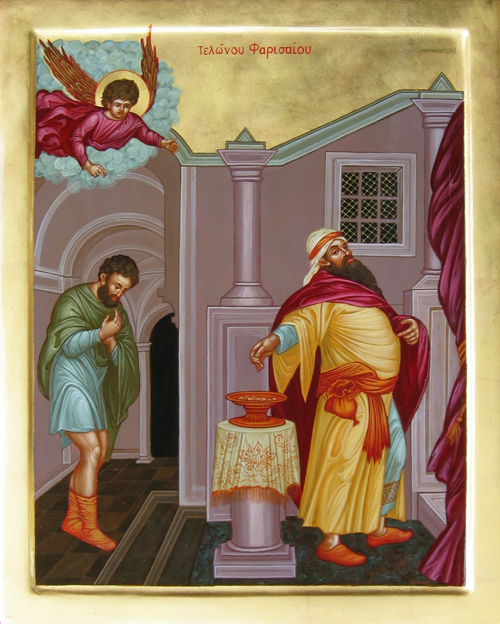
The Publican and the Pharisee 

Question: "Christ gave a parable about the Pharisee and how he fasts twice a week (Luke 18:12). Why did the Orthodox adopt things Christ condemned in Scripture?"

Nowhere in that passage does it suggest that Christ condemned the Pharisee because he fasted twice a week. What is condemned is his boasting, and his judging himself to be better than the publican. In Matthew 23:23, Christ said: "Woe unto you, scribes and Pharisees, hypocrites! for ye pay tithe of mint and anise and cummin, and have omitted the weightier matters of the law, judgment, mercy, and faith: these ought ye to have done, and not to leave the other undone." Note that while Christ clearly indicates that tithing the mint, anise, and cummin was of lesser importance than the weightier matters of the law, He nevertheless says that they should have done the former without omitting the latter... not that they should have blown off  the tithing of these things.

We begin our preparation for Lent with the Sunday of the Publican and Pharisee, and in fact, in the following week we do not fast on Wednesday and Friday to drive home the point that humility is more important than fasting. But in that service, we clearly acknowledge that the good things that the Pharisee was doing were good in and of themselves, and worthy of emulation, but we should reject his pride:

"Let us make haste to follow the Pharisee in his virtues and to emulate the Publican in his humility, and let us hate what is wrong in each of them: foolish pride and the defilement of transgressions" (Lenten Triodion, Sunday of the Publican and Pharisee, Canon at Matins, Ode 5, first troparion).

In Matthew 9:14, were are told that St. John the Baptists disciples asked Christ: "Why do we and the Pharisees fast oft, but thy disciples fast not?" Christ did not use this occasion to denounce fasting. He instead explained why His disciples were not fasting at that time, by asking them the question: "Can the children of the bridechamber mourn, as long as the bridegroom is with them?" But he went on to say: "...but the days will come, when the bridegroom shall be taken from them, and then shall they fast." And so ever since the time of Christ's ascension into heaven fasting has been an important part of the Church's life. Fasting on Wednesday and Friday is apostolic in origin. It is recording in the Didache (8:1), which was a first century record of Apostolic Teaching.

Canon 69 of the Holy Apostles (which was affirmed by the Ecumenical Councils) states:

"If any Bishop, or Presbyter, or Deacon, or Subdeacon, or Reader, or Chanter fails to fast throughout the forty days of Holy Lent, or on Wednesday, or on Friday, let him be deposed from office. Unless he has been prevented from doing so by reason of bodily illness. If, on the other hand, a layman fail to do so, let him be excommunicated."

So clearly fasting is important, but it is important as a spiritual discipline, and is a means to an end -- not an end in itself. It teaches us to say "no" to our desires, which is a skill that comes in handy throughout our life. It is also a matter of obedience to the Church, and of entering into periods of fervent prayer with the whole Church. However, if we fast, but allow ourselves to fall into pride over it, our fasting is of no benefit. But the cure to that ailment is to humble ourselves, not to give up fasting. Indeed "Let us make haste to follow the Pharisee in his virtues and to emulate the Publican in his humility, and let us hate what is wrong in each of them: foolish pride and the defilement of transgressions"


Friday, January 10, 2014

Stump the Priest: Fasting on the Eves of the Nativity and Theophany


Question: The Eves of Christmas and Theophany are called "strict fast days;" however, it appears that these days are also "wine and oil" days, and not just when they fall on Saturday or Sunday, but any day. At least this is so on calendars in the Slavic tradition. However, I do see that on the Greek Archdiocesan website, the Eve of Theophany, is counted as a fast without wine and oil despite it being a Sunday. So maybe the Greeks keep these days strictly by abstaining from wine and oil even on Sundays. But what does it mean for Slavic usage if it's a "strict fast day", but with wine and oil? 

There are different degrees of fasting, in terms of what may be eaten, but there are also various rubrics regarding at what point in the day we can eat something on fast days. But then sometimes the rubrics in the typikon are not very explicit, and so are capable of more than one interpretation. The Typikon is very explicit that when the Eves of Christmas or Theophany fall on a Saturday or Sunday, that it is not a strict fast. The Typikon says that when this happens, after the Liturgy we eat some bread and drink a cup of wine, and then have a fuller meal after Vespers. Whereas, when these days fall on week days, if health allows, we do not eat or drink anything until after Vespers. Even during Lent, wine and oil are always permitted on Saturdays and Sundays, because strict fasting is forbidden on those days. The exception to this is Holy Saturday, on which we do not eat until after the Vesperal Liturgy, which is according to the rubrics, the lattest Liturgy of the year, and then we have wine, but not oil, and may otherwise have a simple lenten meal. I suspect that the Greek practice is actually the same on this point, and that the Greek Archdiocesan website is just imprecise on this point.

On Holy Friday, the typikon actually calls for nothing to be eaten:

"On this Holy day neither a meal is offered nor do we eat on this day of the crucifixion. If someone is unable or has become very old and those unable to fast, he may be given bread and water after sunset. In this way we come to the holy commandment of the Holy Apostles not to eat on Great Friday" (Trans. Fr. Eugene Tarris, see http://transfig.orthodoxws.com/files/Bulgakov/0543.pdf).

As is often the case, however, modern practice is generally more lenient, but this is the ideal.

Now as to whether or not wine and oil would be permitted on the Eves of Christmas or Theophany, the Festal Menaion notes "The Forefeast of Christmas (24 December) is observed as a fast, and neither animal products nor fish may be eaten. In the Greek use, wine and oil are not permitted, except when the Forefeast falls on Saturday or Sunday; but in the Slav use, wine and oil may be taken, whatever day of the week it may be" (Festal Menaion (Tr. Mother Mary and Archimandrite Kallistos Ware, Faber and Faber, London, 1984), p. 220).  There is a similar note for the Eve of Theophany (Festal Menaion, p. 313).

This difference seems to arise from the fact that the Typikon, while explicit on what is allowed when these days fall on Saturday or Sunday, is not explicit regarding what is allowed when these days fall on weekdays. But even though wine and oil are permitted according to Slavic practice on these days, when they fall on weekdays, both Greek and Slavic practice agree that eating and drinking should be postponed until the evening. It is a pious custom to await the appearance of the first star on Christmas Eve before eating a meal (See Bulgakov's Handbook for Church Servers, December 24th).

It is also a practice among Ukrainians, Poles, Carpatho-Russians, and many Russians (those living in the South, and Western parts of Russian) to eat a somewhat elaborate lenten meal on the Eve of Nativity, in which each dish has a symbolic meaning related to the the feast of the Nativity. This meal is often called "the Holy Supper."

Wednesday, July 31, 2013

Stump the Priest: How Much is Too Much?


Question: "In this world where we are taught to enjoy ourselves and seek pleasure, where, even as Christians, we want to glorify God's creation, how are we to know when we have reached a level of overly enjoying the pleasures of the earth or of God's creation? I mean to say, if we are relaxing on the beach, or walking in wood, or gazing at the heavens, how do we know when enough is enough? It seems obvious we could or should all be working continuously for the Lord by praying or doing good works. But then it seems almost sinful to not enjoy the beauties of the world and God's creation as well. Is there a formula mentioned or something to help us know when enough is enough?"

There is not a simple formula. When you learn how to ride a bike, you have to learn how to balance your weight on the bike, while you peddle, but how do you do that? You do that by trying to do it, and when you fall down, you get back on the bike, and try it again.

There are some things that are inherently evil, and so there is no question but that we should abstain from such things. But it is not a sin to enjoy a good meal, or enjoy the company of another person. These are good things, but most good things can be taken to excess, and then it can become sinful.. but the sin is in the excess, not in the thing itself.

It can be an even better thing to abstain from such pleasures, if you are doing so out of love for God and a desire to draw closer to Him and to remove things that distract from that desire. But even asceticism can become sinful if it is seen as an end in itself or used as a means to vainglory.

It is also sinful if you abstain from things that are good, because you find them abominable. Canon 51 of the Holy Apostles says:

"If any Bishop, or Presbyter, or Deacon, or anyone at all on the sacerdotal list, abstains from marriage, or meat, or wine, not as a matter of mortification, but out of an abhorrence thereof, forgetting that all things are exceedingly good, and that God made man male and female, and blasphemously misrepresenting God’s work of creation, either let him mend his ways or let him be deposed from office and expelled from the Church. Let a layman be treated similarly."

So marriage is good. Eating meat is good. Drinking wine is good. However, if you abstain from these out of true asceticism, that is also good. But if you view these things as sinful in and of themselves, this view is itself sinful, and if not repented of will separate you from the Church.

So the key here is to find a balance. And what the right balance is will be different for different people.

In order to find that balance, you need to inform your conscience by regularly studying the Scriptures, the writings of the saints, and other edifying books. You need to keep the fasts of the Church. You should also pray that God will guide you, and go to confession regularly. And remember the words of St. Poemen the Great: "Everything that goes to excess comes from the demons" (Saying 129 of St. Poemen, from the Alphabetical Collection of the Sayings of the Desert Fathers).

You can listen to a sermon on some of the sayings of St. Poemen the Great which relate to this question, by clicking here.


Thursday, March 14, 2013

Daniel and the Three Youths in a Non-Kosher Cafeteria


A sermon on how the Prophet Daniel (1:1-21) and the Three Youths learned to tame lions, and walk around in fiery furnaces by standing for God in small ways first: Click here to listen.