Congressman Joe Wilson, of South Carolina, wrote a letter to Attorney General Pam Bondi in which he accused the Russian Orthodox Church Outside of Russia and "other Russian Orthodox Churches" of engaging in espionage on behalf of the Russian government. He of course made these assertions without the slightest evidence, but let's consider how absurd his claim actually is. The alleged espionage consisted of an effort by clergy and laity of ROCOR, the OCA, the Serbian Patriarchate, and the Antiochian Archdiocese to lobby members of our government. What were they lobbying for? Was it to eliminate sanctions against Russia? No. Was it to pass on military secrets to the Russian government? No. Was it to end military support of Ukraine? No. It was to stop the persecution of the Ukrainian Orthodox Church. If this is what the Russian government put these people up to, you would have to conclude that the Russian government was the most selfless, altruistic, and Christian government that exists today, and perhaps has ever existed.
Some will claim that this effort was an attempt to embarrass the Ukrainian government, but that is also a ridiculous claim, because the only thing Ukraine would need to do to stop the embarrassment would be to stop persecuting the Ukrainian Orthodox Church.
What kind of persecution is happening? Clergy are being beaten. Parishioners are being beaten. Churches are being stolen, and then often just padlocked. Clergy and monks are being drafted into the Army, despite the fact they cannot fight, by profession.
This video shows the brutal beating of Metropolitan Theodosy of Cherkassy.
Several bishops have been imprisoned on trumped up charges, and kept under inhumane conditions.
In this video, Robert Amsterdam, who represents the Ukrainian Orthodox Church was interviewed by Tucker Carlson, and it also shows scenes of the persecution of the Church in Ukraine:
My daughter Catherine Whiteford did a video which also elaborates on the truth of what is going on in Ukraine:
Congressman Joe Wilson faced so much backlash for his ridiculous claims, that he attempted to walk it back, and say he was only talking about the leadership of the Russian Orthodox Church Outside of Russia, but he would have us believe that they are Russian agents. Our primate, Metropolitan Nicholas was born in New Jersey. Prior to his repose a year ago, my bishop was Archbishop Peter, who was born in San Francisco. My acting bishop right now, Archbishop Gabriel, was born in Australia. Congressman Wilson's mother was my 7th cousin, and his father was my 8th cousin. My ancestors were among the earliest settlers in Virginia who arrived long before the Mayflower landed at Plymouth, and some of my ancestors were among the Indians that were already there to greet them. He is not attacking foreigners. He is attacking Americans, and he is attacking them for daring to speak out about the abuse of innocent people.
This persecution has nothing to do with the war, because it actually began in earnest in 2019, three years prior to the Russian invasion. The war is a pretext for intensifying and accelerating the persecution, but it was going on before that, and would have continued regardless of anything Russia did. This persecution was encourage by the US government, which established a fake Ukrainian Church back in 2018. You can see Mike Pompeo take the credit for it in this video, in which he thought he was speaking with Petro Poroshenko.
On Friday, August 12th, we went to the nearby town of Căușeni, which, as best as I could tell, is pronounced "Cow-shen." As I was beginning to get some idea of how Romanian spellings translated into actual sounds, I asked Elena at one point if the "i" at the end was silent, and she said "No," it is pronounced..." and I still detected no "i" at the end, but apparently it is there very subtly, and I can't hear it.
We had breakfast on the porch. One thing that was very enjoyable was just watching the family life at Elena's parents' home. None of her siblings still live at home with her parents, but her sister, Tatiana and her husband Veceslav live nearby in the village, but not too long before we came, they had a fire that destroyed much of their house, and so their four children were staying for the most part with their grandparents, while the house was being rebuilt. One of their children, Taisia, was then about two years old, and she was very excited that her cousin Fabi was there for a visit, and so kept shouting "Faaa-biii!" She sometimes did this even when Fabi was just a few feet away, and they were both looking at each other. I started imitating this, and told Fabi that if I got to serve her wedding, I would say at the end "You may now kiss Faaa-biii!"
First, we went to an open-air market, to pick up several things that we needed to get, and then we went to the Ss. Martha and Mary Convent, which is not an ancient convent, but was founded in the 1990's. There had been a campground on this site during the Soviet period, but one day someone cut down a tree, and found that there was a cross shape in the rings of the tree. Some wondered if there had once been a monastery there, but no record exists of there having been one, but some locals said that a hermit did live in that area. It was decided to build a convent there, and in a relatively short period of time a very large convent has flourished.
When we arrived, we first got coffee in their coffee shop, which was quite good, and then we went to their bookstore, because we had a long list of things we needed to get, especially for Fr. Gregory Solis and the Holy Cross parish in Corpus Christi -- which at the time was being served once a month by Fr. David Companik, but was soon to be having regular services after Fr. Gregory's ordination later in October of that year, and so they had many things that they desperately needed to get, in order to be able to do these services. We also wanted to get some things as gifts for various friends and family back home. We didn't have enough cash on us at the time, and so most of what we were going to buy was set aside for us, and we would come back later to pick it up. They didn't have the ability to charge anything on a credit card.
It was interesting to see that they had books by Fr. Seraphim (Rose), which have been translated into Romanian, on sale. They also had a lot of books in Russian, and service books in Slavonic, because there is a sizable Russian community in Moldova. We bought a lot of silver crosses for our bookstore, because the prices were far lower than anything you can find in the United States.
We then went on to the main Church of the Convent.
The entrance of the main Church
This Icon of St. Stephen the Great is on the walls of the main Church. The inscription in Romanian reads: "Moldova was not my ancestors', was not mine, and is not yours, but belongs to our descendants and our descendants' descendants to the end of time."
A reliquary which has relics of many New Testament Saints, as well as a number of other later saints.
As we were venerating the icons and relics in the main Church, I asked Elena a number of questions about the Church, and the iconography. There was an older nun who was sitting in the Church, probably to make sure that visitors behaved themselves there, and she overheard these questions, and jumped in at a certain point, and so we began a conversation. When she found out that I was a visiting priest from America, she asked for, and received permission to take us on a tour of the Convent.
First we went to the lower Church, but on the way down I noticed frescos of many scenes from the Lord's passion that I do not recall seeing in other churches I have seen.
Prayer in the Garden of Gethsemane
Pilate, washing his hands after condemning Christ.
We went by the residence of the Nuns, and I believe a building in which they also teach classes for area children. Then we went to a beautiful wooden chapel, which is normally kept locked, but we were getting the VIP treatment. Interestingly, most Churches in Moldova are built in the Russian style, but this one is in a Romanian style.
Those are antlers in the chandelier.
St. Stephen the Great is a figure you keeping bumping into in Moldova, and in Romania.
And we then went to a miraculous spring that they have there. Everyone but me went in for a dip.
While I was waiting outside of the spring, there was a Russian woman who lives in Transnistria, but who is a regular visitor there who came by and struck up a conversation. She was an English teacher, and so spoke English very well. She told me that there was a very large monastery in Transnistria that we should come and visit. I told her that I would like to do that someday. I think we also talked a bit about the Pochaev Lavra in Ukraine, which I would also like to see someday, when the war in Ukraine is over.
The nun who was giving us the tour had told us that we were invited to stay for a meal. We told her that we needed to leave soon to have dinner at one of Elena's uncle's homes, but she told us we could eat a little here, and then still have room for dinner there. She had pointed us to the spring, and left, but before we could leave, she reappeared, to make sure we didn't just leave. As I said before, hospitality is a very big deal for Moldovans, and so we couldn't say "no.". So we went back to the Trapeza. It was a very large dining hall, and we thought we would be eating with the nuns, but she took us to a side room for special guests, and then we were treated a multi course Lenten feast, complete with desert. The food was all fresh, locally grown food, and it was wonderful.
After we were stuffed to the gills, we then had to hurry to our planned dinner with one of Elena's many aunts and uncles, Fr. Chiril and Matushka Maria. Fr. Chiril is the priest in the nearby village of Opaci.
Fr. Chiril and me, in front of the village Church in Opaci.
When we arrived, Fr. Chiril invited us to walk to his parish Church, which is dedicated to the Feast of the Protection of the Mother of God. While we were entering, my older daughter called to do a video chat with us and our two granddaughters, the oldest of which was two at the time, but she was already very talkative. Since we previously had some trouble coordinating such calls with the time zone differences, and since I very much missed my grandbabies, I went ahead and video chatted with them, and showed them the Church as we entered. My older granddaughter said "I want to go to that Church!" I had to explain that it was a long way away from our home. I had to end the call, so I could venerate their icons. They have a miraculous Icon of the Mother of God in the parish.
The Miraculous Icon of the Mother of God in Opaci
After we were able to venerate the icons in the Church, we walked back to their home, and had a very nice dinner with Fr. Chiril, Matushka Maria, and one of their children, Nicu (John), although we didn't have the appetite we normally would have had. The food was wonderful, however, and after dinner, we were treated to what they called "vodka," but which was some sort of liquor made from cherries, which was also very good. My wife, who normally doesn't like alcohol in any form, liked it very much.
Poor Elena had to translate throughout the evening, and we had a lengthy discussion with Nicu, who is planning on becoming a priest like his father, about mixed marriages. Somehow we had begun to discuss "modernism," and for Nicu, the prime example of modernism was that some bishops allow Orthodox Christians to marry non-Orthodox Christians. I tried to explain why in the west, there are good reasons that this is allowed, though it is obviously not ideal. I pointed out that in Moldova, he would have to go out of his way to find a non-Orthodox woman to marry, but in the United States, it is usually the opposite. And so bishops in the west usually allow mixed marriages, as an act of economia, on the condition that the non-Orthodox spouse agrees to raise the children in the Church. Often, the non-Orthodox spouse eventually becomes Orthodox. But I explained that when this has not been allowed, the result was not that the Orthodox person moved on, and kept looking for an Orthodox mate, but that in most cases, they would end up getting married anyway, outside of the Church, without such a promise, and often this resulted in even the Orthodox spouse losing their connection with the Church. But there was something refreshing about people who live in a culture where the worst example of modernism that they encounter is bishops allowing mixed marriages.
Matushka Maria, Matuska Patricia, myself, Nicu, and Fr. Chiril
Matushka Patricia and Matushka Maria
We then said our good-byes and headed back to Sălcuța for another night.
Saturday was the last day of the trip that would not fall during the Dormition Fast, and so we enjoyed our last non-lenten breakfast, which consisted of fresh food, with much more flavor than we were used to in the United States. I believe we decided to take it easy that day prior to Vespers, because some of us were not feeling well.
The Dormition Church in Sălcuța
Anytime there was a service in the village Church, the bells could be heard throughout Sălcuța. We drove to the Church, but most people walked, because most people don't own their own car. The simple life these people were living was so beautiful, and yet I knew that we were just across the border of the Odesa Oblast in Ukraine, and that there were many villages in Ukraine that were not very different from this one, aside from the language being spoken, and yet many of these villages have been destroyed, and their people have been scattered, and many of the people have also been killed. The evil of such wars, and what those who cause them to happen will have to answer for, became less theoretical and more concrete. I hope and pray that the war does not eventually come to Moldova, though I know that there are many people around the world, who live in gated communities, live in luxury, have never heard a shot fired in anger, and yet think of the people in places like this as mere pawns on a chess board, and would very much like to see this happen.
Sunday was the Feast of the Procession of the Cross, and so when we arrived at the Church. In their local practice, they serve Vespers on Saturday Evening, but they followed it by another service, and because I know almost no Romanian, I was not sure what it was. It may have been Small Compline. On the Holy Table was what looked like a bundle of wildflowers, formed into the shape of a big Cross, upon which was laid a decorated, wooden Cross. Outside, the temperature was warm, but not too warm. However, the Church had no air conditioning, and for what I assume are cultural reasons, the windows of the Church were kept closed (I know in some cultures have a cross breeze indoors is thought to be unhealthy). I think I only wore an epitrachelion during the service, and so it wasn't as hot as it would prove to be on Sunday morning during the Liturgy, when I would be fully vested.
The village Church has three priests: the rector is Fr. Nikolai, and the assistant priest is his younger brother, Fr. Sergei -- who is an English teacher, and so when in the altar, he was my primary means of communication. Their father, Fr. Gregory, is retired, but he still hears confessions at the Church. He is the one who baptized Elena when she was a baby. He was also one of the signers of the Moldovan Declaration of Independence and Constitution, if I remember correctly. During the Soviet period, he was sometimes harassed by the KGB, but the KGB only went so far, because I am told they feared his Matushka. After the service, when she met me and my wife, she thought my wife was my daughter -- this happens to me a lot. I explained that she was only a year and half younger, but we had not aged at the same rate.
Once, when I was still working for the State of Texas, my wife and I went out for dinner for our wedding anniversary, and when we had the picture developed, she ask me if I would like to put it in my office at work. I told her people would ask "Who is that young woman with that old man?" She framed it, I took it to work, and on the very first day, a co-worker asked if that was my daughter.
After the service, we headed back home, and then went to Elena's sister Tatiana's house for dinner. It was held outdoors, and that evening the flies were particularly aggressive. I was told that they were not normally like this, but recent rains had caused them to multiply. Flies are called "muska" in the local dialect, and Constantine and I often went "muska" hunting. My wife wished she had brought her electronic fly-swatter. On one occasion, Constantine, who had been a sniper in the Marine Corps, took a butter knife, and with perfect aim, swatted and killed a "muska" on the first try. I was quite impressed. The food, however, was one again wonderful, and the homemade wine flowed freely. But we had a Liturgy the next day, so before it got too late, we headed back home for the night.
Recently Public Orthodoxy published an article by Lidiya Lozova, in which she excused the government sponsored persecution of the Ukrainian Orthodox Church, and alleged that this reflects the popular opinion of the Ukrainian people. After expressing her objection to the use of violence as a means of "resolving conflicts among church communities in Ukraine" (i.e. the use of violence when government backed Nazi thugs* steal Church property from the canonical Church in order to give it to the schismatics** under Epiphony Dumenko), she goes on to blame this violent persecution on the people being persecuted, suggested essentially that they asked for it and have it coming, and then she denies almost completely the role of the Ukrainian government in ginning up that violence in the first place:
"...in the context of international sympathies expressed to the UOC [Ukrainian Orthodox Church] today, I have to admit that the social opposition and violence directed at this church in Ukrainian society is not an artificial construct of the Ukrainian authorities; it is, in my opinion, a reaction to the hidden structural violence, which has been present in the matrix of this organization since 1990s and especially after 2014, when the leadership of the UOC changed" [Emphasis added].
Among the alleged transgressions the Ukrainian Orthodox Church is accused of by the author, is supposedly that some priests have refused to do funerals for Ukrainian soldiers... though she provides no specific information on that. Likely, if there were such cases, the refusal would have been due to the fact that the soldiers in question were not members of the canonical Orthodox Church. Countless funerals have been performed for soldiers who were members of the UOC.
She goes on to make the assertion:
"In short, the UOC as a whole is not welcomed in Ukraine in spite of their participation in the humanitarian aid efforts and the service of many UOC members in the Ukrainian Armed Forces."
She, however, presents us with no reason to believe that this assertion is true. But even if, for the sake of argument, we were to assume that it was true, it would be true in the context of the Ukrainian government controlling the media, and the people in Ukraine being fed a constant stream of propaganda accusing the Ukrainian Orthodox Church of being disloyal. Anyone who deviates from the government narrative puts themselves at risk of both judicial and extra-judicial punishment [aka public lynchings]. So there is in fact no objective way to measure the actual opinions of the people in Ukraine at the present.
We can, however, gauge the opinions of people who actually go to Church in Ukraine, because we consistently see that when Churches have been stolen from the canonical Church, they are either left padlocked, or the number of people attending the schismatic services is a mere fraction of the number who attended the Church before.
Though the author states that she is "not fully satisfied with the actions of the state and the reaction from the OCU [the schismatic Ukrainian Church] members..." She fails to honestly confront the role of the Ukrainian government, nor does she give the reader any real idea of the scope and severity of the persecution of the canonical Ukrainian Orthodox Church. One day, when the full truth of what has been going on in Ukraine is more widely known, she may have reason to be embarrassed that she made excuses for those who were persecuting the faithful under the canonical Ukrainian Orthodox Church under the Metropolitan Onuphry.
* When I speak of "Nazi thugs," I am not using the term "Nazi" as a pejorative slur. I am referring to the actual Nazis that are usually the ring leaders behind the seizure of Church in Ukraine. For example, Yevhen Karas is the head of the Nazi group "C14." You can see the role his group has been playing recently in this video from the Union of Orthodox Journalists. You will see Yevhen Karas prominently featured in this video which takes about the role of Nazis in Ukraine. The fact that the government is backing them is shown by the fact that they are allowed to operate freely and openly engage in violent assaults directed at innocent people. Given the manpower shortage the Ukrainian army has, one has to wonder why so many young men are allowed to engage in such things, and remain out of uniform and out of the war. What one makes of these facts is up to them, but these are indeed facts.
** That Epiphony is the head of schismatic Church is laid out in the following articles:
Furthermore, I would point out that the fact that the monastics in Ukraine have overwhelmingly remained loyal to Metropolitan Onuphry should tell any pious Orthodox Christian everything that they need to know about who is legitimate, and who is not.
"Greater love hath no man than this, that a man lay down his life for his friends" (John 15:13).
Even before the beginning of the direct involvement of Russia in the war in Ukraine (which actually began in 2014), the American people had already been subjected to a steady stream of anti-Russian propaganda. Sorting out what is true and what is false in the midst of the fog of war is not very easy, even if someone puts forth the effort to try to discern such things... but most Americans are not interested enough in the subject to even make the effort, and so assume that what they are hearing in the mainstream media is true. Not only has the Russian government been criticized regularly, since the 2016 election and the beginnings of the Russian Collusion Hoax, but the Russian Orthodox Church has also increasingly been a target.
Patriarch Kirill was put into a very difficult situation by Russia's involvement in the war, and he probably would have been highly criticized no matter how carefully or wisely he had responded to it -- and while I suppose one could make the case that he could have handled it better, it is easier to criticize someone in his position than to be that someone, and to try to navigate all the landmines this set of circumstances laid for him.
I doubt anyone in the leadership of the Russian Church wanted to see things come to the point of a direct war between Russia and Ukraine. However, most people inside of Russia -- whether rightly or wrongly -- view this war as a matter of dealing with an existential threat against Russia, and it seems Patriarch Kirill shares this view. On the other hand, many, and perhaps most Ukrainians have a very different view. Certainly, some of them at least, support Russian involvement, but many do not, to be sure. One has to have enough of an imagination to see how people on both sides can believe that they are on the right side, and not be evil.
Even if we assume, for the sake of argument, that most Russians are wrong in how they view Russia's role in this war, they don't have to be evil to be wrong. They could simply be misinformed. That would also be true of Patriarch Kirill. We all view the world through the lens of our own experiences, and we trust some sources of information, and distrust others. Only God has a truly accurate grasp of all that is going on.
The background of the war is complicated, to say the least, and it is not my intention here to argue the merits of Russia's actions one way or the other. I do, however, want to address a very clear example of how western propaganda has attempted to distort something that Patriarch Kirill has said, and twist it into something that is almost the complete opposite of what he said. Even if we disagree with someone, we should at least try to be fair, and when describing their views, we should try to do so in a way that they would recognize as being accurate, and in this case, the efforts being made are focused on distorting what he has said rather than to fairly represent his actual statements.
In a sermon delivered on Sunday, September 25th, 2022 (the Sunday before the Exaltation of the Holy Cross), Patriarch Kirill is said to have promised heaven to Soldiers who kill Ukrainians.
"Russian mercenaries and soldiers murdered, raped, kidnapped, and looted with his blessing -- Patriarch Kirill's blessing -- even with his Jihadist-like promise of heaven for killing their spiritual brethren."
"In the name of the Father, and of the Son, and of the Holy Spirit!
For God so loved the world that He gave His only begotten Son (John 3:16). To death! The Only Begotten Son, the Divine Son! And why was this terrible divine Sacrifice required, the scale and significance of which cannot be grasped by the human mind? Almighty God gives Himself to the execution, which was used to execute criminals, outcasts of human society, who really committed terrible, dangerous crimes.
When one thinks of this ineffable divine Sacrifice, it is difficult for the human mind to grasp the whole divine plan. But it is quite obvious that the Lord does not give Himself, humanly suffers and dies for something that would be completely incomprehensible to us and inherent only in Him, who has an immense knowledge of Himself. He gives us the opportunity to understand that if God in His Son gives His human life for the sake of other people, for the sake of the human race, then sacrifice is the highest manifestation of man's love for his neighbors. Sacrifice is the greatest manifestation of the best human qualities.
We know that today many are dying on the fields of internecine warfare. The Church prays that this war will end as soon as possible, that as few brothers as possible will kill each other in this fratricidal war. At the same time, the Church realizes that if someone, driven by a sense of duty, the need to fulfill an oath, remains faithful to his vocation and dies in the performance of military duty, then he undoubtedly commits an act tantamount to sacrifice. He sacrifices himself for others. Therefore, we believe that this sacrifice washes away all the sins that a person has committed.
The war that is now going on in the vastness of Russia is an internecine strife. That is why it is so important that this battle should not result in a wave of bitterness and alienation; So that fraternal peoples are not divided by an impassable wall of hatred. And how we all behave towards each other today, what we ask the Lord in our prayers, what we hope for, will largely depend not only on the outcome of battles, but also on what will happen as a result of all this. May God grant that the present military operations do not destroy the single spiritual space of Holy Russia, and even more so do not harden our peoples. So that by the grace of God all wounds may be healed. So that by the grace of God, everything that today brings sorrow to many and many will be erased from memory. So that what will replace the current situation, including in relations between our fraternal peoples, is bright, peaceful and joyful.
And this can only happen if we live with faith in our hearts. Because faith destroys fear, faith gives the possibility of mutual forgiveness, faith strengthens relationships between people and really can and does transform these relationships into fraternal, cordial and kind ones. May God grant that everything that now darkens the souls of many will end. May God grant that during this internecine struggle as few people as possible will die or be injured. May God grant that there may be as few widows and orphans as possible, fewer separated families, less shattered friendship and brotherhood.
The Church, which carries out its pastoral ministry among the peoples of Russia, Ukraine, Belarus and many others in the vastness of historical Russia, today especially suffers and especially prays for the speedy cessation of internecine strife, for the triumph of justice, for the restoration of fraternal communion and the overcoming of all that, having accumulated over the years, eventually led to a bloody conflict. We believe that all the saints who shone forth in the Russian land – in this case, using the already accepted expression "in the Russian land", we mean Russia, the whole Russian land, Holy Russia – today together with us lift up prayers to the Lord for peace to be established on earth, for the reconciliation of fraternal peoples and, most importantly, for justice to triumph, because without justice there can be no lasting peace.
May the Lord protect us all and help all of us to walk our Christian career with dignity, despite the difficult life circumstances that today are the reality of our earthly existence. Through the prayers of the saints, whose names we have glorified today, may the Lord help us all to be strengthened in peace, love, like-mindedness and purity [Emphasis added]."
Very few references to this sermon make any mention of the fact that he called this a "fratricidal war," and states that the Church prays for it to end swiftly. Furthermore, when he speaks of soldiers sacrificing themselves, he does not limit his comments to soldiers going to Ukraine, nor does he assign any merit to killing Ukrainians. He simply speaks of soldiers who, out of a sense of duty and in the fulfilling their oath as a soldier, die in the course of that duty. These words would apply to Ukrainian soldiers or to any other Orthodox Christian soldiers who lay down their lives out of a sense of duty.
What does he mean by a soldier having "a sense of duty"? Perhaps this comes across differently in Russian and in the context of Russian culture, but I think he is clearly speaking of the love that such a soldier would have for their country, and for their family and friends... and so it seems to me it would have been clearer had he made reference to "love" explicitly, but it clearly is implicit.
So the Patriarch did not say that any soldier who goes to Ukraine and happens to die there falls into this category of soldier, much less did he say this of soldiers who kill Ukrainians. He is speaking of soldiers motivated by love, duty, and honor. Furthermore, there is no reason to think he was speaking of atheists or non-Orthodox Christians here, or even of otherwise unrepentant Orthodox Christians.
But does such sacrifice in fact wash away sins? Let's first consider whether the blood of martyrdom washes away sins? The Church clearly does teach that the blood of martyrdom, in some sense, washes away a person's sins. However, this does not apply to everyone who is ostensibly a martyr. As St. John Chrysostom said:
"Now a certain holy man said what might seem to be a bold thing; yet, nevertheless, he spoke it out. What then is this? He said, that not even the blood of martyrdom can wash out this sin. For tell me for what dost thou suffer as a martyr? Is it not for the glory of Christ? Thou then that yieldest up thy life for Christ’s sake, how dost thou lay waste the Church, for whose sake Christ yielded up His life?" (Emphasis added, Homily 11 on Ephesians).
"What sacrifices do those who are rivals of the priests think that they celebrate? Do they deem that they have Christ with them when they are collected together, who are gathered together outside the Church of Christ? Even if such men were slain in confession of the Name, that stain is not even washed away by blood: the inexpiable and grave fault of discord is not even purged by suffering. He cannot be a martyr who is not in the Church; he cannot attain unto the kingdom who forsakes that which shall reign there. Christ gave us peace; He bade us be in agreement, and of one mind. He charged the bonds of love and charity to be kept uncorrupted and inviolate; he cannot show himself a martyr who has not maintained brotherly love" (Treatise on the Unity of the Church 13-14).
For one to be a true martyr, they would have to be a right-believing person, who was offering himself as a sacrifice for his confession of Christ, and this cannot apply to a person who is a heretic or a schismatic. But in what sense does the blood of martyrdom wash away a person's sins? Obviously not in the same sense that only Christ's blood can wash away sin. Christ's sacrifice alone provides the basis upon which anyone can be saved. However, this sacrifice is only available to those who repent and believe the Gospel. But repentance is not a one-time act. St. John the Baptist taught that those who repent have to bring forth the fruits of repentance (Luke 3:8). The Church teaches that if a person dies with at least the beginnings of repentance, but without having had a chance to bring forth the fruits of repentance, that they do not immediately enter into God's presence upon death, but that there is some period of time in which by the prayers of the Church, they grow in grace, until they are able to enter into God's presence.
Bringing forth the fruits of repentance involves our cooperation with God's grace, so that we purify our hearts and minds, and become filled with the Holy Spirit. This makes someone a truly holy person, and when such a person dies, they do enter immediately into God's presence. What is true of the sacrifice made in martyrdom, Patriarch Kirill argues is also true of a Christian soldier who willfully lays down his life out of love. In the case of martyrs, the Church usually does not long hesitate to declare them to be saints. In the case of soldiers, this is not true, but probably this is so because in the case of martyrs the disposition of the person is clearer. Whereas in the case of soldiers, they may or may not have died out of love for God, country, family, and friends -- it is simply harder for us to make such a judgment, but obviously God would have no such difficulty.
We also find the idea that our actions in cooperation with God's grace can cleanse sins in the Scriptures. St. Peter, in his first epistle, states: "And above all things have fervent love for one another, for “love will cover a multitude of sins” (1 Peter 4:8). St. Peter is in turn alluding to Proverbs 10:12, which says "Hatred stirs up strife, but love covers all sins" (c.f. James 5:19-20). And as Christ Himself said: "Greater love hath no man than this, that a man lay down his life for his friends" (John 15:13). Christ is the supreme example of this to be sure, but this statement has long been applied to soldiers who lay down their lives for their friends, family, and country. And so if a Christian soldier willfully lays down his life for others, this, according to Patriarch Kirill, qualifies as bringing forth the fruits of repentance fully and completely.
I suppose one could criticize him for not putting more qualifications and clarifications in his sermon, but it is simply not fair to suggest that he said that soldiers would go to heaven by killing Ukrainians, or simply by virtue of dying while fighting in the war in Ukraine. And there is no comparison with the Jihadist belief that one gains salvation by killing people for God. He neither said any such thing, nor did he imply it.
The use of the word "ecumenical" with reference to the Church has been twisted to mean something entirely different than it has meant historically. The word itself literally means "universal," but in the context of the Church it was used to refer to universal councils of the One, Holy, Catholic, and Apostolic Church. These councils were not convened in order for Orthodox bishops to hobnob with heretics, or to sweep their differences under the rug. Quite the contrary, these councils were convened in order to drive heresies and unrepentant heretics out of the Church.
The term "Ecumenical" was, however, hijacked by the Ecumenical Movement, which had its origins among Protestants. During the 19th century, Protestant missionary activity around the world expanded exponentially, but since Protestants have wildly different beliefs, the problem of different Protestant sects competing for the same converts on the mission field quickly became apparent. The desire to not have Protestant missionaries working at cross purposes resulted in the first World Missionary Conference, which was held in Edinburgh, Scotland in 1910. This also happened at a time when Protestant liberalism was on the rise, which undermined the doctrinal certainty the various Protestant sects had previously maintained with regard to their own beliefs. So out of the Protestant missionary movement, the Ecumenical movement began to gain steam. The Ecumenical movement had as its goal the unity of all Christians -- which would not be a bad goal at all, if the end goal was a unity in the Truth, but as liberal Protestants began abandoning any belief that there was such a thing as Truth, this movement was no longer burdened by conflicting beliefs about what is true, and instead was focused on unity for unity's sake. The Ecumenical Movement has indeed gone far beyond seeking the unity of all Christians, to seeking the unity of all religions.
Orthodox involvement in the Ecumenical movement has a long and complicated history. In short, some have participated in it for the purpose of bearing witness to the Orthodox Faith, or to facilitate cooperation on matters of mutual interest. But other have participated in it because they have bought into the idea that the Church is divided into various branches, with the Orthodox Church being but one of many branches. Such people have bought into this idea for the same reason that liberal Protestants did -- they no longer really believe what the Orthodox Church has always taught, and so are no longer burdened by question of Truth.
There is much more that could be said about the Ecumenical Movement, and why its motivations are heretical (and indeed a pan-heresy, because it seeks to incorporate all heresies into the Church), but I will instead refer the reader to the voluminous articles on Ecumenism on the Orthodoxinfo.com website.
I do however want to draw attention to how Ecumenism among those who are ostensibly Orthodox is working to merge renovationism, modernism, and LGBTQP and abortion activism into what will likely come to be the church of the Antichrist. For evidence of this, one need look no further than Archbishop Elpidophoros.
On July 15, 2021, Archbishop Elpidophoros gave a speech at the International Religious Freedom Summit, entitled “The Rising Tide of Religious Nationalism,” in which he said:
"When you elevate one religion above all others, it is as if you decide there is only one path leading to the top of the mountain. But the truth is you simply cannot see the myriads of paths that lead to the same destination, because you are surrounded by boulders of prejudice that obscure your view."
So not only do the Ecumenists no longer believe that the Orthodox Church is the One, Holy, Catholic, and Apostolic Church, as it has always taught and believed, but that Christ is not the only path to salvation, contrary to the words of Christ Himself: "I am the way, the truth, and the life: no man cometh unto the Father, but by me." (John 14:6).
On top of all this, the Ecumenical Patriarch has long promoted the idea of union with Rome, which is a church that is much further down the path of "inter-religious dialogue" (see this video and this video, for examples. These videos were produced by Greek Old Calendarists, but the footage shown speaks for itself). Rome is also quickly heading down the path of embracing LGBTQP ideology. German bishops are already allowing services to recognize gay marriages, and while Pope Francis may be uncomfortable with how quickly they are moving, he shows no signs of actually wanting to stop them.
What has been going on in Ukraine (long before 2022) illustrates how these various heresies are converging together. Let me quote what I said in a talk I gave in Moscow in February of 2019 about the actions of the Ecumenical Patriarch in Ukraine, and where things seem to be heading:
"In the United States and in the English-speaking Orthodox world generally, we hear many voices from within the Patriarchate of Constantinople, which are supporting homosexuality, openly. The Archons have helped fund an Orthodox institute at Fordham University. The heads of this institute have used this platform to launch a website called “Public Orthodoxy” which regularly promotes homosexuality and other forms of deviancy. And it is not bad enough that they publish this material in English, but they now translate their articles into Russian, Greek, and Serbian. And they do this without the slightest hint of any rebuke from the Greek Archdiocese of America. In fact, whenever they have a big event, Archbishop Demetrios of New York is usually present, adding his authority to that event. For example, one of the heads of this institute, Aristotle Papanikolaou, in an article in another pro-homosexual journal, The Wheel, wrote that expecting people who suffer from same-sex attraction to remain celibate is “unrealistic” and unhealthy, and that such desires should best be expressed in the context of “long-term committed relationships or marriages” (The Wheel 13/14, Spring/Summer 2018, p. 97 [emphasis added]. See also "Unitarian Morality With a Little "Theosis" Sprinkled on Top," "The Living Church 2.0," and "Cultural Marxism and Public Orthodoxy").
Patriarch Bartholomew’s Archdeacon, Fr. John Chryssavgis, has made a number of pro-homosexual statements. For example, he wrote a review of a book that was a simple piece of pro-homosexual propaganda written by a homosexual Episcopal priest, and he gushed with praise for what a great contribution this book was to the important “dialogue” on homosexuality. The only slight criticism he made of this book was to say that he remained “unconvinced” by some of the book’s arguments that the Scriptures support homosexuality. This is from a man who has no difficulty expressing his disagreement, in eloquent and striking terms… when he wishes to.
Many of you are aware of the call that was made to “Metropolitan” Epifany, by a Russian prankster, who pretend to be a western diplomat, and congratulated him on the “autocephaly” of the Church in Ukraine, but expressed his hope that Epifany would take a different stand on homosexuality than the conservative one taken by the Russian Church. Epifany assured him that he would not take such a conservative stand against homosexuality.
And what I have noticed, in the English-speaking Orthodox world at least, is that those who promote the acceptance of homosexuality in the Orthodox Church have all been consistently lining up behind the EP’s actions in Ukraine.
One other agenda item that I think is clearly behind the EP’s actions in Ukraine is the goal of union with Rome. We already see the schismatics in Ukraine concelebrating with Uniates with increasing frequency. One thing that is certain is that Patriarch Bartholomew’s actions in Ukraine make no sense, if he intends to remain in the Orthodox Church.
Furthermore, there are very strong indications that the United States State Department has had some role in pushing for these actions, but to what extent, or in what form this pressure was applied, we do not yet know" (An American Perspective on the Ukraine Crisis).
We can of course hope that the Ecumenical Patriarchate will reverse course, and that things will not unfold as I am suggesting, but this will be a lot more likely to happen if more people are aware of where they have been heading, and begin to call these erring "Orthodox" back to the fold.
You cannot be pro-abortion, and be an Orthodox Christian. You cannot advocate LGBTQP ideology and be an Orthodox Christian. You cannot be a renovationist and be an Orthodox Christian. You cannot embrace Ecumenism, and deny what the Orthodox Church has always taught about itself, and be an Orthodox Christian. Such people may be formally members of the Church, but they have spiritually cut themselves off from both Christ and the Church. Those who actually are Orthodox need to speak clearly on these issues, so that those want to remain Orthodox Christians, or who want to become Orthodox Christians, will not be confused by their errors.
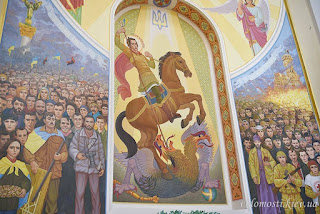
A wall in Cathedral of the Schismatic Church in Ukraine, which has been recognized by the Ecumenical Patriarchate. In it you see St. George slaying the Russian Double-Headed Eagle, people literally draped in the Ukrainian flag, and you also see the Neo-Nazi Right Sector Flag in the background.
The people at Public Orthodoxy have issued a declaration against the Russian Church in which they accuse the Russian Church of heresy -- which they assert is the idea of "Русский мир" or "The Russian World." They included accusations against the Russian Church for failing to condemn one of the three major parties in the war in Ukraine (which includes Russia, the post-coup Ukrainian government, and the United States). They also allude to the controversy over the Ecumenical Patriarchate's recognition of the schismatics in Ukraine. I won't repeat what I have said about the complexities of the war, in part 1. And I have written fairly extensively on the Ukrainian schism -- which you can read in full here, but if you only want to read one article, see "An American Perspective on the Ukraine Crisis." In this article, I will focus specifically on the merits of the claim that there is a heresy called "The Russian World."
What Public Orthodoxy has Not Felt a Need to Condemn
Before getting into the merits of their claims in this declaration, I think it is interesting to consider that while Public Orthodoxy has posted numerous articles condemning the Russian Church and its position on the Ukrainian schism, as well as numerous articles condemning Russia for the war in Ukraine (which has been going on for 8 years, and began with a coup sponsored by the United States), but they have not felt any need to condemn the United States' regime change war in Syria which has raged for 10 years. Far more people have been killed in that war (the current estimates range between 500,000 and 610,000), and this war represents an existential threat to the Orthodox Christians in Syria (which was about 10% of the Syrian population before the war). If the United States had succeeded in installing an Islamic jihadist government in Syria, this would have meant the end of Christianity in Syria, for all practical purposes, and likely the same fate would have befallen Lebanon. Russian military intervention has thus far prevented that from happening, but the United States continues to occupy 10% of Syria, denying Syria access to its own oil resources, and it has imposed crippling sanctions on Syria that are causing immeasurable suffering among the people of Syria -- both Christian and Moslem. So this is an issue that Orthodox Christians ought to be concerned about -- and yet not only has Public Orthodoxy not issued a statement condemning the actions of the American government in Syria, it has hardly said anything about it at all. Perhaps some big money might dry up, if they chose to take such a stand, but one would think anyone who was a believer, and had an ounce of courage would take the right stand regardless. Why the silence?
Public Orthodoxy not only fails to condemn those who oppose Christian morality -- they are one of the chief purveyors of these heretical teachings. So Public Orthodoxy is hardly a reliable guide on the subject of what is, or is not heretical.
"Ethno-Phyletism" for Me, but Not for Thee
One telling fact of this declaration is that it does not include a single quote of a specific statement that it might have cited as an example of the errors they claim the Russian Church is teaching. They also do not reference any document in which one might look to find this heresy espoused.
In a search of the official website of the Moscow Patriarchate, I found an article in which Patriarch Kirill summarized what he understands the concept of "The Russian World" to refer to: "Святейший Патриарх Кирилл: Русский мир — особая цивилизация, которую необходимо сберечь," which in English means "His Holiness Patriarch Kirill: The Russian world is a special civilization that must be preserved."
Patriarch Kirill notes that the Orthodox Culture of the Kievan Rus', which is the common heritage of the Russians, Belarusians, Ukrainians, and Carpatho-Russians, is not defined by political boundaries, and he has does not see it as promoting the building or rebuilding of any empire. He does see it has something worth preserving, which if lost, would be a loss to humanity. He does not see this as ethnic or racial, but cultural. He also does not assert that this culture is superior to all others, only that it is their culture, and it is worth preserving.
In the official conciliar documents of the Russian Church, the question of the Church's relationship to culture has been addressed in detail. "The Basis of the Social Concept of the Russian Orthodox Church," which was approved in 2000, includes in section II, a statement entitled "Church and Nation." I would defy anyone to point to anything in this statement, and to lay out a reasoned and supported argument for why it is heretical.
It is especially curious to hear this charge from an organization which is headed by two members of the Greek Archdiocese, because one hears a very similar concept to "The Russian World" fairly frequently, only it is called "Hellenism." A Google search of the official website of the Greek Archdiocese for the word "Hellenism" turns up "About 13,900" hits. One of the first articles to come up is entitled "New Program to Promote Hellenism in the United States." And the subtitle of that article is, interestingly enough "The Greek Orthodox Archdiocese and the Foundation for the Hellenic World Announce New Program to Promote Hellenism in the United States" [emphasis added]. In that article, you will see that Archbishop Elpidophoros himself was involved in the promotion of this new program. It certainly seems like Archbishop Elpidophoros thinks that there is a Greek Orthodox culture that is not limited by political boundaries, which is the heritage of all Greek people, and is worth preserving.
So is there a heresy of "The Hellenic World"? If not, it seems like members of a Church that considers the promotion of Hellenism to be a key part of their mission, might want to lay out exactly how this concept is not heretical, before they accuse the Russian Church of heresy for essentially having the same idea with regard to their own culture.
As a non-Russian who has been in the Russian Orthodox Church for close to 32 years now, I can tell you that I never felt pressured to become a Russian, nor have I been made to feel like I was a second class member of the Russian Church because I was not a Russian. For more on that, see "Converts and Culture," and "The Colors of the Russian Church."
In short, this declaration consists of a series of assertions that the Russian Church teaches things that they provide no evidence of anyone actually teaching, and they should perhaps examine their own views of Orthodoxy and culture, before they attack those of others.
Once again, Sister Vassa and Public Orthodoxy have boldly staked out positions, which just happens to coincide with the fashionable opinion of the moment. In a video by Sister Vassa, and then in a declaration published by Public Orthodoxy (which Sister Vassa signed), they express their belief that Russia's invasion of Ukraine is evil, that Putin is solely to blame, and that the Russian Church should condemn Putin for it. And the declaration goes on to accuse the Russian Church of outright heresy. In this response, I will focus my attention on Sister Vassa's video. In part 2, I will address the Public Orthodoxy declaration.
The Intentional Fog of War Propaganda
Before getting into Sister Vassa's specific assertions, I would like to remind those who are old enough to remember the lead up to the first Gulf War -- and to inform those who were too young or not yet born -- of the lies our government propaganda machine churned out to talk us into going to war. I remember it well, and enlisted in the United States Marine Corps because I believed the things we were told. Iraq had invaded Kuwait, and we were told horror stories of how the Iraqi soldiers treated Kuwaitis. One of the more memorable things we were told was that Iraqi soldiers burst into hospitals, took babies out of incubators, left them on the floors to die, and then carted those incubators off to Iraq. There was testimony to this effect before the United States Congress, from a young woman who claimed to have been an eye witness to these barbarous acts. George H. W. Bush alluded to this frequently as he beat the war drums. This could not stand. Something had to be done. The only problem was, it was a lie. The young woman who testified before Congress happened to be the daughter of the Kuwaiti ambassador to the United States, and had not been in Kuwait at all during or after the Iraqi invasion. Of course, this only came to light long after the war was over. In 1990 and in 2003, the vast majority of Americans supported going to war with Iraq. Today, the vast majority of Americans believe it was a mistake.
Then under Bill Clinton we launched a war against Serbia, in which we bombed them back to the stone age, killed thousands of civilians, and carved off Kosovo from Serbia, where we still have American troops stationed to this day. This also happened due to the stenographers in the mainstream media, which dutifully presented a one-sided story of a complicated civil war, along with countless fabrications and lies which were designed to inflame the emotions of the American people... and then the United States did exactly what we are accusing Russia of doing right now.
In the lead up to the second Gulf War we were assured that there were weapons of mass destruction being amassed by Sadam Hussein, and this also turned out to be a lie. We invaded Iraq, and a country that was 10% Christian now has few remaining Christians because we unleashed Islamic Jihadists that Sadam Hussein had kept on a short leash, and the country has been a wreck ever since. I think there are few people left who would not gladly turn back the clock, and put Sadam Hussein back in charge of Iraq. As bad as he was, the world was a far safer place, and Iraq was a far better and safer place too.
More recently we launched regime change wars in Syria and Libya in which our military played direct roles, which have resulted in the deaths of hundreds of thousands of civilians, and millions of refugees. What we did in Libya caused further Islamic terror in other parts of Africa, as Libyan weapons made their way into the hands of Islamic terrorists, like Boko Haram. We have seen open slave markets, and human misery increased exponentially all because we wanted to take out the latest Hitler of the Month. If when we embarked on these regime change wars, we were creating paradises in their stead, perhaps one could justify this as a foreign policy theme, but instead, we consistently make bad situations into hell holes.
I could go on, but we have been repeatedly lied into going to war in country after country, and in almost every case, the situation has been made far worse by our actions. But the point here is that the media willfully presented propaganda to the American people, designed to whip up public opinion and get them to support American foreign policy based on lies.
The Complexities of the War in Ukraine
In Sister Vassa's comments, she repeats a great deal of the spin we are hearing in the western media, as if it were all true, and there was nothing more to it. Her arguments amount to appeals to emotion based on the media narrative, and appeals to majority opinion, rather than on reason, evidence, or logical argument. The problem here is we should know by now that we cannot put a lot of faith in what our government or the media tells us when our government is trying to push public opinion to support a war. And make no mistake, that is what is happening. We are being asked to support an economic war, which will have huge repercussions on our own economy, as well as every economy in the world -- which will disproportionately affect the poor throughout the world, and put them in positions in which keeping body and soul together will be extremely difficult. We are being asked to supply weapons to one side, and there is the very real prospect that we could soon be drawn into the fighting on the ground before all is said and done, if we are not careful.
Anyone who is presenting this war in simple terms is either ignorant of the facts, or is trying to deceive you, and they are certainly not advancing the cause of peace. This war has an extremely complicated background. For one thing, Ukraine was never an independent country prior to the 1990's. For most of the last 3 centuries it has been united with Russia, and so there are strong ties to Russia, particularly with the Eastern and Southern regions of Ukraine. Ukraine has had two "revolutions" since it became independent, both of which the United States had more than a small role in. In 2014, we had a blatant coup d'etat in which our country sponsored the violent overthrow of the lawfully elected government of the country. As a result there was unrest throughout Eastern and Southern Ukraine. The Russian government seized Crimea, which has been the base for the Russian Black Sea fleet since Catherine the Great, and whose population overwhelming supported the action. In most of the South, unrest was violently squelched, but in Eastern Ukraine, two regions declared their independence, and with Russian support, were able to keep from being crushed by the new Ukrainian government, but the people in those regions have been subjected to continuous shelling by the Ukrainian military for the past 8 years, and about 14,000 people have been killed... but CNN didn't bother stoking anyone into being outraged about those deaths -- and in fact, most people are unaware of this aspect of the present conflict entirely.
Since 2014, there have been two peace agreements that have been signed which would have ended the war in Eastern Ukraine, and in both cases, nothing came of them, because the president of Ukraine was either unable, or unwilling to implement them. I am sure the politics of this is very difficult to navigate, but while the last two Ukrainian presidents both ran on a platform of bringing peace to Eastern Ukraine, and they may both have been very sincere in their intentions, neither was able to accomplish their stated intentions... for whatever reason. Zelensky even went to Eastern Ukraine and personally ordered the overtly Nazi Azov Battalion to withdraw... and they simply refused to do so. So it is unclear who has really been running the show in Ukraine.
On top of the 8 year war against Russian speaking people in Eastern Ukraine, Zelensky suggested in February of this year that Ukraine would be seeking to acquire Nuclear weapons, and Ukraine has stated its intention to join NATO, and to retake Crimea from Russia... by force if necessary. Russia had laid out to the US a list of its "Red Lines," the biggest of which is Ukraine entering NATO, and the US refused to accommodate Russia on any of its concerns. Countless experts have been warning that this policy of NATO expansion would eventually lead to a military response from Russia:
And so given that this was entirely predictable, one has to wonder why the Biden administration chose to continue to press ahead with NATO expansion, rather than to press Ukraine to actually implement the Minsk agreements, and end the 8 year war in Eastern Ukraine.
Sister Vassa notes that even Fox and CNN agree that this is all Russia's fault. The problem is that war is the one remaining bi-partisan issue in America. The establishments of both parties generally support going to war. Fox News has generally taken the same stance.
Sister Vassa dismisses concerns about Nazis in Ukraine because Israel sides with the US, Zelensky is Jewish, Ukraine fought against the Nazis in World War II, and she suggests that like any other country, Ukraine simply has people with various political leanings. But Israel has little choice but to side with the US, given that the US is Israel's only ally in the world, and heavily funds and supplies its military. Zelensky is Jewish, but that doesn't prove that there are not Nazis throughout Ukraine's military and security forces, and when you have overtly Nazi Battalions that are part of the Ukrainian Army, that is not just having some kooks in your country. Yes, 8 million Ukrainians died fighting the Nazis, but many of those from Western Ukraine died fighting for the Nazis. You had Ukrainian divisions of the SS. And they have a Nazi war criminal that is celebrated as a National hero -- Stepan Bandera. Obviously the average Ukrainian is not a Nazi, and one could argue that the Russian government makes more of this than is warranted, but pretending that this is not a real issue is either ignorant or dishonest.
The BBC has reported on the heavy role played by Nazis in Ukrainian politics as well:
A good case can be made that the primary reason why the Minsk Agreements have never been implemented is that the Ukrainian government has a legitimate fear of being overthrown by these Nazi forces.
You cannot honestly discuss the current war in Ukraine without addressing the 2014 coup, the last 8 years of war in Eastern Ukraine and the 14,000 people (mostly Russian speaking Ukrainians) who have been killed under nearly constant shelling, and dealing with the role of various Nazi groups in both the coup and the war, and you certainly cannot discuss this without mentioning the United States' role in all of the aforementioned. And yet Sister Vassa almost completely ignored all of this.
To say that this war is all Putin's fault is, at the very least, simplistic. If you say it is all his fault, you are in effect saying it is not the United States' fault, or the fault of the post-coup Ukrainian government. But it is quite possible that there is some blame that is due to each party here. And while God knows exactly how much everyone responsible is to blame, I don't believe we do, at this point. It certainly simplifies things if you can paint one side as heartless people who take babies out of incubators and throw them on the floor, but it probably is better to wait until you have a better idea of what has actually happened before you jump to simplistic conclusions.
Furthermore, laying all the blame on Putin takes off any pressure for the US or Ukraine to seek a compromise solution, and at this point, a compromise solution is the only way the fighting will end in the short term. So while people who take this position have the self satisfaction of virtue signaling, and can claim that they are for peace, they actually are making it less likely that peace will be restored any time soon.
The Pastoral Issues for the Russian Church
Aside from the problem with pinning the blame on only one side when we don't have sufficient evidence to really reach that conclusion, the Russian Church has the very real problem of having people who are on the various sides, and everywhere in between -- and this is true just among the Ukrainians in the Russian Church. In my parish alone I have Ukrainian people who believe Russia is coming to the rescue, and people who think Putin is evil, and then people who have mixed opinions. I don't want to alienate any of those people. They all have family and friends who are suffering, and many who have been killed or will be killed. The Church has to rise above such things, and appeal to all sides to find a way towards peace.
Conclusion
We can all agree that war is evil. We are praying for a swift end to the war. And in the meantime we are doing what we can to raise money to help those who have been displaced by the war. No one in the Russian Church wanted to see things come to this point. All sides should do what they can to end this war as soon as possible. We can certainly say that anyone who contributed to causing this war will have a lot to answer for before God. Anyone who chooses war when they have other viable options is committing a great sin. God knows the truth. At this point, I don't believe we do.
This war was certainly preventable. I believe the US government could have prevented it, and so if I was going to condemn anyone, I would have to start with the government that at least theoretically answers to the American people.
Update: Let me clarify one point so that no one is confused. It is not my place or the place of the Church to tell Ukrainians that they should not want to have an independent country, nor would it be to say that they should. Ukrainians themselves are not of one mind on this question, and so obviously everyone cannot have their way when people disagree. They should find a peaceful way to resolve such disputes, but this really should be a matter that they settle without outside interference.
Furthermore, war is always an evil thing, and there is always at least one side that is in the wrong. Sometimes both sides are in the wrong. Reasonable people can disagree about such things, because we all have limited knowledge, and we come from our own perspective. God, however, knows exactly who is to blame, and it would be a horrible thing to have to answer for on the day of judgment.
Update 2: One other point, just to be clear. Anyone has the right to think or say whatever they believe to be true about the current war in Ukraine. If Sister Vassa had simply voiced her opposition to it, I wouldn't have responded. It is the accusation that the Church has to condemn one of the three major parties to this war, but not condemn either of the other two, that I take issue with. War is horrible. Everyone with any compassion would rather it not have happened, and would want it to end as soon as possible. But the reasons for why we are where we are at this point in history are not simple, and demanding that the Church pretend otherwise, and exonerate the US and the post-coup government of Ukraine, while laying the blame only on the Russian government, is not a reasonable position to take. If Russia had invaded Ukraine out of the blue, that would be a different matter, but there has been a war going on for 8 years, and so it is not nearly so clear cut. More facts will hopefully come out, and as they do I hope everyone will revise their opinions accordingly, but that is how I see it at this point.
Also, one commentator mentioned that a lot of other people collaborated with the Nazis, including Russians. I can understand why people living under Stalin, knowing only what they knew at the time, might have thought that Hitler was the lesser of the two evils. However, when you have groups of Ukrainians in 2022, who choose to identify with this particular chapter of their history, and identify themselves as Nazis, they have a lot less of an excuse then their grandfathers had. And furthermore, when you have those people functioning openly in the Ukraine military, in Nazi units, it is a far more problematic matter. Every country has its share of kooks. Most don't have Kook Battalions in their military.