Thursday, June 08, 2023

"Public Orthodoxy" Defends the Persecution of the Ukrainian Orthodox Church


Recently Public Orthodoxy published an article by Lidiya Lozova, in which she excused the government sponsored persecution of the Ukrainian Orthodox Church, and alleged that this reflects the popular opinion of the Ukrainian people. After expressing her objection to the use of violence as a means of "resolving conflicts among church communities in Ukraine" (i.e. the use of violence when government backed Nazi thugs* steal Church property from the canonical Church in order to give it to the schismatics** under Epiphony Dumenko), she goes on to blame this violent persecution on the people being persecuted, suggested essentially that they asked for it and have it coming, and then she denies almost completely the role of the Ukrainian government in ginning up that violence in the first place:

"...in the context of international sympathies expressed to the UOC [Ukrainian Orthodox Church] today, I have to admit that the social opposition and violence directed at this church in Ukrainian society is not an artificial construct of the Ukrainian authorities; it is, in my opinion, a reaction to the hidden structural violence, which has been present in the matrix of this organization since 1990s and especially after 2014, when the leadership of the UOC changed" [Emphasis added]. 

She makes this assertion, despite the fact that we have countless videos of the police assisting in this violence, and we have figures in the government controlled Ukrainian media calling for violence against the Ukrainian Church -- not to mention laws that legally ban the UOC from legally functioning in various cities and provinces, and a proposed ban that would eliminate them from the entire country.

One of many videos chronicling the active role of the Ukrainian government in the violent seizures of Ukrainian Orthodox Church. More can be found on the YouTube channel of the Union of Orthodox Journalists.

She goes on to attribute the cause for this violent opposition to the fact that the Ukrainian Church teaches its people to observe Church order and discipline, and also to view even the bad things that we experience in this life as being for our salvation -- just as St. John Chrysostom himself not only taught with his words, but more importantly taught by his deeds as he endured severe persecution, and ended his life, by saying "Glory to God for all things."

Among the alleged transgressions the Ukrainian Orthodox Church is accused of by the author, is supposedly that some priests have refused to do funerals for Ukrainian soldiers... though she provides no specific information on that. Likely, if there were such cases, the refusal would have been due to the fact that the soldiers in question were not members of the canonical Orthodox Church. Countless funerals have been performed for soldiers who were members of the UOC.

She goes on to make the assertion: 

"In short, the UOC as a whole is not welcomed in Ukraine in spite of their participation in the humanitarian aid efforts and the service of many UOC members in the Ukrainian Armed Forces."

She, however, presents us with no reason to believe that this assertion is true. But even if, for the sake of argument, we were to assume that it was true, it would be true in the context of the Ukrainian government controlling the media, and the people in Ukraine being fed a constant stream of propaganda accusing the Ukrainian Orthodox Church of being disloyal. Anyone who deviates from the government narrative puts themselves at risk of both judicial and extra-judicial punishment [aka public lynchings]. So there is in fact no objective way to measure the actual opinions of the people in Ukraine at the present. 

We can, however, gauge the opinions of people who actually go to Church in Ukraine, because we consistently see that when Churches have been stolen from the canonical Church, they are either left padlocked, or the number of people attending the schismatic services is a mere fraction of the number who attended the Church before. 

After Epiphony was made the head of the combined schismatic Church, the Ukrainian government tried to pad the numbers of people attending things like his procession on St. Vladimir's day, but even with the addition of government employees, and people being bussed into Kiev from western Ukraine, the crowd was dwarfed by the number of people in the canonical procession. More recently, after the Ukrainian government seized some of the churches in the Kiev caves, Epiphony has only conducted a few services there, (though previously a full cycle of daily services were held when these were in the hands of the canonical Church) and even with people being bussed in, the crowds are very sparse, whereas the crowds attending the services of the canonical Church in Ukraine remain packed.

Though the author states that she is "not fully satisfied with the actions of the state and the reaction from the OCU [the schismatic Ukrainian Church] members..." She fails to honestly confront the role of the Ukrainian government, nor does she give the reader any real idea of the scope and severity of the persecution of the canonical Ukrainian Orthodox Church. One day, when the full truth of what has been going on in Ukraine is more widely known, she may have reason to be embarrassed that she made excuses for those who were persecuting the faithful under the canonical Ukrainian Orthodox Church under the Metropolitan Onuphry. 

* When I speak of "Nazi thugs," I am not using the term "Nazi" as a pejorative slur. I am referring to the actual Nazis that are usually the ring leaders behind the seizure of Church in Ukraine. For example, Yevhen Karas is the head of the Nazi group "C14." You can see the role his group has been playing recently in this video from the Union of Orthodox Journalists. You will see Yevhen Karas prominently featured in this video which takes about the role of Nazis in Ukraine. The fact that the government is backing them is shown by the fact that they are allowed to operate freely and openly engage in violent assaults directed at innocent people. Given the manpower shortage the Ukrainian army has, one has to wonder why so many young men are allowed to engage in such things, and remain out of uniform and out of the war. What one makes of these facts is up to them, but these are indeed facts.

** That Epiphony is the head of schismatic Church is laid out in the following articles: 

What's Going on in Ukraine? Part 1: The Historical Background

What's Going on in Ukraine? Part 2: The Canonical Issues

An American Perspective on the Ukraine Crisis

Furthermore, I would point out that the fact that the monastics in Ukraine have overwhelmingly remained loyal to Metropolitan Onuphry should tell any pious Orthodox Christian everything that they need to know about who is legitimate, and who is not.

Thursday, June 01, 2023

Did Patriarch Kirill Espouse "Jihadist Theology"?

"Greater love hath no man than this, that a man lay down his life for his friends" (John 15:13).

Even before the beginning of the direct involvement of Russia in the war in Ukraine (which actually began in 2014), the American people had already been subjected to a steady stream of anti-Russian propaganda. Sorting out what is true and what is false in the midst of the fog of war is not very easy, even if someone puts forth the effort to try to discern such things... but most Americans are not interested enough in the subject to even make the effort, and so assume that what they are hearing in the mainstream media is true. Not only has the Russian government been criticized regularly, since the 2016 election and the beginnings of the Russian Collusion Hoax, but the Russian Orthodox Church has also increasingly been a target.

Patriarch Kirill was put into a very difficult situation by Russia's involvement in the war, and he probably would have been highly criticized no matter how carefully or wisely he had responded to it -- and while I suppose one could make the case that he could have handled it better, it is easier to criticize someone in his position than to be that someone, and to try to navigate all the landmines this set of circumstances laid for him. 

I doubt anyone in the leadership of the Russian Church wanted to see things come to the point of a direct war between Russia and Ukraine. However, most people inside of Russia -- whether rightly or wrongly -- view this war as a matter of dealing with an existential threat against Russia, and it seems Patriarch Kirill shares this view. On the other hand, many, and perhaps most Ukrainians have a very different view. Certainly, some of them at least, support Russian involvement, but many do not, to be sure. One has to have enough of an imagination to see how people on both sides can believe that they are on the right side, and not be evil. 

Even if we assume, for the sake of argument, that most Russians are wrong in how they view Russia's role in this war, they don't have to be evil to be wrong. They could simply be misinformed. That would also be true of Patriarch Kirill. We all view the world through the lens of our own experiences, and we trust some sources of information, and distrust others. Only God has a truly accurate grasp of all that is going on.

The background of the war is complicated, to say the least, and it is not my intention here to argue the merits of Russia's actions one way or the other. I do, however, want to address a very clear example of how western propaganda has attempted to distort something that Patriarch Kirill has said, and twist it into something that is almost the complete opposite of what he said. Even if we disagree with someone, we should at least try to be fair, and when describing their views, we should try to do so in a way that they would recognize as being accurate, and in this case, the efforts being made are focused on distorting what he has said rather than to fairly represent his actual statements. 

In a sermon delivered on Sunday, September 25th, 2022 (the Sunday before the Exaltation of the Holy Cross), Patriarch Kirill is said to have promised heaven to Soldiers who kill Ukrainians.

For example, Archbishop Elpidophoros of the Greek Archdiocese under the Ecumenical Patriarchate said in a recent seminar, entitled "Religious Freedom, Self-Defense, and the Orthodox Communities in Ukraine":

"Russian mercenaries and soldiers murdered, raped, kidnapped, and looted with his blessing -- Patriarch Kirill's blessing -- even with his Jihadist-like promise of heaven for killing their spiritual brethren."

The US State Department Funded propaganda website "The Orthodox Times," didn't go quite as far, but it nevertgeless intentionally misrepresented what Patriarch Kirill said in an article entitled "Patriarch of Moscow: Any Russian soldier who dies in the war in Ukraine is forgiven for his sins." But did Patriarch Kirill actually say this, or did he suggest that killing Ukrainians would get you into heaven and 72 virgins? No, he did not.

Here is a Google Translation of the text from the original Russian text, posted at http://www.patriarchia.ru/db/text/5962628.html 

"In the name of the Father, and of the Son, and of the Holy Spirit!

For God so loved the world that He gave His only begotten Son (John 3:16). To death! The Only Begotten Son, the Divine Son! And why was this terrible divine Sacrifice required, the scale and significance of which cannot be grasped by the human mind? Almighty God gives Himself to the execution, which was used to execute criminals, outcasts of human society, who really committed terrible, dangerous crimes.

When one thinks of this ineffable divine Sacrifice, it is difficult for the human mind to grasp the whole divine plan. But it is quite obvious that the Lord does not give Himself, humanly suffers and dies for something that would be completely incomprehensible to us and inherent only in Him, who has an immense knowledge of Himself. He gives us the opportunity to understand that if God in His Son gives His human life for the sake of other people, for the sake of the human race, then sacrifice is the highest manifestation of man's love for his neighbors. Sacrifice is the greatest manifestation of the best human qualities.

We know that today many are dying on the fields of internecine warfare. The Church prays that this war will end as soon as possible, that as few brothers as possible will kill each other in this fratricidal war. At the same time, the Church realizes that if someone, driven by a sense of duty, the need to fulfill an oath, remains faithful to his vocation and dies in the performance of military duty, then he undoubtedly commits an act tantamount to sacrifice. He sacrifices himself for others. Therefore, we believe that this sacrifice washes away all the sins that a person has committed.

The war that is now going on in the vastness of Russia is an internecine strife. That is why it is so important that this battle should not result in a wave of bitterness and alienation; So that fraternal peoples are not divided by an impassable wall of hatred. And how we all behave towards each other today, what we ask the Lord in our prayers, what we hope for, will largely depend not only on the outcome of battles, but also on what will happen as a result of all this. May God grant that the present military operations do not destroy the single spiritual space of Holy Russia, and even more so do not harden our peoples. So that by the grace of God all wounds may be healed. So that by the grace of God, everything that today brings sorrow to many and many will be erased from memory. So that what will replace the current situation, including in relations between our fraternal peoples, is bright, peaceful and joyful.

And this can only happen if we live with faith in our hearts. Because faith destroys fear, faith gives the possibility of mutual forgiveness, faith strengthens relationships between people and really can and does transform these relationships into fraternal, cordial and kind ones. May God grant that everything that now darkens the souls of many will end. May God grant that during this internecine struggle as few people as possible will die or be injured. May God grant that there may be as few widows and orphans as possible, fewer separated families, less shattered friendship and brotherhood.

The Church, which carries out its pastoral ministry among the peoples of Russia, Ukraine, Belarus and many others in the vastness of historical Russia, today especially suffers and especially prays for the speedy cessation of internecine strife, for the triumph of justice, for the restoration of fraternal communion and the overcoming of all that, having accumulated over the years, eventually led to a bloody conflict. We believe that all the saints who shone forth in the Russian land – in this case, using the already accepted expression "in the Russian land", we mean Russia, the whole Russian land, Holy Russia – today together with us lift up prayers to the Lord for peace to be established on earth, for the reconciliation of fraternal peoples and, most importantly, for justice to triumph, because without justice there can be no lasting peace.

May the Lord protect us all and help all of us to walk our Christian career with dignity, despite the difficult life circumstances that today are the reality of our earthly existence. Through the prayers of the saints, whose names we have glorified today, may the Lord help us all to be strengthened in peace, love, like-mindedness and purity [Emphasis added]."

Very few references to this sermon make any mention of the fact that he called this a "fratricidal war," and states that the Church prays for it to end swiftly. Furthermore, when he speaks of soldiers sacrificing themselves, he does not limit his comments to soldiers going to Ukraine, nor does he assign any merit to killing Ukrainians. He simply speaks of soldiers who, out of a sense of duty and in the fulfilling their oath as a soldier, die in the course of that duty. These words would apply to Ukrainian soldiers or to any other Orthodox Christian soldiers who lay down their lives out of a sense of duty. 

What does he mean by a soldier having "a sense of duty"? Perhaps this comes across differently in Russian and in the context of Russian culture, but I think he is clearly speaking of the love that such a soldier would have for their country, and for their family and friends... and so it seems to me it would have been clearer had he made reference to "love" explicitly, but it clearly is implicit.

So the Patriarch did not say that any soldier who goes to Ukraine and happens to die there falls into this category of soldier, much less did he say this of soldiers who kill Ukrainians. He is speaking of soldiers motivated by love, duty, and honor. Furthermore, there is no reason to think he was speaking of atheists or non-Orthodox Christians here, or even of otherwise unrepentant Orthodox Christians.

But does such sacrifice in fact wash away sins? Let's first consider whether the blood of martyrdom washes away sins? The Church clearly does teach that the blood of martyrdom, in some sense, washes away a person's sins. However, this does not apply to everyone who is ostensibly a martyr. As St. John Chrysostom said:

"Now a certain holy man said what might seem to be a bold thing; yet, nevertheless, he spoke it out. What then is this? He said, that not even the blood of martyrdom can wash out this sin. For tell me for what dost thou suffer as a martyr? Is it not for the glory of Christ? Thou then that yieldest up thy life for Christ’s sake, how dost thou lay waste the Church, for whose sake Christ yielded up His life?" (Emphasis added, Homily 11 on Ephesians).

Probably, the holy man St. John Chrysostom had in mind was St. Cyprian of Carthage, who wrote:

"What sacrifices do those who are rivals of the priests think that they celebrate? Do they deem that they have Christ with them when they are collected together, who are gathered together outside the Church of Christ? Even if such men were slain in confession of the Name, that stain is not even washed away by blood: the inexpiable and grave fault of discord is not even purged by suffering. He cannot be a martyr who is not in the Church; he cannot attain unto the kingdom who forsakes that which shall reign there. Christ gave us peace; He bade us be in agreement, and of one mind. He charged the bonds of love and charity to be kept uncorrupted and inviolate; he cannot show himself a martyr who has not maintained brotherly love" (Treatise on the Unity of the Church 13-14). 

For one to be a true martyr, they would have to be a right-believing person, who was offering himself as a sacrifice for his confession of Christ, and this cannot apply to a person who is a heretic or a schismatic. But in what sense does the blood of martyrdom wash away a person's sins? Obviously not in the same sense that only Christ's blood can wash away sin. Christ's sacrifice alone provides the basis upon which anyone can be saved. However, this sacrifice is only available to those who repent and believe the Gospel. But repentance is not a one-time act. St. John the Baptist taught that those who repent have to bring forth the fruits of repentance (Luke 3:8). The Church teaches that if a person dies with at least the beginnings of repentance, but without having had a chance to bring forth the fruits of repentance, that they do not immediately enter into God's presence upon death, but that there is some period of time in which by the prayers of the Church, they grow in grace, until they are able to enter into God's presence. 

Bringing forth the fruits of repentance involves our cooperation with God's grace, so that we purify our hearts and minds, and become filled with the Holy Spirit. This makes someone a truly holy person, and when such a person dies, they do enter immediately into God's presence. What is true of the sacrifice made in martyrdom, Patriarch Kirill argues is also true of a Christian soldier who willfully lays down his life out of love. In the case of martyrs, the Church usually does not long hesitate to declare them to be saints. In the case of soldiers, this is not true, but probably this is so because in the case of martyrs the disposition of the person is clearer. Whereas in the case of soldiers, they may or may not have died out of love for God, country, family, and friends -- it is simply harder for us to make such a judgment, but obviously God would have no such difficulty.

We also find the idea that our actions in cooperation with God's grace can cleanse sins in the Scriptures. St. Peter, in his first epistle, states: "And above all things have fervent love for one another, for “love will cover a multitude of sins” (1 Peter 4:8). St. Peter is in turn alluding to Proverbs 10:12, which says "Hatred stirs up strife, but love covers all sins" (c.f. James 5:19-20). And as Christ Himself said: "Greater love hath no man than this, that a man lay down his life for his friends" (John 15:13). Christ is the supreme example of this to be sure, but this statement has long been applied to soldiers who lay down their lives for their friends, family, and country. And so if a Christian soldier willfully lays down his life for others, this, according to Patriarch Kirill, qualifies as bringing forth the fruits of repentance fully and completely.

I suppose one could criticize him for not putting more qualifications and clarifications in his sermon, but it is simply not fair to suggest that he said that soldiers would go to heaven by killing Ukrainians, or simply by virtue of dying while fighting in the war in Ukraine. And there is no comparison with the Jihadist belief that one gains salvation by killing people for God. He neither said any such thing, nor did he imply it.

Wednesday, December 07, 2022

Response to a Slanderous Attack on a Recently Ordained Priest


Fr. Aleksandr Groves was ordained a priest by Bishop Irenei in London on the Feast of the Entry of the Mother of God, this past Sunday. A Twitter user used the occasion to attack Fr. Aleksandr, and to accuse him of being a homosexual, and also to attack ROCOR as a whole as somehow being pro-LGBTQP. This claim was made on the basis of an article in the Daily Telegraph from 2013, which referred to Fr. Aleksandr and his business partner as a "couple." Having been quoted by reporters about a half dozen times in my life, I don't believe I was ever quoted accurately in even a single case... and some of these were in non-controversial contexts, in which intentional misrepresentation would not have been a motive. It is not hard to imagine how referring to a business partner as a "partner" could be taken the wrong way in our times is not hard to imagine.

I have heard from Orthodox people from the who have said that in their corner of England, the Orthodox community is very small, and so if something like this were actually true, it would be known, but of course it is not true.

St. Paul warns us that we should not receive an accusation against a presbyter, except from at least two or three witnesses (1 Timothy 5:19). So obviously, any Orthodox Christian that may have had questions raised by this article should have made some effort to find out if it was true before spreading it on Twitter for all the world to see.

A clergyman that I am very good friends with and know to be completely trustworthy, who was also present for the ordination, and who knows Fr. Aleksandr, sent me the following text, asking that it be posted on Twitter. Since it is too big to post to Twitter directly, I am including it in this post, and will post the link on Twitter:

"What’s the end game of this post? To cause emotional distress to a newly ordained priest and disorient catechumens? Fact checking on Twitter or public media is an idle strategy to start with. Why not contact the Bishop and clear your concerns, if any? 

The Daily Telegraph article from nearly ten years ago misconstrued the information shared during the interview. Stephen (received into Orthodoxy as Aleksandr) and Paul are life-long friends, who unequivocally presented themselves to the reporter as business partners, not a couple. The property they own is a 9-bedroom old Victorian house, with ample space even when it was split into several apartments, so both friends always lived in separate rooms. For anyone who is even loosely familiar with the UK real estate market, there is nothing unusual when an old Victorian mansion is converted into a multi-user/tenant facility, depending on the business strategy and needs.

Bishop Irenei and many parishioners from the Cathedral visited this property and met with Mr Oxborrow as well. Aside from the chapel mentioned in the 2013 article, Fr Aleksandr and several parishioners from the London Cathedral built a new small church, which is due to be blessed/consecrated by Bishop Irenei as a new ROCOR parish to which Fr Aleksandr will be attached. 

It’s not a secret that any candidate to ROCOR clergy has to state, amongst other covenants, his attitude to homosexuality, be diligently tested and vetted by his Spiritual Father and other senior clergy of the Diocese. There was no exception or cut-corners in this case. Fr Aleksandr does not hold views other than the teaching of the Orthodox Church on human sexuality, and is a celibate man, living a chaste life. Furthermore, Fr Aleksandr served as a reader and then a deacon at the Cathedral under Bishop’s Irenei’s direct supervision. 

I can certainly appreciate the confusion about the DT article, but a critical eye would find it rather unusual that two converts to Orthodoxy (who are being called Catholics by the reporter) decide to build a new Orthodox chapel on their property for morning and evening prayers. Yet, why ROCOR? There are several Greek parishes to choose from in the area. It takes Fr Aleksandr 4 hrs each Sunday to drive to and from the London Cathedral. These sort of things would at least make you question the DT article, but you didn’t and continued to push the narrative.

Unfortunately, British reporters do not bother sharing their draft articles with the people they interviewed. Nor do there seem to be any checks for plagiarism in their material, as the 2021 article appears to be a recycled text lacking any new significant details. The 2013 publication caused a lot of stress to now-Father Aleksandr. He was horrified at the way the DT article was written and phrased (and also that it became the basis for another article), but at the time he winced and thought no more -- anyway, how can such things be corrected once published?

Please delete this post and send your apology (as a new post?) to Fr Aleksandr, his Bishop, and your subscribers some of whom you managed to confuse."

Monday, December 05, 2022

The Ecumenist "Orthodox" (The Birth of a New Religion, Part 4)


The use of the word "ecumenical" with reference to the Church has been twisted to mean something entirely different than it has meant historically. The word itself literally means "universal," but in the context of the Church it was used to refer to universal councils of the One, Holy, Catholic, and Apostolic Church. These councils were not convened in order for Orthodox bishops to hobnob with heretics, or to sweep their differences under the rug. Quite the contrary, these councils were convened in order to drive heresies and unrepentant heretics out of the Church. 

The term "Ecumenical" was, however, hijacked by the Ecumenical Movement, which had its origins among Protestants. During the 19th century, Protestant missionary activity around the world expanded exponentially, but since Protestants have wildly different beliefs, the problem of different Protestant sects competing for the same converts on the mission field quickly became apparent. The desire to not have Protestant missionaries working at cross purposes resulted in the first World Missionary Conference, which was held in Edinburgh, Scotland in 1910. This also happened at a time when Protestant liberalism was on the rise, which undermined the doctrinal certainty the various Protestant sects had previously maintained with regard to their own beliefs. So out of the Protestant missionary movement, the Ecumenical movement began to gain steam. The Ecumenical movement had as its goal the unity of all Christians -- which would not be a bad goal at all, if the end goal was a unity in the Truth, but as liberal Protestants began abandoning any belief that there was such a thing as Truth, this movement was no longer burdened by conflicting beliefs about what is true, and instead was focused on unity for unity's sake. The Ecumenical Movement has indeed gone far beyond seeking the unity of all Christians, to seeking the unity of all religions.

Orthodox involvement in the Ecumenical movement has a long and complicated history. In short, some have participated in it for the purpose of bearing witness to the Orthodox Faith, or to facilitate cooperation on matters of mutual interest. But other have participated in it because they have bought into the idea that the Church is divided into various branches, with the Orthodox Church being but one of many branches. Such people have bought into this idea for the same reason that liberal Protestants did -- they no longer really believe what the Orthodox Church has always taught, and so are no longer burdened by question of Truth.

There is much more that could be said about the Ecumenical Movement, and why its motivations are heretical (and indeed a pan-heresy, because it seeks to incorporate all heresies into the Church), but I will instead refer the reader to the voluminous articles on Ecumenism on the Orthodoxinfo.com website.

I do however want to draw attention to how Ecumenism among those who are ostensibly Orthodox is working to merge renovationism, modernism, and LGBTQP and abortion activism into what will likely come to be the church of the Antichrist. For evidence of this, one need look no further than Archbishop Elpidophoros.

On June 11th, 2021, Archbishop Elpidophoros served the liturgy for the new calendar feast of the Apostle Bartholomew at the Episcopal Church in Manhattan which happens to be dedicated to St. Bartholomew. He served there, not because there were no Orthodox Churches in the area that would allow him to serve the Liturgy that day, but as a show of unity with a church that has homosexual and transgendered bishops and clergy, and which embraces abortion, and accommodates those who deny the deity of Christ and the reality of the Resurrection (e.g. "Bishop" John Shelby Spong). He did this, while gay pride flags flew over the entrance to this church.

"St. Bart's" Cathedral, Manhattan

On July 15, 2021, Archbishop Elpidophoros gave a speech at the International Religious Freedom Summit, entitled “The Rising Tide of Religious Nationalism,” in which he said:
"When you elevate one religion above all others, it is as if you decide there is only one path leading to the top of the mountain. But the truth is you simply cannot see the myriads of paths that lead to the same destination, because you are surrounded by boulders of prejudice that obscure your view."

So not only do the Ecumenists no longer believe that the Orthodox Church is the One, Holy, Catholic, and Apostolic Church, as it has always taught and believed, but that Christ is not the only path to salvation, contrary to the words of Christ Himself: "I am the way, the truth, and the life: no man cometh unto the Father, but by me." (John 14:6).

On top of all this, the Ecumenical Patriarch has long promoted the idea of union with Rome, which is a church that is much further down the path of "inter-religious dialogue" (see this video and this video, for examples. These videos were produced by Greek Old Calendarists, but the footage shown speaks for itself). Rome is also quickly heading down the path of embracing LGBTQP ideology. German bishops are already allowing services to recognize gay marriages, and while Pope Francis may be uncomfortable with how quickly they are moving, he shows no signs of actually wanting to stop them. 

The Ecumenical Patriarch has, along with Pope Francis, jointly invited all Christians to participate in the 1700th anniversary of the Council of Nicaea. Among the issues that are to be addressed at this event is the establishment of a common date for the celebration of Pascha (Easter), which is a pre-requisite for the false union that is being promoted. There are good reasons to believe that this is when they will seal some sort of union.

What has been going on in Ukraine (long before 2022) illustrates how these various heresies are converging together. Let me quote what I said in a talk I gave in Moscow in February of 2019 about the actions of the Ecumenical Patriarch in Ukraine, and where things seem to be heading:

"In the United States and in the English-speaking Orthodox world generally, we hear many voices from within the Patriarchate of Constantinople, which are supporting homosexuality, openly. The Archons have helped fund an Orthodox institute at Fordham University. The heads of this institute have used this platform to launch a website called “Public Orthodoxy” which regularly promotes homosexuality and other forms of deviancy. And it is not bad enough that they publish this material in English, but they now translate their articles into Russian, Greek, and Serbian. And they do this without the slightest hint of any rebuke from the Greek Archdiocese of America. In fact, whenever they have a big event, Archbishop Demetrios of New York is usually present, adding his authority to that event. For example, one of the heads of this institute, Aristotle Papanikolaou, in an article in another pro-homosexual journal, The Wheel, wrote that expecting people who suffer from same-sex attraction to remain celibate is “unrealistic” and unhealthy, and that such desires should best be expressed in the context of “long-term committed relationships or marriages” (The Wheel 13/14, Spring/Summer 2018, p. 97 [emphasis added]. See also "Unitarian Morality With a Little "Theosis" Sprinkled on Top," "The Living Church 2.0," and "Cultural Marxism and Public Orthodoxy").

Patriarch Bartholomew’s Archdeacon, Fr. John Chryssavgis, has made a number of pro-homosexual statements. For example, he wrote a review of a book that was a simple piece of pro-homosexual propaganda written by a homosexual Episcopal priest, and he gushed with praise for what a great contribution this book was to the important “dialogue” on homosexuality. The only slight criticism he made of this book was to say that he remained “unconvinced” by some of the book’s arguments that the Scriptures support homosexuality. This is from a man who has no difficulty expressing his disagreement, in eloquent and striking terms… when he wishes to.

Many of you are aware of the call that was made to “Metropolitan” Epifany, by a Russian prankster, who pretend to be a western diplomat, and congratulated him on the “autocephaly” of the Church in Ukraine, but expressed his hope that Epifany would take a different stand on homosexuality than the conservative one taken by the Russian Church. Epifany assured him that he would not take such a conservative stand against homosexuality.

And what I have noticed, in the English-speaking Orthodox world at least, is that those who promote the acceptance of homosexuality in the Orthodox Church have all been consistently lining up behind the EP’s actions in Ukraine.

One other agenda item that I think is clearly behind the EP’s actions in Ukraine is the goal of union with Rome. We already see the schismatics in Ukraine concelebrating with Uniates with increasing frequency. One thing that is certain is that Patriarch Bartholomew’s actions in Ukraine make no sense, if he intends to remain in the Orthodox Church.

Furthermore, there are very strong indications that the United States State Department has had some role in pushing for these actions, but to what extent, or in what form this pressure was applied, we do not yet know" (An American Perspective on the Ukraine Crisis).

Along the same lines, I would refer the reader to "The War in Ukraine as a Tool for Progressive Revolution Against Orthodoxy."

We can of course hope that the Ecumenical Patriarchate will reverse course, and that things will not unfold as I am suggesting, but this will be a lot more likely to happen if more people are aware of where they have been heading, and begin to call these erring "Orthodox" back to the fold.

You cannot be pro-abortion, and be an Orthodox Christian. You cannot advocate LGBTQP ideology and be an Orthodox Christian. You cannot be a renovationist and be an Orthodox Christian. You cannot embrace Ecumenism, and deny what the Orthodox Church has always taught about itself, and be an Orthodox Christian. Such people may be formally members of the Church, but they have spiritually cut themselves off from both Christ and the Church. Those who actually are Orthodox need to speak clearly on these issues, so that those want to remain Orthodox Christians, or who want to become Orthodox Christians, will not be confused by their errors.

For More Information, See:

Further Thoughts on the Ancient Faith Today Discussion: The Pope and the Patriarch

Unfortunate Trends in the Roman Catholic Church

Friday, September 16, 2022

The Renovationist "Orthodox" (The Birth of a New Religion, Part 3)

Alexander Vvedensky, the last leader of the "Living Church"

For Part 1, see The Pro-Abortion "Orthodox" (The Birth of a New Religion, Part 1)

For Part 2, see: The Pro LGBTQP "Orthodox" (The Birth of a New Religion, Part 2)

Renovationists are people who see that the Church is out of sync with the modern world, and rather than conclude that the world needs to repent and come into line with the teachings of the Church, instead assume that the Church is what needs to be fixed. To them, the solution to this problem is to make the Church more like the world, rather than to make the world more like the Church.

In any given time or place, one can certainly find problems within the Church, and see a need to do something about those problems. And so a desire to see things change within the Church is not necessarily a bad thing. One could point to the example of the Kollyvades Fathers, or even to St. John Chrysostom, as people who saw spiritual deficiencies within the Church, and spent their lives trying to raise the general spiritual level of those around them. But the big difference between people like the Kollyvades Fathers, St. John Chrysostom, and the Renovationists is where they look for answers to problems and where they want to take things. The Kollyvades and St. John Chrysostom embraced the authentic Traditions of the Church and the teachings of the Scriptures and Holy Fathers who came before them. Renovationists look outside the Church for answers. 

When Renovationists see that the Church is out of sync with the mindset of the modern world, they are embarrassed that the Church is "backward," or "old fashioned," or "stuck in the past." They do not approach things by seeking to better understand the Orthodox Tradition, or to come closer to the mind of the Fathers. They have a worldly mindset, and their solutions are worldly. They do not have a belief in what the Church teaches, but perhaps have a sentimental attachment to the Church, or they may simply see using the Church to promote worldly agendas as advantageous.

Renovationism first began to appear in the Orthodox Church in the early 20th century. It was most obviously embodied in the "Living Church" in Russia, but it was also behind the agenda of Patriarch Meletios Metaxakis as seen in his 1923 "Pan Orthodox Congress," and this also explains why he later recognized the "Living Church" schismatics as the legitimate Church in Russia, and threw the authentic persecuted Russian Church under the bus. What was their agenda? They wanted to switch to the New Calendar. They wanted to shorten the fasts, shorten the services, allow bishops and monks to marry, and priest to remarry, and to marry widows. They also wished to introduce liturgical innovations. The Living Church died off in Russia, because the faithful in Russia rejected it, but Renovationism has continued to exist elsewhere, and while all of the aforementioned issues are still on the table for them, they have added quite a few since then.

Renovationism is closely related to Protestant liberalism and its "Social Gospel." Advocates of the Social Gospel, having lost faith in anything like the actual Gospel, seek to hitch their wagons to anything current in the culture that might make them relevant. Unfortunately, they usually are about 10 years behind the culture, and so by the time they hitch their wagon to an issue, the culture in general has moved on to the new "current thing."

Some more current examples of renovationism are the push for the acceptance of homosexuality and transgenderism in the Church, the push for ecumenism and religious syncretism, the acceptance of abortion as an acceptable option for Orthodox Christian, the ordination of women, and pretty much any other "current thing" that is being pushed. The Ecumenical Patriarchate's acceptance of the schismatics in Ukraine is in many ways similar to the Ecumenical Patriarchate's entering into communion with the Living Church in Russia. The Schismatics in Ukraine are concelebrating with Uniates, and are open to the acceptance of homosexuality -- which makes the Living Church look like conservative traditionalists by comparison.

Just to cite a few recent examples of renovationism at work, we have Archbishop Elpidophoros of the Ecumenical Patriarchate baptizing the children of a homosexual couple (produced with surrogate mothers) and using the occasion to celebrate the acceptance of both homosexuality and using poor women to produce surrogate children for homosexual men. Archbishop Elpidophoros also felt the need to align himself with Black Lives Matters and to march with them in a protest, despite the fact that the organization is headed by self-described Marxists who want to destroy the family, and even while he had essentially shut down Church services in his Archdiocese due to concerns about the COVID virus.

And then you have Metropolitan Nathaniel of Chicago ordaining a gaggle of women readers, and challenging them to press forward and demand that they be allowed to fill even more roles in the Church.

And if you have ever seen a proper ordination of a reader, you will note that what happens here bears very little resemblance to what is found in the service books of the Church. Many more examples could be cited, but the point is, it is not a question of what the "current thing" happens to be, the issue with renovationism is the felt need to keep up with the "current thing." 


The problem for renovationists, however, is that people don't get up early on Sunday morning, to go to stand in a service for a couple of hours, just so they can be like the world. They can stay home, and drink their coffee, and be like the world. What motivates people to actually go to Church is their hunger for something that the world can't provide them, and that is the Way, the Truth, and the Life (John 14:6). The world can only point to the wrong way, promotes lies, and lead to death.

For Part 4 see: The Ecumenist "Orthodox" (The Birth of a New Religion, Part 4)

For More Information, see:

The Living Church and New Martyrs of Russia

The 70th Anniversary of the Pan-Orthodox Congress, Part I 

The 70th Anniversary of the Pan-Orthodox Congress, Part II 

An American Perspective on the Ukraine Crisis

The Living Church 2.0


Thursday, August 04, 2022

An Open Letter to Archdeacon John Chryssavgis from Fr. Benigno Pardo

Reverend Archdeacon John Chryssavgis,

Glory to Jesus Christ!

After reading your letter in defense of the action of the Archbishop Elpidophoros, in opposition to all the critics who have condemned his actions, this unworthy servant was extremely surprised to see all the serious errors you have asserted. You would have the entire Church change the Faith we have always held, and which are expressed clearly in the Holy Scriptures and in the teaching of the Church, concerning which Jesus Christ told us to "Go therefore, and teach all nations… to observe all things whatsoever I have commanded you" (Matthew 28:19-20). I am completely astonished to read your arguments that we should change our Faith and to follow yours – and especially that we change our "rituals [which are an expression of our Faith] and flamboyant vestments.” 

You said that all the criticism Archbishop Elpidophoros has received is only another episode in the “culture wars” and you accuse the church of living in a bubble. Archdeacon, that kind of response to the criticisms that the Archbishop actions have justly brought upon himself are extremely simplistic. The Church is not in a bubble. I think it is more likely that you and the ones who think like you are the ones living in bubbles. The criticisms of the Archbishop’s actions have come from everywhere in the Church, throughout the world. Archdeacon, the Church is and always will be down the streets of the big cities and little towns of the world teaching what Jesus sent us to teach – which is the Truth, and the eternal life which is Jesus Christ Himself according with St. John 17. Archdeacon the Truth is that God create man and woman. Do you remember – you should as an Archdeacon – what He did right after He made Man in His image, as male and female (Genesis 1:27)? He blessed them and then He told them: “Be fruitful, and multiply, and replenish the earth, and subdue it” (Genesis 1:28). To put it in words more down to earth, he said: “Go and make babies,” which is something only males and females can do, and so it is only in the context of lawful marriage between a man and woman that two human beings can have sexual relations in a way that is blessed by God, and it is only this kind of sexual activity, which has the capacity of procreation in love, which  can be holy and blessed by God. Can we say God married Adam and Eve with the sacrament of Matrimony? Yes, because He blessed them and made them one flesh, and so He made their sexual relationship holy and blessed. So what the Archbishop did was absolutely wrong, and there is no excuse possible. The Holy Scripture is clear, and this is not an ambiguous question, subject to various interpretations.  There is no sexual “love” outside of the love of a male and female, in the context of marriage. “Same sex unions” are only a perversion, as the Holy Scriptures make clear (e.g. Romans 1:20-32; Leviticus 20:13). You know there are more texts but, natural law also makes this clear enough, as we see simply by the configuration of our bodies.

You quoted St. Porphyrios, who went to bless a brothel as saying that those women are in “a better spiritual state than other people.” Reverend deacon, I agreed with that, I do not doubt that those women suffer a lot doing what they do to make some money to bring food to their kids, and of course any of those women may open the Gates of Heaven for me, but are they sinning? According to the law, yes, they are, but whether they understand that this is wrong, only God knows. But what did Christ say to the woman caught in adultery? He had mercy on her, but said “Go and sin no more,” but, Deacon, we are talking of a sin according to nature, female and male ....not a perversion of two people of the same sex, which St. Paul says is “against nature” (Romans 1:26).

You said the children are entitled to be baptized. This is true, but this also depends on the circumstances, because there are quite a few requirements that have to be met, the most basic of which is a promise by the parents and godparents that the child will be raised in the faith, and only Orthodox Christians in good standing can make such a promise, and this requirement was not met in this case. It is amazing the archbishop disregarded this most basic requirement, and that is why he is absolutely wrong, and why he has been condemned for it. It is also important that children have a proper home to grow up in, with their father and mother, in order for them to grow with a proper balance in life. Fathers and mothers are both essential, and neither is dispensable. How then can we encourage homosexual couples to produce children with surrogate mothers, and raise them without the benefit of their mothers?  Men cannot be mothers, and mothers cannot be fathers. A human being needs to have one of each, even if one of them is only a memory handed on to them after they have died. Furthermore, this sacred ceremony was made into a celebration of a perverse relationship, and this overshadowed the actual baptisms which united these children to Christ and His Church. This was a sacrilegious abuse of Baptism. It made a mockery of this most important Sacrament, because through Baptism all the other sacraments are made available to us as members of the Church.

What makes this event even worse, is that these children were produced as a business transaction which made use of surrogate mothers, and so the children were produced by unnatural means, in the absence of love. It is not an exaggeration to call this “satanic." And so Archbishop Elpidophoros not only participated in the celebration of a perverse lifestyle, but also was by his actions endorsing the trafficking of poor women who are compelled by their poverty to rent out their wombs to produce children for wealthy gay men.

Deacon, don’t you know that Morality cannot change? In the final analysis if our actions are not in agreement with the Faith and Tradition of the Church that action is wrong... it is as simple as that. Do you think we change Christian Morality every few decades or so, because society thinks we should?  No, Deacon, you are as wrong as the Archbishop, Morality does not change. 

Rev. Deacon, this unworthy priest has spent fifty years in Christian ministry. You don't seem to understand the tremendous harm the Archbishop has done to the simple people down the street. Society is so confused today with all the different types of problems people face, and such people often don’t know what to do. They need to hear a clear voice from the Church to guide them, but that is not what they heard from the actions of Archbishop Elpidophoros in Athens. I am inclined to think he doesn’t have very much experience with the regular and simple people, how they live, or the problems they have, and probably you are in the same boat. Go to the streets, go do some prison ministry. There you find life in the real world, and those people need the Church to seek them out and bring their souls back to God. When Jesus Christ changes a person’s heart, there is no need for the Church to change Christian morality to conform to his former ideas and desires, because Christ will help him to change, and will instead conform such a person to the moral teachings of the Church.

Unworthy,

Fr. Benigno Pardo 

Assistant Priest at St. Jonah Orthodox Church

Spring, Texas   


Saturday, June 25, 2022

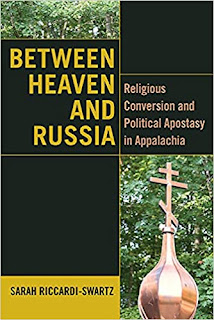
Review: "Between Heaven and Russia," by Sarah Riccardi-Swartz


Before reading this review, I would recommend anyone who has not already done so, read my essay "Sarah Riccardi-Swartz and Russophobia." That essay was written before the book in question was available to the public, and so was not based on my having read that book, but was based on reading a number of essays on the same subject written by Sarah, after listening to a number of talks and interviews she has done, and also based on my own experience with her, as well as with people in the communities she has focused on, along with my 32 years as a member of the Russian Orthodox Church Outside of Russia (ROCOR). This book repeats quite a bit of what Sarah had already put out in public, but it does provide some new information and new accusations that I don't recall her having stated in public previously, and so I will primarily be focusing on what is new in this book.

One new fact I learned from this book is that she never considered herself to be a member of ROCOR. This is interesting because when she first began appearing as a speaker at various forums and panels, she was routinely identified as a member of ROCOR, and I don't think she would have failed to notice this, but for whatever reason, she made no attempt to correct this information that I have seen, prior to the publication of this book.

In her book, Sarah Riccardi-Swartz uses pseudonyms for places and people, ostensibly because this is how anthropologists do their thing, but the people and the places she is taking about are easily determined by anyone with the slightest familiarity with the Holy Cross Monastery and Christ the Savior Orthodox Church in Wayne, West Virginia. In this review, I will replace these pseudonyms with the real names, because under these circumstances, using pseudonyms is just silliness. I will note this by the use of brackets, where applicable.

Those "Crazy Converts"

One of the notable aspects of this book is how frequently Sarah Riccardi-Swartz chooses to use the label of "convert" -- which is odd, given that she is ostensibly a convert to Orthodoxy herself. For example, as she sets the stage for the rest of her book, she attributes the existence of the parish and monastery in Wayne, West Virginia to converts:

"Both [Holy Cross Monastery] and [Christ the Savior Orthodox Church] came to be in [Wayne, WV] in the early 2000s when two converts -- a local university professor, who donated land for the monastery, and a local politician, who built the parish building -- began to missionize the region" (p. 4).

This is an example of telling half-truths, in the interest of building the desired narrative. The university professor that she is referring to is Maurice Sill, who is a man I got to know fairly well. He was indeed a convert. But Maurice was a man who had long been married to Nadya Danilchik Sill, who was a Russian American who was not a convert, and in fact was the daughter of a very well known, old school, ROCOR priest, Fr. Michael Danilchik (who was the first assigned priest for the Seattle ROCOR Cathedral) -- and so it would be difficult to find a person with deeper roots in ROCOR than Nadya Sill had. And given that the property that Maurice and Nadya Sill owned was joint property, and also given that Maurice would not have done anything of that magnitude without the agreement of his wife in any case, the whole truth would be that that this property was donated by a "cradle" member of ROCOR and her convert husband, who had been a convert of many decades by that time -- but this didn't fit the narrative that Sarah wanted to build, and so this fact was simply excluded from being mentioned here.

Another example of Sarah being selective with the facts that she will mention is that she always mentions that the people she is criticizing are white, except that when she talks about other converts who are not white, she will simply omit any mention of their race. For example, she often mentions a person on Twitter who is known as Patriarch Primus, and who is a convert to Orthodoxy, but she almost never mentions that he is black, though she will mention that he lives in the South (leaving people to assume he is a white southern "cracker"), and this is clearly because the whole truth doesn't fit her narrative.

Those "Crazy People in ROCOR"

Sarah also took pains to try to portray the Russian Orthodox Church Outside of Russia as some sort of fringe entity. And so, when laying out the landscape of Orthodox Christianity in America, she says:

"Historically, other forms of Orthodoxy in the United States, particularly the Greek Archdiocese, the Antiochian Church, and the Orthodox Church of America, focused on assimilation, social care and justice movements, and, in many ways, the mainstreaming of Orthodoxy. ROCOR, however, perhaps because of its noncanonical status until 2007, created an insular social group that would preserve not only their understanding of Orthodox theology, but also particular cultural expressions of faith in order to re-missionize Russia after the end of the Soviet Union. Despite this containment of sorts, ROCOR did attract converts, and within the past thirty-plus years the number of coverts have begun to rise, even prior to the religious reunification between ROCOR and the ROC in 2007, when ROCOR was still considered non-canonical in the Eastern Orthodox world" (p. 24).

The history of the Russian Church after the Bolshevik Revolution is complicated, but to make a long story short, the persecution of the Russian Orthodox Church by the Soviets resulted in divisions within the Russian Church both inside of Russia and outside of Russia. Between the time of the death of St. Tikhon, who was elected Patriarch of Moscow in 1918, and the collapse of the Soviet Union in 1991, there was of course the Moscow Patriarchate, but at various times there was also the renovationist Living Church, as well as various catacomb groups, though after World War II, both the Living Church and the catacomb groups ceased to exist in any significant forms. Outside of Russia, there were two times when most of the Russian bishops were united together within ROCOR, and then there were times when the Paris Exarchate, American Metropolia, ROCOR, the Moscow Patriarchate, and the Living Church had all gone separate ways. For those who want to read about this history in detail, I would recommend reading the book "A Long Walk to Church: A Contemporary History of Russian Orthodoxy," by Nathaniel Davis, the Orthodoxwiki article "ROCOR and OCA," and also Metropolitan Kallistos (formerly Timothy Ware)'s "The Orthodox Church (it should be noted, however, that the older edition goes into much greater detail on this subject). But to be concise, with the exception of the Living Church, which was heretical and schismatic, the rest of the Orthodox Church generally viewed these divisions as unfortunate, temporary, and matters for the Russian Church to settle for itself, when it was free to do so -- which is ultimately what happened. 

Prior to the 1970's, ROCOR regularly concelebrated with the various local Orthodox Churches. For example, Archbishop Vitaly (Maximenko) was one of the consecrators of Metropolitan Anthony (Bashir) of the Antiochian Archdiocese -- and that obviously would not have happened if the Antiochians considered ROCOR to be noncanonical.

Under Metropolitan Philaret, there was the beginnings of a self-isolation on the part of ROCOR as a whole, that was a reaction to the lifting of the Anathemas against Papism by Patriarch Athenagoras of Constantinople, but this was something that varied quite a bit depending on the various bishops of ROCOR, and especially on which local Churches were in question. And the key thing is that this isolation was self-imposed. It was not at all something imposed upon it by any other local Church. ROCOR always maintained close relations with the Serbian Patriarchate (because of the decades prior to World War II when it was headquartered in Serbia with the permission of the Serbian Patriarchate), and also with the Patriarchate of Jerusalem (because ROCOR has always maintained a presence in the Holy Land which continues to the present day, and this was always with the blessings of the Patriarch of Jerusalem). The low point of ROCOR relations with other local Churches was probably in the mid to late 90's under Metropolitan Vitaly, but even then, no local Church condemned ROCOR as "noncanonical." And I myself frequently concelebrated with the local Serbian clergy the entire time I was a clergyman (beginning in 1995). My spiritual father, who baptized me and my wife was ordained by Metropolitan Philip (Saliba) of the Antiochian Archdiocese, and he was given a canonical release by him to ROCOR in the 80's -- which again, would not have happened if they considered ROCOR to be noncanonical.

It is also hardly accurate to suggest that the Greek Archdiocese and the OCA were promoting assimilation in America, while ROCOR was not. The oldest continually published Orthodox Journal in English is "Orthodox Life," which has been published by Holy Trinity Monastery since 1950. ROCOR sponsored the translation of the first complete set of service books into the English language. The Greek Archdiocese, on the other hand, while it is by far the largest Orthodox jurisdiction in the United States, and certainly has far greater resources, has still not published even half of the service books in English translations, and many of their parishes continue to primarily use Greek, and generally if you talk to Americans who have had the experience of looking into Orthodoxy, Greek parish remain some of the least welcoming parishes to outsiders of any jurisdiction. The OCA has certainly had many parishes that have used English going back before the Bolshevik Revolution, but it has also not published an extensive set of English Language service books of their own, and many of their parishes continued to use mostly Slavonic well into the 80's. You can still find ROCOR parishes that serve mostly in Slavonic, to be sure, and some would be less welcoming to outsiders than others, but on the whole, ROCOR has been very welcoming to non-Russian converts, and this goes back to the 1950's. Speaking from my own experience in ROCOR -- having been in mostly Russian parishes, mostly convert parishes, and parishes with a good mix -- I have never been made to feel unwelcome because I was not a Russian.

The Antiochians were probably the earliest champions of using English extensively in the United States, and that goes back to the influence of St. Raphael (Hawaweeny), who had the foresight to see that this was necessary if his flock was to keep future generations within the fold, and so they were ahead of the curve on this point.

"Because ROCOR was not in communion with most of the Orthodox world for almost eight decades, it has seemingly become an echo chamber or perhaps an incubator of prerevolutionary Russian Orthodox thought. Its emphasis on tradition, adherence to the Old Calendar (Julian), submission to spiritual father confessors, and highly structured gender roles have all become concentrated over the years. These distilled ideological distinctions often put them in opposition to their spiritual cousin, the Orthodox Church in America, which embraced among other things, the New Calendar (Revised Julian), pews, and shorter service rubrics" (p. 28).

For Sarah to assert that ROCOR was not in communion with most of the Orthodox world for "nearly eight decades" is an assertion that even the harshest critics of ROCOR would not support -- at least not the ones with the slightest familiarity with the actual history of the period of time in question. 

We live in times that are extremely ideological, and no doubt this is why Sarah cannot imagine embracing Orthodox Tradition and piety without that being an ideology. Ideological thinking is a relatively modern mode of thinking, which is pretty much the opposite of traditional thinking. For more on that, see "What is Wrong with Ideology?" by Donald Livingston.

Speaking for myself, when I discovered the Orthodox Faith, it happened to be in ROCOR. There was nothing political about it, and having brought more than a few people into the Church since then, I have only rarely seen where political thinking even played a significant role in the motivation behind someone becoming interested in the Church, much less was it a big factor in moving them to actually convert. 

Sarah also seems unaware of the fact that the OCA was on the Old Calendar until the 1980's, and big parts of it remains on the Old Calendar to this day (the Dioceses of Alaska and Canada, along with scattered parishes throughout the lower 48 states).

Sarah also fails to explain why being in America requires wearing Roman Catholic clergy suits, being on the New Calendar, shortening the services, or the use of pews. As far back as 1972, it was observed in the book "Why Conservative Churches Are Growing: A Study in Sociology of Religion," by Dean Kelley, that liberal churches tend to shrink, and conservative churches tend to grow. So there is no scientific basis for such an assertion -- there is just the bare assertion of Sarah's opinions without any basis.

For one thing, Roman Catholic clergy suits are of fairly recent vintage. Traditionally, Roman Catholic Priests wore cassocks that were not all that different from the kind of cassocks that Orthodox clergy wear. 

In the classic Bing Crosby movie, Going My Way (1944), Barry Fitzgerald played the old Irish priest Father Fitzgibbon, and he is seen wearing an old fashioned Roman Catholic cassock as well as a clerical biretta which looks no less odd than an Orthodox skufia. Bing Crosby played a young hipster priest, who wears a modern Roman Clergy suit. In the 1940's, you could see why people might have thought that this was an improvement, but looking at the decline in Roman Catholic piety ever since then, I am not so sure it has worked out very well for them, and so why should we emulate failure?

"...many of the older Orthodox folks in [Wayne, WV] converted to ROCOR prior to the reunification [of the Russian Church in 2007]. Those who did so, opted to select an Orthodox body without canonical authority. It seems as if these converts were not looking for an unbroken line of apostolic succession, but rather a religious world built for the purposes of preserving and defending what they saw as traditional Orthodoxy and orthopraxy" (p. 29).  

This statement is a gross distortions of the actual history of ROCOR. It also reflect a rather shallow view of Orthodox Tradition and ecclesiology. Sarah would have her readers believe that St. John (Maximovitch) was a fake bishop, "without canonical authority." But no local Church believed that during his life, and none have believed that since then either. He is one of the most highly venerated saints throughout the Orthodox world today.

Pluralizing Singular Instances

In speaking of the rise of a "new wave of conservatism" since the 1990s. Sarah spoke of "Shootings in historic Black churches throughout the American South..." (p. 45). I am only aware of one shooting since 1990 in an historic Black Church, and that was the shooting in Charleston in 2015 -- which was of course horrendous enough by itself, but it is a gross exaggeration to suggest that this happened many times throughout the American South, when we are actually talking about the actions of a lone crazed young man.

This propensity for taking an isolated case and extrapolating it into something that is ubiquitous perhaps explains how she could take a single layman who allegedly said that he hoped to take up arms on behalf of Russia when it invades the United States (p. 124), and extrapolating this to be a common view among converts in ROCOR. I have been in ROCOR for 32 years, and have never heard anyone say any such thing.

Gender and Sexuality

She is particularly bothered by the fact that people in ROCOR tend to have "ultra-conservative understandings of gender, sexuality, and the roles of women and men should have in the Church, the domestic sphere, and society more broadly" (p.127). The question an Orthodox Christian should be asking, however, is whether or not these views are consistent with the teachings of the Church. Sarah, on the other hand supports homosexuality, transgenderism, and the whole ever expanding alphabet soup of sexual deviancy that the left is promoting. These things are completely contrary to the teachings of the Church, and so she should either humbly submit to the teachings of the Church, or find a religion that better suits her predetermined beliefs. The Orthodox Church is not a religious Burger King, where you can "have it your way." The Orthodox Church is what it is, and you can either take it, or you can leave it. See: The Pro LGBTQP "Orthodox," for more information.

"Within ROCOR, it is the job of spiritual fathers to monitor how and in what ways men and especially women participate in the church, just as it should be the job of a monarch to guide a country" (p.130).

 I don't think Sarah knows what she is talking about here. In my parish, I have a Greek American woman choir director who has a Masters of Divinity degree from St. Vladimir Seminary. I have had her teach classes before in the parish in the past, and would do so more frequently if she didn't already have her hands full with the choir. I don't micromanage the choir, because I know that she knows what she is doing. And as a matter of fact, if I have a question about how something ought to be handled liturgically, I often ask for her opinion, because she has been in the Church all of her life, she knows both Greek, Antiochian, and Russian practices fairly well, and so she has a good feel for what is normal or what is odd. I have a Sisterhood Vice-President who is an engineer, and as I often tell my parish, she is the handiest man or woman in the parish. If something needs to be fixed, built, or if I need an opinion on what we ought to do with regard to anything mechanical, I call her. And since I am usually busy serving or hearing confessions, I have little time to pay attention to what happens in the Nave of the Church during the services. I leave that to lay leaders in the parish, both men and women. I certainly am not monitoring the women in my parish during the services, or outside of it. I do hear confessions, and so give advice when it is warranted, and direction when it is called for, but I have told my people where the boundaries are when it comes to pastoral guidance from a priest, and that they should flee any spiritual father that would try to impose monastic style obedience on a layman. For more articles on Women in the Church, Click Here.

Monarchism and American Politics

Sarah seems to think that ROCOR is full of monarchist revolutionaries who want to overthrow the United States government and install a Tsar (p. 126f). You will certainly find a higher than average percentage of people in ROCOR who admire the idea of Christian Monarchy, I don't believe I have ever heard anyone seriously suggest that it could be imposed in the United States. There are many prophecies of a new Tsar returning to power in Russia, and so you do find interest in that. But I don't think anyone envisions that happening even in Russia by a violent revolution.

There are certainly people in ROCOR who are "right-wing," but what that means, even among those who could fairly be labelled as such, varies quite a bit. You have those who are American Nationalists, in the Hamiltonian sense, and then there are those who have more of a small government Jeffersonian view, and then you have just about everything in between. But there are people who are in ROCOR who politically are on the left, but who theologically nevertheless embrace the Traditions and teachings of the Church. I have some in my parish, and I am sure if I had a parish in a heavily Democrat region, I would have a lot more of those folks. I don't tell people how to vote, and I don't get upset if they don't share my opinions on political matters, because I believe in being tolerant of other people, and I can imagine people coming to conclusions that are different from my own without them having to be evil people. If someone denies the teachings of the Church, however, that is obviously another matter altogether.

The Russian Collusion Hoax Goes to Church

Sarah repeatedly makes assertions about "Russian interference" in the 2016 election (e.g., p. 76), as if it were a fact. I don't think that it is a coincidence that she began looking for Russian boogeymen in West Virginia in 2017 either. There is no doubt that Sarah is on the political left. She promotes the LGBTQP agenda. She capitalizes "President" when she speaks of Barak Obama (e.g., p.168), but not in reference to Donald Trump. She speaks of people who were merely at the rally in Washington D.C. on January 6th, 2021, as "insurrectionists," even if they were nowhere near the Capital building. Clearly, Sarah was one of those on the political left that was traumatized that Donald Trump was elected, and spent four years arguing that the 2016 election was stolen, but who now argues that any suggestion that the 2020 election might have been less than kosher is a Q-Anon conspiracy theorist. It doesn't seem to matter that the claims about Russia and the 2016 election have since been debunked, and originated with the Hillary Clinton Campaign. Not only is it clear that politics drove Sarah's interest in this research, but if it were not for this political element, it is also clear that few would be paying any attention to her work.

West Virginia is one of the most conservative states in the United States. It should come as no surprise that you would find a high concentration of political conservatives in a ROCOR parish in rural West Virginia. Had Sarah gone down the street and spent much time in a local Baptist Church, she probably would have found that those people have lots of guns, voted for Trump, and that they don't support transgenderism either. On the other hand, if Sarah went to a ROCOR parish in a heavily Democrat area, while there would probably also be some people who were politically conservative, she would also find a lot of Democrat voters too.

Conclusion

In June of 2020, my parish had a serious terroristic threat from someone who referred to our parish as "St. Jonah Russian Orthodox Church," despite the fact that we never use "Russian" in the name of our parish, though we make no secret about being part of the Russian Orthodox Church Outside of Russia.* When that happened, I called the FBI, as well as the local Constables office. The local authorities were very responsive, but the FBI never called me back. I mentioned what had happened to a Protestant minister I know who is fairly well connected. He contacted our Lt. Governor, and he called the FBI. Only then did I get a call back, but in the end, they did almost nothing to track down the person who had made these threats, though he had an online profile that should not have been hard to track down, and he was certainly living in this area. This year, on Old Calendar Annunciation, I finally received a visit from an FBI agent (nearly two years later), who began by mentioning what had happened in 2020, and who said that they just wanted to make sure everything was OK, given tensions around the war in Ukraine. He asked if I would agree to talk to him, and I did. His line of questioning had almost nothing to do with the safety and security of my parish. It was all about what contacts I may have had with the Russian Consulate in Houston, whether the Russian government had any influence over my Church, and things of that nature. Recent history has shown that you don't have to actually be guilty of anything for the FBI to put you in jail. So obviously, this attention is unwelcome, though it would have been nice if they had been more interested in my parish in June of 2020. 

When people like Sarah Riccardi-Swartz promote conspiracy theories that try to convince people that ROCOR is somehow connected to Putin stealing the 2016 election, and is full of a bunch of Fifth Columnists, who are anxiously awaiting the Russian invasion of the United States, so that they can join in on their side, this has real world consequences. If Russophobia continues to heat up in this country because of further deteriorations in our relations with Russia, it is not farfetched that the kind of Blue-Anon conspiracy theories spun by people like Sarah will result in innocent people being seriously harmed or killed. This is dangerous, unchristian, and it is irresponsible.

Aside from all of that, this book is not particularly well written. Sarah doesn't know her history. She is politically motivated, and she has taken her own spin on isolated people and two particular communities, and made the logical leap that she can fairly characterize the entirety of ROCOR, despite all of the geographic and cultural differences one can find within ROCOR. We have parishes in Australia and New Zealand. These parishes have very different histories than the typical ROCOR parish in the United States and Canada. We have parishes in Latin America, Asia, Great Britan and Western Europe that are even more distinct. Sarah Riccardi-Swartz has made no effort to study ROCOR more broadly than what she could find in Wayne, West Virginia. Anyone with any sense of logic or even just a sense of fairness would not make extrapolations beyond what she actually has studied. But from what I know of the communities in Wayne, West Virginia, I have little reason to believe she was fair to them either. In a recent presentation, she pointed out in passing that these communities did not tolerate hate speech, but she has made an entire career out of suggesting that they are somehow connected with racism and white supremacy... but how she could think that those two things could coexist in the same universe is beyond me.

*We don't have that on our sign, are website, or anywhere else, because we do not want anyone who is not a Russian to think that this is not a Church for them. Our parish, as a matter of fact, is a fairly diverse parish in comparison with what you would find in the average Orthodox parish in the United States.

Saturday, May 14, 2022

The Pro LGBTQP "Orthodox" (The Birth of a New Religion, Part 2)

For Part 1, see The Pro-Abortion "Orthodox" (The Birth of a New Religion, Part 1)

The fact that today we have people openly promoting the LGBTQP agenda in the Orthodox Church is something that was unthinkable less than a dozen years ago. But here we are. They are a vocal minority to be sure, but like most leftists, they try to convince people that their opponents are the minority, and they are only motivated by hate.

The tactic that the Pro-LGBTQP "Orthodox" have generally taken to promote their agenda is to pretend that the only people concerned about what they are pushing are "fundamentalist" converts. The suggestion being that somehow prior to the time when Americans began to convert to Orthodoxy in large numbers, everyone in the Orthodox Church was fine with the idea that homosexuality was an acceptable lifestyle. Back then, they would have us believe, no one would have objected to embracing transgenderism, or any of the other limitless "sexual preferences" and "gender identities." This is of course complete nonsense. Not only was no one pushing for the acceptance of homosexuality in the Orthodox Church prior to 2009, no one in the Orthodox Church was even contemplating the acceptance of transgenderism, and most had never even heard of it. 

Homosexuality was considered a mental disorder by the American Psychiatric Association until 1973, when activists pushed the organization to change this designation. It was only in 1987 that homosexuality was completely removed from the Diagnostic and Statistical Manual of Mental Disorders. It was in the wake of the AIDS epidemic, which began in 1981, that the acceptance of homosexuality in the wider culture began to increase from something which previously had been close to non-existent.

Fr. Alexander Schmemann is not usually thought of as a fundamentalist convert, and yet one of his students told me that around 1981, he made the statement "I refuse to be the dean of a seminary of pot-smoking homosexuals." This was in the context of him having actually kicked a pot-smoking homosexual seminarian out of the seminary, and so these were not idle words.

If you look at the views of the Orthodox in traditional Orthodox countries even today, you don't find them embracing homosexuality or transgenderism either -- this is true of their populations as a whole, but it is all the more true when you consider those who actually go to Church.

I have been blogging since 2004, and the first article I have in which I felt a need to respond to the push for gay marriage was in 2009, and this was completely without reference to any dispute within the Church, because at that time, there was no such dispute. I suspect that this began in 2009 because prior to that, George W. Bush had successfully used the issue to win his second term, by ensuring that there were ballot measures in swing states that banned gay marriage. But after Obama was elected, apparently people on the left felt emboldened, and so the push began. And it was only in 2011 that I began to see Orthodox Christians who were pushing for the acceptance of homosexuality. Initially, this was mostly done anonymously, or in private discussion groups. 

2013 was the year that the Supreme Court struck down the Defense of Marriage Act, and forced every state to allow for gay marriage. Many dismissed the significance of this at the time, but two things happened almost immediately as a result of it -- this strengthened the general push for the acceptance of homosexuality, and no sooner had gay marriage been forced on the country did the push for the acceptance of transgenderism begin in earnest. 

2014 was the first time to my knowledge that an Orthodox priest began to publicly push for the acceptance of homosexuality. In November of 2014, Fr. Robert Arida posted an essay to the official OCA website. After being overwhelmed with complaints, the OCA removed the essay, though you can still read it via the Internet Archive. Among the many statements which responded to this essay, the Orthodox Clergy Association of Houston and Southeast Texas wrote a rebuttal, which was signed by almost of all the clergy in the Association (and was signed by all who were present at the meeting which discussed it). This rebuttal was reposted on the Greek Archdiocesan website at the time.

In 2015, the City of Houston tried to push through an ordinance which would have forced churches and businesses to allow men who identify as women to use women's restrooms. Again, the Orthodox Clergy Association issued a statement against it. The ordinance was overturned by a referendum, and it was mostly Black and Hispanic churches in Houston that led the fight against it. Houston is about 44% Hispanic, 24% White (Non-Hispanic), 22% black, and 7% Asian, and so it was not a bunch of racist White people who overturned this ordinance. The vote was not even close: 61% opposed to 39% in favor.

Onto the scene came George Demacopoulos and later, Public Orthodoxy. George wrote an essay attacking those he termed Orthodox Fundamentalists on January 29th, 2015. I wrote a reply, and we later had a sort of debate hosted by Kevin Allen on Ancient Faith Radio. Since then, George has made attacking anyone who is not ready to embrace homosexuality, transgenderism, modernism, and a whole host of other perversions a career through his website Public Orthodoxy, which is a part of the Fordham University Orthodox Christian Studies Center, which has been formally endorsed by the Greek Archdiocese.

If you look over the archives of Public Orthodoxy, you will see that it has produced a steady stream of articles that defy almost every aspect of Orthodox Christian morality, and as a matter of fact they regularly argue that while dogmatic issues (which they define as being limited to strictly theological matters) are beyond debate, moral issues are not dogmatic, and therefore up for revision. This is a completely novel approach, and one that is heretical and contrary to the clear Tradition of the Church.

Most recently, the former Chancellor of the OCA, Fr. John Jillions gave a lecture for the Orthodox Theological Society in America, in which he bemoaned those Orthodox "fundamentalists" who are unwilling to dialogue on matters such as homosexuality and transgenderism. He argues that we cannot judge such matters "before the time," which will apparently only come when (so they hope) they finally wear everyone else down with their endless pressing of their agenda and we let them have their way. The problem is that these issues are not up for debate. Not only are the Scriptures clear on these issues, we have numerous canons from Ecumenical Councils, and the clear and unified testimony of the Fathers and Saints of the Church which leave no room for doubt as to what the Church has always taught on these subjects. In this lecture, you see the same kind of mealy-mouthed argumentation that we found in the essay by Fr. Robert Arida, but as time goes on, they are becoming more emboldened. One has to wonder how long their respective bishops will put up with this, but I think at this point, we have to conclude that at least some of the bishops in question allow this to go on because they agree with it.

Now if people like Fr. John Jillions wanted to dialogue about how to deal pastorally with people who are struggling with these sins, in order to help them overcome their sins, that would be a dialogue worth having. But you can't have that dialogue with people who are unwilling to concede that we are talking about actual sins. That has to be the starting premise. And to be clear, this is the point that they refuse to concede. In fact, they will almost never provide a direct answer to a direct question on whether or not these things are inherently sinful -- and that is for the simple reason that to say what they actually believe would put them in an indefensible position, and would force their bishops to do something about it.

We are not opposed to the LGBTQP agenda because we hate those who have been sucked into going along with it. We are opposed to it because this agenda is destructive to these people. As St. Paul tells us, these things are contrary to God's created order, and as such, they can only lead to great misery and the destruction of souls. St. Paul tells us that homosexuals and the transgendered (i.e. effeminate) will not inherit the Kingdom of God:

"Know ye not that the unrighteous shall not inherit the kingdom of God? Be not deceived: neither fornicators, nor idolaters, nor adulterers, nor effeminate [malakoi], nor sodomites [i.e., homosexuals, arsenokoitai], nor thieves, nor covetous, nor drunkards, nor revilers, nor extortioners, shall inherit the kingdom of God. And such were some of you: but ye are washed, but ye are sanctified, but ye are justified in the name of the Lord Jesus, and by the Spirit of our God" (1 Corinthians 6:9-11).

Not inheriting the Kingdom of God is a pretty big deal, if you actually believe in God, and so if you love the people struggling with these issues, you would want to help them to repent and overcome them, rather than affirm them in a choice that will lead to their spiritual deaths. 

I hope I am wrong, but I believe we are witnessing the unfolding of a full-blown schism. It will not just be over abortion, or over the LGBTQP agenda, or over the other issues we will be looking at, but each of these are pieces to the larger puzzle. If a schism is to be averted, it will only be averted because bishops begin to find their backbones, put their collective foot down, and put a stop to the spreading of these false and destructive teachings.

Update:

Someone has put together a very useful video that provides an overview of what has been going on in terms of the push for the acceptance of LGBTQP ideology in the Orthodox Church, particularly in the English-speaking world:

The same channel has a 4-part video series that covers the same ground, but provides some additional footage that is very helpful.

Update 2: This is a film that focuses on who is funding the groups promoting the LGBTQP Agenda in the Orthodox Church: The Secret Subversion of American Orthodoxy

For Part 3 see: The Renovationist "Orthodox" (The Birth of a New Religion, Part 3)


Update 3: It is just keeps getting worse. They keep getting bolder, and don't even try to cloak what they are pushing any more. In this video, Ashley Purpura says Christ is queer, gay marriages should be blessed, and sodomy is a path to theosis, among many other blasphemous heretical assertions:


For More, See: 

Sermon: A Mad Mad World (Which was in response to Fr. John Jillions lecture referenced above)

Moral Heresy?

Discernment or Scaffolding?

The Living Church 2.0

The Bible the Church and Homosexuality: Obscurantegesis vs the Truth