Showing posts with label Ordination of Women. Show all posts

Friday, March 08, 2024

Deaconesses, Female Deacons, and the Agenda of the St. Phoebe Center


St. Phoebe, the Deaconess

On February 2nd, 2024, Ancient Faith Radio held a discussion about deaconesses, which was a documentary by John Maddox, interspersed with discussions between Fr. Thomas Soroka and John Maddox, and which eventually included callers, included me, among a few others.

There are a number of people whose opinions I respect who thought that the discussion was giving a platform to feminists with an agenda. Personally, I thought it was a mostly useful show, and found the full unedited interviews that John Maddox did with the various guest on the documentary to be even more revealing. Some of the interviews were more interesting than others, but in the description box on YouTube, you can select which interview you want to listen to, which makes navigating this more than 10-hour compilation manageable. 

This show reminded me of the kind of shows that Kevin Allen (of blessed memory) used to do on AFR. The only difference being that he probably would have had Fr. Patrick Mitchell on with someone from the Phoebe Center for Deaconesses, and would have moderated an informal debate designed to let people hear how the two sides compare with each other. 

I think both the shorter show and the full-length interviews make a very strong case against the push for deaconesses, and apparently the Phoebe Center for Deaconesses thought so too, because no sooner was the show over than they were claiming to have been victimized by the show, and the discussions which it sparked.

What Complicates This Discussion

There are several questions that complicate this discussion: 1. What were deaconesses, and how did they function? 2. If the office was restored, what would that look like? 3. Why did they cease to be a living part of the life of the Church and should that office be restored? 4. Is there an agenda behind the push to restore deaconesses? So let's take a look at each of these questions:

1. What were deaconesses, and how did they function? 

We know that deaconesses were celibate women 40 years old and above. They eventually became associated with female monasticism. They certainly assisted with the baptism of women adult converts -- because the practice of the early Church was to baptize everyone in the nude, and obviously this required that adult women be baptized outside of the viewing of men. So while a priest said the words of the baptism from behind a screen, a deaconess performed all of the functions, such as the anointing with oil, the triple immersion, the robing, the chrismation, and the tonsuring. 

In addition to this, we know deaconesses took communion to women who were sick. They also maintained order on the side of the Church in which women were praying during the services. They also, at least in some places formed a choir and sang parts of the services, antiphonally, with the male choir.

There is some debate about whether deaconesses qualified as minor clergy (analogous to readers and subdeacons), or whether they were part of the major orders of clergy (such as deacons, priests, and bishops). There is some good evidence that they were classed closely with deacons, in terms of rank, but this may or may not have been how they were viewed from the beginning, and in various places.

2. If the office was restored, what would that look like?

Without question, deaconesses did not function in the same way as male deacons. This is a key point upon which much confusion arises, because people like the folks at the Phoebe Center are pushing for deaconesses to be ordained on the same basis as male deacons -- and so with the same age limit of 25 and older, no requirement for celibacy, and the same liturgical functions as male deacons. The problem with this is that this is not restoring the ancient order of deaconesses -- this is the establishment of something entirely different. Were they actually calling for the restoration of deaconesses as they once existed in the Church, there would be a lot less controversy on this subject. But speaking of "restoring" deaconesses while actually promoting the introduction of something novel is not accidental sloppiness -- it is a marketing strategy.

In the discussion on this issue, someone pointed out that the Phoebe Center was engaging in the "Motte-and-bailey fallacy." This occurs when someone conflates two positions that share some similarities -- one which is more easily defensible, and one which is not -- and then go back and forth between these two conflated positions, depending on their need to retreat to the more defensible position, or their desire to push the indefensible position. I think this was an insightful observation. When people attack their push for women to function as male deacons, they appeal to the evidence for the ancient order of deaconesses, without ever actually engaging the merits of the criticisms of their far less defensible agenda.

3. Why did they cease to be a living part of the life of the Church and should that office be restored? 

It seems to me that the decline in adult conversions and thus the lack of need for deaconesses to fulfil this most important role was the biggest factor in the decline and eventual disappearance of deaconesses. The fact that they ceased to exist very early on in the Western Church was probably a factor too. I think it ultimately doesn't matter so much why this happened as it does that it did in fact happen. That this order ceased to exist is good evidence that it was no longer needed by the Church, and so those arguing for the restoration of deaconesses have the burden of proof that there is a need for it now. But again, if they were actually talking about restoring deaconesses as they once actually were, it would not be that controversial.

For example, about an hour from Houston, there is a Greek convent. The abbess is a very holy woman, and were she made a deaconess, I certainly would have no reason to object. But the fact is, as an abbess, she already can function pretty much as a deaconess use to function. She cannot now commune in the altar, but she can do pretty much everything else. Even bringing communion to other nuns could be done when there was a need (such as when no priest is available because of the isolation of the convent), with the blessing of her bishop.

I have not asked the abbess for her opinion on this question, but I suspect that if I did, she would not be in favor of restoring deaconesses. I say this because when you look at who is pushing for restoring deaconesses, they are almost always academics.* Serious and experienced monastics that are vocally supporting the restoration of deaconesses are as scarce as hens' teeth. 

4. Is there an agenda behind the push to restore deaconesses?

The evidence that those pushing the "restoration" of deaconesses have an agenda was made very clear if you listened closely to the full interviews. This is seen by the fact that they conflate restoring deaconesses as they once were with introducing women deaconesses that function like male deacons, but that is far from the only evidence.

John Maddex made a point of asking each of the advocates for "restoring" deaconesses whether or not they would agree that women should never be ordained as priests and bishops, and without exception, they all either dodged the question, or eventually acknowledged that this "could" happen since "women deacons would inevitably lead to a conversation about ordaining women priests." John pressed for them to affirm they were not going to go on to push the ordination of women priests and bishops, because he pointed out that if they took the position that this was impossible, this would relieve a lot of the concerns people have on this issue, but not one of them was willing to provide any such assurance, and that is clearly because they have no intention of stopping with women deacons. You will hear the same question being asked, and the same essential answer in the interviews with Dr. Carrie Frederick Frost, Dr. Valerie Karras, and Dr. Helen Theodoropolous. In each case, this question comes close to the end of the interview. In fact, if you compare all three interviews, they all answer controversial questions in ways so similar that it sounds like they all have agreed upon talking points.

You can see the sleight of hand at work on the Phoebe Center website. They have a FAQ page, and one of the questions is "Does the St. Phoebe Center promote the ordination of women to the priesthood (i.e. the episcopos or presbytery)?" And the answer provided is "No, ordination of women to those offices is not part of the Orthodox Christian Tradition and the St. Phoebe Center does not promote this." This answer at first glance sounds like they are opposed to the ordination of women as priests and bishops, but they are careful to not say that. They say it is not part of our tradition... but that doesn't mean they think it is impossible, because if they did think that, they wouldn't refuse to say so. All they say is that "the Phoebe Center does not promote this." But that is because it is part of their talking point strategy. In fact, Dr. James Skedros of Holy Cross Seminary (who did not seem to be an enthusiastic advocate for the "restoration" of deaconesses, but he certainly is not opposed to it, and he has been involved in Phoebe Center discussions on this issue), said that those advocating the "restoration" of deaconesses "recognize [the need] not even to bring up the topic" of ordaining women as priests. It is important to note that this is merely a marketing strategy, and has nothing to do with taking a principled position, being honest, seeking the Truth, or striving to be faithful to the Orthodox Tradition.

Of the interviews of those who best opposed ordaining women deacons, I would recommend listening to Dr. Edith M. Humphrey, Presbytera Dr. Eugenia Constantinou, Khouriah Frederica Mathews-Green, and Dr. Mary Ford.

My Part in this Discussion

I did not intend to call in to this show, but in the chat discussions on YouTube, there were many people who said that AFR should have me on to discuss the issue. Eventually, Fr. Thomas Soroka asked me to call in -- he even sent me a private message. So I did call in. You can listen to my call here, but we got cut off, and I had to call back in twice. 

In my call, I began by pointing out the dishonest use of the phrase "restoration" with relation to what they are promoting, when in fact, they are promoting something entirely different from a restoration. At the end of my call, I made a comment that the Phoebe Center folks took exception to, and claimed was somehow unfit for the ears of women to hear. AFR eventually edited my comments, in a likely vain effort to make the folks at the Phoebe Center happy, but you can listen to the unedited comments by clicking here. This is what I said without editing:

"One other thing I would say quickly about the Phoebe Center, is they say, well, we’re not pushing for women priests, we’re only talking about deaconesses, and I’m very tempted to use a very crass reference to what guys often try to do to pressure women when they’re out in the back seat of a car, but you know, you say I just want to go this far, but no further, but once you get there, then what happens? I don't trust that kind of an argument. I don't think that is where they want to stop, and some of them have openly advocated for women being ordained as priests. We've seen this before. The slippery slope is a real thing, when you have people who intentionally grease it, and we just need to be really on guard."

When I said that I was "tempted to use a very crass reference," what I in fact went on to say was not the crass reference I was tempted to use. I instead toned it down to keep it acceptable for mixed company. Pretty much everyone above the age of 15 knows what I was talking about, and anyone under that age was not likely listening anyway. I think it is an apt analogy. The point is, like the guy in the back seat of a car, they know that saying what they really want is not going to get the desired result, and so ask for something short of that... with every intention of pushing to go beyond that point once they get there. It is obvious that they really want women priests and women bishops, but they know saying so plainly would get them nowhere.

The faux outrage over what I said is especially rich given that many of those expressing that outrage are also are pushing the LGBTQP agenda and would never object to that agenda being pushed on kids in school, nor would you likely hear them expressing outrage over gay pride parades in which men expose themselves to children and engage in lewd public acts in their presence.

If I had been able to hear Dr. Edith Humphries interview before I called in, I might have simply referred to this a "sleight of hand" tactic as she did, so that they would not then be able to avoid dealing with the substance of my criticisms, and instead deflect attention by clutching their pearls, and by unironically appealing to pre-feminist notions that women are too fragile to hear such things said.

Before my call, there was a young woman who called in and who said that God had called her to be a deaconess, and asked what she should do about it. Fr. Thomas Soroka's answer was very pastoral, but he did not say that she should be made a deaconess in the end. And so somehow this very pastoral answer was later referred to as being unkind. The woman who called in has published articles on this subject, and when you put your thoughts out there publicly, people do have a right to express contrary opinions. Also when you claim God has told you something, people also have a right to question whether this was really God, or just symptoms of self deception. There were people who made some unkind comments elsewhere about her. I certainly don't defend being unnecessarily harsh with anyone. But the faux outrage that was expressed in this case was another example of having a double standard. You can't contend that women are so strong and tough that they can do anything a man can do, while at the same time act as if anyone who contradicts a woman and makes her feel bad is a "big fat meany!" One of these two views may be a correct way to view women, but both cannot be true in the same universe. 

In any case, here is what I have to say on the subject in a forum in which I have more time to lay out the case:

Now if the folks at the Phoebe Center actually agree that women can never be ordained as priests or bishops, because this would be an unthinkable violation of the Orthodox Tradition, I will gladly make a public apology in response. But I won't be holding my breath in the meantime. They won't say that, because clearly that is where they want to go next, and "restoring" deaconesses is a means to an end, rather than an end in itself.

* This point was made in the full interview with Khouriah Federica Matthews-Green.

See also: 

Sister Vassa on the Ordination of Women to the Priesthood

Stump the Priest: Altar Girls?

Stump the Priest: The Churching of Boys vs. the Churching of Girls

Saturday, April 28, 2018

Sister Vassa on the Ordination of Women to the Priesthood


Sister Vassa posted a rather tortured answer to the question of whether women can be ordained as priests, which you can listen to here:


Apparently we should understand that the reason the Church doesn't ordain women is because it just doesn't want to... but she insists that there is no reason why this is the case. The Church just doesn't want to for purely random and arbitrary reasons:
"You know, when people ask me about women in priesthood, they say, "Sister, why can't women be priests?' And I say, 'Women can be priests. We don't want them to be priests." Because you see, God can do anything, and the Church, by divine authority, uh, can do anything, but, the Church doesn't want to -- and that's a legitimate reason. What I don't like is when we try to pretend that there are other reasons for this, because it's legitimate not to want something, and there are reasons not to want this - right? - but, we shouldn't pretend that there's some... reason, that, for example, the maleness of Christ is essential to priesthood. Because, the question in this whole big question, is, when we discuss something like the fact that Christ is indeed male, we can ask, with regard to priesthood... we should ask, this is the question for the whole argument -- is Christ's maleness essential to priesthood, or is it accidental? According to Aristotelian logic this would be at the heart of the question, okay? Is it essential, or is accidental? So, is it something... a sine qua non to Christian priesthood?"
The fact that Christ was a male, may or may not have anything to do with why we have a male only priesthood. It could very well be, at least in part, that the priest serves as an icon of Christ liturgically, and that this is part of the reason. However, it is also true that women can function as icons of Christ too. But whether or not this is a reason, there clearly are reasons for this practice, whether we individually understand them or not. If there really was no reason for this practice, what sense would it make? It wouldn't. And the idea that this practice was due to the limitations of the times, and that perhaps it just never occurred to anyone that women could be ordained as priests is a ridiculous argument... because the Israelites and later on the Christians were surrounded by pagans that had priestesses. And yet in both the Old and the New Testaments, the liturgical priesthood was exclusively male, despite the practice of all those around them.

Being a priest is a fatherly role... which is why priests are called "Father". There are also motherly roles in the Church, and women fulfill them. Then there are roles that are open to "whosoever will," and women fulfill those roles too. And we as families and as a Church need to encourage men to fulfill those roles which are in fact fatherly. Women tend to be more pious than men, speaking generally. Often at lesser attended weekday services, I am reminded of the women at the Cross of Christ, because when I look out at the congregation, I might see the occasional "John", but the women almost always outnumber the men by rather large margins. Men need to be encouraged, especially by the women in their lives, to take up their responsibilities as spiritual leaders in the home and in the parish, otherwise, you generally won't see men functioning in positive ways in the Church, in any great numbers. Of course many in our politically correct culture will immediately react to any suggestion that there is a need for male spiritual leadership, but there is empirical data that demonstrates that this is simply a fact of human nature, as God created it.

There was  a Swiss study that showed that if both the father and mother attend Church regularly, 33 percent of their children will be regular churchgoers, and 41 percent will attend irregularly, and 25 percent of their children will cease practicing their faith altogether. If the father attends Church irregularly but the mother is regular, only 3 percent of the children will attend Church regularly, 59 percent will attend irregularly, and 38 percent will cease practicing their faith. If the father is non-practicing and mother attends Church regularly, only 2 percent of children will attend Church regularly, 37 percent will attend irregularly, and over 60 percent of will cease practicing their faith. However, if the father attend Church regularly but the mother attends irregularly or is non-practicing, the percentage of children who grow up to be attend Church regularly goes up from 33 percent to 38 percent with the irregular mother, and to 44 percent with the non-practicing mother. Clearly this shows that the spiritual leadership of the father, or the lack thereof, plays a crucial role... and that is just the way it is, whether one likes it or not (See: Touchstone Magazine: The Truth About Men & Church, by Robbie Low, you can also listen to a sermon on this topic: Christian Leadership in the Home).

Furthermore, if ever there was a human being (aside from Christ Himself) that was more worthy of any honor the Church could bestow, it would be the Virgin Mary, and yet she was never ordained to serve a priestly role in the services of the Church. However, while she did not preside over the celebration of the Mystery of the Eucharist -- she played a rather crucial part in the Mystery of the Incarnation of Christ, which made the Eucharist possible. Motherhood (both natural and spiritual) is a great honor and a thing of incredible power, beauty, and worth. Fatherhood (both natural and spiritual) is not a better thing, it is simply different. As most of us have noticed, men and women are different, and our roles are different, but they are complementary. Neither is possible without the other, and both depend on the strength and support of the other. And so we should not allow ourselves to be talked into blurring the lines between the two by a culture that is on a self destructive trajectory, and which has only managed to rob both men and women of the virtues of their sexes.

Sister Vassa continued:
"And if you pay attention to the argumentation in Hebrews, where the author of Hebrews is at pains to show that there is the possibility of change to the way priesthood is, um... is... how do you say... served, right? Those who have ...see, the author of Hebrews is at pains to explain to Jews how in the world those who are not of the tribe of Aaron and so on, those who are not Levites, why in the New Testament now other can be priests. And he is explaining that... uh... the priesthood according to the rite of Melchizedek. So, he's explaining a new kind of priesthood, and he is explaining that this is something that is changeable, as to who can be a priest, okay? So if one explores the Epistle to the Hebrews, one can see that there are... that the question of who can be a priest is something that is indeed a changeable aspect of tradition. What is not changeable is the basis for all priesthood, and that is of course Our Lord Jesus Christ. That's where the question arises: who... you know... what... what aspect of his person is essential to that service that is priesthood, that ministry, that, that mystery, um... is it, does it include his maleness, for example, would it include, if Christ indeed had black hair, for example, would priesthood be limited to those with dark hair? You know, I mean, we would ask what is essential to the person of Jesus Christ in his priesthood? Would his maleness be part of that? Anyway, traditionally, actually, we don't see the maleness of Christ thematized at all... it's not a patristic... nowadays some people who are at pains to argue against females in priesthood... whereas I don't think there's a big problem, we should just say honestly, "We don't want women to be priests. As Church, we don't want that." That's fine, you know, that's fine, but we shouldn't say that we couldn't have women as priests."
Actually, the Epistle to the Hebrews does not in the least suggest that who can be a priest is changeable, in the sense that it might just change again at any moment. St. Paul says that with the New Covenant there is a new ministry, i.e., the worship of the Old Testament is changed with the New (Hebrews 8). Unless Sister Vassa is expecting the establishment of a New and Improved Covenant before  the second coming, there is no reason to expect any change in the priesthood... and as a matter of fact, the exclusively male character of the liturgical priesthood is one aspect that has remained constant in both the Old and New Testaments.

Obviously, Sister Vassa wants to have plausible deniability here, and to be able to say that she is not advocating for women to be ordained as priests, but that is in fact what she is doing. If you insist that there is no reason why women cannot be ordained as priests, and that the Church just "doesn't want to," at this point, but that this is a matter entirely up in the air, the logical conclusion is very clear.

A parody of the song "Call Me Maybe," advocating for the ordination of women:


The key lyric: "Don't listen to St. Paul..."

See also:

Stump the Priest: Altar Girls?

Stump the Priest: The Churching of Boys vs. the Churching of Girls

h/t Byzantine Texas: Sr. Vassa: There's no ontological impediment to priestesses

Friday, August 14, 2015

Stump the Priest: Altar Girls?


Question: "Is it proper for a parish to have altar girls?"

This is clearly contrary to the Tradition of the Church, and is an unfortunate example of creeping modernism that it is tolerated in parishes anywhere -- but thankfully it is still fairly rare.

It is certainly true that there is not an absolute prohibition against women entering the altar when there is a need for it, and in convents, it is common to have nuns serve in the altar, because obviously in a convent there are not a lot of males available for serving in the altar. However, this is done because it is necessary, not because it is "fair" or to give the nuns "something to do" during the services.

See: The Churching of Boys vs. the Churching of Girls for more on that subject.

Why is this the Tradition? We are not always given a list of justifications along with the Traditions that the Church has handed down to us, and so in this case, one cannot point to the official reasons for it, so far as I am aware. However, where the Tradition is clear, we should simply follow it out of obedience. As St. John Chrysostom put it: "Is it Tradition?  Seek no further" [Homilies on the Second Epistle to the Thessalonians 4:2].

However, here is what I think explains this Tradition:

Traditionally, clergy are generally drawn from those who first served as altar servers. Altar servers were once classified as minor clergy, and it is still the case that before one is tonsured a reader (which is called "the first degree in the Priesthood" in that service), the individual being tonsured is first made a "taper-bearer" (or "candle-bearer," i.e. an acolyte). Readers, subdeacons, deacons, priests, and bishops have always been men, and so it makes no sense to have "altar girls" entering into a path that they could not follow.

Of course those who oppose this Tradition would at this point ask, "What about deaconesses?" The office of deaconess was never a female equivalent of deacon. It was a ministry that existed for women, and the primary liturgical function they had was to perform the baptisms of adult women at a time when adults of both sexes were baptized naked. Because adults were baptized naked, women and men were not baptized together, and when women were baptized, the deaconesses performed all the functions a priest would otherwise perform, and a priest would say the prayers behind a screen. When Christianity succeeded in gaining at least nominal adherence from most of the people in the countries in which it existed, adult baptism became rare, because most people were baptized as infants, and so the office of the deaconess ceased to have a need to fulfill, and gradually disappeared. Though in our time, adult baptisms are very common, the practice is no longer to baptize adults naked.

See: Voices from St. Vladimir: Deaconesses, which is a conversation between Fr. Chad Hatfield and Fr. Lawrence Farley on this subject. You may also want to read Fr. Lawrence Farley's book on the subject: Feminism and Tradition: Quiet Reflections on Ordination and Communion.

The next question that one may ask is why only men can be ordained as clergy. Again, we first must simply say that this is the Tradition of the Church. Furthermore, the notion that this is based on cultural prejudices of the time of the Apostles, and that perhaps it never occurred to Christ or the Apostles that women might be ordained is belied by the fact that pagan priestesses existed not only during the time of the Apostles, but also throughout the history of Israel. So clearly Christ and the Apostles made a conscious decision that clergy would be males only. This is not because women are not smart, or capable -- because obviously they are -- but because they have other roles to fill.

Being a priest is a fatherly role... which is why priests are called "Father". There are also motherly roles in the Church, and women fulfill them. Then there are roles that are open to "whosoever will," and women fulfill those roles too. And we as families and as a Church need to encourage men to fulfill those roles which are in fact fatherly. Women tend to be more pious than men, speaking generally. Often at lesser attended weekday services, I am reminded of the women at the Cross of Christ, because when I look out at the congregation, I might see the occasional "John", but the women almost always outnumber the men by rather large margins. Men need to be encouraged, especially by women, to take up their responsibilities as spiritual leaders in the home and in the parish. Of course many in our politically correct culture will immediately react to any suggestion that there is a need for male spiritual leadership, but there is empirical data that demonstrates that this is simply a fact of human nature, as God created it.

There was  a Swiss study that showed that if both the father and mother attend Church regularly, 33 percent of their children will be regular churchgoers, and 41 percent will attend irregularly, and 25 percent of their children will cease practicing their faith altogether. If the father attends Church irregularly but the mother is regular, only 3 percent of the children will attend Church regularly, 59 percent will attend irregularly, and 38 percent will cease practicing their faith. If the father is non-practicing and mother attends Church regularly, only 2 percent of children will attend Church regularly, 37 percent will attend irregularly, and over 60 percent of will cease practicing their faith. However, if the father attend Church regularly but the mother attends irregularly or is non-practicing, the percentage of children who grow up to be attend Church regularly goes up from 33 percent to 38 percent with the irregular mother, and to 44 percent with the non-practicing mother. Clearly this shows that the spiritual leadership of the father, or the lack thereof, plays a crucial role... and that is just the way it is, whether one likes it or not (See: Touchstone Magazine: The Truth About Men & Church, by Robbie Low, you can also listen to a sermon on this topic: Christian Leadership in the Home).

Male participation in the Orthodox Church is generally better than most, but we need to work harder to encourage men to step up to the plate and take on their responsibilities as pious laymen, husbands, and fathers (See: Why Orthodox Men Love: Many men may not love church, but Orthodox men do, by Khouriah Frederica Matthews-Green).

What then should girls and women do during the services? The same thing that men who are not serving in the altar or singing in the choir should be doing -- praying, and worshiping God. That is the first and most important task that we come to Church to perform. And it is not such a small task that one should need something else to do. But some parishes do have some roles they assign to young girls, such as tending the candle stands, or serving the zapivka after the faithful receive Holy Communion. They can also sing in the choir -- and in fact the choir serves a more crucial role than the altar servers, because while a priest can serve without an altar server, if he must, he cannot serve without at least one chanter.

If ever there was a human being (aside from Christ Himself) that was more worthy of any honor the Church could bestow, it would be the Virgin Mary, and yet she was never ordained to serve a priestly role in the services of the Church. However, while she did not preside over the celebration of the Mystery of the Eucharist -- she played a rather crucial part in the Mystery of the Incarnation of Christ, which made the Eucharist possible. Motherhood (both natural and spiritual) is a great honor and a thing of incredible power, beauty, and worth. Fatherhood (both natural and spiritual) is not a better thing, it is simply different. As most of us have noticed, men and women are different, and our roles are different, but they are complementary. Neither is possible without the other, and both depend on the strength and support of the other. And so we should not allow ourselves to be talked into blurring the lines between the two by a culture that is on a self destructive trajectory, and which has only managed to rob both men and women of the virtues of their sexes.

See also: Stump the Priest: The Priesthood.

Update: On Facebook I was asked why a women cannot fulfill a clerical role?

I responded:

"When there are no men who know how to read the Epistle at a service it often happens that a women does read it. I would imagine in a convent, if a bishop came to serve, you might also have some of the nuns doing some of the functions of a subdeacon. It is certainly not that women could not perform the tasks in any in terms of their ability. But if you have a normal size parish, the percentage of people serving in the altar are a small fraction of the total. I think these functions are reserved for males, because men need to be encourage to step up to the plate of spiritual leadership, as I mentioned in the article. I have seen Protestant Churches were there are almost no men that attend. It is only women and children, and the Pastor... and in some cases the Pastor is a woman too. Men need women to encourage them to fulfill active, and positive roles, or else men will shirk responsibility and engage in only negative and destructive behavior."

The person commented that it was sad to see such negative expectations of men expressed, and so I responded:

"In my secular job, I am a Child Support Officer, and so I see this phenomenon on display on a much wider scale than in the context of the Church. I have also seen comments from the fathers that confirm the generalization that women tend to be more pious than men. That does not mean that men cannot be pious or that women always are. But if you take a look at the article I linked to on the Swiss study, it is just a fact that male spiritual leadership is needed. Women often fill the role of spiritual leader in a family because the father is not there, but they also do so in many cases because the father will not step up the plate. They need to expect men to fulfill that role, and encourage them to do it. This should begin with their mothers, and should continue with their wives."

In response to this, Rhonda Dodson told a telling story:

"I am so glad to hear a man say that, Fr. John! I've said that myself & received considerable flack.

I was once in a parish where a few women did everything except serve in the altar. I once saw the priest ask 3 men to help him serve in different aspects...just small & short tasks one of which was to hold the communion cloth. All 3 refused stating that we women could do it. One commented that women should be allowed to serve in the altar if the men did not want to & since the priest was not willing to allow us to do that, then the priest obviously did not really need the help. Another even stated that as far as he was concerned, his "duty" to the Church was done when he dropped his check into the offering box. The third stated that he came to Church to relax, not to "work".

Ironically, a 7-yr old boy who had never served volunteered immediately showing himself to be the real man of the group. Overall, the whole day was extremely sad."

Wednesday, May 21, 2014

Stump the Priest: The Churching of Boys vs. the Churching of Girls
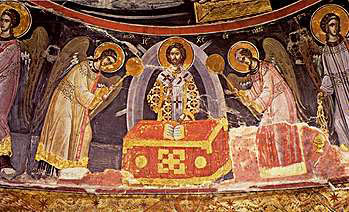

Question: What is the reason for the difference in practice of churching boys, who are taken behind the altar, and the churching of girls, who are not?

In Baptism, a person is united with Christ and His Church, and becomes a full member of the Church. The Rite of the Churching of an infant who has been baptized is the solemn act of bringing the child into the Church, and offering them to God. Baptisms are now often done inside the Nave of the Church, but historically, baptisms were either done outside (in a flowing river or lake), or in a baptistery that might be separate from the Church altogether, or which is located in the Narthex of the Church. And so, historically, after the Baptism concluded, the newly baptized was brought into the Nave for the first time.

Why is it that boys are brought into the Altar, but girls are only brought in front of the Royal Doors? Both are being offered to God, but their service to the Church in this life will be different. Fr. Victor Potapov says that boys are brought into the Altar, because this is "a sign that he may become a minister of the altar" (On the Significance of the Rite of Churching).

The fact that this has been the universal practice of the Church should be sufficient to convince us that we should accept it, and pass it on without change. However, in our times, when many seek to erase all gender distinctions, many now object to this practice as being "unfair.' And this, of course, also raises the question of having altar girls, as well as the ordination of women.

First off, it should be pointed out that there is not an absolute prohibition against women entering the altar. No one should go into the altar who does not have a blessing to do so. Normally, the altar servers are in fact all male, but in convents, nuns often serve as altar servers, as can been seen in this video which shows Greek nuns censing the Kursk Icon:


(If you click here, it will take you to the point of the video in which the censing begins -- which is done very impressively)

It is also true that there were deaconesses in the early church, who did not serve in a way identical to male deacons, but who did enter the altar.

As for the question of the ordination of women as priests, it is often argued that the long standing practice of the Church to the contrary was simply based on cultural prejudices of the day, and that perhaps it never occurred to the Apostles that women might be ordained. The problem with this line of argument is that while Israel had a male only priesthood, the Canaanites had priestesses, and so did the Greeks and Romans during the time in which the Early Church took shape. So clearly Christ and the Apostles made a conscious decision that Presbyters and Bishops would be males only. Not because women are not smart, or capable -- because obviously they are -- but because they have other roles to fill.

I was raised in the Church of the Nazarene, which allowed for the ordination of women from its founding (1908). And early on, about 20% of their ministers were women, but by the time I was growing up in that denomination, I never saw a local Church that had a woman functioning as a pastor. When I was studying to be a minister, there were some women that were also preparing for ordination, but when you asked them what they wanted to do as ministers, the ones I went to school with all wanted to do things that they could have done in the Orthodox Church without having been ordained: children's ministry, music ministry, etc. So why is it that in a denomination that allowed women to be ordained as elders, that almost none of the women wanted to serve as pastors? Because being the pastor of a Church is a fatherly role. Like it or not, men and women are different, and they each have unique attributes that they bring to a parish that are necessary for a healthy and balanced community. Priests in the context of the Church play a fatherly role, and usually their wives, along with other strong women in the parish play a motherly role. Both roles are needed.

When I think of the best examples of Orthodox womanhood, I think of the Most Holy Theotokos, for one, who was never in the limelight during her life, but who is more honorable than the cherubim and more glorious beyond compare than the seraphim. Aside from the God-man Himself, there is no other human that has ever lived that even comes close to her -- man or woman.

I also think of the Holy New-martyr Grand Duchess Elizabeth, who was a strong woman who did great things for the Church, was loved by the people, and died a Martyr's death. She lived a life of humility and service, and was fearless in her intention to remain faithful to Christ. And while in this life she may never have entered the altar of a Church, in my parish's altar, on the Holy Table itself, there is a relic of hers that is in our Antimins, upon which we celebrate every liturgy, and without which we could not celebrate the Liturgy at all. Whether we are able to enter the Altar in this life is not nearly as important as the space we will occupy for all eternity.

One of the most important Christian virtues is humility, and one of the most important arenas to exercise that humility is when it comes to receiving the Tradition of the Church, and passing it on without change to the next generation. It is not for us to judge the Tradition of the Church -- it is for us to be judged by that Tradition. It is not for us to conform the Tradition to the fads of our time, but rather for us to conform ourselves to that Tradition, despite those fads.

Update: Fr. Andrew Damick makes a somewhat contrary case in his article: "The Churching of Infants: Reflections on Liturgics in a Pan-Orthodox World." In the comment section, he commented on this post:
"...Fr. John’s piece is basically explaining his understanding of why his church does things the way they do. But it is only one practice among several and a relatively later one and not historically normative. He does say of his church’s practice “this has been the universal practice of the Church,” but offers no evidence that that is so. The notes from Fountoules demonstrate that this is not so."
I would note however, that the notes from Fountoules, which he references, specifically state: "Today, only males are taken into the altar, baptized or not." Which shows that this has been the universal practice. Whether it has always been is another question.  And in fact, the Book of Needs, published by St. Tikhon Seminary Press states in a note:
"The pattern for entering the Altar with the infant is not stated in the Book of Needs [i.e., it is not spelled out], but it is taken from St. Simeon of Thessalonica: The Priest carried the infant (if a male) into the Altar through the south door, and, circling the Holy Table (when he reaches the east side) he inclines the infant to the Holy Table, as a sign of veneration to the Holy Table, and then, having placed the infant by one of  the icons in the Altar, near the place where is the Table of Oblation (if it be in a separate room), he takes him up from the Altar and sets him on the Ambon. But, if the infant is female, then the Priest does not bring her into the Altar, but sets his face towards one of the Icons near the Royal Gates, and then places her on the Ambon" (The Great Book of Needs," Volume I, St. Tikhon's Seminary Press, 1998, p. 15).
In any case, there may well have been different practices over the centuries, but the practice which we have received is in fact the practice that the entire Church had adopted, at least at some point.

See also: Stump  the Priest: The Priesthood