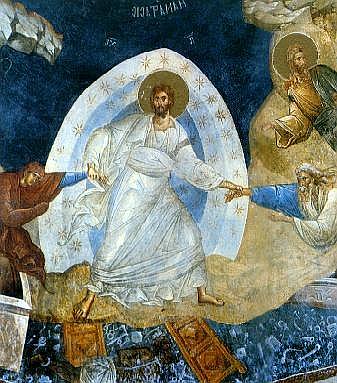
Showing posts with label Pascha. Show all posts

Thursday, May 16, 2024

Stump the Priest: "Indeed He is Risen!" or "Truly He is Risen!"?


Question: "Why do some Orthodox respond to "Christ is Risen!" with "Indeed He is Risen!" but others say, "Truly He is Risen!"? Which one is correct?"

Both responses are perfectly good translations of the responses in Greek and Slavonic. But "Truly He is Risen!" is most likely based on the Greek response, and "Indeed He is Risen!" is most likely based on the Slavonic.

The oldest English Orthodox text of the Paschal services that I have been able to find actually differs slightly from both. The Service book of the Holy Orthodox-Catholic Apostolic Church, which was translated by. Isabel Hapgood, and was originally published in 1906, and then published in a corrected edition in 1922, uses the phrase: "He is risen indeed!"

In Greek, the response is Alithos Anesti! (Αληθώς Ανέστη!), and the most natural translation of the Greek word "Alithos" would be "Truly." However, in Slavonic the response is Voistinu Voskrese! (Воистину Воскрес!), and the word "Воистину" has the prefix, "Во" which means "in" followed by "истину" which means "truth." So you could translate it literally as "In Truth," but "Indeed" is probably a more elegant way to translate it. In any case, that is how Isabell Hapgood translated it, and although we did not keep her phrasing exactly, it probably influenced the form we now commonly use.

I hope someone writes a good book on the history of English translations of Orthodox liturgical texts, because you can see that usage has evolved. For example, Hapgood translated "Theotokos" as "Birth giver of God," which is a good literal translation, but most English speaking Orthodox today simply use "Theotokos," which has been in English usage as theological term since at least 1868. On the other hand, it is interesting that Hapgood's translation of the Paschal Troparion ("Christ is risen from the dead, trampling down death by death, and upon those in the tombs bestowing life") is what is most commonly used today. So over time, what seems to work best in English bubbles to the surface, and we settle on particular translations.

Thursday, April 09, 2020

Holy Week at Home, Part 2


The following is a continuation of Holy Week at Home, Part 1. This concludes the most important services of Holy Week that can be done as reader services.

You will also find a lot of answers to practical questions about how to do reader services on the Reader Service Horologion Page.

On Holy Saturday morning (April 18th):

You can do the 3rd, 6th, and 9th Hour, for Holy Saturday:

http://www.saintjonah.org/services/3rd6th9th_holysaturday_rs.doc

Followed immediately by Typika and Vespers for Holy Saturday:

http://www.saintjonah.org/services/holysaturday_vespers_rs.doc

Alternatively, you could just read the Holy Saturday Old Testament Readings:

http://www.saintjonah.org/services/holysat_readings.doc

On Holy Saturday afternoon, or evening, you could read through the book of Acts, which is what is appointed by the Typikon.

At about 11:30 p.m. on Holy Saturday, you would do the Midnight Office:

http://www.saintjonah.org/services/paschal_midnightoffice_rs.doc

The Midnight Office is the last service of the Triodion, and we then immediately begin the services of Pascha. Paschal Matins is served at approximately 12:00 a.m., April 19th:

http://www.saintjonah.org/services/paschal_matins_rs.doc

Then you do the Paschal Hours. If you were doing what the Typikon calls for, you would do this service three times, for the 1st, 3rd, and 6th hours. In parish practice, it is usually only done once.

http://www.saintjonah.org/services/paschalhours_rs.doc

During Bright Week, the Paschal Hours are what we do for our morning and evening prayers. For more on how they can be sung, see: https://fatherjohn.blogspot.com/2015/04/the-paschal-hours.html

And then, in the place of the Paschal Liturgy, we do Typika:

http://www.saintjonah.org/services/typika_pascha.doc

The above order of Typika incorporates the Festal Antiphons, and so is a bit more like the Paschal Liturgy. Fr. George Lardas has also put together the Typika according to the order found in the Slavonic Great Horologion, and he provides it in various languages, and combinations of languages:

https://drive.google.com/drive/u/0/folders/1-HaeJSqEnxFYbvnsuNB0RueAxmBMl7PR

On the Afternoon of Pascha, you can serve the Agape Vespers:

http://www.saintjonah.org/services/agape_vespers_rs.doc

If doing the other Paschal services is too much, Typika is fairly simple, and the Paschal Hours are also short and simple, so you should at least do those services.

Update: If you prefer ePub format, some of the above services have been converted to that format, and are available here: https://drive.google.com/drive/folders/1nF7NEF3N6SxQf6jp-aReuNj1VwpuioZs

Update 2: The Carpatho-Russian Diocese has a document that has some useful ideas for doing Holy Week at home, especially with children. It also has some icons at the end that with a color printer could be very useful for the services: https://www.acrod.org/assets/files/PDFS/Bishop/2020-archpastoral/HOLY%20WEEK%20FROM%20HOME%20Letter%20Size.pdf

Tuesday, April 14, 2015

The Paschal Hours (How to do them)


During Bright Week, the Paschal Hours are done in place of the usual order for Small Compline and the Midnight Office, in addition to the First, Third, Sixth, and Ninth Hours. It is also a pious practice to do them in place of our usual morning and evening prayers (which are based on the Midnight Office, and Small Compline). If you have a Jordanville Prayer Book, you have the text of the Paschal Matins, followed by the text for the Paschal Hours (in the 4th edition, it begin on page 206). You can also find the text, arranged for use by a laymen here. And you can also listen to this audio file to learn how to sing the Paschal Hours, if you don't know how to sing the tones: http://www.saintjonah.org/podcasts/paschalhours.mp3

Singing the Paschal Hours during bright week make for an easy and joyful prayer rule, and help keep us connected with the celebration of Bright Week, if we are unable to attend services this week.

Thursday, May 01, 2014

2014 Pascha Photos

The Midnight Office

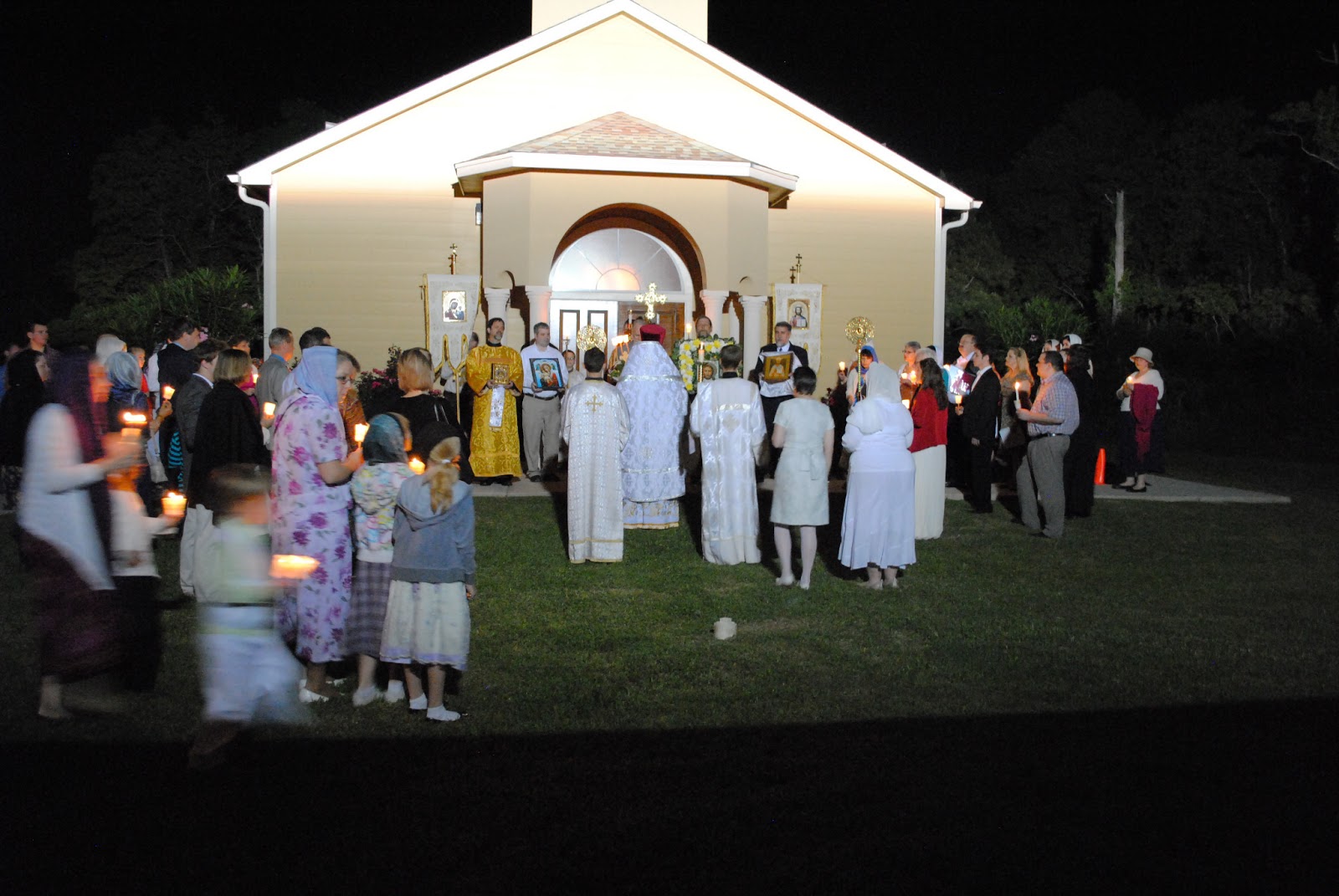
The Procession


Paschal Matins


A Video of the Censing at the First Ode


The Blessing of the Artos


The blessing of the Baskets


The Paschal Trapeza


The Agape Vespers


The Reading of the Gospel
In English

French

Russian

Greek and German

Mandarin Chinese

Polish

Korean

Japanese

It was also read in Spanish


The Picnic

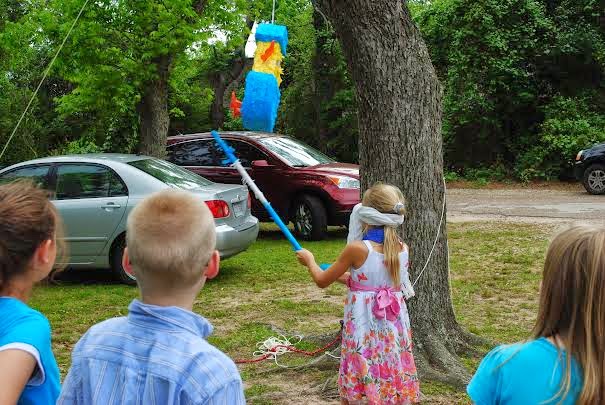
The Pinata


The End of the day

Saturday, June 01, 2013

Pictures from Pascha at St. Jonah 2013


The Midnight Office


The beginning of the Paschal Matins


The blessing of Paschal Baskets


After the Agape Vespers

The Paschal Piñata

Tuesday, April 17, 2007

Today is the Day of Rejoicing


The first Tuesday following Bright Week (Easter week) is Radonitsa (which means "Day of Rejoicing"). On this day, Orthodox Christians go to the tombs of their loved ones, and share the joy of Pascha with them.

After work, I stopped by Anastasia Titov's grave, for the first time since her funeral. I served a Panikhida (memorial service) for her and some of the other Orthodox people I know who are buried in that cemetery. I was afraid that it would be raining, but the rain stopped just before I got there, and then resumed after I was finished and back in my car. Although Anastasia has no relatives in this part of the country, I could see that I was not the first one there. There were Easter eggs left on her tomb; as well as some palms and pussy-willows, flowers, and a candle decorating her grave.

The words of the Paschal Troparion had a new significance to me, as I sang out loud before her grave:

"Christ is risen from the dead, trampling down death by death, and upon those in the tombs bestowing life."

What a joy it was, indeed... because Indeed He is Risen. And indeed, she is with him, and will rise again just as He is risen.

Wednesday, April 11, 2007

Rita Wilson: Why Easter is Greek to Me: Xristos Anesti!

From the Washington Post

Once every few years, Greek Easter falls the same week as “American Easter,” as it was called when I was growing up.

In order for “Greek Easter” to be celebrated the same week as “American Easter,” Passover has to have been celebrated already. We Greeks don’t do Easter until after Passover, because how can you have Easter BEFORE Passover. Jesus went to Jerusalem to celebrate Passover, after all. Unless it is one of the years when the two holidays align. Like this year.

Here are some of the things that non-Greeks may not know about Greek Easter: We don’t do bunnies. We don’t do chocolate. We don’t do pastels.

We do lamb, sweet cookies, and deep red. The lamb is roasted and not chocolate, the sweet cookies are called Koulorakia and are twisted like a braid, and our Easter eggs are dyed one color only: blood red. There is no Easter Egg hunt. There is a game in which you crack your red egg against someone else’s red egg hoping to have the strongest egg, which would indicate you getting a lot of good luck.

Holy Week, for a Greek Orthodox, means you clear your calendar, you don’t make plans for that week at all because you will be in church every day, and you fast. Last year, in addition to not eating red meat and dairy before communion, my family also gave up sodas for the 40-day Lenten period.

During one particularly stressful moment, there were many phone calls amongst our kids as to whether or not a canned drink called TING, made with grapefruit juice and carbonated water was, in fact, a soda and not a juice, which our then 10-year-old decided it was, so we had a Ting-less Lent.

No matter where I find my self in the world I never miss Easter, or as we call it, Pascha. I have celebrated in Paris, London, New York City, Los Angeles, and in Salinas, California at a small humble church that was pure and simple.

When we were kids, our parents would take us, and now as parents ourselves we take our children to many of the Holy Week services including the Good Friday service where you mourn the death of Jesus by walking up to the Epitaphio, which reperesents the dead body of Christ, make your cross, kiss the Epitaphio, and marvel at how it was decorated with a thousand glorious flowers, rose petals and smells like incense.

Some very pious people will crawl under the Epitaphio. I have always been so moved to see this. There is no self- consciousness in this utter act of faith. There is no embarrassment to show symbolic sorrow at the death of our Saviour.

At a certain point in the Good Friday service, the Epitaphio is carried outside by the deacons of the church, as if they are pall bearers, followed by worshippers carrying lit candles protected from dripping on your clothes and on others by having a red plastic cup that sits below the flame to catch the wax drippings. Every Greek person knows all too well the smell of burning hair.

One time, in London, I smelled something and turned to look at where the smell might be coming from, only to be horrified that it was coming form me and my head was on fire. But I digress.

It is somber and quiet as we follow the Epitaphio, in candlelight, from the altar to the outdoors, in order for it to circle the church before it returns back to the altar. We sing beautiful lamentations that make your heart break with their pure expression of sadness and hope.

One of my favorite services during Easter is Holy Unction. This happens on the Wednesday of Holy Week. Holy Unction is a sacrament. It is for healing of our ills, physical and spiritual. It is preparing us for confession and communion. This sacrament has always been so humbling to me.

When you approach the priest for Holy Unction, you bow your head and as he says a prayer and asks you your Christian name, he takes a swab of blessed oil and makes the sign of the cross on your forehead, cheeks, chin, backs of your hands and palms. It is a powerful reminder of how, with faith, we can be healed in many ways.

The holy oil is then carefully dabbed with cotton balls provided by the church so you don’t leave there looking as if you’re ready to fry chicken with your face, and before you exit the church, you leave your cotton balls in a basket being held by altar boys, so as not to dispose of the holy oil in a less than holy place. The church burns the used cotton balls.

There have been times when I have left church with my cotton ball and have panicked when I am driving away. At home I take care of it. Imagine a grown woman burning cotton balls in her sink. But that is what I do.

Midnight Mass on Saturday night, going into Sunday morning is the Anastasi service. We will arrive at church at around 11 p.m., when it starts, and listen to the chanter as he chants in preparation for the service. My kids, dressed in their suits and having been awakened from a deep sleep to come to church, groggily sit and wait holding their candles with red cup wax catchers.

As the service progresses, the moment we have all been waiting for approaches. All the lights in the church are turned off. It is pitch black It is dead quiet. The priest takes one candle and lights his one candle from the one remaining lit altar candle, which represents the light of Christ’s love ( I believe).

From this one candle, the priest approaches the congregation and using his one candle he shares his light with a few people in the front pews. They in turn share their light with the people next to them and behind them. In quiet solemnity, we wait until the entire church is lit with only the light of candles, the light that has been created by one small flame has now created a room of shared light.

And at a moment that can only be described as glorious, the priest cries out, “Xristos Anesti!” “Christ is Risen!” We respond with “Alithos Anesti!” “Truly, He is Risen!” We sing our glorious Xristos Anesti song with the choir. That moment, which happens about an hour, to an hour and half into the service and seems as if the service is over, actually marks the beginning of the service. The service then continues for another hour and a half.

When I was a kid, after the service was over, we would go to the Anastasi Dinner that the church would throw in the church hall, where we would break our fast, drink Cokes at 2:30 in the morning, dance to a raucous Greek band and not go home until our stomachs were full of lamb, eggs, Koulouraki, and we saw the sun rise. Or was it the Son rise?

But usually now, after Midnight Mass, we drive home with our still-lit candles. I always love seeing the looks on peoples faces as they pull up to our car seeing a family with lit candles calmly moving at 65 m.p.h. down the highway. When we get home, we crack eggs, eat cookies, drink hot chocolate (so not Greek) and I burn a cross into our doorways with the carbon from the candle smoke to bless our house for the year.

There have been many times when painters touching up the house have wondered why there was this strange black cross burned into our doorways. The next day is usually followed by a late sleep in, then getting up and doing the same thing you just did but in the daytime at the Easter Picnic, usually held at a local park.

I have to say, the Greeks know how to do Easter. Make no mistake. This is the most important holiday in our church. It is a beautiful week. I haven’t even begun to touch on what the week is really like. This is a sampling of a sampling of what it is like. It is so much more deep, so much richer than I have written here.

But one thing is clear. It is a powerful, beautiful, mysterious, humbling, healing and moving week. It is filled with tradition and ritual. It is about renewal and faith. And even though it is still too early to say, Xristos Anesti! Alithos Anesti!

Actress Rita Wilson, whose mother and father both were born in Greece, is widely credited with landing Nia Vardalos a movie deal for "My Big Fat Greek Wedding." Wilson and her actor husband Tom Hanks had their own "Big Fat Greek Wedding" in 1988. They have two children.

Thursday, April 27, 2006

Pascha in Dachau, 1945


The Russian Memorial Chapel at Dachau
Click here to the see the interior


Pascha in Dachau

Gleb Alexandrovitch Rahr - Prisoner R (Russian)

Dachau concentration camp, April 27th, 1945

This is my father's account of how he celebrated the feast in 1945.

The last transport of prisoners arrives from Buchenwald. Of the 5,000 originally destined for Dachau, I was among the 1,300 who had survived the trip. Many were shot, some starved to death, while others died of typhus... April 28th: I and my fellow prisoners can hear the bombardment of Munich taking place some 30 km from our concentration camp. As the sound of artillery approaches ever nearer from the west and the north, orders are given proscribing prisoners from leaving their barracks under any circumstances. SS-soldiers patrol the camp on motorcycles as machine guns are directed at us from the watch-towers, which surround the camp.

April 29th: The booming sound of artillery has been joined by the staccato bursts of machine gun fire. Shells whistle over the camp from all directions. Suddenly white flags appear on the towers - a sign of hope that the SS would surrender rather than shoot all prisoners and fight to the last man. Then, at about 6:00 p.m., a strange sound can be detected emanating from somewhere near the camp gate which swiftly increases in volume... Finally all 32,600 prisoners join in the cry as the first American soldiers appear just behind the wire fence of the camp. After a short while electric power is turned off, the gates open and the American GIs make their entrance. As they stare wide-eyed at our lot, half-starved as we are and suffering from typhus and dysentery, they appear more like fifteen-year-old boys than battle-weary soldiers...

An international committee of prisoners is formed to take over the administration of the camp. Food from SS-stores is put at the disposal of the camp kitchen. A US military unit also contributes some provision, thereby providing me with my first opportunity to taste American corn. By order of an American officer radio-receivers are confiscated from "prominent Nazis" in the town of Dachau and distributed to the various national groups of prisoners. The news come in: Hitler has committed suicide, the Russians have taken Berlin, and German troops have surrendered in the South and in the North. But the fighting still rages in Austria and Czechoslovakia...
Naturally, I was ever cognizant of the fact that these momentous events were unfolding during Holy Week. But how could we mark it, other than through our silent, individual prayers? A fellow-prisoner and chief interpreter of the International prisoner's committee, Boris F., paid a visit to my typhus-infested barrack "Block 27" to inform me that efforts were underway in conjunction with the Yugoslav and Greek National Prisoner's Committees to arrange an Orthodox service for Easter day, May 6th.

There were Orthodox priests, deacons and a group of monks from Mount Athos among the prisoners. But there were no vestments, no books whatsoever, no icons, no candles, no prosphoras, no wine... Efforts to acquire all these items from the Russian parish in Munich failed, as the Americans just could not locate anyone from that parish in the devastated city. Nevertheless, some of the problems could be solved: The approximately 400 Catholic priests detained in Dachau had been allowed to remain together in one barrack and recite mass every morning before going to work. They offered us Orthodox the use of their prayer room in "Block 26", which was just across the road from my own "block". The chapel was bare, save for a wooden table and a Czenstochowa icon of the Theotokos hanging on the wall above the table - an icon which had originated in Constantinople and was later brought to Belz in Galicia, where it was subsequently taken from the Orthodox by a Polish king. When the Russian Army drove Napoleon's troops from Czenstochowa, however, the abbot of the Czenstochowa Monastery gave a copy of the icon to czar Alexander I, who placed it in the Kazan Cathedral in Saint-Petersburg where it was venerated until the Bolshevik seizure of power. A creative solution to the problem of the vestments was also found. New linen towels were taken from the hospital of our former SS-guards. When sewn together lengthwise, two towels formed an epitrachilion and when sewn together at the ends they became an orarion. Red crosses, originally intended to be worn by the medical personnel of the SS-guards, were put on the towel-vestments.

On Easter Sunday, May 6th (April 23rd according to the Church calendar), - which ominously fell that year on Saint George the Victory-Bearer's Day, Serbs, Greeks and Russians gathered at the Catholic Priests barrack. Although Russians comprised about 40 percent of the Dachau inmates, only a few managed to attend the service. By that time "repatriation officers" of the special "Smersh" units had arrived in Dachau by American military planes, and begun the process of erecting new lines of barbed wire for the purpose of isolating Soviet citizens from the rest of the prisoners, which was the first step in preparing them for their eventual forced repatriation. In the entire history of the Orthodox Church there has probably never been an Easter service like the one at Dachau in 1945. Greek and Serbian priests together with a Serbian deacon adorned the make-shift "vestments" over their blue and gray-striped prisoners uniforms. Then they began to chant, changing from Greek to Slavonic, and then back again to Greek. The Easter Canon, the Easter Sticheras - everything was recited from memory. The Gospel - "In the beginning was the Word" - also from memory.

And finally, the Homily of Saint John Chrysostom - also from memory. A young Greek monk from the Holy Mountain stood up in front of us and recited it with such infectious enthusiasm that we shall never forget him as long as we live. Saint John Chrysostomos himself seemed to speak through him to us and to the rest of the world as well! Eighteen Orthodox priests and one deacon - most of whom were Serbs, participated in this unforgettable service. Like the sick man who had been lowered through the roof of a house and placed in front of the feet of Christ the Saviour, the Greek Archimandrite Meletios was carried on a stretcher into the chapel, where he remained prostrate for the duration of the service.

The priests who participated in the 1945 Dachau Easter service are commemorated at every Divine Service held in the Dachau Russian Orthodox Memorial Chapel, along with all Orthodox Christians, who lost their lives "at this place, or at another place of torture" ("na meste sem i v inykh mestakh mucheniya umuchennykh i ubiennykh"). The Dachau Resurrection-Chapel, which was constructed by a unit of the Russian Army's Western Group of Forces just before their departure from Germany in August, 1994, is an exact replica of a North-Russian "tent-domed" (Shatrovyie) church or chapel. Behind the altar-table of the chapel is a large icon depicting angels opening the gates of the Dachau concentration camp and Christ Himself leading the prisoners to freedom. Today I would like to take the opportunity to ask you, Orthodox Christians all over the world, to pass on the names of fellow Orthodox who were imprisoned and died here in Dachau or in other Nazi concentration camps so that we can include them in our prayers. Should you ever come to Germany, be sure to visit our Russian Chapel on the site of the former concentration camp in Dachau and pray for all those who died "at this place, or at another place of torture".

Khristos voskrese! Christos anesti! Christ has risen! El Messieh Qahm!

Paschal Blogging


The Holy Fire in Jerusalem

Pascha in Uganda.

Notes for Bright Week