Recently Public Orthodoxy published an article by Lidiya Lozova, in which she excused the government sponsored persecution of the Ukrainian Orthodox Church, and alleged that this reflects the popular opinion of the Ukrainian people. After expressing her objection to the use of violence as a means of "resolving conflicts among church communities in Ukraine" (i.e. the use of violence when government backed Nazi thugs* steal Church property from the canonical Church in order to give it to the schismatics** under Epiphony Dumenko), she goes on to blame this violent persecution on the people being persecuted, suggested essentially that they asked for it and have it coming, and then she denies almost completely the role of the Ukrainian government in ginning up that violence in the first place:
"...in the context of international sympathies expressed to the UOC [Ukrainian Orthodox Church] today, I have to admit that the social opposition and violence directed at this church in Ukrainian society is not an artificial construct of the Ukrainian authorities; it is, in my opinion, a reaction to the hidden structural violence, which has been present in the matrix of this organization since 1990s and especially after 2014, when the leadership of the UOC changed" [Emphasis added].
Among the alleged transgressions the Ukrainian Orthodox Church is accused of by the author, is supposedly that some priests have refused to do funerals for Ukrainian soldiers... though she provides no specific information on that. Likely, if there were such cases, the refusal would have been due to the fact that the soldiers in question were not members of the canonical Orthodox Church. Countless funerals have been performed for soldiers who were members of the UOC.
She goes on to make the assertion:
"In short, the UOC as a whole is not welcomed in Ukraine in spite of their participation in the humanitarian aid efforts and the service of many UOC members in the Ukrainian Armed Forces."
She, however, presents us with no reason to believe that this assertion is true. But even if, for the sake of argument, we were to assume that it was true, it would be true in the context of the Ukrainian government controlling the media, and the people in Ukraine being fed a constant stream of propaganda accusing the Ukrainian Orthodox Church of being disloyal. Anyone who deviates from the government narrative puts themselves at risk of both judicial and extra-judicial punishment [aka public lynchings]. So there is in fact no objective way to measure the actual opinions of the people in Ukraine at the present.
We can, however, gauge the opinions of people who actually go to Church in Ukraine, because we consistently see that when Churches have been stolen from the canonical Church, they are either left padlocked, or the number of people attending the schismatic services is a mere fraction of the number who attended the Church before.
Though the author states that she is "not fully satisfied with the actions of the state and the reaction from the OCU [the schismatic Ukrainian Church] members..." She fails to honestly confront the role of the Ukrainian government, nor does she give the reader any real idea of the scope and severity of the persecution of the canonical Ukrainian Orthodox Church. One day, when the full truth of what has been going on in Ukraine is more widely known, she may have reason to be embarrassed that she made excuses for those who were persecuting the faithful under the canonical Ukrainian Orthodox Church under the Metropolitan Onuphry.
* When I speak of "Nazi thugs," I am not using the term "Nazi" as a pejorative slur. I am referring to the actual Nazis that are usually the ring leaders behind the seizure of Church in Ukraine. For example, Yevhen Karas is the head of the Nazi group "C14." You can see the role his group has been playing recently in this video from the Union of Orthodox Journalists. You will see Yevhen Karas prominently featured in this video which takes about the role of Nazis in Ukraine. The fact that the government is backing them is shown by the fact that they are allowed to operate freely and openly engage in violent assaults directed at innocent people. Given the manpower shortage the Ukrainian army has, one has to wonder why so many young men are allowed to engage in such things, and remain out of uniform and out of the war. What one makes of these facts is up to them, but these are indeed facts.
** That Epiphony is the head of schismatic Church is laid out in the following articles:
Furthermore, I would point out that the fact that the monastics in Ukraine have overwhelmingly remained loyal to Metropolitan Onuphry should tell any pious Orthodox Christian everything that they need to know about who is legitimate, and who is not.
The use of the word "ecumenical" with reference to the Church has been twisted to mean something entirely different than it has meant historically. The word itself literally means "universal," but in the context of the Church it was used to refer to universal councils of the One, Holy, Catholic, and Apostolic Church. These councils were not convened in order for Orthodox bishops to hobnob with heretics, or to sweep their differences under the rug. Quite the contrary, these councils were convened in order to drive heresies and unrepentant heretics out of the Church.
The term "Ecumenical" was, however, hijacked by the Ecumenical Movement, which had its origins among Protestants. During the 19th century, Protestant missionary activity around the world expanded exponentially, but since Protestants have wildly different beliefs, the problem of different Protestant sects competing for the same converts on the mission field quickly became apparent. The desire to not have Protestant missionaries working at cross purposes resulted in the first World Missionary Conference, which was held in Edinburgh, Scotland in 1910. This also happened at a time when Protestant liberalism was on the rise, which undermined the doctrinal certainty the various Protestant sects had previously maintained with regard to their own beliefs. So out of the Protestant missionary movement, the Ecumenical movement began to gain steam. The Ecumenical movement had as its goal the unity of all Christians -- which would not be a bad goal at all, if the end goal was a unity in the Truth, but as liberal Protestants began abandoning any belief that there was such a thing as Truth, this movement was no longer burdened by conflicting beliefs about what is true, and instead was focused on unity for unity's sake. The Ecumenical Movement has indeed gone far beyond seeking the unity of all Christians, to seeking the unity of all religions.
Orthodox involvement in the Ecumenical movement has a long and complicated history. In short, some have participated in it for the purpose of bearing witness to the Orthodox Faith, or to facilitate cooperation on matters of mutual interest. But other have participated in it because they have bought into the idea that the Church is divided into various branches, with the Orthodox Church being but one of many branches. Such people have bought into this idea for the same reason that liberal Protestants did -- they no longer really believe what the Orthodox Church has always taught, and so are no longer burdened by question of Truth.
There is much more that could be said about the Ecumenical Movement, and why its motivations are heretical (and indeed a pan-heresy, because it seeks to incorporate all heresies into the Church), but I will instead refer the reader to the voluminous articles on Ecumenism on the Orthodoxinfo.com website.
I do however want to draw attention to how Ecumenism among those who are ostensibly Orthodox is working to merge renovationism, modernism, and LGBTQP and abortion activism into what will likely come to be the church of the Antichrist. For evidence of this, one need look no further than Archbishop Elpidophoros.
On July 15, 2021, Archbishop Elpidophoros gave a speech at the International Religious Freedom Summit, entitled “The Rising Tide of Religious Nationalism,” in which he said:
"When you elevate one religion above all others, it is as if you decide there is only one path leading to the top of the mountain. But the truth is you simply cannot see the myriads of paths that lead to the same destination, because you are surrounded by boulders of prejudice that obscure your view."
So not only do the Ecumenists no longer believe that the Orthodox Church is the One, Holy, Catholic, and Apostolic Church, as it has always taught and believed, but that Christ is not the only path to salvation, contrary to the words of Christ Himself: "I am the way, the truth, and the life: no man cometh unto the Father, but by me." (John 14:6).
On top of all this, the Ecumenical Patriarch has long promoted the idea of union with Rome, which is a church that is much further down the path of "inter-religious dialogue" (see this video and this video, for examples. These videos were produced by Greek Old Calendarists, but the footage shown speaks for itself). Rome is also quickly heading down the path of embracing LGBTQP ideology. German bishops are already allowing services to recognize gay marriages, and while Pope Francis may be uncomfortable with how quickly they are moving, he shows no signs of actually wanting to stop them.
What has been going on in Ukraine (long before 2022) illustrates how these various heresies are converging together. Let me quote what I said in a talk I gave in Moscow in February of 2019 about the actions of the Ecumenical Patriarch in Ukraine, and where things seem to be heading:
"In the United States and in the English-speaking Orthodox world generally, we hear many voices from within the Patriarchate of Constantinople, which are supporting homosexuality, openly. The Archons have helped fund an Orthodox institute at Fordham University. The heads of this institute have used this platform to launch a website called “Public Orthodoxy” which regularly promotes homosexuality and other forms of deviancy. And it is not bad enough that they publish this material in English, but they now translate their articles into Russian, Greek, and Serbian. And they do this without the slightest hint of any rebuke from the Greek Archdiocese of America. In fact, whenever they have a big event, Archbishop Demetrios of New York is usually present, adding his authority to that event. For example, one of the heads of this institute, Aristotle Papanikolaou, in an article in another pro-homosexual journal, The Wheel, wrote that expecting people who suffer from same-sex attraction to remain celibate is “unrealistic” and unhealthy, and that such desires should best be expressed in the context of “long-term committed relationships or marriages” (The Wheel 13/14, Spring/Summer 2018, p. 97 [emphasis added]. See also "Unitarian Morality With a Little "Theosis" Sprinkled on Top," "The Living Church 2.0," and "Cultural Marxism and Public Orthodoxy").
Patriarch Bartholomew’s Archdeacon, Fr. John Chryssavgis, has made a number of pro-homosexual statements. For example, he wrote a review of a book that was a simple piece of pro-homosexual propaganda written by a homosexual Episcopal priest, and he gushed with praise for what a great contribution this book was to the important “dialogue” on homosexuality. The only slight criticism he made of this book was to say that he remained “unconvinced” by some of the book’s arguments that the Scriptures support homosexuality. This is from a man who has no difficulty expressing his disagreement, in eloquent and striking terms… when he wishes to.
Many of you are aware of the call that was made to “Metropolitan” Epifany, by a Russian prankster, who pretend to be a western diplomat, and congratulated him on the “autocephaly” of the Church in Ukraine, but expressed his hope that Epifany would take a different stand on homosexuality than the conservative one taken by the Russian Church. Epifany assured him that he would not take such a conservative stand against homosexuality.
And what I have noticed, in the English-speaking Orthodox world at least, is that those who promote the acceptance of homosexuality in the Orthodox Church have all been consistently lining up behind the EP’s actions in Ukraine.
One other agenda item that I think is clearly behind the EP’s actions in Ukraine is the goal of union with Rome. We already see the schismatics in Ukraine concelebrating with Uniates with increasing frequency. One thing that is certain is that Patriarch Bartholomew’s actions in Ukraine make no sense, if he intends to remain in the Orthodox Church.
Furthermore, there are very strong indications that the United States State Department has had some role in pushing for these actions, but to what extent, or in what form this pressure was applied, we do not yet know" (An American Perspective on the Ukraine Crisis).
We can of course hope that the Ecumenical Patriarchate will reverse course, and that things will not unfold as I am suggesting, but this will be a lot more likely to happen if more people are aware of where they have been heading, and begin to call these erring "Orthodox" back to the fold.
You cannot be pro-abortion, and be an Orthodox Christian. You cannot advocate LGBTQP ideology and be an Orthodox Christian. You cannot be a renovationist and be an Orthodox Christian. You cannot embrace Ecumenism, and deny what the Orthodox Church has always taught about itself, and be an Orthodox Christian. Such people may be formally members of the Church, but they have spiritually cut themselves off from both Christ and the Church. Those who actually are Orthodox need to speak clearly on these issues, so that those want to remain Orthodox Christians, or who want to become Orthodox Christians, will not be confused by their errors.
Renovationists are people who see that the Church is out of sync with the modern world, and rather than conclude that the world needs to repent and come into line with the teachings of the Church, instead assume that the Church is what needs to be fixed. To them, the solution to this problem is to make the Church more like the world, rather than to make the world more like the Church.
In any given time or place, one can certainly find problems within the Church, and see a need to do something about those problems. And so a desire to see things change within the Church is not necessarily a bad thing. One could point to the example of the Kollyvades Fathers, or even to St. John Chrysostom, as people who saw spiritual deficiencies within the Church, and spent their lives trying to raise the general spiritual level of those around them. But the big difference between people like the Kollyvades Fathers, St. John Chrysostom, and the Renovationists is where they look for answers to problems and where they want to take things. The Kollyvades and St. John Chrysostom embraced the authentic Traditions of the Church and the teachings of the Scriptures and Holy Fathers who came before them. Renovationists look outside the Church for answers.
When Renovationists see that the Church is out of sync with the mindset of the modern world, they are embarrassed that the Church is "backward," or "old fashioned," or "stuck in the past." They do not approach things by seeking to better understand the Orthodox Tradition, or to come closer to the mind of the Fathers. They have a worldly mindset, and their solutions are worldly. They do not have a belief in what the Church teaches, but perhaps have a sentimental attachment to the Church, or they may simply see using the Church to promote worldly agendas as advantageous.
Renovationism first began to appear in the Orthodox Church in the early 20th century. It was most obviously embodied in the "Living Church" in Russia, but it was also behind the agenda of Patriarch Meletios Metaxakis as seen in his 1923 "Pan Orthodox Congress," and this also explains why he later recognized the "Living Church" schismatics as the legitimate Church in Russia, and threw the authentic persecuted Russian Church under the bus. What was their agenda? They wanted to switch to the New Calendar. They wanted to shorten the fasts, shorten the services, allow bishops and monks to marry, and priest to remarry, and to marry widows. They also wished to introduce liturgical innovations. The Living Church died off in Russia, because the faithful in Russia rejected it, but Renovationism has continued to exist elsewhere, and while all of the aforementioned issues are still on the table for them, they have added quite a few since then.
Renovationism is closely related to Protestant liberalism and its "Social Gospel." Advocates of the Social Gospel, having lost faith in anything like the actual Gospel, seek to hitch their wagons to anything current in the culture that might make them relevant. Unfortunately, they usually are about 10 years behind the culture, and so by the time they hitch their wagon to an issue, the culture in general has moved on to the new "current thing."
Some more current examples of renovationism are the push for the acceptance of homosexuality and transgenderism in the Church, the push for ecumenism and religious syncretism, the acceptance of abortion as an acceptable option for Orthodox Christian, the ordination of women, and pretty much any other "current thing" that is being pushed. The Ecumenical Patriarchate's acceptance of the schismatics in Ukraine is in many ways similar to the Ecumenical Patriarchate's entering into communion with the Living Church in Russia. The Schismatics in Ukraine are concelebrating with Uniates, and are open to the acceptance of homosexuality -- which makes the Living Church look like conservative traditionalists by comparison.
And then you have Metropolitan Nathaniel of Chicago ordaining a gaggle of women readers, and challenging them to press forward and demand that they be allowed to fill even more roles in the Church.
And if you have ever seen a proper ordination of a reader, you will note that what happens here bears very little resemblance to what is found in the service books of the Church. Many more examples could be cited, but the point is, it is not a question of what the "current thing" happens to be, the issue with renovationism is the felt need to keep up with the "current thing."
The problem for renovationists, however, is that people don't get up early on Sunday morning, to go to stand in a service for a couple of hours, just so they can be like the world. They can stay home, and drink their coffee, and be like the world. What motivates people to actually go to Church is their hunger for something that the world can't provide them, and that is the Way, the Truth, and the Life (John 14:6). The world can only point to the wrong way, promotes lies, and lead to death.
The fact that today we have people openly promoting the LGBTQP agenda in the Orthodox Church is something that was unthinkable less than a dozen years ago. But here we are. They are a vocal minority to be sure, but like most leftists, they try to convince people that their opponents are the minority, and they are only motivated by hate.
The tactic that the Pro-LGBTQP "Orthodox" have generally taken to promote their agenda is to pretend that the only people concerned about what they are pushing are "fundamentalist" converts. The suggestion being that somehow prior to the time when Americans began to convert to Orthodoxy in large numbers, everyone in the Orthodox Church was fine with the idea that homosexuality was an acceptable lifestyle. Back then, they would have us believe, no one would have objected to embracing transgenderism, or any of the other limitless "sexual preferences" and "gender identities." This is of course complete nonsense. Not only was no one pushing for the acceptance of homosexuality in the Orthodox Church prior to 2009, no one in the Orthodox Church was even contemplating the acceptance of transgenderism, and most had never even heard of it.
Homosexuality was considered a mental disorder by the American Psychiatric Association until 1973, when activists pushed the organization to change this designation. It was only in 1987 that homosexuality was completely removed from the Diagnostic and Statistical Manual of Mental Disorders. It was in the wake of the AIDS epidemic, which began in 1981, that the acceptance of homosexuality in the wider culture began to increase from something which previously had been close to non-existent.
Fr. Alexander Schmemann is not usually thought of as a fundamentalist convert, and yet one of his students told me that around 1981, he made the statement "I refuse to be the dean of a seminary of pot-smoking homosexuals." This was in the context of him having actually kicked a pot-smoking homosexual seminarian out of the seminary, and so these were not idle words.
I have been blogging since 2004, and the first article I have in which I felt a need to respond to the push for gay marriage was in 2009, and this was completely without reference to any dispute within the Church, because at that time, there was no such dispute. I suspect that this began in 2009 because prior to that, George W. Bush had successfully used the issue to win his second term, by ensuring that there were ballot measures in swing states that banned gay marriage. But after Obama was elected, apparently people on the left felt emboldened, and so the push began. And it was only in 2011 that I began to see Orthodox Christians who were pushing for the acceptance of homosexuality. Initially, this was mostly done anonymously, or in private discussion groups.
2013 was the year that the Supreme Court struck down the Defense of Marriage Act, and forced every state to allow for gay marriage. Many dismissed the significance of this at the time, but two things happened almost immediately as a result of it -- this strengthened the general push for the acceptance of homosexuality, and no sooner had gay marriage been forced on the country did the push for the acceptance of transgenderism begin in earnest.
In 2015, the City of Houston tried to push through an ordinance which would have forced churches and businesses to allow men who identify as women to use women's restrooms. Again, the Orthodox Clergy Association issued a statement against it. The ordinance was overturned by a referendum, and it was mostly Black and Hispanic churches in Houston that led the fight against it. Houston is about 44% Hispanic, 24% White (Non-Hispanic), 22% black, and 7% Asian, and so it was not a bunch of racist White people who overturned this ordinance. The vote was not even close: 61% opposed to 39% in favor.
If you look over the archives of Public Orthodoxy, you will see that it has produced a steady stream of articles that defy almost every aspect of Orthodox Christian morality, and as a matter of fact they regularly argue that while dogmatic issues (which they define as being limited to strictly theological matters) are beyond debate, moral issues are not dogmatic, and therefore up for revision. This is a completely novel approach, and one that is heretical and contrary to the clear Tradition of the Church.
Most recently, the former Chancellor of the OCA, Fr. John Jillions gave a lecture for the Orthodox Theological Society in America, in which he bemoaned those Orthodox "fundamentalists" who are unwilling to dialogue on matters such as homosexuality and transgenderism. He argues that we cannot judge such matters "before the time," which will apparently only come when (so they hope) they finally wear everyone else down with their endless pressing of their agenda and we let them have their way. The problem is that these issues are not up for debate. Not only are the Scriptures clear on these issues, we have numerous canons from Ecumenical Councils, and the clear and unified testimony of the Fathers and Saints of the Church which leave no room for doubt as to what the Church has always taught on these subjects. In this lecture, you see the same kind of mealy-mouthed argumentation that we found in the essay by Fr. Robert Arida, but as time goes on, they are becoming more emboldened. One has to wonder how long their respective bishops will put up with this, but I think at this point, we have to conclude that at least some of the bishops in question allow this to go on because they agree with it.
Now if people like Fr. John Jillions wanted to dialogue about how to deal pastorally with people who are struggling with these sins, in order to help them overcome their sins, that would be a dialogue worth having. But you can't have that dialogue with people who are unwilling to concede that we are talking about actual sins. That has to be the starting premise. And to be clear, this is the point that they refuse to concede. In fact, they will almost never provide a direct answer to a direct question on whether or not these things are inherently sinful -- and that is for the simple reason that to say what they actually believe would put them in an indefensible position, and would force their bishops to do something about it.
We are not opposed to the LGBTQP agenda because we hate those who have been sucked into going along with it. We are opposed to it because this agenda is destructive to these people. As St. Paul tells us, these things are contrary to God's created order, and as such, they can only lead to great misery and the destruction of souls. St. Paul tells us that homosexuals and the transgendered (i.e. effeminate) will not inherit the Kingdom of God:
"Know ye not that the unrighteous shall not inherit the kingdom of God? Be not deceived: neither fornicators, nor idolaters, nor adulterers, nor effeminate [malakoi], nor sodomites [i.e., homosexuals, arsenokoitai], nor thieves, nor covetous, nor drunkards, nor revilers, nor extortioners, shall inherit the kingdom of God. And such were some of you: but ye are washed, but ye are sanctified, but ye are justified in the name of the Lord Jesus, and by the Spirit of our God" (1 Corinthians 6:9-11).
Not inheriting the Kingdom of God is a pretty big deal, if you actually believe in God, and so if you love the people struggling with these issues, you would want to help them to repent and overcome them, rather than affirm them in a choice that will lead to their spiritual deaths.
I hope I am wrong, but I believe we are witnessing the unfolding of a full-blown schism. It will not just be over abortion, or over the LGBTQP agenda, or over the other issues we will be looking at, but each of these are pieces to the larger puzzle. If a schism is to be averted, it will only be averted because bishops begin to find their backbones, put their collective foot down, and put a stop to the spreading of these false and destructive teachings.
Update:
Someone has put together a very useful video that provides an overview of what has been going on in terms of the push for the acceptance of LGBTQP ideology in the Orthodox Church, particularly in the English-speaking world:
Update 3: It is just keeps getting worse. They keep getting bolder, and don't even try to cloak what they are pushing any more. In this video, Ashley Purpura says Christ is queer, gay marriages should be blessed, and sodomy is a path to theosis, among many other blasphemous heretical assertions:
“There can be no compromise in matters of the Orthodox Faith.”
In recent years, there are lines of division that not only show the signs of an emerging schism in the Orthodox Church -- it is becoming increasingly clear that we are witnessing the birth of a new religion, which will only retain some of the outward trappings of the Orthodox Christian Faith, but in fact is increasingly becoming unrecognizable as Christian. We see this when it comes to how the innovators see the sanctity of life, sexuality, human nature, the Church, and Tradition.
As we currently contemplate the prospect of Roe vs. Wade being overturned, it is important to remember that in January of this year, at the March for Life, Archbishop Elpidophoros used the occasion to affirm his support for abortion "rights."
When I first saw the above meme, I thought a critic had put it together, only to find that this was the image from Greek Archdiocesan website -- and so evidently they were proud of what he said, and wanted these two quotes to be especially noted.
Today, we come together in solidarity with our Brother Bishops of the United States Conference of Catholic Bishops and of the Assembly of Canonical Orthodox Bishops of the United States of America.
We affirm the gift and sanctity of life – all life, born and unborn. As Christians we confess that every human being is made in the image and likeness of God. Every life is worthy of our prayer and our protection, whether in the womb, or in the world. We are all responsible for the well-being of children. We are their “keepers,” and cannot shirk from our accountability for their welfare.
At the same time, we also affirm our respect for the autonomy of women. It is they who bring forth life into the world. By His incarnation, our Lord, God, and Savior Jesus Christ assumed human nature, through His conception in the womb of the Virgin Mary. She freely chose to bring Him into the world, and God respected her freedom. We can and must make the case for life, both born and unborn, by our own example of unconditional love.
We march not for coercion.
We march with compassion,
With empathy,
With love.
And with our arms extended to embrace all.
Let us pray to the Lord. Lord, have mercy.
Lord, You have granted us the opportunity to offer these common prayers in unison and have promised that when two or three gather in Your name, You are there also. Fulfill now, O Lord, who was conceived in the womb of the Virgin Mary by the power of Your All-Holy Spirit, the petitions of Your servants. Remember, Lord, the people here present and those who are absent with good cause. Have mercy on them and on us according to the multitude of Your mercy. Remember, O God, all those whom we are not able to commemorate by forgetfulness or because of their multitude since You know the name and age of each, even from their mother's womb. For You, Lord, are the helper of the helpless, the hope of the hopeless, the savior of the afflicted, the haven of the voyager, and the physician of the sick, the protector of the voiceless. Be all things to all, You who know all people, their requests, their households, and their needs. For You are the Giver of Life, bringing each person from non-being into being, sealing each person with love and sanctity. May we come to the light of Your Truth and glorify You, the Giver of Life, together with Your Father, and Your All-Holy and Life-giving Spirit, now and ever and unto the ages of ages. Amen."
Clearly Archbishop Elpidophoros agrees with Roe vs. Wade. And so giving such a speech at the March for Life was an insult and a betrayal of all who have prayed and marched to overturn it for nearly a half century.
You find the most devote representatives of every Christian denomination at the March for Life, which has taken place every year since Roe vs. Wade made abortion on demand the law of the land. To have an Orthodox bishop participate in this March, be given a platform, and to have him endorse "a woman's right to choose" to kill her baby was an embarrassment. And make no mistake, everyone understood exactly what he was saying. The Washington Post cited it as an example of a "pro-choice" shift among many Christian and Jewish groups. George Demacopoulos, editor of "Public Orthodoxy," who champions the abandonment of Christian morality in the Orthodox Church, is cited in support of Archbishop Elpidophoros' coming out speech:
"George Demacopoulous [sic], a Fordham University theology professor and expert on Orthodox Christianity noted that abortion is legal in every major Orthodox country. While the faith views abortion as tragic and wrong, he said, it also respects the autonomy of women. Church and state are generally separate, he said, and abortion is more divorced from politics.
What does George Demacopoulos mean when he says that we believe abortion is "tragic and wrong"? The Church has unambiguously taught, from the beginning that abortion is not just a tragedy or a wrong choice, but that it is murder. If you believe it is murder, affirming someone's right to murder someone else is moral nonsense.
The earliest Christian document outside of the New Testament is the Didache (which is usually dated to be of first century origin), and it says:
"...thou shalt not murder a child by abortion nor kill them when born" (Didache 2:2).
Canon 91 of the Sixth Ecumenical Council states:
"As for women who furnish drugs for the purpose of procuring abortion, and those who take foetus-killing poisons, they are made subject to the penalty prescribed for murderers" ((D. Cummings, trans., The Rudder of the Orthodox Catholic Church: The Compilation of the Holy Canons by Saints Nicodemus and Agapius (West Brookfield, MA: The Orthodox Christian Educational Society, 1983), p. 395).
Canon 2 of St. Basil (whose canons were specifically affirmed by the 4th and 6th Ecumenical Councils, states:
"A woman that aborts deliberately is liable to trial as a murderess" (Ibid, 789).
There is absolutely no ambiguity at all on the question of whether or not abortion is murder. How you deal with someone who has engaged in this sin pastorally is another question -- and there certainly is forgiveness for those who confess and repent -- but that it is a sin which is absolutely prohibited by the Church, is as clear as it gets. There are not shades of gray here. You will not find a single Church Father or Saint of the Church that calls abortion anything less than murder.
The Scriptures are abundantly clear that God takes the shedding of innocent blood very seriously. We are told that God destroyed the kingdom of Judah because they engaged in child sacrifice:
"And he [Manasseh] made his son pass through the fire [a form of child sacrifice], and observed times, and used enchantments, and dealt with familiar spirits and wizards: he wrought much wickedness in the sight of the Lord, to provoke him to anger" (2 Kings 21:6).
"Surely at the commandment of the Lord this [the destruction of Judah by the Babylonians] came upon Judah, to remove them from His sight because of the sins of Manasseh, according to all that he had done, and also because of the innocent blood that he had shed; for he had filled Jerusalem with innocent blood, which the Lord would not pardon" (2 Kings 24:3-4).
So is it morally tenable to say that you believe abortion is murder, but affirm the "right" of others to engage in it? Let's see how this logic works when applied elsewhere:
Can a person really be opposed to rape, but not want to "impose their morality" on others? No.
Could a person oppose lynching, but not want to "impose their morality" on others? No.
And so clearly a person cannot be opposed abortion, and yet affirm the "right" of others to engage in it.
Every law reflects someone's morality. There is no reason why Christians should not use their power to vote to influence the laws to protect innocent life. This after all is why the March for Life takes place, and if you want to affirm "abortion rights," you should not only show up at the counter protest, rather than style yourself pro-life -- you should also admit that you have departed from the Orthodox Christian Tradition, because as a matter of fact, you have.
Update: Metropolitan Nathaniel of the Greek Archdiocese felt the need to say something about abortion on Mother's Day Sunday, because as a bishop it is his duty to teach. But watch how he studiously avoids saying anything that might discourage a woman from killing her child in the womb, and ends up affirming that women who abort their babies are mothers too. Well, yes, they are mothers, because the babies they had killed in the womb were really babies, but it would have been good to have said that, and to have pointed out that the Church teaches that this is something that Orthodox Christians are not supposed to do, because it is murder:
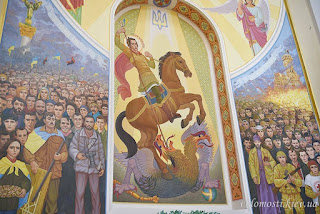
A wall in Cathedral of the Schismatic Church in Ukraine, which has been recognized by the Ecumenical Patriarchate. In it you see St. George slaying the Russian Double-Headed Eagle, people literally draped in the Ukrainian flag, and you also see the Neo-Nazi Right Sector Flag in the background.
The people at Public Orthodoxy have issued a declaration against the Russian Church in which they accuse the Russian Church of heresy -- which they assert is the idea of "Русский мир" or "The Russian World." They included accusations against the Russian Church for failing to condemn one of the three major parties in the war in Ukraine (which includes Russia, the post-coup Ukrainian government, and the United States). They also allude to the controversy over the Ecumenical Patriarchate's recognition of the schismatics in Ukraine. I won't repeat what I have said about the complexities of the war, in part 1. And I have written fairly extensively on the Ukrainian schism -- which you can read in full here, but if you only want to read one article, see "An American Perspective on the Ukraine Crisis." In this article, I will focus specifically on the merits of the claim that there is a heresy called "The Russian World."
What Public Orthodoxy has Not Felt a Need to Condemn
Before getting into the merits of their claims in this declaration, I think it is interesting to consider that while Public Orthodoxy has posted numerous articles condemning the Russian Church and its position on the Ukrainian schism, as well as numerous articles condemning Russia for the war in Ukraine (which has been going on for 8 years, and began with a coup sponsored by the United States), but they have not felt any need to condemn the United States' regime change war in Syria which has raged for 10 years. Far more people have been killed in that war (the current estimates range between 500,000 and 610,000), and this war represents an existential threat to the Orthodox Christians in Syria (which was about 10% of the Syrian population before the war). If the United States had succeeded in installing an Islamic jihadist government in Syria, this would have meant the end of Christianity in Syria, for all practical purposes, and likely the same fate would have befallen Lebanon. Russian military intervention has thus far prevented that from happening, but the United States continues to occupy 10% of Syria, denying Syria access to its own oil resources, and it has imposed crippling sanctions on Syria that are causing immeasurable suffering among the people of Syria -- both Christian and Moslem. So this is an issue that Orthodox Christians ought to be concerned about -- and yet not only has Public Orthodoxy not issued a statement condemning the actions of the American government in Syria, it has hardly said anything about it at all. Perhaps some big money might dry up, if they chose to take such a stand, but one would think anyone who was a believer, and had an ounce of courage would take the right stand regardless. Why the silence?
Public Orthodoxy not only fails to condemn those who oppose Christian morality -- they are one of the chief purveyors of these heretical teachings. So Public Orthodoxy is hardly a reliable guide on the subject of what is, or is not heretical.
"Ethno-Phyletism" for Me, but Not for Thee
One telling fact of this declaration is that it does not include a single quote of a specific statement that it might have cited as an example of the errors they claim the Russian Church is teaching. They also do not reference any document in which one might look to find this heresy espoused.
In a search of the official website of the Moscow Patriarchate, I found an article in which Patriarch Kirill summarized what he understands the concept of "The Russian World" to refer to: "Святейший Патриарх Кирилл: Русский мир — особая цивилизация, которую необходимо сберечь," which in English means "His Holiness Patriarch Kirill: The Russian world is a special civilization that must be preserved."
Patriarch Kirill notes that the Orthodox Culture of the Kievan Rus', which is the common heritage of the Russians, Belarusians, Ukrainians, and Carpatho-Russians, is not defined by political boundaries, and he has does not see it as promoting the building or rebuilding of any empire. He does see it has something worth preserving, which if lost, would be a loss to humanity. He does not see this as ethnic or racial, but cultural. He also does not assert that this culture is superior to all others, only that it is their culture, and it is worth preserving.
In the official conciliar documents of the Russian Church, the question of the Church's relationship to culture has been addressed in detail. "The Basis of the Social Concept of the Russian Orthodox Church," which was approved in 2000, includes in section II, a statement entitled "Church and Nation." I would defy anyone to point to anything in this statement, and to lay out a reasoned and supported argument for why it is heretical.
It is especially curious to hear this charge from an organization which is headed by two members of the Greek Archdiocese, because one hears a very similar concept to "The Russian World" fairly frequently, only it is called "Hellenism." A Google search of the official website of the Greek Archdiocese for the word "Hellenism" turns up "About 13,900" hits. One of the first articles to come up is entitled "New Program to Promote Hellenism in the United States." And the subtitle of that article is, interestingly enough "The Greek Orthodox Archdiocese and the Foundation for the Hellenic World Announce New Program to Promote Hellenism in the United States" [emphasis added]. In that article, you will see that Archbishop Elpidophoros himself was involved in the promotion of this new program. It certainly seems like Archbishop Elpidophoros thinks that there is a Greek Orthodox culture that is not limited by political boundaries, which is the heritage of all Greek people, and is worth preserving.
So is there a heresy of "The Hellenic World"? If not, it seems like members of a Church that considers the promotion of Hellenism to be a key part of their mission, might want to lay out exactly how this concept is not heretical, before they accuse the Russian Church of heresy for essentially having the same idea with regard to their own culture.
As a non-Russian who has been in the Russian Orthodox Church for close to 32 years now, I can tell you that I never felt pressured to become a Russian, nor have I been made to feel like I was a second class member of the Russian Church because I was not a Russian. For more on that, see "Converts and Culture," and "The Colors of the Russian Church."
In short, this declaration consists of a series of assertions that the Russian Church teaches things that they provide no evidence of anyone actually teaching, and they should perhaps examine their own views of Orthodoxy and culture, before they attack those of others.
Once again, Sister Vassa and Public Orthodoxy have boldly staked out positions, which just happens to coincide with the fashionable opinion of the moment. In a video by Sister Vassa, and then in a declaration published by Public Orthodoxy (which Sister Vassa signed), they express their belief that Russia's invasion of Ukraine is evil, that Putin is solely to blame, and that the Russian Church should condemn Putin for it. And the declaration goes on to accuse the Russian Church of outright heresy. In this response, I will focus my attention on Sister Vassa's video. In part 2, I will address the Public Orthodoxy declaration.
The Intentional Fog of War Propaganda
Before getting into Sister Vassa's specific assertions, I would like to remind those who are old enough to remember the lead up to the first Gulf War -- and to inform those who were too young or not yet born -- of the lies our government propaganda machine churned out to talk us into going to war. I remember it well, and enlisted in the United States Marine Corps because I believed the things we were told. Iraq had invaded Kuwait, and we were told horror stories of how the Iraqi soldiers treated Kuwaitis. One of the more memorable things we were told was that Iraqi soldiers burst into hospitals, took babies out of incubators, left them on the floors to die, and then carted those incubators off to Iraq. There was testimony to this effect before the United States Congress, from a young woman who claimed to have been an eye witness to these barbarous acts. George H. W. Bush alluded to this frequently as he beat the war drums. This could not stand. Something had to be done. The only problem was, it was a lie. The young woman who testified before Congress happened to be the daughter of the Kuwaiti ambassador to the United States, and had not been in Kuwait at all during or after the Iraqi invasion. Of course, this only came to light long after the war was over. In 1990 and in 2003, the vast majority of Americans supported going to war with Iraq. Today, the vast majority of Americans believe it was a mistake.
Then under Bill Clinton we launched a war against Serbia, in which we bombed them back to the stone age, killed thousands of civilians, and carved off Kosovo from Serbia, where we still have American troops stationed to this day. This also happened due to the stenographers in the mainstream media, which dutifully presented a one-sided story of a complicated civil war, along with countless fabrications and lies which were designed to inflame the emotions of the American people... and then the United States did exactly what we are accusing Russia of doing right now.
In the lead up to the second Gulf War we were assured that there were weapons of mass destruction being amassed by Sadam Hussein, and this also turned out to be a lie. We invaded Iraq, and a country that was 10% Christian now has few remaining Christians because we unleashed Islamic Jihadists that Sadam Hussein had kept on a short leash, and the country has been a wreck ever since. I think there are few people left who would not gladly turn back the clock, and put Sadam Hussein back in charge of Iraq. As bad as he was, the world was a far safer place, and Iraq was a far better and safer place too.
More recently we launched regime change wars in Syria and Libya in which our military played direct roles, which have resulted in the deaths of hundreds of thousands of civilians, and millions of refugees. What we did in Libya caused further Islamic terror in other parts of Africa, as Libyan weapons made their way into the hands of Islamic terrorists, like Boko Haram. We have seen open slave markets, and human misery increased exponentially all because we wanted to take out the latest Hitler of the Month. If when we embarked on these regime change wars, we were creating paradises in their stead, perhaps one could justify this as a foreign policy theme, but instead, we consistently make bad situations into hell holes.
I could go on, but we have been repeatedly lied into going to war in country after country, and in almost every case, the situation has been made far worse by our actions. But the point here is that the media willfully presented propaganda to the American people, designed to whip up public opinion and get them to support American foreign policy based on lies.
The Complexities of the War in Ukraine
In Sister Vassa's comments, she repeats a great deal of the spin we are hearing in the western media, as if it were all true, and there was nothing more to it. Her arguments amount to appeals to emotion based on the media narrative, and appeals to majority opinion, rather than on reason, evidence, or logical argument. The problem here is we should know by now that we cannot put a lot of faith in what our government or the media tells us when our government is trying to push public opinion to support a war. And make no mistake, that is what is happening. We are being asked to support an economic war, which will have huge repercussions on our own economy, as well as every economy in the world -- which will disproportionately affect the poor throughout the world, and put them in positions in which keeping body and soul together will be extremely difficult. We are being asked to supply weapons to one side, and there is the very real prospect that we could soon be drawn into the fighting on the ground before all is said and done, if we are not careful.
Anyone who is presenting this war in simple terms is either ignorant of the facts, or is trying to deceive you, and they are certainly not advancing the cause of peace. This war has an extremely complicated background. For one thing, Ukraine was never an independent country prior to the 1990's. For most of the last 3 centuries it has been united with Russia, and so there are strong ties to Russia, particularly with the Eastern and Southern regions of Ukraine. Ukraine has had two "revolutions" since it became independent, both of which the United States had more than a small role in. In 2014, we had a blatant coup d'etat in which our country sponsored the violent overthrow of the lawfully elected government of the country. As a result there was unrest throughout Eastern and Southern Ukraine. The Russian government seized Crimea, which has been the base for the Russian Black Sea fleet since Catherine the Great, and whose population overwhelming supported the action. In most of the South, unrest was violently squelched, but in Eastern Ukraine, two regions declared their independence, and with Russian support, were able to keep from being crushed by the new Ukrainian government, but the people in those regions have been subjected to continuous shelling by the Ukrainian military for the past 8 years, and about 14,000 people have been killed... but CNN didn't bother stoking anyone into being outraged about those deaths -- and in fact, most people are unaware of this aspect of the present conflict entirely.
Since 2014, there have been two peace agreements that have been signed which would have ended the war in Eastern Ukraine, and in both cases, nothing came of them, because the president of Ukraine was either unable, or unwilling to implement them. I am sure the politics of this is very difficult to navigate, but while the last two Ukrainian presidents both ran on a platform of bringing peace to Eastern Ukraine, and they may both have been very sincere in their intentions, neither was able to accomplish their stated intentions... for whatever reason. Zelensky even went to Eastern Ukraine and personally ordered the overtly Nazi Azov Battalion to withdraw... and they simply refused to do so. So it is unclear who has really been running the show in Ukraine.
On top of the 8 year war against Russian speaking people in Eastern Ukraine, Zelensky suggested in February of this year that Ukraine would be seeking to acquire Nuclear weapons, and Ukraine has stated its intention to join NATO, and to retake Crimea from Russia... by force if necessary. Russia had laid out to the US a list of its "Red Lines," the biggest of which is Ukraine entering NATO, and the US refused to accommodate Russia on any of its concerns. Countless experts have been warning that this policy of NATO expansion would eventually lead to a military response from Russia:
And so given that this was entirely predictable, one has to wonder why the Biden administration chose to continue to press ahead with NATO expansion, rather than to press Ukraine to actually implement the Minsk agreements, and end the 8 year war in Eastern Ukraine.
Sister Vassa notes that even Fox and CNN agree that this is all Russia's fault. The problem is that war is the one remaining bi-partisan issue in America. The establishments of both parties generally support going to war. Fox News has generally taken the same stance.
Sister Vassa dismisses concerns about Nazis in Ukraine because Israel sides with the US, Zelensky is Jewish, Ukraine fought against the Nazis in World War II, and she suggests that like any other country, Ukraine simply has people with various political leanings. But Israel has little choice but to side with the US, given that the US is Israel's only ally in the world, and heavily funds and supplies its military. Zelensky is Jewish, but that doesn't prove that there are not Nazis throughout Ukraine's military and security forces, and when you have overtly Nazi Battalions that are part of the Ukrainian Army, that is not just having some kooks in your country. Yes, 8 million Ukrainians died fighting the Nazis, but many of those from Western Ukraine died fighting for the Nazis. You had Ukrainian divisions of the SS. And they have a Nazi war criminal that is celebrated as a National hero -- Stepan Bandera. Obviously the average Ukrainian is not a Nazi, and one could argue that the Russian government makes more of this than is warranted, but pretending that this is not a real issue is either ignorant or dishonest.
The BBC has reported on the heavy role played by Nazis in Ukrainian politics as well:
A good case can be made that the primary reason why the Minsk Agreements have never been implemented is that the Ukrainian government has a legitimate fear of being overthrown by these Nazi forces.
You cannot honestly discuss the current war in Ukraine without addressing the 2014 coup, the last 8 years of war in Eastern Ukraine and the 14,000 people (mostly Russian speaking Ukrainians) who have been killed under nearly constant shelling, and dealing with the role of various Nazi groups in both the coup and the war, and you certainly cannot discuss this without mentioning the United States' role in all of the aforementioned. And yet Sister Vassa almost completely ignored all of this.
To say that this war is all Putin's fault is, at the very least, simplistic. If you say it is all his fault, you are in effect saying it is not the United States' fault, or the fault of the post-coup Ukrainian government. But it is quite possible that there is some blame that is due to each party here. And while God knows exactly how much everyone responsible is to blame, I don't believe we do, at this point. It certainly simplifies things if you can paint one side as heartless people who take babies out of incubators and throw them on the floor, but it probably is better to wait until you have a better idea of what has actually happened before you jump to simplistic conclusions.
Furthermore, laying all the blame on Putin takes off any pressure for the US or Ukraine to seek a compromise solution, and at this point, a compromise solution is the only way the fighting will end in the short term. So while people who take this position have the self satisfaction of virtue signaling, and can claim that they are for peace, they actually are making it less likely that peace will be restored any time soon.
The Pastoral Issues for the Russian Church
Aside from the problem with pinning the blame on only one side when we don't have sufficient evidence to really reach that conclusion, the Russian Church has the very real problem of having people who are on the various sides, and everywhere in between -- and this is true just among the Ukrainians in the Russian Church. In my parish alone I have Ukrainian people who believe Russia is coming to the rescue, and people who think Putin is evil, and then people who have mixed opinions. I don't want to alienate any of those people. They all have family and friends who are suffering, and many who have been killed or will be killed. The Church has to rise above such things, and appeal to all sides to find a way towards peace.
Conclusion
We can all agree that war is evil. We are praying for a swift end to the war. And in the meantime we are doing what we can to raise money to help those who have been displaced by the war. No one in the Russian Church wanted to see things come to this point. All sides should do what they can to end this war as soon as possible. We can certainly say that anyone who contributed to causing this war will have a lot to answer for before God. Anyone who chooses war when they have other viable options is committing a great sin. God knows the truth. At this point, I don't believe we do.
This war was certainly preventable. I believe the US government could have prevented it, and so if I was going to condemn anyone, I would have to start with the government that at least theoretically answers to the American people.
Update: Let me clarify one point so that no one is confused. It is not my place or the place of the Church to tell Ukrainians that they should not want to have an independent country, nor would it be to say that they should. Ukrainians themselves are not of one mind on this question, and so obviously everyone cannot have their way when people disagree. They should find a peaceful way to resolve such disputes, but this really should be a matter that they settle without outside interference.
Furthermore, war is always an evil thing, and there is always at least one side that is in the wrong. Sometimes both sides are in the wrong. Reasonable people can disagree about such things, because we all have limited knowledge, and we come from our own perspective. God, however, knows exactly who is to blame, and it would be a horrible thing to have to answer for on the day of judgment.
Update 2: One other point, just to be clear. Anyone has the right to think or say whatever they believe to be true about the current war in Ukraine. If Sister Vassa had simply voiced her opposition to it, I wouldn't have responded. It is the accusation that the Church has to condemn one of the three major parties to this war, but not condemn either of the other two, that I take issue with. War is horrible. Everyone with any compassion would rather it not have happened, and would want it to end as soon as possible. But the reasons for why we are where we are at this point in history are not simple, and demanding that the Church pretend otherwise, and exonerate the US and the post-coup government of Ukraine, while laying the blame only on the Russian government, is not a reasonable position to take. If Russia had invaded Ukraine out of the blue, that would be a different matter, but there has been a war going on for 8 years, and so it is not nearly so clear cut. More facts will hopefully come out, and as they do I hope everyone will revise their opinions accordingly, but that is how I see it at this point.
Also, one commentator mentioned that a lot of other people collaborated with the Nazis, including Russians. I can understand why people living under Stalin, knowing only what they knew at the time, might have thought that Hitler was the lesser of the two evils. However, when you have groups of Ukrainians in 2022, who choose to identify with this particular chapter of their history, and identify themselves as Nazis, they have a lot less of an excuse then their grandfathers had. And furthermore, when you have those people functioning openly in the Ukraine military, in Nazi units, it is a far more problematic matter. Every country has its share of kooks. Most don't have Kook Battalions in their military.
He begins by complaining about some of the online harassment he has received as a result of his previous essay. I truly I am sorry to hear that. However, this is not something unique to him or people of his political or religious views. My parish had a credible terrorist threat in June 2020 that I had to get the FBI, as well as state and local authorities, and my parish had to spend thousands of dollars to increase security. Mean tweets are far more easily handled. If you have someone saying stupid things to you online, blocking them is usually the best and quickest solution. The anonymity of the internet, and the fact that most social media platforms let people use pseudonyms create the environment that promotes that sort of behavior. Pointing out things that Aram Sarkisian has posted in the past, however, is not harassment, and it is certainly something that he feels free to do too.
Aram Sarkisian again plays the game of guilt by association, and he also didn't quote a single thing I actually said in my response to his first essay (nor did he provide a link to my article, so people could read it for themselves and come to their own conclusions). Instead, he mischaracterized what I said, and put his own twist on it. He also failed to address any of the contemporary moral issues that I pointed out -- nor did he explain his strange silence about them. The only contemporary moral issues he does talk about are abortion and the LGBTQP agenda, and on those issues, he promotes baby killing and sexual immorality. We cannot change the past, but we can do something about genocide in China, the genocide against Christians in Africa and the Middle East, the killing of a million babies a year in this country, the promotion of sexual immorality, and the rise of Marxism (the most evil and murderous ideology in human history) -- particularly in the academic environment that Sarkisian lives and works in. But saying something against those things might actually cost Dr. Sarkisian something professionally and personally.
He wrote, with regard to my response to him:
"Co-founder Fr. John Whiteford explained on the Michael Sisco Show in October, after all, that racial harmony in the antebellum South was such that the concept of segregation did not exist there—until it was exported from the North. Fr. John too asserted that post-Reconstruction Jim Crow segregation wasn’t all that bad for Black southerners—just misunderstood and misremembered."
I of course said no such thing, and in fact stated pretty much the opposite. The problem here is that it is unfair to compare the South at any point in its history with an ideal society, and to find it wanting. What is fair is to compare it with other societies at the same time. And as a matter of fact, it is true that there was no segregation in the South prior to the late 19th century -- there was subordination, but not segregation. In the North at that same time, blacks were excluded from society, pushed to the margins, and allowed not even the most basic of rights. As Alexis de Tocqueville put it, in his book Democracy in America:
“So the Negro [in the North] is free, but he cannot share the rights, pleasures, labors, griefs, or even the tomb of him whose equal he has been declared; there is nowhere where he can meet him, neither in life nor in death.”
Northerners, in fact, often criticized Southerners for living in too close proximity to black people. For example, David Wilmot (of Pennsylvania) wrote:
There also were free blacks in the antebellum South, many of whom became prosperous. Many became slave owners themselves. Some even became very wealthy (e.g. Horace King).
It is also true that Jim Crow laws originated in the North, and only came to the South with the New South Movement (which was a progressive movement, by the way -- for more information, see the book "The Strange Career of Jim Crow," by C. Vann Woodward (Oxford University Press, 1955). I never suggested that the Jim Crow period was a good time for black people. The fact people put laws in place to force segregation is evidence that there were many people who were doing the opposite. The same is also true of laws against interracial marriage. I believe that government-imposed segregation is wrong, and while I also think it is not a good thing even when voluntary, there have been many black scholars that have argued that black people were better off under segregation (economically especially), and you have many who are now pushing Critical Race Theory, that are promoting segregation today. I am glad legal segregation is a thing of the past (at least outside of American Universities). But here again, Dr. Sarkisian wants to compare the South with perfection, but fails to compare it with other contemporary examples. Segregation was very common in the North and West of the United States, and still is, in practice today. And the point is that even after segregation ceased to be legally enforced in the North, it remained a more pervasive and absolute reality than it ever was in the South.
I happen to have the ability to see this from both a Northern and Southern perspective, because while my father was from Texas, and came from a deeply rooted Southern family, my mother was from Chicago, and her family was mostly Northern in origin. I wouldn't throw either side of my family under the bus, but let's just say that I didn't hear much racist talk from the folks who were from the South. Chicago remains one of the most segregated cities to this day, but it is not particularly unique among large northern cities.
A black minister I know of pointed out what he saw as the difference between life in the South and life in the North in the post World War II era. He said white people in the South didn't mind living next to black people, but didn't want them to have more than they did. White people in the North, didn't care what black people had, but didn't want to live anywhere near them. That is of course a somewhat exaggerated generalization, but I think it has a lot of truth to it, if we are talking about life prior to about 1980.
Aram Sarkisian wrote:
"There is little I could do in this brief essay that might even begin to dismantle such staggering historical falsehoods, nor do I think Fr. Whiteford would care to hear it."
I would actually love to see Dr. Sarkisian reply to the substance of my essay, but I am not holding my breath. I suspect he will continue to reply to his straw man characterizations of things I have said, rather than what I actually said.
"They were never dehumanized to the status of property, never barred from schools and universities on account of their race, were never asked to count bubbles on a bar of soap so they could vote, never had to hold their bladder until they found a “colored” bathroom, and knew they would never experience the terror of the lynching tree."
I have addressed the issues of slavery, and how this was an American problem, and a world wide problem, and not a specifically Southern Problem in "Orthodox America Has a Cultural Marxist Problem," Lynching was also an American problem. It was worse in the South in the wake of Reconstruction, because of the divide and conquer policies of Radical Reconstruction, which sought to cement Republican political control, rather than to bring about racial reconciliation in the South. The largest single incident of lynching happened in California in 1871, and the people lynched were actually Chinese. Chinese laborers were routinely abused and killed in the American West. The Chinese who worked on the railroad were paid slave labor wages, asked to do the most dangerous work, and little concern for their safety was given... which is the origin of the phrase "a Chinaman's chance," which was usually used in the form of "He hasn't got a Chinamen's chance," which given the slim odds Chinese people were usually given in America, basically means whoever is being spoken off hasn't even got those slim chances. And there would no doubt have been a lot more lynchings of Chinese, except Western politicians managed to pass the Chinese Exclusion Act, and effectively made it impossible for Chinese to immigrate to the United States prior to 1943, when it was finally repealed. Blacks were lynched in nearly every state in the Union. They were lynched more frequently in the South, because there were a lot more black people in the South, but of the lower 48 states, 44 of them had incidents of blacks being lynched, and while the numbers are lower, white people were lynched frequently too. Lynching is of course a horrible crime, and it is of course a good thing that we do not see it very much anymore.
"To be clear, no one is saying that racist ideas are held by all Orthodox Christians in the American South, or that American racism has been, or is now limited only to that region. And there is nothing wrong with Orthodox evangelism to the South. But if evangelism draws on racist Lost Cause mythology and iconography of the failed Confederate rebellion, especially at a moment of renewed Confederate nostalgia, it is important that these ideas are stopped from becoming mainstream. When a group bears witness to Orthodoxy using an image of Stonewall Jackson in uniform with his hand upon a Bible, as is found on the Ludwell Fellowship website, could the message be any clearer?"
I addressed the question of the Lost Cause and Righteous Cause myths, but Dr. Sarkisian didn't bother to address any of my arguments or the evidence I presented, but instead simply repeats the accusation. Booker T. Washington was an actual slave, and yet he had this to say of Stonewall Jackson and Lee:
"The first white people in America, certainly the first in the South to exhibit their interest in the reaching of the Negro and saving his soul through the medium of the Sunday-school were Robert E. Lee and 'Stonewall Jackson.' ... Where Robert E. Lee and 'Stonewall’ Jackson have led in the redemption of the Negro through the Sunday-school, the rest of us can afford to follow.”
Stained glass window in the historically black 5th Avenue Presbyterian Church in Roanoke, Virginia. The scene is of an army camped by a river, and the text contains Stonewall Jackson's last words. It says, "In Memory of Stonewall Jackson. Let us cross the river and rest in the shade of the trees."
Stonewall Jackson taught a black Sunday School class, (which taught children how to read and write -- not just about the faith) and supplied its needs out of his own pocket, and out of that Sunday School class came four black churches, and several Black clergymen, who held him in high regard. There is even a stained-glass window dedicated to Stonewall Jackson in one the churches founded by these clergymen. In dismissing Stonewall Jackson as some sort of cartoonish evil character, Dr. Sarkisian is also dismissing the memory of these black people who knew and admired him. Stonewall Jackson is a good example of the deep religious piety that you find in the South. It has not normally been an Orthodox piety up until now, but it does provide us with something to work with. In my experience, I have seen this kind of piety especially found among the black folks I have worked with over the nearly three decades that I worked for the State of Texas.
"And it’s just as alarming that one of its primary voices is Fr. Whiteford, who has appeared on the “Dissident Mama” podcast, and who promoted the Fellowship alongside another co-founder, Dr. Clark Carlton, on the Michael Sisco Show. One loses plausible deniability when they repeatedly seek and out and accept these kinds of platforms to spread harmful historical falsehoods, especially when they wear a cassock."
I firmly believe, have written, and have preached, that hating someone on the basis of race, or mistreating someone on the basis of race is a sin. I don't believe Michael Sisco or Rebecca Dillingham disagree with that at all. Michael often makes fun of his critics by tweaking them in sarcastic ways, but that is a different matter. Rebecca pushes back against Cultural Marxists, but this is because of what she loves (her children, thus the moniker "Dissident Mama'), not what she hates. I am sure that they have said many things I wouldn't agree with, or said things in ways that I wouldn't say them, but having gotten to know them personally, I don't believe that they hate people, based on race or for any other reason. I believe that the Golden Rule applies to everyone, regardless of race, and I believe that they do too.
And by the way, I have also appeared on Roman Catholic podcasts, and Protestant podcasts, and I would even appear on a podcast by someone like Aram Sarkisian, so long as I thought the format would be fair.
What Aram Sarkisian wants us to do is to hold Southerners to standards that no other group is held too. Do you hear any scholars lecturing Africans, Arabs, Indians, Chinese, or Latin Americans about how they should be ashamed of their own history because it included slavery? No, you do not. You also don't hear them talk very much about slavery in the United States that involved anyone other than Southerners, even though New Englanders ran the Slave Trade, which was the most brutal and inhumane aspect of American slavery. I am not a great student of Armenian history, but I suspect it included slavery too, and I also suspect that Armenians do not have a long history of embracing cultural and racial diversity. However, I would not expect Aram Sarkisian to denounce his ancestors, because that would be evil. The Golden Rule suggests that one should not expect other people to do what they would not want to do themselves.