Showing posts with label Ukraine Schism. Show all posts

Wednesday, November 19, 2025

Congressman Joe Wilson Declares War on the Orthodox Church

Congressman Joe Wilson, of South Carolina, wrote a letter to Attorney General Pam Bondi in which he accused the Russian Orthodox Church Outside of Russia and "other Russian Orthodox Churches" of engaging in espionage on behalf of the Russian government. He of course made these assertions without the slightest evidence, but let's consider how absurd his claim actually is. The alleged espionage consisted of an effort by clergy and laity of ROCOR, the OCA, the Serbian Patriarchate, and the Antiochian Archdiocese to lobby members of our government. What were they lobbying for? Was it to eliminate sanctions against Russia? No. Was it to pass on military secrets to the Russian government? No. Was it to end military support of Ukraine? No. It was to stop the persecution of the Ukrainian Orthodox Church. If this is what the Russian government put these people up to, you would have to conclude that the Russian government was the most selfless, altruistic, and Christian government that exists today, and perhaps has ever existed.

Some will claim that this effort was an attempt to embarrass the Ukrainian government, but that is also a ridiculous claim, because the only thing Ukraine would need to do to stop the embarrassment would be to stop persecuting the Ukrainian Orthodox Church.

What kind of persecution is happening? Clergy are being beaten. Parishioners are being beaten. Churches are being stolen, and then often just padlocked. Clergy and monks are being drafted into the Army, despite the fact they cannot fight, by profession.


This video cannot be embedded, but it shows another violent raid of a Church.

This video shows the brutal beating of Metropolitan Theodosy of Cherkassy.

Several bishops have been imprisoned on trumped up charges, and kept under inhumane conditions.


In this video, Robert Amsterdam, who represents the Ukrainian Orthodox Church was interviewed by Tucker Carlson, and it also shows scenes of the persecution of the Church in Ukraine: 


My daughter Catherine Whiteford did a video which also elaborates on the truth of what is going on in Ukraine:


Congressman Joe Wilson faced so much backlash for his ridiculous claims, that he attempted to walk it back, and say he was only talking about the leadership of the Russian Orthodox Church Outside of Russia, but he would have us believe that they are Russian agents. Our primate, Metropolitan Nicholas was born in New Jersey. Prior to his repose a year ago, my bishop was Archbishop Peter, who was born in San Francisco. My acting bishop right now, Archbishop Gabriel, was born in Australia. Congressman Wilson's mother was my 7th cousin, and his father was my 8th cousin. My ancestors were among the earliest settlers in Virginia who arrived long before the Mayflower landed at Plymouth, and some of my ancestors were among the Indians that were already there to greet them. He is not attacking foreigners. He is attacking Americans, and he is attacking them for daring to speak out about the abuse of innocent people.

This persecution has nothing to do with the war, because it actually began in earnest in 2019, three years prior to the Russian invasion. The war is a pretext for intensifying and accelerating the persecution, but it was going on before that, and would have continued regardless of anything Russia did. This persecution was encourage by the US government, which established a fake Ukrainian Church back in 2018. You can see Mike Pompeo take the credit for it in this video, in which he thought he was speaking with Petro Poroshenko.

If you want to help speak out about the persecution of the Ukrainian Orthodox Church, and want to show Joe Wilson that we still have religious freedom and the right to petition our government for the redress of grievances, come to Washington, D.C. on December 16th, and register with the organizers.

For more information, see: 


Thursday, June 08, 2023

"Public Orthodoxy" Defends the Persecution of the Ukrainian Orthodox Church


Recently Public Orthodoxy published an article by Lidiya Lozova, in which she excused the government sponsored persecution of the Ukrainian Orthodox Church, and alleged that this reflects the popular opinion of the Ukrainian people. After expressing her objection to the use of violence as a means of "resolving conflicts among church communities in Ukraine" (i.e. the use of violence when government backed Nazi thugs* steal Church property from the canonical Church in order to give it to the schismatics** under Epiphony Dumenko), she goes on to blame this violent persecution on the people being persecuted, suggested essentially that they asked for it and have it coming, and then she denies almost completely the role of the Ukrainian government in ginning up that violence in the first place:

"...in the context of international sympathies expressed to the UOC [Ukrainian Orthodox Church] today, I have to admit that the social opposition and violence directed at this church in Ukrainian society is not an artificial construct of the Ukrainian authorities; it is, in my opinion, a reaction to the hidden structural violence, which has been present in the matrix of this organization since 1990s and especially after 2014, when the leadership of the UOC changed" [Emphasis added]. 

She makes this assertion, despite the fact that we have countless videos of the police assisting in this violence, and we have figures in the government controlled Ukrainian media calling for violence against the Ukrainian Church -- not to mention laws that legally ban the UOC from legally functioning in various cities and provinces, and a proposed ban that would eliminate them from the entire country.

One of many videos chronicling the active role of the Ukrainian government in the violent seizures of Ukrainian Orthodox Church. More can be found on the YouTube channel of the Union of Orthodox Journalists.

She goes on to attribute the cause for this violent opposition to the fact that the Ukrainian Church teaches its people to observe Church order and discipline, and also to view even the bad things that we experience in this life as being for our salvation -- just as St. John Chrysostom himself not only taught with his words, but more importantly taught by his deeds as he endured severe persecution, and ended his life, by saying "Glory to God for all things."

Among the alleged transgressions the Ukrainian Orthodox Church is accused of by the author, is supposedly that some priests have refused to do funerals for Ukrainian soldiers... though she provides no specific information on that. Likely, if there were such cases, the refusal would have been due to the fact that the soldiers in question were not members of the canonical Orthodox Church. Countless funerals have been performed for soldiers who were members of the UOC.

She goes on to make the assertion: 

"In short, the UOC as a whole is not welcomed in Ukraine in spite of their participation in the humanitarian aid efforts and the service of many UOC members in the Ukrainian Armed Forces."

She, however, presents us with no reason to believe that this assertion is true. But even if, for the sake of argument, we were to assume that it was true, it would be true in the context of the Ukrainian government controlling the media, and the people in Ukraine being fed a constant stream of propaganda accusing the Ukrainian Orthodox Church of being disloyal. Anyone who deviates from the government narrative puts themselves at risk of both judicial and extra-judicial punishment [aka public lynchings]. So there is in fact no objective way to measure the actual opinions of the people in Ukraine at the present. 

We can, however, gauge the opinions of people who actually go to Church in Ukraine, because we consistently see that when Churches have been stolen from the canonical Church, they are either left padlocked, or the number of people attending the schismatic services is a mere fraction of the number who attended the Church before. 

After Epiphony was made the head of the combined schismatic Church, the Ukrainian government tried to pad the numbers of people attending things like his procession on St. Vladimir's day, but even with the addition of government employees, and people being bussed into Kiev from western Ukraine, the crowd was dwarfed by the number of people in the canonical procession. More recently, after the Ukrainian government seized some of the churches in the Kiev caves, Epiphony has only conducted a few services there, (though previously a full cycle of daily services were held when these were in the hands of the canonical Church) and even with people being bussed in, the crowds are very sparse, whereas the crowds attending the services of the canonical Church in Ukraine remain packed.

Though the author states that she is "not fully satisfied with the actions of the state and the reaction from the OCU [the schismatic Ukrainian Church] members..." She fails to honestly confront the role of the Ukrainian government, nor does she give the reader any real idea of the scope and severity of the persecution of the canonical Ukrainian Orthodox Church. One day, when the full truth of what has been going on in Ukraine is more widely known, she may have reason to be embarrassed that she made excuses for those who were persecuting the faithful under the canonical Ukrainian Orthodox Church under the Metropolitan Onuphry

* When I speak of "Nazi thugs," I am not using the term "Nazi" as a pejorative slur. I am referring to the actual Nazis that are usually the ring leaders behind the seizure of Church in Ukraine. For example, Yevhen Karas is the head of the Nazi group "C14." You can see the role his group has been playing recently in this video from the Union of Orthodox Journalists. You will see Yevhen Karas prominently featured in this video which takes about the role of Nazis in Ukraine. The fact that the government is backing them is shown by the fact that they are allowed to operate freely and openly engage in violent assaults directed at innocent people. Given the manpower shortage the Ukrainian army has, one has to wonder why so many young men are allowed to engage in such things, and remain out of uniform and out of the war. What one makes of these facts is up to them, but these are indeed facts.

** That Epiphony is the head of schismatic Church is laid out in the following articles: 

What's Going on in Ukraine? Part 1: The Historical Background

What's Going on in Ukraine? Part 2: The Canonical Issues

An American Perspective on the Ukraine Crisis

Furthermore, I would point out that the fact that the monastics in Ukraine have overwhelmingly remained loyal to Metropolitan Onuphry should tell any pious Orthodox Christian everything that they need to know about who is legitimate, and who is not.

Monday, December 05, 2022

The Ecumenist "Orthodox" (The Birth of a New Religion, Part 4)


The use of the word "ecumenical" with reference to the Church has been twisted to mean something entirely different than it has meant historically. The word itself literally means "universal," but in the context of the Church it was used to refer to universal councils of the One, Holy, Catholic, and Apostolic Church. These councils were not convened in order for Orthodox bishops to hobnob with heretics, or to sweep their differences under the rug. Quite the contrary, these councils were convened in order to drive heresies and unrepentant heretics out of the Church. 

The term "Ecumenical" was, however, hijacked by the Ecumenical Movement, which had its origins among Protestants. During the 19th century, Protestant missionary activity around the world expanded exponentially, but since Protestants have wildly different beliefs, the problem of different Protestant sects competing for the same converts on the mission field quickly became apparent. The desire to not have Protestant missionaries working at cross purposes resulted in the first World Missionary Conference, which was held in Edinburgh, Scotland in 1910. This also happened at a time when Protestant liberalism was on the rise, which undermined the doctrinal certainty the various Protestant sects had previously maintained with regard to their own beliefs. So out of the Protestant missionary movement, the Ecumenical movement began to gain steam. The Ecumenical movement had as its goal the unity of all Christians -- which would not be a bad goal at all, if the end goal was a unity in the Truth, but as liberal Protestants began abandoning any belief that there was such a thing as Truth, this movement was no longer burdened by conflicting beliefs about what is true, and instead was focused on unity for unity's sake. The Ecumenical Movement has indeed gone far beyond seeking the unity of all Christians, to seeking the unity of all religions.

Orthodox involvement in the Ecumenical movement has a long and complicated history. In short, some have participated in it for the purpose of bearing witness to the Orthodox Faith, or to facilitate cooperation on matters of mutual interest. But other have participated in it because they have bought into the idea that the Church is divided into various branches, with the Orthodox Church being but one of many branches. Such people have bought into this idea for the same reason that liberal Protestants did -- they no longer really believe what the Orthodox Church has always taught, and so are no longer burdened by question of Truth.

There is much more that could be said about the Ecumenical Movement, and why its motivations are heretical (and indeed a pan-heresy, because it seeks to incorporate all heresies into the Church), but I will instead refer the reader to the voluminous articles on Ecumenism on the Orthodoxinfo.com website.

I do however want to draw attention to how Ecumenism among those who are ostensibly Orthodox is working to merge renovationism, modernism, and LGBTQP and abortion activism into what will likely come to be the church of the Antichrist. For evidence of this, one need look no further than Archbishop Elpidophoros.

On June 11th, 2021, Archbishop Elpidophoros served the liturgy for the new calendar feast of the Apostle Bartholomew at the Episcopal Church in Manhattan which happens to be dedicated to St. Bartholomew. He served there, not because there were no Orthodox Churches in the area that would allow him to serve the Liturgy that day, but as a show of unity with a church that has homosexual and transgendered bishops and clergy, and which embraces abortion, and accommodates those who deny the deity of Christ and the reality of the Resurrection (e.g. "Bishop" John Shelby Spong). He did this, while gay pride flags flew over the entrance to this church.

"St. Bart's" Cathedral, Manhattan

On July 15, 2021, Archbishop Elpidophoros gave a speech at the International Religious Freedom Summit, entitled “The Rising Tide of Religious Nationalism,” in which he said:
"When you elevate one religion above all others, it is as if you decide there is only one path leading to the top of the mountain. But the truth is you simply cannot see the myriads of paths that lead to the same destination, because you are surrounded by boulders of prejudice that obscure your view."

So not only do the Ecumenists no longer believe that the Orthodox Church is the One, Holy, Catholic, and Apostolic Church, as it has always taught and believed, but that Christ is not the only path to salvation, contrary to the words of Christ Himself: "I am the way, the truth, and the life: no man cometh unto the Father, but by me." (John 14:6).

On top of all this, the Ecumenical Patriarch has long promoted the idea of union with Rome, which is a church that is much further down the path of "inter-religious dialogue" (see this video and this video, for examples. These videos were produced by Greek Old Calendarists, but the footage shown speaks for itself). Rome is also quickly heading down the path of embracing LGBTQP ideology. German bishops are already allowing services to recognize gay marriages, and while Pope Francis may be uncomfortable with how quickly they are moving, he shows no signs of actually wanting to stop them. 

The Ecumenical Patriarch has, along with Pope Francis, jointly invited all Christians to participate in the 1700th anniversary of the Council of Nicaea. Among the issues that are to be addressed at this event is the establishment of a common date for the celebration of Pascha (Easter), which is a pre-requisite for the false union that is being promoted. There are good reasons to believe that this is when they will seal some sort of union.

What has been going on in Ukraine (long before 2022) illustrates how these various heresies are converging together. Let me quote what I said in a talk I gave in Moscow in February of 2019 about the actions of the Ecumenical Patriarch in Ukraine, and where things seem to be heading:

"In the United States and in the English-speaking Orthodox world generally, we hear many voices from within the Patriarchate of Constantinople, which are supporting homosexuality, openly. The Archons have helped fund an Orthodox institute at Fordham University. The heads of this institute have used this platform to launch a website called “Public Orthodoxy” which regularly promotes homosexuality and other forms of deviancy. And it is not bad enough that they publish this material in English, but they now translate their articles into Russian, Greek, and Serbian. And they do this without the slightest hint of any rebuke from the Greek Archdiocese of America. In fact, whenever they have a big event, Archbishop Demetrios of New York is usually present, adding his authority to that event. For example, one of the heads of this institute, Aristotle Papanikolaou, in an article in another pro-homosexual journal, The Wheel, wrote that expecting people who suffer from same-sex attraction to remain celibate is “unrealistic” and unhealthy, and that such desires should best be expressed in the context of “long-term committed relationships or marriages” (The Wheel 13/14, Spring/Summer 2018, p. 97 [emphasis added]. See also "Unitarian Morality With a Little "Theosis" Sprinkled on Top," "The Living Church 2.0," and "Cultural Marxism and Public Orthodoxy").

Patriarch Bartholomew’s Archdeacon, Fr. John Chryssavgis, has made a number of pro-homosexual statements. For example, he wrote a review of a book that was a simple piece of pro-homosexual propaganda written by a homosexual Episcopal priest, and he gushed with praise for what a great contribution this book was to the important “dialogue” on homosexuality. The only slight criticism he made of this book was to say that he remained “unconvinced” by some of the book’s arguments that the Scriptures support homosexuality. This is from a man who has no difficulty expressing his disagreement, in eloquent and striking terms… when he wishes to.

Many of you are aware of the call that was made to “Metropolitan” Epifany, by a Russian prankster, who pretend to be a western diplomat, and congratulated him on the “autocephaly” of the Church in Ukraine, but expressed his hope that Epifany would take a different stand on homosexuality than the conservative one taken by the Russian Church. Epifany assured him that he would not take such a conservative stand against homosexuality.

And what I have noticed, in the English-speaking Orthodox world at least, is that those who promote the acceptance of homosexuality in the Orthodox Church have all been consistently lining up behind the EP’s actions in Ukraine.

One other agenda item that I think is clearly behind the EP’s actions in Ukraine is the goal of union with Rome. We already see the schismatics in Ukraine concelebrating with Uniates with increasing frequency. One thing that is certain is that Patriarch Bartholomew’s actions in Ukraine make no sense, if he intends to remain in the Orthodox Church.

Furthermore, there are very strong indications that the United States State Department has had some role in pushing for these actions, but to what extent, or in what form this pressure was applied, we do not yet know" (An American Perspective on the Ukraine Crisis).

Along the same lines, I would refer the reader to "The War in Ukraine as a Tool for Progressive Revolution Against Orthodoxy."

We can of course hope that the Ecumenical Patriarchate will reverse course, and that things will not unfold as I am suggesting, but this will be a lot more likely to happen if more people are aware of where they have been heading, and begin to call these erring "Orthodox" back to the fold.

You cannot be pro-abortion, and be an Orthodox Christian. You cannot advocate LGBTQP ideology and be an Orthodox Christian. You cannot be a renovationist and be an Orthodox Christian. You cannot embrace Ecumenism, and deny what the Orthodox Church has always taught about itself, and be an Orthodox Christian. Such people may be formally members of the Church, but they have spiritually cut themselves off from both Christ and the Church. Those who actually are Orthodox need to speak clearly on these issues, so that those want to remain Orthodox Christians, or who want to become Orthodox Christians, will not be confused by their errors.

For More Information, See:

Further Thoughts on the Ancient Faith Today Discussion: The Pope and the Patriarch

Unfortunate Trends in the Roman Catholic Church

Saturday, November 23, 2019

Ukraine Schism: What is a Layman To Do?


I recently received an e-mail with some practical questions about how people should deal with the implications of the mess created by Constantinople's incursion into the canonical territory of the Russian Church, and their embrace of unrepentant and unordained schismatics in Ukraine:
"I've been watching the ecclesiastical crisis over Ukraine since it began. As the crisis worsens, it's causing me growing concern about how it is affecting Orthodox life here in North America. Could you kindly formulate some advice for Orthodox Christians who wish to avoid involvement with the schismatics?
I believe the Ukrainian schismatics are indeed schismatics, and their "clergy" are unordained individuals, and that anyone in the canonical Church who communes or serves with the schismatics deserve to be subjected to the prescribed canonical penalties in due course.
However, I am aware of clergy in canonical jurisdictions who openly support the schismatics, including an OCA deacon who writes for the Fordham blog. How is an Orthodox Christian like myself supposed to act around such clergy? How would I handle it if I visited a canonical parish somewhere for a service, and a clergyman unexpectedly endorsed the schismatics during the service? (For example, Patriarch Theodoros commemorating Dumenko while serving in Cyprus.)
Another difficult issue is that Mr. Dumenko, the self-styled "Metropolitan Epifany," was in the United States in October, and concelebrated with GOA clergy for Liturgy at the GOA cathedral in New York City. During the service, Mr. Dumenko performed a ceremony to "ordain" a man named George Kazoulis as a deacon, and Kazoulis is now serving as a deacon somewhere in the GOA. As far as I know, Dumenko has no holy orders, and cannot transmit what he does not possess.
What happens during services concelebrated by canonical clergy with a man who is no bishop? What happens during services where a man like Kazoulis is serving as a deacon? What should Orthodox Christians do if we unexpectedly find ourselves in a service like this? (For that matter, what happens if Kazoulis is ever subjected to a priestly ordination on the pretext that he is already a deacon?)
I am sorry to have to send a ton of questions at once, but I really wasn't sure what or who else to ask, and I figured that if you chose to respond, you could use it for a blog post that would be helpful to a lot of people. There has been a disappointing lack of practical advice from the canonical jurisdictions. Even ROCOR says very little these days, except to stay away from the clergy and churches that have defected to the GOA.
For what it's worth, I fully expect this crisis to get much worse before it gets better, I expect it to become a practical issue for all Orthodox Christians everywhere, and I think ignoring it is an unconscionable way of downplaying a serious problem."
The schism that has been initiated by the uncanonical actions of the Patriarch of Constantinople, has created a crisis in the Orthodox world, and I think we have only just begun to see how bad things will likely get. However, we also need to rest assured that God is on His throne, and that if not even a sparrow falls to the ground apart from God's providence (Matthew 10:29), then certainly He will work His will in this crisis, despite the fact that it seems we are surrounded by treason against the Faith, cowardice, and deceit. On the one hand, we face problems we never thought we would encounter from within the Church, but on the other hand, God is using this crisis, I believe, to prune His vine.

The immediate issue that is stirring things up is the schism over Ukraine, but there are many other issues at work here. We have long seen those who have been pushing an Ecumenist agenda in the Church. There is also a renovationist agenda being pushed, that began with things like allowing priests to enter into second marriages, but has gone way past that point. Now we have an increasing number of voices, especially from within the Ecumenical Patriarchate, but by no means limited to that Church, who are pushing for the acceptance of homosexuality, transgenderism, and a whole host of other perversions.

For example, five years ago we had the case of Gregory Pappas of the Pappas Post who publicly complained that a Greek Orthodox priest refused to commune him, because he is an active homosexual. In his complaint, there is no suggestion that he is struggling against this sin, only justification for his sin -- and in fact, a clear denial that it really is a sin. But the saddest part of this story is that, according to him, Metropolitan Savas of Pittsburgh told him that while the priest was "technically within his canonical rights" to deny him communion, he would commune him, and that other priests had likewise offered to commune him. This was all posted publicly, and there have been no denials or clarifications from Metropolitan Savas, so far as I have heard.

I have previously been told by Greek Orthodox clergy that in the Metropolis of Chicago, they have been told that they are not to refuse active homosexuals from receiving communion, and just this past week, this was confirmed in a report on the most recent clergy meetings of that Metropolis:
"On Monday, November 18, during a Clergy Syndesmos meeting for the Metropolis of Chicago, His Eminence Metropolitan Nathanael forcefully instructed his priests that they were no longer permitted to announce the parameters for receiving Holy Communion prior to its distribution at any time, even on festal celebrations such as Pascha and Nativity, when there are multitude of unknown persons in the Church.
Nathanael said he knew that his priests were doing this, that he himself had heard them make such announcements and read them in their bulletins and on their websites — no longer!
Nathanael, a noted deep theological thinker and pastoral wizard, explained that if St. John Chrysostom, “the author of the Divine Liturgy” (uh…no…) had wanted such an announcement to be made prior to the distribution of Holy Communion then it would have been encoded in the service itself. As it is, the only “announcement” is that people should approach with the “fear of God, faith and love.” Since the blessed Patriarch of Constantinople included no other warnings, the priests of the Metropolis of Chicago will here after be forbidden from saying anything more than that, hence, as of November 18, 2019, Holy Communion is OFFICIALLY OPEN in the Metropolis of Chicago. No public announcements describing who ought not approach the Chalice will be permitted, Canons be damned.
Nathanael explained that the clergy have no right to discourage anyone from approaching the Chalice, and after all, he said, it makes us “look like bigots” if we forbid people.
He further explained that if a person is told not to approach the Chalice to receive Holy Communion because he / she / it is engaged in sinful behavior that, according to CANON LAW, forbids their participation, they might not come back to Church. He reminded the priests that we don’t want to discourage people from attending Church" (See: "Nathanael Announces Open Communion in the Metropolis of Chicago").
His Eminence would do well to read St. John Chrysostom's homily that is read a few days prior to Pascha:
"O my beloved and greatly-desired brethren who have gathered in the Holy Church of God, in order to serve the Living God in holiness and righteousness, and, with fear, to partake of the holy, most-pure, and immortal, awesome Mysteries of Christ: Hearken unto me who am lowly and unworthy. For it is not I who am speaking to you and instructing you; rather the grace of the Most-holy and Life-giving Spirit; for I speak not from myself, but as I have been instructed by the divine canons, and the God-bearing Fathers, as the Church received instruction from the divine Apostles who received their wisdom from God, so do I myself speak, who am lowly and least of all. I know not your works; I consider not that which you have begun; and so, as one who fears God, I give counsel to everyone among you, whether man or woman, whether great or small, to anyone of you that may be guilty of sin, convicted by your own counsels, that first you must repent and confess your sins, that you may dare, considering yourself unworthy, to approach and touch the Divine Fire Itself. For our God is a consuming Fire, and they, therefore, who with faith and fear draw near to the God and King and Judge of us all, shall burn and scorch their sins; and It shall enlighten and sanctify their souls. But It shall burn and scorch with shame, the souls and bodies of them that draw near with unbelief. Therefore, many among you are ill and sleep in sickness, that is, many are dying unconfessed and unrepentant. And furthermore, my brethren, I beseech you, and I say: no one that swears oaths, nor a perjurer, nor a liar, nor one that finds fault with others, nor a fornicator, nor an adulterer, nor a homosexual, nor a thief, nor a drunkard, nor a blasphemer, nor one that envies his brother, nor a murderer, nor a sorcerer, nor a magician, nor a charmer, nor an enchanter, nor a robber, nor a Manichean, shall, unconfessed and unprepared, approach, touch, or draw near the dread Mysteries of Christ, for it is terrible to fall into the hands of the Living God. For the Word of God is sharper than any two-edged sword, piercing even to the joints and marrow and bones, and thoughts and hearts. See, therefore, my brethren, that no one approach, unrepentant or unprepared or unworthily, to partake of His dread and most-pure Mysteries. For He Himself saith: I am He, and there is no god besides me; I kill, and I make alive; neither is there any that can deliver out of My hand; for I, Myself, am King forever: to Whom is due all glory, honor, and worship: to the Father, and to the Son, and to the Holy Spirit, now and ever, and unto the ages of ages, Amen" (Homily for Holy Thursday (See The Great Book of Needs, Volume II, St. Tikhon's Seminary Press, 1998, pp. 332-333)).
Given the support that the Greek Archdiocese gives to publications like "Public Orthodoxy," which incessantly promotes the acceptance of perversion within the Church, this should come as no shock to anyone. This is the fruit of nearly a century of spiritual drifting on the part of the Patriarchate of Constantinople, which St. John of Shanghai spoke of in 1938, in a report to the 2nd All-Diaspora Sobor. It may be that repentance will turn Constantinople around, but it is not likely to happen in the near term, if it happens at all.

So to get to the practical answers you are looking for here, we need to stick to the royal path between the extremes, neither turning to the right nor to the left. In the history of the Church, there have been heresies and schisms. Many times heresies have brewed for long periods of time, and at times it has taken centuries for those heresies to either be finally put down, or for those who have refuse to be corrected to finally be cut off from the Church entirely. During these periods of controversy, the lines have often not been clear and things have been messy.

St. Basil the Great compared such times to a naval battle:
"To what then shall I liken our present condition? It may be compared, I think, to some naval battle which has arisen out of time old quarrels, and is fought by men who cherish a deadly hate against one another, of long experience in naval warfare, and eager for the fight. Look, I beg you, at the picture thus raised before your eyes. See the rival fleets rushing in dread array to the attack. With a burst of uncontrollable fury they engage and fight it out. Fancy, if you like, the ships driven to and fro by a raging tempest, while thick darkness falls from the clouds and blackens all the scenes so that watchwords are indistinguishable in the confusion, and all distinction between friend and foe is lost. To fill up the details of the imaginary picture, suppose the sea swollen with billows and whirled up from the deep, while a vehement torrent of rain pours down from the clouds and the terrible waves rise high. From every quarter of heaven the winds beat upon one point, where both the fleets are dashed one against the other. Of the combatants some are turning traitors; some are deserting in the very thick of the fight; some have at one and the same moment to urge on their boats, all beaten by the gale, and to advance against their assailants. Jealousy of authority and the lust of individual mastery splits the sailors into parties which deal mutual death to one another.
Think, besides all this, of the confused and unmeaning roar sounding over all the sea, from howling winds, from crashing vessels, from boiling surf, from the yells of the combatants as they express their varying emotions in every kind of noise, so that not a word from admiral or pilot can be heard. The disorder and confusion is tremendous, for the extremity of misfortune, when life is despaired of, gives men license for every kind of wickedness. Suppose, too, that the men are all smitten with the incurable plague of mad love of glory, so that they do not cease from their struggle each to get the better of the other, while their ship is actually settling down into the deep" (On the Holy Spirit, Ch. XXX).
We should neither be indifferent to these issues, nor should we take the "landmine" view of the canons, and assume that everyone in the Ecumenical Patriarchate is already outside of the Church because of the actions of their leaders.

What should a layman do under today's circumstances? A lot would depend on what parish you are in, and what options you may have. There are many priests within the jurisdiction of Constantinople that I know to be devout, and firm in their stand for the Faith. Were I a layman in such a parish, I would certainly not make any hasty decisions, particularly if there was not a better option in the area  that I lived in. However, it is hard to see how much longer faithful clergy will be allowed to remain so, given the kind of instructions they are getting from their bishops.

I would say that one should absolutely not participate in any service in which one of the Ukrainian schismatics, or anyone ordained by them was serving. As time goes on, this is a line that will become increasing difficult to draw within the Ecumenical Patriarchate, because of ordinations such as the one you mention, which was clearly done as a means of forcing those in America to accept this schism, whether they like it or not.

One thing I think we all need to avoid, is allowing anyone to paint this crisis in terms of it being just a matter of Russians vs. the Greeks. This is not about ethnicity, this is about Orthodoxy. This is not Russian vs. Greeks -- it is Orthodoxy vs. heresy and schism. I know too many Greeks who are standing for the Faith, and know enough Russians who are not, to see it in those terms.

Everyone should look to their conscience, and ask their guardian angel to speak them through the voice of their conscience. One should also seek wise counsel with regard to their specific circumstances, and pray that God would show them the way, and then they should take the wiser path that is in accordance with their conscience. They should also pray that God would correct them, if they should stray from the right path.

There is a Chinese proverb, which I think is a good and wise one: "A wise rabbit has three holes." I think it would be wise for those within the Ecumenical Patriarchate, or any other jurisdiction that has bishops who show signs of wavering in terms of the Truth, to at least contemplate their alternatives now, and keep their options open.

One thing that is clear, is that if Constantinople does not correct itself, everyone in the Church will eventually have to make a choice to either take a stand against what they are doing, or to accept the growing apostasy that we are seeing unfold.

If push comes to shove, obviously, one should go to a parish that is standing for the Truth. That may mean another parish down the road, or it may mean a parish that is far away, and doing reader services at home when you are unable to make it to that parish. See: What should Orthodox Christians do, when there is no parish nearby?

For more information on the Crisis in Ukraine, see:

What's Going on in Ukraine? Part 1: The Historical Background

What's Going on in Ukraine? Part 2: The Canonical Issues

An American Perspective on the Ukraine Crisis

Sermon: The Schism over Ukraine

Sermon: St. Maximus the Confessor and the Schism in Ukraine

Sermon: Papism and Neo-Papism

Tuesday, April 23, 2019

Sermon: Papism and Neo-Papism


A sermon given on the Sunday of St. Gregory Palamas, March 24th, 2019, on the Ukraine Crisis and the ultimate triumph of Orthodoxy.

Click here to listen: http://www.saintjonah.org/podcasts/sermons/neopapism.mp3

Wednesday, April 10, 2019

2019 Moscow Trip -- Part 2


Holy Ground
Monday, February 25th

The Conference was to begin with a Hierarchical Liturgy, at 9:00 a.m. Fr. Sergei was going to come by and take me to St. Tikhon University by the Metro, but he was delayed a bit by traffic, and so we ended up taking a taxi.

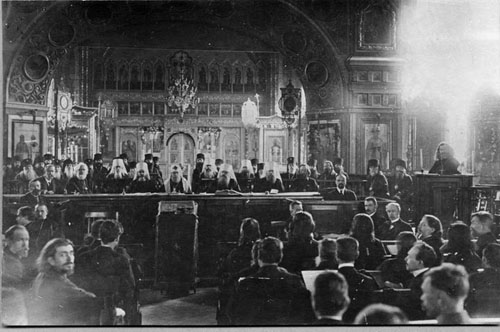
Fr. Sergei wasn't able to stay for the morning session, but he made sure I made it into the Church which was up the stairs, and part of a large hall. I wasn't aware of the history of this place until the next day, and perhaps it was just as well, because it was intimidating enough to speak at this conference in the first place -- but as I later learned, I was serving in a Church which was dedicated to St. Vladimir, and built by the Hieromartyr Vladimir (Bogoyavlensky), who was the first bishop to be martyred by the Bolsheviks when he was then Metropolitan of Kiev. It was built because prior to it, there was no Church dedicated to St. Vladimir the Great in Moscow, and they wanted a Church suitable to celebrate the 900th anniversary of the Baptism of Rus' in 1888. In 1917, it was chosen as the site of the pivotal All-Russian Council which elected Patriarch Tikhon and played such a key role in charting the course of the Russian Church up to the present day.


The Soviets destroyed the interior of this Church, and it was used simply as a concert hall. However, it was restored, almost exactly as it was originally. However, while you can see in the photo above from the 1917 Council that there was an archway separating the main hall from the Church, which was decorated with icons. When the Church was restored, it was decided that the icons on this archway would be composed of saints who participated in the 1917 Council, but were either martyrs or confessors.


When I first entered the Altar, Fr. Paul Ermilov introduced himself, and pointed me to the vestments set aside for me. It was a good thing that they had a set for me to use, because I had assumed the Liturgy would be in gold vestments, but as it turned out, they were in blue, for the feast of the Iveron Icon of the Mother of God.

Archbishop Ambrose (Yermakov)

I did not bring my kamilavka, because travelling with a big hat is very inconvenient. Fr. Paul made several attempts to find one that would fit, but I have a big head, as Texans often do. I guess Serbs may have something similar, because to make things symmetrical, he had me stand opposite Fr. Darko Djogo, who was also an invited speaker, from the University of East Sarajevo's Faculty of Theology, and he likewise didn't have a kamilavka that fit. But as it would happen, he also speaks wonderfully good English, and so I made a point of sticking close by him for the rest of the Conference.


So we lined up to greet Archbishop Ambrose (Yermakov), who is the Rector of the Moscow Theological Academy. The choir was especially amazing.


The Liturgy itself was very beautiful, though there are a few minor differences between the practice in ROCOR that I am familiar with, and the Moscow practice, but I made it through without incident. I was able to meet Archbishop Ambrose, as well as Fr. Vladimir Vorobyov who is the rector of the University. Unfortunately for me, our conversations were limited by their limited English, and my even more limited Russian.

Fr. Vladimir Vorobyov

After the Liturgy, the clergy were invited to a dinning hall where we had a very nice lunch, and I was able to speak with the clergy... mostly Fr. Darko and Fr. Paul, though some of the other clergy spoke a bit of English. There was a priest from Ukraine who spoke some English, and he pointed out that he had the same kind of coat that I was wearing, which I wasn't clear on how he happened to have gotten one. We were both wearing United States Navy pea coats -- which I wear for three reasons: 1) my father was in the Navy in World War II, and told me that this was a very warm and practical coat; 2) you can get them from an Army / Navy surplus store very cheaply; and 3) they happen to work well with my usual wardrobe. I later learned that he was another invited speaker, and that he had been forcibly evicted from his Church in Ukraine, though I can't remember where it was, or the details of how it happened in his case.

After the meal, the Conference itself began. The first session was focused on the theological issues behind the crisis, and the speakers came from Moscow Theological Academy, Stretensky Theological Seminary, Moscow State University, and also included Fr. Paul Ermilov who is a professor at St. Tikhon University.

Fr. Paul Ermilov

I sat next to Fr. Darko, and he translated the highlights of what was said for me.


After another break, we began the session that both Fr. Darko and I were to speak at, which was entitled: "A look at the church crisis from abroad." Fr. Sergei Baranov arrived for this session, and provided a fairly complete translation for all the other talks for me -- which gave me a good idea of how much I had been missing up until then. I had asked Fr. Sergei to translate my talk to the audience, because I have known him for about a decade now, and I knew he would understand what I was saying (he speaks fluent Texan). He has more degrees than most people have pairs of socks, in fields ranging from the hard sciences, to theology, and is currently working on a Ph.D. in Theology.


He brought a recorder with him, which looks similar to the one that I use, but a bit newer and more advanced. He asked if I would like to take charge of it, but I suggested he do so, since I knew from using my own that it was easy to think you were recording when you weren't, and he was more familiar with his recorder. We also had a time limit for our talk, and I wanted to make sure we didn't go over.

I didn't realize it until Fr. Sergei told me later, but he thought he was recording the first 10 minutes, only to realize that he wasn't, and then he began recording. I thought we had stuck to the time limit as I checked the minutes on the recorder, but as a result of this mishap we went a bit over. However, the talk seemed to be well received. You can read the text of that talk here:
An American Perspective on the Ukraine Crisis
After that session, we ended the conference with an evening meal, which was quite festive. Fr. Sergei needed to head home, but I stayed until the end and was given a ride back to my apartment by Fr. Dimitri, whose surname escapes me, but he is a deacon, and a son-in-law of Fr. Vladimir Vorobyov. He's a very cheerful man, who speaks English fairly well, and so we had a great conversation on the way home.

The plan the next day was for me to serve at one of the parishes near my apartment that is connected to St. Tikhon University. It was close enough for me to walk it. And then I would catch a ride for the the second and final day of the conference.

This had been an amazing day, and if my trip had ended at this point, it already would have been one of the highlights of my life, but there was a lot more yet to come.


To be continued...

2019 Moscow Trip -- Part 1

Wednesday, April 03, 2019

2019 Moscow Trip -- Part 1


I was unexpectedly able to travel to Russia for the first time since 2007 (to read about that trip, click here). In late January I received an e-mail from Fr. Paul Ermilov of St. Tikhon University in Moscow, which asked if I would be willing to speak at a conference they were going to hold at the end of February on the crisis in Ukraine, which has resulted from the intrusion of the Patriarch of Constantinople into the territory of the Russian Orthodox Church. He said he was not expecting an academic presentation, but simply reflections from a priest in America on the issue -- and he said that the University would cover my travel expenses. My initial reaction was to think someone was pulling my leg, and so I forwarded the e-mail to Deacon Sergei Baranov (who was ordained at St. Jonah's in Spring, Texas, but who is currently lives and works in Moscow), to ask him if he could confirm that this was a legitimate request. Within a few hours, he responded that indeed it was, and that he had spoken to Fr. Paul about it. He also offered to show me around after the conference, if I was able to make it.

The biggest hurdle was getting my visa in time, but fortunately there is a Russian Consulate in Houston. It took a few weeks to get the invitation done on the Russian end, and then I was able to get the Visa on my end, with about a week to spare.

The last time I went to Russia, was in the spring, and so the weather was beautiful and warm. This time, I knew it would be quite a bit colder. And so I had to buy a pair of water-resistant cowboy boots with slip-resisting treads -- which worked well in the snow and the slush. I almost slipped on a few occasions, but didn't. On Fr. Sergei's recommendation, I flew on Lufthansa, which I believe is the best airline I have ever flown on.

I left Houston a bit after 4 p.m. on Friday, February 22nd. I packed several books, primarily for my return flight. During this flight, I was focused on preparing for my talk. I had a month to think about it, but didn't have much of a chance to organize my thoughts, and put them on paper prior to then. Starting with Theophany (January 19th, on the civil calendar) up until the beginning of Lent, I am exceptionally busy, because almost every evening I either was blessing the homes of parishioners (this is done every year, around this time, according to custom) or had an evening service. I am retiring from my secular job at the end of April, and so next year things will hopefully be different, but that is how it has been in the past, and this year was no exception. I don't use a lap top, or an iPad, and so I composed my notes the old fashioned way, with pen and paper.

A Room with a View

Flying from the west to the east is a bit like flying into the future, and so after a lay-over in Frankfurt, it was about 6 p.m. Saturday evening, when I landed in Moscow. I was met by a kindly young deacon, sent by the University, and taken to an apartment they use for guests, to the south of the Moskva River in central. I knew it was near the Convent of Ss. Martha and Mary, founded by the New-Martyr Grand Duchess Elizabeth, but I didn't realize how near it was until I woke up Sunday morning, looked out of my window, and recognized the distinctive features of the Convent Church, right outside.


St. Elizabeth was a granddaughter of Queen Victoria, and a German Princess (her mother married a German Prince), and she was raised Lutheran. When she married into the Russian royal family, she was not obligated to convert, but did so after many years of study, of her own free will. When her husband (Grand Duke Sergei) was assassinated, in 1905, she established this convent, and dedicated the rest of her life to serving the poor, but was martyred by the Bolsheviks in 1918, one day after her sister, the Tsaritsa was also martyred, along with the Tsar and their children. She was targeted because she was a member of the Romanov family, and her work in Moscow among the poor, ran counter to the narrative the Communists were trying to tell about pre-revolutionary Russia.

The St. Mary Magdalene Convent, on the Mount of Olives in Jerusalem, which was built largely through the efforts of the Grand Duchess Elizabeth and her husband. 
After the White Army recovered St. Elizabeth's body, it was brought to the Church of the Martyrs in Beijing (when they retreated into China at the end of the Russian Civil War), and then the British Royal Family paid for it to be brought to this Church, along with the relics of St. Barbara, her faithful assistant, who refused to be separated from her, even though it meant that she was martyred along with her.

I named my firstborn child after St. Elizabeth, and we celebrate every liturgy at St. Jonah over her relics. In 2014, I was also able to venerate her relics at her final resting place at the St. Mary Magdalene convent in Jerusalem, but it was a special blessing to begin my visit to Moscow so near to this convent, founded by such a dear saint.

St. Tatiana

The Icon and Relics of St. Tatiana at St. Tatiana's in Moscow

Fr. Sergei came by on foot at around 8:30 a.m, and we walked to the nearest Metro station (their subway) and took a train that brought us to within walking distance from the Church of St. Tatiana. The Metro now makes all announcements in English, as well as Russian, and so it is possible to navigate around the city even if you do not speak Russian. St. Tatiana is the parish that Fr. Sergei is on loan to while in Russia, and is at Moscow University. It has inscribed on the exterior of the Church the words from the Presanctified Liturgy: "Свет Христов просвещает всех," which means "The Light of Christ Illumineth All."


That's an idea I may steal as we design our new Church in Spring.

St. Tatiana is now considered the patron saint of education in Russia, and this is because it was on St. Tatiana's day that the Empress Elizabeth granted the petition to establish Moscow University in 1755, and so this Church was built on the campus and dedicated to St. Tatiana. Her feast is now celebrated throughout Russia as "Russian Students Day," and marks the end of the winter term of school.

Fr. Vladimir Vigilyansky

I was warmly greeted by the rector of the parish, Archpriest Vladimir Vigilyansky. But while I had assumed I would have little to do as a visiting priest, he immediately asked if I could serve proskomedia, so that he could help the other priest who was hearing confessions. That other priest continued to hear confessions throughout the entire liturgy. In fact, I don't think I got to meet him, and so he may still have been hearing confessions after the service was over.

The Parishioners during the Liturgy

I was planning on doing whatever exclamations I was given to do in English, but Fr. Vladimir wanted Fr. Sergei to do some of the litanies in English as well, evidently thinking the people might enjoy hearing part of the service in English. Ironically, we did more English in that service than some Russian parishes typically do in the United States. Fr. Sergei didn't think to bring his copy of the service book in English, and so he had to borrow my book for one litany, which meant that I ended up having to do the exclamation in Slavonic, because I had to use Fr. Vladimir's book in the absence of my own.

As I was about to hand off my service book to Fr. Sergei

Another interesting thing about this parish is that the Holy Table is the largest in Moscow. Not even Christ the Savior Cathedral has one larger.


During the announcements, Fr. Vladimir introduced me, and told the people that this was the first time Fr. Sergei had been able to serve with both of his rectors at the same Liturgy.

The Iconostasis


Their current Iconostasis is a reproduction of the one they had before it was destroyed by the Soviets. Interestingly, from 1998 up until 2014, they were using an Iconostasis which came from a parish dedicated to St. Seraphim in Manhattan, which was donated by the late Fr. Alexander Kiselev:


This iconostasis is still used in their lower Church.

The Church interior, after the service

After the Liturgy, they had trapeza, and I was able to visit with Fr. Vladimir and other members of the community a bit more. After that, Fr. Sergei showed me around, and among other things, he showed me a calendar which listed all the services and activities in the parish, which fill up much of every day of the week. For example, on this day, they held an exhibit, complete with lectures on the life and ministry of St. Nicholas of Japan -- who was one of the most successful missionaries in the history of the Church. We weren't able to stay for the lectures, and my limited Russian would have made that difficult, but the exhibit itself was very impressive.


Walking Through Moscow

Then we set out on foot across the center of Moscow. When you drive around a city like Moscow, you only see things as you speed past them, but walking through a city allows you really see it.


I was able to see a good bit of the Kremlin in 2007, but this was the first time I was able to see the inside of the Kazan Cathedral.


This was another Church destroyed by Stalin in the 1930's, but rebuilt in the 1990's exactly as it was before.

Of course, no trip to Moscow would be complete without a visit to St. Basil's Cathedral.


The mostly still frozen Moskva river:


We made it back to my apartment, and so I was able to drop off my vestments. Then we visited the inside of the Ss. Martha and Mary Convent next door.


They have signs in several languages explaining the history of the Convent, as well as it's current purpose, which is again to minister to the poor.


They have a statue of St. Elizabeth in the court yard.


You can tell by the white walls that this is a Church that was destroyed on the inside by the Communists, and is still in the process of restoration. You can see some of the nuns cleaning the Church in the pictures.


In the Church they have a reliquary with a relic from St. Elizabeth's right arm, which was given to the Convent by the Russian Ecclesiastical Mission in Jerusalem.


We then went to see some of the other sites in the area, including a Church dedicated to St. Clement of Rome, which had been a long time in restoration, but when we saw the inside, it was easy to see what took so long.


While we we walking about, a young Serbian man named Darko, who is currently a student in Moscow, walked up to me and introduced himself. It turns out he is a Facebook friend who saw my first posts about being in Moscow. It's a small world.

At one point we walked by this place:


That sign says "Louisiana Steakhouse." Those familiar with the swamps of Louisiana will find the Cacti quite humorous. But since I can get Texas steaks and Louisiana cooking anytime, we decided to eat dinner at a Russian Bistro. The food was quite good.

Throughout the afternoon, Fr. Sergei was telling me about all the places I could walk to and see on my own that evening. He needed to return home. I make a point of walking in the morning for exercise, but I had already walked a lot more that day than I was used to, and either that, the jet-lag, my age, or all three were catching up with me. When I finally made it back to my apartment, I was in no condition to go anywhere else. So spent a little bit of time going over the talk I would be giving the next day, and then I went to sleep.

To be continued...