Showing posts sorted by date for query New Jerusalem. Sort by relevance Show all posts

Wednesday, July 29, 2026

Becoming a Catechumen


Becoming a catechumen is analogous to being betrothed before a marriage. In fact, there are many parallels between the making of a catechumen and the subsequent baptism, with the service of betrothal and the marriage service. And in the Orthodox Church, it should be understood that a betrothal already counts as a marriage. If a betrothal is broken, this requires an ecclesiastical divorce -- which is why we usually do the betrothal service immediately prior to the marriage service, in contemporary practice. In our culture, it is not uncommon for people to say that they are engaged to be married, and then to call it off, and move on without much ceremony. But a real betrothal is a far more serious thing than that.

Likewise, one should not become a catechumen in the first place, if they are not sure that they want to ultimately be baptized.

Just as a couple is betrothed to be married, for a period of time so that they can become better acquainted with each other before they enter into the intimate relationship of marriage, a catechumen is entering a time that is to be dedicated towards them coming to better understand the teachings of the Church, and for them to enter into the beginnings of living the Orthodox life, keeping the fasts, learning the disciplines of the Christian life, and working to prepare themselves for receiving baptism, and then beginning the full sacramental life of the Church.

When anyone asks me about being made a catechumen, the first thing I do is have them review the renunciations and affirmations that converts from other faiths make. We incorporate these renunciations and affirmations in the service for the making of a catechumen. I asked people to review these renunciations and affirmations in advance, because I want them to be sure that they know what they are committing to. If someone is prepared to sincerely make these renunciations and affirmations, and are fully committed to entering the Church, they are ready to become a catechumen.

Here are the renunciations that are made by most converts from Protestantism (though Lutheran converts have a slightly different renunciation with regard to the Lutheran understanding of the Eucharist):

Priest:  Dost thou renounce the false doctrine that, for the expression of the dogma touching the Procession of the Holy Spirit the declaration of our Savior Christ himself: 'who proceedeth from the Father': doth not suffice; and that the addition, of man's invention: 'and from the Son': is required?

Answer: I do.

Priest:  Dost thou renounce the false doctrine, that the predestination of men to their salvation, or their rejection, is not in accordance with the Divine foreknowledge of the faith and good works of the former, or of the unbelief and evil deeds of the latter; but in accordance with some arbitrary destiny, by reason of which faith and virtue are robbed of their merit, and God is held accountable for the perdition of sinners?

Answer: I do.

Priest:  Dost thou renounce the erroneous belief that in the Sacrament of the Holy Eucharist the bread and wine are not transmuted into the Body of Christ, and doth not become the Body and Blood of Christ, and are merely emblems of the Body and Blood of Christ?

Answer: I do.

Priest:  Dost thou renounce the erroneous belief of the Reformed teachers who reject five Sacraments: Chrismation, Confession, Marriage, Anointing with Oil, and the Priesthood itself, which administereth the other Sacraments, and presume to administer Baptism and the Eucharist, never having received, through the laying-on of hands by a Bishop, that Ordination which hath been transmitted from one to another, even from the Apostles?

Answer: I do.

Priest:  Dost thou renounce the erroneous belief of the Reformed teachers who receive not the traditions of the Holy Church reverence not the Saints, and deprive the dead of spiritual aid and the living of spiritual consolation, in that they reject prayers for the dead?

Answer: I do.

Priest:  Hast thou renounced all ancient and modern heresies and false doctrines which are contrary to the teachings of the Holy Orthodox-Catholic Church?

Answer: I have.

The specific renunciation regarding predestination is only done by those who come from a Reformed background, which pertains to their view of double predestination.

These are the renunciations that are made by converts from a Roman Catholic background:

Priest: Dost thou renounce the false doctrine that, for the expression of the dogma touching the Procession of the Holy Spirit the declaration of our Savior Christ himself: 'who proceedeth from the Father': doth not suffice; and that the addition, of man's invention: 'and from the Son': is required?

Answer: I do.

Priest: Dost thou renounce the erroneous belief that it doth not suffice to confess our Lord Jesus Christ as the head of the Universal Church; and that a man, to wit, the Bishop of Rome, can be the head of Christ’s Body, that is to say, of the whole Church?

Answer: I do.

Priest: Dost thou renounce the erroneous belief that the Holy Apostles did not receive from our Lord equal spiritual power, but that the holy Apostle Peter was their Prince: And that the Bishop of Rome alone is his successor: And that the Bishops of Jerusalem, Alexandria, Antioch, and other are not, equally with the Bishop of Rome, successors of the Apostles?

Answer: I do.

Priest: Dost thou renounce the erroneous belief of those who think that the Pope of Rome is superior to the Ecumenical Councils, and infallible in faith, notwithstanding the fact that several of the Popes have been heretics, and condemned as such by the Councils?

Answer: I do.

Priest: Dost thou renounce all the other doctrines of the Western Confession, both old and new, which are contrary to the Word of God, and to the true traditions of the Church, and to the decrees of the seven Ecumenical Councils?

Answer: I do.

Priest:  Hast thou renounced all ancient and modern heresies and false doctrines which are contrary to the teachings of the Holy Orthodox-Catholic Church?

Answer: I have.
There are also specific renunciations made by those coming from a Monophysite, Jewish, or Muslim background.

The affirmations are the same for all converts:

Priest: Dost thou accept the Apostolical and Ecclesiastical Canons framed and established at the Seven Holy Ecumenical and Provincial Councils, and the other traditions and ordinances of the Orthodox Church?

Answer: I do.

Priest: Dost thou acknowledge that the Holy Scriptures must be accepted and interpreted in accordance with the belief which hath been handed down by the Holy Fathers, and which the Holy Orthodox Church, our Mother, hath always held and still doth hold?

Answer: I do.

Priest: Dost thou believe and confess that there are seven Sacraments of the New Testament, to wit: Baptism, Chrismation, the Eucharist, Confession, the Priesthood, Marriage, and Anointing with Oil, instituted by the Lord Christ and his Church, to the end that, through their operation and reception, we may obtain blessings from on high?

Answer: I believe and confess it.

Priest: Dost thou believe and confess that in the Divine Liturgy, under the mystical forms of the holy bread and wine, the faithful partake of the Body and Blood of our Lord Jesus Christ, unto the remission of sins, and unto life eternal?

Answer: I believe and confess it.

Priest: Dost thou believe and confess that it is proper to reverence and invoke the Saints who reign on high with Christ; and that their prayers and intercessions before God avail with the beneficent God unto our salvation: and that it is well-pleasing in the sight of God that we should do homage to their relics, glorified through incorruption, as precious memorials of their virtue?

Answer: I believe and confess it.

Priest: Dost thou confess that the images of our Savior Christ; and of the Ever-virgin Mother of God, and of the other Saints are worthy of being possessed and honored; not unto idolatry, but that, through contemplation thereof, we may be incited unto piety, and unto emulation of the deeds of the holy persons represented by these images?

Answer: I do.

Priest: Dost thou confess that the prayers of the faithful which are offered up to God, and more especially when accompanied by the oblation of the unbloody sacrifice, for the salvation of those who have departed this life in the faith, are favorably received, through the mercy of God?

Answer: I do.

Priest: Dost thou believe and confess that power hath been given by our Savior Christ unto the Orthodox-Catholic Church to bind and to loose: and that whatsoever, by virtue of that power, is bound or loosed on earth will be bound or loosed in heaven?

Answer: I believe and confess it.

Priest: Dost thou believe and confess the Foundation, Head, and Great High Priest and Chief Shepherd of the Holy Orthodox-Catholic Church is our Lord Jesus Christ; and that Bishops, Pastors, and Teachers are appointed by him to rule the Church; and that the Guide and Pilot of this Church is the Holy Spirit?

Answer: I believe and confess that this Church is the Bride of Christ, and that therein is true salvation, which was in the Ark of Noah at the Flood.

Priest: Dost thou promise true obedience, unto thy life’s end, in guidance which is salutary unto the soul, to the Most Holy Synod; to the Most Holy Patriarch, the Equal-of-the-Apostles (or to the Ecclesiastical Authorities of the Autocephalous Provincial Church); and to the Bishop of this Diocese, as the true Pastors appointed by the Holy Spirit; and to the Priests ordained by them?

Answer: I promise it, with heart unfeigned.
One thing a catechumen has to decide on is on a patron saint. Archbishop Peter, of blessed memory, had a directive that said that anyone who already has a Christian name needed to keep it. Often, there are many saints with the same name, and so one still has to decide on which saint they will choose. If someone doesn't have an obviously Christian name, they should speak to the priest because often there is a saint whose name has the same meaning as their name.

After one is made a catechumen, we have catechumen meetings via Google Meets, and also some face to face meetings to help prepare people for baptism. How long someone remains a catechumen varies, but it depends on how long they were studying Orthodoxy before they were formally made catechumens, and also depends on when both they and the priest agree that they are ready.

One of the great blessings of being a catechumen is that the Church has specific prayers that are said for them during the divine liturgy, and also during the presanctified liturgies during Great Lent.

One frequent question that catechumens often ask is whether or not they are supposed to leave the Church at the dismissal of the catechumens. This is not generally done in parishes, though some monasteries require it, and some parishes do have the catechumens leave the service, but then take them to an instructional class for catechumens. We, as of yet, do not do this, though we have discussed the idea, and may incorporate this practice if we can get a sufficient number of catechists committed to making this possible.

Before baptism, a person needs to decide on who their godparent will be. It is possible to have both a godmother, and godfather, but it is necessary to have at least one godparent who is of the same sex as the person being baptized.

Before a catechumen is actually baptized, they make a life confession, which should be discussed with the priest ahead of time, but basically consists of the catechumen confessing all of the types of sins that they have committed in their life, that they are able to remember.

We have an article that covers the practical things that a person being baptized needs to do to prepare for the actual service.


Friday, August 01, 2025

Cyril Lukaris and the Confession of Dositheus

Patriarch Cyril Lukaris

Jason Wallace of the Ancient Paths YouTube channel has produced two videos attacking Orthodoxy. The first was "The Failure of Eastern Orthodoxy," and the second was "Cyril Lucaris: Calvinist Patriarch/Orthodox Saint." Craig Truglia and I did two video responses, which you can view here:


More recently, Jason Wallace appeared on "The Dividing Line," with James White, and discussed his videos, but focused on the question of Cyril Lukaris, on an episode entitled "Let’s Make Cyril Lucaris Great Again!

This latest video doesn't warrant another lengthy video rebuttal, but there were a number of erroneous things asserted that should be corrected.

To sum up his argument, he claims that Cyril Lukaris was in fact a Calvinist, and that the Orthodox tried to cover up this fact because supposedly this would call into question our understanding of Apostolic Succession, he asserts that the Orthodox Church has affirmed that the Council of Jerusalem and the Confession of Dositheus are on the same level as the Seven Ecumenical Councils and Scripture, and that the Orthodox Church has recognized Cyril Lukaris as a saint, despite the fact that he was a Calvinist, and thus a heretic from an Orthodox perspective. All of this, he claims, proves that the Orthodox Church has contradicted itself and is therefore not infallible, as it claims.

Was Cyril Lukaris a Calvinist?

In Jason Wallace's interview with James White, he claimed that I had asserted that the Confession of Cyril Lukaris was a forgery, but the clip he refers to clearly shows that I said "There is an argument to be made that his confession was a forgery, or that it was altered." I put it this way precisely because the arguments I had read were clearly not proof that this was this case, but they seemed reasonable to me at the time. But I would still say that there is an argument to be made to that effect. Jason Wallace's video does present a strong case that this is not true. The bottom line is that it doesn't really matter that much. Heretical occupants of the patriarchal throne of Constantinople are no novelty in the history of the Church.

The historical context here is very complicated, and there was a lot intrigue going on. The Church of Constantinople was under the thumb of the Turks, and so outside powers, both Protestant and Catholic, were able to manipulate Sultans who were more than happy to remove a Patriarch so that they could extract money from whoever wanted him replaced, and so that is why Cyril was removed five times from that position. In that context, lots of people presented one face to one group, and a different one to another. Cyril may well have been such a person.

Stephanie Falkowski, in her dissertation "Not Quite Calvinist: Cyril Lucaris a Reconsideration of His Life and Beliefs," makes the case that Cyril was not as much of a Calvinist as has been generally claimed, but that he was trying to get help from Calvinists, and so tried to sound like as much of a Calvinist as he could, though he often used ambiguous language to accomplish that purpose. I won't take the time to lay out the case that she does, but would recommend those interested give her dissertation a read.

If Cyril Lukaris was In Fact a Calvinist, Would This Disprove Apostolic Succession?

Most of those who have been labelled as heresiarchs (the founder of a heresy or the leader of a heretical sect) have in fact been bishops, and several were Patriarchs of Constantinople. We do not hide this fact. On the Sunday of Orthodoxy, bishops recite the Synodikon of Orthodoxy, and pronounce anathemas on the most prominent of these heretics. So if Cyril Lukaris was a Calvinist, this would be not be an anomaly in Church history.

Wallace asserts that the reason why Orthodox people, going back to the time of the Council in Jerusalem in 1672, have argued that Cyril Lukaris was not a Calvinist because (he mistakenly believes) this would prove Orthodoxy to be false, but even if we assume Cyril was a full blown Calvinist, the reason why the Council of Jerusalem may have argued otherwise is simply because this was not the face he showed to his flock, and so many had positive memories of him. One of the reasons why he would have sought out specifically Protestant allies is that he had spent much of his ministry battling Jesuits who were promoting Uniatism in Ukraine, which was obviously something the Orthodox would have seen as a very laudable part of his history.  

Wallace noted that the Council of Jerusalem cited sermons of Cyril Lukaris without providing the dates these sermons were delivered, as if this was an intentional way of clouding the facts. Modern footnotes are relatively recent things. They certainly are often helpful, but the fact that the council didn't provide modern footnotes doesn't prove anything, other than that they were not accustomed to later conventions. It may also be that the texts of these sermons simply were not dated. The fact that this Council argued that his Confession was either forged or altered was not necessarily because they knew this was false. There was a lot of confusion that reigned during this time, and so there are good reasons why they probably believed this to be the case, even if, in fact, this was not true.

Did the Orthodox Church Recognize Cyril Lukaris as a Saint?

Jason Wallace seems to think that the fact that the local Church of Alexandria glorified Cyril Lukaris as a saint means that, if he in fact was a Calvinist, the Orthodox Church would be guilty of error, and it its infallibility would be thus disproven. The problem is that the decisions of one local Church have never been considered to be necessarily infallible. The only way the decisions of a local Council to glorify a saint could be claimed to be approved by the whole Church, would be either for the whole Church to affirm that decision in an Ecumenical Council (and that would entail a Council both claiming to be Ecumenical, and that Council being received by all the local Churches as Ecumenical); or he would need to be officially recognized by all of the local Orthodox Church as a saint. Neither of these things have happened.

I have seen references to the Patriarchate of Constantinople recognizing Cyril Lukaris as a saint in 2022, but I have been unable to find anything that actually demonstrates that this happened. But even if it did, that would still be only two local Churches, and there is no guarantee that such a decision would be infallible. The Orthodox Church has never claimed that it was impossible for a local Orthodox Church to fall into error. This is also no novelty in the history of the Church.

Is the Council of Jerusalem of 1672 an Ecumenical Council?

Jason Wallace stated that the conciliar work of the Orthodox Church continued uninterrupted in history through the later councils of universal authority, but there have been no Ecumenical Councils outside of the Seven Ecumenical Councils, that both claimed to be Ecumenical and have been universally received in the Orthodox Church to be such. One does find references to the Eighth and to the Ninth Ecumenical Councils, and they would certainly be the best candidates to be labeled such, but while these councils have been universally received as authoritative, they have not been universally received as being on the same level as the Seven Ecumenical Councils.

The Council of Jerusalem is considered to be of some authority, but it's decrees were in fact not seen to be infallible, as is shown by the fact that another Council in 1723 made corrections to the Confession of Dositheus (see the Epistle of the Patriarchs of the Eastern Catholic Church on the Orthodox Faith (1723). These corrections were reflected in the Russian text of the Confession of Dositheus which was published by St. Philaret of Moscow.

One of the things Jason Wallace highlighted as objectionable in the Confession of Dositheus was what is said in Question 1 of the Confession:

"Question 1

Should the Divine Scriptures be read in the vulgar tongue [common language] by all Christians?

No. Because all Scripture is divinely-inspired and profitable {cf. 2 Timothy 3:16}, we know, and necessarily so, that without [Scripture] it is impossible to be Orthodox at all. Nevertheless they should not be read by all, but only by those who with fitting research have inquired into the deep things of the Spirit, and who know in what manner the Divine Scriptures ought to be searched, and taught, and finally read. But to those who are not so disciplined, or who cannot distinguish, or who understand only literally, or in any other way contrary to Orthodoxy what is contained in the Scriptures, the Catholic Church, knowing by experience the damage that can cause, forbids them to read [Scripture]. Indeed, it is permitted to every Orthodox to hear the Scriptures, that he may believe with the heart unto righteousness, and confess with the mouth unto salvation {Romans 10:10}. But to read some parts of the Scriptures, and especially of the Old [Testament], is forbidden for these and other similar reasons. For it is the same thing to prohibit undisciplined persons from reading all the Sacred Scriptures, as to require infants to abstain from strong meats."

This statement was in the context of the Greek speaking Church, at a time when the Turks suppressed the education of Christians. Cyril Lukaris had published a translation of the New Testament into modern Greek, and this translation was objected to by many. Protestants have many people who still object to updating the King James Version, but these bishops were not objecting to replacing an older translation of the New Testament with a new one -- they were objecting replacing the inspired original text of the Greek New Testament with a modern translation. Greek Orthodox Christians continue to use the original text of the Greek New Testament to this day. It does require some effort for a modern Greek to be able to fully understand it, but I used to have a Greek auto mechanic who had a copy of the Orthodox Bible in Greek, which consisted of the Septuagint text for the Old Testament and the Greek New Testament, which he read regularly. When I admired his copy, he gave it to me, and it is well worn. While one might ridicule people who insist on exclusively reading a 400 year old English translation of the Bible, it should be understandable why Greeks would want to maintain the use of the inspired original Greek text. 

Nevertheless, other bishops did object to the way this question was answered in the Confession of Dositheus, and so it was corrected in 1723 to read:

Question 1. – Should all Christians read the Holy Scriptures?

Answer. We know that all Scripture is God-inspired and beneficial, and so necessary that without it it is absolutely impossible to be pious; but not all are able to read it, but only those who know how to test the Scriptures, to study them, and to understand them correctly. Thus, every pious person is allowed to hear the Scriptures, in order to believe in the truth with his heart and confess with his lips unto salvation, but not everyone is allowed to read certain parts of the Scriptures, especially the Old Testament, without guidance. To indiscriminately allow the unskilled to read the Holy Scriptures is the same as to offer infants the use of strong food.

This is the wording reflected in the text of the Confession published by St. Philaret of Moscow. And, you will note that the beginning word "No" has been removed. And as a matter of fact, St. Philaret of Moscow oversaw the publication of the Russian Synodal translation of the Bible, and encouraged people to read it, especially the New Testament. This translation is still used by many Russian speaking Protestants, by the way. When this text speaks of guidance being necessary for the Old Testament, Protestants who constantly published study Bibles for that same purpose should hardly find that objectionable. Providing such guidance has long been one of the primary focuses of catechetical instruction provided to young Orthodox laymen, as one could see by looking at texts, such as "The Law of God: For Study at Home and School," by Fr. Seraphim Slobodskoy, which is 651 pages in length in the English translation, and close to half of that text is about the content of the Bible, and about half of that is focused on the Old Testament (as can be seen online, here).

Wallace argues that the Orthodox Church declared the Council of Jerusalem to be an Ecumenical Council at the Council of Crete in 2016, having "universal authority, just like the Ecumenical Councils," this is incorrect. For one thing, the Churches of Antioch, Georgia, Bulgaria, and Russia did not attend this council, and so far more than half of Orthodox world was not represented -- contrary to Wallace's assertion that "You had Alexandria, Antioch, Jerusalem, Constantinople, and Moscow, Bulgarians... basically everyone represented." Secondly, even if you look at the Encyclical which Wallace assumes to have referenced the Council of Jerusalem, it actually refers to a council held in Constantinople in 1672, which was held prior to the Council of Jerusalem:

"...and furthermore through the Holy and Great Councils convened in Constantinople, in 1484 to refute the unionist Council of Florence (1438-1439), in 1638, 1642, 1672 and 1691 to refute Protestant beliefs, and in 1872 to condemn ethno-phyletism as an ecclesiological heresy" [Emphasis added].

All of the councils referenced here were held in Constantinople. And while it does cite these councils as being part of the ongoing conciliar work of the Church, it does not actually assert that they are on the same level as the Seven Ecumenical Councils, contrary to Wallace's claim.

Archbishop Vasily (Krivoshein), in his "Symbolic Texts in the Orthodox Church," points out that the Council in 1672 held in Constantinople was attended by 40 bishops, and produced a statement against Calvinism. Later, in that same year, Patriarch Dositheus of Jerusalem, who had participated in that council took advantage of a gathering of clergy and laity for festivities held at the Church of the Nativity in Bethlehem, and presented his Confession. Only 8 bishops were present and signed this document, and so to even speak of a "Council of Jerusalem" is a debatable point, but it was hardly on the same level as an Ecumenical Council, and as stated, was later corrected by a subsequent council, and so while the corrected Confession of Dositheus is a document of some authority, neither that council nor this document was ever seen as an infallible.

Jaroslav Pelikan, who was a preeminent scholar on the history of Christian doctrine (who was a Lutheran most of his life, but converted to Orthodoxy in 1998) discusses in some detail the status of texts like the Confession of Dositheus in his book "Credo: Historical and Theological Guide to Creeds and Confessions of Faith in the Christian Tradition," which has a chapter on the Orthodox Church (which includes a telling subsection entitled "The Ambivalence of the Orthodox Church Toward "Symbolic Books"). Toward the end of that chapter, Pelikan sums things up as follows: 

"Drawing upon this liturgical confession of the faith of the church and shaping it in turn, the doctrinal decisions and formulations of the seven church councils between 325 and 787 stand as the formal deposit of normative dogma for Eastern Orthodox teaching. "The West incessantly asks us for the symbolical books of Orthodoxy," the Bulgarian Orthodox New Testament scholar Nikolaj Nikaronovic Glubokovsky once observed with some annoyance. "We have no need of them. The faith of the seven first councils is sufficient for us." In one sense, therefore, the sacred tradition of the seven ecumenical councils... is a legacy that Eastern Orthodoxy shares with Roman Catholicism, as well as with those other Western confessions in which the validity of the ecumenical councils is acknowledged, albeit with varying degrees of authority being assigned to them. 

In another sense, however, the Eastern Orthodox view of the councils is peculiar to the East. One reason for this is that no later actions of any church, neither those actions that lay claim to the title "ecumenical" in Western dogmatics and canon law nor even the actions of the East itself since 787 at "provincial synods" nor the Eastern Orthodox "confessions" may be ranked on a level with the seven councils" (Credo: Historical and Theological Guide to Creeds and Confessions of Faith in the Christian Tradition (New Haven and London: Yale University Press, 2003), p. 413f). 

Only God knows the future. The day may come when a new Ecumenical Council is held and is received as being on the same level as the first seven, but that day has not come yet. The Church managed for nearly three centuries without an Ecumenical Council, and so having had Seven, the urgency for another is not as great as many would like to imagine.

Do the Orthodox See the Services of the Church as Being on the Same Level as Scripture?

Another claim Wallace makes is that we see the services as being on the same level as the Scriptures, and cites as an example an Akathist to St. Constantine the Great which states that St. Constantine was baptized by St. Sylvester of Rome, despite the fact that Eusebius and other contemporary writers stated that he was baptized by Eusebius of Nicomedia, who was later condemned as an Arian. He claims that this is an example of the Orthodox Church trying to re-write history to cover up uncomfortable facts.

First off, it is the Orthodox Church that preserved texts, like Eusebius' History of the Church, and so obviously the Church is not engaged in any cover up there. Secondly, the fact that a bishop who was in good standing with the Church at the time later was condemned as a heretic does not mean that those who were baptized by him were heretics, or that the baptism was invalid.

I am not sure where Wallace got the impression that we put the services of the Church on the same level as Scripture, but we do see universally received services as being part of the Tradition of the Church, as are the Scriptures. However, not all parts of the Tradition of the Church are on the same level of authority, nor would we affirm that everything that is true of the Scriptures is equally true of the services. Even within Scripture, not all the Scriptures are on the same level. The book of Esther, for example, is not on the same level of authority as the Gospels -- though we would affirm that all Scripture is inspired and inerrant. 

When it comes to the services, not all services are on the same level of authority. Akathists, aside from the Akathist to the Mother of God, are not appointed to be served in the regular services of the Church. They are a popular genre, because they are easy for laymen to use on their own. However, most of them have not been endorsed by even a single local Orthodox Church, much less the entire Church. The texts of the liturgies of St. John Chrysostom, St. Basil the Great, and the Presanctified Liturgy are certain held in very high regard. Menaion services vary in their authority, because not all of them are used universally in the Church. But we would affirm that any service that is used universally does not contain doctrinal error, and they certainly do lay out our Faith. 

The principle of Lex Orandi, Lex Credendi -- which means "the rule (or law) of prayer is the rule of Faith," was first articulated (at least so far as we have it in writing) by St. Prosper of Aquitaine, who wrote:

"Let us consider the sacraments of priestly prayers, which having been handed down by the apostles are celebrated uniformly throughout the whole world and in every Catholic Church so that the law of praying might establish the law of believing" (Patrologia Latina 51:209-210).

And this stands to reason. I would encourage those who want to dig into this question to read the book "The Shape of the Liturgy," by Dom Gregory Dix. In that book he makes the compelling case that all the ancient Liturgies of the Church have a common order, that this order is rooted in Jewish worship, and so this order is apostolic in origin. It is not as if Christians in 350 would have looked over the shoulder of non-Christian Jews and would have started copying their forms of worship. The only time in Church history that Jewish forms of worship could have entered the Tradition of the Church is the time of the Apostles themselves. And so this is a clear example of Apostolic Tradition which has been preserved by the Church.

Does the Orthodox Church Anathematize All Protestants?

The Church certainly condemns Protestant heresies, but we do not pass judgment on individuals who are outside of the Church. Furthermore, when an anathema is proclaimed, unless it names specific people, it is not a judgment on any individual. There are many people in the Church who hold opinions that are heretical, but in most cases, this would simply be due to ignorance. If an Orthodox laymen stated something that was a condemned heresy, they would only be subject to an anathema, if they refused to be corrected. Anathemas and canons do not work like landmines, which go off on their own accord when someone tramples on them. Similarly, when you have a speed limit sign, the sign does not write you a ticket -- a police officer has to write you a ticket, and then you have an opportunity to dispute the ticket in court. Likewise, if someone says or does something contrary to a canon or an anathema, there are things that the authorities in the Church have to do to make the respective penalty apply to an individual.

This is made very clear in the most authoritative compilation of the Ecumenical Canons:

"We must know that the penalties provided by the Canons, such as deposition, ex- communication, and anathematization, are imposed in the third person according, to grammatical usage, there being no  imperative available. In such cases in order to express a command, the second person would be necessary. I am going to explain the matter better. The Canons command the council of living bishops to depose the priests, or to excommunicate them, or to anathematize laymen who violate the canons. Yet, if the council does not actually effect the deposition of the priests, or the excommunication, or the anathematization of laymen, these priests and laymen, are neither actually deposed, nor excommunicated, nor anathematized. They are liable to stand trial, however, judicially, here as touching deposition, excommunication, or anathematization, but there as touching divine vengeance. Just as when a king commands his slave to whip another who did something that offended him, if the slave in question fail to execute the king’s command, he will nevertheless be liable to trial for the whipping. So those silly men make a great mistake who say that at the present time all those in holy orders who have been ordained contrary to canons are actually deposed from office. It is an inquisitional tongue that foolishly twaddles thus without understanding that the command of canons, without the practical activity of the second person, or, more plainly speaking, of the council, remains unexecuted, since it does not act of itself and by itself immediately and before judgment. The Apostles themselves explain themselves in their c. XLVI unmistakably, since they do not say that any bishop or presbyter who accepts a baptism performed by heretics is already and at once actually in the state of having been deposed, but that they command that he be deposed, or, at any rate, that he stand trial, and, if it be proved that he did so, then “we command that he be stripped of holy orders by your decision,” they say" (D. Cummings, trans., The Rudder of the Orthodox Catholic Church: The Compilation of the Holy Canons, Saints Nicodemus and Agapius (West Brookfield, MA: The Orthodox Christian Educational Society, 1983), p. 5f [emphasis added]). 

Of course if someone is guilty of sin, either in terms of moral failures or of intentionally harboring heretical views and refusing the correction of the Church, even if the authorities in the Church never take any action either because they are kept hidden, or the authorities neglect their duties, this does not mean that the person will not go to hell as a result, if they refuse to repent. But this does mean, contrary to Donatism, that even if a bishop or priest is secretly living a double life for which they should be removed from the clergy, so long as the Church allows them to continue to function in their role, the sacraments they perform continue to have the grace of God, because the grace of God is not dependent on the worthiness of those performing them. Otherwise, one could never be sure that they ever received any sacrament.

Conclusion

I am sure Jason Wallace is a sincere man, but I would encourage him to spend more time studying what we actually believe, before he comments any further about the Orthodox Faith. He no doubt believes what his own church teaches. I am sure he thinks he is doing the work of the Lord by defending his own beliefs, and attacking what he perceives to be errors in the teachings of the Orthodox Church, but anyone who is familiar with what we believe cannot fail to notice how frequently he fails to understand even some of the most basic teachings of our Faith. 

For more information, see also:

Are Ecumenical Councils Infallible?

Sola Scriptura

The Inerrancy of Scripture


Saturday, June 25, 2022

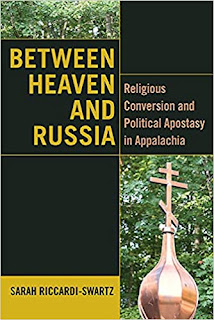
Review: "Between Heaven and Russia," by Sarah Riccardi-Swartz


Before reading this review, I would recommend anyone who has not already done so, read my essay "Sarah Riccardi-Swartz and Russophobia." That essay was written before the book in question was available to the public, and so was not based on my having read that book, but was based on reading a number of essays on the same subject written by Sarah, after listening to a number of talks and interviews she has done, and also based on my own experience with her, as well as with people in the communities she has focused on, along with my 32 years as a member of the Russian Orthodox Church Outside of Russia (ROCOR). This book repeats quite a bit of what Sarah had already put out in public, but it does provide some new information and new accusations that I don't recall her having stated in public previously, and so I will primarily be focusing on what is new in this book.

One new fact I learned from this book is that she never considered herself to be a member of ROCOR. This is interesting because when she first began appearing as a speaker at various forums and panels, she was routinely identified as a member of ROCOR, and I don't think she would have failed to notice this, but for whatever reason, she made no attempt to correct this information that I have seen, prior to the publication of this book.

In her book, Sarah Riccardi-Swartz uses pseudonyms for places and people, ostensibly because this is how anthropologists do their thing, but the people and the places she is taking about are easily determined by anyone with the slightest familiarity with the Holy Cross Monastery and Christ the Savior Orthodox Church in Wayne, West Virginia. In this review, I will replace these pseudonyms with the real names, because under these circumstances, using pseudonyms is just silliness. I will note this by the use of brackets, where applicable.

Those "Crazy Converts"

One of the notable aspects of this book is how frequently Sarah Riccardi-Swartz chooses to use the label of "convert" -- which is odd, given that she is ostensibly a convert to Orthodoxy herself. For example, as she sets the stage for the rest of her book, she attributes the existence of the parish and monastery in Wayne, West Virginia to converts:

"Both [Holy Cross Monastery] and [Christ the Savior Orthodox Church] came to be in [Wayne, WV] in the early 2000s when two converts -- a local university professor, who donated land for the monastery, and a local politician, who built the parish building -- began to missionize the region" (p. 4).

This is an example of telling half-truths, in the interest of building the desired narrative. The university professor that she is referring to is Maurice Sill, who is a man I got to know fairly well. He was indeed a convert. But Maurice was a man who had long been married to Nadya Danilchik Sill, who was a Russian American who was not a convert, and in fact was the daughter of a very well known, old school, ROCOR priest, Fr. Michael Danilchik (who was the first assigned priest for the Seattle ROCOR Cathedral) -- and so it would be difficult to find a person with deeper roots in ROCOR than Nadya Sill had. And given that the property that Maurice and Nadya Sill owned was joint property, and also given that Maurice would not have done anything of that magnitude without the agreement of his wife in any case, the whole truth would be that that this property was donated by a "cradle" member of ROCOR and her convert husband, who had been a convert of many decades by that time -- but this didn't fit the narrative that Sarah wanted to build, and so this fact was simply excluded from being mentioned here.

Another example of Sarah being selective with the facts that she will mention is that she always mentions that the people she is criticizing are white, except that when she talks about other converts who are not white, she will simply omit any mention of their race. For example, she often mentions a person on Twitter who is known as Patriarch Primus, and who is a convert to Orthodoxy, but she almost never mentions that he is black, though she will mention that he lives in the South (leaving people to assume he is a white southern "cracker"), and this is clearly because the whole truth doesn't fit her narrative.

Those "Crazy People in ROCOR"

Sarah also took pains to try to portray the Russian Orthodox Church Outside of Russia as some sort of fringe entity. And so, when laying out the landscape of Orthodox Christianity in America, she says:

"Historically, other forms of Orthodoxy in the United States, particularly the Greek Archdiocese, the Antiochian Church, and the Orthodox Church of America, focused on assimilation, social care and justice movements, and, in many ways, the mainstreaming of Orthodoxy. ROCOR, however, perhaps because of its noncanonical status until 2007, created an insular social group that would preserve not only their understanding of Orthodox theology, but also particular cultural expressions of faith in order to re-missionize Russia after the end of the Soviet Union. Despite this containment of sorts, ROCOR did attract converts, and within the past thirty-plus years the number of coverts have begun to rise, even prior to the religious reunification between ROCOR and the ROC in 2007, when ROCOR was still considered non-canonical in the Eastern Orthodox world" (p. 24).

The history of the Russian Church after the Bolshevik Revolution is complicated, but to make a long story short, the persecution of the Russian Orthodox Church by the Soviets resulted in divisions within the Russian Church both inside of Russia and outside of Russia. Between the time of the death of St. Tikhon, who was elected Patriarch of Moscow in 1918, and the collapse of the Soviet Union in 1991, there was of course the Moscow Patriarchate, but at various times there was also the renovationist Living Church, as well as various catacomb groups, though after World War II, both the Living Church and the catacomb groups ceased to exist in any significant forms. Outside of Russia, there were two times when most of the Russian bishops were united together within ROCOR, and then there were times when the Paris Exarchate, American Metropolia, ROCOR, the Moscow Patriarchate, and the Living Church had all gone separate ways. For those who want to read about this history in detail, I would recommend reading the book "A Long Walk to Church: A Contemporary History of Russian Orthodoxy," by Nathaniel Davis, the Orthodoxwiki article "ROCOR and OCA," and also Metropolitan Kallistos (formerly Timothy Ware)'s "The Orthodox Church (it should be noted, however, that the older edition goes into much greater detail on this subject). But to be concise, with the exception of the Living Church, which was heretical and schismatic, the rest of the Orthodox Church generally viewed these divisions as unfortunate, temporary, and matters for the Russian Church to settle for itself, when it was free to do so -- which is ultimately what happened. 

Prior to the 1970's, ROCOR regularly concelebrated with the various local Orthodox Churches. For example, Archbishop Vitaly (Maximenko) was one of the consecrators of Metropolitan Anthony (Bashir) of the Antiochian Archdiocese -- and that obviously would not have happened if the Antiochians considered ROCOR to be noncanonical.

Under Metropolitan Philaret, there was the beginnings of a self-isolation on the part of ROCOR as a whole, that was a reaction to the lifting of the Anathemas against Papism by Patriarch Athenagoras of Constantinople, but this was something that varied quite a bit depending on the various bishops of ROCOR, and especially on which local Churches were in question. And the key thing is that this isolation was self-imposed. It was not at all something imposed upon it by any other local Church. ROCOR always maintained close relations with the Serbian Patriarchate (because of the decades prior to World War II when it was headquartered in Serbia with the permission of the Serbian Patriarchate), and also with the Patriarchate of Jerusalem (because ROCOR has always maintained a presence in the Holy Land which continues to the present day, and this was always with the blessings of the Patriarch of Jerusalem). The low point of ROCOR relations with other local Churches was probably in the mid to late 90's under Metropolitan Vitaly, but even then, no local Church condemned ROCOR as "noncanonical." And I myself frequently concelebrated with the local Serbian clergy the entire time I was a clergyman (beginning in 1995). My spiritual father, who baptized me and my wife was ordained by Metropolitan Philip (Saliba) of the Antiochian Archdiocese, and he was given a canonical release by him to ROCOR in the 80's -- which again, would not have happened if they considered ROCOR to be noncanonical.

It is also hardly accurate to suggest that the Greek Archdiocese and the OCA were promoting assimilation in America, while ROCOR was not. The oldest continually published Orthodox Journal in English is "Orthodox Life," which has been published by Holy Trinity Monastery since 1950. ROCOR sponsored the translation of the first complete set of service books into the English language. The Greek Archdiocese, on the other hand, while it is by far the largest Orthodox jurisdiction in the United States, and certainly has far greater resources, has still not published even half of the service books in English translations, and many of their parishes continue to primarily use Greek, and generally if you talk to Americans who have had the experience of looking into Orthodoxy, Greek parish remain some of the least welcoming parishes to outsiders of any jurisdiction. The OCA has certainly had many parishes that have used English going back before the Bolshevik Revolution, but it has also not published an extensive set of English Language service books of their own, and many of their parishes continued to use mostly Slavonic well into the 80's. You can still find ROCOR parishes that serve mostly in Slavonic, to be sure, and some would be less welcoming to outsiders than others, but on the whole, ROCOR has been very welcoming to non-Russian converts, and this goes back to the 1950's. Speaking from my own experience in ROCOR -- having been in mostly Russian parishes, mostly convert parishes, and parishes with a good mix -- I have never been made to feel unwelcome because I was not a Russian.

The Antiochians were probably the earliest champions of using English extensively in the United States, and that goes back to the influence of St. Raphael (Hawaweeny), who had the foresight to see that this was necessary if his flock was to keep future generations within the fold, and so they were ahead of the curve on this point.

"Because ROCOR was not in communion with most of the Orthodox world for almost eight decades, it has seemingly become an echo chamber or perhaps an incubator of prerevolutionary Russian Orthodox thought. Its emphasis on tradition, adherence to the Old Calendar (Julian), submission to spiritual father confessors, and highly structured gender roles have all become concentrated over the years. These distilled ideological distinctions often put them in opposition to their spiritual cousin, the Orthodox Church in America, which embraced among other things, the New Calendar (Revised Julian), pews, and shorter service rubrics" (p. 28).

For Sarah to assert that ROCOR was not in communion with most of the Orthodox world for "nearly eight decades" is an assertion that even the harshest critics of ROCOR would not support -- at least not the ones with the slightest familiarity with the actual history of the period of time in question. 

We live in times that are extremely ideological, and no doubt this is why Sarah cannot imagine embracing Orthodox Tradition and piety without that being an ideology. Ideological thinking is a relatively modern mode of thinking, which is pretty much the opposite of traditional thinking. For more on that, see "What is Wrong with Ideology?" by Donald Livingston.

Speaking for myself, when I discovered the Orthodox Faith, it happened to be in ROCOR. There was nothing political about it, and having brought more than a few people into the Church since then, I have only rarely seen where political thinking even played a significant role in the motivation behind someone becoming interested in the Church, much less was it a big factor in moving them to actually convert. 

Sarah also seems unaware of the fact that the OCA was on the Old Calendar until the 1980's, and big parts of it remains on the Old Calendar to this day (the Dioceses of Alaska and Canada, along with scattered parishes throughout the lower 48 states).

Sarah also fails to explain why being in America requires wearing Roman Catholic clergy suits, being on the New Calendar, shortening the services, or the use of pews. As far back as 1972, it was observed in the book "Why Conservative Churches Are Growing: A Study in Sociology of Religion," by Dean Kelley, that liberal churches tend to shrink, and conservative churches tend to grow. So there is no scientific basis for such an assertion -- there is just the bare assertion of Sarah's opinions without any basis.

For one thing, Roman Catholic clergy suits are of fairly recent vintage. Traditionally, Roman Catholic Priests wore cassocks that were not all that different from the kind of cassocks that Orthodox clergy wear. 

In the classic Bing Crosby movie, Going My Way (1944), Barry Fitzgerald played the old Irish priest Father Fitzgibbon, and he is seen wearing an old fashioned Roman Catholic cassock as well as a clerical biretta which looks no less odd than an Orthodox skufia. Bing Crosby played a young hipster priest, who wears a modern Roman Clergy suit. In the 1940's, you could see why people might have thought that this was an improvement, but looking at the decline in Roman Catholic piety ever since then, I am not so sure it has worked out very well for them, and so why should we emulate failure?

"...many of the older Orthodox folks in [Wayne, WV] converted to ROCOR prior to the reunification [of the Russian Church in 2007]. Those who did so, opted to select an Orthodox body without canonical authority. It seems as if these converts were not looking for an unbroken line of apostolic succession, but rather a religious world built for the purposes of preserving and defending what they saw as traditional Orthodoxy and orthopraxy" (p. 29).  

This statement is a gross distortions of the actual history of ROCOR. It also reflect a rather shallow view of Orthodox Tradition and ecclesiology. Sarah would have her readers believe that St. John (Maximovitch) was a fake bishop, "without canonical authority." But no local Church believed that during his life, and none have believed that since then either. He is one of the most highly venerated saints throughout the Orthodox world today.

Pluralizing Singular Instances

In speaking of the rise of a "new wave of conservatism" since the 1990s. Sarah spoke of "Shootings in historic Black churches throughout the American South..." (p. 45). I am only aware of one shooting since 1990 in an historic Black Church, and that was the shooting in Charleston in 2015 -- which was of course horrendous enough by itself, but it is a gross exaggeration to suggest that this happened many times throughout the American South, when we are actually talking about the actions of a lone crazed young man.

This propensity for taking an isolated case and extrapolating it into something that is ubiquitous perhaps explains how she could take a single layman who allegedly said that he hoped to take up arms on behalf of Russia when it invades the United States (p. 124), and extrapolating this to be a common view among converts in ROCOR. I have been in ROCOR for 32 years, and have never heard anyone say any such thing.

Gender and Sexuality

She is particularly bothered by the fact that people in ROCOR tend to have "ultra-conservative understandings of gender, sexuality, and the roles of women and men should have in the Church, the domestic sphere, and society more broadly" (p.127). The question an Orthodox Christian should be asking, however, is whether or not these views are consistent with the teachings of the Church. Sarah, on the other hand supports homosexuality, transgenderism, and the whole ever expanding alphabet soup of sexual deviancy that the left is promoting. These things are completely contrary to the teachings of the Church, and so she should either humbly submit to the teachings of the Church, or find a religion that better suits her predetermined beliefs. The Orthodox Church is not a religious Burger King, where you can "have it your way." The Orthodox Church is what it is, and you can either take it, or you can leave it. See: The Pro LGBTQP "Orthodox," for more information.

"Within ROCOR, it is the job of spiritual fathers to monitor how and in what ways men and especially women participate in the church, just as it should be the job of a monarch to guide a country" (p.130).

 I don't think Sarah knows what she is talking about here. In my parish, I have a Greek American woman choir director who has a Masters of Divinity degree from St. Vladimir Seminary. I have had her teach classes before in the parish in the past, and would do so more frequently if she didn't already have her hands full with the choir. I don't micromanage the choir, because I know that she knows what she is doing. And as a matter of fact, if I have a question about how something ought to be handled liturgically, I often ask for her opinion, because she has been in the Church all of her life, she knows both Greek, Antiochian, and Russian practices fairly well, and so she has a good feel for what is normal or what is odd. I have a Sisterhood Vice-President who is an engineer, and as I often tell my parish, she is the handiest man or woman in the parish. If something needs to be fixed, built, or if I need an opinion on what we ought to do with regard to anything mechanical, I call her. And since I am usually busy serving or hearing confessions, I have little time to pay attention to what happens in the Nave of the Church during the services. I leave that to lay leaders in the parish, both men and women. I certainly am not monitoring the women in my parish during the services, or outside of it. I do hear confessions, and so give advice when it is warranted, and direction when it is called for, but I have told my people where the boundaries are when it comes to pastoral guidance from a priest, and that they should flee any spiritual father that would try to impose monastic style obedience on a layman. For more articles on Women in the Church, Click Here.

Monarchism and American Politics

Sarah seems to think that ROCOR is full of monarchist revolutionaries who want to overthrow the United States government and install a Tsar (p. 126f). You will certainly find a higher than average percentage of people in ROCOR who admire the idea of Christian Monarchy, I don't believe I have ever heard anyone seriously suggest that it could be imposed in the United States. There are many prophecies of a new Tsar returning to power in Russia, and so you do find interest in that. But I don't think anyone envisions that happening even in Russia by a violent revolution.

There are certainly people in ROCOR who are "right-wing," but what that means, even among those who could fairly be labelled as such, varies quite a bit. You have those who are American Nationalists, in the Hamiltonian sense, and then there are those who have more of a small government Jeffersonian view, and then you have just about everything in between. But there are people who are in ROCOR who politically are on the left, but who theologically nevertheless embrace the Traditions and teachings of the Church. I have some in my parish, and I am sure if I had a parish in a heavily Democrat region, I would have a lot more of those folks. I don't tell people how to vote, and I don't get upset if they don't share my opinions on political matters, because I believe in being tolerant of other people, and I can imagine people coming to conclusions that are different from my own without them having to be evil people. If someone denies the teachings of the Church, however, that is obviously another matter altogether.

The Russian Collusion Hoax Goes to Church

Sarah repeatedly makes assertions about "Russian interference" in the 2016 election (e.g., p. 76), as if it were a fact. I don't think that it is a coincidence that she began looking for Russian boogeymen in West Virginia in 2017 either. There is no doubt that Sarah is on the political left. She promotes the LGBTQP agenda. She capitalizes "President" when she speaks of Barak Obama (e.g., p.168), but not in reference to Donald Trump. She speaks of people who were merely at the rally in Washington D.C. on January 6th, 2021, as "insurrectionists," even if they were nowhere near the Capital building. Clearly, Sarah was one of those on the political left that was traumatized that Donald Trump was elected, and spent four years arguing that the 2016 election was stolen, but who now argues that any suggestion that the 2020 election might have been less than kosher is a Q-Anon conspiracy theorist. It doesn't seem to matter that the claims about Russia and the 2016 election have since been debunked, and originated with the Hillary Clinton Campaign. Not only is it clear that politics drove Sarah's interest in this research, but if it were not for this political element, it is also clear that few would be paying any attention to her work.

West Virginia is one of the most conservative states in the United States. It should come as no surprise that you would find a high concentration of political conservatives in a ROCOR parish in rural West Virginia. Had Sarah gone down the street and spent much time in a local Baptist Church, she probably would have found that those people have lots of guns, voted for Trump, and that they don't support transgenderism either. On the other hand, if Sarah went to a ROCOR parish in a heavily Democrat area, while there would probably also be some people who were politically conservative, she would also find a lot of Democrat voters too.

Conclusion

In June of 2020, my parish had a serious terroristic threat from someone who referred to our parish as "St. Jonah Russian Orthodox Church," despite the fact that we never use "Russian" in the name of our parish, though we make no secret about being part of the Russian Orthodox Church Outside of Russia.* When that happened, I called the FBI, as well as the local Constables office. The local authorities were very responsive, but the FBI never called me back. I mentioned what had happened to a Protestant minister I know who is fairly well connected. He contacted our Lt. Governor, and he called the FBI. Only then did I get a call back, but in the end, they did almost nothing to track down the person who had made these threats, though he had an online profile that should not have been hard to track down, and he was certainly living in this area. This year, on Old Calendar Annunciation, I finally received a visit from an FBI agent (nearly two years later), who began by mentioning what had happened in 2020, and who said that they just wanted to make sure everything was OK, given tensions around the war in Ukraine. He asked if I would agree to talk to him, and I did. His line of questioning had almost nothing to do with the safety and security of my parish. It was all about what contacts I may have had with the Russian Consulate in Houston, whether the Russian government had any influence over my Church, and things of that nature. Recent history has shown that you don't have to actually be guilty of anything for the FBI to put you in jail. So obviously, this attention is unwelcome, though it would have been nice if they had been more interested in my parish in June of 2020. 

When people like Sarah Riccardi-Swartz promote conspiracy theories that try to convince people that ROCOR is somehow connected to Putin stealing the 2016 election, and is full of a bunch of Fifth Columnists, who are anxiously awaiting the Russian invasion of the United States, so that they can join in on their side, this has real world consequences. If Russophobia continues to heat up in this country because of further deteriorations in our relations with Russia, it is not farfetched that the kind of Blue-Anon conspiracy theories spun by people like Sarah will result in innocent people being seriously harmed or killed. This is dangerous, unchristian, and it is irresponsible.

Aside from all of that, this book is not particularly well written. Sarah doesn't know her history. She is politically motivated, and she has taken her own spin on isolated people and two particular communities, and made the logical leap that she can fairly characterize the entirety of ROCOR, despite all of the geographic and cultural differences one can find within ROCOR. We have parishes in Australia and New Zealand. These parishes have very different histories than the typical ROCOR parish in the United States and Canada. We have parishes in Latin America, Asia, Great Britan and Western Europe that are even more distinct. Sarah Riccardi-Swartz has made no effort to study ROCOR more broadly than what she could find in Wayne, West Virginia. Anyone with any sense of logic or even just a sense of fairness would not make extrapolations beyond what she actually has studied. But from what I know of the communities in Wayne, West Virginia, I have little reason to believe she was fair to them either. In a recent presentation, she pointed out in passing that these communities did not tolerate hate speech, but she has made an entire career out of suggesting that they are somehow connected with racism and white supremacy... but how she could think that those two things could coexist in the same universe is beyond me.

*We don't have that on our sign, are website, or anywhere else, because we do not want anyone who is not a Russian to think that this is not a Church for them. Our parish, as a matter of fact, is a fairly diverse parish in comparison with what you would find in the average Orthodox parish in the United States.

Thursday, May 05, 2022

The Pro-Abortion "Orthodox" (The Birth of a New Religion, Part 1)

who as the Icon shows, famously said 
There can be no compromise in matters of the Orthodox Faith.

In recent years, there are lines of division that not only show the signs of an emerging schism in the Orthodox Church -- it is becoming increasingly clear that we are witnessing the birth of a new religion, which will only retain some of the outward trappings of the Orthodox Christian Faith, but in fact is increasingly becoming unrecognizable as Christian. We see this when it comes to how the innovators see the sanctity of life, sexuality, human nature, the Church, and Tradition.

As we currently contemplate the prospect of Roe vs. Wade being overturned, it is important to remember that in January of this year, at the March for Life, Archbishop Elpidophoros used the occasion to affirm his support for abortion "rights." 

When I first saw the above meme, I thought a critic had put it together, only to find that this was the image from Greek Archdiocesan website -- and so evidently they were proud of what he said, and wanted these two quotes to be especially noted.

Here is the full text of his speech, taken from the official website of the Greek Archdiocese:

"Dear Sisters and Brothers,

Today, we come together in solidarity with our Brother Bishops of the United States Conference of Catholic Bishops and of the Assembly of Canonical Orthodox Bishops of the United States of America.

We affirm the gift and sanctity of life – all life, born and unborn. As Christians we confess that every human being is made in the image and likeness of God.  Every life is worthy of our prayer and our protection, whether in the womb, or in the world. We are all responsible for the well-being of children. We are their “keepers,” and cannot shirk from our accountability for their welfare.

At the same time, we also affirm our respect for the autonomy of women.  It is they who bring forth life into the world.  By His incarnation, our Lord, God, and Savior Jesus Christ assumed human nature, through His conception in the womb of the Virgin Mary. She freely chose to bring Him into the world, and God respected her freedom. We can and must make the case for life, both born and unborn, by our own example of unconditional love.

We march not for coercion.

We march with compassion,

With empathy,

With love.

And with our arms extended to embrace all.

Let us pray to the Lord. Lord, have mercy.

Lord, You have granted us the opportunity to offer these common prayers in unison and have promised that when two or three gather in Your name, You are there also. Fulfill now, O Lord, who was conceived in the womb of the Virgin Mary by the power of Your All-Holy Spirit, the petitions of Your servants. Remember, Lord, the people here present and those who are absent with good cause. Have mercy on them and on us according to the multitude of Your mercy. Remember, O God, all those whom we are not able to commemorate by forgetfulness or because of their multitude since You know the name and age of each, even from their mother's womb. For You, Lord, are the helper of the helpless, the hope of the hopeless, the savior of the afflicted, the haven of the voyager, and the physician of the sick, the protector of the voiceless. Be all things to all, You who know all people, their requests, their households, and their needs. For You are the Giver of Life, bringing each person from non-being into being, sealing each person with love and sanctity. May we come to the light of Your Truth and glorify You, the Giver of Life, together with Your Father, and Your All-Holy and Life-giving Spirit, now and ever and unto the ages of ages. Amen."

Clearly Archbishop Elpidophoros agrees with Roe vs. Wade. And so giving such a speech at the March for Life was an insult and a betrayal of all who have prayed and marched to overturn it for nearly a half century.

You find the most devote representatives of every Christian denomination at the March for Life, which has taken place every year since Roe vs. Wade made abortion on demand the law of the land. To have an Orthodox bishop participate in this March, be given a platform, and to have him endorse "a woman's right to choose" to kill her baby was an embarrassment. And make no mistake, everyone understood exactly what he was saying. The Washington Post cited it as an example of a "pro-choice" shift among many Christian and Jewish groups. George Demacopoulos, editor of "Public Orthodoxy," who champions the abandonment of Christian morality in the Orthodox Church, is cited in support of Archbishop Elpidophoros' coming out speech:

"George Demacopoulous [sic], a Fordham University theology professor and expert on Orthodox Christianity noted that abortion is legal in every major Orthodox country. While the faith views abortion as tragic and wrong, he said, it also respects the autonomy of women. Church and state are generally separate, he said, and abortion is more divorced from politics.

"In the United States, the debate is very much positioned as these two goods at war with one another; we’re being asked to pick. And he’s saying that’s theologically wrong," he said of Elpidophoros. "It’s a Christian truism that you can hold seemingly contradictory views. Christian moral teaching isn’t black and white"" (Washington Post: "The threat to Roe v. Wade is driving a religious movement for reproductive choice," by Michelle Boorstein, February 5, 2022, Emphasis added).

George Demacopoulos

This is part of a pattern on the part of the Fordhamites at "Public Orthodoxy," of downplaying Christian morality, and suggesting that it is fluid, something apart from dogma, and therefore open to debate and revision. Here they suggest that one can affirm the sanctity of life, while supporting the "right" to murder the innocent. Elsewhere, they suggest that perhaps homosexual sex might be allowable, and transgenderism is something we should embrace. Up until recently, while we have seen a shift on the part of modernists in the past decade towards defending sexual deviancy, they at least used to give lip service to being pro-life. Apparently, the slippery slope is a thing, and where it stops, nobody knows.

What does George Demacopoulos mean when he says that we believe abortion is "tragic and wrong"? The Church has unambiguously taught, from the beginning that abortion is not just a tragedy or a wrong choice, but that it is murder. If you believe it is murder, affirming someone's right to murder someone else is moral nonsense.

The earliest Christian document outside of the New Testament is the Didache (which is usually dated to be of first century origin), and it says:

"...thou shalt not murder a child by abortion nor kill them when born" (Didache 2:2).

Canon 91 of the Sixth Ecumenical Council states:

"As for women who furnish drugs for the purpose of procuring abortion, and those who take foetus-killing poisons, they are made subject to the penalty prescribed for murderers" ((D. Cummings, trans., The Rudder of the Orthodox Catholic Church: The Compilation of the Holy Canons by Saints Nicodemus and Agapius (West Brookfield, MA: The Orthodox Christian Educational Society, 1983), p. 395).

Canon 2 of St. Basil (whose canons were specifically affirmed by the 4th and 6th Ecumenical Councils, states:

"A woman that aborts deliberately is liable to trial as a murderess" (Ibid, 789).

There is absolutely no ambiguity at all on the question of whether or not abortion is murder. How you deal with someone who has engaged in this sin pastorally is another question -- and there certainly is forgiveness for those who confess and repent -- but that it is a sin which is absolutely prohibited by the Church, is as clear as it gets. There are not shades of gray here. You will not find a single Church Father or Saint of the Church that calls abortion anything less than murder.

The Scriptures are abundantly clear that God takes the shedding of innocent blood very seriously. We are told that God destroyed the kingdom of Judah because they engaged in child sacrifice:

"And he [Manasseh] made his son pass through the fire [a form of child sacrifice], and observed times, and used enchantments, and dealt with familiar spirits and wizards: he wrought much wickedness in the sight of the Lord, to provoke him to anger" (2 Kings 21:6).

"Surely at the commandment of the Lord this [the destruction of Judah by the Babylonians] came upon Judah, to remove them from His sight because of the sins of Manasseh, according to all that he had done, and also because of the innocent blood that he had shed; for he had filled Jerusalem with innocent blood, which the Lord would not pardon" (2 Kings 24:3-4).

So is it morally tenable to say that you believe abortion is murder, but affirm the "right" of others to engage in it? Let's see how this logic works when applied elsewhere:

Can a person really be opposed to rape, but not want to "impose their morality" on others? No.

Could a person oppose lynching, but not want to "impose their morality" on others? No.

And so clearly a person cannot be opposed abortion, and yet affirm the "right" of others to engage in it. 

Every law reflects someone's morality. There is no reason why Christians should not use their power to vote to influence the laws to protect innocent life. This after all is why the March for Life takes place, and if you want to affirm "abortion rights," you should not only show up at the counter protest, rather than style yourself pro-life -- you should also admit that you have departed from the Orthodox Christian Tradition, because as a matter of fact, you have.

Update: Metropolitan Nathaniel of the Greek Archdiocese felt the need to say something about abortion on Mother's Day Sunday, because as a bishop it is his duty to teach. But watch how he studiously avoids saying anything that might discourage a woman from killing her child in the womb, and ends up affirming that women who abort their babies are mothers too. Well, yes, they are mothers, because the babies they had killed in the womb were really babies, but it would have been good to have said that, and to have pointed out that the Church teaches that this is something that Orthodox Christians are not supposed to do, because it is murder:

Continued in The Pro LGBTQP "Orthodox" (The Birth of a New Religion, Part 2)

See Also: Moral Heresy?

Sermon: Choose Life (Roe vs. Wade and the Orthodox View of Manhood and Womanhood).

Friday, June 04, 2021

Review: The Eastern Orthodox Bible, New Testament


Over the past couple of years, I have often been asked my opinion about the Eastern Orthodox Bible, published by Newrome Press, and so I purchased a copy of their "portable" edition, and read my way through it. So my comments are about this edition specifically, but while other editions may not have some of the same issues in terms of font size, or typos, my comments about the translation itself would generally apply to all current editions. To better understand the issues involved in translations of the Bible, I would recommend reading my article An Orthodox Look at English Translations of the Bible.

In terms of the quality of the book itself, it is beautifully printed. I personally do not like the zipper on the cover (which is especially a problem with the ribbon markers), but the imitation leather cover is attractive, does not look or feel cheap, and it seems like it should hold up very well over time. The text is gold leafed, and the text itself is beautiful, as is the artwork. The paper is high quality. The font is far too small, in my opinion. The main body of the text is in 7 to 7.5 point font, which is small, but at least legible. The footnotes are in 6 point font, and are very hard to read without a magnifying glass.

Unlike most modern English translations of the New Testament, there is not a problem with the choice of the base text that is behind this translation. The text is translated from the Patriarchal Greek Text, which generally (though not always) coincides with the text behind the King James Version, and the New King James Version (which you would find in the Orthodox Study Bible), and so the base text does adhere to the textual tradition of the Church. 

The translation is generally not in what I would describe as beautiful English, and so I would not recommend it for liturgical use, for that reason alone. However, a contemporary English translation, that is well done and accurate could be very helpful for private study. In its present form, however, this translation has a number of problems, and here are some specific examples: 

In the introduction to the text, there is a section that explains the use of  abbreviations and codes, and this table begins with two kinds of brackets, the first kind is square brackets "[ ]" for words which are not literally found in the Greek, but which are added to the text for clarity. In the King James Version, these kinds of words are put into italics. Then there are curly brackets "{ }" which are used for words that are included for theological clarity -- but it states that these words should not be read aloud in the public reading of Scripture. There are two problems with this. One is that  because the text is so small, it is nearly impossible to tell the difference between these two kinds of brackets in the Portable edition. Secondly, most people don't pay close attention to the introduction to a Bible, and so most people will assume that these words are part of the text and intended to be read aloud. And this becomes a particular problem, for example, with John 1:1, which the EOB translates as: "In the beginning was the Word, and the Word was with God, and the Word was {what} God {was}." I am not sure why these bracketed words were thought to be useful here, but it would have been far better to have put some comments into a footnote to explain what was going on with the Greek text (and you can see commentary on this translational question in the footnotes the NET Bible provides for John 1:1), because, if the intention here is that when this text is read aloud, that it be read as "and the Word was God,"  that is what the main body of the text should actually read.

Throughout the text, you find certain Old Testament names listed with two forms, for example,  you find "Isaias (Isaiah)," and "Elias (Elijah)," but for some reason they use "Jeremiah" rather than "Jeremias," and "Elisha," rather than "Eliseus." I think it makes the most sense to consistently use the form of a name that is most commonly used in English, and so even though in the New Testament the King James uses  "Isaias," "Elias," "Jeremias" (though it also uses "Jeremy"), and "Eliseus," I think it is far less confusing to use the forms the King James Version uses in the Old Testament, which are clearly the most common forms used today in English for these Old Testament persons (the KJV did this differently in the New Testament because the underlying text in the New Testament is Greek, and so they use a transliteration of the name as it occurs in Greek). But in any case, a translation should pick which form of the name they are going to go with, and then just use that one form. Putting two forms into the text is distracting.

The EOB consistently translates the word "proskyneō (προσκυνέω)" as "express adoration," and "latreuō" (λατρεύω)" as "offer divine service." The translators are trying make a clear distinction between these two words, because proskynesis refers to showing reverence... and literally refers to bowing. This can be in reference to God, but it can also be in reference to people, or icons. Latria literally means "service," and specifically refers to the worship that is due to God alone. The problem with these translations is that they make for clunky translations. For example, you have Christ speaking to the Samaritan woman:
"Woman, believe me, a time is coming when neither in this mountain nor in Jerusalem will you express adoration to the Father. You express adoration to what you do not know. We express adoration to what we know, for salvation is from the Jews. But the hour is coming, and now is, when the true worshipers will express adoration to the Father in spirit and truth, for the Father is seeking such [people] to express adoration to him. God is a spirit, and those who express adoration to him must express adoration in spirit and truth” (John 4:21-24).
If one was trying to avoid translating proskynesis as "worship," it would generally be better to use the word "bow" or "reverence," but often "worship" is the only thing that really works in English, and this passage is clearly a case in point. In our Protestant culture, it is common today to use the word "worship" exclusively with reference to God, but this is not historically true, and I think it is often better to use the word "worship" and simply educate people better on what the word actually means. For example, in the services we often hear "O come let us worship..." "O come let us us express adoration..." would not do at all.

Furthermore, the word "adoration" has often been used to refer to the worship due only to God, and so this choice of translation is more likely to confuse people, then to illuminate the question. For more on the meaning of the words proskynesis, latria, and the Hebrew word hishtahawa (which has a meaning which closely parallels proskyneo), see The Icon FAQ, and Old Testament Exegesis on the Hebrew Terms for Prostration and Worship).

Another odd quirk in the EOB is that in the Sermon on the Mount, where we find the Lord's prayer, they shift into traditional English, and have it as: 
"Our Father who art in heaven, hallowed be thy Name. Thy Kingdom come, thy will be done on earth as it is in heaven. Give us this day our daily bread and forgive us our trespasses as we also forgive our those who trespass against us [sic]. And lead us not into temptation but deliver us from the evil one. <For thine is the Kingdom, the power, and the glory, now and unto ages of ages. Amen.>"
Then in a footnote, you find: 
"EOB Translation: "Our Father in heaven, may your name be sanctified. May your Kingdom come. May your will be done on earth as it is [done] in heaven. Give us this day our sustaining bread and forgive us our debts as we also forgive our debtors. Do not bring us o a period of trial, but deliver us from the evil one. <For yours is the Kingdom, the power, and the glory, now and unto the ages of ages. Amen.>"
This is odd on a number of levels. If the translator makes the decision to go with contemporary English, it is odd to switch back to traditional English simply because this prayer is used Liturgically. There are other parts of the Gospels that we use liturgically (aside from reading the Gospel lectionary readings), and this is not done (e.g. in the Magnificat in Luke 1:46-55). And curiously, when the Lord's Prayer occurs in Luke 11:2-4, contemporary English is used.

The decision to consistently translate the word "presbyteros" as "presbyter," even when it is in reference to Jewish elders, and so you end up with texts like this:
"In the morning, all the chief priests and the presbyters of the people took counsel against Jesus to put him to death..." (Matthew 27:1).
Since in English, the word "presbyter" is used exclusively in reference to Christian clergy, this choice makes little sense.

Between Matthew 27:31, and Matthew 27:32, there is a section header, which apparently was meant to be in the margin, that somehow found its way into the body of the text.

In the account of the rich young ruler, in Mar 10:21, instead of translating it as: "Then Jesus beholding him loved him," the EOB reads "Jesus look at him and felt love for him." The problem with this translation is that not only is it exceptionally awkward, there is nothing in the Greek that speaks of how Christ "felt." It just says that he loved him, and the word for love that is used here is a verbal form of the word "agape," which is not at all about feelings or emotions.

Rather than the more familiar "...when the Son of man cometh, shall he find faith on the earth?" in Luke 18:8, the EOB reads "...when the Son of Man comes, will he find faith on the land?" In a footnote, "on the earth" is provided as an alternative translation, but it is hard to imagine how finding "faith on the land" was considered to be an improvement. There is no subtly in the Greek that is being brought out here, just a very strange way of expressing the same idea.

Because the translator seems to favor translating "psyche (ψυχή)" as "life," whenever possible, rather than "soul," instead of the familiar words of Christ with regard to those facing persecutions: "In your patience possess ye your souls" (Luke 21:19), the EOB translates it as "By your endurance acquire your lives." This is not only an unnecessary choice, in the context, it is clearly a bad choice, because when facing persecution, preserving your soul and preserving you life are two very different questions, and often one has to be prepared to give up their life, to save their soul.

The big advantage to a new translation over the King James is supposed to be that it is easier to understand, but compare these two translations of 1 Corinthians 2:11, and ask yourself which one is easier to follow:
KJV: "For what man knoweth the things of a man, save the spirit of man which is in him? even so the things of God knoweth no man, but the Spirit of God."

EOB: "For what human being knows what is truly human except the human spirit that is within? Likewise, no one truly comprehends things of God except the Spirit of God"
And if we look at some other modern literal translations, we see that the KJV has conveyed the sense of the text far better and more clearly than the EOB:
NET: "For who among men knows the things of a man except the man’s spirit within him? So too, no one knows the things of God except the Spirit of God."

MEV: "For what man knows the things of a man, except the spirit of man which is in him? Likewise, no one knows the things of God, except the Spirit of God."

NASB: "For who among people knows the thoughts of a person except the spirit of the person that is in him? So also the thoughts of God no one knows, except the Spirit of God."

RSV: "For what person knows a man’s thoughts except the spirit of the man which is in him? So also no one comprehends the thoughts of God except the Spirit of God."
One of the more famous verses in the Bible is St. Paul's statement: 
"Now faith is the substance of things hoped for, the evidence of things not seen" (Hebrews 11:1).
However,  the EOB translates it as: 
"Now faith is the personal foundation of things hope for, certainty about thing hat cannot be seen." 
So do any other major translations translate this in a similar way? Not one. There are different ways that this could reasonably be translated, but this is not one of them. The Greek word that the King James translates as "substance," and the EOB translates as "personal foundation" is the word "hypostasis (ὑπόστασις)," but I don't think any patristic interpretation of this passage would support this translation, and every other translation either ops for "substance," "confidence," "reality," or "assurance." Though this term obviously acquired a particular meaning in the context of Trinitarian theology, we cannot read that meaning into this text when neither the context, nor the historical use of the word prior to St. Paul's time supports its. 

Many more examples of quirky, idiosyncratic translation choices could be cited, but of course much of the translation is accurate, and there are some cases in which I would say that he EOB does a better job than most translations of accurately conveying the meaning of the original Greek. But there would need to be a thorough revision of the text before I would recommend anyone consider using it as a primary text for personal study, and it would need a lot more work before it would be suitable for liturgical use. Even so, I think it is worth having for comparison, and often the footnotes, as hard as they are to read, are very insightful. I sincerely hope that a revision of this text is done, because clearly a lot of work has been put into the text, and there is a need for a good, accurate translation of the New Testament that matches the Greek texts the Church has actually used, and is done by, and for, Orthodox Christians.

You may also find these two reviews by R. Grant Jones helpful:

This is a review of the original edition of the EOB New Testament:


And this is a review specifically of the EOB New Testament, portable Edition: