Showing posts with label Bible. Show all posts

Friday, August 21, 2026

Is the Septuagint the Authoritative Version of the Old Testament for the Orthodox Church?

Fr. Stephen De Young has repeatedly made the claim that the Septuagint has no more authority in the Orthodox Church than does the Masoretic Hebrew Text (for example, in his interview with Fr. Thomas Soroka, entitled: "Orthodoxy, the Old Testament, & the Septuagint"). This is simply not the case. Now, Fr. Stephen is obviously an extremely intelligent man, and well educated. I have learned a lot from listening to him, and have often found him to be very insightful. But the idea that the Septuagint has superior authority to the Masoretic Text is not an urban legend -- this has been the consistent teaching of the Church.

The Orthodox Study Bible went to the trouble of producing a translation of the Septuagint (albeit an imperfect one) for a reason. In the introduction to the Orthodox Study Bible, Bishop Basil (Essey) of the Antiochian Archdiocese writes:

"It is helpful to keep in mind that, like the earliest Christian community, the Orthodox Church of today continues using the Greek Septuagint version of the Old Testament known as the Septuagint (LXX). The Septuagint -- referencing the seventy finest Jewish scholars, from all twelve Jewish tribes, who made the translation from the Hebrew into Greek -- became the universally accepted version of the Old Testament...." ("Overview of the Books of the Bible," in The Orthodox Study Bible, ed. St. Athanasius Academy of Orthodox Theology (Nashville: Thomas Nelson, 2008), p. xv).

Metropolitan Hilarion (Alfeyev) notes:

"...the basis of the Old Testament text in the Orthodox tradition is the Septuagint, a Greek translation by the "seventy interpreters" made in the third to second centuries BCE for the Alexandrian Hebrews and the Jewish diaspora. The authority of the Septuagint is based on three factors. First of all, though the Greek text is not the original language of the Old Testament books, the Septuagint does reflect the state of the original text as it would have been found in the third to second centuries BCE, while the current Hebrew text of the Bible, which is called the "Masoretic," was edited up until the eighth century CE. Second, some of the citations taken from the Old Testament and found in the New mainly use the Septuagint text. Third, the Septuagint was used by both the Greek Fathers of the Church, and Orthodox liturgical services (in other words, this text became part of the Orthodox church Tradition). Taking into account the three factors enumerated above, St. Philaret of Moscow considers it possible to maintain that "in the Orthodox teaching of Holy Scripture it is necessary to attribute a dogmatic merit to the Translation of the Seventy, in some cases placing it on equal level with the original and even elevating it above the Hebrew text, as is generally accepted in the most recent editions" (Orthodox Christianity, Volume II: Doctrine and Teaching of the Orthodox Church, (New York: St. Vladimir Seminary Press, 2012) p. 34).

And in the above quote, when it says "some of the citations taken from the Old Testament and found in the New mainly use the Septuagint text," it is so awkwardly worded that I assumed something was lost in translation, and so I contacted Metropolitan Hilarion and asked him if what he was saying in Russian was that most (not just "some") of the quotes of the Old Testament in the New Testament are based on the Septuagint, and he confirmed that this was correct.

Fr. Seraphim Slobodskoy, in his classic catechetical text, wrote:

"...it is clear why the Church prefers the Septuagint and Peshitta translations for the authoritative text of the Old Testament, and principally the first, for the Septuagint text was produced under the inspiration of the Holy Spirit by the concerted effort of the Old Testament Church" (The Law of God: For Study at Home and School (Jordanville, NY: Holy Trinity Monastery, 1994) p. 440).

Metropolitan Kallistos (Ware), in his book The Orthodox Church, likewise says:
"The Orthodox Church has the same New Testament as the rest of Christendom. As its authoritative text for the Old Testament, it uses the ancient Greek translation known as the Septuagint" (The Orthodox Church: An Introduction to Eastern Christianity. 3rd ed. London: Penguin Books, 2015, p. 194).
St. Nicodemos of the Holy Mountain, in the classic canonical text of the Orthodox Church writes:
"As for editions or versions of the Old Testament the principal ones are five in number, namely, the Greek, the Syriac, the Arabic, the Aramaic (formerly called “Chaldaic”), and the Latin (or Roman). The Greek is divided into four main versions. Of these the first and most ancient is that of the LXX (or LXXXII), commonly known as the Septuagint in English, which, in the time of Ptolemy Philadelphus, interpreted not only the Pentateuch, as mistakenly maintained by Scaligerus and other modernists, but the entire Old Testament, as is attested by Justin, Irenaeus, Clement of Alexandria, and others, before the times of the Maccabees, which is the same as saying 230 years before the birth of Christ. It was from that version, indeed, that the divine Apostles drew the predictions of the prophets. But if Bellarminus the Jesuit says that that version is incomplete as it now stands, citing as witnesses St. Jerome, who says in the preface to the Chronicles (or Paralipomena) that the ancient and genuine version was corrupted and that originals thereof were extant wherein it could be seen that they differed from one another, as well as Justin, who says in the Dialogue with Pryphon that Aristeus, an aide-de-camp of King Ptolemy, bears witness that the Septuagint Version agreed with the Hebrew originals, though by his time (the saint asserts in his own declaration) it had come to differ in many points from the Hebrew manuscripts. Nevertheless, let Bellarminus learn that the Septuagint Version (i.e., the text of the genuine LXX) was directly in the beginning judged by the Church to be genuine and authoritative; and the divine Apostles used it in testimony; and it was recognized by the whole Church—not only the Eastern, but also the Western—before the translation made by St. Jerome into the Latin. Even Philo the Jew praises the LXX, not only as interpreters of the Scriptures, but also as prophets inspired with divine Spirit. And St. Augustine (in his book concerning the City of God) says: “the Spirit which illumined the prophets when they preached, the same Spirit illumined also the LXX when they interpreted the writings of the prophets.” Both divine Justin and Tertullian say that each of the LXX interpreters translated the Scripture separately in separate houses, and, miraculous to relate! not one of them was found to have added or to have omitted a single thing even of the slightest kind in the books which they had severally written, but, on the contrary, identically the same very words were found to have been written in all of them. So who can prefer any other version to this God-inspired version of the LXX?" (D. Cummings, trans., The Rudder of the Orthodox Catholic Church: The Compilation of the Holy Canons Saints Nicodemus and Agapius (West Brookfield, MA: The Orthodox Christian Educational Society, 1983), p. 157).

The Encyclical of the Eastern Patriarchs of 1848 is a document that was signed by all the Patriarchs of that time, and was endorsed by the Russian Church, certainly has Pan-Orthodox authority, and it says:

"Our Church holds the infallible and genuine deposit of the Holy Scriptures, of the Old Testament a true and perfect version, of the New the divine original itself" (Encyclical of the Eastern Patriarchs, 1848: A Reply to the Epistle of Pope Pius IX, ‘to the Easterns,' Orthodox Christian Information Center, accessed August 20, 2026, http://orthodoxinfo.com/ecumenism/encyc_1848.aspx).

Fr. Eugen Pentiuc, who certainly could not be described as an absolutist on the question of the Septuagint, writes:
"For [the] Eastern Orthodox Church, the Septuagint has first of all a religious value. It is the Bible witnessing to all phases of the church history, beginning with the New Testament and apostolic times through to church fathers, ecumenical councils and beyond. The Septuagint is doubtlessly the Bible of the undivided Church" (The Old Testament in Eastern Orthodox Tradition (New York: Oxford University Press, 2014), p. 90 emphasis in the original).

I am well aware that the history of the Septuagint is complicated, but whether or not one takes the same view of the origins of the Septuagint that Bishop Basil or St. Nicodemos expressed in the quotes cited, or if one takes the view of contemporary Orthodox scholars, like Fr. Eugen Pentiuc, who lays out his more complicated view, there is no serious question that the Septuagint has "pride of place" in terms of its authority in the Orthodox Church.

What is the Septuagint?

Now as to the question of what we mean by the term Septuagint, Fr. Stephen takes the position that this only really refers to the texts of the Pentateuch, and that the rest of the texts that are commonly referred to as being in the Septuagint are simply a collection of various Greek translations that came to be used by the Church. And the biggest example of this is the book of Daniel, which is usually said to be the work of Theodotion, who was a second century Anti-Christian Jew. The real story seems to be more complicated, because we have "Theodotion" citations in the New Testament itself, which would obviously be impossible if Theodotion actually lived in the second century and was the original translator of these texts. A number of examples can be cited, but two fairly clear examples are 1 Cor. 15:54 quoting Isa. 25:8, and John 19:3 quoting Zech. 12:10. So it would seem likely that either Theodotion lived in the first century or before, or that Theodotion may have simply reworked some translations that were already in existence and already widely known in the first century, and so his name came to be associated with texts were actually the work of an earlier translator or translators (See Moore, Colton. “Theodotion Zechariah in the Fourth Gospel.” Novum Testamentum 63, no. 2 (March 17, 2021): 221–28. https://www.jstor.org/stable/27068126). Whatever the case may be -- and we may never know -- the version of Daniel that the Church chose to use is what we find in the Greek Old Testament, and we have long referred to the entire collection as the Septuagint.

Is the Russian Synodal Bible a Translation of the Masoretic Text?

Another point that Fr. Stephen has often made is that the Russian translation of the Bible (The Russian Synodal Bible) was made from the Masoretic Text, but this is not really true either. There was a great deal of controversy on what texts to use for the translation of the Old Testament, and the best book in English on this subject that I am aware of is aptly titled "Russian Bible Wars: Modern Scriptural Translation and Cultural Authority," by Stephen K. Batalden. To sum up the history, there were many who wanted to just stick with the Slavonic Bible as it was. There were those who wanted a straight translation from the Septuagint, and there were those who wanted a straight translation from the Masoretic Text (not among the bishops, as best as I can tell, but among some Russian biblical scholars). What they ended up deciding on doing was a translation that used the Masoretic Text as the base text for those parts of the Old Testament that could be found there, but then noting in brackets which were imbedded in the text (not just footnotes) where the Septuagint was different. This is not evident in Protestant editions of this translation that have removed these bracketed texts, but if you look at the original published text, or at the editions currently published by the Russian Church, you will see that they have these Septuagint translations in abundance. If you look at Genesis 4, for example, you will see that the word "Lord" (Господь) is frequently by the word "God" (Бог) in brackets, and this is because the Hebrew texts in this chapter usually have the name of God (YHWH), which the Septuagint (and also in the New Testament) is translated with the word "Lord." But here the Septuagint simply has "God," and so the Russian translation notes this difference. There is a more significant difference in verse 8, where the Hebrew text literally reads: "And Cain said to Abel his brother. And when they were in the field, Cain rose up against his brother Abel and killed him." But what Cain said to Abel is absent, and so the text doesn't make much sense as it is, though translations generally smooth this over. However, the Septuagint, the Samaritan Pentateuch, the Syriac, and the Latin Vulgate all contain this missing clause which tells us what Cain actually said: "Let us go out into the field." The Russian Synodal Bible thus reads "И сказал Каин Авелю, брату своему: [пойдем в поле]. И когда они были в поле, восстал Каин на Авеля, брата своего, и убил его." Which in English reads: "And Cain said to Abel his brother: [Let us go out into the field.] And when they were in the field, Cain rose up against Abel his brother and killed him."

There are also blocks of texts that are lacking in the Masoretic Texts, that are included in the Russian Synodal Bible, for example at the end of Job we find:

42:17a«Написано, что он опять восстанет с теми, коих воскресит Господь. 42:17b О нем толкуется в Сирской книге, что жил он в земле Авситидийской на пределах Идумеи и Аравии: прежде же было имя ему Иовав. 42:17c Взяв жену Аравитянку, родил сына, которому имя Еннон. Происходил он от отца Зарефа, сынов Исавовых сын, матери же Воссоры, так что был он пятым от Авраама. 42:17d И сии цари, царствовавшие в Едоме, какою страною и он обладал: первый Валак, сын Веора, и имя городу его Деннава; после же Валака Иовав, называемый Иовом; после сего Ассом, игемон из Феманитской страны; после него Адад, сын Варада, поразивший Мадиама на поле Моава,- и имя городу его Гефем. 42:17e Пришедшие же к нему друзья, Елифаз (сын Софана) от сынов Исавовых, царь Феманский, Валдад (сын Амнона Ховарского) савхейский властитель, Софар Минейский царь. 42:17f (Феман сын Елифаза, игемон Идумеи. О нем говорится в книге Сирской, что жил в земле Авситидийской, около берегов Евфрата; прежде имя его было Иовав, отец же его был Зареф, от востока солнца.)»

Which in English, reads:

42:17a “It is written that he will rise again with those whom the Lord will raise up. 42:17b Concerning him it is explained in the Syriac Book that he dwelt in the land of Ausitis, on the borders of Idumea and Arabia: and his former name was Jobab. 42:17c And he took an Arabian wife, and begat a son, whose name was Ennon. His father was Zereth, the son of the sons of Esau, and his mother was Bosorah, so that he was the fifth from Abraham. 42:17d And these are the kings who reigned in Edom, which country he also possessed: the first was Balak the son of Beor, and the name of his city was Denaba; and after Balak, Jobab, who was called Job; after him, Assom, governor of the country of the Temanites; After him, Hadad, the son of Barad, who defeated Midian in the field of Moab, and the name of his city was Gatham. 42:17e And his friends came to him: Eliphaz (son of Zophan), king of Teman, of the sons of Esau; Baldad (son of Amnon the Chebarite), ruler of the Sabhaeans; Zophar the Minean king. 42:17f (Teman, the son of Eliphaz, governor of Idumea. It is said of him in the book of Syria that he dwelt in the land of Ausitis, near the banks of the Euphrates. His former name was Jobab, and his father was Zareth, from the east.)"

This text is liturgically significant, because we read it at the Vesperal Liturgy of Holy Saturday.

Furthermore, many of the translations of the texts that are not bracketed nevertheless reflect Septuagint influence, though this is not noted in the text, and these texts are still retained in Protestant editions of this version.

What we find in the the Russian Synodal Bible is in some ways similar to the Orthodox Study Bible, which took the New King James text (which is based on the Masoretic Text in the Old Testament), and corrected it with the Septuagint. The big difference being that when the Orthodox Study Bible corrected the text, they made no effort to note this, but they also do not always actually correct the text, and so in some cases, the Russian Synodal Bible more accurately reflects the Septuagint.

The other important thing to note here is that the Russian Synodal Bible was never intended for Liturgical Use. The Slavonic Bible remained the text that one would hear in the services of the Church, but it was intended as an aid to study the Scriptures, especially for those who were not able to adequately understand the Slavonic texts.

Conclusion

It remains a fact that in every local Orthodox Church, we continue to use either the Septuagint itself, or translations that are based on the Septuagint. This is true even of Fr. Stephen De Young's own Archdiocese. So this alone underlines the unique authority that the Septuagint has in the Orthodox Church.

All of this is not to argue that the Hebrew Masoretic Text or other ancient versions of the Bible should be ignored. Personally, I think when we can see that the Hebrew text aligns with the Septuagint, the best method of translation would be to use the Hebrew text in conjunction with the Septuagint. And I think noting differences between the Masoretic Text, when they are significant, would be worth including in a translation. 

It is a fact that there are many parts of the Septuagint that are difficult to understand without a knowledge of Hebrew, and it is also true that there are parts of the Masoretic Text which are corrupted or simply unintelligible, and every translation uses the Septuagint, the Syriac, and the Vulgate to translate those parts of the texts in question -- including the King James Version. For example, if you look at the footnotes for the book of Habakkuk in the NRSV there are 5 places in which it states that the Hebrew text is uncertain, and 3 times in which they state that they are simply translating from the Septuagint, Peshitta, and/or the Vulgate, because the Hebrew text is so unclear.

Most of the Fathers could not read Hebrew, but they did generally have access to Jewish translations which gave them a good idea of what was in the Masoretic Text, and while it is clear that they favored the Septuagint, they often make comments on the differences, and even provide alternative interpretations of the text based on those differences. 

Personally, I regularly read from translations that are based on the Masoretic Text as well as those based on the Septuagint, because for one thing, Protestants that I come into contact with are generally going to be more persuaded by references to translations from the Masoretic Text, than they will be from those based on the Septuagint. So I want to be familiar with both, and I think this is generally a good idea for others as well. But when it comes to the services, my parish, like every other parish, uses translations based on the Septuagint when it comes to the Old Testament texts that are part of the fixed parts of the services, the Psalms, and the Old Testament Lectionary.

For more information:


Friday, July 10, 2026

"Worship" as a False Friend


What is a "False Friend"?

As a Bible nerd, I have spent a lot time watching videos from a Protestant podcaster by the name of Mark Ward, who spent several years doing videos about "false friends" in the King James Bible. A "false friend" is a word you think you know, but that actually means something different. You find this phenomenon when the same word in one language means something completely different in another, such as "Burro," which in Spanish means "donkey," but in Italian means "butter." But you also encounter this over time within a language, when a word changes meaning. For example, the word "villain" once meant "villager," but now has a very different meaning.

False Friends in the King James Version

You find many examples of such false friends in the King James Bible, for example, "conversation," which in contemporary English means "to have a discussion," but in the King James Bible, usually means "conduct" or "behavior." When we read in Philippians 1:27, "...let your conversation be as it becometh the gospel of Christ," this does not just mean we should speak to each other in a Christian way, it means we need to live and act in a way that becomes the Gospel. There are many editions of the King James Version that have notes that explain what these words actually mean in contemporary English, and of course we have many more contemporary translations that eliminate these known false friends altogether. But one word which even these contemporary translations generally continue to use is "worship," as a translation for words in Hebrew and Greek which literally mean "to bow." In contemporary English, when we speak of "worship," most people immediately think of the worship which is due to God only, but these words in the original languages of the Bible do not have this limited meaning.

With My Body, I Thee Worship

It is a fact that the word "worship" in English had a broader meaning than is usually understood today. For example, in the old Anglican wedding service, the groom said to his bride, as he placed the ring on her finger: "With this ring I thee wed, with my body I thee worship, and with all my worldly goods I thee endow: In the Name of the Father, and of the Son, and of the Holy Ghost. Amen." Even though I was married in a Chinese Baptist Church, I said these words too, because this Anglican service was often used as the standard Protestant wedding service, though you are unlikely to hear these words used in a wedding these days. It was obviously not the intent of those who composed this service that the groom was to render to the wife the worship which was due to God alone. What this actually meant at the time it was composed was "with my body, I honor you." So what the word used to mean in English is "to honor," or "to reverence," or "to venerate," and often it was in reference to bowing to someone or something to show reverence, such as in Matthew 9:18, when we are told that Jairus came to Christ and "worshipped him...." More contemporary translations translate this as saying he "knelt before him," or "bowed low before him." The key word in Greek here is a form of the word "proskuneo." Obviously, at that time, Jairus would have not had reason to believe that Christ was God, and so he was not offering to him that worship which was due to God only. 

Worshiping the LORD and the King

Another clear example of this is found in 1 Chronicles 29:20, which speaks of the people of Israel, in response to King David, "bowed down their heads, and worshipped the LORD, and the king." Here, the same verb, "shachah" is used with two objects, the LORD and King David. This clearly did not mean that the people were rendering to King David the worship that was due to God alone. Many modern translations translate this verse as saying that the people "paid homage" or "prostrated themselves" before the LORD and the King.

Worshiping the Ark of the Covenant

We also see in Scripture that we are to bow to (or "worship") holy things. The Ark of the Covenant, for example, is referred to as "the Footstool" of God's feet:

"Then David the king stood up upon his feet, and said, Hear me, my brethren, and my people: As for me, I had in mine heart to build an house of rest for the ark of the covenant of the Lord, and for the footstool of our God, and had made ready for the building" (1 Chronicles 28:2).

And in the Psalms, the people of Israel were commanded to bow to it:

"We will go into his tabernacles: we will worship at his footstool. Arise, O Lord, into thy rest; thou, and the ark of thy strength" (131[132]:7-8).

"Exalt ye the Lord our God, and worship the footstool of His feet; for He is holy" (Psalm 98[99]:5).

Now, in the first verse we have the phrase "worship [or "bow"] at his footstool," and in the second "worship [or "bow to"] the footstool." In both cases, there is a preposition ["ל" which is the Hebrew letter lamed] which is translated as "at" in the first case, and not translated in the second. But we find the same construction in Psalm 28[29]:2 where we have the command "worship the Lord in the beauty of holiness." The primary meaning of this Hebrew preposition in these contexts is "to" or "toward," not merely "in the general vicinity," and so indicates the object of the bowing.

The Second Commandment

The second commandment in the King James Version reads: 

"Thou shalt not make unto thee any graven image, or any likeness of any thing that is in heaven above, or that is in the earth beneath, or that is in the water under the earth: Thou shalt not bow down thyself to them, nor serve them...." (Exodus 20:4-5a).

There are several things that need to be understood about what this commandment is really saying, and it is not saying. First off, what does the word translated "graven images" mean? The Hebrew word is "pesel" (פּסל), which is only used in reference to images of false gods, and never of the images that God commanded the Israelites to make (such as the images of Cherubim on the Ark, which God commanded the Israelites to make only five chapters later in Exodus 25:10-22), and so it simply cannot be understood as referring to images in general. Our best guide, however, to what Hebrew words mean, is what they meant to Hebrews—and when the Hebrews translated the Bible into Greek, they translated this word simply as "eidoloi", i.e. "idols." So clearly the reference here is to pagan images rather than to images in general.

Secondly, the second commandment says that you cannot make these images in the first place, and so if this commandment was speaking of images in general, the Ark of the Covenant would be the first of many examples of God contradicting Himself on the same issue.

Thirdly, we find the King James translating the word "shachah" as "bow" here, which is the word "proskuneo" in the Septuagint. And the word translated as "serve" here is "‛abad" in Hebrew and "latreuo" in the Septuagint, and this refers to sacrificial worship, which is true worship due to God alone. 

So this commandment says you cannot make idols, you cannot bow to idols, and you cannot offer sacrifices to idols. It obviously does not say you cannot make any images of any kind, and it also does not say that you cannot bow to any images of any kind.

The Temptation of Christ by the Devil

In the Gospels, we are told that Christ responded to Satan's offer to give Him all the kingdoms of the world, if he would "worship" (or "prostrate") him, by saying: "Get thee hence, Satan [or "Away with you, Satan!"]: for it is written, Thou shalt worship ["proskuneo"] the Lord thy God, and him only shalt thou serve ["latreuo"]" (Matthew 4:10). So while "proskynesis" can be offered to persons or things other than God (though obviously not to the Devil, or to false gods), "latreia" is true worship, which can only be offered to God.

Conclusion

So why do we continue, even in modern translations, to use the "worship" to translate words that mean "to bow" or "to prostrate" or "to honor," except when God is not the object? I think it is because many of these translations are so deeply imbedded in our culture. For example, we have the Psalm verse: "O come, let us worship and bow down: let us kneel [the LXX and Vulgate read "weep" rather than kneel here] before the Lord our maker (Psalm 94[95]:6). This could more precisely translated as "Come, let us prostrate ourselves and fall down..." but that doesn't quite have the same ring as the older translations, and when the word "worship" is used in reference to God, it causes no problems for Protestant sensibilities, and Protestants are generally the ones producing most of these translations, and Protestants are also the primary audience.

There are some instances in which "worship" is probably still the best way to translate "proskynesis" into English. For example, in John 4:20-24, where Christ is speaking to the Samaritan woman about whether proper worship was to be offered in Jerusalem (as the Jews did) or in Mount Gerizim (as the Samaritans did), the word is being used in the broad sense of the totality of the religious worship of the two respective religions, and so to translate it here as "to bow," or to translate the closely related word "proskunetes" ("worshipers") as "bowers" would not only be awkward, but too limiting, given the way it is used in this context.

I am not proposing that we should never use the word "worship" in these translations, because I generally prefer using traditional forms of English, especially with texts that are going to be used liturgically, but I do think we need to educate people to understand what these words actually mean, and do not mean.

For More Information, See:

The Icon FAQ

Old Testament Exegesis on the Hebrew Terms for Prostration and Worship, by Edwin Yamauchi

Stump the Priest: The Veneration of the Cross

Wednesday, October 09, 2024

Romans Chapter 1 & 2


We are currently doing a study of the Book of Romans via Google Meets, which I intend to post to our parish channel on YouTube. Unfortunately, I didn't hit the record button for the last session, which went back over a few things from chapter 1, and then covered chapter 2. Here is a summary of a few things covered in that session:

In our first session, we discussed the fact that St. Paul is largely concerned with the problem of the relations between Jewish Christians and Gentile Christians. In the second session, I pointed out how the expulsion of the Jews from Rome under Claudius probably forms the backdrop of this problem. Suetonius records that Claudius ordered all the Jews to leave Rome, because they were rioting over a certain "Chrestus." This most likely means that the Jews in Rome were having violent disagreements about whether Jesus Christ was the Messiah. So while all the Jewish Christians, including Ss. Priscilla and Aquila (cf. Acts 18:1-18), were gone, the Roman Church became a Gentile Church over night, but when Claudius died, the Jews were allowed to return, and so Jewish Christians, who had been running things in the Church would likely have had some difficulties adjusting to a now Gentile Church. We know from the final chapter of Romans that St. Paul knew many of these Jews, and no doubt heard about these problems from them, and so this was at least in large part the occasion for St. Paul writing this letter.

I also went back and talked a but about Romans1:17, because I was side tracked in first session, by my microphone problem, and so forgot to point out a few things.

Romans 1:17 says: 

"For therein is the righteousness of God revealed from faith to faith: as it is written, The just shall live by faith."

This is a quotation from Habakkuk 2:4, which neither follows exactly the Septuagint or the Masoretic Hebrew text.

The Hebrew text of Habakkuk 2:4, as we now have it, reads:  

"Behold, his soul which is lifted up is not upright in him: but the just shall live by his faith" (KJV)

The Septuagint Greek text reads:

"If he should draw back, my soul has no pleasure in him: but the just shall live by my faith" (Brenton LXX).

One other thing I pointed out is that one could translate the Hebrew text as the NET Bible does: 

"Look, the one whose desires are not upright will faint from exhaustion, but the person of integrity will live because of his faithfulness." 

St. Paul phrases the text in such a way that it could be taken in both senses -- that the righteous is justified by his faith, and by God's faithfulness. And it also could be understood to encompass both that the righteous man is justified by faith, and by being faithful. We will be getting into this in more detail later, when we talk about the relationship between faith and works.

On Romans Chapter 2, I have preached three sermons which cover some of the same ground I covered in session 2:

To the Jew first, and also to the Gentile (Romans 2:1-11)

Conscience (Romans 2:12-16)

Circumcision of the Heart (Romans 2:17-29)

You can also read St. John Chrysostom's Fifth and Sixth homilies, which cover Romans 2.


Wednesday, May 15, 2024

How James 2:18-24 Parallels Romans 3:27-4:22 According to James Dunn

Yesterday I participated in a discussion with one other Orthodox person and two Protestants on the question of Justification, and in particular, about whether the Scriptures teach the Protestant doctrine of Justification by Faith Alone (Sola Fide).

One point that I raised was the parallels between Romans 3:27-4:22 and James 2:18-24, according to  the Protestant Biblical commentator Dr. James D. G. Dunn, who as it turns out was a Wesleyan Biblical scholar, though I bought his commentary on Romans, I simply bought it because I knew many consider it to be the best Protestant commentary on Romans. Here is the chart that he included in his commentary, laying out the parallels, which he of course discussed in far greater detail:

                                                                 Romans           James

Issue posed in terms of faith and works  3:27-28            2:18

Significance of claiming “God is one”   3:29-30            2:19

Appeal to Abraham as test case              4:1-2                2:20-22

Citation of proof text – Gen 15:6           4:3                    2:20-22

Interpretation of Gen 15:6                      4:4-21              2:23

Conclusion                                              4:22                 2:24

 (James D. G. Dunn, Word Biblical Commentary: Romans 1-8, vol. 38a (Nashville, TN: Thomas Nelson, 1988), p. 197).

The fact that James 2 so closely and precisely parallels Romans 3 and 4 cannot be merely coincidental, and so what we have is St. James commenting on what St. Paul wrote -- not to contradict St. Paul, but to correct a misunderstanding of what St. Paul was saying. And so when St. James says "You see then that a man is justified by works, and not by faith alone" (James 2:24), he is directly contradicting the notion that St. Paul taught justification by faith alone. He did teach that we are justified by faith, but not by faith alone. Rather, as he says in Galatians 5:6, true faith is faith that "works by love," or as St. James also says, "Even so faith, if it hath not works, is dead, being alone" (James 2:17).

What Dunn and many of the Fathers who comment on Romans point out is that St. Paul was not talking about "works" in general, as Protestants have generally taken it, but he is dealing with Jews (both those who accepted Jesus as the Messiah, and those who did not) as having a privileged position with God because of their adherence to the Law of Moses, and the ceremonial aspects of that Law in particular. His point in Romans 3 and 4 was that it is only on the basis of faith in what Christ did for us on the Cross that anyone is saved, and not on the basis of "the works of the law," which was the observance of the rules and rituals of the Mosaic covenant. He was not arguing that we are saved by "Faith alone," regardless of whether we are faithful to God's commandments, as they are properly understood in the light of the Gospel.


Friday, June 04, 2021

Review: The Eastern Orthodox Bible, New Testament


Over the past couple of years, I have often been asked my opinion about the Eastern Orthodox Bible, published by Newrome Press, and so I purchased a copy of their "portable" edition, and read my way through it. So my comments are about this edition specifically, but while other editions may not have some of the same issues in terms of font size, or typos, my comments about the translation itself would generally apply to all current editions. To better understand the issues involved in translations of the Bible, I would recommend reading my article An Orthodox Look at English Translations of the Bible.

In terms of the quality of the book itself, it is beautifully printed. I personally do not like the zipper on the cover (which is especially a problem with the ribbon markers), but the imitation leather cover is attractive, does not look or feel cheap, and it seems like it should hold up very well over time. The text is gold leafed, and the text itself is beautiful, as is the artwork. The paper is high quality. The font is far too small, in my opinion. The main body of the text is in 7 to 7.5 point font, which is small, but at least legible. The footnotes are in 6 point font, and are very hard to read without a magnifying glass.

Unlike most modern English translations of the New Testament, there is not a problem with the choice of the base text that is behind this translation. The text is translated from the Patriarchal Greek Text, which generally (though not always) coincides with the text behind the King James Version, and the New King James Version (which you would find in the Orthodox Study Bible), and so the base text does adhere to the textual tradition of the Church. 

The translation is generally not in what I would describe as beautiful English, and so I would not recommend it for liturgical use, for that reason alone. However, a contemporary English translation, that is well done and accurate could be very helpful for private study. In its present form, however, this translation has a number of problems, and here are some specific examples: 

In the introduction to the text, there is a section that explains the use of  abbreviations and codes, and this table begins with two kinds of brackets, the first kind is square brackets "[ ]" for words which are not literally found in the Greek, but which are added to the text for clarity. In the King James Version, these kinds of words are put into italics. Then there are curly brackets "{ }" which are used for words that are included for theological clarity -- but it states that these words should not be read aloud in the public reading of Scripture. There are two problems with this. One is that  because the text is so small, it is nearly impossible to tell the difference between these two kinds of brackets in the Portable edition. Secondly, most people don't pay close attention to the introduction to a Bible, and so most people will assume that these words are part of the text and intended to be read aloud. And this becomes a particular problem, for example, with John 1:1, which the EOB translates as: "In the beginning was the Word, and the Word was with God, and the Word was {what} God {was}." I am not sure why these bracketed words were thought to be useful here, but it would have been far better to have put some comments into a footnote to explain what was going on with the Greek text (and you can see commentary on this translational question in the footnotes the NET Bible provides for John 1:1), because, if the intention here is that when this text is read aloud, that it be read as "and the Word was God,"  that is what the main body of the text should actually read.

Throughout the text, you find certain Old Testament names listed with two forms, for example,  you find "Isaias (Isaiah)," and "Elias (Elijah)," but for some reason they use "Jeremiah" rather than "Jeremias," and "Elisha," rather than "Eliseus." I think it makes the most sense to consistently use the form of a name that is most commonly used in English, and so even though in the New Testament the King James uses  "Isaias," "Elias," "Jeremias" (though it also uses "Jeremy"), and "Eliseus," I think it is far less confusing to use the forms the King James Version uses in the Old Testament, which are clearly the most common forms used today in English for these Old Testament persons (the KJV did this differently in the New Testament because the underlying text in the New Testament is Greek, and so they use a transliteration of the name as it occurs in Greek). But in any case, a translation should pick which form of the name they are going to go with, and then just use that one form. Putting two forms into the text is distracting.

The EOB consistently translates the word "proskyneō (προσκυνέω)" as "express adoration," and "latreuō" (λατρεύω)" as "offer divine service." The translators are trying make a clear distinction between these two words, because proskynesis refers to showing reverence... and literally refers to bowing. This can be in reference to God, but it can also be in reference to people, or icons. Latria literally means "service," and specifically refers to the worship that is due to God alone. The problem with these translations is that they make for clunky translations. For example, you have Christ speaking to the Samaritan woman:
"Woman, believe me, a time is coming when neither in this mountain nor in Jerusalem will you express adoration to the Father. You express adoration to what you do not know. We express adoration to what we know, for salvation is from the Jews. But the hour is coming, and now is, when the true worshipers will express adoration to the Father in spirit and truth, for the Father is seeking such [people] to express adoration to him. God is a spirit, and those who express adoration to him must express adoration in spirit and truth” (John 4:21-24).
If one was trying to avoid translating proskynesis as "worship," it would generally be better to use the word "bow" or "reverence," but often "worship" is the only thing that really works in English, and this passage is clearly a case in point. In our Protestant culture, it is common today to use the word "worship" exclusively with reference to God, but this is not historically true, and I think it is often better to use the word "worship" and simply educate people better on what the word actually means. For example, in the services we often hear "O come let us worship..." "O come let us us express adoration..." would not do at all.

Furthermore, the word "adoration" has often been used to refer to the worship due only to God, and so this choice of translation is more likely to confuse people, then to illuminate the question. For more on the meaning of the words proskynesis, latria, and the Hebrew word hishtahawa (which has a meaning which closely parallels proskyneo), see The Icon FAQ, and Old Testament Exegesis on the Hebrew Terms for Prostration and Worship).

Another odd quirk in the EOB is that in the Sermon on the Mount, where we find the Lord's prayer, they shift into traditional English, and have it as: 
"Our Father who art in heaven, hallowed be thy Name. Thy Kingdom come, thy will be done on earth as it is in heaven. Give us this day our daily bread and forgive us our trespasses as we also forgive our those who trespass against us [sic]. And lead us not into temptation but deliver us from the evil one. <For thine is the Kingdom, the power, and the glory, now and unto ages of ages. Amen.>"
Then in a footnote, you find: 
"EOB Translation: "Our Father in heaven, may your name be sanctified. May your Kingdom come. May your will be done on earth as it is [done] in heaven. Give us this day our sustaining bread and forgive us our debts as we also forgive our debtors. Do not bring us o a period of trial, but deliver us from the evil one. <For yours is the Kingdom, the power, and the glory, now and unto the ages of ages. Amen.>"
This is odd on a number of levels. If the translator makes the decision to go with contemporary English, it is odd to switch back to traditional English simply because this prayer is used Liturgically. There are other parts of the Gospels that we use liturgically (aside from reading the Gospel lectionary readings), and this is not done (e.g. in the Magnificat in Luke 1:46-55). And curiously, when the Lord's Prayer occurs in Luke 11:2-4, contemporary English is used.

The decision to consistently translate the word "presbyteros" as "presbyter," even when it is in reference to Jewish elders, and so you end up with texts like this:
"In the morning, all the chief priests and the presbyters of the people took counsel against Jesus to put him to death..." (Matthew 27:1).
Since in English, the word "presbyter" is used exclusively in reference to Christian clergy, this choice makes little sense.

Between Matthew 27:31, and Matthew 27:32, there is a section header, which apparently was meant to be in the margin, that somehow found its way into the body of the text.

In the account of the rich young ruler, in Mar 10:21, instead of translating it as: "Then Jesus beholding him loved him," the EOB reads "Jesus look at him and felt love for him." The problem with this translation is that not only is it exceptionally awkward, there is nothing in the Greek that speaks of how Christ "felt." It just says that he loved him, and the word for love that is used here is a verbal form of the word "agape," which is not at all about feelings or emotions.

Rather than the more familiar "...when the Son of man cometh, shall he find faith on the earth?" in Luke 18:8, the EOB reads "...when the Son of Man comes, will he find faith on the land?" In a footnote, "on the earth" is provided as an alternative translation, but it is hard to imagine how finding "faith on the land" was considered to be an improvement. There is no subtly in the Greek that is being brought out here, just a very strange way of expressing the same idea.

Because the translator seems to favor translating "psyche (ψυχή)" as "life," whenever possible, rather than "soul," instead of the familiar words of Christ with regard to those facing persecutions: "In your patience possess ye your souls" (Luke 21:19), the EOB translates it as "By your endurance acquire your lives." This is not only an unnecessary choice, in the context, it is clearly a bad choice, because when facing persecution, preserving your soul and preserving you life are two very different questions, and often one has to be prepared to give up their life, to save their soul.

The big advantage to a new translation over the King James is supposed to be that it is easier to understand, but compare these two translations of 1 Corinthians 2:11, and ask yourself which one is easier to follow:
KJV: "For what man knoweth the things of a man, save the spirit of man which is in him? even so the things of God knoweth no man, but the Spirit of God."

EOB: "For what human being knows what is truly human except the human spirit that is within? Likewise, no one truly comprehends things of God except the Spirit of God"
And if we look at some other modern literal translations, we see that the KJV has conveyed the sense of the text far better and more clearly than the EOB:
NET: "For who among men knows the things of a man except the man’s spirit within him? So too, no one knows the things of God except the Spirit of God."

MEV: "For what man knows the things of a man, except the spirit of man which is in him? Likewise, no one knows the things of God, except the Spirit of God."

NASB: "For who among people knows the thoughts of a person except the spirit of the person that is in him? So also the thoughts of God no one knows, except the Spirit of God."

RSV: "For what person knows a man’s thoughts except the spirit of the man which is in him? So also no one comprehends the thoughts of God except the Spirit of God."
One of the more famous verses in the Bible is St. Paul's statement: 
"Now faith is the substance of things hoped for, the evidence of things not seen" (Hebrews 11:1).
However,  the EOB translates it as: 
"Now faith is the personal foundation of things hope for, certainty about thing hat cannot be seen." 
So do any other major translations translate this in a similar way? Not one. There are different ways that this could reasonably be translated, but this is not one of them. The Greek word that the King James translates as "substance," and the EOB translates as "personal foundation" is the word "hypostasis (ὑπόστασις)," but I don't think any patristic interpretation of this passage would support this translation, and every other translation either ops for "substance," "confidence," "reality," or "assurance." Though this term obviously acquired a particular meaning in the context of Trinitarian theology, we cannot read that meaning into this text when neither the context, nor the historical use of the word prior to St. Paul's time supports its. 

Many more examples of quirky, idiosyncratic translation choices could be cited, but of course much of the translation is accurate, and there are some cases in which I would say that he EOB does a better job than most translations of accurately conveying the meaning of the original Greek. But there would need to be a thorough revision of the text before I would recommend anyone consider using it as a primary text for personal study, and it would need a lot more work before it would be suitable for liturgical use. Even so, I think it is worth having for comparison, and often the footnotes, as hard as they are to read, are very insightful. I sincerely hope that a revision of this text is done, because clearly a lot of work has been put into the text, and there is a need for a good, accurate translation of the New Testament that matches the Greek texts the Church has actually used, and is done by, and for, Orthodox Christians.

You may also find these two reviews by R. Grant Jones helpful:

This is a review of the original edition of the EOB New Testament:


And this is a review specifically of the EOB New Testament, portable Edition:

Wednesday, September 16, 2020

Stump the Priest: The Johannine Comma

1 John 5: 7-9 in the Codex Montfortianus

Question: "According to the Orthodox Church, Is 1 John 5:7 original or a later insertion? I've been studying the subject, but I would greatly appreciate your input."

In most contemporary translations of the Bible, you encounter portions of Scripture that are put in brackets or reduced to a footnote, and it is claimed that "the earliest and most reliable manuscripts" do not include the texts in questions. However, when you look further into these cases, you will generally find that the vast majority of Greek  manuscripts include the text. For example, in the case of the ending of the Gospel of Mark (Mark 16:9-20), there are only two 4th century Greek manuscripts that omit these verses, and one other manuscript that is much later in origin, while there are sources that pre-date the 4th century (such as the Diatessaron) that include these verses, not to mention ancient translations that predate that period. And when you add that to the fact that every other Greek Manuscript does include these verses, it makes the move to omit these verses highly questionable, despite all protests to the contrary.

In the case of 1 John 5:7-8, however, the evidence in favor of the longer reading is very weak, although there is some support for it, particularly in the Latin tradition.

The longer reading of 1 John 5:7-8 is as follows, in the King James text:

"For there are three that bear record in heaven, the Father, the Word, and the Holy Ghost: and these three are one. And there are three that bear witness in earth, the Spirit, and the water, and the blood: and these three agree in one."

And so without the longer portion, the text would read:

"For there are three that bear record, the Spirit, and the water, and the blood: and these three agree in one."

When it comes to Greek Manuscripts, there are only eight that provide support for the longer reading, and they are all relatively late:

61: codex Montfortianus, dating from the early sixteenth century.

88: a variant reading in a sixteenth century hand, added to the fourteenth-century codex Regius of Naples.

221: a variant reading added to a tenth-century manuscript in the Bodleian Library at Oxford.

429: a variant reading added to a sixteenth-century manuscript at Wolfenbüttel.

629: a fourteenth or fifteenth century manuscript in the Vatican.

636: a variant reading added to a sixteenth-century manuscript at Naples.

918: a sixteenth-century manuscript at the Escorial, Spain.

2318: an eighteenth-century manuscript, influenced by the Clementine Vulgate, at Bucharest, Romania.

A case can be made that the text is quoted in part by St. Cyprian of Carthage, however, this is disputable.

The longer reading is found in most Latin texts, and the Old Latin text was probably translated in Apostolic times, and so this is not an insignificant fact.

When printing was invented, Erasmus was the first to publish the Greek New Testament, and in his earlier editions, he did not include the longer reading. This is why Luther's translation never included this reading, and so this has never been much of an issue in the German speaking world. However, because the text had such strong support in the Latin, and this was the text of Scripture best known to western scholars of Erasmus' time, there was pressure for him to include it, and he eventually did include it in later editions, after a Greek manuscript was found that included the longer reader. This is why the longer reading is included in the King James Version.

If you look at a Greek Bible, published by the Orthodox Church in Greece, you will see that the longer reading is included, but is reduced to a smaller font, to indicate that it is questionable. I believe this is the only example of this that text.

Η Αγία Γραφή: Η Παλαιά Διαθήκη και Η Καινή Διαθήκη (The Holy Bible: The Old Testament and the New Testament), published by the Zoe Brotherhood of Theologians, Athens, Greece, 2004, p. 1051. 

On the other hand, the Slavonic Bible, the Slavonic Apostol (the Liturgical Epistle Book), and the Russian Synodal translation of the Bible all include the longer reading without any notes questioning its authenticity. This may be due to the influence of Erasmus' New Testament, or due to the influence of the Latin text. Latin was a key part of the the study of early Slavic seminaries. 

The Slavonic Apostol showing the section from 1 John 5 which includes the longer reading.

Obviously there is nothing to object to in terms of the content of the longer reading of 1 John 5:7-8, but given that the support for it is relatively weak, especially in the Greek textual tradition, it is not a text that one should cite authoritatively, given that doing so is more likely to side-track any discussion, rather than settle anything. On the whole, it seems unlikely to have been the original reading. It may have originated as an explanatory margin note that somehow found its way into the body of the text over time. As such, the text is not wrong, just not likely original. The fact there is a textual issue like this should not bother us. There is no single perfect text of Scripture, and yet, the Church has within its tradition the fullness of Scripture as God inspired it, and we can be sure that the Church has properly preserved and understood this text.


Friday, June 19, 2020

Review: The Soul's Longing: An Orthodox Christian Perspective on Biblical Interpretation


For several years I have been trying to find a good Orthodox book on biblical studies that was not just warmed over Protestant scholarship with a little Orthodoxy sprinkled on top, but I could find any such text (at least in English) until now. Dr. Mary Ford's book "The Soul's Longing: An Orthodox Christian Perspective on Biblical Interpretation," does an excellent job of explaining the Orthodox approach to scripture, in contrast to contemporary Protestant scholarship. It beautifully explains the historic approach of the Fathers of the Church to scripture, and also critically examines the origins and assumptions behind the historical-critical approach to scripture which is most common in contemporary academia.

Discovering the assumptions behind the historical-critical method played a big role in my own conversion to the Orthodox Faith, because even as a Protestant, it was apparent that these assumptions were not Christian in origin. Two texts that I think lay out this history well are "Politicizing the Bible: The Roots of Historical Criticism and the Secularization of Scripture 1300-1700," by Scott Hahn and Benjamin Wiker; and "The Death of Scripture and the Rise of Biblical Studies," by Michael C. Legaspi. I would still recommend both of these books to those who want to really dig into this subject, but with far fewer pages, Dr. Ford makes a similar case, but in a way that is easier to understand for the average reader, and far more likely to actually be read by such people.

Dr. Ford goes on to explain how Orthodox Christians can make discerning use of Protestant biblical scholarship, while remaining faithful to the patristic approach to Scripture. This book is, at least to my knowledge, the best book on the scriptures currently available in English, and one I would recommend to any Orthodox Christian who wants to learn more about how to interpret the Scriptures... which should be everyone.

For more information, see:

Orthodox Biblical Interpretation and Protestant Biblical Scholarship

Friday, May 01, 2020

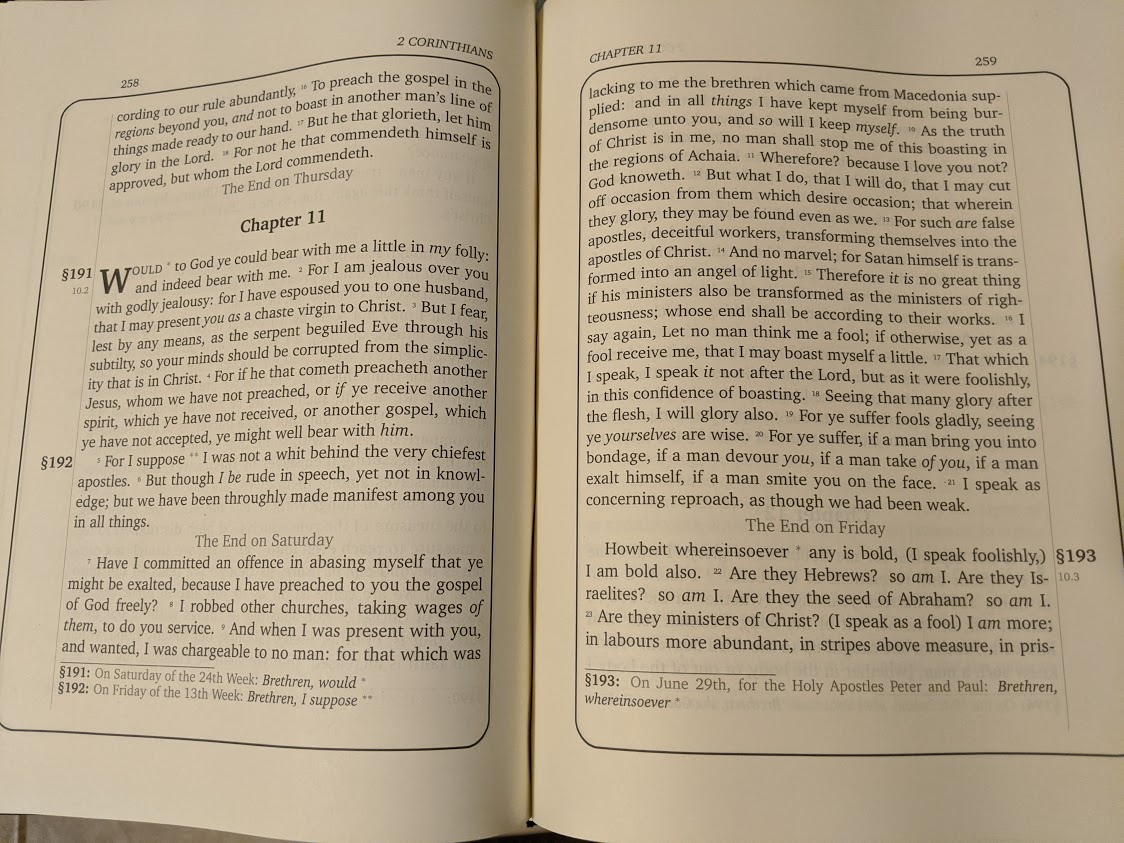
Review: A New Epistle Book


Deacon Peter Gardner has previously published a Gospel Book, a Prophetologion, and a Lenten Lectionary (which consists of those parts of the Prophetologion used during Lent and Holy Week). But he has now added to these useful texts an Epistle Book, which is according to the King James Version, with only some amendments to make it conform to the Slavonic Apostol (and these are minor, and few and far between). The text also contains translations of the introductions to each book. The translation used for the prokimena and alleluia verses is the Psalter According to the Seventy, commonly known as the "Boston Psalter," and since is the most commonly used translation of the Psalter in ROCOR and to some extent in other jurisdictions as well, this makes this text especially useful for those in such parishes. The text is also well bound, and seems sturdy enough to last, and the size is just about perfect, and the size of the font is as well. A lot of work went into putting it together, and the more I have looked it over, the more I have liked it.

The text would be improved, in my opinion, with some minor editing of the KJV text to eliminate words or phrases that are particularly obscure. The margins are wide enough, however, that one can make margin notes so that a reader will make whatever amendments are considered necessary -- which is what I am in the process of doing with my copy.

It is available for $70.00. It was originally available in a black and white text, or color, but now it is available in color only (red rubrics), which makes the text much easier to use, and pleasant to the eye. It comes with a dust cover, but the text itself is in a simple dark blue cover, with the words "Epistle Book" printed on the spine. If one could find a nice metallic cover that fits this edition, this would also be a nice touch.

In my parish, we have been using an earlier version of the St. Tikhon Apostol, and I have had to regularly print out a sheet for each Liturgy, so that the reader would read the prokimena and alleluia verses in the translation we use. This edition makes that unnecessary, and so this makes a great addition to the options that are available for English speaking Orthodox Christians -- especially for those who love the traditional form of Liturgical English in our services.

I would also recommend anyone who is interested in doing Reader Services, even if occasionally, that they get a copy of the Prophetologion, Gospel, and Epistle Book by Fr. Peter Gardner. There is really nothing else available right now that is comparable.

Update: You can see a list of suggested changes I would make to the text here:

https://saintjonah.org/articles/epistle_amendments.htm

You can do this by hand, by underling the text that needs to be amended, and writing the amended word text in the margin. If you use correction tape to white out the border before you write, this gives you more room. In some cases, it may be easier to white out the text that needs to be changed, and to write the correction over it, you just need to do so legibly, and keep the space you have in mind.

See Also: 

King James English and Orthodox Worship

Beauty and the Bible

An Orthodox Look at English Translations of the Bible

Friday, February 07, 2020

Sermons on Psalm 118[119]

An Orthodox Funeral, at which is chanted Psalm 118

In August 2014, I began a series of sermons on Psalm 118 (in the Septuagint, Psalm 119 in Protestant translations), and have preached an average of 4 sermons a year on this Psalm, and so after 5 1/2 years, I have finally finished the series. Here is the text of the Psalm, with the sermons at the end of each of the 22 sections, which in the Hebrew text consist of 8 lines each, and in each section the lines all begin with the letter of the Hebrew alphabet which correspond to that section. This is thus an acrostic Psalm, and the longest chapter in the Bible.

I drew heavily upon St. Theophan the Recluse's commentary on Psalm 118, but also on Blessed Theodoret, St. Augustine, and Cassiodorus, as well as some the occasional commentaries of some other saints. I would strongly recommend reading all of these commentaries, but if you were looking for a single source on Psalm 118, St. Theophan's commentary is the one to get.

St. John of Shanghai's words on the importance of the Psalms in general and of this Psalm in particular are mentioned several times in the various sermons below:
"Perhaps it will happen that you will die without having once in your life read in full the Psalter of David... You will die, and only then will good people read over your lifeless body this holy Psalter, which you had no time even, to open while you lived on earth! Only then, at your burial, will they sing over you the wondrously instructive, sweetly-wise-but alas, to you completely unknown-words of David: Blessed are the undefiled in the way, who walk in the law of the Lord... Blessed are they who search His testimonies. who keep His revelations, and seek Him with their whole heart. Do you hear: Blessed are they who search His testimonies, seek out the revelations of the Lord; and you had no time even to think of them! What will your poor soul feel then, your soul to which every word of the Psalmist, repeated by a reader or singer over your coffin, will sound as a strict reproach that you never read this sacred book?... Open now, before it is too late, this wondrous book of the Prophet King. Open it and read with attention at least this 118th Psalm, and you will involuntarily feel that your heart becomes humble, soft, that in the words of David are the words of the merit of God, and you will repeat involuntarily, many times, with sighing of heart, the verse of this Psalm: I have gone astray like a sheep that is lost; seek out Thy slave, Lord!" (from his weekly diocesan bulletin (Shanghai, November 24, 1941, no. 503, emphasis added).

א
Aleph

Blessed are the blameless in the way, who walk in the law of the Lord.  Blessed are they that search out His testimonies; with their whole heart shall they seek after Him.  For they that work iniquity have not walked in His ways.  Thou hast enjoined Thy commandments, that we should keep them most diligently.  Would that my ways were directed to keep Thy statutes.  Then shall I not be ashamed, when I look on all Thy commandments.  I will confess Thee with uprightness of heart, when I have learned the judgments of Thy righteousness.  I will keep thy statutes; do not utterly forsake me.
Blessed are the Blameless (Psalm 118:1-8)
ב
Beth

Wherewithal shall a young man correct his way? By keeping Thy words.  With my whole heart have I sought after Thee, cast me not away from Thy commandments.  In my heart have I hid Thy sayings that I might not sin against Thee.  Blessed art Thou, O Lord, teach me Thy statutes.  With my lips have I declared all the judgments of Thy mouth.  In the way of Thy testimonies have I found delight, as much as in all riches.  On Thy commandments will I ponder, and I will understand Thy ways.  On Thy statutes will I meditate; I will not forget Thy words.
Blessed art Thou, O Lord, Teach Me Thy Statutes (Psalm 118:9-16)
ג
Gimel

Give reward unto Thy servant, quicken me and I will keep Thy words.  O unveil mine eyes, and I shall perceive wondrous things out of Thy law.  I am a sojourner on the earth, hide not from me Thy commandments.  My soul hath longed to desire Thy judgments at all times.  Thou hast rebuked the proud; cursed are they that decline from Thy commandments.  Remove from me reproach and contempt, for after Thy testimonies have I sought.  For princes sat and they spake against me, but Thy servant pondered on Thy statutes.  For Thy testimonies are my meditation, and Thy statutes are my counselors.
Unveil Mine Eyes (Psalm 118:17-24)
ד
Daleth

My soul hath cleaved unto the earth; quicken me according to Thy word.  My ways have I declared, and Thou hast heard me; teach me Thy statutes.  Make me to understand the way of Thy statutes, and I will ponder on Thy wondrous works.  My soul hath slumbered from despondency, strengthen me with Thy words.  Remove from me the way of unrighteousness, and with Thy law have mercy on me.  I have chosen the way of truth, and Thy judgments have I not forgotten.  I have cleaved to Thy testimonies, O Lord; put me not to shame.  The way of Thy commandments have I run, when Thou didst enlarge my heart.
The Doors of Repentance (Psalm 118:25-32)

ה
He

Set before me for a law, O Lord, the way of Thy statutes, and I will seek after it continually.  Give me understanding, and I will search out Thy law, and I will keep it with my whole heart.  Guide me in the path of Thy commandments, for I have desired it.  Incline my heart unto Thy testimonies and not unto covetousness.  Turn away mine eyes that I may not see vanity, quicken Thou me in Thy way.  Establish for Thy servant Thine oracle unto fear of Thee.  Remove my reproach which I have feared, for Thy judgments are good.  Behold, I have longed after Thy commandments; in Thy righteousness quicken me.
The Way of Thy Statutes (Psalm 118:33-40)

ו
Vav

Let Thy mercy come also upon me, O Lord, even Thy salvation according to Thy word.  So shall I give an answer to them that reproach me, for I have hoped in Thy words.  And take not utterly out of my mouth the word of truth, for in Thy judgments have I hoped.  So shall I keep Thy law continually, for ever, and unto the ages of ages.  And I walked in spaciousness, for after Thy commandments have I sought.  And I spake of Thy testimonies before kings, and I was not ashamed.  And I meditated on Thy commandments which I have greatly loved.  And I lifted up my hands to Thy commandments which I have loved, and I pondered on Thy statutes.
 Our Anchor of Hope (Psalm 118:41-48)

ז
Zayin

Remember Thy words to Thy servant, wherein Thou hast made me to hope.  This hath comforted me in my humiliation, for Thine oracle hath quickened me.  The proud have transgressed exceedingly, but from Thy law have I not declined.  I remembered Thy judgments of old, O Lord, and was comforted.  Despondency took hold upon me because of the sinners who forsake Thy law.  Thy statutes were my songs in the place of my sojourning.  I remembered Thy name in the night, O Lord, and I kept Thy law.  This hath happened unto me because I sought after Thy statutes.
Remember  Thy Words to Thy Servant (Psalm 118:49-56)

ח
Heth

Thou art my portion, O Lord; I said that I would keep Thy law.  I entreated Thy countenance with my whole heart: Have mercy on me according to Thy word.  I have thought on Thy ways, and I have turned my feet back to Thy testimonies.  I made ready, and I was not troubled, that I might keep Thy commandments.  The cords of sinners have entangled me, but Thy law have I not forgotten.  At midnight I arose to give thanks unto Thee for the judgments of Thy righteousness.  I am a partaker with all them that fear Thee, and with them that keep Thy commandments.  The earth, O Lord, is full of Thy mercy; teach me Thy statutes.
Overcoming Sin (Psalm 118:57-64)

 ט
Teth

Thou hast dealt graciously with Thy servant, O Lord, according to Thy word.  Goodness and discipline and knowledge teach Thou me, for in Thy commandments have I believed.  Before I was humbled, I transgressed; therefore Thy saying have I kept.  Thou art good, O Lord, and in Thy goodness teach me Thy statutes.  Multiplied against me hath been the unrighteousness of the proud; but as for me, with my whole heart will I search out Thy commandments.  Curdled like milk is their heart; but as for me, in Thy law have I meditated.  It is good for me that Thou hast humbled me, that I might learn Thy statutes.  The law of Thy mouth is better to me than thousands of gold and silver.
God's Work to Guide Us on the Path of Salvation (Psalm 118:65-72)

י
Yod

Thy hands have made me and fashioned me; give me understanding and I will learn Thy commandments.  They that fear Thee shall see me and be glad, for on Thy words have I set my hope.  I have known, O Lord, that Thy judgments are righteousness, and with truth hast Thou humbled me.  Let now Thy mercy be my comfort, according to Thy saying unto Thy servant.  Let Thy compassions come upon me and I shall live, for Thy law is my meditation.  Let the proud be put to shame, for unjustly have they transgressed against me; but as for me, I will ponder on Thy commandments.  Let those that fear Thee return unto me, and those that know Thy testimonies.  Let my heart be blameless in Thy statutes, that I may not be put to shame.
Thy hands have made me and fashioned me (Psalm 118:73-80)

כ
Kaph

My soul fainteth for Thy salvation; on Thy words have I set my hope.  Mine eyes are grown dim with waiting for Thine oracle; they say: When wilt Thou comfort me?  For I am become like a wine-skin in the frost; yet Thy statutes have I not forgotten.  How many are the days of Thy servant? When wilt Thou execute judgment for me on them that persecute me?  Transgressors have told me fables, but they are not like Thy law, O Lord.  All Thy commandments are truth. Without a cause have men persecuted me; do Thou help me.  They well nigh made an end of me on the earth; but as for me, I forsook not Thy commandments.  According to Thy mercy quicken me, and I will keep the testimonies of Thy mouth.
On Thy Words have I Set My Hope (Psalm 118:81-88)

ל
Lamed

For ever, O Lord, Thy word abideth in heaven.  Unto generation and generation is Thy truth; Thou hast laid the foundation of the earth, and it abideth.  By Thine ordinance doth the day abide, for all things are Thy servants.  If Thy law had not been my meditation, then should I have perished in my humiliation.  I will never forget Thy statutes, for in them hast Thou quickened me.  I am Thine, save me; for after Thy statutes have I sought.  Sinners have waited for me to destroy me; but Thy testimonies have I understood.  Of all perfection have I seen the outcome; exceeding spacious is Thy commandment.
Forever, O Lord, Thy Word Abideth in Heaven (Psalm 118:89-96)

מ
Mem

O how I have loved Thy law, O Lord! the whole day long it is my meditation.  Above mine enemies hast Thou made me wise in Thy commandment, for it is mine for ever.  Above all that teach me have I gained understanding, for Thy testimonies are my meditation.  Above mine elders have I received understanding, for after Thy  commandments have I sought.  From every way that is evil have I restrained my feet that I might keep Thy words.  From Thy judgments have I not declined, for Thou hast set a law for me.  How sweet to my palate are Thy sayings! more sweet than honey to my mouth.  From Thy commandments have I gained understanding; therefore have I hated every way of unrighteousness.
Loving God and Hating Sin (Psalm 118:97-104)

נ
Nun

Thy law is a lamp unto my feet and a light unto my paths.  I have sworn and resolved that I will keep the judgments of Thy righteousness.  I was humbled exceedingly; O Lord, quicken me according to Thy word.  The free-will offerings of my mouth be Thou now pleased to receive, O Lord, and teach me Thy judgments.  My soul is in Thy hands continually, and Thy law have I not forgotten.  Sinners have set a snare for me, yet from Thy commandment have I not strayed.  I have inherited Thy testimonies for ever, for they are the rejoicing of my heart.  I have inclined my heart to perform Thy statutes for ever for a recompense.
A Light Unto My Paths (Psalm 118:105-112)

ס
Samech

Transgressors have I hated, but Thy law have I loved.  My helper and my protector art Thou; on Thy words have I set my hope.  Depart from me, ye evil-doers, and I will search out the commandments of my God.  Uphold me according to Thy saying and quicken me, and turn me not away in shame from mine expectation.  Help me, and I shall be saved; and I will meditate on Thy statutes continually.  Thou hast set at nought all that depart from Thy statutes, for unrighteous is their inward thought.  I have reckoned as transgressors all the sinners of the earth, therefore have I loved Thy testimonies.  Nail down my flesh with the fear of Thee, for of Thy judgments am I afraid.
Hitherto Hath the Lord Helped Us (Psalm 118:113-120)

ע
Ayin

I have wrought judgment and righteousness; O give me not up to them that wrong me.  Receive Thy servant unto good, let not the proud falsely accuse me.  Mine eyes have failed with waiting for Thy salvation, and for the word of Thy righteousness.  Deal with Thy servant according to Thy mercy, and teach me Thy statutes.  I am Thy servant; give me understanding, and I shall know Thy testimonies.  It is time for the Lord to act; for they have dispersed Thy law.  Therefore have I loved Thy commandments more than gold and topaz.  Therefore I directed myself according to all Thy commandments; every way that is unrighteous have I hated.

The Eye of the Soul (Psalm 118:121-128)

פ
Pe

Wonderful are Thy testimonies; therefore hath my soul searched them out.  The unfolding of Thy words will give light and understanding unto babes.  I opened my mouth and drew in my breath, for I longed for Thy commandments.   Look upon me and have mercy on me, according to the judgment of them that love Thy name.  My steps do Thou direct according to Thy saying, and let no iniquity have dominion over me.  Deliver me from the false accusation of men, and I will keep Thy commandments.  Make Thy face to shine upon Thy servant, and teach me Thy statutes.  Mine eyes have poured forth streams of waters, because I kept not Thy law.

Wonderful are Thy Testimonies (Psalm 118:129-136)

צ
Tsade

Righteous art Thou, O Lord, and upright are Thy judgments.  Thou hast ordained as Thy testimonies exceeding righteousness and truth.  My zeal for Thee hath made me to pine away, because mine enemies have forgotten Thy words.  Thine oracle is tried with fire to the uttermost, and Thy servant hath loved it.  I am young and accounted as nothing, yet Thy statutes have I not forgotten.  Thy righteousness is an everlasting righteousness, and Thy law is truth.  Tribulations and necessities have found me, Thy commandments are my meditation.  Thy testimonies are righteousness for ever; give me understanding and I shall live.

Blessed are They that Hear the Word of God and Keep it (Psalm 118:137-144)

ק
Qoph

I have cried with my whole heart; hear me, O Lord, and I will seek after Thy statutes.  I have cried unto Thee; save me, and I will keep Thy testimonies.  I arose in the dead of night and I cried; on Thy words have I set my hope.  Mine eyes woke before the morning that I might meditate on Thy sayings.  Hear my voice, O Lord, according to Thy mercy; according to Thy judgment, quicken me.  They have drawn nigh that lawlessly persecute me, but from Thy law are they far removed.  Near art Thou, O Lord, and all Thy ways are truth. From the beginning I have known from Thy testimonies that Thou hast founded them for ever.
Imitating God (Psalm 118:145-152)

ר
Resh

Behold my humiliation and rescue me, for Thy law have I not forgotten.  Judge my cause and redeem me; for Thy word's sake quicken me.  Far from sinners is salvation, for they have not sought after Thy statutes.  Thy compassions are many, O Lord; according to Thy judgment quicken me.  Many are they that persecute me and afflict me; from Thy testimonies have I not declined.  I beheld men acting foolishly and I pined away, because they kept not Thy sayings.  Behold, how I have loved Thy commandments; O Lord, in Thy mercy, quicken me.  The beginning of Thy words is truth, and all the judgments of Thy righteousness endure for ever.
If They Hear Not Moses and the Prophets (Psalm 118:153-160)

ש
Shin

Princes have persecuted me without a cause, and because of Thy words my heart hath been afraid.  I will rejoice in Thy sayings as one that findeth great spoil.  Unrighteousness have I hated and abhorred, but Thy law have I loved.  Seven times a day have I praised Thee for the judgments of Thy righteousness.  Much peace have they that love Thy law, and for them there is no stumbling-block.  I awaited Thy salvation, O Lord, and Thy commandments have I loved.  My soul hath kept Thy testimonies and hath loved them exceedingly.  I have kept Thy commandments and Thy testimonies, for all my ways are before Thee, O Lord.

All My Ways are Ever Before Thee (Psalm 118:161-168)

ת
Tav

Let my supplication draw nigh before Thee, O Lord; according to Thine oracle give me understanding.  Let my petition come before Thee, O Lord; according to Thine oracle deliver me.  My lips shall pour forth a hymn when Thou hast taught me Thy statutes.  My tongue shall speak of Thy sayings, for all Thy commandments are righteousness.  Let Thy hand be for saving me, for I have chosen Thy commandments.  I have longed for Thy salvation, O Lord, and Thy law is my meditation.  My soul shall live and shall praise Thee, and Thy judgments will help me.  I have gone astray like a sheep that is lost; O seek Thy servant, for I have not forgotten Thy commandments. 
The Signs of Life (Psalm 118:169-176)

Note: The translation of Psalm 118 is that of The Psalter According to the Seventy, © Copyright Holy Transfiguration Monastery, Brookline, MA, used by permission. All rights reserved.