Thursday, August 29, 2013

Stump the Priest: Faith that Moves Mountains?


Question: "Could you explain Matthew 17:20? When Jesus is talking about moving the mountain, is it implied that it is only when the request is in accordance with God's will? Are there other prerequisites involved? And could you comment on the different ways that people might be deceived by that quote, like with having too much faith in their own prayers, etc?" 

In this passage, Christ said: "If ye have faith as a grain of mustard seed, ye shall say unto this mountain, Remove hence to yonder place; and it shall remove; and nothing shall be impossible unto you."  

Christ was not suggesting that we could simply perform tricks to amaze our friends, but that if we have the faith for some need, and asked for it in faith, our prayer will be answered. But faith is itself a gift from God (1 Corinthians 12:9; Ephesians 2:8), and God will only give us the faith to ask for things that are in accordance with His will. St. John the Apostles says this explicitly in 1 John 5:14-15: "And this is the confidence that we have in Him, that, if we ask any thing according to His will, He heareth us: and if we know that He hear us, whatsoever we ask, we know that we have the petitions that we desired of Him." 

Commenting on this, St. Justin Popovich says: 

"True human confidence is in the confidence of God, i.e., when man's confidence is completely in the confidence of God, then it is infinite,  salvific, and almighty. Its boundaries are: Nevertheless not as I will, but as Thou wilt (Matt. 26:39). What is the will of God towards us, the human race? To achieve, through faith in the Son of God, eternal life. The will of God is completely and perfectly expressed in the God-man Christ, through His Gospel, through His works of salvation (cf. Eph. 1:9-10). Therefore, our confidence is in that we ask for that which belongs to Christ and is evangelical, and -- we receive it from God. It would not be confidence but insolence, shameless, and blind slavery to sin to ask from God something that is unevangelical and to wait for Him to fulfill it for us. Ultimately, that would mean wanting God to be a co-participant in our sin, to bring Him into our love of sin. The reason why our all-good and omniscient God does not fulfill many of our prayers is because they are not according to His will. The stipulation for our prayers to be fulfilled is that they be according to the will of God, and you shall receive. That which is according to the will of God is what is of the Gospel and in accordance with the Gospel. Through this, man's confidence is vouchsafed movement and life within God's infinite Goodness, God''s infiniteness. This is most perfect and the sweetest confidence. Everything else, directly or indirectly, is slavery to sin, death, the devil, and evil" (Archimandrite Justin Popovich, Commentary on the Epistles of St. John the Theologian, trans. Radomir M. Plavsic (Alhambra, CA: Sebastian Press, 2009) p.76f).

There is nothing that I can add to these words of St. Justin.

Wednesday, August 21, 2013

Stump the Priest: Unicorns?


Question: "In the antiphons of the feast of the Transfiguration I was struck by a reference to unicorns. What does that mean?"

In the second antiphon of the feast, there are three stichoi:

Stichos 1: The mountains of Zion on the side of the north, the city of the Great King (Psalm 47:3 LXX, 48:2 KJV)

Stichos 2: And He brought them unto the mountain of His sanctuary, this mountain which His right hand had gained as a possession (Psalm 77[78]:54).

Stichos 3: Mount Zion which He loved, and He built His sanctuary like that of a unicorn (Psalm 77[78]:68-69).

Each stichos is followed by the refrain: "O Son of God Who wast transfigured upon the mountain, save us who sing to Thee: Alleluia."

The Psalm verses, which reference the mountain of God's sanctuary are obviously being tied to the Transfiguration on Mount Tabor. But before we get into the meaning of this particular passage, let's consider the wider meaning of "unicorn" in the Scriptures.

The Hebrew words for this creature are riem (ראם), rieym (ראים), reym (רים), or rem (רם), and its root is related to the word "rise" râ'am (ראם).

Unlike the gentle unicorns we tend to think of when we hear that word, unicorns in Scripture are used as symbols of strength. For example, in Numbers 23:22, it states: "God brought them out of Egypt; he hath as it were the strength of an unicorn." In Psalm Psalm 21[22]:22, it refers to unicorns in a parallelism with lions: "Save me from the mouth of the lion, and my lowliness from the horns of the unicorns."


In the Greek Septuagint, this words is consistently translated as "monokerotos" (μονοκερωτος), which literally means "single-horn", which is also what the word "unicorn" means.  What is interesting is that in St. Jerome's translation of the Vulgate, he often uses the Latin word "unicornis", which is where we get the English word, but at other times he uses the Latin word "rinoceros" (rhinoceros), and this is reflected in the Douay-Rheims translation of Numbers 23:22: "God hath brought him out of Egypt, whose strength is like to the rhinoceros."

There are several species of Rhinos still in existence. Some of them have two horns, though one is large and the other one is smaller, and both are on the nose. Others have one horn only. In  fact, the scientific name for a single horn Rhino is "Rhinoceros unicornis".

A rhinoceros unicornis

It is also interesting to note that in some passages in Hebrew, a singular "unicorn" (re'em) is spoken of as having plural horns ("His glory is like the firstling of his bullock, and his horns are like the horns of a unicorn..." (Deuteronomy 33:17), which St. Jerome's texts has as "his horns as the horns of a rhinoceros"). However, in other places, it is clear that it refers to an animal with only one horn ("But my horn shall be exalted like that of the unicorn" (Psalm 91:11 LXX, (92:10 KJV). If various types of Rhinos are in view, single-horned and double-horned varieties exist. These animals also cannot be domesticated, which is consistent with the description found in Job 39:9-10: "Will the unicorn be willing to serve thee, or abide by thy crib? Canst thou bind the unicorn with his band in the furrow? or will he harrow the valleys after thee?"

Also, in the instance in Deuteronomy 33:17, when plural horns are spoken of, the horns are compared to the half-tribes of Ephraim and Manasseh:

"His glory is like the firstling of his bullock, and his horns are like the horns of a rhinoceros: with them he shall push the people together to the ends of the earth: and they are the ten thousands of Ephraim, and they are the thousands of Manasseh."

The tribe of Ephraim was much larger than the tribe of Manasseh, which fits the analogy of the horns of a two-horned Rhino.

There were also some now extinct relatives of the Rhino, the Elasmotherium, that was much larger than a rhino, and had a huge single-horns -- and based on cave drawings, there is good reason to believe that ancient humans had some interaction with some of them.

An elasmotherium sibiricum

So these references are not to a fairy-tale animal that flies through the air, and leaves a trail of pixie dust in its wake -- it refers to an animal that people recognized as very strong, fierce, and a creature who could not be tamed by men.

Now, getting back to the psalm verses used in the second Antiphon. The full psalm verses quoted in part in stichos three read:

"And He chose the tribe of Judah, Mount Zion which He loved. And He built His sanctuary like that of a unicorn, on the earth He established it for ever" (Psalm 77[78]:68-69).

Here is what the Fathers say about these verses:

Blessed Theodoret: ""He built His sanctuary like a unicorn" (v. 69). They say the unicorn is equipped with one horn, and the Law gave instruction for the adoring of one God; and so it was right for him to liken the one Temple, dedicated to the one God, to a unicorn"(Theodoret of Cyrus: Commentary on the Psalms, 73-150), trans. Robet C. Hill (Washington, D.C.: Catholic University of America Press, 2001), p. 39).


St. Augustine: "Lastly there followeth, "and He builded like as of unicorns His sanctification" (ver. 70): or, as some interpreters have made thereof a new word, "His sanctifying." The unicorns are rightly understood to be those, whose firm hope is uplifted unto that one thing, concerning which another Psalm saith, "One thing I have sought of the Lord, this I will require"" (NPNF1, p. 379).

Cassiodorus: ""Unicorns"" signifies those who posses a single hope in the most holy Trinity, towards which the consecrated hearts of the faithful are humbly raised, and they rely on the constancy of faith as the strongest of horns" (Cassiodorus: Explanation of the Psalms, Vol. 2, trans. P. G. Walsh, (New York: Paulist Press,1991), p. 273).

 See also

The Berean's Desk: Unicorns

Creation Today: Why Does the Bible Mention Unicorns?

Answers in Genesis: Unicorns in the Bible

See also this video:

Thursday, August 15, 2013

Stump the Priest: Old Calendarism


A monk from Esphigemenou monaster, about to toss a Molotov cocktail.

Question: "The Esphigmenou monastery [on Mount Athos] has recently made headlines; what is happening with them and why are the monks being evicted? How do you view Old Calendarists like these monks, who have broken communion with the rest of the Church?"

The history of the Greek Old Calendar movement is a sad one. What is most sad about it is that it was a problem that could have so easily been avoided had the New Calendar not been introduced into the Church of Greece (along with several other local Orthodox Churches) in the manner in which it was.

In the turmoil that followed World War I, you had the Bolsheviks reeking havoc in Russia, and the Greeks having launched a disastrous attempt to recapture Asia Minor from the Turks which led to a mass expulsion of the Greek population of Asia Minor, there were those who seized the opportunity presented by this upheaval to push for various "reforms" in the Church, and one of those "reforms" was to change the Church Calendar. Specifically, the kingdom of Greece had changed the civil calendar to the Gregorian Calendar, and so there were those who wished to push this change in the Church of Greece as well. In 1923, there was a "pan-Orthodox Synod" (which had representatives from less than half of the Church) which was held to consider this change. What they approved was a calendar that was essentially the same as the Gregorian Calendar, but which preserved the Old Calendar Paschalion (which determines the date of Pascha, and therefore all the aspects of the liturgical calendar that are determined by the date of Pascha). In 1924, the Church of Greece adopted this "Revised Julian Calendar," and in reaction, an Old Calendarist movement began.

The Church of Greece in cooperation with the government of Greece began a policy of repressing the Old Calendarists, which only added bitterness to schism. Gradually various divisions emerged among the Old Calendarists. Many of the Old Calendarists declared the New Calendar Church of Greece to be "without grace," and the degree to which extreme stances were taken added to the division among the Old Calendarists.

The history of the various Old Calendarists schisms is very complicated, and having read the conflicting accounts that the different factions have given about their history, it is my opinion that only God knows which of them are telling the truth in any given instance, and there is good reason to believe that none of their accounts add up entirely. But rather than get lost in the woods discussing their history, let me make a few observations, and then get to the key issues to this question:

1. Had the Calendar not been changed the way that it was, there never would have been a schism.

2. Old Calendarists have pointed to many Ecumenical abuses, especially on the part of clergy under the Ecumenical Patriarchate, and many of their objections have merit -- though their arguments that the rest of the Orthodox Church has fallen away as a result of these abuses does not stand up to scrutiny. However, those responsible for these abuses have some share in the blame that these groups have not been reconciled with the rest of the Church.

3. However, the Old Calendarists have generally taken a simplistic view of the canons and Church history in an attempt to justify their separation from the Church that has swayed many, but which is not justified by the Tradition and Canons of the Church.

4. Many (probably most) Old Calendarists are sincere, but there are also many who use the issues that motivate the Old Calendarists as an excuse for schism in order to provide a haven for those who simply wish to function outside of the reach of the accountability they would have to face in legitimate Orthodox Churches.

Is the New Calendar a Heresy?

While Old Calendarists cite other issues today, the issue that caused their groups to originally go into schism was the change of the Calendar, and so the question must be asked, is the New Calendar a heresy? Was it a sufficient basis for going into schism, and denouncing the Church of Greece?

I am not on the New Calendar, and I am glad that this is the case for two reasons:

1. I do not believe that the New Calendar should have been introduced unless every local Church agreed to make the change, at the same time. Whatever advantages the New Calendar may have, they are not worth causing division, and that is in fact what it caused.

2. Changing the fixed calendar to the New Calendar, but continuing to use the Old Calendar to determine the date of Pascha causes liturgical chaos. The Typikon was not written with such a strange mix in mind. Personally, I think it would make far more sense to change the entire calendar, so that it still worked with the Typikon. As it is, you have lenten commemorations occurring before Lent (such as the feast of the 40 Martyrs of Sebaste), and you have paschal commemorations occurring during lent (such as the feast of St. George). You also have the Apostles fast often ending before it begins, as it did this year.

But despite these issues, it cannot be successfully argued that the New Calendar is a heresy, and according to the Canons, it is only heresy, preached clearly and unequivocally, that is a sufficient basis for separating from your lawful bishop, or a bishop separating from his lawful synod.

The Canons

If you ask an Old Calendarist for the canonical basis of their schism, they will point to Canon 15 of the First and Second Council (The Protodeutera Council) of Constantinople, held in 861, which states in part:

"But as for those persons, on the other hand, who, on account of some heresy condemned by holy Councils, or Fathers, withdrawing themselves from communion with their president, who, that is to say, is preaching the heresy publicly, and teaching it barehead in church, such persons not only are not subject to any canonical penalty on account of their having walled themselves off from any and all communion with the one called a Bishop before any conciliar or synodal verdict has been rendered, but, on the contrary, they shall be deemed worthy to enjoy the honor which befits them among Orthodox Christians. For they have defied, not Bishops, but pseudobishops and pseudo-teachers; and they have not sundered the union of the Church with any schism, but, on the contrary, have been sedulous to rescue the Church from schisms and divisions."

Another basis that is often appealed to is the example of St. Theodore the Studite, who broke communion with the Patriarch of Constantinople because he allowed the Emperor to enter into a fourth marriage.. which was certainly contrary to the well established Tradition of the Church. This controversy is known as the Moechian Controversy (from the Greek word "μοιχός," which means "adulterer," because St. Theodore considered this marriage to be nothing more than adultery). During this controversy, St. Theodore the Studite briefly separated himself from two Patriarchs who are also Saints of the Church.The fact that he separated from two saints of the Church suggests that the example is not one that is so clear cut that one could base a great deal upon it.

Aside from that, a few decades after the repose of St. Theodore, the First and Second Synod was called in Constantinople, and while they did say that a bishop preaching heresy bareheaded in the Church was grounds for schism, they made it very clear that personal sins or canonical violations were not a sufficient basis for a schism.

Canon 13 of that council states:

“The All-evil One having planted the seed of heretical tares in the Church of Christ, and seeing these being cut down to the roots with the sword of the Spirit, took a different course of trickery by attempting to divide the body of Christ by means of the madness of the schismatics. But, checking even this plot of his, the holy Council has decreed that henceforth if any Presbyter or Deacon, on the alleged ground that his own bishop has been condemned for certain crimes, before a conciliar or synodal hearing and investigation has been made, should dare to secede from his communion, and fail to mention his name in the sacred prayers of the liturgical services in accordance with the custom handed down in the Church, he shall be subject to prompt deposition from office and shall be stripped of every prelatic honor. For anyone who has been established in the rank of Presbyter and forestalls the Metropolitan’s judgment, and, judging matters before a trial has been held, insofar as lies in his power, condemns his own father and Bishop, he is not even worthy of the honor or name of Presbyter. Those, on the other hand, who go along with him, in case any of them should be among those in holy orders, they too shall forfeit their own rights to honor, or, in case they should be monks or laymen, let them be utterly excommunicated from the Church until such time as they spew upon and openly renounce all connection with the schismatics and decide to return to their own Bishop” (D. Cummings, trans., The Rudder of the Orthodox Catholic Church: The Compilation of the Holy Canons Saints Nicodemus and Agapius (West Brookfield, MA: The Orthodox Christian Educational Society, 1983), p. 469).


Canon 14 says:

If any Bishop, on the allegation that charges of crime lie against his own Metropolitan, shall secede or apostatize from him before a conciliar or synodal verdict has been issued against him, and shall abstain from communion with him, and fail to mention his name, in accordance with consuetude, in the course of the divine mystagogy (i.e., liturgical celebration of the Eucharistic mystery), the holy Council has decreed that he shall be deposed from office, if merely by seceding from his own Metropolitan he shall create a schism. For everyone ought to know his own bounds, and neither ought a presbyter treat his own bishop scornfully or contemptuously, nor ought a bishop to treat his own Metropolitan so” (Ibid., p. 470).


Essentially, this says that what goes for Deacons and Priests, goes for a Bishop in his dealings with his Metropolitan too.


And then we have Canon 15:


“The rules laid down with reference to Presbyters and Bishops and Metropolitans are still more applicable to Patriarchs. So that in case any Presbyter or Bishop or Metropolitan dares to secede or apostatize from the communion of his own Patriarch, and fails to mention the latter’s name in accordance with custom duly fixed and ordained, in the divine Mystagogy, but, before a conciliar verdict has been pronounced and has passed judgment against him, creates a schism, the holy Council has decreed that this person shall be held an alien to every priestly function if only he be convicted of having committed this transgression of the law. Accordingly, these rules have been sealed and ordained as respecting those persons who under the pretext of charges against their own presidents stand aloof, and create a schism, and disrupt the union of the Church. But as for those persons, on the other hand, who, on account of some heresy condemned by holy Councils, or Fathers, withdrawing themselves from communion with their president, who, that is to say, is preaching the heresy publicly, and teaching it barehead in church, such persons not only are not subject to any canonical penalty on account of their having walled themselves off from any and all communion with the one called a Bishop before any conciliar or synodal verdict has been rendered, but, on the contrary, they shall be deemed worthy to enjoy the honor which befits them among Orthodox Christians. For they have defied, not Bishops, but pseudobishops and pseudo-teachers; and they have not sundered the union of the Church with any schism, but, on the contrary, have been sedulous to rescue the Church from schisms and divisions” (Ibid., p. 470f).


And so what was said in the previous canons about separating from Bishops and Metropolitans is all the more applicable to one’s Patriarch. There is only one exception given here, and that is when one separates from their Bishop, Metropolitan, or Patriarch, on the basis of heresy that is publicly taught “bareheaded” in the Church.  The canon does not say it is justified merely on the grounds that a bishops holds a heretical opinion.  It also does not say it is justified because such an heretical opinion might be inferred from his actions or vaguely worded statements. It is only when it is a heresy that has been condemned by the fathers or councils, and is taught publicly, and “bareheadedly”.

These canons, coming as they do in the wake of the Moechian controversy, were clearly designed to ensure that another such controversy would not occur. They clearly define the only basis for schism prior to a conciliar verdict, and that is the clear preaching of heresy. Furthermore, even this canon does not provide for the establishment of parallel jurisdictions prior to a conciliar verdict. In other words, you could withdraw from communion from a bishop who is preaching heresy, but until the Church deals with the matter, you have no grounds for establishing rival Synods, as the Greek Old Calendarists have done.

Now getting back to the monks at Esphigmenou, while all the monasteries on Mount Athos have at times raised objections to actions and statements of the Ecumenical Patriarchate, and while they all have remained on the Old Calendar, all of them remain in communion with the rest of the Church... except for this monastery. It has unfortunately attracted the most extreme monks on the Holy Mountain, and they have painted themselves into a theological and ecclesiological corner.

There have been other examples of Orthodox governments using military force to remove heretical or schismatic monks from a monastery, but I think it would have been better in this case for the Ecumenical Patriarchate to focus their attention on removing the points of scandal that have inspired these monks to take the extreme position that they have, and then to attempt to reason with them in good faith, rather than resorting to the use of force at this point.

The shame of it all is that among the Old Calendarists there are many people who are very pious and devout, and were it not for the issues that have led them into schism, they would be great assets to the rest of the Church and contribute much to its strength. We should pray that they will see their error in their position, but we should also speak out against examples of modernism and ecumenism when we see them, because these things are not only a temptation that has led many into schism -- they are also things that could eventual divide the Church even further. The more we all embrace the Tradition of the Church, the more we will be united; but the more that people in the Church disregard that Tradition, the more division will be the result.

I would recommend that you read "Anti-Patristic: The Stance of the Zealot Old Calendarists, by Monk Basil of the Holy Monastery of Saint Gregory (Grigoriou), Mount Athos.

I would also recommend you read "A Rejoinder to Hieromonk Patapios’ essay: “The Deficient Scholarship of Monk Basil’s Comments on the Allegedly Anti-Patristic Stand of the So-Called“Old Calendarist Zealots."


Tuesday, August 06, 2013

Stump the Priest: The Priesthood


Edward G. Robinson, playing Dathan, in the movie the Ten Commandments

Question: "How does the Orthodox Church views the nature of Holy Orders when compared to the view of the Roman Catholic Church. The Roman church claims that its priests are "Alter Christus," -- another Christ  -- who undergo a fundamental change in being at their ordination, and who will be priests even in heaven or hell ("once a priest always a priest"). Does the Orthodox Church accept this formulation? Perhaps you could also express the Orthodox view of the Protestant notion of the "Priesthood of all believers.""

We of course believe that, not only priests, but all Christians, are called to be like Christ. We also believe that in certain respects and at certain times in the Liturgy a priest or bishop represent Christ in a symbolic sense. We do not believe that ordination leaves an “indelible mark on the soul” and that therefore once a person is ordained a priest or bishop, he is therefore “forever a priest, after the order of Melchizedek.” St. Basil’s 3rd and 32nd canon make clear that if a person is justly deposed, no sacrament that they perform would be valid.

In commenting on Canon 28 of the Holy Apostles, St. Nicodemus of the Holy Mountain compares someone who is unjustly deposed with an artist whose tools have been taken away from him. Once the unjust deposition is annulled, he is given back his tools, and is able to paint as before. But a person who is justly deposed is like an artist whose hands are crippled, and even if he takes up his tools again, he is unable to again do with them what he was able to do before.

As for the Protestant view of the "Priesthood of all believers," we would agree with them up to a point. St. Peter indeed says that "you also, as living stones, are being built up a spiritual house, a holy priesthood, to offer up spiritual sacrifices acceptable to God through Jesus Christ…. you are a chosen generation, a royal priesthood, a holy nation, His own special people, that you may proclaim the praises of Him who called you out of darkness into His marvelous light" (1 Peter 2:5, 9). You also find the same idea expressed three times in the book of Revelation (Revelation 1:6; 5:10; 20:6). But you also find the same idea in the Old Testament. For example in the Law of Moses it says "And you shall be to Me a kingdom of priests and a holy nation." These are the words which you shall speak to the children of Israel" (Exodus 19:6).

However, in the Old Testament, even though they were a kingdom of priests, they still had a distinct priesthood. And there is a very interesting incident found in Numbers chapter 16, in which some people began to assert that there should not be such a distinction. In fact, the basic argument of Korah, Dathan and Abiram is not much different than what you hear from many Protestants:

"They gathered together against Moses and Aaron, and said to them, "You take too much upon yourselves, for all the congregation is holy, every one of them, and the Lord is among them. Why then do you exalt yourselves above the assembly of the Lord?"" (Numbers 16:3).

If you read the rest of that chapter, you will see that this attempt to democratize the Liturgical Priesthood of the Old Testament did not end well for them.

Deacons, priests, and bishops have a special grace that is bestowed upon them by the laying on of hands (ordination), and so they have a distinct role in leading the people in worship, and performing the sacraments of the Church. They also have special canonical requirements that not all Orthodox Christians are held to. For example, a blind or deaf person cannot be ordained. They also should have good character, and can only have been married once. And if a man who has married a women who has been married before, even if she is a widow, he cannot be ordained. This does not mean that there is any sin in marrying a widow, but it does mean that clergy have to meet certain standards of ritual purity to be ordained... and so must his wife, if he has one. But clergy function in these roles only because they have the blessing of the Church to do so. If that blessing is taken away, they cannot continue to function in those roles. Also, every Orthodox Christian can pray, and do all the services of the Church without a priest -- short of the sacraments and liturgical blessings specific to the clergy. For example, a parent can and should bless their children by making the sign of the cross over them. If an Orthodox layman is unable to attend a Church, they can do a Vigil as a reader service, and do Typika in the place of the Liturgy. An Orthodox Christian can even baptize someone in the case of an emergency. So we are all a kingdom of priests, but God has established a distinct priesthood to perform a particular role in the life of the Church.

Wednesday, July 31, 2013

Stump the Priest: How Much is Too Much?


Question: "In this world where we are taught to enjoy ourselves and seek pleasure, where, even as Christians, we want to glorify God's creation, how are we to know when we have reached a level of overly enjoying the pleasures of the earth or of God's creation? I mean to say, if we are relaxing on the beach, or walking in wood, or gazing at the heavens, how do we know when enough is enough? It seems obvious we could or should all be working continuously for the Lord by praying or doing good works. But then it seems almost sinful to not enjoy the beauties of the world and God's creation as well. Is there a formula mentioned or something to help us know when enough is enough?"

There is not a simple formula. When you learn how to ride a bike, you have to learn how to balance your weight on the bike, while you peddle, but how do you do that? You do that by trying to do it, and when you fall down, you get back on the bike, and try it again.

There are some things that are inherently evil, and so there is no question but that we should abstain from such things. But it is not a sin to enjoy a good meal, or enjoy the company of another person. These are good things, but most good things can be taken to excess, and then it can become sinful.. but the sin is in the excess, not in the thing itself.

It can be an even better thing to abstain from such pleasures, if you are doing so out of love for God and a desire to draw closer to Him and to remove things that distract from that desire. But even asceticism can become sinful if it is seen as an end in itself or used as a means to vainglory.

It is also sinful if you abstain from things that are good, because you find them abominable. Canon 51 of the Holy Apostles says:

"If any Bishop, or Presbyter, or Deacon, or anyone at all on the sacerdotal list, abstains from marriage, or meat, or wine, not as a matter of mortification, but out of an abhorrence thereof, forgetting that all things are exceedingly good, and that God made man male and female, and blasphemously misrepresenting God’s work of creation, either let him mend his ways or let him be deposed from office and expelled from the Church. Let a layman be treated similarly."

So marriage is good. Eating meat is good. Drinking wine is good. However, if you abstain from these out of true asceticism, that is also good. But if you view these things as sinful in and of themselves, this view is itself sinful, and if not repented of will separate you from the Church.

So the key here is to find a balance. And what the right balance is will be different for different people.

In order to find that balance, you need to inform your conscience by regularly studying the Scriptures, the writings of the saints, and other edifying books. You need to keep the fasts of the Church. You should also pray that God will guide you, and go to confession regularly. And remember the words of St. Poemen the Great: "Everything that goes to excess comes from the demons" (Saying 129 of St. Poemen, from the Alphabetical Collection of the Sayings of the Desert Fathers).

You can listen to a sermon on some of the sayings of St. Poemen the Great which relate to this question, by clicking here.


Tuesday, July 30, 2013

Unfortunate Trends in the Roman Catholic Church


When confronted with videos of really odd abuses in Roman Catholic Masses, such as the video below, Roman Catholic apologists usually just dismiss them as aberrations:


But aside from the usual She-devil distributing communion, or the occasional priest wearing a Barney suit, if you just listen to the music, what you are hearing is run of the mill Charismatic "praise and worship" music.

But then you have this Mass that was done in Los Angeles, with a dozen or so bishops, including the Cardinal, and quite a few deacons and priests, along with thousands of the laity... and this service was broadcasted as well:


Here we have music that could have been from the "Lion King", followed by a Charismatic "praise and worship" song that could have been sung in any non-denominational Protestant Church in the United States. The only parts of the service that are not completely Protestant are the pagan elements of dancers carrying bowls of incense, who are dancing around the holy table. Nevertheless, we are still told that this was just an aberration.

But then there is this video:


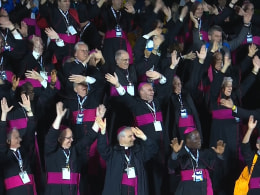
This is from Pope Francis' recent trip to Brazil. Granted, this is not a liturgical dance, but here you have a whole group of Bishops engaged in a tacky dance to celebrate the Pope's visit. Trying to be "hip" and holding fast to the Traditions of the Church do not mix well... and usually those that have tried to make the sacred "hip" have only succeeded in making themselves look foolish, and encouraging the mockery of the sacred.

The Bishops were practicing for this "flash mob" dance, which was done just before the Pope's mass on the beach:


Here is a video of the full mass on the beach:


Here is another video of the current Pope participating in a Children's Mass:


The idea of "Children's Church" is another bad idea imported from Protestantism. What was "Children's Church" in the 70's and 80's, is what is now adult Church in most Protestant Churches. The idea of separating children out from the rest of the Church, and having worship that caters to them has no basis in the Tradition of the Church, and inevitably leads to a dumbing down of the services.

Prior to Vatican II, even the worst critics of Rome would have agreed that their services were solemn. Whatever else you might have said, there was an undeniable dignity and reverence to their services. There is not much dignity or reverence in any of the aforementioned.

The first step in fixing a problem is acknowledging that you have one. Rome, you have a problem.

Update:

As a contrast, you can watch the videos of a very prominent Orthodox Liturgy, which was also outdoor, that took place in Kiev this past Sunday, to mark the 1025th Anniversary of the Baptism of Rus' here:

Part 1:


Part 2:


And if your are wondering what the significance of that occasion was, you can listen to my sermon on it from this past Sunday here: http://www.ancientfaith.com/podcasts/amvon/the_baptism_of_russia

Second Update: Here is a Roman Catholic video critiquing the "Bishop Dance" in Brazil:


Here is a video with a side by side comparison:


Third Update: A pious Roman Catholic assessment of the state of contemporary Roman Catholicism:

Thursday, July 25, 2013

Stump the Priest: Where do the Races Come From?


Question: "Where did all the other races come from?  If God created heaven and earth, did he also create the different languages and different colors of skin?  If so, what was the reason he created all of us different?"

The concept of race actually does not appear in the Bible. In Scripture, people are categorized as belonging to groups according to their family, tribe, people, nation, and tongue.


There are three broad racial categories that we recognize today: Negroid, Mongoloid, Caucasoid -- and so some suggest a connection between these and Noah's three sons, Ham, Shem, and Japeth, but there is no way to prove or disprove that.

National and linguistic divisions, according to Scripture, began with the Tower of Babel, where God divided the nations by creating differences in language (Genesis 11), and so by dividing the nations God set limits on the ability of evil to spread among from one nation  to another.

It should be pointed out that contrary to the beliefs of people prior to the discovery of blood types, all races have all the same blood types. Those features that we consider racial are truly superficial, and the Church does not consider them to be worthy of note.

In Numbers 12 we have an incident that we would think of as racial today, but which was more a question of ethnicity and culture, in which Moses' brother and sister complained about his Ethiopian wife, and it should be noted that God made it clear that it was not Moses who had erred in marrying the Ethiopian, but his siblings in speaking against him on account of it. See "Moses' Black Wife" for more on that incident.

The Jews, of course made a sharp distinction between themselves and the gentiles (nations), but this was not ultimately racial, because it was possible for a gentile to convert to Judaism. But the New Testament repeatedly makes the point that "in Christ there is neither Jew nor Greek," but rather we "are all one in Christ Jesus" (Galatians 3:28; Colossians 3:11). St. Peter, after witnessing the Holy Spirit coming upon Cornelius, said: "In truth I perceive that God shows no partiality. But in every nation whoever fears Him and works righteousness is accepted by Him" (Acts 10:34-35).

The Church Fathers and the Services of the Church, speak of  only two races: the race of man (Adam), and the Christian race, and the only mixed marriages we speak of are when an Orthodox Christian marries a heterodox Christian.

In the Kontakion of Pentecost, we are told that at Pentecost, the division of the nations at Babel was undone at Pentecost:

"Once, when He descended and confounded the tongues, the Most High divided the nations; and when He divided the tongues of fire, He called all men into unity; and with one accord we glorify the All-Holy Spirit."

And so while we belong to a particular family, tribe, and nation, and speak different languages, and while we have our racial, and cultural differences -- as Christians we are all one family, and one nation. We are Orthodox Christians first and foremost, and any other difference we may have is only superficial.

Why did he make us with different colors of skin, hair, and eyes? Probably for the same reason that Jacob made Joseph a coat of many colors... such variety makes for more beauty. This is a gift from God to humanity.

Wednesday, July 17, 2013

Stump the Priest: Mass Ordinations?


A Roman Catholic mass ordination 

Question: "Why did our bishops declare the ordinations of a group of Western Rite clergy invalid because they were ordained in a single service? Why was this such a big deal?"

There are several reasons. To begin with, every clergyman in the Russian Church, before he is ordained, takes an oath before the Gospel and the Cross, saying that they will “…perform all liturgical services or prayers according to the rules of the Church….” This means that we cannot just make up services, or introduce innovations into the services, but must do the services as approved by the Church and in conformity with its Tradition. They also “promise to be obedient to the ecclesiastical authorities and act according to the Canons of the Holy Apostles, of the Ecumenical and Local Councils and the teachings of the Holy Fathers.” And so not even a Bishop may introduce liturgical innovations into the services of the Church that are contrary to Church Tradition, and not sanctioned by the Church that they belong to.

The argument in favor of doing a mass ordination in the Western Rite is that this was the practice in the pre-schism West. The problem with this argument is the assumption that anything that was done in the pre-schism West is therefore acceptable. In Orthodox Liturgics, we partake of only one loaf for communion… and so no matter how large the congregation, a loaf of sufficient size must be used to be consecrated for the Eucharist (1 Corinthians 10:16-17). In Western practice, the priest partakes of one wafer, but the people all partake of different wafers. In Orthodox Liturgics, a clergyman may only serve one liturgy in a day, and only one liturgy may be served on a given altar. In the west, a priest may celebrate as many Masses as he has the time and strength to perform, and he can do so on the same altar. Likewise, in the West, numerous priest, deacons, and bishops can be ordained at one time, but in Orthodox practice, only one Bishop, one Priest, and one Deacon can be ordained at the same liturgy, because each one represents the fullness and unity of that order. In all of these Western deviations, the idea that we all partake of one Eucharist is obscured by the admission of multiplicity. These deviations in the West were already the subject of controversy before the schism, and were criticized by the Eastern Fathers. In the West you also have the practice of a priest serving a private Mass, with no one beside the priest in attendance. In the Orthodox Church, this is forbidden. This is because the focus in the West was on the Mass as a individual act of private devotion, whereas in the Orthodox Church it is a corporate act of communion, which expresses our unity of Faith. What begins as a small deviation in course, over  time leads to one getting very far off course from where they should be. And so while many things were done in the West before the schism, we have to look to the practice of the Church that did not depart into heresy and schism for guidance on these matters.

St. Nicodemus of the Holy Mountain, commenting on Canon 68 of the Holy Apostles (which says that one person can only be ordained once to a given office, which means that if a clergyman is deposed for wrong doing, he cannot subsequently be ordained again), wrote:

“What can be the reason why only two of all the seven Mysteries cannot be performed twice, namely, that of baptism and that of ordination into holy orders? The scholastics, on the one hand, say that it is because these two leave an indelible imprint or stamp which according to them (in the fourth chapter of Theology, as it is to be found in the Catechism by Nicholas Boulgaris) is a real quality inherent in the soul and is a supernatural power. This opinion of the scholastics was followed by almost all our own modern theologians, and especially by Koressios. But to me, on the other hand, it seems that the sole reason why these two mysteries alone are incapable of being celebrated a second time in the life of one and the same individual as a recipient thereof, is because they are carried out in the type, or form, of the Lord’s death, which occurred but once and can never occur a second time. For those who are being baptized are baptized into the Lord’s death, according to St. Paul and Ap. c. XLVII. As for priests who have fallen out of holy orders, the reason why they cannot be ordained a second time is that they typify the first and great priest who came but once to the office of holiness, after finding everlasting redemption, according to St. Paul, and He remains perpetually incapable of fall from holy orders. This in my opinion is the real reason why a priest cannot be reordained. For holy orders in Christ are incapable of fall and cannot be forfeited. Hence His type ought always to stand in the purity demanded and required for holy orders, in order that the likeness may be well preserved, as between the high priest and the one typifying Him. Another reason, however, is also the fact that a priest consists mainly in the exercise of sacerdotal functions, or, more plainly speaking, in sacrificing the mystic sacrament, which is the bloodless sacrifice whereby the one death of the Lord is denounced, according to St. Paul. For it is a question whether there is any good and sufficient reason why these mysteries cannot be celebrated a second time in the nature of the imprint or stamp invented or imagined by the scholastics, because second chrismation is permissible, notwithstanding that the chrism is called a seal, and really does imprint a seal and stamp upon the soul of the one receiving it. For John the Evangelist says: “And the chrism which ye have received from him abideth in you” (I John 2:27). And St. Paul says: “Who hath also sealed us, and hath given us the earnest of the Spirit in our hearts” (II Cor. 1:22). Moreover, one must remember that David even called Saul “anointed of the Lord,” not only after his disregard of God, but also after his death (II Sam. 1:14). Hence and for this reason, namely, the Lord’s unique death, only a single deacon, and only a single presbyter, and only a single bishop or other prelate ought to be ordained at any one liturgy, and not two, or several, according to Symeon of Thessalonica (Reply 39), and also according to Job in the Syntagmation of Chrysanthus. As for those who are not uniquely ordained—i.e., who are not ordained once for all—what they are I know not, says the same Symeon, seeing that they have not been ordained in accordance with the tradition of the Church. In spite of the fact that several anagnosts and sub-deacons are ordained at one and the same liturgy; on the theory that they are more imperfect members of the holy orders, and that they are outside owing to their being in a minor service (commonly called “minor orders” in English), according to the same Job (ibid.). For this reason, that is to say, because of the fact that the unique death of Christ cannot occur a second time, the local synod held in the time of Heraclius against Isidorus in A.D. 613 ordained that two liturgies should not be celebrated on one and the same day and on one and the same table, saying: “It is not lawful on one table in the same day for two liturgies to be said, nor on the same table on which the bishop officiated in a liturgy, for any presbyter to officiate in a liturgy in the same day”: which rule the Papists (i.e., the so-called Roman Catholics) transgress. But then the fact is that even our own priests who celebrate liturgy twice in the same day, under the misconception that this conduces to outspoken emphasis and greater impressiveness, are gravely sinning. Accordingly, let them henceforth cease committing this absurd impropriety." The Rudder, p. 120, note 2.

Archbishop Chrysostomos (Alexopoulos) wrote: “By the same token, the tradition which forbids the Ordination of more than one Deacon, Presbyter, or Bishop at the same Liturgy is not simply a matter of adherence to legalistic formulæ. The Priesthood is given once and forever, despite the fact that informed “experts” have quite wrongly attributed this characterization of the Priesthood to “Latin” influence. In order to emphasize this sacerdotal singularity and, again, the unique, singular, life-giving death of Christ, a single Deacon, Presbyter, or Bishop is ordained at any one Liturgy. St. Symeon of Thessaloniki, a Father with true expertise in issues theological and liturgical, thus clearly states that only one Deacon, Presbyter, or Bishop can be ordained at a single Liturgy, and that those who “overturn” this rule are innovators who do not “follow the Church” (“Answer XXXV,” Answers to Various Questions, in St. Symeon of Thessaloniki, Τὰ Ἅπαντα [Thessaloniki: Bas. Regopoulos, n.d. (fourth edition)], pp. 366–367). Also, see the Πηδάλιον, op. cit., p. 90, n. 1, in which St. Nicodemos comments in a similar vein on this issue, making reference to St. Symeon, citing as his thirty-ninth “Answer” that which is cited as “Answer XXXV” in my edition of Symeon’s work). See, finally, Patriarch Chrysanthos of Jerusalem (1663–1731) and his Συνταγμάτιον Περὶ τῶν Ὀφφικίων, Κληρικάτων καὶ Ἀρχοντικίων τῆς τοῦ Χριστοῦ Ἁγίας Ἐκκλησίας, καὶ τῆς Σημασίας Αὐτῶν (Târgovis,te, 1715), in which he points out that only a single Deacon, Presbyter, or Bishop can be Ordained in a single Liturgy. This he calls an “ancient tradition.” Hence, he, too, affirms that, without violating Holy Tradition and acting “outside the Church,” one cannot accept mass Ordinations.”

Every bishop who serves a diocese for a significant length of time no doubt finds some occasions in which ordaining two or more priests or two or more deacons would be more convenient than doing two or more separate Liturgies, and yet the fact is that for century after century this Tradition has been of sufficient strength and universality that this has not been done.

Even if one were to argue that these saints were simply narrow minded easterners that did not understand the Western traditions, those who would wish to introduce such practices into the life of the Orthodox Church today would need to first seek and obtain the sanction of the Church prior to putting them into practice, and in this case, this was most certainly not done.

No clergyman has inherent “magical” powers to perform sacraments. The power comes from their ordination, and their serving with the authority of the Church, and that authority is to do the services in the manner that the Church has authorized them to be done… not as they might personally wish them to be done.

To see the decision of the Bishops, click here.

Friday, July 12, 2013

Stump the Priest: Divorce


Question: "I have heard Roman Catholics argue that Christ taught that remarriage after divorce was adultery, regardless of who is the innocent party, and they quote Church Fathers that seem to agree. They criticize the Orthodox Church’s position on this. How should we respond?"

There are some background points that have to be understood to understand this question:

1. Christ, St. Paul, and the Church clearly teach that the ideal for each person is that they either remain single, or marry only one person for life. Any second or third marriage is considered less than that ideal, even if you are a widow or widower. In fact, you find in the lives of the saints many examples of people who were betrothed to another, and their betrothed died before they were finally married, and yet they chose to remain faithful to their betrothed even after their death, refused to marry any other, and in many cases became monastics instead. So you will find many fathers that encourage people to not enter into a second marriage for any reason. This is why a deacon, priest, or bishop cannot have been married more than once, nor are priest and deacons allowed to marry again, even if their wife passes away.

2. In the Gospels, Christ does say that if someone is divorced for any reason other than infidelity, and they remarry, they commit adultery and cause their former spouse to commit adultery (Matthew 5:31-32). St. Paul adds another reason for divorce – abandonment (1 Corinthians 7:10-15). All of the reasons for the Church granting a divorce with a blessing to remarry are extrapolations from these two exceptions. For example, if a woman has a husband who is a drunk, beats her, and does not support the family, this is considered a form of abandonment. Nevertheless, divorce is always a last option, a bad option (though in some cases the least bad option) and one best avoided if at all possible.

3. Canon 9 of St. Basil the Great states that the innocent party may remarry without any sin on their part or the part of the person that they marry.

In our time, divorce is treated as a very light matter, and this is contrary to the tradition of the Church. We should enter into marriage without allowing even the thought of divorce to enter into their mind. However, it is not an unpardonable sin, and with the blessing of the Church, a person may remarry.

The irony with Roman Catholics who make these arguments is that they simply call divorce “annulment,” and so in their minds maintain a consistency that they charge us with lacking. I would say that we are honest with it, while they are not. When a couple have been married and have had children together, to call their divorce an annulment, when there was no canonical reason why they should never have been married (such as close kinship) is simply ridiculous. The Orthodox Church is honest, and also pastoral. But we should never forget that God hates divorce (Malachi 2:16), and so should we.

You can also listen to a sermon that discusses what the Bible says about divorce by clicking here.

Friday, July 05, 2013

Stump the Priest: What Can We Do to Fight for Traditional Values?

 St. Alexander Peresvet in single combat with the Tatar champion Chelubey 
at the opening of the Battle of Kulikovo (8 September 1380).

What are the ways (either derived from doctrine, history, or as guided by current leadership) that ordinary members of the Church--those who need to go to work everyday and may not have a whole lot of extra time to devote--contribute in trying to influence our culture to affirm traditional values and "push back" against those forces that are trying to destroy them?

There are a number of different levels on which we have to push back:

1). The most important thing for us to do is to begin with ourselves, and to make sure that we are living a pious Christian life, in accordance with the Orthodox Tradition. If we do so, we will influence those around us, and what we say and do otherwise to defend traditional values will carry weight, whereas if we speak out about these values, but do not live them ourselves, everything else we say and do will be a waste of time.

2). Going one step further, we must make sure that our homes reflect traditional Orthodox Christian values. Aside from working on ourselves, ensuring that our children will grow up to be devote Orthodox Christians is the greatest work we can accomplish.

3).We should also work within our parish to make sure that there is one more welcoming spiritual haven for those seeking salvation. A parish has many things that need to be done, and not everyone can do them all, but everyone can do something. We should ask God to show us what our part is, and take it as seriously as we would our secular jobs… in fact we should take it more seriously.

4). Beyond that, there are a number of things that we can do impact those outside of our parishes:

a). We can of course pray for our country and for the whole world. This is a very important duty that we all have.

b). Since we live in a representative democracy, we can and should vote for candidates that reflect Christian values. We never have perfect choices, but we should pray, and vote for those who come closest to the values that we hold. Among the highest values that we hold are the sanctity of human life and the sanctity of the family. We should not vote for those who favor killing innocent unborn children for the sake of convenience. We should also not vote for those candidates that seek to undermine the traditional definition of marriage, or support other policies that are detrimental to the family. Sometimes weighing these values and looking at the choices we have can be difficult, and of course reasonable Christians can disagree, but let everyone vote their conscience first -- not their pocketbook.

c). We can make sure that we are well informed, so that we can talk intelligently with our friends and coworkers about these issues, and hopefully sway them over time.

d). Some may be called to run for public office themselves, and there is no reason why a pious Orthodox layman should not pursue so a path, if they feel that this is what God has for them to do.

e). You can support groups that defend Tradition values with your time and/or your money. You can also engage in lawful protests.

f). And if it should come to the point that the government is either asking us to do things that we cannot in good conscience do, or forbids us from doing things that our conscience requires us to do, we can engage in civil disobedience.

I would encourage you to read The Basis of the Social Concept of the Russian Orthodox Church, especially the section on the relationship between Church and State, Christian Ethics and Secular Law, and the section on the Church and Politics.

Monday, July 01, 2013

God's Reply to the Supreme Court on Homosexual Marriage

"Suppose ye that I am come to give peace on earth? I tell you, Nay; but rather division" 
(Luke 12:51).

On Wednesday, June 26th, the United States Supreme Court struck down much of the Defense of Marriage Act, and began to lay the ground work for declaring homosexual "marriage" to be a constitutional right.

The Orthodox Epistle reading for that same day was Romans 1:18-27:

"For the wrath of God is revealed from heaven against all ungodliness and unrighteousness of men, who hold the truth in unrighteousness; because that which may be known of God is manifest in them; for God hath shewed it unto them. For the invisible things of him from the creation of the world are clearly seen, being understood by the things that are made, even his eternal power and Godhead; so that they are without excuse: because that, when they knew God, they glorified him not as God, neither were thankful; but became vain in their imaginations, and their foolish heart was darkened. Professing themselves to be wise, they became fools, and changed the glory of the uncorruptible God into an image made like to corruptible man, and to birds, and fourfooted beasts, and creeping things. Wherefore God also gave them up to uncleanness through the lusts of their own hearts, to dishonour their own bodies between themselves: who changed the truth of God into a lie, and worshipped and served the creature more than the Creator, who is blessed for ever. Amen. For this cause God gave them up unto vile affections: for even their women did change the natural use into that which is against nature: and likewise also the men, leaving the natural use of the woman, burned in their lust one toward another; men with men working that which is unseemly, and receiving in themselves that recompence of their error which was meet."

I don't believe this was mere coincidence.

This past Sunday, I decided to preach on that passage: Click Here to Listen.

Wednesday, June 26, 2013

Stump the Priest: "What About the Violence in the Old Testament?"


 The Destruction of the city of Ai

Question: "What are we to make of passages of Scripture in the Old Testament in which God commanded  the Israelites to slaughter entire cities or tribes, including the women and children? How do we square such a vengeful God with the merciful God we find in the New Testament?"

This is a question that is often raised by atheists to attack the Christian Faith, but it is also raised by sincere laymen who are unsure of how we should understand these passages. To answer the question requires that we consider several issues, and not look at the question in a superficial way.

What is interesting is that people do not generally raise moral objections to the flood in the days of Noah, even though every man, woman, and child, except Noah's family, was drowned. Nor do they raise moral objections to the fact that God destroyed Sodom and Gomorrah, even though women and children were no doubt killed. And no one raises moral objections when the Scriptures talk about God sending other nations to destroy the Israelites, even though men, women, and children were killed as a result.

The problem we have with God telling the Israelites to kill women and children is that we live in a rationalistic age, and people are not so sure God really talked to people like Joshua. Also, we don't want folks to go around killing people because they claim God told them to do it. But if God could wipe out a city with fire and brimstone, there's no reason why He couldn't do it via the Israelites if that was indeed His choice. And so if He did indeed tell the Israelites to utterly destroy a city, He had the sovereign right to do so, and the people of Israel, who had seen so many miracles worked by God had every reason to believe that God was speaking to them through, Joshua, and later through their Judges. The Church has not taken this as a precedence, but has seen it as something of literal application only to that specific time and place. The applications we can make from these passages today would be primarily of an allegorical nature, from a patristic perspective.

Another thing that we should keep in mind is that, if you really believe in God and in the afterlife, death is not the worst fate that could befall someone. Far worse than physical death is spiritual death, and it was for the salvation of future generations that these things were commanded. Death is a punishment for sin, but it is also a mercy in that it puts limits on the evil men may do, and also gives them cause to repent and turn to God. God sometimes allows people to die young in order that they might be spared worse things that would come their way. For example, the wicked king Jeroboam’s son was allowed to die at a very early age, “because in him there is found something good toward the Lord God of Israel in the house of Jeroboam,” and so of the house of Jeroboam, only this child died in peace, and was properly buried. And no doubt, in his early death he was also spared the evil influence of his family (1 Kings 14:13).

God judges nations in history. Nations do not have an afterlife in which they can receive punishment or reward. God dispenses His justice upon nations in history, and so this justice by its very nature is dispensed collectively. If a nation is wicked, it will suffer the fruits of that wickedness, and unfortunately that means even the youngest children in that nation reap the bitter harvest sown by their parents. Our culture is very individualistic, but in Scripture, we find a view of the human race that sees us as having a corporate personality as well as being individuals. We are ultimately judged as individuals in eternity, but in this life we are not just individuals... we are part of families, tribes, and nations. If our forefathers make wise decisions, we reap benefits that are not due to our individual choices or merit. If our forefathers make wicked decisions, we also reap what they have sown. This is why you find people in Scripture not only repenting of their own sins, but of those of their forefathers. Of course if we come from a line of unbelievers, we can make the decision to embrace the Gospel and change the future for our descendants for the better. Is it “fair” that a child who is born in a Christian home hears the Gospel, and is more likely to grow up as a Christian than a child born to an unbeliever? Is it fair that a child born to a drug addict will grow up facing challenges that other children do not? If you look at this with a purely individualistic mindset, it might seem unfair, but the Biblical worldview is that we are not islands unto ourselves. We are not just souls who had the misfortune or fortune to be born to a particular set of parents, but we are their offspring, and are connected to them on a deeper level. Adam and Eve’s choice to sin has affected all of their offspring – we were not consulted before they made their decision, and yet we have suffered the effects of their decision. However we have been given the option of placing ourselves under a new head, and aligning ourselves with a new Adam – Jesus Christ (1 Corinthians 15:20-49), and so we can change the future for our offspring for the better, though they have not been consulted either.

The other thing that has to be kept in mind is that the level of civilization at the time, made things like internment camps impossible. If the Israelites were going to spare the children, they would have had to have spared the mothers, and unless they were going to marry the mothers or keep them as slaves, they would have needed to spare the men also. But the Canaanites were an incredibly evil people who engaged in ritual prostitution and child sacrifice, and so leaving Canaanite culture in their midst would prove to be a snare to the Israelites, who were like children spiritually, and more likely to be influenced by the Canaanites than to be able to convert them to a better way of living and thinking. It was God’s intention that the Canaanite culture be wiped out, and that could not be accomplished if the adults of the Canaanites were spared. Even the pagan Romans were shocked by the evils of the Carthaginian culture, which was Phoenician colony, that shared the same religion as that of the Canaanites – which is why their battle cry was "Carthago delenda est!" (Carthage must be destroyed!).

But the fact is, the Israelites did not obey God. They did not kill all the Canaanites, and in fact the Canaanites and their culture were a thorn in their side that continually led them astray up until the time that God finally sent the Babylonians to destroy Jerusalem, and to take the people into exile. When Israelite farmers had Canaanites telling them that if they wanted their crops to grow, they had to make Baal happy, they repeatedly gave in to the temptation to cover all the bases, and engage in the ritual prostitution and child sacrifice that the Canaanites believed were the only sure way to ensure good harvests. As it says in Psalm 105 (106):34-39: "They did not destroy the heathen, concerning which the Lord had spoken to them. They mingled among the nations and learned their works; and they served their graven things, and it became for them a stumbling-block. And they sacrificed their sons and their daughters unto demons. And they poured out innocent blood, the blood of their sons and daughters, whom they sacrificed to the graven things of Canaan. And the land was befouled with the blood of murder, and it was defiled with their works; and they went a whoring with their own inventions."

It was only after this experience of the exile that the Jews matured spiritually enough that they would never again be tempted into idolatry by their neighbors, though they often lived in a diaspora, in which they were a small minority surrounded by a pagan majority. Having the fullness of Gospel, we are better able to resist the temptations that come with being surrounded by evil people, and in fact, we are called to bring the Gospel to those wicked people, and to change the spiritual climate by the power of the Gospel, and not by the sword, as before, in the Old Testament.

What is perhaps most ironic about this issue is that the atheists that point to these passages to argue against Christianity are appealing to a Christian sense of morality, love, and mercy, in order to be outraged. But the fact is, as Dostoyevsky pointed out, if there is no God, all things are lawful. If there is no God, the slaughter of innocent children is of no more moral significance than when a colony of ants is washed away in a flood. There is no moral standard that one can appeal to. There is only power, and those who have the will to use it. And in fact, if you want to see the worst and most monstrous examples of the brutal slaughter of innocents by the millions, no one has surpassed brutality of militant atheism in the Soviet Union, Communist China, Cambodia, Laos, Vietnam, etc.

The only moral standard that can have any real meaning is one based on what God has revealed. God has revealed the most excellent way of the Gospel to us, and that is the standard we live by now. God, who is the giver of life, does not have to answer to us when He chooses to take it. We know that He is Love, and we know that He is Holy. We know that He always seeks the salvation of men, but we also know that He punishes the wicked, and places limits on their wickedness by His judgments, and that “the judgments of the Lord are true and righteous altogether” (Psalm 18(19):9).

None of this means that we should read these accounts and feel no sense of grief over what happened. In fact, we have an entire book of the Bible that is called "Lamentations", and it was written by the Prophet Jeremiah, who prophesied that the judgment of God would fall on the Kingdom of Judah, and he lived to see it come to pass. And this book is a lament over the fulfillment of Jeremiah's prophesy, because the people did not listen before it was too late. Obviously, he knew that the judgment of God was just, but he nevertheless wrote:

"Oh, that my head were waters, and my eyes a fountain of tears, that I might weep day and night for the slain of the daughter of my people!" (Jeremiah 9:1).

"My eyes fail with tears, my heart is troubled; my bile is poured on the ground because of the destruction of the daughter of my people, because the children and the infants faint in the streets of the city" (Lamentations 2:11).

"The young and the old lie on the ground in the streets: my virgins and my young men are fallen by the sword; Thou hast slain them in the day of Thine anger; Thou hast killed, and not pitied" (Lamentations 2:21).

But even in the midst of the Prophet Jeremiah's lament over the destruction of his people, he also confesses:

"But though He cause grief, yet will He have compassion according to the multitude of His mercies. For He doth not afflict willingly nor grieve the children of men" (Lamentations 3:32-33).

We should grieve over such destruction, but we should grieve for the right reason – not because God wished to destroy the Canaanites for some arbitrary reason, and that this was unjust of Him; but rather because sin and rebellion against God inevitably lead to such horrible ends as this.

It should also be pointed out that one finds a great deal of God's mercy revealed in the Old Testament, and one finds a great deal of God's wrath revealed in the New Testament. There was a heresy in the early Church called "Marcionism" and this heresy taught that the God of the Old Testament was not the same as the God of the New Testament, and so Marcion, the heresy's founder, rejected all of the Old Testament, but also much of the New Testament – he only accepted the Gospel of Luke and 10 of St. Paul's epistles, but he also edited those books he did accept in order to come up with a version of Scripture that matched his views. But the Church decisively condemned Marcionism as a heresy, and so the God of the Old Testament is the same God that we find in the New. He find God more fully revealed in the New Testament, but rejecting what we find in the Old is heretical.

Finally, it is a tempting approach to this problem to simply say “Those Israelites were primitive people, and God wouldn’t have really said those things.” However, if you say that about the passages in which God commanded the Israelites to kill all of the Canaanites, there is no reason why someone else could not come along and apply the same logic to the question of sodomy, for example, and say “Those Israelites were primitive people, and God wouldn’t have really said those things.” In fact, once you go down that road, there’s no reason why you couldn’t dismiss just about anything in Scripture that you may happen to not like. However, if we believe, as the Church always has, that the Scriptures are fully inspired, this solution to this question is unacceptable.

Additional Reference:

You can listen to a podcast on this question by Dr. Eugenia Constantinou by clicking here.

Blessed Theodoret writes in his "Questions on Joshua", in Question 12: "There are those who accuse the prophet [Joshua] of cruelty for slaying everyone without exception and crucifying the kings.

    Whoever accuses the prophet accuses him who gave the order: It was he who, through Moses, the lawgiver, enjoined the slaying of every single inhabitant of that land for reaching the limit of lawlessness and committing crimes deserving of extermination. For this reason, in ancient times he brought on the flood and wiped out Sodom and Gomorrah with Fire.

    The prophet also ordered the officers to place their feet on the necks of the kings so that they would grow in confidence and go into battle with greater enthusiasm. And this is just what Jesus our Lord told us to do: "Lo, I have given you power to walk on snakes, and scorpions, and on all the might of the foe." So, may we too put our feet on the necks of hostile spirits!" (Theodoret of Cyrus,trans. Robert C. Hill, The Questions on the Octateuch, vol. 2, On Leviticus, Numbers, Deuteronomy, Joshua, Judges, and Ruth, (Washington, D.C.: Catholic University of America Press, 2007), pp. 285-287).

Tuesday, June 25, 2013

The Truth About Illegal Aliens, Amnesty Aliens, and Food Stamps

With the current discussion about "immigration reform", on the one hand, you have people like Marco Rubio, saying these those given amnesty will not be about to get "welfare", but others saying that they already do. So can they get Food Stamps (now known as SNAP) or not? The answer is "yes and no", but mostly "yes".

I have not worked in the Food Stamp, Medicaid, or TANF programs directly since 2005, but I checked the online policy handbook for Texas Health and Human Services Commission, and the policies are basically the same in this regard. Most illegal aliens tend to have intact families, and so usually they would not be on TANF (cash assistance), but their children, if born in the United States, are usually eligible for Medicaid, and their children are eligible for Food Stamps. Not only that, the fact that the parents are "not eligible" for Food Stamps, often results in them getting more Food Stamps for their household than they would have if they were eligible -- because instead of counting their income fully, their income is prorated.

I remember when the Amnesty Aliens under the Reagan Amnesty completed their five years of "ineligibility" in the early 1990's. Back in those days my Spanish was better than it is now, but still limited, however, I could usually get through most of an eligibility interview before calling in a translator to make sure that something wasn't confused. And if I was dealing with someone who could speak some English, usually I could get through the whole interview. On one occasion I was interview a man who was a blue collar worker, making decent money, who was married, and had about 5 kids. He had been getting several hundreds of dollars each month in Food Stamps, despite him and his wife being "ineligible". I made it through almost the entire interview, but when I ran the budget on the case, now that he was "eligible" and his income was counted fully, his case was denied. So I tried to explain to him that now that he was "eligible" he was ineligible for anything. He was understandably confused. Finally he said, "Somebody speaka da Spanish?" So I brought in an interpreter, but it didn't make any more sense in proper Spanish. Welcome to the United States of America!

It makes no sense that a household should end up with more benefits because the wage earner is "ineligible" than they would get if he was "eligible". What should be the policy is that the benefits should be calculated for the household the same way as they are for a fully eligible household, but then the benefits should be divided by the number of people in the household, and multiplied by the number of "eligible" people. And so, for example, if the whole household would otherwise be eligible for $400.00 per month, and there are two ineligible adults and 5 eligible children, it should be calculated thus: $400/7*5=$286. But in the case that I mentioned above, since his whole household would have been ineligible, it should have been calculated as $0/7*5=$0 all along.


Thursday, June 20, 2013

Stump the Priest: What about "closed communion"?


Question: "What is a considerate response to the question as to why we have "closed" communion, especially since none of us are really worthy?"

First we should talk about the reasons why we do not allow the non-Orthodox to commune, and then we can talk about how to explain them to people whom we do not want to unnecessarily offend.

The word "communion" in Greek is Koinonia, and that word can be translated as "communion" or "fellowship". When we receive communion, we are not just expressing our communion and fellowship with God, but also our communion and fellowship with one another. We are proclaiming our oneness of mind and our unity of Faith every time we commune. So if we commune with those who are not Orthodox, we would be proclaiming a lie, because we do not share a oneness of mind or a unity of Faith. If we did, they would be Orthodox. We do not judge them, or condemn them, but we cannot pretend that we have a unity that we do not. For more on this, see "What should Orthodox Christians do, when there is no parish nearby?"

Now as to how to present this without causing unnecessary offense, it would depend on who you were dealing with. If you are dealing with a typical Evangelical who denies that the Eucharist is really the Body and Blood of Christ, I would begin by asking them what they believe about communion, and when they express their belief that communion is simply a memorial of Christ's death, I would explain what we believe, and then point out that we cannot share communion when we do not agree on what communion is.

If you get into a more involved discussion about the meaning of Communion, you can point out what St. Paul says in 1st Corinthians:

"The cup of blessing which we bless, is it not the communion of the blood of Christ? The bread which we break, is it not the communion of the body of Christ?" (1 Corinthians 10:16).

"Wherefore whosoever shall eat this bread, and drink this cup of the Lord, unworthily, shall be guilty of the body and blood of the Lord. But let a man examine himself, and so let him eat of that bread, and drink of that cup. For he that eateth and drinketh unworthily, eateth and drinketh damnation to himself, not discerning the Lord's body. For this cause many are weak and sickly among you, and many sleep (1 Corinthians 11:27-30).

What he is saying is that if we do not recognize that the Eucharist is truly the Body and Blood of Christ, and approach it with repentance, and awe, we are eating and drinking to our own damnation. And if someone does not even believe the Eucharist is the Body and Blood of Christ, they are clearly "not discerning the Lord's body." And so it is the priest's responsibility to ensure that people who are not prepared for communion do not harm themselves by communing unworthily.

It is true that none of us is worthy of communion, but we can prepare ourselves to partake of communion in a worthy manner, as St. Paul teaches... and being a member of the Orthodox Church, and sharing in the unity of our Faith is a basic prerequisite to that.

Now if the person does believe that the Eucharist is the Body and Blood of Christ, then they come from a tradition that also understands closed communion, even if they have relaxed it to some extent in recent years. No group that I am aware of affirms the Eucharist to be the true Body and Blood of Christ, and does not have some measure of closed communion. Roman Catholics are told that they may receive communion from the Orthodox, and would be willing to commune the Orthodox; but the reverse is not true, and this is a very recent change on their part. The historic position of the Church is that only those that you are officially in communion with may share communion. Being in communion with someone or some group is synonymous with saying that we are in the same Church. If we are not in the same Church, we are by definition not in communion.

And after explaining that we cannot share communion so long as we are not of oneness of mind and faith, and members of  the same Church, be sure to point out that we would be happy to fix that for them if they would like, and refer them to your priest, if they are interested.

Thursday, June 13, 2013

Stump the Priest: Corrective Baptism?


Question: "I am/was a Baptist convert to Orthodoxy, and though it's been many years (about 20) that I was accepted into Orthodoxy through Chrismation, I have read things in the Rudder, and Canons which state that this was an anathema to the faith of the Church. I still, after all these years, feel that I should have been Baptized, and yet I have done other Sacraments in the Church. I have a certificate of Chrismation, but I still feel very uncomfortable! Should I be baptized in the Orthodox Church now?"

The short answer is "no". But to get to the longer answer, there are several things to consider here:

If the question is should a Baptist, who has been baptized by a single immersion, be received by chrismation? -- my answer would be that I do not believe that they should. The reason for this is that being baptized by triple immersion (or pouring, in cases of necessity) in the name of the Trinity is the canonical standard of a baptism that is valid in outward form. Canon 7 of the Second Ecumenical Council lists various groups that would either be received by confession of faith, or by chrismation, but specifically mentions that the Eunomians "who are baptized with a single immersion" are to be received by baptism. Of course there are bishops and jurisdictions that take the position that anyone who is baptized in the name of the Trinity should be received by chrismation, even when only baptized by a single immersion, and that is why you were received the way that you were.

The historic practice of the Russian Church has been to receive Monophysites, Roman Catholics, Reformed (Episcopalians, Presbyterians), and Lutherans by economia. Since the 70's, the practice of the Russian Church Outside of Russia has been to baptize all converts as a rule, unless the bishop gives a specific blessing to receive someone by economia.

Another question we should consider is how does the Church view the baptisms of those outside of the Church? True baptism unites one to the Church, and obviously, those who are baptized outside of the Church are not united to the Church by their baptism. We pass no judgment on the souls of those outside of the Church, and leave that question in the hands of God, but we can say that at least in this life, they remain outside of the Church until and unless they are received into the Orthodox Church.

In the early Church there was a dispute about whether converts who had been baptized by heretics or schismatics should be baptized or not. St. Cyprian of Carthage took the position that they should, and he presided over a council in Carthage that declared there is no true baptism outside of the Church. And this canon was affirmed by the Sixth Ecumenical Council in its second canon. However, that same canon also affirmed the canons of St. Basil, and his first canon, provides a bit more nuance. He agreed that the Church is under no obligation to recognize baptisms that take place outside of the Church, but states that for the sake of "economia" the Church may do so, though he also noted that in different regions, different practices prevailed when it came to how certain heretics or schismatics were received.

So what happens when the Church accepts a baptism that was done outside of the Church, by economia? St. Augustine compared baptism to the "military mark" which was a tattoo a soldier was given when entered the Roman Army, and it showed what commander he belonged to. St. Augustine said that such a mark could be retained by deserters (schismatics), and it could illicitly be given to those who had never been in the army, and yet unless and until such men actually joined (or rejoined) the army, those marks did not have the real significance that they should have... however if they did rejoin or join the army, the mark would not need to be redone. And so what happens when someone is received by economia is they are finally united to the Church, and their baptism is then given the real meaning of what true baptism is.

But getting back to the question of what to make of someone who had been baptized by a single immersion, and was received by economia -- even though, as I said, I do not agree that this should have been done; the fact is that it has been done. Bishops, as successors of the Apostles have the power to bind and to loose (Matthew 18:18), and so when the bishop over the parish that you were received in made the decision that this is how you should be received, you were truly received into the Church. If anyone will have to answer for that, it will be the bishop, and not you. And so I would not allow yourself to be troubled by this question any further.

Fr. Seraphim (Rose) was a Methodist who was received by Chrismation, and St. John of Shanghai received people in this manner, and never suggested corrective baptism.

The New Martyr Elizabeth Fyodorovna was a Lutheran, who was received by Chrismation prior to the revolution, and is now a highly venerated saint of the Church.