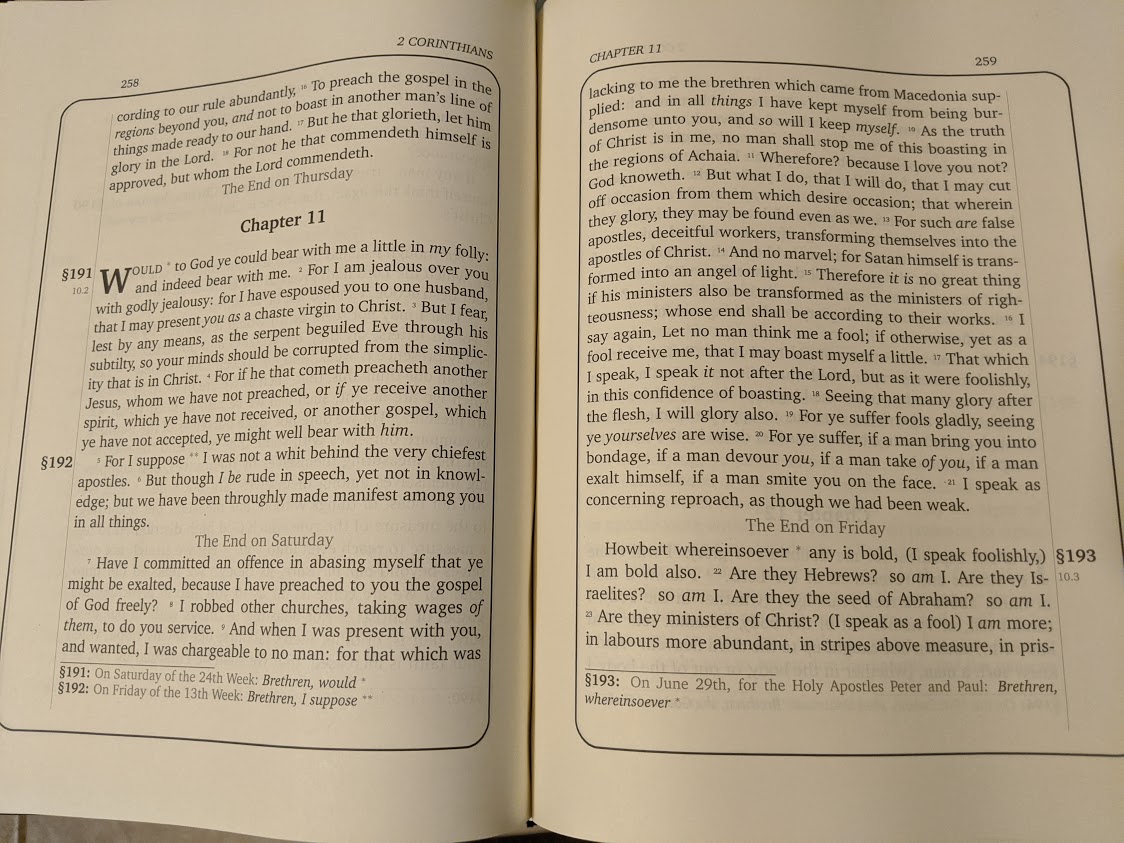
Deacon Peter Gardner has previously published a Gospel Book, a Prophetologion, and a Lenten Lectionary (which consists of those parts of the Prophetologion used during Lent and Holy Week). But he has now added to these useful texts an Epistle Book, which is according to the King James Version, with only some amendments to make it conform to the Slavonic Apostol (and these are minor, and few and far between). The text also contains translations of the introductions to each book. The translation used for the prokimena and alleluia verses is the Psalter According to the Seventy, commonly known as the "Boston Psalter," and since is the most commonly used translation of the Psalter in ROCOR and to some extent in other jurisdictions as well, this makes this text especially useful for those in such parishes. The text is also well bound, and seems sturdy enough to last, and the size is just about perfect, and the size of the font is as well. A lot of work went into putting it together, and the more I have looked it over, the more I have liked it.
The text would be improved, in my opinion, with some minor editing of the KJV text to eliminate words or phrases that are particularly obscure. The margins are wide enough, however, that one can make margin notes so that a reader will make whatever amendments are considered necessary -- which is what I am in the process of doing with my copy.
It is available for $70.00. It was originally available in a black and white text, or color, but now it is available in color only (red rubrics), which makes the text much easier to use, and pleasant to the eye. It comes with a dust cover, but the text itself is in a simple dark blue cover, with the words "Epistle Book" printed on the spine. If one could find a nice metallic cover that fits this edition, this would also be a nice touch.
In my parish, we have been using an earlier version of the St. Tikhon Apostol, and I have had to regularly print out a sheet for each Liturgy, so that the reader would read the prokimena and alleluia verses in the translation we use. This edition makes that unnecessary, and so this makes a great addition to the options that are available for English speaking Orthodox Christians -- especially for those who love the traditional form of Liturgical English in our services.
I would also recommend anyone who is interested in doing Reader Services, even if occasionally, that they get a copy of the Prophetologion, Gospel, and Epistle Book by Fr. Peter Gardner. There is really nothing else available right now that is comparable.
Update: You can see a list of suggested changes I would make to the text here:
You can do this by hand, by underling the text that needs to be amended, and writing the amended word text in the margin. If you use correction tape to white out the border before you write, this gives you more room. In some cases, it may be easier to white out the text that needs to be changed, and to write the correction over it, you just need to do so legibly, and keep the space you have in mind.
The first question to ask before you get a Bible is what translation you should use. For an article on that question, see An Orthodox Look at English Translations of the Bible. But if you want to get a copy of the King James Version, you have a lot of options. There are several factors to consider when you are considering which edition to buy: 1. the text itself (font size, paragraphing, etc), 2. the notes, 3. the appendices, 4. the binding, and 5. the cost. There are more options out there than would be practical to cover in one article, so I am going to focus on the options I would most recommend.
1. Cambridge New Paragraph Bible with the Apocrypha
The all around best text of the KJV, despite the font size (in my opinion), is the Cambridge New Paragraph Bible with the Apocrypha. This is one of only two edition of the KJV that include the deuterocanonical books that is currently in print. It uses modern spelling, punctuation and paragraphing, it has the original KJV margin notes, but no cross references. It is also only available in black text (i.e., no red letter editions).
You can get it in a hard back version (for about $38); or you can get in a nice calfskin cover (for about $118). The shortcoming of this text is that it is printed in an 8.5 point font. You can still get the text in a 10 point font in calfskin if you contact Cambridge directly, but this is the original edition which had a few fairly minor typos that were corrected in the current edition. If you are interested in that text, click here for details. These editions have no appendices, maps, or a concordance, but it does have the full dedicatory epistle to King James, as well as the introduction of the translators to the readers (which was included in the original editions of the KJV, but which is normally omitted in most editions currently available). This edition is, I believe, especially useful when you are teaching your children to read, because the spelling, punctuation, and the layout of the text will not throw them (see How to teach your children to read and understand the King James Version of the Bible).
A review of the hardback edition of the Cambridge New Paragraph Bible
An edition that is somewhat similar, but which does not include the deuterocanonical books, or have the revised spelling or punctuation, but which is laid out in modern paragraph format, is the Cambridge Clarion KJV. It is in an 8.75 point font, and has a "Readers Companion", which has a number of useful features. Click here for a video review.
2. Cambridge Cameo KJV with Apocrypha
If you don't mind 8 point font, the Cambridge Cameo with Apocrypha has the advantage of having the full margin notes and cross references throughout the text, including the deuterocanonical books. It is available in calfskin currently for about $133.00. How long it will be available is unclear, because it is listed as being out of stock on several websites, including Cambridge. This text is the traditional Cambridge KJV text with double columns and center column references.
Review of the Cambridge Cameo KJV with Apocrypha
3. The Cambridge Turquoise
There are a number of other Cambridge editions to consider, but what I like about the Turquoise is that it has the traditional Cambridge KJV text, with the original KJV margin notes, and standard Cambridge Cross references. It has maps and a concordance in the back, and the dedicatory epistle and translators introduction to the reader at the beginning. And what I like best about this particular edition is that it is in 11 point font, which is very easy on the eyes. It does not include the deuterocanonical books, but the margin cross references frequently reference them. You can get either a black text only, or a red letter edition.
You can get this in a top of the line goatskin cover from Cambridge for around $200, or a calfskin for about $140. However, if you want the same text from another source, you can save money by getting it from Church Bible Publishers in a calfskin cover, for $75. Cambridge Bibles are printed on the best paper, and are bound very well, and so the quality from them is a little bit better, but Church Bible Publishers produce very high quality Bibles as well, and because this edition is public domain, it is essentially identical to the Cambridge edition between the covers, and is about half the price. Church Bible Publishers is a non-profit ministry, and so they sell their Bibles at close to the actual costs of production.
A review of the Cambridge Turquoise Reference Bible
This review compares the Cambridge Turquoise and the Church Bible Publishers Turquoise
The Westminster Reference Bible is produced by the Trinitarian Bible Society, which like Church Bible Publishers, is a non-profit ministry. This edition is a fairly recent computer setting, and so the font is very crisp and clear. You can get it in a large print 11.8 point font (which is what I would recommend), in a mid-size 9.6 point font, or a compact 7.3 point font. The large print text comes in a proportionately large size Bible, but personally I like it -- though some people do find in a bit unwieldy. If you don't mind the smaller size fonts, the other editions are closer to typical bibles in size. This edition has the original KJV margin notes, and the most extensive cross references of any edition of the KJV. It also provides definitions in the margins of any obscure words, or words that have change in meaning since the KJV was translated. It has 4 columns per page, and so the reference columns are specific to a text column, and so it is easy to see which references go with which text. It does not include the deuterocanonical books, and there is no red letter option, but it does have color maps. You can get the large print edition in a calfskin cover for about $81.00.The mid-size is very manageable, and readable, it sells in the calfskin cover for about $70.00. You can also get it in large print hardback for about $27; and the mid-size hardback for $20. The mid-size edition has a concordance, but the larger and smaller sizes do not. This Bible also has an introduction which explains how the column references work (which most bibles do not), and each chapter has a chapter summary at the beginning, as did the original King James version. Aside from the fact that it does not have the deuterocanonical books, this edition has a lot to recommend it, and because it defines obscure words in the margins, even people who are not used to the KJV text could start reading this text and do so without a great deal of difficulty.
Review of the Large Print Westminster KJV
5. The Thomas Nelson Premier KJV
If you want a goatskin Bible, but you don't want to pay $200 to get one, this is a great option. It does not have the deuterocanonical books, the original KJV margin notes, or the translator's introduction to the reader, but it is in a new comfort print typeface, and in 12 point font, which is very easy on the eyes. It has a good concordance. It also defines obscure words and phrases in the margin notes... and does so a bit more thoroughly than the Westminster does, though I often find the margin notes explain words and phrases that are not really obscure to me; however, this is also a text that even someone unfamiliar with the KJV could begin reading without difficulty, as a result. The quality of the binding is amazing, and it feels very good in the hand when you read it. You can get it from Christian Book Distributors for $85.49, which is amazingly cheap, given the quality of the text and binding. Because they use red ink for verse numbers, and book titles, there is no version of this with the words of Christ in red.
8. Deuterocanonical Texts
One solution to the problem of KJV editions that lack them is to buy a copy of "The Rest of the Old Testament," By Deacon Peter Gardner, as a supplementary text. This text cost is 45.00 in hardback, $14.95 for the paperback edition.
Imprinting
If you are interested in getting a Bible imprinted with a name, either for yourself or as a gift, Church Bible Publishers, Christian Book Distributors, and EvangelicalBible.com all offer that as an option. I think this is especially a good idea for parents when giving a good quality Bible to their children when they reach young adulthood. It is something they will keep for the rest of their lives, and if you teach them well, they will use it too.
I am sure that there is not just one reason that accounts for this entirely. I would imagine that some stick to the KJV because it is more deeply rooted in the culture, and their religious tradition. However, I think a good part of the reason for this is beauty. The KJV is simply a far more beautiful translation than any other. There is not even a close contender on that front.
Personally, I have been making a point of doing some of my personal Scripture reading out of the Orthodox Study Bible, because I want to be more familiar with its Old Testament translation. The Orthodox Study Bible uses contemporary English -- but it does preserve some of the cadence of the KJV, because it's Old Testament text used the New King James Version (NKJV) as its starting point, and in the New Testament, it is identical to the NKJV. However, despite the fact that it is one of the better examples of a contemporary English translation, reading that text compared to reading the King James is a bit like the difference between eating a hot dog and eating a good steak. A hot dog is better than nothing, and can even be enjoyable on some level, but when given a choice, most people will go with a steak. I make a point of reading the Orthodox Study Bible first each day, simply because I have found doing the least pleasant tasks first, and holding back on the more pleasant tasks, as a reward, is the best way to get them all done. I thoroughly enjoy reading the KJV, and look forward to it very much. And often, I will read it outside of my normal reading plan, later in the day, just because it is a joy to do so. And compared with the NIV, the Orthodox Study Bible is the Sistine Chapel.
People often buy other translations, because they are not used to reading the KJV and they have been convinced that it is too hard to read, but while reading a text like the NIV may be easier on the front end, it has all the beauty of reading a car repair manual, and about as much in it that resonates in the soul or inspires the reader. I think this explains why so many people buy that text, but so few people, comparatively, actually read it with any regularity.
I still have a copy of the NIV that I acquired not long after that translation was first published. And I did read it for a few years, but I have not even cracked it open in close to two decades. On the other hand, I have a copy of the KJV that my mother gave me a year or two earlier (identical to the one pictured above), and I still use it.
John Fotopoulos and Aristotle Papanikolaou, in their recent article "Women and the Creed: Who For Us Humans and for Our Salvation," (published by "Public Orthodoxy") have expressed their unhappiness that the Greek Archdiocese has decided to use a translation of the Creed that is in line with pretty much every other translation that English speaking Orthodox Christians have been using for as long as we have had Orthodox Christians speaking English. They are offended by the use of the word "man". Here is the line of the Creed in question,as it is usually translated:
"Who for us men and for our salvation came down from the heavens, and was incarnate of the Holy Spirit and the Virgin Mary, and became man..."
And here is their suggested "improvement" to that translation:
"Who for us humans and for our salvation came down from heaven and was incarnate of the Holy Spirit and the Virgin Mary and became human..."
Aside from the fact that this sounds like a translation done by a Federation Starship's computer, it is simply ugly and unnecessary. It has long been said that the Greek Archdiocese has intentionally used the worst English translations possible, in hopes that people will just forget the whole thing, and keep using Greek. In this case, they are moving in the right direction. The folks at Public Orthodoxy, however, would have them opt for an even more ugly translation then they had previously ("Who for us and for our salvation...").
Their argument, in a nutshell, is as follows:
"...“men” is not the most accurate translation for the word ἀνθρώπους in contemporary English. Rather, translating ἀνθρώπους as “men” can be viewed, at best, as an expression of outdated English usage and, at worst, as an expression of gender exclusive English translation. There is no good reason to use outdated English in a new translation of the Creed or to use a gender exclusive English term when ἀνθρώπους is meant to be inclusive. The word ἄνθρωπος is the generic term for a human being in ancient Greek, while there are other terms for “man” and “woman.”
It is certainly true that "anthropos" is not a gender specific word in Greek, but "man" is also not a gender specific word in English -- it can be, as the usage has developed, but we still use it in its non-gender specific sense... all of the time.
The PO folks may not have noticed, but the offending word "man" is also found in the word "woman". That is because a woman is a particular variety of man. The word woman comes from the Old English 'wīfman" -- "a wife man." Males use to be referred to as "werman" (a male man) but gradually the first syllable dropped out of common use. So should we opt for "wo-person" over "woman"?
A friend of mine told me about an English professor he had in college (who was a woman) who insisted on using traditional words like "man" in the generic sense, and she had a young female student who objected. The professor responded: "If you were at the beach, and you were told that there was a man-eating shark in the water, would you go swimming? Because if you wouldn't, you're a hypocrite, because you understand full well that "man" refers generically to all human beings."
If someone accidentally killed a woman, and was charged with manslaughter, I doubt a defense that hinged on manslaughter laws applying only to male victims would go very far.
The word "man" goes very deep into the history of Indo-European languages. We find a form of it in Sanskrit: "manu", which has the same meaning. To purge English of the generic use of "man" you would have to deface a good bit more of the language than just that word "man" itself. Even the word "human" has the offending "man" root word. So should we opt for "hu-person"? Or perhaps we should just go with "hu", since the last three letters in "person" might offend those who want to neuter the language. While this might expand the possibilities for future versions of the old "Who's on first?" routine, it is all just silly, and nonsensical.
The translation proposed by PO is certainly defensible in terms of accuracy, but it is indefensible in terms of the aesthetics of the English language. The reason why the King James Version has stood the test of time, whereas no other modern translation has approached its beauty is because the translators of the KJV were not just accomplished biblical scholars, well versed in the pertinent languages they were translating from -- they also were well versed in the language they were translating the Bible into. They had a sense of the English language that few scholars today have -- and clearly John Fotopoulos and Aristotle Papanikolaou are not among those few, regardless of how well they no doubt grasp the original Greek.
If we followed their proposal here consistently, we would have to make the following changes to our translations of Scripture:
Instead of Pontius Pilate referring to the blooded and beaten Christ with the words "Behold the man!" (John 19:5) we would have him say "Behold the human!"
Instead of Christ saying: "The foxes have holes, and the birds of the air have nests; but the Son of man hath no where to lay his head" (Matthew 8:20), we would have him say "the Son of Human," or more loosely "The human being has no where to lay his head."
And instead of putting off the "old man" at baptism, and putting on the "new man" (Colossians 3:8-10), we would put off the "old human" and put on the "new human."
None of these steps would be an improvement to accuracy, and they certainly would not add to the beauty and majesty of the services in which they were read.
On the broader question of neutering the English language -- there are two major languages that have no gender distinctions at all, and so the two cultures associated with these languages should have been feminist utopias, if gender neutrality was the key to such a thing. The two languages I refer to are Turkish and Chinese. However, I think one could easily defend the argument that women in European cultures have been treated significantly better in the past two thousand years, despite them having to suffer the indignities of being forced to use languages that make gender distinctions. In fact, I think one would be hard pressed to find two literate cultures in which woman have historically been treated worse than that of the Turks and the Chinese -- and I say that as one who otherwise loves Chinese culture, but the way women were (and to a large extent, still are) treated is not the high point of Chinese civilization.
To this day, Chinese girls are often killed at birth, or aborted selectively before birth, because of a very low view of the value of women. When I was in college, I once worked in a Chinese restaurant, and one day I was asked about my family by an elderly Chinese woman who worked there. When I told her that I had four brothers, she said "Your momma have five boy? Oh, she very lucky!" But my mother had five boys because she wouldn't give up trying to have a girl, until having five boys had sufficiently worn her down. One woman came from a culture with perfect gender neutrality in their language, and the other didn't. Feminists somehow think that the culture with gender distinctions is the one that needs to be fixed. Go figure.
Update:
Giacomo Sanfilippo made a comment worth passing on in response to the article at Public Orthodoxy on Facebook: "To say that ἄνθρωπος is un-gendered strikes me as a bit simplistic, and requires nuance. Gen 2 (LXX) uses ἄνθρωπος interchangeably/synonymously with Adam, going so far as to say the ἄνθρωπος (not ἀνήρ) leaves father and mother to cling to his wife."
Christ Himself also quotes this passage (Genesis 2:24) in the Gospels (Matthew 19:5), and the Greek text uses "anthropos" to refer to a male who leaves father and mother and is joined to his wife.
Furthermore, in Matthew 10:35, Christ says: "For I am come to set a man [anthropos] at variance against his father, and the daughter against her mother, and the daughter in law against her mother in law."
James Latimir provides yet another example: "Consider 1 Esdras 9:40, where anthropos is used in clear opposition to gyne, as in, ‘men and women.’ (Jerome even translates anthropos in this case as vir!) That would make no sense if anthropos meant genderless ‘human’ (‘humans and women’: Public Orthodoxy are the real bigots! 😂), rather than inclusively masculine ‘man.’"
So clearly anthropos can be used to refer specifically to a male, just as the English word "man" can.
Before getting into the question of how you can teach your children to read and understand the King James Version, we should probably first discuss why you should want to do so.
If you are an English speaker, even if you are an atheist you should want your child to be familiar with the great works in the history of the English Language, and the King James Version is certainly close to the top of the list, if not at the very top.
Even some of the greatest skeptics were of this opinion:
“It is the most beautiful of all translations of the Bible; indeed it is probably the most beautiful piece of writing in all the literature of the world.” -H. L. Mencken
“The translation was extraordinarily well done because to the translators what they were translating was not merely a curious collection of ancient books written by different authors in different stages of culture, but the Word of God divinely revealed through His chosen and expressly inspired scribes. In this conviction they carried out their work with boundless reverence and care and achieved a beautifully artistic result.” –George Bernard Shaw
"It is written in the noblest and purest English, and abounds in exquisite beauties of mere literary form." -Aldous Huxley
The influence of the King James Version on the English language has been huge, and there aren't many other texts that would be comparable in that regard.
For many centuries, even poorly educated people read and understood the King James Bible, because they made the effort to do so. For the most part, the King James Version is perfectly understandable for a modern reader. There are perhaps a hundred words or so that one would have to acquaint themselves with, if they were not already familiar with them. All of these words are found in a standard dictionary, and the intended meaning of the word in question will usually be listed as the primary or secondary meaning. There are also some handy guides online and in print that provide quick definitions with these words. And you could always look up a difficult text in the New King James Version, for clarification.
How?
First off, you have to teach them how to read, and teach them to love reading.
My wife and I home schooled our children, and the single best text we used was a book entitled "Teach Your Child to Read in 100 Easy Lessons," by Siegfried Engelmann. It provides a parent with simple and clear instructions as to how to use the text, and it effectively teaches a child how to read phonetically, and also how to understand the many quirks we have in English spelling (something that is often not taught in public schools in our times). Most importantly, it works. I started teaching both of my children how to read with this text when they were three, and had them reading on a basic level within a few months.
The first books I had my children read were in a series of Bible story booklets from Concordia Press that are designed for beginning readers -- the closest thing that they have to what we used in print now is in a series called "Hear Me Read."
You should regularly read to your children. For very young children, I found reading them stories that rhymed got their attention, and so I read them rhyming Bible stories. Concordia Press has a large collection of short Bible stories that rhyme -- many of which I remember from my own childhood.
As they got a bit older, I read them a comic book collection of Bible Stories (The Picture Bible), and as their reading improved, they would read it on their own. This gave them an overall understanding of the Bible in broad strokes, and helped to improve their own reading.
In addition to reading books directly connected to the Bible, reading other classic texts to your children helps to develop a love for reading.
We did not have our children read much of Shakespeare, because Shakespeare's plays were not meant to be read -- they were meant to be watched. We had them watch all of his major plays -- some in multiple versions, and they enjoyed them. And this helped to familiarize them with Elizabethan English, and in a way that was not at all tedious.
Finally, when their reading level got to the point that they could begin to do it, I had them read the Bible to me. This helped their reading and pronunciation, and it also gave me a chance to explain any words that were obscure, and to discuss the meaning of the text. We started with Genesis, and stuck to the narrative portions of the Law and the Historical books. We eventually brought in the Wisdom books, the prophets, and also the Gospels and Epistles.
A very important help to this whole process was to get an edition of the King James that had modern spelling, punctuation, and paragraphing -- and to have the same edition in everyone's hand, so we were literally all on the same page. At the time, we used the Third Millennium Bible, but what I would recommend now is using the Cambridge New Paragraph Bible with the "Apocrypha". This edition is laid out in a way that is much easier for contemporary readers, and the more I use it myself, the more I have come to like it.
One other thing I did was to have my children memorize the names and order of the books of the Bible, and then we would do something which I learned from Sunday School as a child -- "Sword drills". When we finished reading the Bible, I would call out random Scripture references, and we would see which child could find it first. This taught them how to navigate their way around the Bible.
One doesn't usually look to Orthodox Jewish sources for guidance on the kind of English that is best suited for worship, but years ago I stumbled across some very telling comments in the preface to the book "To Pray as a Jew," by Rabbi Hayim Halevy Donin. Commenting on his translations of the prayers his book would discuss, he says:
"I have decided to retain the use of "Thou," "Thee," and "Thy" in all passages that address themselves directly to God. The more contemporary "You" and "Your," which I had at first considered using, made me uncomfortable in some instances, although I find it difficult to explain why this should be so. The Hebrew atah (and the Yiddish du) reflect the familiar and the intimate approach to God with which I am comfortable. Still, English seems to demand, at least in some places, the more reverent "Thou" and "Thy." (To Pray as a Jew: A Guide to the Prayer book and the Synagogue Service, (New York: Basic Books [Harper Collins], 1980), p. xx.).
I would argue that Rabbi Donin was right in his gut, but wrong in his explanation. It makes no sense to limit the use of "Thee" and "Thou" to God, and so he correctly senses the inconsistency of his translation choices here. He is also incorrect in his assumption that these forms are not the "intimate you" he sees in Hebrew and Yiddish. In fact, "Thou" is simply the English form of the German "Du", which is where the Yiddish pronoun comes from (English being, after all, a Germanic language).* He is correct, however, that in English there is a need to use more traditional language when praying because we sense that the sacredness of the act requires a more reverent form of the language. Traditional English also has the added advantage of being more precise, because it allows for a distinction between the second-person singular pronoun ("thou"), and the plural ("you"), which is present in both Hebrew and Greek, and often this distinction is very important to the meaning of a text. Aside from all of that, praying "O You Who..." just doesn't work.
From time to time we hear some in the Orthodox Church arguing that English-speaking Orthodox Christians should abandon the use of "King James English" and simply use contemporary English in our translations of the Scriptures and the services. This is, however, a fairly recent phenomenon. From the time that the first modern English-speaking Orthodox Christians began translating the services (the earliest known example being in 1760), up until the 1960's, it never seems to have even occurred to anyone that they should translate the services into anything other than the traditional style of English that we find in the King James Version, and the pre-1980's editions of the Book of Common Prayer.
Even non-native English speakers followed this pattern. Nicholas Orloff, who translated a number of texts at the end of the 19th century did so, though these texts are notoriously clunky, and no longer in common use. Likewise Fr. Seraphim Nassar, published a compendium of liturgical texts in 1938 (affectionately known as the "Nassar Five Pounder") that used traditional English, and this text is still in use today, In 1906, Isabel Hapgood first published her Service Book, which was blessed by the Hieromartyr Tikhon of Moscow, and funded by the Tsar-Martyr Nicholas II (who spoke English in the home with the Tsarina Alexandra (who was raised by Queen Victoria), and their children). She was an Anglican, and she clearly modeled her translation on the style of the Book of Common Prayer. This text is likewise still in use today, and was highly influential on subsequent translations of the services. More recently, the Lenten Triodion translated by Metropolitan Kallistos (Ware) and Mother Mary is probably one of the most standard English texts in use in the Orthodox Church today, being in use in the vast majority of parishes that use English. The fact is, one cannot find a complete set of service books in English that are not in traditional English, and the obvious reason for this is because this how the English speaking Orthodox Christians generally think it ought to be, and this has been true for more than 250 years.
But some might object that this is just due to Protestant influence. The fact that this is not true is shown by the oldest Catholic translation of the Bible in English, the Douay Rheims Bible, as well as the text of the "Hail Mary" that is still in general use:
"Hail Mary, full of grace. The Lord is with thee. Blessed art thou amongst women, and blessed is the fruit of thy womb, Jesus. Holy Mary, Mother of God, pray for us sinners, now and at the hour of our death. Amen."
The Orthodox approach to translation has generally been a conservative one. Slavonic was never the street language of Slavic speakers. It was a high form of Slavic language, with a huge amount of created terms, using Slavic root words, and putting them together in the same way Greek theological terms were constructed. The end result was a highly elevated language which was within reach of Slavic speaking people, but was not the language of the street.
When the services were translated into Chinese and Japanese, for example, the style used was that which was used in traditional Chinese and Japanese religious practice... which was an older form of these languages.
Furthermore, contrary to popular belief, the Greek of the New Testament was not really "street Greek." It is certainly in a form of Koine Greek, but it is in a Semitic style that it full of Hebraisms rooted in the Old Testament, both the Hebrew original, and the Greek Septuagint (which likewise is full of Hebraisms, see The Semitic Style of the New Testament, and Was the Bible Written in ‘Street Language’?, by Michael D. Marlowe). Furthermore, even in the Hebrew Old Testament, you find the use of intentional archaisms, not to mention the fact that Jews continued to use the Hebrew text of the Old Testament long after Hebrew ceased to be the spoken language of the people (and in fact, they continue to use it to this day).
The Orthodox Church has always taken the position that the language used in our services and translations of Scripture should be within reach of the people (which is why Christians did not just continue to use the Hebrew Old Testament, and why we have always had so many different liturgical languages in use), but the Church has not felt the need to use the language of the street, or to regularly update our translations.
This does not mean that we should never update our translations. While I would argue that when it come to the text of Scripture we should begin with the text of the King James version, I would not argue that there is no need to correct the KJV or to update it when changes to English have rendered a particular text very difficult for the average person to properly understand. One does have to learn some vocabulary and get use to some older grammatical forms, but for the most part, these are not difficult.
Traditional English is also not a dead language. It is simply a form of English used in worship and in other solemn contexts. People use this language every day in prayer, and they do so naturally. Even among those who pray extemporaneously, they are able to pray in this manner without any difficulty, nor is what they say difficult to comprehend. For an example, I would refer people to one of the many extemporaneous prayers Billy Graham gave at his evangelistic rallies: https://youtu.be/ei_eIL08vbs?t=733
I think we should take to heart the comments of Metropolitan Athanasios of Limassol, Cyprus to Dr. Kyriakos Markides:
“We must avoid addressing ourselves to God in a superficial casual way. For this reason Elder Sophrony goes so far as to say that the language we use in prayer must be different from the ordinary language of everyday usage. That is why he insisted that the language of the liturgy should not be translated into the contemporary spoken vernacular.”
“A lot of people today would strongly object to that suggestion,” I pointed out. “They demand that church services be conducted in the spoken ordinary language so that they can understand what is being said. Why did Elder Sophrony hold to such a position?”
“Elder Sophrony claimed that when we conduct the liturgy using everyday language, we lower the level of our communication with God.”
“How is that so?” I asked.
“He believed that ordinary language carries meanings and images from our daily reality that usually lack the element of holiness and purity. On the other hand, when we address ourselves to God in a language that has, as it were, an exclusive usage within the boundaries of the Ecclesia, the very words and sounds of that language evoke sacred feelings and images that facilitate communication with God. A special language that offers precise and exclusive meanings can automatically be experienced as the language of the Ecclesia. It carries greater spiritual force” (Markides, Kyriakos C., Gifts of the Desert: The Forgotten Path of Christian Spirituality, Random House-Doubleday, NY, 2005, quoted by Nun Nectaria (McLees), in an interview with the journal "Road to Emmaus').
*It is interesting to note that when the Austrian-Jewish philosopher Martin Buber's book Ich und Du was translated into English, the title was translated as "I and Thou", rather than "I and You."
Update: I received an interesting comment from Jason Rogers: "In linguistics, using different forms of a language in certain contexts is referred to as "registers" and they exist *almost* in every language. Religious registers are very common, if not the most common, kind of register. so in a sense, humans are predisposed - or "hardwired" - to use religious registers and I think this, in part, explains why older, elevated styles of language are important to us."
Update 2: For those who say that King James English is too hard to understand, my wife's first 3 languages are not English, and she did not live in an English speaking country until she was 16. She did not grow up hearing King James English. However, she has been hearing it for many years since in Church, and today (8/10/2017) I sent her a Chinese Orthodox text that was in classical Chinese, and asked her what it said. she translated three hymns into English... and into King James English to boot, and she translated all the verbs and pronouns into their proper grammatical forms.
It has been many years since the hardback edition of the Holoviak King James Version Gospel was available for sale, apart from being purchased along with a somewhat expense metal cover. A few years there was a Byzantine Lectionary based on the KJV available in hardback, but now that edition is only available in a softcover. Now, at long last, Reader Peter Gardner has come to the rescue.
This edition is available in two sizes: a smaller edition for $45.00 (6"x 9", with 12-point font); and a larger edition for $50.00 (8.25"x 10.75", with 14-point font), and it actually has several elements that are not in the older Holoviak edition. Based on the contents of the standard Slavonic Gospel, it contains a brief life of the four Evangelists, an extensive appendix of the Gospel readings (more extensive than is found in the Holoviak version), and the rubrics for how the Gospel readings are done throughout the year, including the "Lukan Jump." The cover is as seen in the photo above (this is the actual hardcover, not a dust jacket). For a small mission or home, it is usable as it is. The text is in standard sizes, and so could also be put into a nicer Gospel cover.
There are a few things that would improve future editions of the text. The King James text of the Gospels is remarkably easy to read, even after 400 years of changes to the English language, and so there are not a lot of obscure archaisms that are a factor, but because the King James text was done by different teams, there are some inconsistencies in the original King James, and one of them is that in the Old Testaments, the names of people and places were based on transliterations of the Hebrew (e.g., "Elijah," "Elisha," "Jeremiah"), whereas in the New Testament, the names of those same Old Testament figures are found in forms based on the Greek text, or older English usage ("Elias," "Eliseus," "Jeremy"). Also, even within the Gospels there was some inconsistency in the use of "Holy Ghost" and "Holy Spirit." The Holoviak Gospel made the decision to use the most standard form of the names of Old Testament figures in its Gospel. It also generally replaced "Holy Ghost" with "Holy Spirit", though there are some places in which it failed to do that consistently. In my opinion, these were both good decisions. In the case of the names of Old Testament figures, to the extent that Biblical literate people know anything about these figures when they are mentioned in the Gospels, they know them by the more standard form of their names in the Old Testament, where their stories are found. While "Holy Ghost" was once commonly used in English, that usage has become increasingly rare, and I think we might as well have some consistency with the form we normally use in our private prayers, and in our public services. One other thing that would improve the text would be to use red ink for the rubrics. This would of course make the text more expensive, but perhaps, since the text is a print on demand edition, a more expensive edition could be made available as an option.
Reader Peter Gardner also has plans to publish an Apostol that will likewise be based on the King James Version. In the case of the Apostol, my recommendation would be to do a little more revision of the King James text to eliminate some of the more obscure passages, because unlike the text of the Gospels, some of these readings can be very difficult for the average English speaker to understand.
This text fills an important need for English speakers, in many respects it is the first full edition of the Slavonic Gospel in English, it is sturdily bound, and very affordable. I highly recommend it.
In 1911 the English-speaking world paused to mark the 300th anniversary of the King James Version (KJV) of the Bible, with American political leaders foremost in the chorus of exaltation. To former president Theodore Roosevelt, this Bible translation was "the Magna Carta of the poor and the oppressed . . . the most democratic book in the world." Soon-to-be president Woodrow Wilson said much the same thing: "The Bible (with its individual value of the human soul) is undoubtedly the book that has made democracy and been the source of all progress."
Americans at the time mostly agreed with these sentiments, because the impact of the KJV was everywhere so obvious. It was obvious for business, with major firms like Harper & Brothers having risen to prominence on the back of its Bible publishing. It was obvious in the physical landscape and in many households because of the widespread use of Bible names for American places (95 variations on Salem) and the nation's children (John, James, Sarah, Rebecca). It was obvious in literature, as with the memorable opening of Herman Melville's Moby Dick: "Call me Ishmael." And it was obvious in politics, with no occasion more memorable than March 4, 1865, when four quotations from the KJV framed Abraham Lincoln's incomparable Second Inaugural Address: Genesis 3:19 ("wringing their bread from the sweat of other men's faces"); Matthew 18:7 ("woe unto the world because of offences!"); Matthew 7:1 ("judge not that we be not judged"); and Psalm 19:9 ("the judgments of the Lord are true and righteous altogether").
Because the KJV was so widely read for religious purposes, it had also become a source of public ideals. Because it was so central in the churches, and because the churches were so central to the culture, the KJV functioned also as a common reservoir for the language. Hundreds of phrases (clear as crystal, powers that be, root of the matter, a perfect Babel, two-edged sword) and thousands of words (arguments, city, conflict, humanity, legacy, network, voiceless, zeal) were in the common speech because they had first been in this translation. Or to be more precise, because they had been in the KJV or in the earlier translations, like those of John Wycliffe's followers (1390s) and William Tyndale (1520s), that King James' translators mined for their own version.
But during the past half-century, we have come into a new situation. For believers who read the Bible because they think it is true, a welter of modern translations compete for the space once dominated by the KJV. For the public at large, the linguistic and narrative place that for more than two centuries had been occupied by the KJV is now substantially filled by the omnipresent electronic media. The domains that have been most successfully popularized by television, the movies and the Internet are sport, crime, pornography, politics, warfare, medicine and the media itself. Within these domains there is minimal place for biblical themes of any sort, much less the ancient language of the KJV.
For some purposes, it is well that the KJV has lost its hold. Roman Catholics and Jews were once victims of coercive discrimination when they were forced to recite this Protestant translation of the Bible in the nation's public schools. And at many moments, like the Civil War, free use of this one version made it all too easy to transgress the boundary between the proper business of the churches and the proper business of the public sphere.
Yet if the KJV was sometimes abused, nearly universal use also meant that its spiritual themes of reproof and liberation, its stories of human sin and divine grace, also exerted a great influence for good. In the 1890s Elizabeth Cady Stanton and other aggrieved feminists published "The Woman's Bible" in an effort to counter interpretations of Scripture that had done women harm. When they asked others to comment, Frances Willard of the Women's Christian Temperance Union made a telling response: "No such woman, as Mrs. Elizabeth Cady Stanton, with her heart aflame against all forms of injustice and of cruelty . . . has ever been produced in a country where the Bible was not incorporated into the thoughts and the affections of the people and had not been so during many generations."
It was the KJV that Willard meant as the Bible "incorporated" in American consciousness "during many generations." Today the legacy of the KJV remains fixed in the common speech, even if awareness of the language's debt to this translation is fading (another KJV word). Whether any modern translation of the Scriptures, or any other moral guide, can anchor the culture as the KJV once did, is a question worth serious consideration in the run-up to 2011 and the 400th anniversary of this unsurpassed cultural force.
Mr. Noll, professor of history at the University of Notre Dame, recently lectured on "The King James Version in American History" at the Library of Congress.