Fr. Deacon Michael Hyatt, who was recently elected CEO of Thomas Nelson Publishers, the largest Christian publisher in the world, was recently featured on the Internet/Radio broadcast of "Come Receive The Light". You can hear that show by clicking here. Thomas Nelson is the publisher of the New King James Version, which is the best contemporary English translation of the Bible (which is based on the traditional Received (aka Byzantine, aka Majority) Greek Text of the New Testament. The Orthodox consider the Septuagint Greek text of the Old Testament to be the more reliable than the Masoretic Hebrew Text, and to date there has only been a somewhat awkward translation into English of the full Septuagint text. However, Thomas Nelson, which has already published the New Testament Orthodox Study Bible, is going to publish a complete Bible that will use the New King James New Testament text, and a new translation of the Septuagint, that will follow the style of the New King James. Previous press releases had indicated it would be out this year, but Fr. Michael Hyatt answered the question of when this text would be out as follows:
"...we're probably still about a year and a half away.. we've got the full manuscript in house now, thank God, but now it begins its scholarly review...."
In many ways this is good news, because that means this will not be a half baked job, but will be something of the highest quality. I am looking forward to seeing the final product.
Thursday, October 13, 2005
Sunday, October 02, 2005
Arnold Winkelried

Monument to Winkelried at the site of the Battle of Sempach. The inscription reads: "Here Winkelried made a path for his comrades 1386"
Christ taught "Greater love hath no man than this, that a man lay down his life for his friends" (John 15:13).
We see this vividly illustrated in the life of the Swiss hero, Arnold Winkelried. The Swiss are thought of a peaceful people today, and they are famous for remaining neutral and staying out of wars that do not concern them. However, their independence did not come to them so easily. Most people have heard of William Tell, who was a famous Swiss patriot, but here is the story of another man whose death is in many ways an image of the victory of the Cross of Christ:
[The Austrians] were drawn up in a solid compact body, presenting an unbroken line of spears, projecting beyond the wall of gay shields and polished impenetrable armour.
The Swiss were not only few in number, but armour was scarce among them; some had only boards fastened on their arms by way of shields, some had halberts, which had been used by their fathers at the battle of Morgarten, others two-handed swords and battleaxes. They drew themselves up in the form of a wedge and
"The gallant Swiss confederates then
They prayed to God aloud,
And He displayed His rainbow fair,
Against a swarthy cloud."
Then they rushed upon the serried spears, but in vain. "The game was nothing sweet ".
The banner of Lucerne was in the utmost danger, the Landamman was slain, and sixty of his men, and not an Austrian had been wounded. The flanks of the Austrian host began to advance so as to enclose the small peasant force, and involve it in irremediable destruction. A moment of dismay and stillness ensued. Then Arnold von Winkelried of Unterwalden, with an eagle glance saw the only means of saving his country, and, with the decision of a man who dares by dying to do all things, shouted aloud: "I will open a passage."
"'I have a virtuous wife at home,
A wife and infant son:
I leave them to my country's care,
The field shall yet be won!'
He rushed against the Austrian band
In desperate career,
And with his body, breast, and hand,
Bore down each hostile spear;
Four lances splintered on his crest,
Six shivered in his side,
Still on the serried files he pressed,
He broke their ranks and died!"
The very weight of the desperate charge of this self-devoted man opened a breach in the line of spears. In rushed the Swiss wedge, and the weight of the nobles' armour and length of their spears was only encumbering. They began to fall before the Swiss blows, and Duke Leopold was urged to fly. "I had rather die honourably than live with dishonour," he said. He saw his standard bearer struck to the ground, and seizing his banner from his hand, waved it over his head, and threw himself among the thickest of the foe. His corpse was found amid a heap of slain, and no less then 2000 of his companions perished with him, of whom a third are said to have been counts, barons and knights.
"Then lost was banner, spear and shield
At Sempach in the flight;
The cloister vaults at Konigsfeldt
Hold many an Austrian knight."
The Swiss only lost 200; but, as they were spent with the excessive heat of the July sun, they did not pursue their enemies. They gave thanks on the battlefield to the God of victories, and the next day buried the dead, carrying Duke Leopold and twenty-seven of his most illustrious companions to the Abbey of Konigsfeldt, where they buried him in the old tomb of his forefathers, the lords of Aargau, who had been laid there in the good old times, before the house of Hapsburg had grown arrogant with success.
As to the master-singer, he tells us of himself that
"A merry man was he, I wot,
The night he made the lay,
Returning from the bloody spot,
Where God had judged the day."
On every 9th of July subsequently, the people of the country have been wont to assemble on the battlefield, around four stone crosses which mark the spot. A priest from a pulpit in the open air gives a thanksgiving sermon on the victory that ensured the freedom of Switzerland, and another reads the narrative of the battle, and the roll of the brave 200, who, after Winkelried's example, gave their lives in the cause. All this is in the face of the mountains and the lake now lying in summer stillness, and the harvest fields whose crops are secure from marauders, and the congregation then proceed to the small chapel, the walls of which are painted with the deed of Arnold von Winkelried, and the other distinguished achievements of the confederates, and masses are sung for the souls of those who were slain. No wonder that men thus nurtured in the memory of such actions were, even to the fall of the French monarchy, among the most trustworthy soldiery of Europe.
Click here for more information on the battel of Sempach.
Click here to see a painting of Arnold Winkelried's heroic death at the battle of Sempach..


Thursday, September 22, 2005
Everything has a purpose
Fr. Jospeh Huneycutt has just moved to Houston, and talks about the welcome he has received here, here, here, and here.
I went to the local grocery store today, and it was so packed with panic shoppers that there were no shopping carts to be had. I had to empty a box of snickers to buy the things I had come to pick up. It took about 45 minutes to get through the check out line. While waiting in line one unhappy immigrant to Houston said "This makes me sick. I should have never moved here."
These hurricanes can be bothersome, but if it wasn't for the hurricanes, the summer heat, and the bugs, everyone would want to live here, and next thing you know Houston would be taken over by commie libs from the North who would turn it into another San Francisco. So even the yellow rose of Texas has a thorn, but the thorn is only meant to scare the fur-nurs.
:)
I went to the local grocery store today, and it was so packed with panic shoppers that there were no shopping carts to be had. I had to empty a box of snickers to buy the things I had come to pick up. It took about 45 minutes to get through the check out line. While waiting in line one unhappy immigrant to Houston said "This makes me sick. I should have never moved here."
These hurricanes can be bothersome, but if it wasn't for the hurricanes, the summer heat, and the bugs, everyone would want to live here, and next thing you know Houston would be taken over by commie libs from the North who would turn it into another San Francisco. So even the yellow rose of Texas has a thorn, but the thorn is only meant to scare the fur-nurs.
:)
Sunday, September 11, 2005
The Religion of Peace Strikes Again... an update on Taybeh
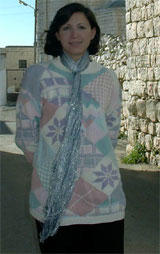
Dr. Maria Khoury
Rage Followed the Forbidden Affair in Taybeh
Maria C. Khoury, Ed. D.
Our Biblical Christian village has co-existed in peace with the surrounding Muslim villages for centuries. Not being able to comprehend the tragic events that took place in our little innocent village of Taybeh, I have been speechless for many days. I literally lost my voice yelling at the fanatics to go away from our doorsteps at the Taybeh Brewery as they were about to torch modern-state of the art equipment that produces the only micro brewed beer in the whole Middle East area named after our village. A violent mob of armed young men took the law in their own hands and come for a revenge attack on our whole extended family since a distant cousin was accused of having an affair with a woman from their village of Deir Ejreer. Over three hundred men aggressively raided the village between 9 p.m. and 1 a.m. on Sept 3rd burning down houses, cars and looting. Taybeh residents evacuated their homes in fear of their lives thus no one was injured.
At the moment, Taybeh Beer, for me stands as a symbol for democracy in Palestine. It was Muslim fanatics that wanted to burn it and Muslim policemen that saved us. It is a challenge for the Palestinian Authority to protect the small Christian community and diverse populations in Palestine if there is to be a democratic two-state solution following the pro-longed years of occupation. By the way, the Israeli army jeep came in the village and the soldiers simply watched the houses burn down without doing anything in their power to stop the rage. Although we were on the phone with the army captain begging for immediate help to stop the violence.
We are overpowered by tribal laws which make it legal in the Islamic religion to kill women in the honor of the family. Thus, the Muslim woman, Hiyam was killed and buried by her brothers without a death certificate after discovered pregnant. The accused man, a Christian, paid the highest price by not only going to jail but knowing that sixteen homes were attacked belonging to his extended family leaving fourteen homes completely burned. Innocent families losing all of their personal belongings, furniture, clothes, family keepsakes that were passed down from generation to generation and beautiful family portraits that reflect the deep roots of this Christian village having a unique character and identity since the time Christ our Lord walked into this village before his crucifixion (John 11:54).
This barbaric and uncivilized behavior could not be stopped by the Israeli Occupying army or by the Palestinian Authority. As American citizens we made numerous phone calls to the American Consulate Emergency services pleading for help to put pressure on the Israelis to allow the Palestinian police to pass the checkpoints and arrive in Taybeh to stop the catastrophe. It took over three hours for the Palestinian police to arrive but with great appreciation to the American Consulate at least our brewery and our home were saved. This was totally unjustified violence that left over 72 people, the majority children, in despair and agony having nothing left except the shirt on their backs.
Furthermore, as a woman believing in human rights, what bothers me the most is that I live in a culture that wants to punish the man who slept with the woman instead of the men who killed the woman? And not only punish one man but in barbaric style punish every family member that is related to him; and we are talking about fifth cousins and sixth cousins; innocent people that have nothing to do and cannot control the sin of an individual. This aggression is something bizarre that has happened in our village and should be condemned by all people who believe in law and order.
I have never had such an experience in my twenty-five years in Palestine. It is my Muslim collogues who call me before my Christian friends to wish me “Merry Christmas.” It is a Muslim mother that picks up my son at midnight when he is stranded in the city. My son’s best friend is a Muslim and I love him like my own son Costa. I cannot make logical sense of what has happened in our village. And we are in such deep need of reconciliation among all groups of people who are just in pure shock.
Christ’s love and peace is more important than ever. Our witness to Christian values and our struggle to exist as a small community is now at the mercy of not only the Israeli Occupying power which is legally responsible for protecting unarmed civilians but also at the hands of the Palestinian Authority who must bring law and order and put an end to tribal laws which are detrimental in this new millennium. Family feuds should be taken to a courtroom not solved in the hands of hundreds of crazy fanatics that are capable of wiping out a whole village with such aggressive violence that leave you speechless.
My husband David Khoury, the new mayor of Taybeh has make an appeal to many religious leaders, both Muslim and Christian and to all authorities including humanitarian organizations to help us have a strong voice as a Christian community and send letters of condemnation to the Israeli and Palestinian Prime Ministers that justice, law and order should prevail. Protection against such aggressive unjustified violence should be guaranteed for all human beings in the Holy Land regardless of religion, race, and gender. The violent aggression against our village should be condemned to help Taybeh maintain its unique character and identity as one of the most ancient places in Palestine and the only 100% Christian village left. We want the Palestinian justice system to prevail and not the tribal traditions that seek blood for forbidden relationships.
Note: Maria Khoury is author of Witness in the Holy Land and the new children’s book, Christina’s True Heroes about seven women saints.
Monday, September 05, 2005
The Religion of Peace Strikes Again... This time it's Taybeh
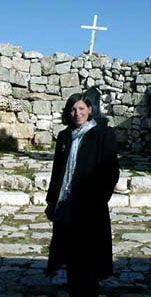
This village that was attacked is the same village that Dr. Maria Khoury has been trying to help. It is the last completely Christian town in the west bank.
Sep. 5, 2005 4:39 | Updated Sep. 5, 2005 6:55
Muslims ransack Christian village
By KHALED ABU TOAMEH
TAIBA
Efforts were under way on Sunday to calm the situation in this Christian village east of Ramallah after an attack by hundreds of Muslim men from nearby villages left many houses and vehicles torched.
The incident began on Saturday night and lasted until early Sunday, when Palestinian Authority security forces interfered to disperse the attackers. Residents said several houses were looted and many families were forced to flee to Ramallah and other Christian villages, although no one was injured.
The attack on the village of 1,500 was triggered by the murder of a Muslim woman from the nearby village of Deir Jarir earlier this week. The 30-year-old woman, according to PA security sources, was apparently murdered by members of her family for having had a romance with a Christian man from Taiba.
"When her family discovered that she had been involved in a forbidden relationship with a Christian, they apparently forced her to drink poison," said one source. "Then they buried her without reporting her death to the relevant authorities."
When the PA security forces decided to launch an investigation into the woman's death, her family protested for fear that the relationship would be exposed. The family was further infuriated by the decision to exhume the body for autopsy.
The attack is one of the worst against Christians in the West Bank in many years. Residents said it took the PA security forces several hours to reach Taiba. Others complained that the IDF, which is in charge of overall security in the area, did not answer their desperate calls for immediate help.
"More than 500 Muslim men, chanting Allahu akbar [God is great], attacked us at night," said a Taiba resident. "They poured kerosene on many buildings and set them on fire. Many of the attackers broke into houses and stole furniture, jewelry and electrical appliances."
With the exception of large numbers of PA policemen, the streets of Taiba were completely deserted on Sunday as the residents remained indoors. Many torched cars littered the streets. At least 16 houses had been gutted by fire and the assailants also destroyed a statue of the Virgin Mary.
"It was like a war, they arrived in groups, and many of them were holding clubs," said another resident.
"Some people saw them carrying weapons. They first attacked houses belonging to the Khoury family [looking for the man who had the affair with the women, not realizing he had already fled the village.] Then they went to their relatives. They entered the houses and destroyed everything there. Then they tried to enter the local beer factory, but were repelled by PA security agents.
The fire engine arrived five hours later."
Col. Tayseer Mansour, commander of the PA police in the Ramallah area, said his men arrived late because of the need to coordinate their movements with the IDF. "The delay resulted in the torching of a number of houses and cars in the village," he said.
Taiba, the only West Bank village that is completely inhabited by Christians, is famous for its Taiba Beer factory, which was established by the Khoury family in 1994.
The residents are Roman Catholic, Greek Orthodox or Greek Catholic. The village was originally called Ephraim, and is thought to be the city to which Jesus came with his disciples before his crucifixion: "Jesus therefore walked no more openly among the Jews; but went thence unto a country near the wilderness, into a city called Ephraim" (John 11:54).
According to some accounts, Salah a-Din, who led the war against the Crusaders, was responsible for the name change. He is said to have found the villagers there to be nice and kind – in Arabic, taybeen – and the name stuck, to become Taiba.
Saturday, September 03, 2005
Katrina, Race, and Simple Answers
For several years, I was an assistant to the manager of a welfare office here in Houston, and one of my primary duties was to handle complaints that had gone beyond the unit level, and the person making the complaint wanted to speak to head honcho. I wasn’t the head honcho, but I was the closest that they usual got to him. One of the things I observed over time was how issues of race entered into these complaints.
Particularly, if the person making the complaint had been interviewed by a case worker of another race, they would often charge that racism had played a role in them not getting the benefits they wanted in the amount or in the time that they believed that they should have… but some times, they would make claims of racism even if the case worker was the same race. In those cases, they would claim there was a larger conspiracy to prevent their race from getting the right amount of benefits or timely service.
Black folks would tell me that if they were white, they would have been treated differently. White folks would tell me if they were black, they would have been treated differently. Hispanic folks would tell me that if they were white or black, they would have been treated differently. I have spoken with many people of other races who also work in government bureaucracies, who have have observed this same phenomenon
I had the advantage of knowing the bureaucracy, the policy, and the people involved, and I know that race had nothing to do with it. Regardless of the race of the people they dealt with, Case workers invariably just wanted to stay on top of their work, get cases finished, and not be cited with an error by a quality control auditor for having worked the case incorrectly. However, there were policies that often prevented people from getting what they wanted… and often those policies did not make sense even to us. There were also staff shortages and work load issues that resulted in people not having their cases completed timely. Race was not the issue, but what I came to conclude was that when things do not make sense, and people feel ill-treated, people look for simple explanations that explain why. And unfortunately race is one of the first things we notice about people that we do not know, and so it is also one of the first things to get blamed whenever we have a negative experience interacting with people of other races.
In less politically correct times, it use to be said that all Chinese people look alike. My wife tells me that Chinese people have said the same thing about white people. In fact, in Vietnam, I recall hearing about an American GI that was convicted of some crime on the basis of the testimony of some Vietnamese civilians. He was later proven to be innocent, but when asked why they identified him as the one who had committed the crime, they said "How can you tell one from another? They all look alike." Of course, if you aren’t use to seeing Asians, their distinctive features are all that you notice. However, if you spend a lot of time around Asians, and get to know them, soon you discover that they don’t all look alike.
Likewise, if a white man were to car jack another white man, the first thing the white man would be thinking was not that all white people were not to be trusted, but rather than some dirty scumbag had stole his car. However, if a black man car jacked him, he would be far more likely to reach conclusions about black people in general. The same is true in reverse.
Prejudice, to some extent, is a survival characteristic that is hard wired in our brains. If we eat pickled herring, and we get sick, we will likely be prejudiced against that kind of fish. That would be less likely to happen, if we had been eating pickled herring all of our life. We would be more likely able to distinguish between the bad experience with that particular pickled herring, and pickled herring in general. If we run across a skunk, and trying to pet it, we will likely be prejudiced against skunks for life. However, as rational human beings, we should be aware of this tendency towards hasty generalizations based on particular experiences, and resist that temptation when it comes to entire groups of people.
Certainly, we should expect that elected representatives would have more sense than to encourage such prejudice.
In Houston, all Houstonians are moved by the suffering they see. Everyone is asking what they can do to help. Millions of dollars were raised on a radio station in the space of a few hours, at the spur of the moment. Whites, Hispanics, Asians, Blacks, and all the various combinations thereof that make up Houston are trying to help all of those who are streaming into our city in need of help. People are opening up their homes to complete strangers.
In New Orleans, rescuers of all stripes are risking their lives to save people of different races. Just as with Americans on the battlefield, people are willing to die to save people that have neither race, nor creed in common with them.
What a shame it is then, to see certain Democrats trying to make political hay by taking the cheap political shots of accusing people of being racists. How completely anti-American this is.
Those who are suffering, are suffering not because they are black, pink, or green, but because of a natural disaster that turned out to be more devastating than was originally thought, and a large bureaucracy has had many inexplicable inefficiencies and simply mishandled many aspects of the disaster… which of course pundits, sitting safely on their butts can analyze and comment on, as if they would have handled it so much better had they been the ones actually trying to organize such a massive effort, in a chaotic situation, made worse by the “Big Easy” "laissez les bon temps rouler [Let the good times roll]" attitude that makes Louisiana both charming, and irritatingly French (and all that goes with being French).
Particularly, if the person making the complaint had been interviewed by a case worker of another race, they would often charge that racism had played a role in them not getting the benefits they wanted in the amount or in the time that they believed that they should have… but some times, they would make claims of racism even if the case worker was the same race. In those cases, they would claim there was a larger conspiracy to prevent their race from getting the right amount of benefits or timely service.
Black folks would tell me that if they were white, they would have been treated differently. White folks would tell me if they were black, they would have been treated differently. Hispanic folks would tell me that if they were white or black, they would have been treated differently. I have spoken with many people of other races who also work in government bureaucracies, who have have observed this same phenomenon
I had the advantage of knowing the bureaucracy, the policy, and the people involved, and I know that race had nothing to do with it. Regardless of the race of the people they dealt with, Case workers invariably just wanted to stay on top of their work, get cases finished, and not be cited with an error by a quality control auditor for having worked the case incorrectly. However, there were policies that often prevented people from getting what they wanted… and often those policies did not make sense even to us. There were also staff shortages and work load issues that resulted in people not having their cases completed timely. Race was not the issue, but what I came to conclude was that when things do not make sense, and people feel ill-treated, people look for simple explanations that explain why. And unfortunately race is one of the first things we notice about people that we do not know, and so it is also one of the first things to get blamed whenever we have a negative experience interacting with people of other races.
In less politically correct times, it use to be said that all Chinese people look alike. My wife tells me that Chinese people have said the same thing about white people. In fact, in Vietnam, I recall hearing about an American GI that was convicted of some crime on the basis of the testimony of some Vietnamese civilians. He was later proven to be innocent, but when asked why they identified him as the one who had committed the crime, they said "How can you tell one from another? They all look alike." Of course, if you aren’t use to seeing Asians, their distinctive features are all that you notice. However, if you spend a lot of time around Asians, and get to know them, soon you discover that they don’t all look alike.
Likewise, if a white man were to car jack another white man, the first thing the white man would be thinking was not that all white people were not to be trusted, but rather than some dirty scumbag had stole his car. However, if a black man car jacked him, he would be far more likely to reach conclusions about black people in general. The same is true in reverse.
Prejudice, to some extent, is a survival characteristic that is hard wired in our brains. If we eat pickled herring, and we get sick, we will likely be prejudiced against that kind of fish. That would be less likely to happen, if we had been eating pickled herring all of our life. We would be more likely able to distinguish between the bad experience with that particular pickled herring, and pickled herring in general. If we run across a skunk, and trying to pet it, we will likely be prejudiced against skunks for life. However, as rational human beings, we should be aware of this tendency towards hasty generalizations based on particular experiences, and resist that temptation when it comes to entire groups of people.
Certainly, we should expect that elected representatives would have more sense than to encourage such prejudice.
In Houston, all Houstonians are moved by the suffering they see. Everyone is asking what they can do to help. Millions of dollars were raised on a radio station in the space of a few hours, at the spur of the moment. Whites, Hispanics, Asians, Blacks, and all the various combinations thereof that make up Houston are trying to help all of those who are streaming into our city in need of help. People are opening up their homes to complete strangers.
In New Orleans, rescuers of all stripes are risking their lives to save people of different races. Just as with Americans on the battlefield, people are willing to die to save people that have neither race, nor creed in common with them.
What a shame it is then, to see certain Democrats trying to make political hay by taking the cheap political shots of accusing people of being racists. How completely anti-American this is.
Those who are suffering, are suffering not because they are black, pink, or green, but because of a natural disaster that turned out to be more devastating than was originally thought, and a large bureaucracy has had many inexplicable inefficiencies and simply mishandled many aspects of the disaster… which of course pundits, sitting safely on their butts can analyze and comment on, as if they would have handled it so much better had they been the ones actually trying to organize such a massive effort, in a chaotic situation, made worse by the “Big Easy” "laissez les bon temps rouler [Let the good times roll]" attitude that makes Louisiana both charming, and irritatingly French (and all that goes with being French).
Saturday, August 20, 2005
Japanese "Schindler" was an Orthodox Christian
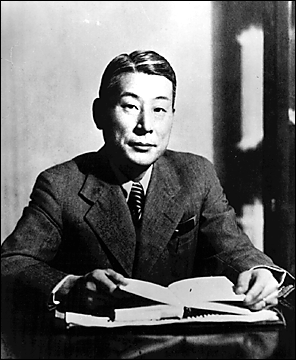
Chiune Sugihara, the Japanese "Schindler"
I've seen several mentions of Chiune Sugihara in documentaries... but no mention was made of one interesting fact -- he converted to Orthodox Christianity while in Harbin, China.
Chiune Sugihara: His conscience gleams out of the darkness
By ROGER PULVERS
Special to The Japan Times
Exactly 60 years ago, during the evening of Aug. 14, 1945, Emperor Hirohito recorded the speech of surrender to be broadcast to the Japanese nation the next day at noon.
Aug. 15, 1945 found Chiune Sugihara, his wife, Yukiko, and their three little children in Romania, interned there by the Red Army. It was unclear what their fate would be. Japan had been officially at war with the Soviet Union, albeit for only a few days.
Who was Chiune Sugihara, and how did he come to be in Bucharest at the war's end? At a time when Japan is being branded in some quarters as the unrepentant perpetrator of cruel misdeeds during World War II and before, a look at the life of this man of conscience may serve to lighten this dark image. It may also be a guide to Japanese people living today: proof that an individual can make a difference, even in the most callous of times.
I was fortunate to have known Sugihara's eldest son, Hiroki, who was named after Koki Hirota, the prime minister in 1936 when Hiroki was born.
The elder Sugihara was a diplomat who was posted to the Japanese consulate in Kaunas, Lithuania, in November 1939. He was soon to be presented with a striking dilemma.
"My father woke up one morning in late July, 1940, to see a great crowd of people milling outside the gate of the consulate," Hiroki told me in July 2000. "I remember staring down at them from the second-story window. They were Jews, and they had come to get exit visas from my father."
Strict instructions
Sugihara was under strict instructions from his superiors at the Foreign Ministry in Tokyo not to issue any Japanese visa other than a transit visa, and this only when the applicant had a valid visa to a subsequent destination.
However, Sugihara deliberately disobeyed those instructions, issuing more than 2,000 visas, some of them covering more than one member of a family, to Jews who were desperate to escape the Nazi terror that had overtaken Poland and was gradually moving eastward.
"The consulate was shut down on Sept. 4 that year," Hiroki told me, "but my father continued to pen visas even at the railway station, throwing the last stamped passports out of the window of our train to Jews whose lives would, thanks to him, be spared."
The more than 2,000 refugees traveled by train across Siberia and on to Japan, from where they eventually made it to Shanghai, Australia, the United States or other destinations. Incidentally, those Jewish refugees were treated humanely while in Japan, despite general Japanese sympathies for the Axis cause.
Meanwhile, Sugihara made his own way from Kaunas to posts in Prague, Konigsberg and, eventually, in 1942, Bucharest, where he remained until 1945.
Born on Jan. 1, 1900, in the village of Yaotsu in Gifu Prefecture, Sugihara went to Waseda University in Tokyo in 1918, but dropped out the next year to join the Foreign Ministry. After being sent by the ministry to Harbin in China, he converted to Russian Orthodox Christianity and married a White Russian woman named Klavdia.
In Harbin, Sugihara studied Russian and became, it was said, the best Russian-speaker in the Japanese government. He also negotiated, on terms exceedingly favorable to Japan, the agreement with the Soviet Union that allowed for the expansion of Japan's Northern Manchurian Railway. Then in 1935, after divorcing Klavdia* (who died several years ago, age 93, in a Russian nursing home in Sydney), Sugihara returned to Japan and married Yukiko Kikuchi, Hiroki's mother.
The Soviets were not well disposed to Sugihara, given his hand in the railway negotiations, and disallowed his proposed next posting, to Moscow. He was dispatched instead to Helsinki and then to Kaunas where, with his linguistic skills (he had studied German as well as Russian), he was invaluable to the Japanese foreign service.
Pure humanity
Why did Sugihara go out on a limb to save those Jews? His son, Hiroki, saw it as a matter of personal conscience.
"My father made a decision based on pure humanity. If you had the power to save people and didn't, what kind of a man were you?"
In 1946, Sugihara, his wife and their three children, found themselves on the same trans-Siberian train line ridden by the Jewish refugees he saved. They were finally repatriated in April 1947. Before long, however, Sugihara was relieved of his duties at the Foreign Ministry, in what some have interpreted as a rebuke for his disobedience. This explanation fits into the stereotypical view of the conformist Japanese, but I believe it was not the case here. Instead, Sugihara was simply let go in the postwar changing of the guard that saw a third of the Foreign Ministry's staff receive their marching orders in those chaotic years.
Afterward, Sugihara found various jobs, one of them as manager of a PX on an American base. Eventually he took up a position with a trading company and moved, alone, to Moscow, where he lived for 16 years. He passed away in Japan on July 31, 1986.
"I think that my father may have felt more at home with Russians than he did with Japanese," Hiroki told me. "I guess he wasn't very much at home in postwar Japan."
There are tens of thousands of people around the world today who would not have been born had it not been for the compassion of Chiune Sugihara.
On a day such as this one, perhaps it will help both Japan and those who genuinely wish this country well to remember that the devils of the past were not alone in their undertakings. There were angels in their midst. Thanks to Japanese like Chiune Sugihara, "Lest we forget" may justifiably be said in the same breath as "kindly remember."
* It should be noted that it was actually Klavdia who initiated the divorce, because she feared having children, and he wanted very much to have children.
Nothing has changed ...
Yesterday was the feast of the Transfiguration, and is also the 14th anniversary of the fall of communism in Russia. As I have mentioned, the Russian Orthodox Church is in the process of healing divisions that resulted from the Bolshevik take over. There are those who oppose this process who say that nothing has really changed in Russia. This little news item from yesterday shows how ridiculous this is:
2005-08-19 15:04:00
Russian defense minister attends the Holy Transfiguration Day celebrations led by Patriarch Alexy in Valamo
Valamo, August 19, Interfax - Russian Defence Minister Sergey Ivanov attended the divine liturgy celebrated by Patriarch Alexy II of Moscow and All Russia at the Cathedral of the Holy Transfiguration in the Valamo Monastery on Friday.
The minister, who came to Valamo at the invitation of Patriarch Alexy, will visit the Sixth Air Force Army special radar company deployed in the island.
The Defence Ministry information office noted that the special company is manned by the General Staff according to the list sent in by the abbot of the monastery, Father Panrkaty, through the Moscow Patriarchate. This practice has been observed since 1995.
The company is distinguished for the absence of any violations of army discipline in it. Diocesan priests come to the company for a talk with the staff every day. There is an iconostasis in the leisure room and mess for novice soldiers to pray before it.
The foundation of a chapel has been laid in the territory of the unit. The construction of the chapel is planned to be completed next year.
The company is fully staffed and there are no problems of supply or domestic equipment. Twelve servicemen of the company are novices of the Valamo Monastery
Under the communists, soldiers were closing monasteries and rounding up monks to shoot them, or send them off to die in a gulag. Now you have soldiers who are also novice monks, and the Russian military is clearly encouraging this.
No... nothing has changed. There is none more blind than he who will not see.
2005-08-19 15:04:00
Russian defense minister attends the Holy Transfiguration Day celebrations led by Patriarch Alexy in Valamo
Valamo, August 19, Interfax - Russian Defence Minister Sergey Ivanov attended the divine liturgy celebrated by Patriarch Alexy II of Moscow and All Russia at the Cathedral of the Holy Transfiguration in the Valamo Monastery on Friday.
The minister, who came to Valamo at the invitation of Patriarch Alexy, will visit the Sixth Air Force Army special radar company deployed in the island.
The Defence Ministry information office noted that the special company is manned by the General Staff according to the list sent in by the abbot of the monastery, Father Panrkaty, through the Moscow Patriarchate. This practice has been observed since 1995.
The company is distinguished for the absence of any violations of army discipline in it. Diocesan priests come to the company for a talk with the staff every day. There is an iconostasis in the leisure room and mess for novice soldiers to pray before it.
The foundation of a chapel has been laid in the territory of the unit. The construction of the chapel is planned to be completed next year.
The company is fully staffed and there are no problems of supply or domestic equipment. Twelve servicemen of the company are novices of the Valamo Monastery
Under the communists, soldiers were closing monasteries and rounding up monks to shoot them, or send them off to die in a gulag. Now you have soldiers who are also novice monks, and the Russian military is clearly encouraging this.
No... nothing has changed. There is none more blind than he who will not see.
Friday, August 12, 2005
Bono is no Bonehead

Click here to read more about a new book of conversations with U2 singer Bono. Many conservatives assume he is a typical dope-smoking liberal rock-and-roller, but since the begining days of U2, he has always identified himself as a Christian, and often this is reflected in his songs. In fact, U2's October Album is probably more overtly Christian than most of what passes for Christian music these days. I was a big fan before most people in America had heard of them, and I remember when they first hit the big time how the press made quite an issue of the fact that Bono was a Christian, who wasn't sleeping with his girl friend, or smoking pot back stage. I saw them in concert twice, and they were great shows... and quite clean.
Jesse Helms has even taken a liking to Bono, and when they talked about this on 60 minutes, he commented that Bono was a great student of the Bible. 60 minutes probably thought that meant that he knew how to fool a conservative Republican Senator, but that is not the case.
I wouldn't defend everything Bono has ever said or did, but I do believe he is a sincere believer.... and his music is cool too. (:)
Here's an excerpt from the book:
Bono: My understanding of the Scriptures has been made simple by the person of Christ. Christ teaches that God is love. What does that mean? What it means for me: a study of the life of Christ. Love here describes itself as a child born in straw poverty, the most vulnerable situation of all, without honor. I don't let my religious world get too complicated. I just kind of go: Well, I think I know what God is. God is love, and as much as I respond [sighs] in allowing myself to be transformed by that love and acting in that love, that's my religion. Where things get complicated for me, is when I try to live this love. Now that's not so easy.
Assayas: What about the God of the Old Testament? He wasn't so "peace and love"?
Bono: There's nothing hippie about my picture of Christ. The Gospels paint a picture of a very demanding, sometimes divisive love, but love it is. I accept the Old Testament as more of an action movie: blood, car chases, evacuations, a lot of special effects, seas dividing, mass murder, adultery. The children of God are running amok, wayward. Maybe that's why they're so relatable. But the way we would see it, those of us who are trying to figure out our Christian conundrum, is that the God of the Old Testament is like the journey from stern father to friend. When you're a child, you need clear directions and some strict rules. But with Christ, we have access in a one-to-one relationship, for, as in the Old Testament, it was more one of worship and awe, a vertical relationship. The New Testament, on the other hand, we look across at a Jesus who looks familiar, horizontal. The combination is what makes the Cross.
Assayas: Speaking of bloody action movies, we were talking about South and Central America last time. The Jesuit priests arrived there with the gospel in one hand and a rifle in the other.
Bono: I know, I know. Religion can be the enemy of God. It's often what happens when God, like Elvis, has left the building. [laughs] A list of instructions where there was once conviction; dogma where once people just did it; a congregation led by a man where once they were led by the Holy Spirit. Discipline replacing discipleship. Why are you chuckling?
Assayas: I was wondering if you said all of that to the Pope the day you met him.
Bono: Let's not get too hard on the Holy Roman Church here. The Church has its problems, but the older I get, the more comfort I find there. The physical experience of being in a crowd of largely humble people, heads bowed, murmuring prayers, stories told in stained-glass windows …
Assayas: So you won't be critical.
Bono: No, I can be critical, especially on the topic of contraception. But when I meet someone like Sister Benedicta and see her work with AIDS orphans in Addis Ababa, or Sister Ann doing the same in Malawi, or Father Jack Fenukan and his group Concern all over Africa, when I meet priests and nuns tending to the sick and the poor and giving up much easier lives to do so, I surrender a little easier.
Assayas: But you met the man himself. Was it a great experience?
Bono: … [W]e all knew why we were there. The Pontiff was about to make an important statement about the inhumanity and injustice of poor countries spending so much of their national income paying back old loans to rich countries. Serious business. He was fighting hard against his Parkinson's. It was clearly an act of will for him to be there. I was oddly moved … by his humility, and then by the incredible speech he made, even if it was in whispers. During the preamble, he seemed to be staring at me. I wondered. Was it the fact that I was wearing my blue fly-shades? So I took them off in case I was causing some offense. When I was introduced to him, he was still staring at them. He kept looking at them in my hand, so I offered them to him as a gift in return for the rosary he had just given me.
Assayas: Didn't he put them on?
Bono: Not only did he put them on, he smiled the wickedest grin you could ever imagine. He was a comedian. His sense of humor was completely intact. Flashbulbs popped, and I thought: "Wow! The Drop the Debt campaign will have the Pope in my glasses on the front page of every newspaper."
Assayas: I don't remember seeing that photograph anywhere, though.
Bono: Nor did we. It seems his courtiers did not have the same sense of humor. Fair enough. I guess they could see the T-shirts.
Later in the conversation:
Assayas: I think I am beginning to understand religion because I have started acting and thinking like a father. What do you make of that?
Bono: Yes, I think that's normal. It's a mind-blowing concept that the God who created the universe might be looking for company, a real relationship with people, but the thing that keeps me on my knees is the difference between Grace and Karma.
Assayas: I haven't heard you talk about that.
Bono: I really believe we've moved out of the realm of Karma into one of Grace.
Assayas: Well, that doesn't make it clearer for me.
Bono: You see, at the center of all religions is the idea of Karma. You know, what you put out comes back to you: an eye for an eye, a tooth for a tooth, or in physics—in physical laws—every action is met by an equal or an opposite one. It's clear to me that Karma is at the very heart of the universe. I'm absolutely sure of it. And yet, along comes this idea called Grace to upend all that "as you reap, so you will sow" stuff. Grace defies reason and logic. Love interrupts, if you like, the consequences of your actions, which in my case is very good news indeed, because I've done a lot of stupid stuff.
Assayas: I'd be interested to hear that.
Bono: That's between me and God. But I'd be in big trouble if Karma was going to finally be my judge. I'd be in deep s---. It doesn't excuse my mistakes, but I'm holding out for Grace. I'm holding out that Jesus took my sins onto the Cross, because I know who I am, and I hope I don't have to depend on my own religiosity.
Assayas: The Son of God who takes away the sins of the world. I wish I could believe in that.
Bono: But I love the idea of the Sacrificial Lamb. I love the idea that God says: Look, you cretins, there are certain results to the way we are, to selfishness, and there's a mortality as part of your very sinful nature, and, let's face it, you're not living a very good life, are you? There are consequences to actions. The point of the death of Christ is that Christ took on the sins of the world, so that what we put out did not come back to us, and that our sinful nature does not reap the obvious death. That's the point. It should keep us humbled… . It's not our own good works that get us through the gates of heaven.
Assayas: That's a great idea, no denying it. Such great hope is wonderful, even though it's close to lunacy, in my view. Christ has his rank among the world's great thinkers. But Son of God, isn't that farfetched?
Bono: No, it's not farfetched to me. Look, the secular response to the Christ story always goes like this: he was a great prophet, obviously a very interesting guy, had a lot to say along the lines of other great prophets, be they Elijah, Muhammad, Buddha, or Confucius. But actually Christ doesn't allow you that. He doesn't let you off that hook. Christ says: No. I'm not saying I'm a teacher, don't call me teacher. I'm not saying I'm a prophet. I'm saying: "I'm the Messiah." I'm saying: "I am God incarnate." And people say: No, no, please, just be a prophet. A prophet, we can take. You're a bit eccentric. We've had John the Baptist eating locusts and wild honey, we can handle that. But don't mention the "M" word! Because, you know, we're gonna have to crucify you. And he goes: No, no. I know you're expecting me to come back with an army, and set you free from these creeps, but actually I am the Messiah. At this point, everyone starts staring at their shoes, and says: Oh, my God, he's gonna keep saying this. So what you're left with is: either Christ was who He said He was—the Messiah—or a complete nutcase. I mean, we're talking nutcase on the level of Charles Manson. This man was like some of the people we've been talking about earlier. This man was strapping himself to a bomb, and had "King of the Jews" on his head, and, as they were putting him up on the Cross, was going: OK, martyrdom, here we go. Bring on the pain! I can take it. I'm not joking here. The idea that the entire course of civilization for over half of the globe could have its fate changed and turned upside-down by a nutcase, for me, that's farfetched …
Bono later says it all comes down to how we regard Jesus:
Bono: … [I]f only we could be a bit more like Him, the world would be transformed. …When I look at the Cross of Christ, what I see up there is all my s--- and everybody else's. So I ask myself a question a lot of people have asked: Who is this man? And was He who He said He was, or was He just a religious nut? And there it is, and that's the question. And no one can talk you into it or out of it.
Wednesday, August 10, 2005
New Epistle Lectionary

The Center for Traditionalist Orthodox Studies has published a new Epistle Book (aka Apostolos, or Apostol). It uses the King James text, which I prefer. The text it uses for the prokimena and alleluia verses is their own translation. It is layed out in the Greek Style. The Slavic Apostol has all the books from Acts through Jude, with the complete texts, and with notes that tell you how and where to begin and where to end each reading. The Greek style has the readings in the order they are used in the liturgical year, with text exactly as it would be read in Church, which eliminates the need for all of those notes. The problem for those who follow Slavic practice is that these readings do not always precisely match where the Slavic readings begin and end.
The biggest draw back is that this is published only in paper back, at present... which means the text will not last long under heavy use. However, this also makes the text much more inexpensive than it would otherwise be. It is only $25.00, which makes it practical for individuals to purchase it for their own use.
Monday, August 08, 2005
Farewell to Welfare
Note: The comments expressed on this blog, are the views of a private citizen, and do not represent the views of any state agency.

After working for 13 years for what was until recently the Texas Department of Human Services (in the Food Stamps, Medicaid and TANF programs), I am transferring to the Office of the Attorney General, Child Support division later this month. I am doing this for two reasons:
1). The ongoing down-sizing of permanent (and well trained) staff, without any decrease in workload, has made things increasingly unmanagable.
2). We have had to deal with long hiring freezes in the past, as well as high stress levels; but unlike the past, this time around, the only thing we have to look forward to is busting our chops for the next year, and then eventually getting a position at reduced pay… if we get one at all.
Given those two realities, I decided it was best to create my own options, and find a position in another agency entirely.
This wouldn’t bother me so much if this was happening because the state had decided to cut welfare programs, and so fewer staff were needed to do the work. It also would not bother me so much if I thought that the new system would work, and save the state money. However, I am firmly convinced that this new system will be a boondoggle of historical proportions when all is said and done. I am also convinced that the day will come that the state will have to rebuild the agency that they are now dismantling… but at a huge cost, because they will have lost all the infrastructure that they had both in terms of facilities and equipment, and in terms of experienced staff who knew how to get the work done. This is bad business for the state, and a shameful way to treat staff that have maintained one of the most cost efficient state welfare agencies in the United States.
Up until now, I suppose some might have thought my complaints were due only to selfish concerns, but now that I will now longer have a personal financial interest in the matter, I hope those who think so will reconsider what I have been saying.
I will continue to keep an eye on how things develop, though in the future, from the outside looking in.
People who have never had to work with these programs really have no idea of what it takes to make them work. I think, because the people we deal with are generally poor and less educated, the assumption is that those who work with them must be as well. Also, because we have long been the red headed step child of state government, and have thus been chronically underfunded and understaffed, that the fact that our offices did not run like clock work was due to our incompetence, rather than due to the reality into which we had been placed. Recently the Fort Worth Star Telegram had an editorial praising the new system that is being implemented as a model of how government should work, and one can certainly detect such attitudes in that article. They of course assume that the state really will save money, and that services really will be more accessible to those who need those benefits. It is good to see recently that the Federal Government is finally expressing some of the same concerns that I have been blogging about, and has serious doubts about both of these assumptions… which the Fort Worth Star Telegram accepted as established facts. The Federal Government is unconvinced that the new software will actually function as promised, or that the state will actually save money, and is threatening to withhold funding. Unfortunately, I doubt that the politicians will allow these concerns to stop Accenture from getting its hands on that billion dollars the state has promised them, but it is nice to see that at least someone is beginning to take these issues seriously who is in a position to be heard. (If you have Adobe Acrobat, you can click here to read the actual letter from FNS to the Texas Health and Human Services Commission).
The worst thing of all for me personally is that I will be leaving the people I have worked so closely with for the past 13 years, who have become like extended family, and that those who are not fortunate enough to find work elsewhere, will have to remain in an increasingly difficult mess that was entirely avoidable, but seems inevitable now.
I will miss these people very much, but will keep them in my thoughts and prayers.
After working for 13 years for what was until recently the Texas Department of Human Services (in the Food Stamps, Medicaid and TANF programs), I am transferring to the Office of the Attorney General, Child Support division later this month. I am doing this for two reasons:
1). The ongoing down-sizing of permanent (and well trained) staff, without any decrease in workload, has made things increasingly unmanagable.
2). We have had to deal with long hiring freezes in the past, as well as high stress levels; but unlike the past, this time around, the only thing we have to look forward to is busting our chops for the next year, and then eventually getting a position at reduced pay… if we get one at all.
Given those two realities, I decided it was best to create my own options, and find a position in another agency entirely.
This wouldn’t bother me so much if this was happening because the state had decided to cut welfare programs, and so fewer staff were needed to do the work. It also would not bother me so much if I thought that the new system would work, and save the state money. However, I am firmly convinced that this new system will be a boondoggle of historical proportions when all is said and done. I am also convinced that the day will come that the state will have to rebuild the agency that they are now dismantling… but at a huge cost, because they will have lost all the infrastructure that they had both in terms of facilities and equipment, and in terms of experienced staff who knew how to get the work done. This is bad business for the state, and a shameful way to treat staff that have maintained one of the most cost efficient state welfare agencies in the United States.
Up until now, I suppose some might have thought my complaints were due only to selfish concerns, but now that I will now longer have a personal financial interest in the matter, I hope those who think so will reconsider what I have been saying.
I will continue to keep an eye on how things develop, though in the future, from the outside looking in.
People who have never had to work with these programs really have no idea of what it takes to make them work. I think, because the people we deal with are generally poor and less educated, the assumption is that those who work with them must be as well. Also, because we have long been the red headed step child of state government, and have thus been chronically underfunded and understaffed, that the fact that our offices did not run like clock work was due to our incompetence, rather than due to the reality into which we had been placed. Recently the Fort Worth Star Telegram had an editorial praising the new system that is being implemented as a model of how government should work, and one can certainly detect such attitudes in that article. They of course assume that the state really will save money, and that services really will be more accessible to those who need those benefits. It is good to see recently that the Federal Government is finally expressing some of the same concerns that I have been blogging about, and has serious doubts about both of these assumptions… which the Fort Worth Star Telegram accepted as established facts. The Federal Government is unconvinced that the new software will actually function as promised, or that the state will actually save money, and is threatening to withhold funding. Unfortunately, I doubt that the politicians will allow these concerns to stop Accenture from getting its hands on that billion dollars the state has promised them, but it is nice to see that at least someone is beginning to take these issues seriously who is in a position to be heard. (If you have Adobe Acrobat, you can click here to read the actual letter from FNS to the Texas Health and Human Services Commission).
The worst thing of all for me personally is that I will be leaving the people I have worked so closely with for the past 13 years, who have become like extended family, and that those who are not fortunate enough to find work elsewhere, will have to remain in an increasingly difficult mess that was entirely avoidable, but seems inevitable now.
I will miss these people very much, but will keep them in my thoughts and prayers.
Sunday, July 31, 2005
Reconsidering the Meaning of Conversion
The latest issue of Christianity Today has an essay by Sam Torode, entitled “It’s All About Jesus: A Convert to Orthodoxy Reconsiders Evangelicalism."
I should begin by saying that I am sure that Sam Torode means well, and is sincerely trying to grapple with the Orthodox Faith and Ortho-praxis – so I don’t wish anything I am going to say as a criticism of him personally. However, given that his article was published in Christianity Today, there are a number of things he has stated that need a response.
Christianity Today, despite it’s rather broadly sounding title is an Evangelical magazine that only takes minimal note of what it going on in non-Evangelical Christianity. For example, when there was an article on how Christians in Serbia were dealing with the US bombing of their country, the article focused on the less than 1% of Serbians who are Protestants rather than on the much larger percentage of Serbians who are Orthodox. When they do talk about the Orthodox, they like to find Orthodox writers who affirm Evangelicalism, and take shots at Orthodoxy (which is why you often see articles by “Orthodox expert” Bradley Nassif., for example).
I have been a subscriber to Christianity today for nearly 20 years, and I maintained my subscription after I converted to Orthodoxy because I wanted to keep up with what is going on in the Evangelical world, and also because I wanted to know what Evangelicals are saying about the Orthodox.
In this particular essay we have a convert to Orthodoxy who is reconsidering his previous Evangelicalism. The first question I had when reading this article was how long Sam Torode has been Orthodox? The article gives no indication, but after poking around on the internet, I was able to discover that he and his wife converted to Orthodox in June of 2003… which means, given when I received the issue his article appeared in (which was mid-July, 2005), he probably had not been Orthodox a full two years before this article was written. I converted to Orthodoxy about 15 years ago.
In the early Church one generally had to be a catechumen for 3 years before they were baptized and admitted to communion. The reason for this is that it takes time to develop an Orthodox Christian world view. It is even more difficult for someone coming from a heterodox background to develop an Orthodox Christian world view. I go into great detail as to why this is in a talk I gave entitled "Renewing the Mind: Acquiring an Orthodox outlook", and so rather than duplicate what I said there, I will refer the reader to that text, but in short, because Protestantism shares much of the same terminology as the Orthodoxy, but with slightly different meaning, Protestants who convert to Orthodoxy have to work harder than a convert from paganism would have to work to ensure that what they think they know about the faith is really Orthodox.
A similar phenonomen occurs when someone studies one style of Martial arts and then begins to study a very different style. A person off the street is more likely to learn the techniques of the new style the way that they are supposed to be done than someone who has a black belt in a different style, because they not only have to learn new things, they have to learn to not do them the way that they have already had drilled into their head.
Unfortunately, many converts to Orthodoxy are not told this, and so fail to grasp the need for them to approach Orthodoxy differently than they approached their former Protestantism. The results are often people who have only half converted to Orthodoxy, but think they already know what Orthodoxy is all about.
Not only does one need to understand the need for a change in world view, but one needs to allow the time for that change to occur. When I was a Protestant, I was an associate pastor, and was used to teaching and preaching to others about the faith. When I converted to Orthodoxy, I had to take the time to stop teaching others, and learn things I didn’t know… and unlearn things I thought I knew that were either completely wrong, or partly wrong. My priest made clear to me that this was a process that would take time, and so I had to get used being a “white-belt” again. The only subject that I felt competent to speak or write on at that time was why I became Orthodox… and even then, I would submit what I wrote to review by more deeply rooted Orthodox Christians than I. I didn’t so much as attempt to teach a children’s Sunday school class until I had been Orthodox for three years.
Now to some specific issues raised by Sam Torode in this essay:
1) Fasting and legalism:
Sam writes: “Faced with all this fasting, it’s easy to get obsessive. We joined a parish of mostly ex-Protestants who, like us, were eager to be good Orthodox. We looked down on those “ethnic Orthodox” who still eat their gyros and feta cheese during Lent. During church fellowship times, our conversations often centered on fasting…”
I don’t doubt that this was Sam Torode’s experience, but this is not the norm in the Orthodox Church. In my experience, it is only very recent converts who spend much of their time chatting about fasting. It doesn’t make for particularly engaging conversation, if done with any regularity. It is also true that it is a temptation for converts to look down on “cradle Orthodox” who are less fervent. However, this is a temptation that a parish priest should be actively fighting against if he wishes his converts to develop a healthy spirituality. First of all, judging others is something that the Scriptures and the Fathers focus on as a serious spiritual problem that one has to overcome. Secondly, converts have much to learn from their “cradle Orthodox” brethren… even the less pious ones can often teach you things you wouldn’t learn from other converts. But obviously, one wants to emulate those cradle Orthodox that do manage to abstain from their feta cheese and gyros during lent.
One of the most beneficial (and trying) things my wife and I did after we converted was to move to an area where we joined a very Russian parish. It was difficult dealing with the language, and the cultural issues that we were confronted with, but we learned a great deal, and met some very pious people who had a great impact on us. For example, the choir director at this parish was a lady who was a Russian born in Harbin, China (which is where many Russians fled after the communists took over Russia), where she was raised in a very pious Russian exile community that came very close to re-creating the best features of pre-revolutionary Russian culture – until they again had to flee when the Communists took over China. She also worked in the administrative offices of St. John of Shanghai, and so got know a man who was an extraordinary saint. She was also very well educated, and spoke several languages fluently, including English (fortunately for us).
Just to give a small example of what it was like to be around her in that parish, I was singing with her at the kleros on the feast of the Dormition. Most of the hymns we were singing were in Slavonic… which was of course a challenge for me. At one point we sang a hymn in which I put the emphasis on the wrong words, and when she had the chance she did an on-the-fly translation of the hymn into English (which I knew was accurate, because I had the English text where I could see it), and she explained the meaning of that hymn in such pious terms that I was deeply moved – her point was to explain why certain words needed to be emphasized, but I was struck by the evident depth of her love for God and the beauty and theology of the services. She didn’t eat cheese on fasts days either, even though her health and age has long exempted her from an obligation to fast.
Mr. Torode also mentioned the tradition of married couples abstaining from sex during the fasts. He writes: “Married couples are encouraged to take [fasting] a step further, by abstaining from intercourse on these same fast days. That’s not something Orthodox apologists like to broadcast….”
One thing that I discovered when I became Orthodox was that there were many things in Scripture that I never realized where there, even though I had read them over and over again. This is something that perhaps has not yet revealed itself to Sam Torode, but this tradition is entirely based on Scripture – see 1st Corinthians 7:4-5. This is not something that is “broadcasted” because it is only done by mutual consent, and is a matter for the couple to discuss with each other and their spiritual fathers.
Sam Torode: “One Sunday, a friend in the church confided to my wife, “Sometimes, I forget it’s all about Jesus.” That’s when it hit us – we’d forgotten that it’s all about Jesus, too. Most of the time, instead of overflowing with God’s love, I was just ticked off about not being able to eat a burger.”
Fasting is not an end in itself, it is a means to an end. This is clearly brought home each year in the Sundays of preparation for great lent. Most notably on the Sunday of the Publican and the Pharisee.
Fasting is something that the New Testament speaks about on a regular basis, however – though Protestants generally fail to even occasionally mention it. Coming from a Wesleyan background, I had some exposure to fasting. In fact, when I was a sophomore in High School, I began fasting on Wednesdays and Fridays because I had read that this was the practice of John Wesley… because the “early Church” fasted on these days. And in fact, this tradition is spoken of in the Didache, which is considered by many scholars to be the oldest Christian text outside of the New Testament canon.
Yes, fasting can be misunderstood. It can become an end rather than a means to an end… but so can studying the Bible.
For more on fasting, see this excerpt from the Lenten Triodion on the meaning and history of fasting.
2) How we should view Evangelicals:
Sam Torode writes near the end of his essay: “Instead of “evangelizing” my evangelical friends, I now hope to learn from them. Discussing differences is worthwhile, but it’s more important to encourage each other as we grow in Christ.” Sam sees this as being a question of “humility” rather than of truth.
This reflects a serious misunderstanding of what it means to be Orthodox… as well as what it means to be heterodox. Being Orthodox does not mean that we are better than anyone else. I have known many pious Protestants who I am sure will have an easier time of it on the day of judgment than I will. Being Orthodox gives us a greater responsibility because we have the fullness of the truth and all the grace that is only available through the Church. To whom much is given, much is required.
We do not judge Protestants, because that is a matter for God. However, we do have an obligation to speak the truth in love to those who are not Orthodox.
We can learn a lot from Protestants. Here’s something I learned from one years ago. I was in a discussion between several college students and a Nazarene Missionary to Korea. We had just heard a lecture that spoke of the light and grace that God has made available to those who have never heard the Gospel. One student asked why we would bother sending missionaries to non-Christian countries, because they have their own culture, and if they hear the Gospel that will only increase their responsibility on the day of judgment. Why not just leave them be, and let them be judged based on the light that they already have? The Missionary responded roughly thus: “You tell me that people can be saved without hearing the Gospel, and I accept that as a possibility… and likewise I can believe that a man might be able to sail a kayak across the Pacific Ocean… but if I am in an Ocean liner, I am going to encourage the guy in the kayak to get on board the Ocean liner.
Likewise, I personally am convinced that many Protestants will be saved, but I know that the boats that they have crafted for themselves are not as sure as the Ark of Salvation that is the Church. And so, it is not due to a lack of humility that I encourage them to get on board the Ark… because I didn’t build the Ark, and have nothing to boast about it in any case. I entered the Ark the same way that I am now encouraging my Protestant friends to enter. It would only be due to a supreme lack of love and gratitude to God that I would fail to do so.
For more on this issue see "The Non-Orthodox", by Patrick Barnes, and "Will the Heterodox Be Saved?" by Metropolitan Philaret.
I should begin by saying that I am sure that Sam Torode means well, and is sincerely trying to grapple with the Orthodox Faith and Ortho-praxis – so I don’t wish anything I am going to say as a criticism of him personally. However, given that his article was published in Christianity Today, there are a number of things he has stated that need a response.
Christianity Today, despite it’s rather broadly sounding title is an Evangelical magazine that only takes minimal note of what it going on in non-Evangelical Christianity. For example, when there was an article on how Christians in Serbia were dealing with the US bombing of their country, the article focused on the less than 1% of Serbians who are Protestants rather than on the much larger percentage of Serbians who are Orthodox. When they do talk about the Orthodox, they like to find Orthodox writers who affirm Evangelicalism, and take shots at Orthodoxy (which is why you often see articles by “Orthodox expert” Bradley Nassif., for example).
I have been a subscriber to Christianity today for nearly 20 years, and I maintained my subscription after I converted to Orthodoxy because I wanted to keep up with what is going on in the Evangelical world, and also because I wanted to know what Evangelicals are saying about the Orthodox.
In this particular essay we have a convert to Orthodoxy who is reconsidering his previous Evangelicalism. The first question I had when reading this article was how long Sam Torode has been Orthodox? The article gives no indication, but after poking around on the internet, I was able to discover that he and his wife converted to Orthodox in June of 2003… which means, given when I received the issue his article appeared in (which was mid-July, 2005), he probably had not been Orthodox a full two years before this article was written. I converted to Orthodoxy about 15 years ago.
In the early Church one generally had to be a catechumen for 3 years before they were baptized and admitted to communion. The reason for this is that it takes time to develop an Orthodox Christian world view. It is even more difficult for someone coming from a heterodox background to develop an Orthodox Christian world view. I go into great detail as to why this is in a talk I gave entitled "Renewing the Mind: Acquiring an Orthodox outlook", and so rather than duplicate what I said there, I will refer the reader to that text, but in short, because Protestantism shares much of the same terminology as the Orthodoxy, but with slightly different meaning, Protestants who convert to Orthodoxy have to work harder than a convert from paganism would have to work to ensure that what they think they know about the faith is really Orthodox.
A similar phenonomen occurs when someone studies one style of Martial arts and then begins to study a very different style. A person off the street is more likely to learn the techniques of the new style the way that they are supposed to be done than someone who has a black belt in a different style, because they not only have to learn new things, they have to learn to not do them the way that they have already had drilled into their head.
Unfortunately, many converts to Orthodoxy are not told this, and so fail to grasp the need for them to approach Orthodoxy differently than they approached their former Protestantism. The results are often people who have only half converted to Orthodoxy, but think they already know what Orthodoxy is all about.
Not only does one need to understand the need for a change in world view, but one needs to allow the time for that change to occur. When I was a Protestant, I was an associate pastor, and was used to teaching and preaching to others about the faith. When I converted to Orthodoxy, I had to take the time to stop teaching others, and learn things I didn’t know… and unlearn things I thought I knew that were either completely wrong, or partly wrong. My priest made clear to me that this was a process that would take time, and so I had to get used being a “white-belt” again. The only subject that I felt competent to speak or write on at that time was why I became Orthodox… and even then, I would submit what I wrote to review by more deeply rooted Orthodox Christians than I. I didn’t so much as attempt to teach a children’s Sunday school class until I had been Orthodox for three years.
Now to some specific issues raised by Sam Torode in this essay:
1) Fasting and legalism:
Sam writes: “Faced with all this fasting, it’s easy to get obsessive. We joined a parish of mostly ex-Protestants who, like us, were eager to be good Orthodox. We looked down on those “ethnic Orthodox” who still eat their gyros and feta cheese during Lent. During church fellowship times, our conversations often centered on fasting…”
I don’t doubt that this was Sam Torode’s experience, but this is not the norm in the Orthodox Church. In my experience, it is only very recent converts who spend much of their time chatting about fasting. It doesn’t make for particularly engaging conversation, if done with any regularity. It is also true that it is a temptation for converts to look down on “cradle Orthodox” who are less fervent. However, this is a temptation that a parish priest should be actively fighting against if he wishes his converts to develop a healthy spirituality. First of all, judging others is something that the Scriptures and the Fathers focus on as a serious spiritual problem that one has to overcome. Secondly, converts have much to learn from their “cradle Orthodox” brethren… even the less pious ones can often teach you things you wouldn’t learn from other converts. But obviously, one wants to emulate those cradle Orthodox that do manage to abstain from their feta cheese and gyros during lent.
One of the most beneficial (and trying) things my wife and I did after we converted was to move to an area where we joined a very Russian parish. It was difficult dealing with the language, and the cultural issues that we were confronted with, but we learned a great deal, and met some very pious people who had a great impact on us. For example, the choir director at this parish was a lady who was a Russian born in Harbin, China (which is where many Russians fled after the communists took over Russia), where she was raised in a very pious Russian exile community that came very close to re-creating the best features of pre-revolutionary Russian culture – until they again had to flee when the Communists took over China. She also worked in the administrative offices of St. John of Shanghai, and so got know a man who was an extraordinary saint. She was also very well educated, and spoke several languages fluently, including English (fortunately for us).
Just to give a small example of what it was like to be around her in that parish, I was singing with her at the kleros on the feast of the Dormition. Most of the hymns we were singing were in Slavonic… which was of course a challenge for me. At one point we sang a hymn in which I put the emphasis on the wrong words, and when she had the chance she did an on-the-fly translation of the hymn into English (which I knew was accurate, because I had the English text where I could see it), and she explained the meaning of that hymn in such pious terms that I was deeply moved – her point was to explain why certain words needed to be emphasized, but I was struck by the evident depth of her love for God and the beauty and theology of the services. She didn’t eat cheese on fasts days either, even though her health and age has long exempted her from an obligation to fast.
Mr. Torode also mentioned the tradition of married couples abstaining from sex during the fasts. He writes: “Married couples are encouraged to take [fasting] a step further, by abstaining from intercourse on these same fast days. That’s not something Orthodox apologists like to broadcast….”
One thing that I discovered when I became Orthodox was that there were many things in Scripture that I never realized where there, even though I had read them over and over again. This is something that perhaps has not yet revealed itself to Sam Torode, but this tradition is entirely based on Scripture – see 1st Corinthians 7:4-5. This is not something that is “broadcasted” because it is only done by mutual consent, and is a matter for the couple to discuss with each other and their spiritual fathers.
Sam Torode: “One Sunday, a friend in the church confided to my wife, “Sometimes, I forget it’s all about Jesus.” That’s when it hit us – we’d forgotten that it’s all about Jesus, too. Most of the time, instead of overflowing with God’s love, I was just ticked off about not being able to eat a burger.”
Fasting is not an end in itself, it is a means to an end. This is clearly brought home each year in the Sundays of preparation for great lent. Most notably on the Sunday of the Publican and the Pharisee.
Fasting is something that the New Testament speaks about on a regular basis, however – though Protestants generally fail to even occasionally mention it. Coming from a Wesleyan background, I had some exposure to fasting. In fact, when I was a sophomore in High School, I began fasting on Wednesdays and Fridays because I had read that this was the practice of John Wesley… because the “early Church” fasted on these days. And in fact, this tradition is spoken of in the Didache, which is considered by many scholars to be the oldest Christian text outside of the New Testament canon.
Yes, fasting can be misunderstood. It can become an end rather than a means to an end… but so can studying the Bible.
For more on fasting, see this excerpt from the Lenten Triodion on the meaning and history of fasting.
2) How we should view Evangelicals:
Sam Torode writes near the end of his essay: “Instead of “evangelizing” my evangelical friends, I now hope to learn from them. Discussing differences is worthwhile, but it’s more important to encourage each other as we grow in Christ.” Sam sees this as being a question of “humility” rather than of truth.
This reflects a serious misunderstanding of what it means to be Orthodox… as well as what it means to be heterodox. Being Orthodox does not mean that we are better than anyone else. I have known many pious Protestants who I am sure will have an easier time of it on the day of judgment than I will. Being Orthodox gives us a greater responsibility because we have the fullness of the truth and all the grace that is only available through the Church. To whom much is given, much is required.
We do not judge Protestants, because that is a matter for God. However, we do have an obligation to speak the truth in love to those who are not Orthodox.
We can learn a lot from Protestants. Here’s something I learned from one years ago. I was in a discussion between several college students and a Nazarene Missionary to Korea. We had just heard a lecture that spoke of the light and grace that God has made available to those who have never heard the Gospel. One student asked why we would bother sending missionaries to non-Christian countries, because they have their own culture, and if they hear the Gospel that will only increase their responsibility on the day of judgment. Why not just leave them be, and let them be judged based on the light that they already have? The Missionary responded roughly thus: “You tell me that people can be saved without hearing the Gospel, and I accept that as a possibility… and likewise I can believe that a man might be able to sail a kayak across the Pacific Ocean… but if I am in an Ocean liner, I am going to encourage the guy in the kayak to get on board the Ocean liner.
Likewise, I personally am convinced that many Protestants will be saved, but I know that the boats that they have crafted for themselves are not as sure as the Ark of Salvation that is the Church. And so, it is not due to a lack of humility that I encourage them to get on board the Ark… because I didn’t build the Ark, and have nothing to boast about it in any case. I entered the Ark the same way that I am now encouraging my Protestant friends to enter. It would only be due to a supreme lack of love and gratitude to God that I would fail to do so.
For more on this issue see "The Non-Orthodox", by Patrick Barnes, and "Will the Heterodox Be Saved?" by Metropolitan Philaret.
Friday, July 29, 2005
The NCC and other Commie Lib Organizations
It is about time that those Orthodox who have been participating in the NCC have begun to leave. As bad as the WCC has been, the NCC has been worse.
All of this reminds me of a satirical hymn I wrote about the left wing agenda of the NCC back when I was still a Nazarene ministerial student in college. To understand the humor, I need to explain a few things that were going on in the 80's with the NCC:
The NCC was funding a Marxist revolutionary group in Namibia known as SWAPO (the South West African People's Organization). Namibia was being ruled at that time by the Apartheid government of South Africa (which was indeed a racist government, but blacks were trying to sneak into South Africa at that time rather than out it of it, as they are currently doing in Marxist Zimbabwe). Another feature of Marxists in Southern Africa of that time is that they subjected their enemies (white and black) to the practice of "necklacing" (in which they forced a rubber tire, filled with gasoline, around a victim's chest and arms, and set it on fire).
On another front at that time, the Communists had taken power in Nicaragua, and there was a counter-revolutionary group supported by the Reagan administration, known as the "Contras", that was trying to liberate that country from the Communists thugs that were opposing them. The NCC was adamantly opposed to any funding for the Contras. In fact, until the fall of communism in the Soviet Union, the NCC had almost nothing bad to say about any Communists, but were adamantly opposed to any group that was actively trying to oppose the Communists.
My satirical hymn was written to the tune of the famous hymn by Charles Wesley, "Arise, my soul, arise!", which you can hear by clicking here.
And so, with that lengthy introduction, here it is:
Arise SWAPO, Arise!
Arise, SWAPO, Arise!
Kill all your racist peers!
Light tires around their necks,
And watch their bodies sear.
We support you through the NCC.
We back your fight to set you free,
But Contra aid, we cannot see!
My apologies to Charles Wesley.
Thursday, July 28, 2005
Antiochian Orthodox Archdiocese Votes to Leave NCC

Breaking News: Orthodox Leave NCC
Dearborn, Michigan. July 28, 2005.This afternoon the General Convention of the Antiochian Orthodox Christian Archdiocese of North America voted overwhelmingly to leave the National Council of Churches of Christ. The General Convention is holding its annual meeting this week in Dearborn, Michigan.
The action was not a temporary “suspension” of membership, but a formal withdrawal from the NCC. The clergy unanimously approved the withdrawal, followed by a unanimous vote of the lay delegates supporting the move. An announcement of the final vote was met with thunderous applause by the Convention.
Reasons given for the withdrawal include the general liberalism of the NCC, whose General Secretary, Bob Edgar, withdrew his signature from a statement defining marriage as being between a man and a woman.
Metropolitan PHILIP, head of the Antiochian Orthodox Archdiocese, was reportedly outspoken in calling for the church to withdraw from the NCC, stating that the relationship had proven fruitless.
The National Council of the Churches of Christ has listed on its website "36 member communions and denominations." It now has 35.
Note: An interview about this vote and its consequences with the Very Rev. Olof Scott, the newly-elected chairman of the Department of Interfaith Relationships, is scheduled to air on Ancient Faith Radio this coming Sunday, July 31, 2005, at 5 PM EDT.
My Comment: Harumph!
Thursday, June 30, 2005
The Massacre of the Cossacks at Lienz, Austria

This image is a black and white version of “The Betrayal of the Cossacks at Lienz” by S.G. Korolkoff, with a German inscription.
Click on image for a full color, enlargement of the original painting
The Rutland Herald has a very interesting article about the 60th anniversary of the Massacre of the Cossacks at the end of World War II, by the British and Soviets. It mentions Fr. Michael Protopopov as speaking and serving the memorial service that took place.

I got to meet Fr. Michael when I went to Australia in December of 2000. I think he got almost as much a kick out of meeting a cowboy boot wearing Deacon (at that time) from Texas (with my accompanying mannerism and manner of speaking) who had converted to Orthodoxy from Protestantism, as I did out of meeting a Russian Priest from an aristocratic Russian family, knighted by the Queen of England, with an Australian accent, a great sense of humor, an incredible sense of history, a deeply rooted and balanced Orthodox spirituality, and a jolly disposition. I enjoyed listening to him in particular, and he and the other Aussies apparently enjoyed listening to me. They kept asking me to repeat certain phrases, and then laughing. Some phrases, I could figure out why (like when I used the phrase "chewing buddy" to refer to a close friend), but other phrases I couldn't see the humor of... but they did.
I was fortunate enough to get to spend time with Fr. Michael again at a clergy conference in New York in 2003.
As I recall, he wrote a book about the Massacre at Lienz, and "Operation Keel Haul". It is amazing how many dark chapters of history, such as this, are almost completely unknown to the vast majority of people.
You can see pictures of the service that took place, as well as the monument in Lienz by clicking here.
Tuesday, June 28, 2005
The Ten Commandments On Display... at the Supreme Court and Other Federal Buildings

The Ten Commandments on the Doors of the Supreme Court
If you wondered why the Supreme Court split hairs over displays of the Ten Commandments, and didn't ban all of them in public buildings, it probably had something to do with the extensive redecorating that they would need to do in their own Court House... not to mention the rest of Washington, D.C.
See this article in Human Events for a number of photos of the 10 Commandments on Display at the Supreme Court Building, and in other federal buildings.
Click here, for another image of the U.S. District Court's display of the Ten Commandments.

I would suggest every court building in the united states should incorporate the exact same images of the 10 commandments that are found in the Supreme Court Building, and see what they have to say next.
I also think it's great that someone is trying to seize Justice Souters home on the basis of the the court decision that he signed onto this week.
These liberal justices should be impeached. We need to take back our country from judicial tyrants.
Saturday, June 25, 2005
Reconciliation in the Russian Orthodox Church

After almost 80 years of alienation, resulting from the machinations of the Soviets and its attempt to utter destroy the Church, the division between the Orthodox Church in Russia (aka the Moscow Patriarchate) and the Russian Orthodox Church Outside of Russia is coming to an end.
Just this week, mutually agreed upon documents were published on the official web site of both Churches (in English and Russian), and so the final steps in the process of reconciliation are now under way.
Saturday, June 18, 2005
Serbs, Lies, and Video Tapes

Mujahideen (i.e. Islamo-Facists) fought for the pro-Muslim Bosnian army
FrontPage Mag has an article by Julia and Lev Gorin that is well worth the reading, on video tapes recently sent to the Hague about atrocities in the Bosnian War.
How Oral Tradition Works... and Doesn't work

Paradosis has a great post on how Oral Tradition works, as opposed to how it is often suggested to work. (hat-tip Deacon Raphael)
Thursday, June 16, 2005
Waltzing Matilda

Speaking of interesting songs, this song is considered Australia's national song. When I visited Australia in December of 2000, I was introduced to it at a Russian Orthodox Youth Conference in Western Australia. They sang this song with a lot of gusto, and it had a catchy Irish sounding tune, but the words didn't make much sense to me at the time.
If you have ever seen the movie "On The Beach" with Gregory Peck, you would have heard it throughout the movie (which is about an American Nuclear Sub that goes to Australia after a nuclear war between the Soviet Union and the United States, only to watch everyone eventually die off from the radiation).
There is an entire web site dedicated to this song, and it has several sound files you can listen to, if you have never heard it before.
Here are the words:
Waltzing Matilda
'Banjo' (A.B.) Patterson, c. 1890
Once a jolly swagman camped by a billabong
Under the shade of a coolibah tree
And he sang as he watched and waited 'til his billy boiled
You'll come a-waltzing matilda with me
Chorus: Waltzing matilda, waltzing matilda You'll come a waltzing matilda with me And he sang as he watched and waited 'til his billy boiled You'll come a-waltzing matilda with me
Down came a jumbuck to dri-ink at that billabong
Up jumped the swagman and grabbed him with glee
And he sang as he stuffed that jumbuck in his tucker-bag
You'll come a-waltzing matilda with me
Up rode the squatter, mounted on his thoroughbred
Up rode the troopers, one, two, three
"Where's that jolly jumbuck you've got in your tucker-bag?"
You'll come a-waltzing matilda with me
Up jumped the swagman and sprang into that billabong
"You'll never take me alive!", said he
And his ghost may be heard as you pa-ass by that billabong
You'll come a-waltzing matilda with me
Here's the meaning:
billabong
An originally aboriginal word for a section of still water adjacent to a river, cut off by a change in the watercourse, cf. an oxbow lake. In the Australian outback, a billabong generally retains water longer than the watercourse itself, so it may be the only water for miles around.
billy
A tin can, maybe two litres (four pints) in capacity, usually with a wire handle attached to the top rim, in which 'swaggies' (and contemporary Australian campers) boil water to make tea (and to kill the beasties in the water they've taken out of the billabong).
coolibah tree (also coolabah)
A particular kind of eucalyptus that grows beside billabongs.
More specifically, a friend tells me that it's eucalyptus microtheca, a small to medium-sized tree to 20m, widespread in arid and semi-arid areas near watercourses and seasonally inundated areas in open woodlands, found in all states except Victoria and Tasmania.
jumbuck
A sheep.
The Macquarie Dictionary suggests that the term is an Aboriginal corruption of 'jump up'. A correspondent, Leslie (Lee) Harvey advises me that the term derives from 'jombok'. "Jomboks are those big, white, fluffy clouds that typically drift across the inland Australian skies in late summer and Autumn. When the aboriginals first saw sheep they were reminded of jomboks and they just changed one letter to avoid confusion in their spoken language. I also think the first European translators misspelled the word jumbuck".
squatter
As Australia was settled, there was of course little or no authority and bureaucracy in place. People 'squatted' on patches of land, grazed their animals, grew their crops and built their houses and fences. In due course, as authority arrived, it generally accepted the claims of whoever was in apparent possession of the land (aboriginals had been no match for armed white men, and anyway were largely nomadic across reasonably large areas). Particularly in good quality grazing country, squatters quickly became relatively very well off, hence the term 'squattocracy' which blends 'squatter' with 'aristocracy'. The constabulary tended to work with them to maintain law and order. To non-land-owners, squatters were an object of resentment.
swagman
A gentleman of the road, an itinerant roaming country roads, a drifter, a tramp, a hobo. Carried his few belongings slung in a cloth, which was called by a wide variety of names, including 'swag', 'shiralee' and 'bluey'. Given the large number of names for them, they must have been a pretty common sight.
troopers
A cavalry soldier, or perhaps a mounted militia-man or policeman. To a swaggie, what was the difference??
tucker-bag
A bag to keep tucker in. Tucker is grub, victuals/vittles, or food.
waltzing matilda
Matilda was a mock-romantic word for a swag, and to waltz matilda was to hit the road with a swag on your back. Very few non-Australians seem to understand this, and hence regard the song as gibberish or cute, something like 'Jabberwocky' set to music. "'Twas brillig and the slithy toves ..." indeed.
The term is thought to come from a German expression. Auf die Walz gehen means to take to the road (as of apprentices in the Middle Ages, who were required by their Master to visit other Masters and report back, before they could secure their release. In some trades, at least in some parts of Germany and I believe Denmark, they still do). The dance, anglicised as 'waltz', came several centuries later). Matilda is a girl's name, applied to one's bed-roll. As a correspondent points out, this is a bit of a come-down for a name that originated as the Teutonic Mathilde - 'Mighty in Battle'.
--------------------------------------------------------------------------------
So the poem (doggerel? folk song?) can be interpreted as yet another Aussie complaint about them in authority. We're one of the most urbanised nations in the world, who sort-of yearn for the wide open spaces (there's so much of it out there!), and the freedom that goes with it (or at least seems to go with it, to those that don't live there). So Waltzing Matilda strikes a chord (so to speak), generation after generation, for the same reason that Crocodile Dundee was as popular here as anywhere else - we know we're not like that; but it's fun pretending for a while that we are.
Note: These are my own explanations and interpretations, checked against the Macquarie Dictionary; except for the origins of the term to 'waltz matilda', which, like most Australians, I didn't know until I looked it up.
Another Note: The only one of these words that's basically died out of Australian english is 'jumbuck', although 'troopers' is a bit dated, and 'waltzing matilda' only survives because of this song.
An Aside: When the trooper says "where's that jolly jumbuck you've got in your tuckerbag?", he seems like a right galah (twit, twerp, nerd/nurd, fool), asking a question he's already declared he knows the answer to. Actually, it's quite sensible, because, at least in Australian english, you say it with your hand extended expectantly, and it means "give it back!". There's lots of examples of such perversity in the language, derivative, I reckon, from the significant Irish element in early Australia (ever wondered why a redhead's called 'blue'?).
A Final Aside: Many non-Australians assume that the cute-sounding place-names and other words in Australian english are from the Aboriginal language. In fact, there were hundreds of aboriginal languages, and many language families largely unrelated to one another. An illustration of the confusions that this has led to relates to the 'kangaroo'. The word was brought back to Britain by Captain Cook in 1770, along with the first drawings of the animal. He had heard it used by North Queensland aboriginals during one of his landings up there. When the first white settlement was established at Sydney in 1788, over 2,000 kilometers south of Cook's landing, the local aboriginals heard the white men referring to the animal as 'kangaroo', and assumed it was the white man's name for the thing. I wonder if anyone knows what it was called in the language of the local tribe on the shores of Sydney Harbour (the Dhurag - spelt whichever way you like, because they had no written language, and are long since extinct). The sailors, marines and convicts didn't have an anthropologist with them at the time, let alone a linguistics professor.
Subscribe to:
Posts (Atom)