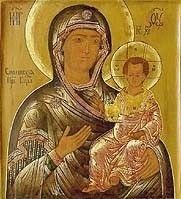
Showing posts with label Theotokos. Show all posts

Friday, May 05, 2017

Stump the Priest: The Feast of the Entry


Question: "Is the story of the Entry of the Theotokos into the Temple historical?"

There are many questions that we cannot answer as fully as we may wish, simply because we are limited in terms of the information that is available to us, and I think this is one of those questions. We have all the information that we really need... just not all that we may wish we had.

One point that I think is often misunderstood about this is that this tradition is not based on the Protoevangelium of James -- that text reflects to a large extent the oral tradition of the Church which preceded it. Were this text our primary source, it would have been included in the New Testament. We should instead look to our services, and to the writings of the Fathers as our best sources of information on this question.

Looking at this question from what we know of history, it is certainly unlikely that the Virgin Mary literally entered into the Holy of Holies of the Temple -- which was the most sacred inner sanctuary of the Temple, that only the High Priest was allowed to enter. If this did literally happen, it would have been something that would have, by divine intervention, remained hidden from most people,

The fact that it was unlikely, does not mean that it did not literally happen. Miracles are by definition unlikely occurrences. However, I think it is possible that the services use the phrase "Holy of Holies" as a more general reference to the Temple as a whole, and I think they do this in part because the Holy of Holies was a foreshadowing of the Lord's incarnation in the Virgin Mary's womb. In a very real sense, she became the Holy of Holies in a way that was more of a reality than the literal earthly Holy of Holies ever was. God was given flesh in her womb, and dwelled there bodily.

What is not unlikely about this story is the idea of a female going to live in the Temple precincts. We have an example in Luke 2:36-37 of a woman who lived in exactly that way:
"And there was one Anna, a prophetess, the daughter of Phanuel, of the tribe of Asher: she was of a great age, and had lived with an husband seven years from her virginity; and she was a widow of about fourscore and four years, which departed not from the temple, but served God with fastings and prayers night and day."
Furthermore, we know that the Prophetess Anna was not a unique example of such a woman from the Old Testament. In Exodus we have a very interesting, but brief mention of such women who served at the Tabernacle, which was  the Tent version of what became the fixed Temple in Jerusalem:
"He made the basin of bronze with its stand of bronze, from the mirrors of the women who served at the entrance to the tent of meeting" (Exodus 38:8 NRSV).
Interestingly, in the Septuagint Greek, the word "served" is translated  "fasted," which was probably a paraphrase intended to describe their primary activity, which was to pray and fast (as seen in the case of the Prophetess Anna in Luke), though they no doubt had other duties related to the Temple.

And these women are mentioned again in 1st Samuel, in the context of a description of the abuses the sons of the Priest Eli engaged in:
"Now Eli was very old. He heard all that his sons were doing to all Israel, and how they lay with the women who served at the entrance to the tent of meeting" (1 Samuel 2:22).
One thing that this passage indicates is that these women were likely not all widows in their 80's, for Eli's sons to be seducing them. And it was especially egregious that they slept with these women, because they were women who were dedicated to serving the Lord.

The Hebrew word translated as "served" is very interesting. It is tsâbâ' (צבא) which has the same root as the word "Sabaoth," as in "Lord of Sabaoth" -- which means "Lord of Hosts" or more literally "Lord of the Armies". This word means "to serve," like a soldier, in troops... and is often translated as "to fight", and it is similarly used in reference to the male Levites who also served in the Tabernacle and the Temple. And so this refers to a band of women who were dedicated to the service of the Lord, and who served at the entrance of the Tabernacle, and later, the Temple.

Unfortunately, I am limited by the reference material I have available to me, and it is striking that the Protestant sources I have generally show a surprising lack of curiosity about who these women were, or what they did. However, Brevard Childs's commentary on Exodus says:
"This verse, which has no earlier correspondent, has evoked much discussion as to its meaning. Who were the 'ministering women'? Why is  their work described by the verb sb' which denotes an organized service like the professional Levites? Some commentators have suggested a cleaning and repairing service, others singing and dancing. The only parallel is I Sam. 2.22 which is of little real help. Driver suggests that the verse implies that the service of the tabernacle had already been under way. There is insufficient evidence to decide whether older historical material is involved or later midrashic exegesis. The literary form would favor the first alternative" (The Book of Exodus: A Critical, Theological Commentary (Philadelphia: Westminster Press, 1974), p. 636).
The Feast of the Entry of the Theotokos is undoubtedly part of our Tradition, and we know that we are celebrating both an historical and theological truth in this feast. However, when it comes to hymnody in particular, how literally we should take what is said will vary -- that is the nature of any kind of poetry, including much of the poetic material we find in Scripture. For example, the Prophet Isaiah, in foretelling the return of the Israelites from the Babylonian captivity says:
"For ye shall go out with joy, and be led forth with peace: the mountains and the hills shall break forth before you into singing, and all the trees of the field shall clap their hands" (Isaiah 55:12).
This prophecy foretold the joy of the return of the Israelites to their land, but we do not need to believe that they were literally greeted with singing mountains and clapping trees for this to be true.

Likewise, in the Akathist to the Theotokos, when it speaks of the Archangel Gabriel speaking to the Theotokos, I don't think anyone would argue that this is intended to be a stenographic account of was actually said at the Annunciation. But in the form of the poetry of the Akathist, we are given a truthful reflection of the meaning of that historical event.

For More Information, see:

Homily on the Entry of the Theotokos, by St. Gregory Palamas

Mary in the Protevangelium of James: A Jewish Woman in the Temple? (Greek, Roman, and Byzantine Studies 53 (2013) 551–578), by Megan Nutzman

Did Jewish Temple Virgins Exist and was Mary a Temple Virgin?, by Dr Taylor Marshall

Friday, January 30, 2015

Stump the Priest: One Mediator, Many Intercessors

The Virgin Mary beseeching Christ at the Wedding of Cana

Question: "Protestants often claim that Orthodox (and other Christians)  raise the Theotokos to the divine level of Jesus Christ by referring to her as "intercessor". In their opinion "there is only one mediator; the Man Christ Jesus". Furthermore they point out that by beseeching her to "turn away the wrath stirred up against us" we turn her into a Christian "type" of the pagan Mother & Child deities from the ancient world. These "mother goddesses" were often invoked to similarly turn away their "son-god's" wrath. They say this is a blasphemous aberration that entered the Church under the "paganization process" they claim happened under the Roman emperor St Constantine. How does one answer these accusations from both Scripture and Tradition?"

This claim is based on St. Paul's statement in 1 Timothy 2:5: "For there is one God, and one mediator between God and men, the man Christ Jesus." However, one need only look to the verses immediately prior to that statement to find: "I exhort therefore, that, first of all, supplications, prayers, intercessions, and giving of thanks, be made for all men; for kings, and for all that are in authority; that we may lead a quiet and peaceable life in all godliness and honesty. For this is good and acceptable in the sight of God our Savior; who will have all men to be saved, and to come unto the knowledge of the truth" (1 Timothy 2:1-4). St. James also tells us that "The effectual fervent prayer of a righteous man availeth much" (James 5:16). So clearly the fact that Christians are called upon to make supplications, prayers, and intercessions on behalf of others is not a contradiction to Christ being the one mediator.

In what sense is Christ the one mediator? In Hebrews 9:15, St. Paul also says: "And for this cause he is the mediator of the new testament, that by means of death, for the redemption of the transgressions that were under the first testament, they which are called might receive the promise of eternal inheritance." So is the unique mediator between God and Man in that He became incarnate, was crucified, died,  and rose again for our salvation. No one else can possibly provide the basis for our salvation. And yet, God desires that we have many intercessors who pray for others, and that God acts in response to these prayers.

When I was a Protestant, who was interested in Orthodoxy, but had to deal with this question myself, it so happened that one day I was talking to a neighbor who was talking about the wife of a retired professor at Southern Nazarene University (the school I attended). He said that this woman was such a woman of prayer that if you ever needed an answer to prayer, she would be the one to go to, because she “had a hotline to God.” Having known some very pious Nazarenes over the years, I didn't find his account hard to believe. But then it dawned on me, if any woman ever had a hotline to God, that would be first and foremost, the Virgin Mary, wouldn't it? And didn't Christ say that God was the God of the living and not the dead (Matthew 22:23-33), and so if I could ask this pious old Nazarene woman  from Bethany, Oklahoma to pray for me, couldn't I also ask the Virgin Mary from Nazareth of Galilee to pray for me?

As for the question of turning away God's wrath, one finds many examples in which God's wrath was turned away by the prayers of righteous men. For example, Moses himself recounts how he turned away God's wrath from the people of Israel: "Furthermore the Lord spake unto me, saying, I have seen this people, and, behold, it is a stiffnecked people: let me alone, that I may destroy them, and blot out their name from under heaven: and I will make of thee a nation mightier and greater than they.... And I fell down before the Lord, as at the first, forty days and forty nights: I did neither eat bread, nor drink water, because of all your sins which ye sinned, in doing wickedly in the sight of the Lord, to provoke him to anger. For I was afraid of the anger and hot displeasure, wherewith the Lord was wroth against you to destroy you. But the Lord hearkened unto me at that time also (Deuteronomy 9:13-14, 18-19). And in the Psalms we are told: "Therefore he said that he would destroy them, had not Moses his chosen stood before him in the breach, to turn away his wrath, lest he should destroy them" (Psalm 105[106]:23). So if Moses could turn away God's wrath, I see no reason why it would be blasphemous to ask the Virgin Mary to pray for us, and to turn away God's wrath from us.

See also:

Stump the Priest: Is There Anything Special About the Virgin Mary?

The Gospel of the Virgin Mary

The Icon FAQ: Answers to common questions about icons (which discusses the veneration of Saints)

Can the Virgin Mary "Save" Us? by Fr. Andrew Damick

One Mediator Between God and Men, by Tim Staples (from Catholic Answers)

Thursday, October 02, 2014

Stump the Priest: Did the Virgin Mary Ever Sin?


Question: Did the Virgin Mary ever sin?

Protestants often argue that the Virgin Mary had to have sinned, because she says in the Magnificat "my spirit hath rejoiced in God my Savior" (Luke 1:47), and so if God was her savior, she must have been a sinner in need of a savior. But while it is certainly true that a person drowning the sea needs a savior, a person who is prevented by someone from falling into the sea in the first place can also be said to have a savior.

There are also some early Fathers of the Church who seem to suggest that the Virgin Mary may have sinned, while there are many Fathers who state clearly that she was sinless. But it is possible that they are all right, but in different senses.

Contrary to the view of many Protestants "sin is sin" (i.e., that any sin is equally bad in the eyes of God as any other sin), the Church and the Scriptures make a clear distinction between willful and intention sins, and sins of ignorance. For an example of this distinction being made in Scripture, see Numbers 15:22-31. In that passage, it is taught that one sacrifice for the sins of ignorance of all the people was sufficient to cleanse them of such sins, but that those who sinned "with a raised hand", as the Hebrew word translated "presumptuously" in verse 30, was specifically not cleanse by such a sacrifice. So it is possible that the Virgin Mary was free from willful sins of intention, but not free from sins of ignorance.

St. John (Maximovitch) deals with this question in his treatise "The Orthodox Veneration of the Mother of God," in the section entitled "Zeal Not According to Knowledge", in which he takes issue with the Roman Catholic doctrine of the Immaculate Conception of the Virgin Mary, and argues that the teaching that the Virgin Mary was completely sinless, in every sense, is contrary to Scripture and to the writings of the Fathers.

Update: For non-Orthodox readers, if you read the treatise by St. John (Maximovitch) you will see that the Orthodox Church rejects the doctrine of the immaculate conception, which teaches that the Virgin Mary was conceived without the taint of original sin. We also do not believe that original sin carries with it any guilt, but is instead an inclination toward sin... but one only acquires personal guilt when they actually commit sins.

Thursday, August 07, 2014

Stump the Priest: Saved in Childbearing?


Question: "What does 1st Timothy 2:15 mean when it says that a woman shall be "saved" in child bearing? How do the Orthodox interpret that passage?"

One important thing to keep in mind here is that the word translated as "saved" has a broader meaning that is often assumed in our culture, which has been heavily influenced by Protestant thinking. It can mean "help", "deliver", "heal", etc.

As is often the case, St. John Chrysostom provides the best answer to the question:

“The woman,” he says, “being deceived was in the transgression.” What woman? Eve. Shall she then be saved by child-bearing? He does not say that, but, the race of women shall be saved. Was not it then involved in transgression? Yes, it was, still Eve transgressed, but the whole sex shall be saved, notwithstanding, “by childbearing.” And why not by their own personal virtue? For has she excluded others from this salvation? And what will be the case with virgins, with the barren, with widows who have lost their husbands, before they had children? will they perish? is there no hope for them? yet virgins are held in the highest estimation. What then does he mean to say? Some interpret his meaning thus. As what happened to the first woman occasioned the subjection of the whole sex, (for since Eve was formed second and made subject, he says, let the rest of the sex be in subjection,) so because she transgressed, the rest of the sex are also in transgression. But this is not fair reasoning; for at the creation all was the gift of God, but in this case, it is the consequence of the woman’s sin. But this is the amount of what he says. As all men died through one, because that one sinned, so the whole female race transgressed, because the woman was in the transgression. Let her not however grieve. God hath given her no small consolation, that of childbearing. And if it be said that this is of nature, so is that also of nature; for not only that which is of nature has been granted, but also the bringing up of children. “If they continue in faith and charity and holiness with sobriety”; that is, if after childbearing, they keep them in charity and purity. By these means they will have no small reward on their account, because they have trained up wrestlers for the service of Christ. By holiness he means good life, modesty, and sobriety" (St. John Chrysostom, Homily 9 on 1 Timothy).

So the reproach against the female sex that was due to Eve's deception is undone by child bearing and the bringing up of children. St. John notes that not all women have children, and so it is not that individual women are saved only if and when they give birth, but the female sex as a whole is delivered from the reproach of Eve through child birth. This is especially true of the Virgin Mary, whose obedience has undone the disobedience of Eve.

Thursday, July 03, 2014

Stump the Priest: A Hymn to the Theotokos


Question: "The last paragraph in the Akathist to the Kursk Root icon says: "...for we have no other help beside thee, no other intercessor, nor gracious comforter but thee, O Mother of God, to preserve and protect us unto the ages of ages. Amen." I have several questions here: 1). No other help beside her? What about our guardian angel and the Akathist to him? Why do we waste our time praying to him if the Theotokos is our only help and intercessor? And why do we waste our time praying to our patron saint and other saints? 2). No gracious comforter but the Theotokos? The Holy Spirit has the role of comforter (John 15:26). Does this prayer teach that no other saint or angel can comfort us? 3). We ask her to preserve and protect us unto the ages of ages. This prayer seems to imply that in the heavenly afterlife, Christians are in some sort of spiritual danger, so that we are in need of protection of the Theotokos."

You have to first consider the genre of literature you are dealing with. You are not dealing with words from a geometry textbook. You are dealing with hymns, that are poetic. Even outside of poetry, you encounter hyperbole in Scripture. For example, when Christ said "And if thy right eye offend thee, pluck it out, and cast it from thee: for it is profitable for thee that one of thy members should perish, and not that thy whole body should be cast into hell" (Matthew 5:29), the point was not that we should systematically eliminate various parts of our bodies. As St. John Chrysostom observed: "therefore He hath given these injunctions; not discoursing about our limbs; -- far from it, -- for nowhere doth He say that our flesh is to be blamed for things, but everywhere it is the evil mind that is accused. For it is not the eye that sees, but the mind and the thought. Often, for instance, we being wholly turned elsewhere, our eye sees not those who are present. So that the matter does not entirely depend upon its working. Again, had He been speaking of members of the body, He would not have said it of one eye, nor of the right eye only, but of both. For he who is offended by his right eye, most evidently will incur the same evil by his left also. Why then did He mention the right eye, and add the hand? To show thee that not of limbs is He speaking, but of them who are near unto us. Thus, “If,” saith He, “thou so lovest any one, as though he were in stead of a right eye; if thou thinkest him so profitable to thee as to esteem him in the place of a hand, and he hurts thy soul; even these do thou cut off.” And see the emphasis; for He saith not, “Withdraw from him,” but to show the fullness of the separation, “pluck it out,” saith He, “and cast it from thee” (Homily 17:3 on Matthew). So hyperbole, particularly in poetry is a perfectly legitimate way of speaking, but it has to be understood in the manner it is intended.

Also, in the Russian prayer book, at the end of the evening prayers, we say "All of my hope I place in thee, O Mother of God: keep me under thy protection." But two prayers after that, we say "My hope is the Father, my refuge is the Son, my protection is the Holy Spirit: O Holy Trinity, glory to Thee." Now if the first statement was meant to suggest that all of our hope was placed in the Virgin Mary, to the exclusion of having hope in anything or anyone else, then you would have a contradiction, but clearly you would not have contradictory statements set right next to one another. The point of the prayer is to say that we have complete hope in the Theotokos. And this hope is not separate from our hope in the Trinity. Thou we do not always spell it out in each and every request we make of the Mother of God, we are always asking that she help us by her prayers. As we sing in the festal antiphons, "Through the prayers of the Theotokos, O Savior, save us." We do not believe that the Virgin Mary and the Saints are demigods that act independently of the Trinity. They help us by their prayers. Obviously, God does not need our prayers, or the prayers of the saints, but it evidently pleases Him that we pray to Him and that we ask others to pray for us, and for Him to work in answer to our prayers. We are told that the saints will reign with Christ (2 Timothy 2:12; Revelation 20:4, 6), and clearly this is not because Christ needs our help... but because it pleases Him that it be so. In 1st Samuel (1st Kings LXX) 2:30 we are told, "for them that honour me I will honour, and they that despise me shall be lightly esteemed." And the Psalter tells us "Wondrous is God in His saints (Psalm 67[68]:35). God chooses to work miracles through the prayers of the saints, because they are His friends (John 15:15, James 2:23) and He wishes to honor them, because they honored Him

When this text speaks of "no other intercessor" and "no other comforter", this is an example of hyperbole. It is a poetic way of expressing our desperate need. A classic example from cinema is from the first Star Wars movie:


That did not mean that no one else was going to be of any assistance in the fight against Darth Vader. And we are certainly not suggesting that the Theotokos can help us, but God cannot. And again, when it talks about being protected and preserved unto the ages of ages, this does not mean that after we are glorified and in heaven with Christ for all eternity that we will be in the same desperate need of the prayers of the Theotokos, but it does mean that if we ever want to get there, it would be a big help to have the help and protection of her prayers.

There are many poetic statements in Scripture that are not likely to be taken literally. For example, we are told in the prophecy of Isaiah that "the mountains and the hills shall break forth before you into singing, and all the trees of the field shall clap their hands" (Isaiah 55:12). Mountains cannot sing, and trees do not have hands. This is poetic statement, that paints a picture, which conveys something true, but has to be understood in the sense in which it was intended.

Wednesday, October 09, 2013

Stump the Priest: The Virgin Mary's "Sister," Mary the Wife of Cleopas


Question: "Did the Virgin Mary have a sister? Wasn't She the only child of St. Joachim and St. Ann? However, in the Gospel of St. John, it says "Now there stood by the cross of Jesus his mother, and his mother's sister, Mary the wife of Cleopas, and Mary Magdalene" (John 19:25).

If John 19:25 intended to make a distinction between "his mother's sister" and "Mary the wife of Cleopas" there would almost certainly be another "and" separating them in Greek, but there is not:

"ειστηκεισαν δε παρα τω σταυρω του ιησου η μητηρ αυτου και η αδελφη της μητρος αυτου μαρια η του κλωπα και μαρια η μαγδαληνη."

You don't find any Church Father interpreting this text as suggesting anything other than that the sister in question is Mary the wife of Cleopas.

This question plays an important role in the question of who the "brothers of the Lord" are, and whether the Virgin Mary was ever virgin, or whether she had other children by St. Joseph.

One of the key passages brought up by Protestants that reject the Tradition of the Church on this issue is  Matthew 1:25: "And [Joseph] knew her not till she had brought forth her firstborn son: and he called his name Jesus."

First of all we must remember that the Bible was not written in English. The word translated "till" in this verse is the same word translated "until" (or "unto" in the KJV) in Matthew 28:20: "...And behold I am with you always, even until the end of the age." If we follow the logic of the Protestant argument in the first chapter of Matthew, we have to conclude that Christ will not be with us after the end of the present age. Also even in English, when we say "Joe refused to repent till the day he died," we obviously do not mean to suggest that he did repent afterwards. The point of this verse is plain. It leaves no room for doubting that Christ was not the result of relations between the Virgin Mary and St. Joseph—it says nothing about what happened thereafter, one way or the other.

St. Jerome wrote a very detailed treatise on this subject that one can find in several readily available translations—it is titled "The Perpetual Virginity of Blessed Mary". Not only was this view held universally in the Early Church, but the Early Reformers all believed it, as did John Wesley.

Nowhere in the NT does it say that the Virgin Mary and St. Joseph ever moved beyond betrothal. The Bible speaks of St. Joseph's "espoused" wife even when she was "great with child" (Luke 2:5) —but never mentions a marriage happening thereafter. In Jewish culture, a betrothal gave a couple all the responsibilities of marriage, but none of the privileges. Once betrothed, one could only break the betrothal with a divorce. Nevertheless, the couple was not permitted to have marital relations until after the public celebration of the marriage.

Protestants often assume that the doctrine of the perpetual virginity of the Virgin Mary is designed to  glorify to the Virgin Mary, and not God. But the doctrine is actually important because it highlights the  uniqueness and holiness of her Son. Consider the following verse:

"Then said the LORD unto me; This gate shall be shut, it shall not be opened, and no man shall enter in by it; because the LORD, the God of Israel, hath entered in by it, therefore it shall be shut." (Ezekiel 44:2).

This has always been interpreted by the Fathers of the Church to be a typological reference to the Virgin Mary and the Incarnation. When we consider that God took flesh from the Virgin's womb, it is not difficult to imagine that this womb would remain virgin. If God would not allow men to pass through an earthly gate because God had entered in by it, how much more would this be necessary when speaking of the womb by which God became man?

Why then did the Virgin need St. Joseph? That question is valid even if one believes she had other children later -- why did she need St. Joseph to give birth to Christ. The answer is obvious: virgins do not as a rule give birth, and Christ would likely have grown up an orphan had he been born to a single mother, because she would have been stoned to death as an adulteress. Of course God could have constantly intervened to protect her and her Son, but that is not normally how God operates in history.

But Protestants object: "Mary had other children. James is called The Lord's brother. The brothers and sisters who came for Jesus while he was teaching are not cousins as Catholic's claim, like there is no Greek word for cousin." There is a Greek word for "cousin," but there is no Aramaic word for "cousin," and this is the language Christ and the Apostles spoke. In Aramaic (and also Arabic) if you want to precisely refer to a cousin, you would have to say "the son of my uncle," or "the daughter of my aunt". But such circumlocutions do not roll off the tongue, if, for example, you are calling out to your cousins "Hey, sons-of-my-uncle! Come here!" So instead, in Aramaic, the word "brother" or "sister" can be used in reference to kinsmen.

It is extremely unlikely that the Virgin Mary had another sister from the same parents who was also named Mary (John 19:25). And so clearly the term "sister" is being used in some broader sense. What is also very interesting is that this Mary, who is not Christ's mother but who also just happens to be the Virgin Mary's sister, also happens to have kids with the same names as Christ's brothers. See: Matt 27:56, Mark 15:40, 16:1; Luke 24:10; John 19:25. The Matthew account has Mary the mother of James and Joseph. Mark has Mary the mother of James the Less and Joses. John has "his mother and his mother's sister, Mary the wife of Clopas". All accounts mention Mary Magdalene separately and Matthew mentions the mother of the sons of Zebedee (who could not also be married to Clopas). This suggests that Mary the wife of Clopas, who is Mary's sister, is the mother of James and Joses, etc.

The Apostle James, the Son of Alpheaus is not necessarily the same as James the less. They are not connected in the Gospels, though this connection is possible. James the less was the son of Cleopas, but, it is possible that "Cleopas" is a variant Hellenized transliteration of the Aramaic name "Chalphi".

Then we have the very early testimony of Hegesippus who states plainly that the brethren of the Lord were the Children of St. Joseph's brother Cleopas and his wife Mary. .

"After the martyrdom of James and the conquest of Jerusalem which immediately followed, it is said that those of the apostles and the disciples of the Lord that were still living came together from all directions, with those that were related to the Lord according to the flesh (for the majority of them also were still alive), to take counsel as to who was worthy to succeed James. They all with once consent pronounced Symeon, the Son of Cleopas, of whom the Gospel also makes mention [note the Gospels only list Symeon as one of the Brother's of the Lord], to be worthy of the episcopal throne of that parish. He was a cousin, as they say, of the Savior. For Hegesippus records that Cleopas was a brother of Joseph" ((Eusebius' Ecclesiastical History 3:11) note: Hegesippus was a 2nd Century Palestinian Jew. Eusebius preserves one of the few fragments left of his works, since he had access to the great library of Ceasarea and of Alexandria—the contents of which were mostly lost later).

"Some of these heretics, forsooth, laid an information against Symeon the son of Clopas, as being of the family of David, and a Christian. And on these charges he suffered martrydom when he was 120 years old, in the reign of Trajan Caesar, when Atticus was Consular legate in Syria. And it so happened, says the same writer, that, while inquiry was then being made for those belonging to the royal tribe of the Jews, the accusers themselves were convicted of belonging to it. With show of reason it could be said that Symeon was one of those who actually saw and heard the Lord, on the ground of his great age, and also because the Scripture of the Gospels makes mention of Mary the [wife] of Clopas, who, as our narrative has shown already, was his father. The same historian mentions others also, of the family of one of the reputed brothers of the Savior, named Judas, as having survived until this same reign, after the testimony they bore for the faith of Christ in the time of Domitian, as already recorded. He writes as follows: They came, then, and took the presidency of every church, as witnesses for Christ, and as being of the kindred of the Lord. And after profound peace had been established in every church they remained down to the reign of Trajan Caesar: that is, until the time then he who was sprung from an uncle of the Lord, the aforementioned Symeon son of Clopas, was informed against by various heresies, and subjected to an accusation like the rest, and for the same cause, before the legate Atticus; and while suffering outrage during many days, he bore testimony for Christ: so that all, including the legate himself were astonished above measure that a man 120 years old should have been able to endure such torments. He was finally condemned to be crucified...." [St. Hegesippus [who reposed 170 ad], Fragments from his five books of commentaries on the acts of the Church, Ante-Nicene Fathers Vol. 8, p 762]