Monday, September 30, 2013
Pravoslavie.ru: 4th Century of Church of Ss. Sergius and Bacchus in Ma'loula, Syria Destroyed by Obama Backed "Free-Syrian Army" (aka Al Qaeda)
Ma'loula, September 29, 2013
Militants have destroyed the ancient Christian Church of Holy Martyrs Sergius and Bacchus in Ma'loula and have stolen or demolished its world-famous icons. A correspondent of ITAR-TASS agency saw it for himself on September 29.
This construction, which was the oldest in the Middle East, had been built in the early 4th century. There was a convent here lately; but after the coming of the terrorists and militants of Al-Nusra Front a month ago the sisters found refuge in the Convent of St. Thecla, Equal-to-the-Apostles, where at the present time they are taking shelter from the militants together with 40 orphaned children. It is still impossible to come up to this convent because of the heavy fire of snipers who do not even spare journalists.
The Church of Sts Sergius and Bacchus became "guilty" because of the building of the "Safir" hotel near it, where earlier numerous Christian pilgrims and tourists used to stay, but then Muslim extremists took their positions there. The Syrian army has almost leveled the hotel to the ground but the militants are still taking cover in its cellars and in neighboring grottos, converted into cells. Where monks used to live in ancient times, now there is sustained artillery fire.
A unique icon of Sts. Sergius and Bacchus painted in the 13th century, which was situated just at the entrance, has been lost forever. The iconostasis and its central icon, painted in the 13th century, have been destroyed together with the icons of the Mother of God and Christ "the Archpastor". The latter always evoked the surprise of researchers because it depicted Christ in a long robe of silk with golden threads which is more typical to Damascus of the 18th century than to the period of the beginnings of Christianity. There is no altar of Sts. Sergius and Bacchus any more. It was semicircular with a low edge—the legacy of pagan altars. Now only debris remains of it.
It is difficult to predict how much of the scientists’ time and strength it will take to calculate all damage; however, in the view of a layman, the church cannot be restored. The main cross fell from the dome, wall paintings were destroyed, shot down and slashed by debris, while the walls themselves were either destroyed or disfigured by holes of shells. At the same time, the militants are continuing to shoot down the remaining church walls with mortar.
According to the report of the soldiers to the ITAR-TASS correspondent, they managed to rescue one icon, though it was damaged by debris as well. It is currently at the house of one Syrian serviceman, and the government bodies are aware of it. But which icon it is, the soldiers could not explain.
In the ancient town of Ma'loula the Syrian army is continuing its clean-up operation against terrorists who have hidden in mountain gorges and are unwilling to leave the town. The military feel certain that the operation will prove successful; however, they say they do not rule out that the militants can out of revenge shoot down not only the Convent of St Thecla, Equal-to-the-Apostles, but also five other Churches of the town whose residents were the last in the world to speak Aramaic. It is possible that some of them will return to their homes, but the former Ma'loula has been lost to mankind forever.
Pravoslavie.ru
30 / 09 / 2013
Friday, September 27, 2013
Stump the Priest: What about Slavery in the Bible?
Uncle Tom and Simon Legree
Question: "I often hear the argument that the Bible approved of slavery and that either this means that the Bible should be dismissed as having any validity, or that things evolve over time, and so just as we no longer allow slavery, perhaps we should change our views on homosexuality. How should we respond?"
To answer this question we have to consider why slavery came into existence in the first place, what the Scriptures actually say, and how it came to be that most forms of slavery came to end in the civilized world.
Why Slavery Came into Existence
Slavery was a result of the fall of man. Because of human sin, men fought with one another, and some were forced into slavery. Prior to the 19th century, Slavery was a universal fact of life in every part of the world, including Africa.
Imagine for a moment that you were a member of an Indian tribe prior to the time of Christopher Columbus, and your tribe is attacked by a neighboring tribe. In the course of that battle, your tribe captures some members of the opposing tribe. Now what do you do with them? You don't have a prison system. You can't call for United Nations Peace-keepers to take them into custody. You really have three choices: 1). You could let them go, but then these same people would be back at war with your tribe, and perhaps will kill or capture members of your tribe next, and may not be so generous. 2). You could kill them all, but all human beings have a natural aversion to killing other human beings. 3). Your only other option is to keep them as captives. Eventually, you may trade them back to the other tribe in a prisoner exchange, but at least for some time they are now on your hands. Now your tribe is barely able to feed it's members, much less feed idle prisoners, and so you put them to work, so that they can be productive and help to earn their keep. So now you have slaves... people subjected to involuntary servitude. It is only when you have strong nation states that you begin to have other options when it comes when dealing with those captured in warfare.
And it should be pointed out that even today, though we have eliminated most forms of slavery, our Constitution still allows for involuntary servitude as a punishment for a crime. We do not pay prisoners minimum wage, and yet we do put them to work to help earn their keep. We also still have the potential for a military draft -- and though many will object to this being a form of involuntary servitude, it is in fact involuntary, by definition, it does involve work, including fighting on the battlefield and risking your own life, and if you refuse to submit to the draft, you can be placed in prison, where you can still be compelled to work involuntarily.
What Does the Bible Actually Say About Slavery?
No where in scripture do you find slavery endorsed as a good thing. No where is it mandated that anyone should own slaves. In fact, if you read the book of Exodus, you will find that Slavery is presented as an evil. The Law of Moses addresses slavery, but it put restrictions on how slaves could be treated. The law put limits on how long an Israelite could be kept as a slave, and laid down rules on how slaves could be treated. In contrast, in ancient Rome, for example, the head of a family not only could kill his slaves for any reason, but he could kill or enslave members of his own family. He had absolute power over everyone in his family, and over any slave owned by his family. Slaves were considered to be living tools, having no more rights than a shovel or a hammer.
In the New Testament, St. Paul does say that slaves should obey their masters as they would the Lord -- and this is often cited out of context to discredit Scripture. However, the context also states that masters were to treat their slaves as their brothers. Now, one may object, "How can a master treat a slave as a brother and leave him as a slave?" The answer is that a truly Christian master would have no slave in the real sense of that term. And a Christian slave would no longer be a slave if he is serving such a master out of Christian love. And a Christian slave who was serving an unbelieving master had the hope of winning his master by his love and humility.
But of course many, perhaps most Christian slave owners failed to live up to the teachings of St. Paul, but this also created the discomfort with slavery that eventually ended it.
How Most Forms of Slavery Come to an End in the Civilized World?
As I said, slavery was a universal fact of life prior to the 19th century (though bans on forms of slavery in Europe and other Christian lands have a long history)... but what changed? Out of all the religions of the world, a movement to end slavery arose... and that movement was spawned by the Christian religion. Christians, like William Wilberforce of England, and Charles Finney of the United States campaigned against Slavery. A book entitled "Uncle Tom's Cabin" was written by a Christian author, which appealed to the Christian sensibilities of the American public, and pointed out how even well intentioned Christian slave owners who considered their slaves to be part of their family nevertheless participated in a system that included unspeakable brutality, separated husbands from their wives, and parents from their children, and included the sexual abuse of women slaves. And in the character of Uncle Tom, who is a Christlike figure who is both humble, but also unbending when asked to participate in evil, the American public was moved to bring about the end of Slavery in America. There was also the Christian Tsar Alexander II, the Tsar Liberator, who ended serfdom in Russia, and did it without a civil war.
It is extremely ironic that Christianity should be especially attacked because of the fact that there is mention of slavery in the Bible, when it was Christianity that moved a slave-holding world to see the evils of slavery in the first place, and inspired them to end it. Islam still embraces slavery to this day, and yet Black Muslims act as if the reverse were true, and that it was Islam that was so much opposed to Slavery... when it fact the slave trade began largely with Muslim slave traders selling slaves to European Slave-traders. And if you are an atheist, there is no moral foundation for opposition to slavery... any more than you could be morally opposed to a cheetah eating an antelope. The strong make use of the weak as they see fit. And in fact, in militant atheist countries, Slave labor has always been and remains an accepted means of production.
And those who wish to compare the issue of slavery with homosexuality has a big problem. The Scriptures nowhere mandate slavery, or endorse it as a good thing; but the Scriptures clearly teach that homosexual sex is inherently sinful.
For more on that, I would recommend you read "Slavery, Homosexuality, and the Bible: A Response," by Robert A. J. Gagnon, Ph.D.
For more information:
Does God Approve of Slavery According to the Bible? by Rich Deem
Does God condone slavery in the Bible? (Old Testament), by Glen Miller
Does God condone slavery in the Bible? (New Testament), by Glen Miller
Stump the Priest: Laws about Slavery, by Fr. John Whiteford
Wednesday, September 25, 2013
Being Frank
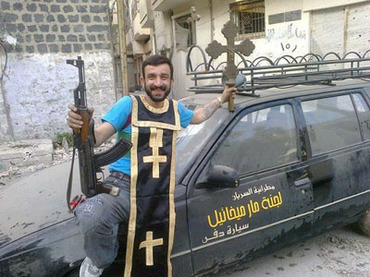
An Obama backed Terrorist, making sport of the loot from a Syrian Church that has been ransacked.
Frank Schaeffer has had a long career as a writer and speaker, and if you have followed him over the years, you know that his primary writing and speaking mode is righteous indignation, peppered liberally with sarcasm, and spiked with a penchant for gross exaggeration of the views of those he disagrees with. That righteous indignation was once directed at those who kill babies for money -- the abortion industry. When he converted to Orthodoxy, his indignation was also turned on the Protestants from whence he came, to whom his father, Francis Schaeffer remains a highly regarded figure. In more recent years, he has become a pro-Obama, pro-homosexual, and anti-war advocate (at least when George Bush was waging the wars), and so now supports the very people in the abortion industry that he was once so righteously indignant about. How one goes from being in favor of blockading abortion clinics, to supporting a president who opposed laws that would protect babies born alive in botched abortions is beyond comprehension.
In his most recent blog post, he has now taken aim against not only the "religious right" (a favorite target of his in recent years), but now even the Orthodox Church that he still is ostensibly a member of is in his cross-hairs -- because they support Russia's laws restricting the promotion of homosexuality.
I looked over his blog to see if he had expressed any concern for his Orthodox Christian brothers and sisters in Syria, who are being raped, murdered, and run out of their ancient homes by Al Qaeda terrorists, who are armed and supported by Barack Obama, but there was not a word. Tens of thousands of Syrian Christians are now dead, millions are refugees, and not a word of concern. He also expresses no concern over the Coptic Christians of Egypt, who are similarly suffering at the hands of supporters of the Muslim Brotherhood regime that Obama helped to put into power. But who is Frank Schaeffer concerned about today? Homosexuals in Russia. Where is his righteous indignation directed at today? The American religious right, and the Orthodox Church.
Vladimir Putin, on the other hand has been one of the lone voices on the international stage that has expressed concern for the Christians of Egypt and Syria. Whatever else one may think of Putin, the Christians of Egypt and Syria have a much higher opinion of Putin right now than they do of Obama. And it should pointed out that Frank Schaeffer's own opinion of Putin has not always been so negative.
When George Bush invaded Iraq, and then the subsequent guerrilla war resulted in a mass exodus of Iraq's Christian population, at least he could say no one saw that coming. However, Obama knows what is going on in Egypt and Syria, and he knows what would happen to the Christians of Syria if he bombed the Syrian government, and the Al Qaeda terrorists he is arming took power... he just doesn't seem to care; and unfortunately, neither does Frank Schaeffer, it would seem.
The laws on the books today in Russia regarding homosexuals are more liberal than the laws we had here in the United States just 40 years ago. It is not a crime in Russia to be a homosexual. It is only a crime for them to propagandize minors. They are also not allowed to have gay pride parades... which in the United States are obscene displays of perversion in the streets of almost every major city in America. And "Natasha's Two Mommies" is not a book read to children in kindergarten in Russia. This, Frank Schaeffer finds more of a concern than the murder of Christians in Syria with the aid and comfort of his beloved Barack Obama.
The Russian Orthodox Church, as Frank well knows, suffered horrendously under the Soviet Union. The Church is therefore not inclined to antagonize the state unnecessarily... especially when that state is on the right side of a question. The Church has spoken against the government when it has taken positions contrary to that of the Church -- for example, Putin was for some time opposed to introducing instruction about Russia's religious heritage, while the Church was a strong advocate of that idea. In the end, the government introduced such courses, and so now parents can choose between courses that study Orthodox Christianity, Islam, Judaism, or Buddhism -- which are the primary religions in Russia. But when the Russian government passes laws that restrict homosexual propaganda, the Church has no reason to oppose those laws, and good reason to support them, since they reflect traditional Christian morality. The Orthodox Church is not going to change its views on homosexuality, since the Scriptures, the Fathers, and the Canons are unambiguous on the subject. Of course Orthodox Christians cannot support thugs that beat up homosexuals in the street. But in the United States we now have homosexuals beating up those that disagree with them in the streets, and we hear nothing from Frank about that.
Frank cites two Orthodox Christian clergymen as being "pro-gay": "Archbishop" Lazar Puhalo, and Fr. Antony Hughes. And suggests that they represent a hopeful trend in the Orthodox Church. However, if Frank read the article about Lazar Puhalo that he linked, he should be aware of the fact that he is a crank, with a very checkered history. He was never an active priest, bishop, or Archbishop in any legitimate Orthodox Church. He was a deacon in ROCOR before he was deposed for disobedience, and began his career as a vagante bishop, and was only received by the OCA as a retired Archbishop as an act of economia-- a decision that was controversial even within the OCA. His views range from being slightly off, to the outlandish, and so he is hardly a mainstream bishop. I know less about Fr. Antony Hughes, but I know that the Bishops of the Antiochian Archdiocese have little patience for anyone who challenges the teachings of the Church that homosexual acts are inherently sinful, and that only a repentant homosexual who is struggling against that sin may receive communion. The views of the Orthodox Church on the question of homosexuality are known, and are not up for debate.
You can read about a Roman Catholic mother who was beaten, raped, and murdered by a homosexual because she had persuaded her son to end his homosexual relationship with him: http://cnsnews.com/news/article/bishop-catholic-mom-murdered-gay-man-died-martyr-her-faith
You can see a video of a gay mob in the Castro District of San Francisco which attacked a group of Christians that were praying peacefully together: http://www.youtube.com/watch?v=O4Xb-au-wpU
You can see a video of a gay mob beating up a Christian at a Gay Pride rally in Seattle: http://youtu.be/OWEV48MPmCM
I am sure most gays oppose such things, just like most Christians oppose gays being beaten.
Also, as I pointed out in a recent post, homosexual activists in the United States, Canada, and the United Kingdom, are using the power of the state to destroy those who do not agree with the homosexual lifestyle in general or gay marriage in particular, if they will not be coerced into either remaining silent about their views or to participate professionally in a gay marriage. In states that have legalized gay marriage, homosexuality is now being taught as normal to even very young children, regardless of the wishes or views of their parents.
Since homosexuals are not proving to be very tolerant of those who disagree with them, now that they have achieved mainstream acceptance in the west, I don't blame Russians for wanting to nip the whole thing in the bud now, so that they don't go down the road to Sodom and Gomorrah too. And it is also interesting that homosexual activists are now focusing their wrath on Russia and the Russian Orthodox Church, but while they will picket an Orthodox Church in San Francisco, for some reason they have not begun picketing mosques to protest the fact that homosexuals are routinely given the death penalty in Muslim countries.
However, whatever grievances gays in Russia, or Christians in the west may have, they are all small potatoes compared with the suffering of Christians in Egypt and Syria at the hands of terrorist groups that have been funded, supported, and defended by the Obama administration. It is a shame that Frank Schaeffer does not use his considerable oratorical and polemical skills to defend Christians who are being threatened, abused, beaten, raped, tortured, beheaded, displaced and butchered by the millions.
Monday, September 23, 2013
Sunday, September 22, 2013
So Gay Marriage Won't Impose Anything on the Rest of Us?
1). If you are a photographer who does not want to take pictures for a gay wedding, either submit to the gay mafia, or be put out of business: N.M. Supreme Court: Photographers Can't Refuse Gay Weddings.
2). If you are a florist, and don't want to decorate a gay wedding, either submit to the gay mafia, or be put out of business:
3). If you own a vacation guest house, and don't want to rent a room with a double bed to a gay couple, you will either submit to the gay mafia, or be put out of business:
Christian guesthouse owners who refused to allow a gay couple a double room because of their religious beliefs say the controversy has forced them to sell up.
4). If you are a 19 year veteran Master Sergeant in the Air Force, and you don't think an airman who said that he personally didn't believe in gay marriage should be subjected to discipline, you with either submit to your Lesbian commanders wishes, or be relieved of your duties: AF sgt. claims he was fired for religious views on gays.
5. If you own a Bakery, and don't want to do a gay wedding cake, you will either submit to the gay mafia, or be shut down: Oregon Bakery Closes Over Owners' Refusal to Serve Gay Wedding.
6. Does your Church own a retreat center, and would rather not have gay weddings served there? If so, you will either get your minds right and allow the gays to have their marriage on your Church property, or you will be sued, and lose: Judge Rules Christian facility cannot ban same-sex civil union ceremony on its own premises.
And given that this is what they are doing when they still have not forced gay marriage down the throats of every state in the union, just wait until they have. Then you will really get to see what the gay mafia means by diversity and tolerance.
Update: I posted a link to this article on a forum, and a homosexual activist responded that it was simply the price of progress, and the march of equal protection under the law. Here is my reply:
So if you had a black photographer, and the Ku Klux Klan wanted to hire her to photograph a cross burning, she should be put out of business if she refused to take the job?
If the Gay Atheists of America owned a retreat center, and the Family Research Council wanted to rent it and hold a seminar on how homosexuals are spreading disease in America, they should be forced by the courts to rent to them?
If a Gay Atheist soldier were to say publicly that they didn't believe in Sacramental Christian marriage, he should be subject to discipline?
Why not just respect everyone's property rights, and let them do with their own property what they wish, and how about we allow people freedom of association, and freedom of speech, rather than putting people out of business because they don't agree with us?
Using the power of the state to destroy people who you disagree with is not likely to win lots of friends for the gay community. If they want tolerance, they might want to start practicing it.
2). If you are a florist, and don't want to decorate a gay wedding, either submit to the gay mafia, or be put out of business:
3). If you own a vacation guest house, and don't want to rent a room with a double bed to a gay couple, you will either submit to the gay mafia, or be put out of business:
Christian guesthouse owners who refused to allow a gay couple a double room because of their religious beliefs say the controversy has forced them to sell up.
4). If you are a 19 year veteran Master Sergeant in the Air Force, and you don't think an airman who said that he personally didn't believe in gay marriage should be subjected to discipline, you with either submit to your Lesbian commanders wishes, or be relieved of your duties: AF sgt. claims he was fired for religious views on gays.
5. If you own a Bakery, and don't want to do a gay wedding cake, you will either submit to the gay mafia, or be shut down: Oregon Bakery Closes Over Owners' Refusal to Serve Gay Wedding.
6. Does your Church own a retreat center, and would rather not have gay weddings served there? If so, you will either get your minds right and allow the gays to have their marriage on your Church property, or you will be sued, and lose: Judge Rules Christian facility cannot ban same-sex civil union ceremony on its own premises.
And given that this is what they are doing when they still have not forced gay marriage down the throats of every state in the union, just wait until they have. Then you will really get to see what the gay mafia means by diversity and tolerance.
Update: I posted a link to this article on a forum, and a homosexual activist responded that it was simply the price of progress, and the march of equal protection under the law. Here is my reply:
So if you had a black photographer, and the Ku Klux Klan wanted to hire her to photograph a cross burning, she should be put out of business if she refused to take the job?
If the Gay Atheists of America owned a retreat center, and the Family Research Council wanted to rent it and hold a seminar on how homosexuals are spreading disease in America, they should be forced by the courts to rent to them?
If a Gay Atheist soldier were to say publicly that they didn't believe in Sacramental Christian marriage, he should be subject to discipline?
Why not just respect everyone's property rights, and let them do with their own property what they wish, and how about we allow people freedom of association, and freedom of speech, rather than putting people out of business because they don't agree with us?
Using the power of the state to destroy people who you disagree with is not likely to win lots of friends for the gay community. If they want tolerance, they might want to start practicing it.
Wednesday, September 18, 2013
Stump the Priest: Is an Eternal Hell Fair?
Question: I have heard from both atheists and inquirers this question: how can we reconcile the idea of a loving God with the idea of an eternal hell? Wouldn't a loving God give those in hell another chance to accept Him, and escape hell, once they have experienced it? Or, it does not seem fair that God would send people to suffer for all eternity for the finite sins they commit in this life. I have heard an Orthodox priest suggest that everyone will be given an opportunity to accept or reject Christ at the Parousia.
Let me address this question in three parts:
1. Does the Church teach that hell is eternal?
I have previously mentioned the problems with the English word "hell", but if by "hell" you mean Gehenna, then the answer is unequivocally "yes." In the early Church, Origen speculated that perhaps God might eventually save everyone, and so suggested the possibility that no one, not even the Devil himself, would be eternally damned. This teaching was specifically anathematized at the Fifth Ecumenical Council.
St. Paul wrote: "since it is a righteous thing with God to repay with tribulation those who trouble you, and to give you who are troubled rest with us when the Lord Jesus is revealed from heaven with His mighty angels, in flaming fire taking vengeance on those who do not know God, and on those who do not obey the gospel of our Lord Jesus Christ. These shall be punished with everlasting destruction from the presence of the Lord and from the glory of His power" (2 Thessalonians 1:6-9).
Commenting on these verses, St. John Chrysostom wrote:
"There are many men, who form good hopes not by abstaining from their sins, but by thinking that hell is not so terrible as it is said to be, but milder than what is threatened, and temporary, not eternal; and about this they philosophize much. But I could show from many reasons, and conclude from the very expressions concerning hell, that it is not only not milder, but much more terrible than is threatened. But I do not now intend to discourse concerning these things. For the fear even from bare words is sufficient, though we do not fully unfold their meaning. But that it is not temporary, hear Paul now saying, concerning those who know not God, and who do not believe in the Gospel, that “they shall suffer punishment, even eternal destruction.” How then is that temporary which is everlasting? “From the face of the Lord,” he says. What is this? He here wishes to say how easily it might be. For since they were then much puffed up, there is no need, he says, of much trouble; it is enough that God comes and is seen, and all are involved in punishment and vengeance. His coming only to some indeed will be Light, but to others vengeance" (Homily 3, 2nd Thessalonians).
2. Are we going to be given a second chance to repent after death?
I have no idea on what the priest you heard may be basing his claim that everyone will be given one more chance to repent after death. In the parable of the Rich Fool, one does not get the impression that he had another chance coming.
The Prophet Isaiah wrote: "Seek ye the Lord while He may be found, call ye upon Him while He is near" (Isaiah 55:6).
St. Paul says in 2nd Corinthians: "We then, as workers together with Him, beseech you also that ye receive not the grace of God in vain. (For He saith, “I have heard thee at an accepted time, and in the day of salvation have I succored thee.” Behold, now is the accepted time! Behold, now is the day of salvation!) (2 Corinthians 6:1-2).
St. Basil the Great, commented on this verse in his longer Rule:
"Now is the acceptable time," says the apostle, "now is the day of salvation." This is the time for repentance; the next life for reward. Now is the time to endure; then will be the day of consolation.: Now God is the helper of such as turn aside from the evil way; then He will be the dread and unerring inquisitor of the thoughts and words and deeds of mankind. Now we enjoy His longanimity; then we shall know his just judgment, when we have risen, some to never ending punishment, others to life everlasting, and everyone shall receiving according to his works." (Ancient Christian Commentary on Scripture, New Testament, vol. VII, 1-2 Corinthians, p. 255).
I have never seen anything in the Scriptures, or in the writings of the Fathers and Saints of the Church that would substantiate such an idea.
3. How can a good God send anyone to hell?
On one level, we can say that God does not send anyone to hell... at least not against their will. People make choices, and many choose to reject God, and by doing so, send themselves to hell.
The Scriptures make it clear that just as the rewards in heaven will not be the same, but will be according to our works; so too will the punishments in hell be in accordance with the works of the individual. Christ said: "And that servant, which knew his lord's will, and prepared not himself, neither did according to his will, shall be beaten with many stripes. But he that knew not, and did commit things worthy of stripes, shall be beaten with few stripes. For unto whomsoever much is given, of him shall be much required: and to whom men have committed much, of him they will ask the more" (Luke 12:47-48).
God desires that all be saved (1 Timothy 2:4) and is not willing that any should perish (2 Peter 3:9), but he allows his creatures to choose for themselves whether they will choose life or death (Deuteronomy 30:19).
The Prophet Ezekiel wrote: "Say unto them: ‘As I live, saith the Lord God, I have no pleasure in the death of the wicked, but that the wicked turn from his way and live. Turn ye, turn ye from your evil ways; for why will ye die, O house of Israel?’ Therefore, thou son of man, say unto the children of thy people: ‘The righteousness of the righteous shall not deliver him in the day of his transgression. As for the wickedness of the wicked, he shall not fall thereby in the day that he turneth from his wickedness, neither shall the righteous be able to live for his righteousness in the day that he sinneth.’ When I shall say to the righteous that he shall surely live, if he trust to his own righteousness and commit iniquity, all his righteousnesses shall not be remembered; but for his iniquity that he hath committed, he shall die for it. Again, when I say unto the wicked, ‘Thou shalt surely die,’ if he turn from his sin and do that which is lawful and right, if the wicked restore the pledge, give back that which he had robbed, walk in the statutes of life without committing iniquity, he shall surely live; he shall not die. None of his sins that he hath committed shall be mentioned unto him. He hath done that which is lawful and right: he shall surely live. “Yet the children of thy people say, ‘The way of the Lord is not fair.’ But as for them, their way is not fair. When the righteous turneth from his righteousness and committeth iniquity, he shall even die thereby. But if the wicked turn from his wickedness and do that which is lawful and right, he shall live thereby. Yet ye say, ‘The way of the Lord is not fair.’ O ye house of Israel, I will judge you every one according to his ways” (Ezekiel 33:11-20).
When we question God's justice, we are like a toddler who does not understand his parents' discipline, and thinks that they are being unfair... only the difference between us and God is infinitely greater.
As God said through the Prophet Isaiah: “For My thoughts are not your thoughts, neither are your ways My ways,” saith the Lord. “For as the heavens are higher than the earth, so are My ways higher than your ways and My thoughts than your thoughts" (Isaiah 55:7-9).
On the day of judgment, no one will be able to say that anyone received an unjust punishment, but will rather say "the judgments of the Lord are true and righteous altogether" (Psalms 18[19]:9).
Tuesday, September 17, 2013
Sermon on the Newly Established Feast of Ss. Peter and Febronia
This past Sunday was the first Sunday in which the newly established feast of Ss. Peter and Febronia was observed, and so you can listen to my sermon on that occasion by clicking here.
Thursday, September 12, 2013
Stump the Priest: The Problem of Evil
Question: A major argument that I hear from atheists against the existence of God is that there cannot be an all-loving, all-knowing, all-powerful God, because such a being would not permit the evil, pain and suffering that exist in our world. What is the Orthodox response to this "problem of evil"?
This argument is often used to argue against the existence of God, but in reality it is an argument against the goodness of God. If God was the kind of God the Deists envisioned, He would simply not concern Himself with the problem of evil.
The problem of evil is one that is often raised, and there are many good answers for it. For example, C. S. Lewis wrote the book "The Problem of Pain", which covers this question very thoroughly, and I think is well worth reading.
The usual argument points out that the only way that God could prevent evil from existing would be to deny his creatures freedom of choice.
Some also deny the premise of the question, by pointing out that there has only been one good man in human history, and He volunteered to suffer. Suffering is the result of the fall of man, and all creation has suffered as a result of that fall. Christ suffered for us to redeem us from the curse that came as a result of the fall.
In Scripture, the closest thing you find to a treatment of the problem of evil is the Book of Job. In that book, a righteous man suffers, and then struggles with the question of why. The reader is let in on the fact that God is allowing Satan to bring calamities upon Job as a test, but God's answer to Job is essentially to point out that Job is in no position to question God, or to understand his judgments. In the end, Job accepts God's answer and is once again greatly blessed by God, but God never gives Job the answer to the question of "Why?"
The fact is that we know that God is good, because He has revealed Himself to be such. We know that He is all-loving, because He became man and suffered for our sakes. Why bad things may happen to us is often unclear to us. Sometimes, we eventually come to know why. In many cases, however, we will never know, this side of eternity. But we do know that all things work together for good for those who love God (Romans 8:28). God can even take the evil choices of men, and use them for good. As Righteous Joseph, who had been sold into slavery by his brothers, came to realize -- though his brothers had "meant evil" against him; "God meant it for good..." (Genesis 50:20).
David Bentley Hart discusses the problem of evil in this video:
This video summarizes C.S. Lewis's answer to this question:
Dr. Hart on the "New Atheists"
See also this article by Dr. Hart: "God and the Problem of Evil."
Thursday, September 05, 2013
Stump the Priest: Giants in the Bible?
Question: “I wonder, how are we to think of the Giants from the Old Testament? Can it be that there was another race of beings that were drowned in the great flood? Why would God do this? Were they made in his image as well? What was their purpose? Is the evidence of them in the archeological record presented in recent years true?”
The first mention of giants found in Scripture is in Genesis 6:1-4:
“And it came to pass, when men began to multiply on the face of the earth, and daughters were born unto them, That the sons of God saw the daughters of men that they were fair; and they took them wives of all which they chose. And the Lord said, My spirit shall not always strive with man, for that he also is flesh: yet his days shall be an hundred and twenty years. There were giants in the earth in those days; and also after that, when the sons of God came in unto the daughters of men, and they bare children to them, the same became mighty men which were of old, men of renown.”
There are a few early Christian writers that took this to refer to demons mating with humans, and producing giants, but most of the Fathers rejected this interpretation, and said that the "Sons of God" are those of the godly line of Seth, who mated with women of the ungodly line of Cain.
Fr. Seraphim (Rose) notes:
"Some have speculated that the 'sons of God' were heavenly beings or angels. The Holy Fathers were aware of this interpretation and they refuted it, saying that angels cannot beget men." [Here a footnote adds the following: "The identification of the 'sons of God' as angels or heavenly beings was based in part on the apocryphal book of Enoch....Some of the early Christian writers mistakenly accepted this interpretation....The first extant Christian reference to the 'sons of God' as descendants of Seth is in the Five Books of Chronology by the early Christian writer Julius Africanus (A.D. 200-245) (Ante-Nicene Fathers, vol. 6, p. 131). This interpretation became the consistent teaching of the Church, being set forth on theological grounds by St. John Chrysostom (Commentary on Genesis 22:6-7), St. Ephraim the Syrian (Commentary on Genesis 6:3, Hymns on the Nativity 1:48, Hymns on Faith 46:9, Hymns against Heresies 19:1-8, and Hymns on Paradise 1:11), St. John Cassian (Conferences 8:20-21), Blessed Augustine (City of God 15:23), St. Gregory Palamas ('Topics of Natural and Theological Science' 62), St. Athanasius (Four Discourses against the Arians 4:22), St. Cyril of Alexandria, and others."] (GENESIS, CREATION and EARLY MAN, page 244, quoted by "Angels Marry Women? Nephilim, sons of God, and Genesis 6:1-5" By Robert E. Gentet).
And so the giants of Scripture were not a different species, but simply men who were extraordinarily large. The best known giant in the Bible is Goliath. If the Hebrew Masoretic text is taken at face value, Goliath would have been 9 feet 9 inches tall (six cubits and a span). However, according to the Septuagint and Dead Sea Scrolls texts, he was 6 feet 9 inches tall (four cubits and a span) [see J. Daniel Hays, "Reconsidering the Height of Goliath", JETS 48/4].
The tallest man in modern history was Robert Pershing Wadlow, who was just over 8 feet 11 inches:
Robert Wadlow compared to his father, Harold Franklin Wadlow
Assuming the Septuagint text is correct, Goliath would have to look up to Robert Wadlow, who was more than 2 feet taller than he was.
Thursday, August 29, 2013
Stump the Priest: Faith that Moves Mountains?
Question: "Could you explain Matthew 17:20? When Jesus is talking about moving the mountain, is it implied that it is only when the request is in accordance with God's will? Are there other prerequisites involved? And could you comment on the different ways that people might be deceived by that quote, like with having too much faith in their own prayers, etc?"
In this passage, Christ said: "If ye have faith as a grain of mustard seed, ye shall say unto this mountain, Remove hence to yonder place; and it shall remove; and nothing shall be impossible unto you."
Christ was not suggesting that we could simply perform tricks to amaze our friends, but that if we have the faith for some need, and asked for it in faith, our prayer will be answered. But faith is itself a gift from God (1 Corinthians 12:9; Ephesians 2:8), and God will only give us the faith to ask for things that are in accordance with His will. St. John the Apostles says this explicitly in 1 John 5:14-15: "And this is the confidence that we have in Him, that, if we ask any thing according to His will, He heareth us: and if we know that He hear us, whatsoever we ask, we know that we have the petitions that we desired of Him."
Commenting on this, St. Justin Popovich says:
"True human confidence is in the confidence of God, i.e., when man's confidence is completely in the confidence of God, then it is infinite, salvific, and almighty. Its boundaries are: Nevertheless not as I will, but as Thou wilt (Matt. 26:39). What is the will of God towards us, the human race? To achieve, through faith in the Son of God, eternal life. The will of God is completely and perfectly expressed in the God-man Christ, through His Gospel, through His works of salvation (cf. Eph. 1:9-10). Therefore, our confidence is in that we ask for that which belongs to Christ and is evangelical, and -- we receive it from God. It would not be confidence but insolence, shameless, and blind slavery to sin to ask from God something that is unevangelical and to wait for Him to fulfill it for us. Ultimately, that would mean wanting God to be a co-participant in our sin, to bring Him into our love of sin. The reason why our all-good and omniscient God does not fulfill many of our prayers is because they are not according to His will. The stipulation for our prayers to be fulfilled is that they be according to the will of God, and you shall receive. That which is according to the will of God is what is of the Gospel and in accordance with the Gospel. Through this, man's confidence is vouchsafed movement and life within God's infinite Goodness, God''s infiniteness. This is most perfect and the sweetest confidence. Everything else, directly or indirectly, is slavery to sin, death, the devil, and evil" (Archimandrite Justin Popovich, Commentary on the Epistles of St. John the Theologian, trans. Radomir M. Plavsic (Alhambra, CA: Sebastian Press, 2009) p.76f).
There is nothing that I can add to these words of St. Justin.
Wednesday, August 21, 2013
Stump the Priest: Unicorns?
In the second antiphon of the feast, there are three stichoi:
Stichos 1: The mountains of Zion on the side of the north, the city of the Great King (Psalm 47:3 LXX, 48:2 KJV)
Stichos 2: And He brought them unto the mountain of His sanctuary, this mountain which His right hand had gained as a possession (Psalm 77[78]:54).
Stichos 3: Mount Zion which He loved, and He built His sanctuary like that of a unicorn (Psalm 77[78]:68-69).
Each stichos is followed by the refrain: "O Son of God Who wast transfigured upon the mountain, save us who sing to Thee: Alleluia."
The Psalm verses, which reference the mountain of God's sanctuary are obviously being tied to the Transfiguration on Mount Tabor. But before we get into the meaning of this particular passage, let's consider the wider meaning of "unicorn" in the Scriptures.
The Hebrew words for this creature are riem (ראם), rieym (ראים), reym (רים), or rem (רם), and its root is related to the word "rise" râ'am (ראם).
Unlike the gentle unicorns we tend to think of when we hear that word, unicorns in Scripture are used as symbols of strength. For example, in Numbers 23:22, it states: "God brought them out of Egypt; he hath as it were the strength of an unicorn." In Psalm Psalm 21[22]:22, it refers to unicorns in a parallelism with lions: "Save me from the mouth of the lion, and my lowliness from the horns of the unicorns."
In the Greek Septuagint, this words is consistently translated as "monokerotos" (μονοκερωτος), which literally means "single-horn", which is also what the word "unicorn" means. What is interesting is that in St. Jerome's translation of the Vulgate, he often uses the Latin word "unicornis", which is where we get the English word, but at other times he uses the Latin word "rinoceros" (rhinoceros), and this is reflected in the Douay-Rheims translation of Numbers 23:22: "God hath brought him out of Egypt, whose strength is like to the rhinoceros."
There are several species of Rhinos still in existence. Some of them have two horns, though one is large and the other one is smaller, and both are on the nose. Others have one horn only. In fact, the scientific name for a single horn Rhino is "Rhinoceros unicornis".
A rhinoceros unicornis
It is also interesting to note that in some passages in Hebrew, a singular "unicorn" (re'em) is spoken of as having plural horns ("His glory is like the firstling of his bullock, and his horns are like the horns of a unicorn..." (Deuteronomy 33:17), which St. Jerome's texts has as "his horns as the horns of a rhinoceros"). However, in other places, it is clear that it refers to an animal with only one horn ("But my horn shall be exalted like that of the unicorn" (Psalm 91:11 LXX, (92:10 KJV). If various types of Rhinos are in view, single-horned and double-horned varieties exist. These animals also cannot be domesticated, which is consistent with the description found in Job 39:9-10: "Will the unicorn be willing to serve thee, or abide by thy crib? Canst thou bind the unicorn with his band in the furrow? or will he harrow the valleys after thee?"
Also, in the instance in Deuteronomy 33:17, when plural horns are spoken of, the horns are compared to the half-tribes of Ephraim and Manasseh:
"His glory is like the firstling of his bullock, and his horns are like the horns of a rhinoceros: with them he shall push the people together to the ends of the earth: and they are the ten thousands of Ephraim, and they are the thousands of Manasseh."
The tribe of Ephraim was much larger than the tribe of Manasseh, which fits the analogy of the horns of a two-horned Rhino.
There were also some now extinct relatives of the Rhino, the Elasmotherium, that was much larger than a rhino, and had a huge single-horns -- and based on cave drawings, there is good reason to believe that ancient humans had some interaction with some of them.
An elasmotherium sibiricum
So these references are not to a fairy-tale animal that flies through the air, and leaves a trail of pixie dust in its wake -- it refers to an animal that people recognized as very strong, fierce, and a creature who could not be tamed by men.
Now, getting back to the psalm verses used in the second Antiphon. The full psalm verses quoted in part in stichos three read:
"And He chose the tribe of Judah, Mount Zion which He loved. And He built His sanctuary like that of a unicorn, on the earth He established it for ever" (Psalm 77[78]:68-69).
Here is what the Fathers say about these verses:
Blessed Theodoret: ""He built His sanctuary like a unicorn" (v. 69). They say the unicorn is equipped with one horn, and the Law gave instruction for the adoring of one God; and so it was right for him to liken the one Temple, dedicated to the one God, to a unicorn"(Theodoret of Cyrus: Commentary on the Psalms, 73-150), trans. Robet C. Hill (Washington, D.C.: Catholic University of America Press, 2001), p. 39).
St. Augustine: "Lastly there followeth, "and He builded like as of unicorns His sanctification" (ver. 70): or, as some interpreters have made thereof a new word, "His sanctifying." The unicorns are rightly understood to be those, whose firm hope is uplifted unto that one thing, concerning which another Psalm saith, "One thing I have sought of the Lord, this I will require"" (NPNF1, p. 379).
Cassiodorus: ""Unicorns"" signifies those who posses a single hope in the most holy Trinity, towards which the consecrated hearts of the faithful are humbly raised, and they rely on the constancy of faith as the strongest of horns" (Cassiodorus: Explanation of the Psalms, Vol. 2, trans. P. G. Walsh, (New York: Paulist Press,1991), p. 273).
See also
The Berean's Desk: Unicorns
Creation Today: Why Does the Bible Mention Unicorns?
Answers in Genesis: Unicorns in the Bible
See also this video:
Thursday, August 15, 2013
Stump the Priest: Old Calendarism
A monk from Esphigemenou monaster, about to toss a Molotov cocktail.
Question: "The Esphigmenou monastery [on Mount Athos] has recently made headlines; what is happening with them and why are the monks being evicted? How do you view Old Calendarists like these monks, who have broken communion with the rest of the Church?"
The history of the Greek Old Calendar movement is a sad one. What is most sad about it is that it was a problem that could have so easily been avoided had the New Calendar not been introduced into the Church of Greece (along with several other local Orthodox Churches) in the manner in which it was.
In the turmoil that followed World War I, you had the Bolsheviks reeking havoc in Russia, and the Greeks having launched a disastrous attempt to recapture Asia Minor from the Turks which led to a mass expulsion of the Greek population of Asia Minor, there were those who seized the opportunity presented by this upheaval to push for various "reforms" in the Church, and one of those "reforms" was to change the Church Calendar. Specifically, the kingdom of Greece had changed the civil calendar to the Gregorian Calendar, and so there were those who wished to push this change in the Church of Greece as well. In 1923, there was a "pan-Orthodox Synod" (which had representatives from less than half of the Church) which was held to consider this change. What they approved was a calendar that was essentially the same as the Gregorian Calendar, but which preserved the Old Calendar Paschalion (which determines the date of Pascha, and therefore all the aspects of the liturgical calendar that are determined by the date of Pascha). In 1924, the Church of Greece adopted this "Revised Julian Calendar," and in reaction, an Old Calendarist movement began.
The Church of Greece in cooperation with the government of Greece began a policy of repressing the Old Calendarists, which only added bitterness to schism. Gradually various divisions emerged among the Old Calendarists. Many of the Old Calendarists declared the New Calendar Church of Greece to be "without grace," and the degree to which extreme stances were taken added to the division among the Old Calendarists.
The history of the various Old Calendarists schisms is very complicated, and having read the conflicting accounts that the different factions have given about their history, it is my opinion that only God knows which of them are telling the truth in any given instance, and there is good reason to believe that none of their accounts add up entirely. But rather than get lost in the woods discussing their history, let me make a few observations, and then get to the key issues to this question:
1. Had the Calendar not been changed the way that it was, there never would have been a schism.
2. Old Calendarists have pointed to many Ecumenical abuses, especially on the part of clergy under the Ecumenical Patriarchate, and many of their objections have merit -- though their arguments that the rest of the Orthodox Church has fallen away as a result of these abuses does not stand up to scrutiny. However, those responsible for these abuses have some share in the blame that these groups have not been reconciled with the rest of the Church.
3. However, the Old Calendarists have generally taken a simplistic view of the canons and Church history in an attempt to justify their separation from the Church that has swayed many, but which is not justified by the Tradition and Canons of the Church.
4. Many (probably most) Old Calendarists are sincere, but there are also many who use the issues that motivate the Old Calendarists as an excuse for schism in order to provide a haven for those who simply wish to function outside of the reach of the accountability they would have to face in legitimate Orthodox Churches.
Is the New Calendar a Heresy?
While Old Calendarists cite other issues today, the issue that caused their groups to originally go into schism was the change of the Calendar, and so the question must be asked, is the New Calendar a heresy? Was it a sufficient basis for going into schism, and denouncing the Church of Greece?
I am not on the New Calendar, and I am glad that this is the case for two reasons:
1. I do not believe that the New Calendar should have been introduced unless every local Church agreed to make the change, at the same time. Whatever advantages the New Calendar may have, they are not worth causing division, and that is in fact what it caused.
2. Changing the fixed calendar to the New Calendar, but continuing to use the Old Calendar to determine the date of Pascha causes liturgical chaos. The Typikon was not written with such a strange mix in mind. Personally, I think it would make far more sense to change the entire calendar, so that it still worked with the Typikon. As it is, you have lenten commemorations occurring before Lent (such as the feast of the 40 Martyrs of Sebaste), and you have paschal commemorations occurring during lent (such as the feast of St. George). You also have the Apostles fast often ending before it begins, as it did this year.
But despite these issues, it cannot be successfully argued that the New Calendar is a heresy, and according to the Canons, it is only heresy, preached clearly and unequivocally, that is a sufficient basis for separating from your lawful bishop, or a bishop separating from his lawful synod.
The Canons
If you ask an Old Calendarist for the canonical basis of their schism, they will point to Canon 15 of the First and Second Council (The Protodeutera Council) of Constantinople, held in 861, which states in part:
"But as for those persons, on the other hand, who, on account of some heresy condemned by holy Councils, or Fathers, withdrawing themselves from communion with their president, who, that is to say, is preaching the heresy publicly, and teaching it barehead in church, such persons not only are not subject to any canonical penalty on account of their having walled themselves off from any and all communion with the one called a Bishop before any conciliar or synodal verdict has been rendered, but, on the contrary, they shall be deemed worthy to enjoy the honor which befits them among Orthodox Christians. For they have defied, not Bishops, but pseudobishops and pseudo-teachers; and they have not sundered the union of the Church with any schism, but, on the contrary, have been sedulous to rescue the Church from schisms and divisions."
Another basis that is often appealed to is the example of St. Theodore the Studite, who broke communion with the Patriarch of Constantinople because he allowed the Emperor to enter into a fourth marriage.. which was certainly contrary to the well established Tradition of the Church. This controversy is known as the Moechian Controversy (from the Greek word "μοιχός," which means "adulterer," because St. Theodore considered this marriage to be nothing more than adultery). During this controversy, St. Theodore the Studite briefly separated himself from two Patriarchs who are also Saints of the Church.The fact that he separated from two saints of the Church suggests that the example is not one that is so clear cut that one could base a great deal upon it.
Aside from that, a few decades after the repose of St. Theodore, the First and Second Synod was called in Constantinople, and while they did say that a bishop preaching heresy bareheaded in the Church was grounds for schism, they made it very clear that personal sins or canonical violations were not a sufficient basis for a schism.
Canon 13 of that council states:
“The All-evil One having planted the seed of heretical tares in the Church of Christ, and seeing these being cut down to the roots with the sword of the Spirit, took a different course of trickery by attempting to divide the body of Christ by means of the madness of the schismatics. But, checking even this plot of his, the holy Council has decreed that henceforth if any Presbyter or Deacon, on the alleged ground that his own bishop has been condemned for certain crimes, before a conciliar or synodal hearing and investigation has been made, should dare to secede from his communion, and fail to mention his name in the sacred prayers of the liturgical services in accordance with the custom handed down in the Church, he shall be subject to prompt deposition from office and shall be stripped of every prelatic honor. For anyone who has been established in the rank of Presbyter and forestalls the Metropolitan’s judgment, and, judging matters before a trial has been held, insofar as lies in his power, condemns his own father and Bishop, he is not even worthy of the honor or name of Presbyter. Those, on the other hand, who go along with him, in case any of them should be among those in holy orders, they too shall forfeit their own rights to honor, or, in case they should be monks or laymen, let them be utterly excommunicated from the Church until such time as they spew upon and openly renounce all connection with the schismatics and decide to return to their own Bishop” (D. Cummings, trans., The Rudder of the Orthodox Catholic Church: The Compilation of the Holy Canons Saints Nicodemus and Agapius (West Brookfield, MA: The Orthodox Christian Educational Society, 1983), p. 469).
Canon 14 says:
“If any Bishop, on the allegation that charges of crime lie against his own Metropolitan, shall secede or apostatize from him before a conciliar or synodal verdict has been issued against him, and shall abstain from communion with him, and fail to mention his name, in accordance with consuetude, in the course of the divine mystagogy (i.e., liturgical celebration of the Eucharistic mystery), the holy Council has decreed that he shall be deposed from office, if merely by seceding from his own Metropolitan he shall create a schism. For everyone ought to know his own bounds, and neither ought a presbyter treat his own bishop scornfully or contemptuously, nor ought a bishop to treat his own Metropolitan so” (Ibid., p. 470).
Essentially, this says that what goes for Deacons and Priests, goes for a Bishop in his dealings with his Metropolitan too.
And then we have Canon 15:
“The rules laid down with reference to Presbyters and Bishops and Metropolitans are still more applicable to Patriarchs. So that in case any Presbyter or Bishop or Metropolitan dares to secede or apostatize from the communion of his own Patriarch, and fails to mention the latter’s name in accordance with custom duly fixed and ordained, in the divine Mystagogy, but, before a conciliar verdict has been pronounced and has passed judgment against him, creates a schism, the holy Council has decreed that this person shall be held an alien to every priestly function if only he be convicted of having committed this transgression of the law. Accordingly, these rules have been sealed and ordained as respecting those persons who under the pretext of charges against their own presidents stand aloof, and create a schism, and disrupt the union of the Church. But as for those persons, on the other hand, who, on account of some heresy condemned by holy Councils, or Fathers, withdrawing themselves from communion with their president, who, that is to say, is preaching the heresy publicly, and teaching it barehead in church, such persons not only are not subject to any canonical penalty on account of their having walled themselves off from any and all communion with the one called a Bishop before any conciliar or synodal verdict has been rendered, but, on the contrary, they shall be deemed worthy to enjoy the honor which befits them among Orthodox Christians. For they have defied, not Bishops, but pseudobishops and pseudo-teachers; and they have not sundered the union of the Church with any schism, but, on the contrary, have been sedulous to rescue the Church from schisms and divisions” (Ibid., p. 470f).
And so what was said in the previous canons about separating from Bishops and Metropolitans is all the more applicable to one’s Patriarch. There is only one exception given here, and that is when one separates from their Bishop, Metropolitan, or Patriarch, on the basis of heresy that is publicly taught “bareheaded” in the Church. The canon does not say it is justified merely on the grounds that a bishops holds a heretical opinion. It also does not say it is justified because such an heretical opinion might be inferred from his actions or vaguely worded statements. It is only when it is a heresy that has been condemned by the fathers or councils, and is taught publicly, and “bareheadedly”.
These canons, coming as they do in the wake of the Moechian controversy, were clearly designed to ensure that another such controversy would not occur. They clearly define the only basis for schism prior to a conciliar verdict, and that is the clear preaching of heresy. Furthermore, even this canon does not provide for the establishment of parallel jurisdictions prior to a conciliar verdict. In other words, you could withdraw from communion from a bishop who is preaching heresy, but until the Church deals with the matter, you have no grounds for establishing rival Synods, as the Greek Old Calendarists have done.
Now getting back to the monks at Esphigmenou, while all the monasteries on Mount Athos have at times raised objections to actions and statements of the Ecumenical Patriarchate, and while they all have remained on the Old Calendar, all of them remain in communion with the rest of the Church... except for this monastery. It has unfortunately attracted the most extreme monks on the Holy Mountain, and they have painted themselves into a theological and ecclesiological corner.
There have been other examples of Orthodox governments using military force to remove heretical or schismatic monks from a monastery, but I think it would have been better in this case for the Ecumenical Patriarchate to focus their attention on removing the points of scandal that have inspired these monks to take the extreme position that they have, and then to attempt to reason with them in good faith, rather than resorting to the use of force at this point.
The shame of it all is that among the Old Calendarists there are many people who are very pious and devout, and were it not for the issues that have led them into schism, they would be great assets to the rest of the Church and contribute much to its strength. We should pray that they will see their error in their position, but we should also speak out against examples of modernism and ecumenism when we see them, because these things are not only a temptation that has led many into schism -- they are also things that could eventual divide the Church even further. The more we all embrace the Tradition of the Church, the more we will be united; but the more that people in the Church disregard that Tradition, the more division will be the result.
I would recommend that you read "Anti-Patristic: The Stance of the Zealot Old Calendarists, by Monk Basil of the Holy Monastery of Saint Gregory (Grigoriou), Mount Athos.
I would also recommend you read "A Rejoinder to Hieromonk Patapios’ essay: “The Deficient Scholarship of Monk Basil’s Comments on the Allegedly Anti-Patristic Stand of the So-Called“Old Calendarist Zealots."
Tuesday, August 06, 2013
Stump the Priest: The Priesthood
Question: "How does the Orthodox Church views the nature of Holy Orders when compared to the view of the Roman Catholic Church. The Roman church claims that its priests are "Alter Christus," -- another Christ -- who undergo a fundamental change in being at their ordination, and who will be priests even in heaven or hell ("once a priest always a priest"). Does the Orthodox Church accept this formulation? Perhaps you could also express the Orthodox view of the Protestant notion of the "Priesthood of all believers.""
We of course believe that, not only priests, but all Christians, are called to be like Christ. We also believe that in certain respects and at certain times in the Liturgy a priest or bishop represent Christ in a symbolic sense. We do not believe that ordination leaves an “indelible mark on the soul” and that therefore once a person is ordained a priest or bishop, he is therefore “forever a priest, after the order of Melchizedek.” St. Basil’s 3rd and 32nd canon make clear that if a person is justly deposed, no sacrament that they perform would be valid.
In commenting on Canon 28 of the Holy Apostles, St. Nicodemus of the Holy Mountain compares someone who is unjustly deposed with an artist whose tools have been taken away from him. Once the unjust deposition is annulled, he is given back his tools, and is able to paint as before. But a person who is justly deposed is like an artist whose hands are crippled, and even if he takes up his tools again, he is unable to again do with them what he was able to do before.
As for the Protestant view of the "Priesthood of all believers," we would agree with them up to a point. St. Peter indeed says that "you also, as living stones, are being built up a spiritual house, a holy priesthood, to offer up spiritual sacrifices acceptable to God through Jesus Christ…. you are a chosen generation, a royal priesthood, a holy nation, His own special people, that you may proclaim the praises of Him who called you out of darkness into His marvelous light" (1 Peter 2:5, 9). You also find the same idea expressed three times in the book of Revelation (Revelation 1:6; 5:10; 20:6). But you also find the same idea in the Old Testament. For example in the Law of Moses it says "And you shall be to Me a kingdom of priests and a holy nation." These are the words which you shall speak to the children of Israel" (Exodus 19:6).
However, in the Old Testament, even though they were a kingdom of priests, they still had a distinct priesthood. And there is a very interesting incident found in Numbers chapter 16, in which some people began to assert that there should not be such a distinction. In fact, the basic argument of Korah, Dathan and Abiram is not much different than what you hear from many Protestants:
"They gathered together against Moses and Aaron, and said to them, "You take too much upon yourselves, for all the congregation is holy, every one of them, and the Lord is among them. Why then do you exalt yourselves above the assembly of the Lord?"" (Numbers 16:3).
If you read the rest of that chapter, you will see that this attempt to democratize the Liturgical Priesthood of the Old Testament did not end well for them.
Deacons, priests, and bishops have a special grace that is bestowed upon them by the laying on of hands (ordination), and so they have a distinct role in leading the people in worship, and performing the sacraments of the Church. They also have special canonical requirements that not all Orthodox Christians are held to. For example, a blind or deaf person cannot be ordained. They also should have good character, and can only have been married once. And if a man who has married a women who has been married before, even if she is a widow, he cannot be ordained. This does not mean that there is any sin in marrying a widow, but it does mean that clergy have to meet certain standards of ritual purity to be ordained... and so must his wife, if he has one. But clergy function in these roles only because they have the blessing of the Church to do so. If that blessing is taken away, they cannot continue to function in those roles. Also, every Orthodox Christian can pray, and do all the services of the Church without a priest -- short of the sacraments and liturgical blessings specific to the clergy. For example, a parent can and should bless their children by making the sign of the cross over them. If an Orthodox layman is unable to attend a Church, they can do a Vigil as a reader service, and do Typika in the place of the Liturgy. An Orthodox Christian can even baptize someone in the case of an emergency. So we are all a kingdom of priests, but God has established a distinct priesthood to perform a particular role in the life of the Church.
Wednesday, July 31, 2013
Stump the Priest: How Much is Too Much?
Question: "In this world where we are taught to enjoy ourselves and seek pleasure, where, even as Christians, we want to glorify God's creation, how are we to know when we have reached a level of overly enjoying the pleasures of the earth or of God's creation? I mean to say, if we are relaxing on the beach, or walking in wood, or gazing at the heavens, how do we know when enough is enough? It seems obvious we could or should all be working continuously for the Lord by praying or doing good works. But then it seems almost sinful to not enjoy the beauties of the world and God's creation as well. Is there a formula mentioned or something to help us know when enough is enough?"
There is not a simple formula. When you learn how to ride a bike, you have to learn how to balance your weight on the bike, while you peddle, but how do you do that? You do that by trying to do it, and when you fall down, you get back on the bike, and try it again.
There are some things that are inherently evil, and so there is no question but that we should abstain from such things. But it is not a sin to enjoy a good meal, or enjoy the company of another person. These are good things, but most good things can be taken to excess, and then it can become sinful.. but the sin is in the excess, not in the thing itself.
It can be an even better thing to abstain from such pleasures, if you are doing so out of love for God and a desire to draw closer to Him and to remove things that distract from that desire. But even asceticism can become sinful if it is seen as an end in itself or used as a means to vainglory.
It is also sinful if you abstain from things that are good, because you find them abominable. Canon 51 of the Holy Apostles says:
"If any Bishop, or Presbyter, or Deacon, or anyone at all on the sacerdotal list, abstains from marriage, or meat, or wine, not as a matter of mortification, but out of an abhorrence thereof, forgetting that all things are exceedingly good, and that God made man male and female, and blasphemously misrepresenting God’s work of creation, either let him mend his ways or let him be deposed from office and expelled from the Church. Let a layman be treated similarly."
So marriage is good. Eating meat is good. Drinking wine is good. However, if you abstain from these out of true asceticism, that is also good. But if you view these things as sinful in and of themselves, this view is itself sinful, and if not repented of will separate you from the Church.
So the key here is to find a balance. And what the right balance is will be different for different people.
In order to find that balance, you need to inform your conscience by regularly studying the Scriptures, the writings of the saints, and other edifying books. You need to keep the fasts of the Church. You should also pray that God will guide you, and go to confession regularly. And remember the words of St. Poemen the Great: "Everything that goes to excess comes from the demons" (Saying 129 of St. Poemen, from the Alphabetical Collection of the Sayings of the Desert Fathers).
You can listen to a sermon on some of the sayings of St. Poemen the Great which relate to this question, by clicking here.
Tuesday, July 30, 2013
Unfortunate Trends in the Roman Catholic Church
When confronted with videos of really odd abuses in Roman Catholic Masses, such as the video below, Roman Catholic apologists usually just dismiss them as aberrations:
But aside from the usual She-devil distributing communion, or the occasional priest wearing a Barney suit, if you just listen to the music, what you are hearing is run of the mill Charismatic "praise and worship" music.
But then you have this Mass that was done in Los Angeles, with a dozen or so bishops, including the Cardinal, and quite a few deacons and priests, along with thousands of the laity... and this service was broadcasted as well:
Here we have music that could have been from the "Lion King", followed by a Charismatic "praise and worship" song that could have been sung in any non-denominational Protestant Church in the United States. The only parts of the service that are not completely Protestant are the pagan elements of dancers carrying bowls of incense, who are dancing around the holy table. Nevertheless, we are still told that this was just an aberration.
But then there is this video:
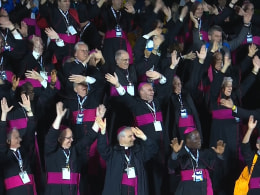
This is from Pope Francis' recent trip to Brazil. Granted, this is not a liturgical dance, but here you have a whole group of Bishops engaged in a tacky dance to celebrate the Pope's visit. Trying to be "hip" and holding fast to the Traditions of the Church do not mix well... and usually those that have tried to make the sacred "hip" have only succeeded in making themselves look foolish, and encouraging the mockery of the sacred.
The Bishops were practicing for this "flash mob" dance, which was done just before the Pope's mass on the beach:
Here is a video of the full mass on the beach:
Here is another video of the current Pope participating in a Children's Mass:
The idea of "Children's Church" is another bad idea imported from Protestantism. What was "Children's Church" in the 70's and 80's, is what is now adult Church in most Protestant Churches. The idea of separating children out from the rest of the Church, and having worship that caters to them has no basis in the Tradition of the Church, and inevitably leads to a dumbing down of the services.
Prior to Vatican II, even the worst critics of Rome would have agreed that their services were solemn. Whatever else you might have said, there was an undeniable dignity and reverence to their services. There is not much dignity or reverence in any of the aforementioned.
The first step in fixing a problem is acknowledging that you have one. Rome, you have a problem.
Update:
As a contrast, you can watch the videos of a very prominent Orthodox Liturgy, which was also outdoor, that took place in Kiev this past Sunday, to mark the 1025th Anniversary of the Baptism of Rus' here:
Part 1:
Part 2:
And if your are wondering what the significance of that occasion was, you can listen to my sermon on it from this past Sunday here: http://www.ancientfaith.com/podcasts/amvon/the_baptism_of_russia
Second Update: Here is a Roman Catholic video critiquing the "Bishop Dance" in Brazil:
Here is a video with a side by side comparison:
Third Update: A pious Roman Catholic assessment of the state of contemporary Roman Catholicism:
Thursday, July 25, 2013
Stump the Priest: Where do the Races Come From?
Question: "Where did all the other races come from? If God created heaven and earth, did he also create the different languages and different colors of skin? If so, what was the reason he created all of us different?"
The concept of race actually does not appear in the Bible. In Scripture, people are categorized as belonging to groups according to their family, tribe, people, nation, and tongue.
There are three broad racial categories that we recognize today: Negroid, Mongoloid, Caucasoid -- and so some suggest a connection between these and Noah's three sons, Ham, Shem, and Japeth, but there is no way to prove or disprove that.
National and linguistic divisions, according to Scripture, began with the Tower of Babel, where God divided the nations by creating differences in language (Genesis 11), and so by dividing the nations God set limits on the ability of evil to spread among from one nation to another.
It should be pointed out that contrary to the beliefs of people prior to the discovery of blood types, all races have all the same blood types. Those features that we consider racial are truly superficial, and the Church does not consider them to be worthy of note.
In Numbers 12 we have an incident that we would think of as racial today, but which was more a question of ethnicity and culture, in which Moses' brother and sister complained about his Ethiopian wife, and it should be noted that God made it clear that it was not Moses who had erred in marrying the Ethiopian, but his siblings in speaking against him on account of it. See "Moses' Black Wife" for more on that incident.
The Jews, of course made a sharp distinction between themselves and the gentiles (nations), but this was not ultimately racial, because it was possible for a gentile to convert to Judaism. But the New Testament repeatedly makes the point that "in Christ there is neither Jew nor Greek," but rather we "are all one in Christ Jesus" (Galatians 3:28; Colossians 3:11). St. Peter, after witnessing the Holy Spirit coming upon Cornelius, said: "In truth I perceive that God shows no partiality. But in every nation whoever fears Him and works righteousness is accepted by Him" (Acts 10:34-35).
The Church Fathers and the Services of the Church, speak of only two races: the race of man (Adam), and the Christian race, and the only mixed marriages we speak of are when an Orthodox Christian marries a heterodox Christian.
In the Kontakion of Pentecost, we are told that at Pentecost, the division of the nations at Babel was undone at Pentecost:
"Once, when He descended and confounded the tongues, the Most High divided the nations; and when He divided the tongues of fire, He called all men into unity; and with one accord we glorify the All-Holy Spirit."
And so while we belong to a particular family, tribe, and nation, and speak different languages, and while we have our racial, and cultural differences -- as Christians we are all one family, and one nation. We are Orthodox Christians first and foremost, and any other difference we may have is only superficial.
Why did he make us with different colors of skin, hair, and eyes? Probably for the same reason that Jacob made Joseph a coat of many colors... such variety makes for more beauty. This is a gift from God to humanity.
Wednesday, July 17, 2013
Stump the Priest: Mass Ordinations?
A Roman Catholic mass ordination
Question: "Why did our bishops declare the ordinations of a group of Western Rite clergy invalid because they were ordained in a single service? Why was this such a big deal?"
There are several reasons. To begin with, every clergyman in the Russian Church, before he is ordained, takes an oath before the Gospel and the Cross, saying that they will “…perform all liturgical services or prayers according to the rules of the Church….” This means that we cannot just make up services, or introduce innovations into the services, but must do the services as approved by the Church and in conformity with its Tradition. They also “promise to be obedient to the ecclesiastical authorities and act according to the Canons of the Holy Apostles, of the Ecumenical and Local Councils and the teachings of the Holy Fathers.” And so not even a Bishop may introduce liturgical innovations into the services of the Church that are contrary to Church Tradition, and not sanctioned by the Church that they belong to.
The argument in favor of doing a mass ordination in the Western Rite is that this was the practice in the pre-schism West. The problem with this argument is the assumption that anything that was done in the pre-schism West is therefore acceptable. In Orthodox Liturgics, we partake of only one loaf for communion… and so no matter how large the congregation, a loaf of sufficient size must be used to be consecrated for the Eucharist (1 Corinthians 10:16-17). In Western practice, the priest partakes of one wafer, but the people all partake of different wafers. In Orthodox Liturgics, a clergyman may only serve one liturgy in a day, and only one liturgy may be served on a given altar. In the west, a priest may celebrate as many Masses as he has the time and strength to perform, and he can do so on the same altar. Likewise, in the West, numerous priest, deacons, and bishops can be ordained at one time, but in Orthodox practice, only one Bishop, one Priest, and one Deacon can be ordained at the same liturgy, because each one represents the fullness and unity of that order. In all of these Western deviations, the idea that we all partake of one Eucharist is obscured by the admission of multiplicity. These deviations in the West were already the subject of controversy before the schism, and were criticized by the Eastern Fathers. In the West you also have the practice of a priest serving a private Mass, with no one beside the priest in attendance. In the Orthodox Church, this is forbidden. This is because the focus in the West was on the Mass as a individual act of private devotion, whereas in the Orthodox Church it is a corporate act of communion, which expresses our unity of Faith. What begins as a small deviation in course, over time leads to one getting very far off course from where they should be. And so while many things were done in the West before the schism, we have to look to the practice of the Church that did not depart into heresy and schism for guidance on these matters.
St. Nicodemus of the Holy Mountain, commenting on Canon 68 of the Holy Apostles (which says that one person can only be ordained once to a given office, which means that if a clergyman is deposed for wrong doing, he cannot subsequently be ordained again), wrote:
“What can be the reason why only two of all the seven Mysteries cannot be performed twice, namely, that of baptism and that of ordination into holy orders? The scholastics, on the one hand, say that it is because these two leave an indelible imprint or stamp which according to them (in the fourth chapter of Theology, as it is to be found in the Catechism by Nicholas Boulgaris) is a real quality inherent in the soul and is a supernatural power. This opinion of the scholastics was followed by almost all our own modern theologians, and especially by Koressios. But to me, on the other hand, it seems that the sole reason why these two mysteries alone are incapable of being celebrated a second time in the life of one and the same individual as a recipient thereof, is because they are carried out in the type, or form, of the Lord’s death, which occurred but once and can never occur a second time. For those who are being baptized are baptized into the Lord’s death, according to St. Paul and Ap. c. XLVII. As for priests who have fallen out of holy orders, the reason why they cannot be ordained a second time is that they typify the first and great priest who came but once to the office of holiness, after finding everlasting redemption, according to St. Paul, and He remains perpetually incapable of fall from holy orders. This in my opinion is the real reason why a priest cannot be reordained. For holy orders in Christ are incapable of fall and cannot be forfeited. Hence His type ought always to stand in the purity demanded and required for holy orders, in order that the likeness may be well preserved, as between the high priest and the one typifying Him. Another reason, however, is also the fact that a priest consists mainly in the exercise of sacerdotal functions, or, more plainly speaking, in sacrificing the mystic sacrament, which is the bloodless sacrifice whereby the one death of the Lord is denounced, according to St. Paul. For it is a question whether there is any good and sufficient reason why these mysteries cannot be celebrated a second time in the nature of the imprint or stamp invented or imagined by the scholastics, because second chrismation is permissible, notwithstanding that the chrism is called a seal, and really does imprint a seal and stamp upon the soul of the one receiving it. For John the Evangelist says: “And the chrism which ye have received from him abideth in you” (I John 2:27). And St. Paul says: “Who hath also sealed us, and hath given us the earnest of the Spirit in our hearts” (II Cor. 1:22). Moreover, one must remember that David even called Saul “anointed of the Lord,” not only after his disregard of God, but also after his death (II Sam. 1:14). Hence and for this reason, namely, the Lord’s unique death, only a single deacon, and only a single presbyter, and only a single bishop or other prelate ought to be ordained at any one liturgy, and not two, or several, according to Symeon of Thessalonica (Reply 39), and also according to Job in the Syntagmation of Chrysanthus. As for those who are not uniquely ordained—i.e., who are not ordained once for all—what they are I know not, says the same Symeon, seeing that they have not been ordained in accordance with the tradition of the Church. In spite of the fact that several anagnosts and sub-deacons are ordained at one and the same liturgy; on the theory that they are more imperfect members of the holy orders, and that they are outside owing to their being in a minor service (commonly called “minor orders” in English), according to the same Job (ibid.). For this reason, that is to say, because of the fact that the unique death of Christ cannot occur a second time, the local synod held in the time of Heraclius against Isidorus in A.D. 613 ordained that two liturgies should not be celebrated on one and the same day and on one and the same table, saying: “It is not lawful on one table in the same day for two liturgies to be said, nor on the same table on which the bishop officiated in a liturgy, for any presbyter to officiate in a liturgy in the same day”: which rule the Papists (i.e., the so-called Roman Catholics) transgress. But then the fact is that even our own priests who celebrate liturgy twice in the same day, under the misconception that this conduces to outspoken emphasis and greater impressiveness, are gravely sinning. Accordingly, let them henceforth cease committing this absurd impropriety." The Rudder, p. 120, note 2.
Archbishop Chrysostomos (Alexopoulos) wrote: “By the same token, the tradition which forbids the Ordination of more than one Deacon, Presbyter, or Bishop at the same Liturgy is not simply a matter of adherence to legalistic formulæ. The Priesthood is given once and forever, despite the fact that informed “experts” have quite wrongly attributed this characterization of the Priesthood to “Latin” influence. In order to emphasize this sacerdotal singularity and, again, the unique, singular, life-giving death of Christ, a single Deacon, Presbyter, or Bishop is ordained at any one Liturgy. St. Symeon of Thessaloniki, a Father with true expertise in issues theological and liturgical, thus clearly states that only one Deacon, Presbyter, or Bishop can be ordained at a single Liturgy, and that those who “overturn” this rule are innovators who do not “follow the Church” (“Answer XXXV,” Answers to Various Questions, in St. Symeon of Thessaloniki, Τὰ Ἅπαντα [Thessaloniki: Bas. Regopoulos, n.d. (fourth edition)], pp. 366–367). Also, see the Πηδάλιον, op. cit., p. 90, n. 1, in which St. Nicodemos comments in a similar vein on this issue, making reference to St. Symeon, citing as his thirty-ninth “Answer” that which is cited as “Answer XXXV” in my edition of Symeon’s work). See, finally, Patriarch Chrysanthos of Jerusalem (1663–1731) and his Συνταγμάτιον Περὶ τῶν Ὀφφικίων, Κληρικάτων καὶ Ἀρχοντικίων τῆς τοῦ Χριστοῦ Ἁγίας Ἐκκλησίας, καὶ τῆς Σημασίας Αὐτῶν (Târgovis,te, 1715), in which he points out that only a single Deacon, Presbyter, or Bishop can be Ordained in a single Liturgy. This he calls an “ancient tradition.” Hence, he, too, affirms that, without violating Holy Tradition and acting “outside the Church,” one cannot accept mass Ordinations.”
Every bishop who serves a diocese for a significant length of time no doubt finds some occasions in which ordaining two or more priests or two or more deacons would be more convenient than doing two or more separate Liturgies, and yet the fact is that for century after century this Tradition has been of sufficient strength and universality that this has not been done.
Even if one were to argue that these saints were simply narrow minded easterners that did not understand the Western traditions, those who would wish to introduce such practices into the life of the Orthodox Church today would need to first seek and obtain the sanction of the Church prior to putting them into practice, and in this case, this was most certainly not done.
No clergyman has inherent “magical” powers to perform sacraments. The power comes from their ordination, and their serving with the authority of the Church, and that authority is to do the services in the manner that the Church has authorized them to be done… not as they might personally wish them to be done.
To see the decision of the Bishops, click here.
Subscribe to:
Posts (Atom)