Wednesday, May 23, 2007

Moscow Trip, Part 2


Christ the Savior Cathedral


Day 4, Thursday, May 17th.

This was of course the big day that we were here for. It was the feast of the Ascension, and also the date for the formal ending of the administrative division between the Russian Church inside Russia and that outside of Russia, after more than 80 years of separation.

If I remember correctly the buses left for the Church of Christ the Savior at about 7:00 or 7:30 a.m., with a police escort to help us get through the traffic. The practical reason for holding the services at Christ the Savior was because it is the largest Church in Russia. But on a symbolic level, it could not have been a better choice. This Church was built originally in honor of the victory of Tsar Alexander I over Napoleon in the war of 1812. It is so big that it is visible from much of Moscow. Because it was such a visible Church which represented Russia's faith as well as reminded people of something good that the Tsars had done, Stalin blew it up in 1931, and the plan was to replace it with a Palace of the Soviets, in honor of Socialism (You can see footage of the destruction of Christ the Savior by clicking here). The building was never finished because it kept sinking into the ground (hint, hint, you atheists...), and then World War II began.


The planned, but never completed Palace of the Soviets


After World War II, it was instead converted into the world's largest swimming pool, with the restrooms on the spot where the altar had been. Many people drowned in this pool. After the collapse of Communism in Russia, Christ the Savior was rebuilt just as it had been before... with the foundation raised so that it would stand even at the same height as before. They did add an underground complex with parking, and thankfully also added A/C, but otherwise it appears the same as it did... complete with the then popular 19th century style of iconography -- though many wish they had improved on the original Cathedral by using the more traditional style of iconography which has since revived in popularity.

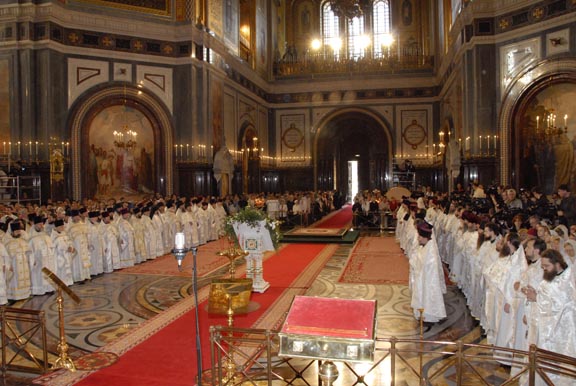
The interior of Christ the Savior Cathedral
Because of security concerns (since Vladimir Putin would be there, as well as the Patriarch, and it being such a high profile event that terrorism was a distinct possibility) only those with an invitation were allowed in, and only then after passing through metal detectors and having all bags inspected. Also, if they had allowed everyone to come who wanted to attend, the Church would have been packed to the brim even more so than it was.

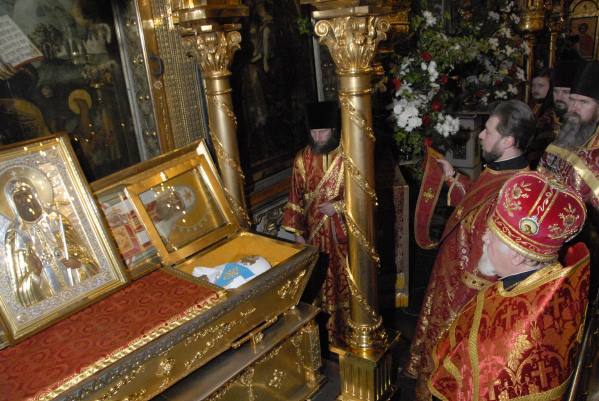
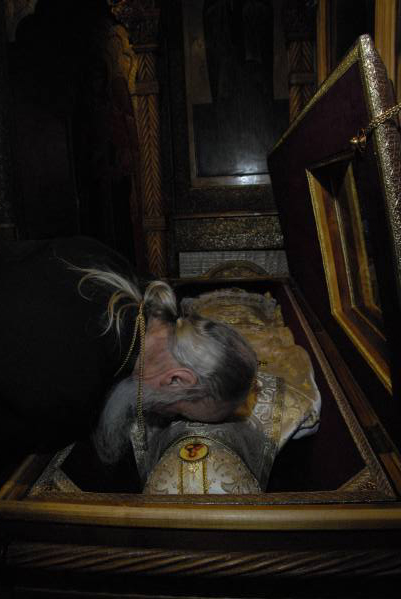
After entering the Church, we venerated the relics of another one of Moscow's previous hierarchs, St. Philaret of Moscow. Then we were taken into a large hall behind the Altar to vest, and then once vested we went into the huge altar area of the Cathedral. The number of clergy who were there was more than I think I have probably ever seen at any one place before. There were certainly more bishops. In fact, when I saw how many priests there were I thought to myself that it would be interesting to see how they would manage to bring some order to the service. When deacons go to a hierarchical service, they are either quite confident of what to do, or else they are sweating it, and are earnestly trying to remember what to do -- because they have so much to do, and what they do can vary a lot, depending on their seniority in relation to the other deacons, and how many deacons are serving. Priests (myself included) have so little to do at such services (because almost everything is done by the Bishops, the Deacons, and Subdeacons), that they often have no worries going into such services at all, and so often mess up the meager parts that they do have. However, there were several priests who were not fully vested whose job it was to make things go smoothly, and it was amazing to see how quickly things did come to order, and how well everything went as a result.
The hours were done well before the arrival of the Metropolitan or the Patriarch. At some point the clergy exited the altar and went to stand in the nave of the Church, to greet the hierarchs. The ROCOR clergy were on one side (the north side of the Church, or on the left side if you are facing the altar), and the Moscow Patriarchate Clergy were on the south side, or right hand side). I was in the second row on the north side, about in the middle, and right behind me was a whole group of cameras and reporters. I thought one of them was going to rest his camera on my shoulder at a few points. We waited for what seemed like a long time to my feet, and then the bells sounded and finally Metropolitan Laurus entered the Church. A bit later, the bells sounded again and the Patriarch also entered.

Metropolitan Laurus is from Carpatho-Russia which is in present day Slovakia, and came to the United States after World War II to escape the Communists who had taken over Czechoslovakia. He is a true monastic, and a man of prayer. I had occasion as a new convert to spend 3 months in Holy Trinity Monastery, in Jordanville, New York, where he is the abbot, and I have seen how his life revolves around prayer.

This was my first experience seeing Patriarch Alexei II in person. He is 78 years old, but does not look it. He is an ethnic German, from Estonia, and became Patriarch during the Glasnost period just before the Soviet Union collapsed in 1991, and I am told he serves the Liturgy almost every day.

As difficult as it was for me to stand through the service, I am impressed that men of their ages do this almost every day.

Then the secretary of the Moscow Patriarchate delegation, Fr. Nikolai Balashov, read the MP's official resolution approving the act of Canonical Communion. His counterpart, Fr. Alexander Lebedeff, read the official ROCOR resolution approving the act. Then an MP protodeacon read the act itself (which you can read by clicking here). Then both the Patriarch and the Metropolitan were seated, signed the document, and then exchanged the kiss of peace, with the Patriarch greeting Metropolitan Laurus with the word's "Christ is in our midst", and the Metropolitan giving the response "He is now, and ever shall be."

Each of them then gave a short speech, then the Patriarch acknowledged Vladimir Putin (who played some role in getting this process going by visiting Metropolitan Laurus in New York and inviting him to come to Russia in 2003), gave him icons of the Holy Trinity, Virgin Mary, and of the New Martyrs of Russia, and then Putin gave a short talk... you can hear some of what was said in the videos linked below.

Then the liturgy itself began, and before long, all the priests returned to the altar, where we remained until the very end of the service. It was very peaceful and joyful to just be able to stand back and pray. In normal parish life, priests have quite a bit to do in a typical liturgy, and it is always a nice break to stand back and let others do all of that stuff, while you just pray.


Me, in the altar of Christ the Savior... the one without the mitre


When it came time for communion, I received the body of Christ from the Patriarch, and the chalice from another bishop whose name I do not know. It was a joy to see that reconciliation had finally come, and this was most fully expressed by our sharing communion with each other.

At one point a Russian priest who did not speak English, and was vested in only an epitrachelion and cuffs came up to me and said something about my phelonion, I couldn't figure out what he was trying to tell me until, after some pointing, it dawned on me that he needed to borrow a phelonion to commune. So I had my first positive interaction with clergy of the MP, post-reconciliation.

Then later, someone came in my direction who looked a lot like one the MP priests who had been making sure everything went off well. Feeling the joy of the occasion, I greeted him as priest normally does another priest. He looked a bit puzzled, and then muttered something in Russian. As he walked off, I realized he was wearing a Panagia (and so was an MP Bishop, whose blessing I should have asked for). So I also had my first misunderstanding with a bishop of the MP, post-reconciliation. I tried very hard to spot him later, to make some attempt at an apology, but didn't see him again.

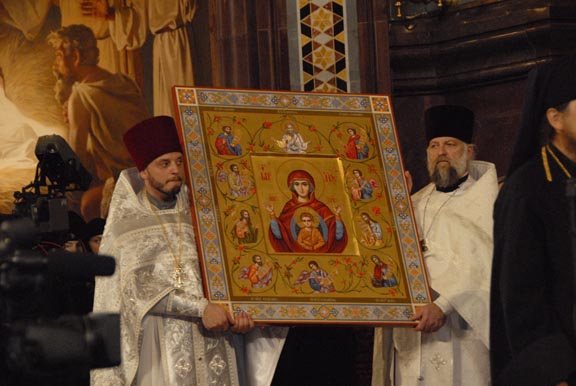
At the dismissal, Metropolitan Laurus and Patriarch Alexei exchanged gifts. The Metropolitan gave a very large copy of the Kursk Icon (an icon more than 750 years old, which was taken out of Russia by ROCOR as the White Army retreated from Russia at the end of the Russian Civil War). This copy was painted by Fr. Lubomir Kupec, and was one of the icons we had lugged around JFK airport, in search of the right terminal for Aeroflot. You can click here to see a photo of this icon.

You can see a photo taken from the nave of all the digital cameras that were in use during the service by clicking here.

After the Liturgy, we had a banquet, but before that, we had to wait for the opening of an exhibit on the life of the Russian Orthodox Church inside and outside of Russia in the 20th and 21st centuries in the basement of Christ the Savior Cathedral. The wait for this to happen dragged on for some time. The exhibit was nice, but we were all quite tired at this point. And no one seemed to know when exactly the banquet would begin, or where exactly it was going to be... at least no one who was saying so in English. Finally, I stumbled across it, just before the opening prayer.

I sat across from an older Russian lady. As the toasts were flowing, with all the singing and well wishing that Russians throw into that, she said something to me in Russian... and as I was habitually doing during this trip, I told her I did not speak much Russian. She then told me in English with tears in her eyes that this was like a second Pascha. I agreed. As we talked, and I told her where I was from and that my parish was dedicated to St. Jonah of Hancow, her eyes lit up, and she told me that she had had a hand in bringing about the glorification of St. Jonah... and so we spoke about that for awhile. She was from San Francisco, where many of the Russians had settled who had fled Russia to China when the Communists took over Russia, and then had to flee from China to the United States when the Communists took over China. I asked what her name was, and she told me her last name was Krassovsky... and so I said that she must be related to Vova and Fr. Roman Krassovsky. She said with a smile, "Well, I am the momma, so I guess you can say that I am somehow related to them."

After more toasts, eating, and singing, the banquet came to an End. And we all headed back to our hotel, and spent the evening celebrating, and watching ourselves on Russian TV.

This service was carried live on Russian Television and was the top story in the news.

Here are some Youtube videos with news clips from Russia Today, which have the advantage of being dubbed into English (some of the English is however a bit imprecisely translated):

Video #1

Video #2

The Full Service:

To be continued

Tuesday, May 22, 2007

Moscow Trip, Part 1

Before I forget the details of my trip to Russia, I had best start making some notes, and so here is part 1.

Day 1, Monday, May 14th.

I arrived at Bush Intercontinental Airport at about 8:00 a.m. Two of my parishioners went with me -- Steve Pennings, and George Nahlous. Fr. Lubomir Kupec happened to be on the same flight, however, I was beginning to think he had missed it, because we were just about to board before we saw him. He had been delayed because he is an iconographer, and had been commissioned to paint four large icons to be given as gifts by the Metropolitan over the course of his visit, and getting these icons on the plane without being damaged took some negotiations. Fortunately, Fr. Lubomir has a parishioner who works for Continental Airlines who was able to help him make that happen.

When we arrived at JFK airport, we had some difficulty figuring out which Terminal Aeroflot flew out of. We were given two bum steers by people who worked for the Airport, before we finally got to the right one (Yankees...). We were helping Fr. Lubomir lug his icons around... which made the whole thing far more interesting. Finally, we got to the right place, and began to see clergy that I knew and clergy that I didn't know, but came to know over the course of the trip. The flight to Russia was probably one of the stranger flights Aeroflot has ever seen. Most of the flight consisted of ROCOR clergy and laity, and so throughout the course of the flight there were people going up and down the rows, catching up with old friends.

Day 2, Tuesday, May 15th

At some point during that flight, we ran into Tuesday. We were flying close to the Arctic circle, and flying against the Earth's rotation, and so night was very brief. It was only completely dark for a short time. When we landed at Moscow's Sheremetyevo Airport, the passengers spontaneously began to sing the Paschal Troparion (in Slavonic), "Christ is risen from the dead, trampling down death by death, and upon those in the tombs bestowing life".

You can see photos of the flight and the arrival by clicking here.

Going through Russian customs, we began to encounter some of the differences between how things are handled in Russia vs. America. The line was very disorganized and long... although they made special arrangements to get us through, which made things go a lot quicker than they probably would have otherwise.

We boarded various buses, and headed to the place which most of us stayed at, which was a hotel owned and operated by the Moscow Patriarchate, called the Universityets Gostinitsa (if I remember correctly) which is so named because it is near to Moscow State University... a building which is known as one Stalin's seven sisters, because all seven buildings were built during his tenure, and they all look very similar... a sort of Stalinesque Gothic.


At the hotel, again more of the experience of Russian lines. I was told though, that compared to how things were 20 years ago, things ran much more efficiently than they used to (God bless America, land that I love...).

By the time we finally got into our rooms, we were all fairly tired. But before the banks closed, I went and changed most of my money into Rubles. I had thought I would encounter more Russians who spoke English than I did, but fortunately most of the people who traveled with us were bilingual, and at the bank one of them (Vladimir Krassovsky, who is the Choir director of the San Francisco Cathedral) happened to be there, and came to my rescue when I hit a snag with the teller. Also there, I got to meet Elizabeth Ledkovsky in person (whom I already knew somewhat via e-mail), the grand daughter of Boris Ledkovsky, and daughter of Alexander Ledkovsky, both of whom are well known composers of Church music. Both of them were part of the Synodal Choir that would participate in the services to come.

Russian TV is quite interesting. There is an Orthodox Channel that runs 24 hours a day. Other news shows spoke a great deal about our delegation and the upcoming reconciliation of the Russian Church. Also, there were many shows I saw throughout my trip that talked about the martyrs under the Communists, and the general havoc the Communists wrought upon Russia. I must say though that it was very disconcerting to hear Michael Jordan and Samurai Jack speaking Russian -- but hearing Kenneth Copeland in Russian was probably the biggest hoot.

Day 3, Wednesday, May 16th.

There was nothing officially planned for most of the pilgrims in the morning, but it was the Apodosis of Pascha, several of us wanted to go to Church, and so I got the Fr. Wally tour of Moscow from Fr. Vladimir Boikov (an exceptionally fun priest whom I got to know in December of 2000 when I traveled to Australia for a youth conference), along with Protodeacon Leonid Mickle of St. John the Baptist Cathedral in Washington D.C., and Protodeacon Nicholas Triantafillidis of the San Francisco Cathedral.

Driving through Moscow in a car is a very harrowing experience. Our Russian driver, fearlessly weaved in and out of traffic, at a high rate of speed whenever possible, and to my surprise managed to get us to where we were going without killing us all.

First, we went to the Danilov Monastery, where our bishops and official delegates were attending the liturgy. Fr. Vladimir had the start time wrong by 1 hour, and so we unfortunately only caught the final parts of the liturgy. While there I was able to venerate the relics of St. Daniel of Moscow.


You can see me standing in the altar at the Danilov monastery
Click here for more photos of the day. Fr. Vladimir Boikov is the very Chinese looking priest. He is part Chinese, part Mongolian, and part Russian, though he sounds like the Crocodile Hunter when he speaks. He has often traveled to China to minister to the Chinese Orthodox there.


We then went to St. Catherine's, which is the OCA's representation Church. They have a beautiful Church, as well as a shop that sells vestments of a very high quality, but at a very reasonable price. The rector, Archimandrite Zacchaeus (Wood), was very hospitable, and insisted on us having tea with him before we left... which was a good thing, since we hadn't had breakfast, and it was time for lunch.


From left to right, Protodeacon Leonid Mickle, Fr. Vladimir Boikov, Archimandrite Zacchaeus (Wood), me, and Protodeacon Nicholas Triantafillidis.


We then went by a Church in Moscow, I can't remember the name, but it was the one that Peter the Great was baptized in. The original iconography had been destroyed by the communists, but new beautiful iconography now adorns the Church. As in every Church I saw, even though no service was going on, there was a steady flow of people who were lighting candles and praying.

After a few more stops around town, we rejoined the official tour at the Donskoy Monastery. They held a moleben before the relics of the Hieromartyr Patriarch Tikhon, who was killed by the Communists. We then were able to venerate his relics. I noticed that the priest in front of me took off his cross to touch it to the relics of the Saint, and so I started doing that myself whenever the opportunity presented itself. (Click here for a picture of those relics, taken during the moleben)

After that we were given a tour of the cemetery, in which many famous Russians are buried. Here again the signs of Communist desecration are still visible -- most of the tombstones had their crosses broken off.

We ended the day with Vigil at the Stretensky Monastery. Our Synodal Choir participated in the service. While there, I was able to venerate the relics of the Hieromartyr Hilarion (Troitsky) (click here to see a photo of someone venerating St. Hilarion's relics), whose essay Christianity or the Church had a big impact on me as I was studying Orthodoxy prior to my conversion. The service was very beautiful, though the Church was a bit small for the number of people there (Click here to see me in the altar, where most of the clergy were standing and click here to see George Nahlous standing on the stairs to the choir loft). The abbot of the monastery, Fr. Tikhon (Shevkunov) is a very impressive man whom I first heard speak at the All-Diaspora clergy conference in Nyack, New York, in December 2003. There was a reception after the service, which included many toasts to those who had made all of this happen. It was a very happy evening.

To be continued

Monday, May 14, 2007

Reuters: Russia Embraces Exiled Church to Heal Soviet Past


Russia Embraces Exiled Church to Heal Soviet Past.

A branch of the Russian Orthodox church whose members fled over 80 years ago to escape Bolshevik rule will rejoin the church in Moscow.

Reuters


A branch of the Russian Orthodox church whose members fled over 80 years ago to escape Bolshevik rule will rejoin the church in Moscow this week in a milestone on Russia's journey to heal the wounds of its Soviet past.

The Russian Orthodox Church Abroad was formed by exiled supporters of the last Tsar Nicholas II, murdered in the Russian revolution, who split from the church in Moscow because it had fallen under the sway of Russia's Communist rulers.

In a ceremony on Thursday, the church abroad will end its decades of estrangement by signing a document restoring its severed link with the church in Moscow.

Even for the majority of Russians who know little about religious affairs, the symbolism of their country re-connecting with its pre-revolutionary past has a powerful appeal.

"This is a truly epoch-making event in the life of the church and in the life of our society as well," Russian President Vladimir Putin said last month.

It also chimes in with Putin's drive to embrace traditional Russian values -- a campaign welcomed by most voters but which his critics say smacks of nationalism.

Putin supported the reconciliation between the two churches and is widely expected to attend the ceremony, along with members of the Romanov family, Russia's former ruling dynasty.

"One of the most grave consequences of the 1917 revolution, the civil war and the Cold War is being overcome," said Fr. Vsevolod Chaplin, deputy chairman of the Moscow's church's department for external church relations.

"All of the heritage that was preserved by the church abroad ... is being returned to Russia."

"That is a heritage of serving the fatherland, a heritage of a self-sufficient identity in the world, a self-sufficient policy in world affairs, and keeping faith with those historic traditions which developed in Russia up to 1917."

MASS EXECUTIONS

On Thursday, Alexiy II, patriarch of the Russian Orthodox Church, will join Metropolitan Laurus, the New York-based leader of the church abroad, in signing an "act of restoration of canonical relations".

In the Christ the Saviour Cathedral -- blown up by Soviet dictator Josef Stalin and rebuilt on the same site after the collapse of Communism -- clergymen from both churches will then jointly serve a mass for the first time in decades.

On Saturday, Alexiy II and Laurus will jointly consecrate a new church in southern Moscow built on the site where the Soviet secret police executed thousands of priests and monarchists.

Russia has already taken important symbolic steps to reconcile itself with its Communist past.

The Orthodox church granted the sainthood to Tsar Nicholas II and his family and what scientists believe were their remains were reburied in 1998 in the imperial crypt in St Petersburg.

Last year, the remains of the last Tsar's mother, Empress Maria Fyodorovna, who died in exile in Denmark, were reburied in St Petersburg.

The church abroad represents about one third of the Russian Orthodox diaspora outside Russia. But it is the part that most closely identified itself with traditional, monarchist values and was for years implacably opposed to Soviet rule.

Some of its adherents say they will leave the church in protest at the re-unification. They argue the church leadership in Moscow is tarnished by its Soviet past and its ties to Putin, a former Soviet intelligence officer.

Staying in the church after re-unification will be "tantamount to living in a Soviet Union scenario," Konstantin Preobrazhensky, a dissident follower of the church in the United States, told the credo.ru religious news Internet site.

But the church in Moscow has dismissed the rebels as a tiny splinter group. Most followers of the church abroad are ready to return to the fold, said Fr. Nikolai Balashov, an official in the Moscow patriarchate.

"They have understood that the church was not the church they had fought against all those years and accused of departing from Orthodox values."

Saturday, May 12, 2007

Interfax: A many-day procession with the cross from Vladivostok to Moscow to mark the reunification of the Russian Church

A many-day procession with the cross from Vladivostok to Moscow to mark the reunification of the Russian Church

Moscow, May 10, Interfax - Eight long processions with the cross symbolizing the eight rays of the Star of Bethlehem are to be held in Russia on May 17 within the program ‘Under the Star of the Mother of God’.

The aim of this international program organized by the Russian Athonite Society, a Russian national public organization, and the St. Andrew’s Flag Foundation, is to promote the unity of Russian peoples, the website of the Vladivostok diocese has reported.

With the blessing of Patriarch Alexy II of Moscow and All Russia, the marchers will set off from six cities in Russia, namely, Vladivostok, Barnaul, Yakutsk, Rostov-on-the-Don, St. Petersburg, Moscow and Arkhangelsk, and from the two centers of universal Orthodoxy - Jerusalem and Mount Athos. In a march through Russia, the participants will cover dozens of thousands of kilometers to converge in Moscow.

The action will be launched on May 17, the day of the historic reunification of the Russian Orthodox Church, when the Act of the Canonical Communion between the Church in and outside Russia will be signed in the Church of Christ the Savior.

On May 20, a many-day procession with the cross will start from St. Nicholas’s in Vladivostok in the direction of Moscow. In the Primorye Region, the procession will go through as many as ten cities and villages. The Vladivostok diocese plans to complete the procession on June 11, 2007. After that the route of the procession will go through the Khabarovsk diocese.

Wednesday, May 09, 2007

Trip to Russia


Christ the Savior Cathedral, Moscow... where I will be, God willing on May 17th.


You can read this article, to see the schedule for the trip to Russia. If you read that article in Russian you will see that my name was the only one they couldn't figure out how to transliterate into Cyrillic.

To keep up with the news of the trip, you can check the official ROCOR web page. Though from past experience, if you want to see pictures as soon as possible, you might also want to keep an eye on the Russian version of the ROCOR web page (which is normally updated first).

You can also check the web site of the Moscow Patriarchate.

You can also check for updates on Google News.

If you want the time and weather in Moscow, click here.

And around Midnight (Wednesday evening, Thursday morning), central time, you should be able to see a live feed of the service at the Christ the Savior Cathedral Web Site. I'll be the guy with the robes and the beard.

Thursday, May 03, 2007

Orthodixie's Greatest hits


One blog that I check just about every day is Fr. Joseph Huneycutt's. I don't post links to every good post of his, because it would be a bit tedious to do so, when you can just read his blog. But he has had two post recently that I have to call attention to:


The Episcopal Church Update

And then there is this post, which linked to a History of Texas.

Wednesday, May 02, 2007

Jerusalem

I've posted about this hymn previously here.

I just found a link to an MP3 file of a very nice version of it here.

Saturday, April 21, 2007

The Destruction and Reconstruction of Christ the Savior Cathedral


In less than a month, God willing, I will be in this Church to witness the reconciliation of the Russian Church inside Russia with the Russian Church Outside of Russia... which is the final page of the story.

Form more, click here.

Friday, April 20, 2007

The Wise Thief


This video has a nicely done version of the "Wise Thief", which is the Exapostilarion of Holy Friday:

"The Wise Thief didst Thou make worthy of Paradise, in a single moment, O Lord. By the wood of thy Cross illumine me as well, and save me."

I have heard it said that the Greeks come to the Holy Friday service to hear the hymn "Today He Who hung the earth upon the waters is hung on the tree," but the Russians come to hear about the thief who stole paradise.

Thursday, April 19, 2007

TIERS: $425 Million, down the rat hole

Before reading the following articles, you should keep in mind that one of the primary reasons we were told that the old system had to be replaced was that it cost the tax payers $1.5 Million a year to maintain the old system. So to save that $1.5 Million, we have already blown $425 million, and still don't have a program that works as well as the old one does. And so in only 283 years, we should break even, and maybe by then TIERS will actually work.

Audit: $425 million system for social services worse than old one, tests find

08:47 AM CDT on Thursday, April 19, 2007
Associated Press


AUSTIN – The new social services computer system that the state has spent six years and $425 million developing is slower, less accurate and more difficult to use than the old system it is supposed to replace, according to an audit released Wednesday by the Health and Human Services Commission's inspector general.

The Texas Integrated Eligibility Redesign System, or TIERS, was supposed to improve access to state benefits by reducing operating and maintenance costs and improving the accuracy and timeliness of eligibility and benefit decisions. The system was implemented in Travis and Hays counties in 2003 and rolled out into Williamson County last year.

TIERS was paired with another new program that aimed to allow people to apply for benefits online, over the phone or by fax through the use of four new call centers run by a private contractor.

But the program was suspended, and the commission announced last month that it was ending the contract. On Wednesday, the commission defended TIERS, saying, "The new system works."

Inspector general Brian Flood's report included a test that found it took 45 minutes longer for experienced employees to process the case in TIERS than in the old system.


Report questions TIERS computer system
Health and Human Services chief defends system
By Corrie MacLaggan

AMERICAN-STATESMAN STAFF

Thursday, April 19, 2007


A new report raises serious questions about whether a computer system used to determine eligibility for programs such as food stamps and Medicaid works.

State officials rebutted the findings in the report and maintained that the computer system, known as TIERS, does work. But they are delaying a planned statewide expansion because Texas failed to meet federal requirements.

This decision comes a year after Texas halted a statewide rollout of call centers to enroll low-income people into state programs and a month after state officials announced that they are canceling an $899 million contract with Accenture LLP to run the call centers, manage the Children's Health Insurance Program and maintain TIERS.

The report, released Wednesday, said the commission did not effectively manage the call center and computer system projects, which have cost taxpayers more than half a billion dollars.

The Health and Human Services Commission's inspector general, Brian Flood, recommended hiring an independent consultant to determine whether to fix TIERS, go back to the old system called SAVERR or choose another system. It takes at least 45 minutes longer to determine eligibility in TIERS than in SAVERR, Flood found.

Health and Human Services Executive Commissioner Albert Hawkins said Wednesday night that the report, requested a month ago by 30 of the state's 31 senators (except Sen. Kyle Janek, R-Houston) contains inaccuracies and represents an incomplete view of the situation.

Hawkins said that TIERS (which is pronounced "teers" and stands for Texas Integrated Eligibility Redesign System) works and that it's a vast improvement over SAVERR (System for Application, Verification, Eligibility, Referral and Reporting), the 35-year-old system lawmakers decided in 1999 to replace.

"Why anybody would think it's feasible to say disregard the expenditure of public funds and go back to an old system already determined to be inadequate is beyond my thinking," said Hawkins, who said that the Office of Inspector General did not interview him. "I think it would be horrible public policy."

[My inserted comments: It was horrible public policy to throw $425 million away, by contracting the program to a vendor, and then paying them the full amount before they had actually delivered a working program. It is not bad public policy to recognize that this waste has already occurred, and to use a system that actually works rather than continue to use one that doesn't in order to avoid recognizing that this waste has already occurred.]

TIERS is in operation in Travis, Hays and Williamson counties and was supposed to expand to seven more Central Texas counties this month and to the rest of the state by late 2008.

Hawkins said that the problems federal officials found with the program were issues with staff training, not technology.

"We have no reason to believe we won't be able to satisfy (the federal officials) with the information they need and the changes they request," said Deputy Executive Commissioner Anne Heiligenstein.

The report found that state officials let the new enrollment system go live in January 2006 even though Accenture informed the state that it would use a subcontractor's employees to manually enter data into TIERS because TIERS was not compatible with a software program used in the call centers.

Having those private employees — rather than seasoned state workers who understood state policy on eligibility — entering data about applicant income and employment into TIERS to determine eligibility was a major problem, said Michael Garbarino, deputy chief counsel of the Office of Inspector General.

Judy Lugo, president of the Texas State Employees Union, said after watching a presentation Garbarino made to Capitol staffers Wednesday afternoon: "This is what we've been saying all along."

Stephanie Goodman, a spokeswoman for the commission, said the agency thought it would work to have Accenture subcontractors entering data into TIERS, but that when the pilot in Travis and Hays began in January 2006, the system was overwhelmed with more applications than expected. Backlogs, along with problems attaching payment stubs and other documents to applications, led to thousands of Texans receiving benefits late. The system was supposed to save the state money, but the savings never materialized.

In April 2006, Hawkins indefinitely postponed statewide rollout of the areas served by the call centers, and last month, he announced that the commission would part ways with Accenture.

Sen. Bob Deuell, R-Greenville, who led the Senate effort to request the report, said he hopes the commission fixes TIERS rather than going back to SAVERR.

"I just want to get it working right," he said.

The House Committee on Human Services is expected to hear a report today from a subcommittee that has been studying TIERS and the centers.

The subcommittee chairman, Rep. Abel Herrero, D-Robstown, said he will recommend that there be more legislative oversight of TIERS and the call centers and that the state not expand the use of either until the problems are fixed.

Herrero said he wants to "ensure that there's a system in place that is actually cost-effective, reliable, dependable and not causing anyone to lose the services they're qualified to receive."

A report by the Health and Human Services Commission's Office of Inspector General raises questions about a computer system, known as TIERS, which powers call centers to enroll low-income Texans into programs such as food stamps and Medicaid. Agency Executive Commissioner Albert Hawkins responds.


Report: State officials made the decision to privatize the call centers using an analysis that relied only on pre-TIERS information, even though the commission had already decided that TIERS would be used in the call centers.

Hawkins: It is irrelevant because the decision on whether privatizing would be cost-effective would not have been affected by whether the system, TIERS, or the old system, SAVERR, was used.

Report: The commission decided to award the contract to Accenture — rather than the other bidder, IBM — by relying on a questionable evaluation tool.

Hawkins: The report fails to take into account that Accenture's bid was about $50 million lower.

Report: State officials let TIERS developer Deloitte hand over management of the system to Accenture in late 2005 even though TIERS had more than 500 deficiencies.

Hawkins: The number includes duplications and issues that had already been solved.

Tuesday, April 17, 2007

Today is the Day of Rejoicing


The first Tuesday following Bright Week (Easter week) is Radonitsa (which means "Day of Rejoicing"). On this day, Orthodox Christians go to the tombs of their loved ones, and share the joy of Pascha with them.

After work, I stopped by Anastasia Titov's grave, for the first time since her funeral. I served a Panikhida (memorial service) for her and some of the other Orthodox people I know who are buried in that cemetery. I was afraid that it would be raining, but the rain stopped just before I got there, and then resumed after I was finished and back in my car. Although Anastasia has no relatives in this part of the country, I could see that I was not the first one there. There were Easter eggs left on her tomb; as well as some palms and pussy-willows, flowers, and a candle decorating her grave.

The words of the Paschal Troparion had a new significance to me, as I sang out loud before her grave:

"Christ is risen from the dead, trampling down death by death, and upon those in the tombs bestowing life."

What a joy it was, indeed... because Indeed He is Risen. And indeed, she is with him, and will rise again just as He is risen.

Texas Observer: Trail of TIERS

Trail of TIERS

Albert Hawkins is pushing another fouled-up, expensive idea
by Dave Mann


Perhaps the biggest boondoggle in Texas government at the moment involves a computer program at the state Health and Human Services Commission that has consumed more than $415 million and seven years of effort. It still doesn’t work.

Yet HHSC Executive Commissioner Albert Hawkins continues to ignore forceful warnings about the system’s flaws, and is pushing the much ballyhooed software into wider use at his agency.

An Observer review of internal HHSC documents shows that Hawkins has been told repeatedly by federal officials and his own auditors over the past two years that the agency’s new system simply wasn’t functioning. In one instance, the agency even misled federal officials about the software’s progress, according to internal agency documents.

The software is called the Texas Integrated Eligibility Redesign System, or TIERS for short (pronounced, appropriately enough, “tears”). It is supposed to bring efficiency to state benefit programs and make it easier for needy Texans to get their food stamps, Medicaid and other benefits.

So far, it’s done the opposite. In pilot programs, the software has mysteriously swallowed data and left applicants wondering if they will ever receive their benefits. At other times, it has paid out too much money, but how much is impossible to tell because the software doesn’t produce the data auditors need to check for mistakes or fraud.

Flaws in the TIERS system contributed to last year’s failure of the agency’s grand experiment to let private call centers run by the consulting firm Accenture handle applications for state benefits [see “What Hawkins Knew,” April 6, 2007]. The call center plan has been suspended indefinitely, and HHSC canceled its contract with Accenture last month.

But TIERS somehow soldiers on. The state and federal tax dollars it has already burned could have provided health coverage for every kid in the Children’s Health Insurance Program in 2007.

HHSC officials contend they have fixed many of the problems, and Hawkins is moving forward with plans to slowly expand TIERS across Texas. “TIERS is a successful system today,” says HHSC spokesperson Stephanie Goodman. “It provides benefits to hundreds of thousands of clients every month.”

But federal officials and some state lawmakers remain deeply suspicious, and in recent weeks have tried to halt TIERS expansion. It’s not just the well-being of needy Texans at stake. If Hawkins sticks with the software and the project continues to fail, the state risks incurring federal sanctions and wasting even more taxpayer money.

Hawkins didn’t create the TIERS mess, but he has perpetuated it. HHSC set out to build its new computer system in 2000—three years before Hawkins took over the agency. It wanted to replace an aging system— antiquated, but it worked well enough—with gadget-heavy, Web-based software. The new system was supposed to be easy to use and handle every task a state worker could desire, from processing Medicaid applications to calculating how much food stamp money to pay out. HHSC hired Deloitte Consulting LLP to build the software. The project was botched from the beginning.

After three years, the state and its contractors launched a trial run of TIERS in two Central Texas counties, and they have yet to move much beyond the pilot program, which handles about 250,000 clients a month, according to HHSC. Goodman says HHSC successfully expanded TIERS to Williamson County last fall without hearing any complaints. But state workers in the pilot area have complained for years that the software takes far too long to process applications.

What’s given HHSC the greatest heartache is the system’s inability to maintain case histories—for example, how much a Medicaid provider was paid three years ago, or whether a food stamp recipient mistakenly received too much money, and if so, how much.

The lack of reliable case histories prevents auditors at the HHSC Office of Inspector General from investigating cases of Medicaid fraud and recovering overpayments. HHSC auditors haven’t pursued a single fraud investigation among the hundreds of thousands of cases handled by TIERS in 28 months. Similarly, they halted all inquiries into cases using TIERS in April 2005, according to a report last fall by the Texas State Auditor’s office.

Internal HHSC documents obtained by the Observer reveal the extent of the problem. For example, the HHSC Inspector General’s office believes, based on sample data, that TIERS is paying too much taxpayer money in the food stamp program. But without case histories, the auditors have no way to determine how much money mistakenly went out, and can’t recoup the overpayments. Goodman, the agency spokesperson, says the data are retrievable from TIERS, but the system has trouble putting the information into a format auditors can use.

The federal government requires the state to track and recoup overpayments in the food stamp program, and to conduct fraud investigations. HHSC’s inability to perform either task in the two counties using TIERS is not only wasting taxpayer money intended for needy Texans, but also violating federal law.

For three years, the feds and HHSC’s own auditors have nagged the agency to correct the software failings. In August 2005, HHSC auditors recommended three steps that might limit the continued waste of taxpayer money, including requiring a supervisor to review and approve any food stamp payments of more than $125. HHSC officials later assured federal officials the safeguards were in place as early as June 2005. That appears to have been untrue. HHSC auditors have found “no confirmation” of safeguards such as supervisor approval “anywhere in TIERS or otherwise,” according to an auditor’s memo last fall. HHSC’s Goodman says those safeguards were automated in late 2006 and the amount of overpayments issued by TIERS fell substantially.

Hawkins was well aware of the problems. He met personally with staff from the HHSC Inspector General's office on April 27, 2005, and again on September 29, 2005. At both meetings, auditors warned Hawkins that the agency’s auditors couldn’t track overpayments or investigate fraud in the TIERS data, according to a memo written by Garbarino last fall. Hawkins’ office didn’t respond to three interview requests for this story.

Hawkins moved ahead with an expansion of TIERS before the flaws were corrected. He decided to link the launch of the Accenture call center network in 2006 with an expansion of TIERS. Hawkins planned to roll out the call centers and TIERS statewide and simultaneously.

While the call center flameout drew widespread coverage, the failings of the state’s new software have garnered little publicity. In early 2007, HHSC quietly moved ahead with its planned expansion of TIERS.

After HHSC notified federal officials of its plans, the feds reprimanded the agency in a March 23, 2007, letter denying HHSC approval to expand its problematic software. Of course, HHSC has ignored the feds before. As the Observer reported on April 6, Hawkins twice pushed the Accenture plan forward without federal approval. The feds issued a stern warning to HHSC not to try that stunt again. “[The Food and Nutrition Service] will not participate in further funding of this project if the State elects to move forward with an expansion of TIERS without FNS’ prior approval,” the letter read. HHSC had hoped to expand TIERS to seven more Central Texas counties by the end of April. Those plans are in doubt.

You couldn’t blame the feds if they decide to cut off funding for TIERS. The state has already burned through about $231 million in federal money developing the software. (The state tab is approaching $200 million.)

Hawkins told a House subcommittee on April 4 that his agency had, remarkably, solved most of the problems with the software, including the case history problem. He said agency leaders met with federal officials on March 29 to discuss TIERS and that the feds were pleased with HHSC’s progress. “We were able to present to [federal officials] documents showing that changes have been made,” HHSC Deputy Commissioner Anne Heiligenstein told lawmakers at the hearing. “Their reaction was very positive.”

Despite that happy talk, sources at the Capitol say federal officials are suspicious of HHSC’s claims, though they took state officials at their word. Asked if HHSC’s progress had satisfied the federal government, Jean Daniel, a spokeswoman with the federal Food and Nutrition Service, said, “That’s under review. [HHSC] has provided answers to the questions and discussion points. Those are under review.” Federal officials will visit Texas in April to test just how fixed the computer system really is.

Meanwhile, time may be running out for TIERS. Several state lawmakers are losing patience with the repeated failures. Sen. Bob Deuell, a Greenville Republican, offered a rider to the state budget to allow HHSC to update its old computer system as a temporary fix until TIERS or another system can function successfully. Other lawmakers want to scrap the software and make HHSC start over with a system that won’t waste so much money.

Wednesday, April 11, 2007

Jerusalem Post: Jesus Tomb Film Scholars Backtrack

Jesus tomb film scholars backtrack
By ETGAR LEFKOVITS


Several prominent scholars who were interviewed in a bitterly contested documentary that suggests that Jesus and his family members were buried in a nondescript ancient Jerusalem burial cave have now revised their conclusions, including the statistician who claimed that the odds were 600:1 in favor of the tomb being the family burial cave of Jesus of Nazareth, a new study on the fallout from the popular documentary shows.

The dramatic clarifications, compiled by epigrapher Stephen Pfann of the University of the Holy Land in Jerusalem in a paper titled "Cracks in the Foundation: How the Lost Tomb of Jesus story is losing its scholarly support," come two months after the screening of The Lost Tomb of Christ that attracted widespread public interest, despite the concomitant scholarly ridicule.

The film, made by Oscar-winning director James Cameron and Emmy-winning Canadian filmmaker Simcha Jacobovici, prompted major criticism from both a leading Israeli archeologist involved in the original dig at the site as well as Christian leaders, who were angered over the documentary's contradictions of main tenets of Christianity.

But now, even some of the scholars who were interviewed for and appeared in the film are questioning some of its basic claims.

The most startling change of opinion featured in the 16-page paper is that of University of Toronto statistician Professor Andrey Feuerverger, who stated those 600 to one odds in the film. Feuerverger now says that these referred to the probability of a cluster of such names appearing together.

Pfann's paper reported that a statement on the Discovery Channel's Web site, which previously read "a statistical study commissioned by the broadcasters...concludes that the probability factor is 600 to 1 in favor of this being the tomb of Jesus of Nazareth and his family," in keeping with Feuerverger's statement, has been altered and now reads, "a statistical study commissioned by the broadcasters... concludes that the probability factor is in the order of 600 to 1 that an equally 'surprising' cluster of names would arise purely by chance under given assumptions."

Another sentence on the same Web site stating that Feuerverger had concluded it was highly probable that the tomb, located in the southeastern residential Jerusalem neighborhood of Talpiot, was the Jesus family tomb - the central point of the film - has also been changed. It now reads: "It is unlikely that an equally surprising cluster of names would have arisen by chance under purely random sampling."

Israeli archeologists have said that the similarity of the names found inscribed on the ossuaries in the cave to the members of Jesus's family was coincidental, since many of those names were commonplace in the first century CE.

The film argues that 10 ancient ossuaries - burial boxes used to store bones - that were discovered in Talpiot in 1980 contained the bones of Jesus and his family. The filmmakers attempt to explain some of the inscriptions on the ossuaries by suggesting that Jesus was married to Mary Magdalene, and that the couple had a son, Judah.

One of the ossuaries bears an inscription reading "Yeshua son of Yehosef" or "Jesus son of Joseph;" a second reads "Mary;" a third is a Greek inscription apparently read by one scholar as "Mary Magdalene;" while a fourth bears the inscription, "Judah, son of Jesus." The inscriptions are in Hebrew or Aramaic, except for the one in Greek.

But Shimon Gibson, who was part of the team that excavated the tomb two and half decades ago and who appeared in the film, is quoted in Pfann's report as saying he doubted the site was the tomb of Jesus and his family.

"Personally, I'm skeptical that this is the tomb of Jesus and I made this point very clear to the filmmakers," Gibson is quoted as saying.

"We need much more evidence before we can say that the Talpiot tomb might be the family tomb of Jesus," he added.

In the film, renowned epigrapher Prof. Frank Moore Cross, professor emeritus of Hebrew and oriental languages at Harvard University, is seen reading one of the ossuaries and stating that he has "no real doubt" that it reads "Jesus son of Joseph." But according to Pfann, Cross said in an e-mail that he was skeptical about the film's claims, not because of a misreading of the ossuary, but because of the ubiquity of Biblical names in that period in Jerusalem.

"It has been reckoned that 25 percent of feminine names in this period were Maria/Miriam, etc. - that is, variants of 'Mary.' So the cited statistics are unpersuasive. You know the saying: lies, damned lies, and statistics," Cross is quoted as saying.

The paper also notes that DNA scientist Dr. Carney Matheson, who supervised DNA testing carried out for the film from the supposed Jesus and Mary Magdalene ossuaries, and who said in the documentary that "these two individuals, if they were unrelated, would most likely be husband and wife," later said that "the only conclusions we made were that these two sets were not maternally related. To me, it sounds like absolutely nothing."

Furthermore, Pfann also says that a specialist in ancient apocryphal text, Professor Francois Bovon, who is quoted in the film as saying the enigmatic ossuary inscription "Mariamne" is the same woman known as Mary Magdalene - one of the filmmakers' critical arguments - issued a disclaimer stating that he did not believe that "Mariamne" stood for Mary of Magdalene at all.

Pfann has already argued that the controversial inscription does not read "Mariamne" at all.

The burial site, which has been contested from the start by scholars and church officials alike, is some distance from the Church of the Holy Sepulchrr in the Old City, where many Christians believe Jesus's body lay for three days after he was crucified.

According to the New Testament, Jesus rose from the dead on the third day after his crucifixion, and an ossuary containing Jesus's bones - the explanations of the movie director notwithstanding - would contradict the core Christian belief that he was resurrected and then ascended to heaven.

Rita Wilson: Why Easter is Greek to Me: Xristos Anesti!

From the Washington Post

Once every few years, Greek Easter falls the same week as “American Easter,” as it was called when I was growing up.

In order for “Greek Easter” to be celebrated the same week as “American Easter,” Passover has to have been celebrated already. We Greeks don’t do Easter until after Passover, because how can you have Easter BEFORE Passover. Jesus went to Jerusalem to celebrate Passover, after all. Unless it is one of the years when the two holidays align. Like this year.

Here are some of the things that non-Greeks may not know about Greek Easter: We don’t do bunnies. We don’t do chocolate. We don’t do pastels.

We do lamb, sweet cookies, and deep red. The lamb is roasted and not chocolate, the sweet cookies are called Koulorakia and are twisted like a braid, and our Easter eggs are dyed one color only: blood red. There is no Easter Egg hunt. There is a game in which you crack your red egg against someone else’s red egg hoping to have the strongest egg, which would indicate you getting a lot of good luck.

Holy Week, for a Greek Orthodox, means you clear your calendar, you don’t make plans for that week at all because you will be in church every day, and you fast. Last year, in addition to not eating red meat and dairy before communion, my family also gave up sodas for the 40-day Lenten period.

During one particularly stressful moment, there were many phone calls amongst our kids as to whether or not a canned drink called TING, made with grapefruit juice and carbonated water was, in fact, a soda and not a juice, which our then 10-year-old decided it was, so we had a Ting-less Lent.

No matter where I find my self in the world I never miss Easter, or as we call it, Pascha. I have celebrated in Paris, London, New York City, Los Angeles, and in Salinas, California at a small humble church that was pure and simple.

When we were kids, our parents would take us, and now as parents ourselves we take our children to many of the Holy Week services including the Good Friday service where you mourn the death of Jesus by walking up to the Epitaphio, which reperesents the dead body of Christ, make your cross, kiss the Epitaphio, and marvel at how it was decorated with a thousand glorious flowers, rose petals and smells like incense.

Some very pious people will crawl under the Epitaphio. I have always been so moved to see this. There is no self- consciousness in this utter act of faith. There is no embarrassment to show symbolic sorrow at the death of our Saviour.

At a certain point in the Good Friday service, the Epitaphio is carried outside by the deacons of the church, as if they are pall bearers, followed by worshippers carrying lit candles protected from dripping on your clothes and on others by having a red plastic cup that sits below the flame to catch the wax drippings. Every Greek person knows all too well the smell of burning hair.

One time, in London, I smelled something and turned to look at where the smell might be coming from, only to be horrified that it was coming form me and my head was on fire. But I digress.

It is somber and quiet as we follow the Epitaphio, in candlelight, from the altar to the outdoors, in order for it to circle the church before it returns back to the altar. We sing beautiful lamentations that make your heart break with their pure expression of sadness and hope.

One of my favorite services during Easter is Holy Unction. This happens on the Wednesday of Holy Week. Holy Unction is a sacrament. It is for healing of our ills, physical and spiritual. It is preparing us for confession and communion. This sacrament has always been so humbling to me.

When you approach the priest for Holy Unction, you bow your head and as he says a prayer and asks you your Christian name, he takes a swab of blessed oil and makes the sign of the cross on your forehead, cheeks, chin, backs of your hands and palms. It is a powerful reminder of how, with faith, we can be healed in many ways.

The holy oil is then carefully dabbed with cotton balls provided by the church so you don’t leave there looking as if you’re ready to fry chicken with your face, and before you exit the church, you leave your cotton balls in a basket being held by altar boys, so as not to dispose of the holy oil in a less than holy place. The church burns the used cotton balls.

There have been times when I have left church with my cotton ball and have panicked when I am driving away. At home I take care of it. Imagine a grown woman burning cotton balls in her sink. But that is what I do.

Midnight Mass on Saturday night, going into Sunday morning is the Anastasi service. We will arrive at church at around 11 p.m., when it starts, and listen to the chanter as he chants in preparation for the service. My kids, dressed in their suits and having been awakened from a deep sleep to come to church, groggily sit and wait holding their candles with red cup wax catchers.

As the service progresses, the moment we have all been waiting for approaches. All the lights in the church are turned off. It is pitch black It is dead quiet. The priest takes one candle and lights his one candle from the one remaining lit altar candle, which represents the light of Christ’s love ( I believe).

From this one candle, the priest approaches the congregation and using his one candle he shares his light with a few people in the front pews. They in turn share their light with the people next to them and behind them. In quiet solemnity, we wait until the entire church is lit with only the light of candles, the light that has been created by one small flame has now created a room of shared light.

And at a moment that can only be described as glorious, the priest cries out, “Xristos Anesti!” “Christ is Risen!” We respond with “Alithos Anesti!” “Truly, He is Risen!” We sing our glorious Xristos Anesti song with the choir. That moment, which happens about an hour, to an hour and half into the service and seems as if the service is over, actually marks the beginning of the service. The service then continues for another hour and a half.

When I was a kid, after the service was over, we would go to the Anastasi Dinner that the church would throw in the church hall, where we would break our fast, drink Cokes at 2:30 in the morning, dance to a raucous Greek band and not go home until our stomachs were full of lamb, eggs, Koulouraki, and we saw the sun rise. Or was it the Son rise?

But usually now, after Midnight Mass, we drive home with our still-lit candles. I always love seeing the looks on peoples faces as they pull up to our car seeing a family with lit candles calmly moving at 65 m.p.h. down the highway. When we get home, we crack eggs, eat cookies, drink hot chocolate (so not Greek) and I burn a cross into our doorways with the carbon from the candle smoke to bless our house for the year.

There have been many times when painters touching up the house have wondered why there was this strange black cross burned into our doorways. The next day is usually followed by a late sleep in, then getting up and doing the same thing you just did but in the daytime at the Easter Picnic, usually held at a local park.

I have to say, the Greeks know how to do Easter. Make no mistake. This is the most important holiday in our church. It is a beautiful week. I haven’t even begun to touch on what the week is really like. This is a sampling of a sampling of what it is like. It is so much more deep, so much richer than I have written here.

But one thing is clear. It is a powerful, beautiful, mysterious, humbling, healing and moving week. It is filled with tradition and ritual. It is about renewal and faith. And even though it is still too early to say, Xristos Anesti! Alithos Anesti!

Actress Rita Wilson, whose mother and father both were born in Greece, is widely credited with landing Nia Vardalos a movie deal for "My Big Fat Greek Wedding." Wilson and her actor husband Tom Hanks had their own "Big Fat Greek Wedding" in 1988. They have two children.

Saturday, March 24, 2007

What have I been up to on OrthodoxWiki?


Someone e-mailed me in response to my previous blog post, and asked what have I been doing on Wikipedia. Most of what I have been doing has been on OrthodoxWiki.org, rather than on the main Wikipedia... although I have tweak a few articles on that one too.

Here are some of the articles I have worked on in a way that went beyond just a minor tweak:

Megalynarion

St. Jonah of Manchuria

Typika

The Midnight Office

Horologion

Liturgical Books

Gospel Book

Compline

All-Night Vigil

Lectionary

Prophetologion

Hieratikon

Archieratikon

Some of these articles I still intend to work on further, but that's what I have been doing for fun lately.

Friday, March 23, 2007

I've been Wikified

I've been a long time user of Wikipedia and its Orthodox counterpart, the Orthodox Wiki. I realize of course the limitations of using an open source encyclopedia, and I have at times been irritated by some of the misinformation I have seen in some articles on Wikipedia. Recently, Andrew Keen, commented about Wikipedia (Newsweek 3/26 p.16), that it was "no more reliable than the output of a million monkeys banging away at their typewriters." While I agree that one has to be cautious with what you read on Wikipedia, and realize that it is not on the same level as a more traditional encyclopedia, the fact remains that it is widely used... and very often, the information is quite good. One just has to learn to be discriminating, and to develop an eye for texts that are not supported by references or sufficient evidence. There is in fact a review process on Wikipedia, and generally speaking, the people who do the reviewing do know what they are talking about in the given area that they work on.

Rather than curse the occasional darkness one finds in Wikipedia articles, I have started working on editing and composing them myself. I have long been attracted to the possibilities of hyper-lined texts, as you can see in my Icon FAQ article. Footnotes are great, but being able to link to entire articles that are immediately accessible is a wonderful advantage of online articles.

I would encourage others to give it a try. It is not as difficult to do as you might think.

Sunday, March 18, 2007

We're off on the road to Moscow...


God willing, I will be going to Moscow in May of this year for the signing of the Act of Canonical Communion between the Russian Orthodox Church Abroad and the Russian Orthodox Church.

For more on why this is important, read this article.

Bitter Sweet Vindication for Carlos Guerra


From the very start of the Accenture/HHSC Privitization debacle, there has been one voice in the media that had this whole thing pegged -- Carlos Guerra of the San Antonio Express. Those who were watching things unravel from the inside had at least some consolation that someone with a voice in the main stream media "got it". I heard later that he was getting some grief at his paper, because he wrote so frequently on the subject... and then unfortunately the frequency of his commentaries on this subject declined sharply. He now has a new piece in which he get's to tell everyone he was right. I am happy for him in that respect, though it is clear that he takes no delight in the fact that so many people had to be hurt before the powers that be finally decided to change course.

This whole disaster was not only preventable, and predictable -- it was predicted by many many voices, my own included.

Here is Carlos Guerra's op ed:

Carlos Guerra: A contract that failed miserably, taking 200,000 Texas kids with it

Web Posted: 03/14/2007 11:01 PM CDT

Express-News


Having first written in May 2003 about what was coming, I wasn't surprised Tuesday morning when Will Rogers of the Texas State Employees Union wrote to say that "Accenture and (the Texas Health and Human Services Commission) will jointly announce that the contract will be 'unraveled,' with each party 'going its own way.'"

Nor did I gag when HHSC and Accenture officials tried to put a positive spin on the dissolution of possibly the nation's largest contract to privatize a state's social services safety net.

I wasn't alone.

"I hate to say that I told them so, but I did — for four years," sighed state Sen. Carlos Uresti, D-San Antonio.

It began when the 2003 Legislature faced a $10 billion budget shortfall and the ideologues in charge were intent on rolling back taxes instead of raising any. So they opted to make up the shortfall largely on the backs of Texas' most vulnerable.

House Bill 2292 was a "reform" and "modernization" of Texas' health and human services safety net, they said, and it would save Texas hundreds of millions through privatization and by being more businesslike. After all, business does everything better than government.

A close reading of 132-page HB2292 revealed the massive reorganization of Texas' social services agencies really was a convenient cover for its more nefarious provisions.

Any real savings, I wrote then, will accrue from slashing or eliminating benefits, unconscionably stiffening eligibility standards and systematically making applying for benefits so frustrating that, needs notwithstanding, people will become discouraged and quit seeking benefits.

At the heart of HB2292 was authorization for HHSC to privatize enrollment for CHIP and Medicaid, and other critical safety net programs.

But a year later, HHSC insisted $177 million would be saved by contracting for four privately run centers to take applications by phone, fax or the Internet, and the firing of 3,377 of the state's 7,864 trained field workers and the shuttering of 217 of the 381 field offices.

Bermuda-based Accenture headed the consortium awarded the $899 million call center contract. But problems surfaced early on, such as interminable hold times and operators giving applicants incorrect information. Software broke down and documents were lost, some of which were inexplicably faxed to a Seattle warehouse.

The new system's roll-out repeatedly was postponed, the call centers' workers had to be retrained, and soon after the trained state workers started getting pink slips — by e-mail, no less — many had to be rehired.

"As (House) Government Reform chair, we had Accenture and HHSC testify, and they kept saying, 'It's getting better, everything is working great'" Uresti says, "when, obviously, that wasn't the truth, or 200,000 kids wouldn't have fallen off CHIP."

And it was shrinking CHIP rolls that set off the outcry that finally has resulted in Accenture getting the boot.

But that's hardly all that has gone wrong.

"This has done more damage to Texas than you can imagine," Uresti adds. "Everyone talks about CHIP and Medicaid because they recognize them; but this has also affected our seniors, our mentally retarded, our disabled, pregnant moms and on and on and on."

And aside from the human cost, this disaster may end up costing hundreds of millions after local indigent health-care costs are factored in.

But there also are lessons.

"We want to balance the budget, but you don't give out a $900 million contract — no company would — without having safeguards in place, without having performance measures and if they aren't met, we cancel the contract, instead of giving them more time," Uresti adds.

Details of what Texas will do now seem to be unknown.

But Uresti's characterization of this debacle is quite apt: "We put all our eggs in one basket, and they dropped the basket."

Friday, March 16, 2007

Senators Urge Accenture Call Center Contract Probe

You can read a shorter version of this story, with commentary from HHSC Employee, by clicking here.

Tyler Morning Telegraph: Senators Urge Call Center Contract Probe

From Staff, Wire Reports

Nearly every state senator has signed a letter asking the inspector general of the Texas Health and Human Services Commission to investigate the failed contract with the company hired to privatize the state's social services eligibility system.

"There are significant questions concerning the contract, and the members of the Texas Senate want them answered," said Sen. Bob Deuell, who circulated the letter.

Deuell, a Republican from Greenville, said he also plans to ask the state auditor to look into the contract.

Sen. Kevin Eltife signed the letter.

"We should demand a full accounting of the Accenture contract," Eltife said. "This venture that was to save the taxpayers millions now looks to have costs taxpayers millions."

The commission announced Tuesday it was ending its contract with the Texas Access Alliance, a group of companies led by Accenture LLP. The letter was released Wednesday.

The consulting giant was hired in 2005 to - among other things - run a new computer system allowing Texans to apply for Medicaid, food stamps and other benefits over the phone, online or in person.

Problems plagued the project from the start, prompting more than a year of harsh rebukes from lawmakers, gubernatorial candidates and advocates for poor families. The commission announced plans to scale back the contract in December, but the two sides couldn't reach an agreement, Executive Commissioner Albert Hawkins said.

The letter, signed by 30 of the 31 state senators, asks the inspector general to conduct an integrity review and, if warranted, a full-scale investigation of both the new computer system and the contract for running it.

Commission spokeswoman Stephanie Goodman said the agency will provide any information that is requested.

"It's hard to imagine that there's a document in the building that hasn't already been provided to every losing candidate for governor, the employees union and IBM's attorneys, but we'll keep the copy machine warmed up and ready to go," she added.

The state's $899 million contract with Accenture was part of a massive effort to make it easier for people to apply for benefits.

The project as a whole was supposed to save the state nearly $650 million over five years. Hawkins said Wednesday he still expects the state to save money, but he could not estimate how much.

Accenture began running the new computer system in Travis and Hays counties a year ago and it was supposed to be implemented in all 254 Texas counties by the end of the year. But technical and operational problems forced Hawkins to indefinitely delay the rollout last spring.

Problems also cropped up when the Texas Access Alliance took over processing applications for the Children's Health Insurance Program, the state's low-cost health insurance program for the children of the working poor. Enrollment dipped below 300,000 for the first time since the program's infancy, but has since rebounded.

Advocates for poor families said contract workers lost CHIP applications and other paperwork, gave contradictory instructions about submitting information missing from their files and failed to credit payments to their accounts.

Democratic State Rep. Patrick Rose, who chairs the House human services committee, said his panel is committed to figuring out what went wrong with the Accenture contract and what needs to be done to prevent it from happening again.

Wednesday, March 14, 2007

Accenture Deal Dead

For those wondering why an Orthodox Priest cares about this news article, click here.

You should also check out Ramblings of an HHSC Employee Amidst Chaos, for some timely commentary on what is happening.

Texas terminating deal with main social services contractor

Medicaid, food stamp duties going back to state; official defends system, admits flaws

12:00 AM CDT on Wednesday, March 14, 2007
By ROBERT T. GARRETT / The Dallas Morning News
rtgarrett@dallasnews.com


AUSTIN – Texas' rush to privatize eligibility screening for such programs as Medicaid and food stamps was dealt a huge blow Tuesday as the state announced that it would sever its relationship with the lead contractor.

State social services czar Albert Hawkins said protracted disagreements over money and changes to the private company's role persuaded him to end the state's five-year contract with the U.S. unit of Bermuda-based Accenture Ltd. more than three years early.

The contract had put Texas on track to be the first state to mostly privatize the process of determining residents' eligibility for social programs. But a pilot effort to combine contractors' screening of applicants for Medicaid, food stamps and welfare with the already-privatized Children's Health Insurance Program swiftly encountered turbulence in two Central Texas counties early last year.

Further rollout of the new system, which relies heavily on four privately run call centers, has been postponed repeatedly as applications and enrollment fees were lost and thousands of families complained of abruptly canceled health coverage for their children.

Mr. Hawkins insisted that the state will carefully assess whether to continue outsourcing some functions or pull most back into state government. But his move underscored the fact that the deal hasn't saved any of the $646 million that officials promised.

"The opportunity for savings is delayed until we get the model fully in place," he said. His confirmation by the Senate to a third two-year term as head of the Health and Human Services Commission has been held up, in part because of problems with the call centers.

For now, little will change for Texans applying for services. Mr. Hawkins said he expects the duties will be handed off by Nov. 1. A separate negotiation will now begin on how much the contractor will be paid. Through Feb. 28, the state had paid it $186 million, said a spokeswoman for Mr. Hawkins.


Looking ahead

Mr. Hawkins and Accenture spokesman Jim McAvoy dismissed suggestions that the new eligibility system's problems should curb state leaders' enthusiasm for outsourcing.

"I don't really think this is about privatization," Mr. Hawkins said. "It's about still moving forward and achieving the goals of transformation that we set out for our eligibility system," which he said hadn't changed much since the late 1960s.

Mr. McAvoy said, "This has less to say about privatization than about how difficult large [information technology] projects are."

Democrats and state employee groups, though, claimed vindication of their 2003 warnings that the privatization effort would fail – especially when combined with budget cuts and tighter eligibility rules in CHIP, the state-federal health insurance program for children in working-poor families.

"Far too many Texas parents have been left to depend on NyQuil and prayer for health insurance because their children were unfairly denied CHIP coverage," said state Democratic Chairman Boyd Richie. "Republicans have wasted millions of taxpayer dollars on dysfunctional private call centers."

Ed Sills, spokesman for the Texas AFL-CIO, called outsourcing of sensitive government duties "an inherently flawed concept in which the public trust is traded for the corporate profit motive. The Accenture fiasco proved us right at every stage."

Mr. McAvoy responded: "We had problems with the initial pilot. We stabilized it."


Lawmakers' reactions

Republican leaders also played down the decision to end the Accenture contract.

House Speaker Tom Craddick said that while he expects Mr. Hawkins to fix problems in the new eligibility system, he still likes outsourcing.

"Privatizations in a lot of areas of government have been real positive, have done a lot of great services for us, saving dollars and allowing us to increase our benefits to different programs and facilities," said Mr. Craddick, a Republican who lured one of the call centers to his hometown of Midland.

Senate Health and Human Services Committee Chairwoman Jane Nelson, R-Lewisville, said she just wants a "user-friendly" system for poor people.

"Whether the state is performing the function or a vendor, the critical point is that we make it as convenient as possible for citizens to enroll in our state services and that we make the best possible use of online tools to help in that process," she said.

Rep. Patrick Rose, chairman of the House Human Services Committee, has asked Mr. Hawkins to testify Thursday about the project's past and future.

"The Legislature needs to pass legislation to prevent future mistakes," said Mr. Rose, D-Dripping Springs.

Mr. Hawkins said he had informed legislative budget writers he might need some extra state employees, depending on how much he decides to dial back the outsourcing.

Mr. Hawkins said he was not sure whether call centers would continue to be staffed by employees of Reston, Va.-based Maximus Inc. – an Accenture subcontractor – or by state workers.

He expressed confidence that after the state's review he would continue to hire private companies for a variety of technical support tasks, such as printing and mailing notices to aid recipients, and a Midland operation that copies and scans applicants' personal financial documents into computer systems.

However, Mr. Hawkins said, there would be a "direct trade-off" between spending on state employees and payments to contractors – and little if any impact on the budget.


Complex system

Advocates for poor families have said the state's original plan for outsourcing got rid of too many of the state eligibility workers who know the programs' differing and often very complex rules about who can qualify. Call center operators, who make between $12 and $15 an hour, initially didn't grasp many of the nuances. Most had to be retrained.

Mr. Hawkins said the whole idea was to test how much could be outsourced before going statewide with a new system.

"We didn't have it calibrated right," he acknowledged. "There needed to be more of those things retained by the state."

The tinkering has ended long times on hold and dropped calls, he said. But critics say it still takes far too long to process applications for Medicaid and food stamps.

In November, Williamson County entered the new system, joining Travis and Hays counties. A new rollout schedule announced Tuesday calls for 28 additional Central Texas counties to be added over the next five months, with Hill County the farthest north.

Mr. Hawkins said no state employees would be fired or demoted for miscalculating how much work should be privatized.

Mr. Hawkins said his agency and the Accenture-led group, the Texas Access Alliance, were unable to agree on financial terms and a revised division of labor that would be needed to carry out a handshake deal they announced in December.

Under that deal, state workers would perform certain functions originally envisioned for the private sector. Also, the state would slash the contract to $543 million, from $899 million. The Dec. 21 deal also called for the contract, originally for five years, to end in 2008 – two years early.

Staff writer Karen Brooks contributed to this report.

My Fair Lady... Southern Style

Tuesday, February 27, 2007

The Lost Tomb?

Dr. Ben Witherington (a real scholar) has a post in which he shows how completely ridiculous the claims of movie director James Cameron (not a scholar by any stretch) that he has discovered the lost tomb of Jesus Christ.

THE JESUS TOMB? ‘TITANIC’ TALPIOT TOMB THEORY SUNK FROM THE START

One does get tired of the media going into a tizzy every time some idiot comes along with such manifestly baseless claims, and making pronouncements about how this could "rock the Christian faith." It would probably help if more people in the media had a real education of their own -- in some field other than how to look good on camera.

Update:
Get Religion weighs in on this as well.

Codex gives a round up of other posts on this subject.

More updates:

Ben Witherington adds to his original comments here.

More from Ben Witherington:

THE SMOKING GUN---TENTH TALPIOT OSSUARY PROVED TO BE BLANK

More from Get Religion:

Can we call Lost Tomb a hoax now?

And Codex gives another days round up of news on this subject.

Friday, February 16, 2007

A Hymn by St. Nectarios


You can hear this hymn in Greek by clicking on the video above. You can read about St. Nectarios, by clicking here.

O Virgin Pure
by St. Nectarios
Plagal First Tone (Tone 5)

Refrain: O Rejoice, Bride Unwedded.

O Virgin pure, immaculate/ O Lady Theotokos
O Virgin Mother, Queen of all/ and fleece which is all dewy
More radiant than the rays of sun/ and higher than the heavens
Delight of virgin choruses/ superior to Angels.
Much brighter than the firmament/ and pure than the sun's light
More holy than the multitude/ of all the heav'nly armies.
O Rejoice, Bride Unwedded.

O Ever Virgin Mary/ of all the world, the Lady
O bride all pure, immaculate/ O Lady Panagia
O Mary bride and queen of all/ our cause of jubilation
Majestic maiden, Queen of all/ O our most holy Mother
More hon'rable than Cherubim/ beyond compare more glorious
than immaterial Seraphim/ and greater than angelic thrones.

O Rejoice, Bride Unwedded.

Rejoice, O song of Cherubim/ Rejoice, O hymn of angels
Rejoice, O ode of Seraphim/ the joy of the archangels
Rejoice, O peace and happiness/ the harbor of salvation
O sacred chamber of the Word/ flower of incorruption
Rejoice, delightful paradise/ of blessed life eternal
Rejoice, O wood and tree of life/ the fount of immortality

O Rejoice, Bride Unwedded.

I supplicate you, Lady/ now do I call upon you
And I beseech you, Queen of all/ I beg of you your favor
Majestic maiden, spotless one/ O Lady Panagia
I call upon you fervently/ O sacred, hallowed temple
Assist me and deliver me/ protect me from the enemy
And make me an inheritor/ of blessed life eternal.

O Rejoice, Bride Unwedded.


You can read the text of this hymn in Greek at:

http://agrino.org/cyberdesert/agni.htm

Saturday, February 03, 2007

Icon Exhibit this weekend

You can read all about it by clicking here.

One thing we have that is new this year is a guide to the icons that you can use to better understand what you are looking at. The icons are numbered, and by looking up each number in the guide, you can find the story behind that particular icon.

Friday we had a very good turn out, due in part to an article that ran Thursday in the Chronicle's Northside insert, which was placed on the front page of that section, and included a color photo which helped to draw attention to the article (unfortunately, the online version does not include the photo).

Unfortunately the article misquotes me as saying:

"We really want people from all backgrounds to understand Orthodox Christianity not as some weird or exotic religion but as rooted in Christianity"

The reporter was taking notes, rather than recording the interview, and I am sure that this was completely unintentional, but what I actually said was that I wanted people of other Christian backgrounds to understand that their faith traces its roots back to our Tradition.

Nevertheless, we have seen a wonderful turn out as a result of that article.

Last night we also had a wonderful talk from Fr. Joseph Huneycutt.