Tuesday, March 21, 2006

How to Survive 600 Years of Terrorism and 60 Years of Communism


A Church Destroyed by Albanian Moslems in Kosovo


How to Survive 600 Years of Terrorism and 60 Years of Communism
By Mary Mostert (03/20/2006)


For the past 10 years I have been writing, off and on, about the disintegration of Yugoslavia and that has led to me having a large and growing number of Serb readers. I got interested in the Serb part of the story because I noticed, during the Bosnian war, that CNN never, NOT ONCE, ever had a Serb spokesman on any news program. That struck me as rather odd, since it was the Serbs who were our ONLY allies in the Balkans during World War 1, when approximately half the Serbian male population was killed, and World War II, when, according to the Holocaust Museum, over a million Serbs, Jews and Roma (gypsies) were slaughtered in Croatian concentration camps, such as Jasenovac.

The cruelty of the Ustashe guards horrified even the Germans, who used the more humane killing method of poison gas than was used on the Serbs. After the war German domination was merely traded for Soviet domination. This happened largely because a British double agent fed lies about who was REALLY on the Allied side to Winston Churchill. At Yalta Churchill insisted on the Allies supporting Josip Broz Tito, a communist, in spite of eye-witness accounts by hundreds of American Air Force pilots and crewmen who knew which group was really supporting the Americans and British. When shot down over Yugoslavia during WWII, over 500 American pilots were saved by the Serbs under General Mihailovich.

Muslims ruled the area for more than 600 years under the Ottoman Turkish Empire, while often trying to force the Serbian Orthodox population to convert to Islam. The rulers of the Austrian Empire often tried to force the Serbs to recognize the Pope. Yet, most of the Serbs maintained their loyalty to the Serbian Orthodox Church throughout hundreds of years of persecution, without trying to force others into their religion when they came to power.

In 1996, the latest chapter in the misinformation about Serbs was being written when President Bill Clinton, OK'ed Terrorist Financed Weapons to Bosnia Muslims. Our media was bombarding us with stories about how the Serbs were killing Albanians – but never told the Americans that the Kosovo Liberation Army, (KLA) until 1998 when Clinton took it off, was on the U.S. State Department list of the major terrorist organizations in the world.

By 1999, the KLA, which was trained and armed by Iran and Osama bin Laden was the source of the stories that Milosevic, and the Serbs, were committing genocide. Also the Albanian lobby in Washington, which appears to have been financed largely by the drug trade in Kosovo and some wealthy Albanian-Americans, was circulating false stories to the media about the “Serbs killing 100,000” Albanians in Kosovo. Based on those reports, American airplanes bombed Belgrade and Kosovo for 78 days.

After the bombing, scores of forensic experts were sent to Kosovo to unearth mass graves containing the bodies of those 100,000 to 200,000 Albanians were buried in. No mass graves were found. The leader of the Spanish forensic team reported after a thorough investigation: "I calculate that the final figure of dead in Kosovo will be 2,500 at the most, including lots of strange deaths that can't be blamed on anyone."

Yet, with the death of Slobodan Milosevic we still are getting cartoons and stories about the “200,000 people” that Milosevic supposedly killed. Only - no one could find the bodies. On the other hand, in Iraq, where the media never even TALKED about genocide, so far 300,000 bodies HAVE been found in mass graves. Meanwhile the media tells us Saddam Hussein wasn't all that bad because he didn’t have “weapons of mass destruction” and the Democrats want to impeach President Bush because there was no reason to invade Iraq. It was a good thing that we bombed Belgrade for 78 days over 2500 deaths but 300,000 bodies in mass graves in Iraq is no big deal?

In ten years of communicating with Serbs from all over the world, I have often tried to get them to give me more background to try to figure out how they have managed to hold fast to their faith during 600 years of Muslim persecution, the Holocaust and 60 years of Communism. Most of them seem puzzled by my questions. But, from their answers it appears that their faith in both their God and their nation has been nurtured and has survived within their strong family units, in SPITE of what was happening in their country. Except for a brief period of time between the fall of Turkish domination and the rise of communism, they have never lived in a nation that had freedom of religion. Yet, their churches and their faith have survived.

Finally, this week, following the death of their last communist president, Slobodan Milosevic, one of my readers, Alex, who lives in Belgrade, wrote a succinct history of Serb experience in living with terrorism for hundreds of years. In this time of rising worldwide terrorism, this is a story the American people need to hear. Neither Alex or any of the other Serbs I've communicated with in the past 10 years EVER seemed to cast themselves in the role of "victim" which has become so common among minorities and special interest groups in the USA and among Bosnian Muslims and Albanians who have e-mailed me. Yet, no group of Americans or the Albanians and Bosnian Muslims who claim to be "victims" of persecution EVER had to face the kind of persecution the Serbs have experienced, from both radical Muslims and radical Christians, and even from America when we destroyed most of the infrastructure of their country based on misinformation and outright lies. Would we be so calm about it if we lost OUR freedom of religion? Alex wrote:

“Serbs have had plenty of experience in dealing with radical Islam, what Americans now call Islamic Terror. Americans tragically lost some 3,000 lives and several buildings on Sept. 11, and promptly wanted to turn the world upside down and intervene in other countries, in pursuit of justice.

“Yet, the Serbs - who have suffered a million times more, for centuries, have not been allowed to fight the same type of terror in their own country.

“For almost 500 years the Turks had beheaded our best men, raped our prettiest women, taken our male babies and young boys and raised them as Turks - these were the yanissaries, they were even more brutal than the ordinary Turks; taken our girls to the sultan's harem, taken our lands, our harvest, our livestock, our food, burned our churches and turned them into mosques or horse stables, placed our men on sticks so that they die a suffering death...

“To give you an idea of how horrific the Turks were, here is a photo of the Cele-kula located in the southern Serbian city of Nis - Serbia's second biggest city after Belgrade. The Turks had beheaded (decapitated) our men after a battle in 1809, and had made a tower out of 952 of their skulls, as a warning to the Serbs to end their rebellion. Some of the skulls had fallen out over time, but some still remain, to date. This is now a historic, cultural and sacred monument protected by the state, but also a brutal reminder of what Serbia had gone through.

“And, instead of America understanding us and supporting us, what does it do? It punishes us in every way possible and then rewards our enemies - Muslims in Bosnia and Kosovo, who have ties with the very Al Qaeda the Americans are fighting. Isn't that a bit strange? Yes, very.

Cele Kula in Nis (pronounced as Chele Kula, Nish)

”Unfortunately, our Catholic and other Christian neighbors did things just as bad as the Islamists. The Croats had performed genocide of Serbs during WW 1, WW 2 (especially WW 2, for example, the death camp at Jasenovac) and again in the 1990s (for example: Operation Storm). Hitler had no better ally, than the Croatian Ustashi. The Hungarians killed us, tortured us, hanged us and mutulated us (in Macva) and placed our people under a freezing river (in the city of Novi Sad, 1942). The Germans had put us in forced labor camps, prisons, death camps, and in front of firing squads (one example: in the city of Kragujevac as many as 7,000 residents were shot in a single day).

“We also suffered greatly under the atheists - communists. It's no secret that Soviet troops had raped many women when they and Tito's partisans liberated Serbia in 1945, only to introduce us to communist terror in which the highest price was paid by Serbs.

“Serbia has had the misfortune to be placed right at the place where Europe meets the Middle East, where two Christian religions clash (Roman Catholic and Orthodox) and where Christianity in general and Islam clash. And we have survived it all, including the betrayal and attacks by what were supposed to be our historical allies.”

Distribute this among your friends and neighbors and especially to your members of Congress.

It is time that we begin to learn some of the history of past terrorism experienced by other people and other places. The Serbs have survived – but their numbers have been cut dramatically by hundreds of years of terrorism. When you read media stories about Kosovo being given to the Albanians who lied to America about a "genocide" - think about what that would really mean. Do we really want to strip Kosovo, the Serb Jerusalem, from the Serbs and give it to a group of people who have poured into Kosovo, from across the border, and used terrorism to kill or drive out its Serb population over the past 60 years? That seems to be about where the Kosovo talks are headed.

Monday, March 20, 2006

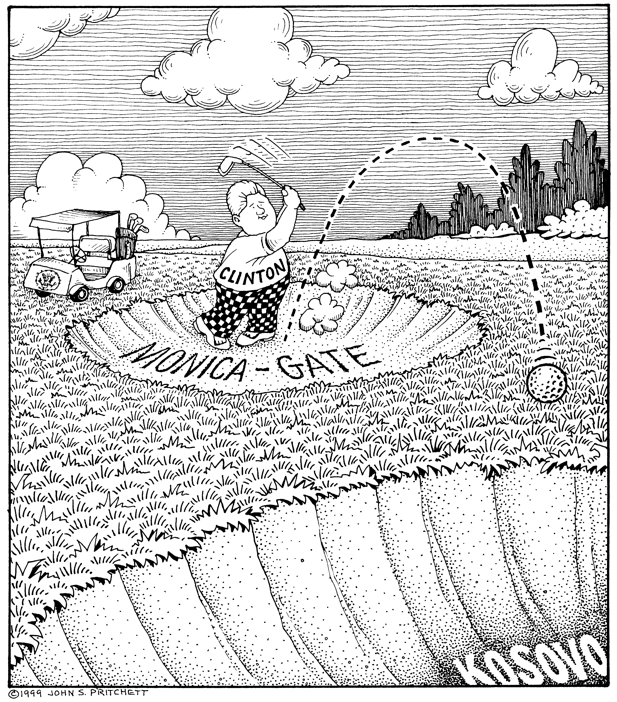
An unpublished Editorial I wrote in 1999 about Clinton, Bin Laden, and Kosovo


Click here to see this post on the Orthodox List, dated April 1st, 1999.

Gone With the Cruise Missiles

This should sound familiar... marauding troops of a Federal government seeking to deny a breakaway province it's autonomy (previously guaranteed by their constitution), making war on civilians; burning homes, farms, villages, and cities; robbing and looting as they go; and causing a humanitarian disaster as starving refugees flee their advance. But this is not present day Kosovo, but the sovereign state of Georgia in 1864 as Sherman made his famous march to the sea, in an effort to break the will of Southerners to continue fighting against the Union. Sherman, who is the originator of the famous maxim "War is hell," justified his actions in Georgia by saying (in his letter to Mayor Calhoun of Atlanta and others of September 12, 1864),"You cannot qualify war in harsher terms than I will. War is cruelty, and you cannot refine it; and those who brought war into our country deserve all the curses and maledictions a people can pour out."

If only Clinton had been around then to demagogue, perhaps Abe Lincoln would have been branded a war criminal... since Sherman was, after all, acting on his orders.

Of course Clinton had his chance to fight in a civil war back in the 60's. He could have joined the Marines and ran through the jungles of Vietnam, M-16 in hand, chasing after the Viet Cong, who were guilty of far worse atrocities than the Serbs have been accused of committing in Kosovo; but instead Clinton ran to England, and like the other draft dodgers of his day, argued that the US had no business getting involved in a civil war, thousands of miles away, in which we have no vital interest, and which we do not understand.

But now Clinton is the Commander-in-Chief, and so can comfortably play golf while he orders other people's children to risk their lives for his photo-op foreign policy. Since assuming office, Clinton has stripped the US military to the bone, while at the same time deploying them all over the globe. His weapon of choice has been cruise missiles, the supply of which is now almost exhausted -- he has fired them off like a kid shooting off bottle rockets on the 4th of July, but has not seen fit to request any new orders of cruise missiles to replace them. Just two days ago, NATO sent B-1 bombers into action over Yugoslavia to make up for this shortage, for which Bill Clinton is completely responsible.

You might recall that Clinton fired rounds of cruise missiles at Osama bin Laden (at a convenient time during the Lewinsky scandal), and declared a "war on terrorism." Though one might reasonably wonder about the moral difference between bin Laden blowing up a US civilian target with a truck bomb, and Clinton blowing up an aspirin factory with a cruise missile, what is even more curious is that it was OK for Clinton to ostensibly fight bin Laden in Afghanistan and the Sudan, but unacceptable for the Yugoslavs to fight the bin Laden backed KLA in Kosovo.

One might also ask why Clinton objects to "ethnic cleansing" in Kosovo, but winked when the Croatians (with NATO weapons, training, and technical support) ethnically cleansed the Krajina region of Croatia of some 200,000 Serbs, most of whom have not been allowed to return to this day.

Another inconvenient question is why is it that NATO continues to include Turkey as a member, despite its ongoing war against Kurdish separatists, and its continues occupation of half of Cyprus, despite numerous UN resolutions calling for their withdrawal?


Questions are also raised as to why Clinton wanted to avoid bombing Iraq during "the holy month of Ramadan" because this would have been "highly offensive to Moslems around the world" (which of course conveniently gave him an excuse for launching air strikes on the eve of the Impeachment vote), and yet he is bombing the Orthodox Serbs during Great and Holy Lent, and has made it clear that he will bomb them straight through Holy Week, and shows no concern for the fact that Orthodox
Christians in Russia, Greece, and throughout the world might find this offensive.

Certainly, we all hate to see civilians caught in the cross fire, but what is going on in Kosovo is not a one sided war. The KLA saw the start of NATO bombing as an opportunity to step up their attacks on the Yugoslav Army. The Yugoslavs responded, and counter attacked. Combine that with bombs dropping all over the place, and it should come as no surprise that we see so many refugees. The KLA has attacked Serbian civilians, and used Albanian villages as their bases of operations -- those who remember the tactics of the Viet Cong should be somewhat sympathetic with the military problem that this poses to the Yugoslav Army, and they should also realize that this is a problem which KLA chooses to impose upon them, at the expense of Albanian civilians. It is terrible to see this play out in Kosovo, but perhaps the same country that burned Atlanta, fire bombed Dresden and Tokyo, and nuked Hiroshima and Nagasaki should not be so quick to cry foul with regard to "making war
on civilians."

Clinton addressed the American people and spoke passionately about his concern for Albanian civilians, with that now famous clinched jaw of his; but this is the same clinched jaw that told us that he didn't have sex with Monica Lewinsky. He graphically told us about Serbs shooting Albanians in cold blood, but this is the same man that told us that Republicans wanted to starve our children, and take away social security checks from helpless old people. But then, if anyone still believes a word Bill Clinton says, then they probably also believe that KLA terrorists wouldn't exaggerate Serbian "atrocities" in order to pump up support for NATO action against Yugoslavia.

Aside from questions about the coherency of this administration's foreign policy, on should also be concerned about their strategic bungling in Kosovo. Clinton began an air war with no plan "B" in mind. We have 10,000 NATO troops across the border in Macedonia, with no tanks. We certainly have a technological edge on the Yugoslavs, but Custer had a technological edge on the Sioux at Little Big Horn -- but as he vividly proved, technology isn't everything.

Every time Clinton has gotten into a jam, a Hitler-du-jour has emerged, and Clinton has fired a few hundred cruise missiles, to save the planet (and his political hide), and make the world safe for philandery. But when the last cruise missile is fired, one wonders what Clinton will do the next time he needs to distract the American people from his personal misdeeds, or to otherwise appear to have a foreign policy.

A Balkan Base for Al Qaeda

A Balkan Base for Al Qaeda?
By Julia Gorin
FrontPageMagazine.com | March 20, 2006


The War on Terror suffered a major blow three years before it was ever announced. It happened when the people of this democracy were misled into attacking the sovereign, emerging post-Communist democracy of Yugoslavia--over rumors of genocide and ethnic cleansing that proved false. In so doing, we put the final touch on delivering the Balkans to al Qaeda.

Today we are being asked to seal that historical blunder, whose repercussions seven years later are only escalating as those we “rescued” turn their weapons against UN and NATO forces. While NATO spends most of its time rooting out terror cells in Kosovo and Bosnia—which served as the logistics bases for the London and Madrid bombings--the 2006 deadline to complete our eagerly forgotten debacle and determine the province’s final status is fast approaching. To persuade the international community that only one final status will be acceptable, our Albanian "rescuees" have been stepping up the violence, a message to the West that it has only one possible exit strategy: grant unconditional independence--without border compromises with Serbia and without protection guarantees for what’s left of the non-Albanian minorities.

If we allow this to happen, the peacekeepers will have to leave, and with them our eyes and ears in this terror haven and thruway. Still, congressional, State Department and UN sentiment seems to be tilting toward self-determination and the logic that if you’ve dug yourself into a hole, keep digging.


Here is the size of that hole so far: In November, 2001, what should have been an explosive article appeared in the European edition of the Wall St. Journal. Headlined “Al Qaeda’s Balkan Links,” it read: “For the past 10 years…Ayman al-Zawahiri [bin Laden’s second in command] has operated terrorist training camps [and] weapons of mass destruction factories throughout Albania, Kosovo, Macedonia, Bulgaria, Turkey and Bosnia…Though the Clinton administration had been briefed extensively by the State Department in 1993 on the growing Islamist threat in former Yugoslavia, little was done to follow through….”


Nor did a December 2003 article in Britain’s Sunday Mirror register a blip: “Posing as members of the Real IRA, we…made our deal in Kosovo, a breeding ground for fanatics with al-Qaeda links. Our contact was the deputy commander of the Kosovo Liberation Army Niam Behljulji, known as Hulji…Hulji is said to supply terrorists across Europe and has been accused of massacring Serbian women and children during the war. He even posed grinning for a photograph, holding the severed head of one of his victims…Hulji said: ‘The plastics (Semtex) is the old type. No metal strips inside. It cannot be detected at airports.’”


Hulji, according to the December issue of London's Defense & Foreign Affairs Strategic Policy journal, is the man who supplied the Semtex-like explosives used in the London and Madrid attacks.


But to perpetuate the version of events we were sold from the beginning, all these connections have gone purposefully unmade by our nation’s “journalists,” who were gung-ho supporters of our 1999 offensive against a historical ally and the culmination of our pro-terror policies in 1990s Yugoslavia. How many Americans know that the terrorists who carried out a spate of suicide attacks in Iraq in August 2004 were trained in Bosnia, or that al Qaeda’s top Balkans operative, al-Zawahiri’s brother Mohammed, had a high position with our terrorist KLA "allies"? And who wants to bring up what former Canadian ambassador to Yugoslavia James Bissett has--that in Bosnia we'd fought alongside at least two of the 9/11 hijackers. The American public certainly won't hear that Bosnian charities have been raided for funding terrorism or that in 1992 Bosnia issued passports to Osama bin Laden and al-Zawahiri. We’ll never know that Bosnia today is the European “one-stop shop” for all the terrorism needs--weapons, money, shelter, documents--of Chechen and Afghani fighters passing through Europe before heading to Iraq. Or that at an al Qaeda training camp in Afghanistan, troops recovered one Albanian Kosovar’s application, reading, “I have Kosovo Liberation Army combat experience against Serb and American forces. ...I recommend operations against parks like Disney.”


Only Britain's Sky News has caught on, in December airing a segment entitled "The Hidden Army of Radical Islam," about Bosnia, where there is "growing radicalization" and a base for Al Qaeda: "In the heart of Europe, thousands of Arab fighters. Zenica [Bosnia], 1995. They come to wage holy war in support of the Bosnian Army. [Bosnian President Alija Izetbegovic shown welcoming the mujahadeen.] ...They committed many atrocities; the tapes Sky News has obtained include beheadings and signs of torture. …This isn’t just about history; it's about now. Western intelligence agencies are now pressing the Bosnians to look into exactly where these people are and what they are doing, and asking have any of these men been in contact with the three young Bosnian Muslims arrested last month on terrorism charges. ...In Sarajevo now the influence of Saudi ideas can be found all over the city. ...Radical Islam is attempting to plant deep roots in the community. …The seeds for change were planted back in 1995."


We see footage of Bosnian Muslim forces destroying an Orthodox Christian church; of a Bosnian Serb being brutalized (we're spared the skull crushing that follows); and a mujahadeen persuading his Bosnian colleagues to let him kill Serb prisoners, who are soon led off and executed. Though there is ample supply of tortured-Serb footage, it doesn’t enjoy the wide circulation that the video of a Bosnian-Serb paramilitary unit killing six Bosnian Muslims got last summer. The narration continues: "There were some serious players sent to Bosnia, among them the man who planned 9/11, Khalid Sheikh Mohamed...The mujahadeen video shows their flag planted in Bosnia and speaks of spreading their jihad. ...Bosnia is a useful place to hide, plan and move. It's why some stay on." The segment opens with the sentence, "Hundreds of radical Islamic holy warriors [are] hiding in Bosnia, a decade after the end of the war." That statement underscores the West's big miscalculaton in the Balkans--that Bosnia was a self-contained war that had an end, rather than an early front in a war that was just unfolding.


A similar picture began to emerge in Kosovo, where the late Wall St. Journal reporter Daniel Pearl was uncovering that "Ethnic-Albanian militants, humanitarian organizations, NATO and the news media fed off each other to give genocide rumors credibility." The anti-Serb propaganda which misled Americans throughout the 90s and which Daniel Pearl was debunking continues to guide our perceptions and foreign policy in the Balkans today. But despite the media’s blackout on the subject of Balkans terror--including by Pearl's own Wall St. Journal--more and more Americans have been scratching their heads, wondering why we forcibly precluded the Serbs from doing in their own backyard what we’ve gone halfway around the globe to do.


Our Balkans interventions are not like our unholy alliances of the past, wherein we strategically chose the lesser of two evils (e.g. allying ourselves with mujahideen against a clear and present Soviet enemy). By 1999, our government knew that the KLA was supported by Islamic nations and bin Laden, against whom the U.S. already had issued two indictments.


The Islamists were by then a known entity, specifically as our main post-Cold War threat, and Serbia wasn't an enemy.


For the past four years, the Hague's International Criminal Tribunal for the Former Yugoslavia has been finding what multiple international forensic teams have found--that claims of Serb “atrocities” were exaggerated and often invented. It turns out we confused an attempt to create an Islamic "Greater Albania" with one to create a “Greater Serbia.” Surely if the latter were Slobodan Milosevic’s goal, he would have started by ethnically cleansing the nearly 300,000 Muslims of Serbia. Though he built his career in whatever dirty ways Tito's Yugoslavia allowed, he was the least of the Balkans' villains. For most Serbs, he was not a hero until he was called upon to defend an entire nation at the Hague.


Now that Milosevic is dead, we are spared the worldwide riots that would have ensued had the tribunal mustered the courage to issue a verdict based on the evidence. And we can all sleep comfortably as the disproved charges are accepted as history.


“If you break it, you fix it.” We’ve heard much of that refrain throughout our Iraq debates—including from the selfsame architects of the Kosovo offensive: Bill and Hillary Clinton, Madeleine Albright and Wesley Clark. Their prescription for fixing what they broke? Bury it.


Clark warned that “a violent collision may occur by year-end” if we don’t do what the Albanians want—and this four-star general advocated doing just that. After all, “unrest” in the region shines an unwelcome spotlight on his “successful war.” Clark even suggested pummeling the Serbs again if Belgrade got in the way; it’s easier than fighting his terrorist Albanian campaign donors.


So far this year we are not witnessing the Albanian pogroms against Kosovo's remaining Serbs, which marked the March madness of 2004. For these tribal and holy warriors know that Kosovo is almost theirs, as the exasperated UN mission is ready to hand the reins over to local Albanian authorities--who are of course controlled by and include the KLA.


As UN human rights observer Jiri Dienstbier notes, "If NATO and the UN can't defeat terrorism in an area the size of one-eighth of the Czech Republic, how do they expect to confront global terrorism?" Balkans author Vojin Joksimovich seconds the question: "Although the intelligence community is fully aware of the threat, political leaders are denying it and the media are silent. Given this cover-up, it's fair to ask whether we are able to prevent yet another major terrorist act." Indeed, can you fight terror with one hand while abetting it with the other?

In early 2001, German TV broadcast a report titled "It Began with a Lie," which publicized the findings of the observer force Organization for Security and Cooperation in Europe (OSCE) that no genocide had taken place in Kosovo. The revelations set off a huge public debate in Germany, a member of the NATO coalition, after the public realized their country had been party to a hoax, and they held the responsible politicians’ feet to the fire.

It’s long past time that we also set the record straight on what we "achieved" in the Balkans -- and change course. As the world closes in on the Serbs again this year, we must stop bin Laden from establishing a terror state in Europe. We know from Madrid and London that we’ll pay for it with our own blood. In fact, we already have

Sunday, March 19, 2006

The Inexhaustible Cup


The "Inexhaustible Chalice" Icon of the Most Holy Theotokos was revealed in Russia in 1878. A retired soldier from Tula had spent his pension on alcohol, ruining his health. Though he was no longer able to walk, he continued to drink.

One night a holy Elder appeared to him in a dream and told him to go to the Serpukhov monastery of the Mother of God. "Have a Molieben served before her Icon "The Inexhaustible Chalice." Since he had no money and could not walk, the man paid no attention to the dream. Then the Elder appeared a second and third time, speaking to him with increasing severity.

Crawling on all fours, the man reached the next village and stayed in the home of an old woman. She rubbed his legs, and he began to feel better. The next day, he resumed his journey with two canes, then with one, until he arrived at the monastery.

He described his dreams to the monks, but none of them had ever heard of "The Inexhaustible Chalice" Icon. Finally, one of them remembered an icon on which a chalice was depicted. On the back of the icon was an inscription, "The Inexhaustible Chaice." After the Molieben, the peasant returned home restored to health, and cured of his alcoholism.

News of the miracle spread, and many alcoholics and their families came to pray before the Icon. Many of them came back to thank the Mother of God for answering their prayers. Every Sunday in the Serpukhov-Vyotsk monastery a Molieben with an Akathist is served before the Icon for those who are addicted to alcohol.

You can find the text of this akathist by clicking here.

Saturday, March 18, 2006

Lent is Different for the Orthodox

Ya don't say. :)


The Very Rev. Nabil Hanna of St. George Antiochian Orthodox Christian Church holds a cross as Amy Madsen venerates (kisses) it. Behind her Wednesday was her mother, Nancy Madsen. Hanna said fasting is a "spiritual exercise" for Orthodox Christians.


Lent is different for the Orthodox
Christians in the Eastern churches give up more foods and have their own calendar

By Robert King
robert.king@indystar.com

For most American Christians, the celebration of the resurrection of Jesus known as Easter falls on April 16.


But for Orthodox Christians around the nation and in 14 Central Indiana congregations, the resurrection celebration, which they call Pascha, comes a full week later -- on April 23.

That offset calendar -- which allows Orthodox families some great deals on chocolate bunnies and bright spring dresses -- is just one way the Orthodox, or Eastern, Church marks the holy season differently from its Western brethren.

Beyond the calendars, the Very Rev. Nabil Hanna, pastor of St. George Antiochian Orthodox Christian Church on the Eastside, said the key difference might be that the Orthodox view their much-stricter Lenten fasting not as a sacrifice but as a "spiritual exercise."

"The body is truly the partner of the spirit rather than being at odds with the body," Hanna said. "We need to discipline ourselves as a whole being, which includes the body. . . . If we just do whatever we feel like whenever, what separates us from the animals?"

The Orthodox Church, which includes Greek, Russian, Antiochian and other churches, was united with what we know today as the Roman Catholic Church through Christianity's first millennium. Differences over the authority of the pope, among other things, pulled them apart in the 11th and 12th centuries.

For Roman Catholics, the observance of Lent is characterized for many by abstaining from meat on Fridays. Some also give up other items -- chocolate or caffeine, for instance -- as a reminder of Christ's sacrifice.

But for observant Orthodox Christians, Lent is preceded not with a feast along the lines of Mardi Gras but with weaning oneself away from the consumption of meat and dairy products.

With the actual start of Lent, many observant Orthodox forgo meat, dairy products and fish for the entire season -- not just Fridays. The most devout may fast completely during daylight hours and consume only fluids, vegetables and grains at night.

"It really is a beautiful time where we see God's presence more," Hanna said. "We shut out so many of those things that, when we think about them, are distractions."
Aside from fasting, the Orthodox Church emphasizes prayer and giving to the poor during Lent. There is a dramatic uptick in the number of worship services and communal meals -- albeit meals with more modest menus.

The calendar discrepancy between the Eastern and Western churches developed in the 16th century, when Pope Gregory commissioned a new calendar. The Eastern Church stayed with the one developed by Julius Caesar.

The two calendars are now 13 days apart. Because the date of their celebrations of Christ's resurrection are based on the first appearance of a full moon following March 21, the dates frequently don't coincide.

Natalie Ashanin, a 74-year-old St. George member and a lifelong Orthodox Christian, is the child of Russian immigrants. She likens the Orthodox Lent to an old Russian phrase -- bright sadness.

"It is a time of thinking about Christ's death," Ashanin said. "Also, there is a joy in it in thinking that Easter is coming and the blessed Resurrection."
Orthodox Pascha and the Western church's Easter do not always fall on separate dates. But the frequent calendar discrepancy between the two was something Ashanin, who has four adult children, always welcomed.

"I loved it. I didn't like it when they were on the same time because the chocolate candies and the things and the dresses would go on sale after Western Easter, and we would go and get things for half-price," she said.

Still, Ashanin said that discrepancy can cause problems for families in which one spouse is Orthodox and the other is Catholic or Protestant. The side of the family that celebrates Easter typically wants to have a big meal on Easter Sunday, she said. But that falls in the midst of the Orthodox side's fasting.

A bigger problem, according to Rev. Hanna, is that the Western churches don't seem to observe Lent and Holy Week with the same special regard that Orthodox churches do. That can lead to issues such as one that occurred with Hanna's son. Two years ago, the boy's middle school band scheduled a trip to a Pacers game on Holy (Good) Friday.

"When I grew up and was in school, Holy Friday was a day people of all denominations went to church," Hanna said. "It seems to have little bearing (these days) on the celebration for Catholics and Protestants."

Hanna said Christians of all denominations need to understand that their faith is not lived out inside the stained-glass world of church services but is demonstrated in the community.

"These are not merely obligations," he said of the fasting and devotion to faith. "They are a way of life. Our faith is not something that we do when we happen to be in this building, but it should be all-pervasive."

A COMPARISON OF CHRISTIAN CALENDARS

Because the Orthodox Christian Church follows the Julian calendar for setting the dates for Lent and the Resurrection (Easter) celebration, their observances in many years fall on dates different from the Western church, which includes Catholics and Protestants. A look at 2006.

Orthodox dates

Lent begins -- March 6.
Palm Sunday -- April 16.
Good Friday -- April 21.
Pascha (Easter) -- April 23.

Roman Catholic/Protestant dates

Lent begins (Ash Wednesday) -- March 1.
Palm Sunday -- April 9.
Good Friday -- April 14.
Easter -- April 16.

Splain Dis

Body 'intact' 15 years after burial


The body of a Greek Orthodox monk was allegedly found intact 15 years after he was buried.

Medical experts are puzzling over the discovery in Lamia, central Greece, after the body of Vissarionas Korkoliakos was exhumed at Agathonos monastery, the semi-state Athens News Agency (ANA) reported.

“I believe this to be a sign from God,” Bishop Nikolaos, of the local prefecture of Fthiotida, said. “Even the monk’s soft parts are intact,” he added.

Four local doctors summoned by church authorities were unable to explain the alleged phenomenon. A fifth expert, an Athens coroner, wrote in his report that he had never seen such a case, ANA said.

Hundreds of faithful are flocking to the site, but the local church is advising restraint.

“We do not intend to declare [this man] a saint, or to summon people to pray before him,” Bishop Nikolaos said. (AFP)

Wednesday, March 08, 2006

Burial Place of St. Chad Discovered


h/t: Huw Raphael

Archaeologists discover Saint Chad's Burial Place and Shrine
- Major discovery re-writes Lichfield's history
- Shrine to be reunited with illuminated Gospels after 1,000 years


In a discovery hailed as being of “European significance” and the “foundation of English art”, archaeologists working at Lichfield Cathedral have uncovered the church built to house the grave of St Chad; together with the “Lichfield Angel” - part of the shrine created around AD700 by Bishop Hedda to mark the resting place of Lichfield’s first Bishop.

And now the remains of the shrine are to be reunited for the first time in more than 1,000 years with the Lichfield Gospels – an illuminated manuscript commissioned in the eighth century to adorn the shrine. And, thanks to collaboration between the Cathedral, the British Library and the Parish of Llandeilo, members of the public will be able to ‘turn the pages’ of the precious Lichfield Gospels as they have been digitised – digital versions of the St Chad Gospels will be on display in the Cathedral and also available to tour across the diocese.


The “Lichfield Angel”


When Chad became the fifth Bishop of the Mercians in AD 669 he moved the bishopric from Repton to Lichfield. The noted church historian, the Venerable Bede, reported that Chad “came to dwell by St Mary’s Church”. Chad died on 2nd March AD672 and Bede reported that he was buried: “close by” the Church of St Mary, but that his body was later transferred to the new church of St Peter.

The exact locations of these churches have never been known; and there has been much speculation that St Chad’s Church in Lichfield is located on the site of one of the original churches. But now, archaeologists can reveal that the remains of both St Peter’s Church and St Mary’s Church lie under the floor of the present cathedral – and that both have been found during recent archaeological investigations.

The latest finds – St Peter’s Church, the shrine, and a number of high-status later burials around the shrine – were discovered as archaeologists conducted a dig in the nave of the Cathedral to prepare the way for a new motorised retractable nave platform. The remains of St Mary’s Church was discovered in the 1990s during a major programme to replace broken limestone flooring flags. It wasn’t until the remains of St Peter’s Church was found that it was possible to identify the remains found in the 1990s as St Mary’s Church – the church where Chad worshipped and preached.

The “Lichfield Angel” is three adjoining fragments of an Anglo-Saxon sculptured panel made of cream shelly limestone. It is believed that this formed part of a shrine in which the bones of St Chad were housed.

Leading ecclesiastical archaeologist, Dr Warwick Rodwell, is Consultant Archaeologist at Lichfield Cathedral, and led the dig. He said: “The remarkable state of preservation of the panel fragments is due to several factors. First, the sculpture had a short life span before being broken and buried. Second, the fragments were deposited inside the church and have therefore not been subject to outside weathering. Third, at least two of the three pieces were placed face-down in a pit, thereby trapping air pockets against some areas of the sculptured surface. Hence, parts of the painted decoration have never had soil in contact with them.”

Professor Rosemary Cramp, a trustee of the British Museum and past president of the Council for British Archaeology is a senior expert in Anglo-Saxon archaeology, described the “Lichfield Angel” as being of “European importance”. She added: “This carving is crucially important for the light it throws on the chronology of Anglo Saxon sculpture. Only a handful of sites have produced sculptures which are archaeologically stratified as belonging to the pre-conquest period. This piece is unusual in that an almost complete panel of a casket has been carefully reburied, some time before the Norman Conquest. This can be paralleled only in the reburied sarcophagus at Alkmund’s, Derby.

“This piece provides something of a missing link between England and the continent in the revival of late antique styles, a revival which on the continent is demonstrated in manuscripts and ivories, not large scale carvings. The conservation of the Lichfield Angel and its formal, stylistic and iconographic analysis is obviously of crucial importance.”

Emily Howe, a conservator of wall paintings and sculptural polychromy, has been given the task of co-ordinating the recording, examination and analysis of the Angel prior to its conservation, and is receiving generous technical support from Birmingham Museum and Art Gallery and a substantial grant from the Pilgrim Trust. She said: “Initial documentation of the panel components, including high resolution digital imaging and close range 3-D laser scanning, has now been completed. Not only will these records serve as an important resource for monitoring the condition of the panel over time, but they will enable a better understanding of the way the panel was made and assist in the provision of interpretative material showing how the fragments might originally have fitted into the St Chad shrine chest.

“Following the Angel’s temporary display in the Cathedral during the month of March, a detailed condition assessment will be undertaken and further research instigated into the object’s physical history. Findings from these non-invasive investigations will inform the need for scientific analysis of the Angel’s stone support and extensive remaining paint layer, and examination of the ways in which the materials were used. Such analyses will not only provide further information on the panel’s current condition, but will also serve to illuminate its considerable technological significance among Britain’s early medieval sculpture.”

Recommendations for the long-term conservation of the Lichfield Angel and suitable conditions for the panel’s display in the Cathedral will be considered by a panel of experts based on the findings of these informative preliminary investigations.

Saturday, March 04, 2006

Jewish Extremist Attempts to bomb Church in Nazareth

Tensions rise over church attack in Nazareth
Updated Sat. Mar. 4 2006 2:14 PM ET

Associated Press


NAZARETH, Israel — A Roman Catholic bishop called for better protection of Christian sites Saturday after an Israeli couple set off a series of explosions in a church in Nazareth.

Israeli Arabs, meanwhile, filled the streets of the biblical city to protest Friday's attack on the Basilica of the Annunciation, which apparently was driven by personal distress and not extremism but still heightened religious and political tensions in northern Israel.

The couple and their 20-year-old daughter used a baby stroller to smuggle firecrackers and small gas canisters into the church on Friday evening.

They threw the explosives from the balcony and were beaten by worshippers before police arrived. After a three-hour standoff between police and thousands of protesters, the suspects were led away through a back exit, disguised as police officers. Club-wielding police fired stun grenades to keep back the mob.

The church suffered only minor damage, but the attack spurred widespread stone-throwing riots in which two dozen people, including 13 police officers, were hurt.

Hundreds of Israeli Arabs — Christian and Muslim — marched through Nazareth, holding up Palestinian flags and banners with slogans such as "Israel breeds hate" and "they accuse us of terrorism but they do terrorism."

The protesters sang church songs as they made their way from the municipality to the basilica. The streets were empty of police forces, who decided to stay out of town to avoid tensions.

Police said the man, Haim Eliyahu Habibi, had financial problems, and apparently is not a Jewish extremist. Habibi, his Christian wife, Violet, and their daughter were treated at a hospital before being taken into custody.

Habibi's daughter told investigators her parents intended to create a provocation to draw attention to their economic troubles and protest that two of their children had been taken from them by the Israeli authorities, Yaakov Sigdon, a police commander in northern Israel, told Israel Radio.

Several years ago, the family had sought political asylum in a West Bank town under Palestinian control for similar reasons.

But many Arabs dismissed the Israeli explanation, saying the government could have done more to prevent the attack and protect the Christian minority.

"We don't understand why and how this man came here, given his personality. Who sent him here?" said Latin Patriarch Michel Sabbah, the top Roman Catholic official in the Holy Land. "It is unclear, but it gives fuel to our anxieties about the future."

Foreign Minister Tzipi Livni contacted the Vatican late Friday, offering assurances that Israel is committed to protecting Christian holy places, officials said. Acting Prime Minister Ehud Olmert also discussed the situation with Nazareth's mayor, Olmert's office said.

Archbishop Elias Shakur, the top Roman Catholic official in Nazareth, issued a call for unity among Israel's citizens and dismissed the attackers as lone extremists. While praising the Israeli response, he said "it is not enough."

"It's a big tragedy for all of us in Israel, for Christians, for having their most holy places spoiled and used in a barbaric way," he said.

At the basilica, a small group of worshippers gathered to pray. Black stains on the walls caused by the explosion were removed.

But tensions remained high in northern Israel, where much of the country's Arab population is located. Police postponed at least seven soccer matches Saturday, fearing riots could break out.

In the Gaza Strip, Ismail Haniyeh, the designated Palestinian prime minister from the Islamic militant Hamas group, said the attack was the result "of a hate culture which Israel is feeding its public against the Palestinians, and their Christian and Islamic holy places and believers."

The Basilica of the Annunciation is built on the site where Christians believe the Angel Gabriel appeared before the Virgin Mary and foretold the birth of Jesus.

Nazareth, the boyhood town of Jesus, is inhabited by about 74,000 Arab Israelis, about two-thirds Muslim and the remainder Christian. Religious tensions have boiled over in the past, with the two sides in a dispute over attempts to build a mosque next to the church.

The attack also underscored the tense relations between Israel's Jewish majority and its Arab minority. Israeli Arabs, who make up about 20 percent of the population, complain of discrimination.

Israel's roughly 1 million Arabs hold Israeli citizenship, in contrast to Palestinian residents of the West Bank and Gaza Strip who live under the Palestinian Authority.

Despite tensions between Jews and Arabs, violence is rare

Tuesday, February 21, 2006

Another reason why the WCC is a joke


The 9th Assembly of the World Council of Churches


Key quote from the article below:

...the US responded to the attacks [of 9/11] "by seeking to reclaim a privileged and secure place in the world, raining down terror on the truly vulnerable among our global neighbours.

And the WCC is trying to "reach out" to conservative Protestant denominations in America, because they want to have nothing to do with the WCC... and they wonder why.

The WCC or NCC never spoke out against the terror of Communists groups such as SWAPO... instead they sent money to fund them. But they have never missed an opportunity to take a shot at the United States.

H/T Orthodoxy Today

US CHRISTIAN LEADERS APOLOGIZE TO ASSEMBLY PLENARY ON VIOLENCE, POVERTY AND
ECOLOGY


Representatives of the US Conference for the World Council of Churches (WCC) addressed a message to the WCC's 9th Assembly on 18 February saying that the US-led Iraq war was a "mistake", and apologized to the ecumenical community for failing to raise a prophetic voice to prevent it.

The Very Rev. Leonid Kishkovsky, moderator of the US Conference for the WCC, made up of 34 US churches that are members of the Council, told a 9th Assembly plenary, "We lament with special anguish the war in Iraq, launched with deception and violating global norms of justice and human rights."

Speaking at a press conference earlier, Kishkovsky said the delegation was making the statement to the ecumenical community to "show repentance and solidarity with those who suffered".

President of the National Council of Churches of Christ in the US, Rev. Michael Livingstone referred to solidarity shown with the US over the terrorist attacks of September 11 2001, saying, "In a number of ecumenical settings, we were deeply moved by post 9/11 visits, where we were offered sympathy over the tragic loss of life."

Nevertheless, the statement says, the US responded to the attacks "by seeking to reclaim a privileged and secure place in the world, raining down terror on the truly vulnerable among our global neighbours.

"Our leaders turned a deaf ear to the voices of church leaders throughout our nation and the world, entering into imperial projects that seek to dominate and control for the sake of our own national interests. Nations have been demonized and God has been enlisted in national agendas that are nothing short of idolatrous."

Presented in the form of a prayer of repentance, the message continues, "We confess that we have failed to raise a prophetic voice loud enough and persistent enough to call our nation to global responsibility for creation, that we ourselves are complicit in a culture of consumption that diminishes the earth. Christ, have mercy."

The statement says that while global warming goes on unchecked, the US refuses to acknowledge its responsibility and rejects multilateral agreements aimed at reversing disastrous trends.

It says, "Starvation, the HIV/AIDS pandemic, the treatable diseases that go untreated indict us, revealing the grim features of global economic injustice we have too often failed to acknowledge or confront."

"Hurricane Katrina," it continues, "revealed to the world those left behind in our own nation by the rupture of our social contract. As a nation we have refused to confront the racism that infects our policies around the world."

Rev. Dr Sharon Watkins, president of the Christian Church Disciples of Christ, who supported the statement, said, "This letter is not an attempt to undermine American troops. They are brave men and women who are our sons and daughters and our neighbours. But here we gather with Christians around the world, and meet the parents of other sons and daughters."

Visibly moved, she said, "We come face to face with brothers and sisters who suffered because of choices our government made, and we are making the statement to acknowledge solidarity with the suffering."

The statement itself affirms, "We mourn all who have died or been injured in this war; we acknowledge with shame abuses carried out in our name."

Explaining the timing of the statement, Rev. John Thomas, president of United Church of Christ, said, "An emerging theme in conversation with our partners around the world is that the US is being perceived as a dangerous nation."

He said that the Assembly was "a unique opportunity to make this statement to all our colleagues" in the ecumenical movement. The statement says, "We come to you seeking to be partners in the search for unity and justice."

Thomas acknowledged that not all church members would agree with the thrust of the statement, but said it was their responsibility as leaders to "speak a prophetic and pastoral word as we believe God is offering it to us".

The US Conference for the World Council of Churches is composed of 34 USchurches which belong to the WCC:
http://www.wcc-usa.org/about-us/member-churches.html

Orthodox church sees gap with Protestants growing


The 9th Assembly of the World Council of Churches


Orthodox church sees gap with Protestants growing
21 February 2006


PORTO ALEGRE: Liberal reforms allowing female clergy and same-sex marriage are creating a widening gulf within world Christianity, a leading Russian Orthodox bishop said.


That growing divide may prompt Orthodox churches to consider a tactical alliance with Roman Catholicism to defend traditional Christian values, Bishop Hilarion Alfeyev said on the sidelines of the global assembly of the mostly Protestant World Council of Churches (WCC).

While Orthodox churches, with some 220 million members, are members of the WCC, now holding its global assembly in Brazil, Alfeyev – the chief Russian Orthodox delegate – said they have less in common with fellow members than they once had.

"The gap between the traditional wing, represented mainly by Orthodox churches and the Roman Catholic Church, and the liberal wing, represented by many Protestant churches, is only growing day by day," he said.

"We (Orthodox and Catholics) are on the same side of the divide." "Traditional Christianity's very survival is in jeopardy. We have no right to delay this strategic alliance, because in 20-40 years it will be too late," he said in an interview, citing threats like "warrior secularism, warrior Islam or warrior liberalism present in Protestantism."

Alfeyev, the Bishop of Vienna also in charge of Russian Orthodox Church relations with the European Union, said the alliance should not be a matter of dogma and should precede the resolution of many centuries-old differences between the two oldest branches of Christianity, some dating back to the Great Schism of 1054.

His comments echoed ideas supported by Roman Catholic Pope Benedict, who has said closer ties with Orthodox churches are a top priority of his papacy. The Catholic Church represents over half of the world's 2 billion Christians but is not a member of the Geneva-based WCC.

AdvertisementAdvertisementAlfeyev said Russian theologians thought decades ago to "establish full Eucharistic contact" with the Anglican church.

"In the past years, it has become clear that it is completely impossible – dogmatically, ideologically and from the point of view of moral teaching, as the Anglican church shifted very far away from Orthodox dogma," he said.

Some Anglican churches in North America and Europe, as well as other Protestant churches, ordain non-celibate gay clergy and bless same-sex unions. Some also ordain women bishops.

These stances, Alfeyev said, make "any talk of unification very hard nowadays." The Orthodox Church does not accept the idea of female clergy as it attributes that development to the influence of secular processes of the past few decades.

Alfeyev said "a revelation from above" is needed for Orthodox churches to start ordaining women.

The Russian Orthodox Church recently broke off relations with the Lutheran Church of Sweden after it established an official ceremony to bless same-sex marriages, he said.

Alfeyev said his church accepts homosexuals as parishioners, treating them "with a sense of pastoral responsibility," but still considered gay relationships "sinful and not to be blessed or promoted," as seen in some Protestant churches. This echoes the traditional Catholic view.

In the wake of the growing differences with liberal churches, Alfeyev suggested an alliance with the Vatican and stressed there was no time to lose.

Alfeyev said the sides were trying to resolve their own issues, including the more modern problem of Catholic proselytism in Ukraine and Russia.

"I'm not calling for a dogmatic alliance. . .. We should unite in a joint testimony of traditional Christian values."

Alfeyev said the two sides were working to prepare a historic meeting between the Pope and the Patriarch of the Russian Orthodox Church, which had not yet taken place "not because of our denial, but because we want it to actually change things and not be just a protocol event."

Saturday, February 11, 2006

BONO'S REMARKS TO THE NATIONAL PRAYER BREAKFAST

I would not endorse every word or point that Bono made in this "homily", but I think it is well worth a read. Bono is not the typical dope-smoking rock and roller. He is a sincere believer. I don't think all of his beliefs are correct, but I think it is nice to see that someone who is on center stage in the pop culture, is talking about God's higher laws, and making people think a bit beyond themselves.


BONO'S REMARKS TO THE NATIONAL PRAYER BREAKFAST

***CHECK AGAINST DELIVERY***

BONO
REMARKS AT THE NATIONAL PRAYER BREAKFAST


Thank you.

Mr. President, First Lady, King Abdullah, Other heads of State, Members of Congress, distinguished guests…

Please join me in praying that I don’t say something we’ll all regret.

That was for the FCC.

If you’re wondering what I’m doing here, at a prayer breakfast, well, so am I. I’m certainly not here as a man of the cloth, unless that cloth is leather. It’s certainly not because I’m a rock star. Which leaves one possible explanation: I’m here because I’ve got a messianic complex.

Yes, it’s true. And for anyone who knows me, it’s hardly a revelation.

Well, I’m the first to admit that there’s something unnatural… something unseemly… about rock stars mounting the pulpit and preaching at presidents, and then disappearing to their villas in the South of France. Talk about a fish out of water. It was weird enough when Jesse Helms showed up at a U2 concert… but this is really weird, isn’t it?

You know, one of the things I love about this country is its separation of church and state. Although I have to say: in inviting me here, both church and state have been separated from something else completely: their mind. .

Mr. President, are you sure about this?

It’s very humbling and I will try to keep my homily brief. But be warned—I’m Irish.

I’d like to talk about the laws of man, here in this city where those laws are written. And I’d like to talk about higher laws. It would be great to assume that the one serves the other; that the laws of man serve these higher laws… but of course, they don’t always. And I presume that, in a sense, is why you’re here.

I presume the reason for this gathering is that all of us here—Muslims, Jews, Christians—all are searching our souls for how to better serve our family, our community, our nation, our God.

I know I am. Searching, I mean. And that, I suppose, is what led me here, too.

Yes, it’s odd, having a rock star here—but maybe it’s odder for me than for you. You see, I avoided religious people most of my life. Maybe it had something to do with having a father who was Protestant and a mother who was Catholic in a country where the line between the two was, quite literally, a battle line. Where the line between church and state was… well, a little blurry, and hard to see.

I remember how my mother would bring us to chapel on Sundays… and my father used to wait outside. One of the things that I picked up from my father and my mother was the sense that religion often gets in the way of God.

For me, at least, it got in the way. Seeing what religious people, in the name of God, did to my native land… and in this country, seeing God’s second-hand car salesmen on the cable TV channels, offering indulgences for cash… in fact, all over the world, seeing the self-righteousness roll down like a mighty stream from certain corners of the religious establishment…

I must confess, I changed the channel. I wanted my MTV.

Even though I was a believer.

Perhaps because I was a believer.

I was cynical… not about God, but about God’s politics. (There you are, Jim.)

Then, in 1997, a couple of eccentric, septuagenarian British Christians went and ruined my shtick—my reproachfulness. They did it by describing the Millennium, the year 2000, as a Jubilee year, as an opportunity to cancel the chronic debts of the world’s poorest people. They had the audacity to renew the Lord’s call—and were joined by Pope John Paul II, who, from an Irish half-Catholic’s point of view, may have had a more direct line to the Almighty.

‘Jubilee’—why ‘Jubilee’?

What was this year of Jubilee, this year of our Lords favor?

I’d always read the Scriptures, even the obscure stuff. There it was in Leviticus (25:35)…

‘If your brother becomes poor,’ the Scriptures say, ‘and cannot maintain himself… you shall maintain him… You shall not lend him your money at interest, not give him your food for profit.’

It is such an important idea, Jubilee, that Jesus begins his ministry with this. Jesus is a young man, he’s met with the rabbis, impressed everyone, people are talking. The elders say, he’s a clever guy, this Jesus, but he hasn’t done much… yet. He hasn’t spoken in public before…

When he does, is first words are from Isaiah: ‘The Spirit of the Lord is upon me,’ he says, ‘because He has anointed me to preach good news to the poor.’ And Jesus proclaims the year of the Lord’s favour, the year of Jubilee. (Luke 4:18)

What he was really talking about was an era of grace—and we’re still in it.

So fast-forward 2,000 years. That same thought, grace, was made incarnate—in a movement of all kinds of people. It wasn’t a bless-me club… it wasn’t a holy huddle. These religious guys were willing to get out in the streets, get their boots dirty, wave the placards, follow their convictions with actions… making it really hard for people like me to keep their distance. It was amazing. I almost started to like these church people.

But then my cynicism got another helping hand.

It was what Colin Powell, a five-star general, called the greatest W.M.D. of them all: a tiny little virus called A.I.D.S. And the religious community, in large part, missed it. The one’s that didn’t miss it could only see it as divine retribution for bad behaviour. Even on children… Even fastest growing group of HIV infections were married, faithful women.

Aha, there they go again! I thought to myself Judgmentalism is back!

But in truth, I was wrong again. The church was slow but the church got busy on this the leprosy of our age.

Love was on the move.

Mercy was on the move.

God was on the move.

Moving people of all kinds to work with others they had never met, never would have cared to meet… Conservative church groups hanging out with spokesmen for the gay community, all singing off the same hymn sheet on AIDS… Soccer moms and quarterbacks… hip-hop stars and country stars… This is what happens when God gets on the move: crazy stuff happens!

Popes were seen wearing sunglasses!

Jesse Helms was seen with a ghetto blaster!

Crazy stuff. Evidence of the spirit.

It was breathtaking. Literally. It stopped the world in its tracks.

When churches started demonstrating on debt, governments listened—and acted. When churches starting organising, petitioning, and even—that most unholy of acts today, God forbid, lobbying… on AIDS and global health, governments listened—and acted.

I’m here today in all humility to say: you changed minds; you changed policy; you changed the world.

Look, whatever thoughts you have about God, who He is or if He exists, most will agree that if there is a God, He has a special place for the poor. In fact, the poor are where God lives.

Check Judaism. Check Islam. Check pretty much anyone.

I mean, God may well be with us in our mansions on the hill… I hope so. He may well be with us as in all manner of controversial stuff… maybe, maybe not… But the one thing we can all agree, all faiths and ideologies, is that God is with the vulnerable and poor.

God is in the slums, in the cardboard boxes where the poor play house… God is in the silence of a mother who has infected her child with a virus that will end both their lives… God is in the cries heard under the rubble of war… God is in the debris of wasted opportunity and lives, and God is with us if we are with them. “If you remove the yolk from your midst, the pointing of the finger and speaking wickedness, and if you give yourself to the hungry and satisfy the desire of the afflicted, then your light will rise in darkness and your gloom with become like midday and the Lord will continually guide you and satisfy your desire in scorched places”

It’s not a coincidence that in the Scriptures, poverty is mentioned more than 2,100 times. It’s not an accident. That’s a lot of air time, 2,100 mentions. [You know, the only time Christ is judgmental is on the subject of the poor.] ‘As you have done it unto the least of these my brethren, you have done it unto me.’ (Matthew 25:40). As I say, good news to the poor.

Here’s some good news for the President. After 9-11 we were told America would have no time for the World’s poor. America would be taken up with its own problems of safety. And it’s true these are dangerous times, but America has not drawn the blinds and double-locked the doors.

In fact, you have double aid to Africa. You have tripled funding for global health. Mr. President, your emergency plan for AIDS relief and support for the Global Fund—you and Congress—have put 700,000 people onto life-saving anti-retroviral drugs and provided 8 million bed nets to protect children from malaria.

Outstanding human achievements. Counterintuitive. Historic. Be very, very proud.

But here’s the bad news. From charity to justice, the good news is yet to come. There’s is much more to do. There’s a gigantic chasm between the scale of the emergency and the scale of the response.

And finally, it’s not about charity after all, is it? It’s about justice.

Let me repeat that: It’s not about charity, it’s about justice.

And that’s too bad.

Because you’re good at charity. Americans, like the Irish, are good at it. We like to give, and we give a lot, even those who can’t afford it.

But justice is a higher standard. Africa makes a fool of our idea of justice; it makes a farce of our idea of equality. It mocks our pieties, it doubts our concern, it questions our commitment.

6,500 Africans are still dying every day of a preventable, treatable disease, for lack of drugs we can buy at any drug store. This is not about charity, this is about Justice and Equality.

Because there's no way we can look at what’s happening in Africa and, if we're honest, conclude that deep down, we really accept that Africans are equal to us. Anywhere else in the world, we wouldn’t accept it. Look at what happened in South East Asia with the Tsunami. 150, 000 lives lost to that misnomer of all misnomers, “mother nature”. In Africa, 150,000 lives are lost every month. A tsunami every month. And it’s a completely avoidable catastrophe.

It’s annoying but justice and equality are mates. Aren’t they? Justice always wants to hang out with equality. And equality is a real pain.

You know, think of those Jewish sheep-herders going to meet the Pharaoh, mud on their shoes, and the Pharaoh says, “Equal?” A preposterous idea: rich and poor are equal? And they say, “Yeah, ‘equal,’ that’s what it says here in this book. We’re all made in the image of God.”

And eventually the Pharaoh says, “OK, I can accept that. I can accept the Jews—but not the blacks.”

“Not the women. Not the gays. Not the Irish. No way, man.”

So on we go with our journey of equality.

On we go in the pursuit of justice.

We hear that call in the ONE Campaign, a growing movement of more than two million Americans… left and right together… united in the belief that where you live should no longer determine whether you live.

We hear that call even more powerfully today, as we mourn the loss of Coretta Scott King—mother of a movement for equality, one that changed the world but is only just getting started. These issues are as alive as they ever were; they just change shape and cross the seas.

Preventing the poorest of the poor from selling their products while we sing the virtues of the free market… that’s a justice issue. Holding children to ransom for the debts of their grandparents… That’s a justice issue. Withholding life-saving medicines out of deference to the Office of Patents… that’s a justice issue.

And while the law is what we say it is, God is not silent on the subject.

That’s why I say there’s the law of the land… and then there is a higher standard. There’s the law of the land, and we can hire experts to write them so they benefit us, so the laws say it’s OK to protect our agriculture but it’s not OK for African farmers to do the same, to earn a living?

As the laws of man are written, that’s what they say.

God will not accept that.

Mine won’t, at least. Will yours?

[pause]

I close this morning on … very… thin… ice.

This is a dangerous idea I’ve put on the table: my God vs. your God, their God vs. our God… vs. no God. It is very easy, in these times, to see religion as a force for division rather than unity.

And this is a town—Washington—that knows something of division.

But the reason I am here, and the reason I keep coming back to Washington, is because this is a town that is proving it can come together on behalf of what the Scriptures call the least of these.

This is not a Republican idea. It is not a Democratic idea. It is not even, with all due respect, an American idea. Nor it is unique to any one faith.

Do to others as you would have them do to you.’ (Luke 6:30) Jesus says that.

‘Righteousness is this: that one should… give away wealth out of love for Him to the near of kin and the orphans and the needy and the wayfarer and the beggars and for the emancipation of the captives.’ The Koran says that. (2.177)

Thus sayeth the Lord: ‘Bring the homeless poor into the house, when you see the naked, cover him, then your light will break out like the dawn and your recovery will speedily spring fourth, then your Lord will be your rear guard.’ The jewish scripture says that. Isaiah 58 again.

That is a powerful incentive: ‘The Lord will watch your back.’ Sounds like a good deal to me, right now.

A number of years ago, I met a wise man who changed my life. In countless ways, large and small, I was always seeking the Lord’s blessing. I was saying, you know, I have a new song, look after it… I have a family, please look after them… I have this crazy idea…

And this wise man said: stop.

He said, stop asking God to bless what you’re doing.

Get involved in what God is doing—because it’s already blessed.

Well, God, as I said, is with the poor. That, I believe, is what God is doing.

And that is what He’s calling us to do.

I was amazed when I first got to this country and I learned how much some churchgoers tithe. Up to ten percent of the family budget. Well, how does that compare the federal budget, the budget for the entire American family? How much of that goes to the poorest people in the world? Less than one percent.

Mr. President, Congress, people of faith, people of America:

I want to suggest to you today that you see the flow of effective foreign assistance as tithing…. Which, to be truly meaningful, will mean an additional one percent of the federal budget tithed to the poor.

What is one percent?

One percent is not merely a number on a balance sheet.

One percent is the girl in Africa who gets to go to school, thanks to you. One percent is the AIDS patient who gets her medicine, thanks to you. One percent is the African entrepreneur who can start a small family business thanks to you. One percent is not redecorating presidential palaces or money flowing down a rat hole. This one percent is digging waterholes to provide clean water.

One percent is a new partnership with Africa, not paternalism towards Africa, where increased assistance flows toward improved governance and initiatives with proven track records and away from boondoggles and white elephants of every description.

America gives less than one percent now. Were asking for an extra one percent to change the world. to transform millions of lives—but not just that and I say this to the military men now – to transform the way that they see us.

One percent is national security, enlightened economic self interest, and a better safer world rolled into one. Sounds to me that in this town of deals and compromises, one percent is the best bargain around.

These goals—clean water for all; school for every child; medicine for the afflicted, an end to extreme and senseless poverty—these are not just any goals; they are the Millennium Development goals, which this country supports. And they are more than that. They are the Beatitudes for a Globalised World.

Now, I’m very lucky. I don’t have to sit on any budget committees. And I certainly don’t have to sit where you do, Mr. President. I don’t have to make the tough choices.

But I can tell you this:

To give one percent more is right. It’s smart. And it’s blessed.

There is a continent—Africa—being consumed by flames.

I truly believe that when the history books are written, our age will be remembered for three things: the war on terror, the digital revolution, and what we did—or did not to—to put the fire out in Africa.

History, like God, is watching what we do.

Thank you. Thank you, America, and God bless you all.

Friday, February 10, 2006

Independent: Once-banned Solzhenitsyn wins 15 million Russian viewers


Once-banned Solzhenitsyn wins 15 million Russian viewers
By Andrew Osborn in Moscow
Published: 10 February 2006


Forty years ago Alexander Solzhenitsyn was a Soviet dissident whose books were suppressed and secretly distributed among a brave trusted few in the then USSR. He was part of a counter-culture that seemed nobly doomed and it was inconceivable that he would ever become part of the mainstream, let alone embrace it.

But 2006 has turned out to be the year Solzhenitsyn came full circle. Today his long bearded features stare at Muscovites from publicity posters and a TV adaptation of his troubling novel The First Circle is attracting impressive ratings and rave reviews.

The semi-autobiographical novel tells the story of a group of skilled mathematicians and specialists who agree to work on KGB special design projects for Joseph Stalin in 1949 in exchange for not being sent to hard labour camps where their chances of survival were much slimmer.

It focuses on the moral dilemmas that such a trade-off with the authorities presents and is based upon a stint that Solzhenitsyn did in such a centre on the outskirts of Moscow.

In an ironic twist that will not be lost on the Nobel Prize-winning writer, the TV serialisation is being funded by the Russian state - as if to underline his extraordinary journey from persecuted dissident to respected government-backed author.

Though, at 87, he continues to live the life of a frail recluse in an exclusive compound in north-west Moscow, he is no longer on the fringes of society but at the heart of it.

A total of 15 million Russians have tuned in to watch certain episodes of the 10-part serialisation, with 40 per cent of Moscow reported to have been glued to their screens during prime-time viewing recently on the state-owned Rossia Channel. Indeed to the surprise of TV executives, the grim morality tale set in Stalinist Russia turned out to have more pulling power than Arnold Schwarzenegger in Terminator 3: Rise of the Machines which was broadcast at exactly the same time on a rival channel.

As the theatre critic Vera Maksimova wrote: "The streets are empty. People are sitting and watching The First Circle. Solzhenitsyn is back."

The man variously described as "Russia's greatest living writer" or as "Russia's conscience" did the voice-over for the powerful drama and penned the screenplay.

It is the first time any of his writings have been transferred to the small or indeed the big screen in his native Russia.

When he watched the rough-cut version he is reported to have wept with emotion. His wife Natalia, who also acts as his official spokeswoman, said that he was struck by the film's authenticity and reminded of his own eight-year stint in labour camps across the Soviet Union.

The series' director, Gleb Panfilov, said in a television interview that he had conceived the idea of turning the novel into a film as long ago as 1974, the year Solzhenitsyn was exiled from the USSR, but never thought it would happen in his lifetime.

"I assumed that bringing it to the screen would be possible in 300 years. But it happened earlier," he said.

That it has happened is all the more remarkable considering that when it was first written in the 1950s the first draft had to be concealed in an empty champagne bottle in a hospital ward where Solzhenitsyn was being treated for cancer. The novel was published in the West in 1968, but appeared officially in the Soviet Union only in the late 1980s when Mikhail Gorbachev's policy of glasnost (openness) began to bite.

Solzhenitsyn returned to Russia in 1994 amid great fanfare after years of living in the United States, but struggled to find his rightful place.

His views - trenchant Russian nationalism, loathing of materialism and vocal support for the Russian Orthodox Church - have at times been controversial.

But with the television film The First Circle he finally appears to have found his niche.

Thursday, February 09, 2006

American Chronicle: The extraordinary tale of an enormous Russian cathedral – birth, destruction and resurrection


By Martine Self
February 8, 2006


What can you say about a cathedral that took 40 years to build, was demolished on the whim of one man, who then planned to replace it by building the tallest building in the world, but instead it became the world’s largest open air swimming pool and then was rebuilt almost exactly as it first was built in the space of five years? In most other countries, the tale would defy belief, but in Russia, somehow it’s easier to understand.

Some see its story as an allegorical tale mirroring the Birth, crucifixion and resurrection of Christ as well as the torment, endurance and rebirth of the Russian state itself.

The departure of Napoleon’s invading forces and the fortitude and sacrifice of the Russian people inspired the then Tsar, Alexander I to sign a manifesto on Christmas Day, 1812, proclaiming the building of an enormous cathedral to celebrate Russia’s liberation.

Many years passed before his good intentions were realized. Work first began in 1817 at Sparrow Hills, but was abandoned in favour of its present site, next to the Moscow River on a piece of land paradoxically known as ‘Devil’s Hill’. The beautiful Alekseevsky Convent which already stood on the site, was demolished by order of the tsar and relocated, but not before the Abbess apparently cursed the ground and foretold that no building built there would stand for any lengthy period of time.

Building began in 1839 and lasted for more than 40 years, being finally consecrated on 26 May 1883, on the day that Tsar Alexander III was crowned. Designed by architect Konstantin Ton in ‘Russo-Byzantine’ style, the building aroused controversy.

By 1924, after seven years in power, the Bolsheviks came up with the grandiose plan of demolishing the vast temple, and replacing it with a ‘super building’ to be known as the ‘Palace of the Soviet’s’ reaching over 415 metres in height. This was to include a 100 metre tall statue of Lenin and was meant to demonstrate to the proletariat and to the rest of the world, the might of the Soviet people. By destroying the largest and most visible symbol of Russian Orthodoxy, Stalin was striking at the heart of the Orthodox Church.

Another seven years passed before the third of three explosions destroyed the massive structure, eerily true to the abbess’s prophesy. By 1939, work started on the foundations, but World War II soon halted construction when metal structures were removed from the building to create ‘hedgehog’ tank traps that protected Moscow suburbs from invasion by Hitler.

Despite continued work on the design after the war, building of the palace never resumed, with just a muddy crater marking the project’s site. After Stalin’s death, little mention was made of it.

Since then, rumours have abounded that subsidence and proximity to the river prevented any further construction of the Palace, while other rumours affirm that the Soviet state ran out of money after the war.

Nevertheless, the flooded foundations were turned into the world’s largest heated outdoor swimming pool in 1958 – 60. It was kept heated at a warm 27C even throughout the winter.

In the late 1980s, the idea of building an exact copy of the demolished cathedral began to take shape, and by 1994, the decision to do so was taken by the Russian Orthodox Church. It became Moscow Mayor Yury Luzhkov’s flagship project to coincide with Moscow’s 850th anniversary in 1997 and the regeneration of Moscow. The splendid monument to the Russian Orthodox Church’s triumph over tyranny was built in five years and finally consecrated in August 2000.

Breathtaking in its enormity – it is the largest Orthodox church in the world – it now lies adorning the Moscow River’s bank, just down the road from the Kremlin, enhancing a fairytale skyline which is even more splendid at night.

A museum dedicated to the church’s history in the building’s basement demonstrates the rise and fall and rise again of one of Christendom’s most magnificent temples. Tours to all parts of the cathedral, including a visit to the base of the dome section, which offers a splendid view of Moscow, are available in English at the church and from tourist agencies in Moscow.

Sunday, January 29, 2006

Sergeant Carney's Flag


In 1863 William H. Carney entered the army and was assigned to Company C of the 54th Massachusetts Regiment, the first regiment composed of black men in the state. They were most renowned for their participation in the battle at Battery Wagner where, through their bravery and sacrifice, they forever silenced the predication that Blacks would not fight. It was at this siege on July 18, 1863 that Color-Sergeant William H. Carney performed a brave deed which earned him the Congressional Medal of Honor for most distinguished gallantry in action.

This act, acknowledged to be one of the most heroic deeds of the Civil War, is recorded in State documents and in the detailed account written by Sergeant Carney.

Here, in part, is his account of the siege:

‘. . .We were all ready for the charge, and the regiment started to its feet, the charge being fairly commenced. We had got but a short distance when we were opened upon with musketry, shell, grape shot and canister, which mowed down our men right and left. As the color-bearer became disabled I threw away my gun and seized the colors, making my way to the head of the column. . . In less than 20 minutes I found myself alone, struggling upon the ramparts, while the dead and wounded were all around me, lying one upon another. Here I said, ‘I cannot go into the battery alone,' and so I halted and knelt down, holding the flag in my hand. While there, the muskets, balls and grape-shots were flying all around me, and as they struck, the sand would fly in my face.


The Storming of Fort Wagner by the 54th Massachusetts Volunteer Infantry, Morris Island, Charleston, S.C., July 18, 1863.

I knew my position was a critical one, and I began to watch to see if I would be left alone. Discovering that the forces had renewed their attack farther to the right, and the enemy's attention being drawn thither, I turned and discovered a battalion of men coming towards me on the ramparts of Wagner. They proceeded until they were in front of me, and I raised my flag and started to join them, when from the light of the cannon discharged on the battery, I saw that they were my enemies. I wound the colors round the staff and made my way down the parapet in to the ditch, which was without water when I crossed it before, but now was filled with water that came up to my waist.

Out of the number that came up with me there was now no man moving erect, save myself, although they were not all dead but wounded. In rising to see if I could determine my course to the rear, the bullet I now carry in my body came whizzing like a mosquito, and I was shot. Not being prostrated by the shot, I continued my course, yet had not gone far before I was struck by a second shot.

Soon after I saw a man coming towards me, and then within halting distance I asked him who he was. He replied, ‘I belong to the One Hundredth New York,' and then inquired if I were wounded. Upon replying in the affirmative, he came to my assistance and helped me to the rear. ‘Now then,' said he, ‘let me take the colors and carry them for you.' My reply was that I would not give them to anyone else unless he belonged to the Fifty-Fourth Regiment. So we passed on , but we did not go far before I was wounded in the head.

We came at length within hailing distance of the rear guard, who caused us to halt, and upon asking who we were, and finding I was wounded, took us to the rear and through the guard. An officer came, and taking my name and regiment, put us in charge of the hospital corps, telling them to find my regiment. When we finally reached the latter the men cheered me and the flag. My reply was, ‘Boys, the old flag never touched the ground.'

It is then said that he fell to the gound in a dead faint, weak from the wounds that he had received.

In May, 1900, Carney became the first Black American to receive the Congressional Medal of Honor. Carney's brave deed is depicted on the Saint-Gaudens Monument in Boston Common. The rescued flag is enshrined in Memorial Hall, Boston.

William Harvey Carney died at his home in New Bedford, Massachusetts on December 9, 1908, and is buried in the Oak Grove Cemetery there.  His final resting place bears a distinctive stone, one claimed by less than 3500 Americans.  Engraved on the white marble is a gold image of the Medal of Honor, a tribute to a courageous soldier and the flag he loved so dearly.


The Robert Gould Shaw Memorial

The 54th Massachusetts Regiment's story was depicted in the movie Glory

Saturday, January 28, 2006

Update on the Orthodox Study Bible


Hat Tip: Uncreated Light

We would like to take this opportunity to give you a status report on the Orthodox Study Bible: The Septuagint / Old Testament Project with study notes.

All the participants in the project - translators, study aid authors, editors, and our publisher, Thomas Nelson - are committed to producing an accurate, faithful, and readable Bible, including all of the Books of the Septuagint Old Testament Bible missing in the present day English bibles and Roman Catholic Vulgate.

Special emphasis has been applied to the integrity of the translation, ensuring that these texts are rendered into the most accurate and appropriate English. The study aids and notes have been composed, edited, and revised to convey as best we are able the tradition of the Orthodox Church. The page layout and flow of text has been scrutinized to ensure that even the more mechanical aspects of the book will enhance its readability and usefulness. These attributes - accuracy, faithfulness, and utility - form the cornerstone of our work.

All other aspects of this project have been subordinated to them - including the schedule.

As we write this message, the final pieces of the new Orthodox Study Bible are making their way to the publisher, where they will be formatted, typeset, printed, collated, bound, packaged, and made ready for distribution. For a project of this scope, we anticipate the publication process committed to by Thomas Nelson will take thirteen to fifteen months. Therefore, we feel confident that the new Orthodox Study Bible will be available for purchase in time for Pascha, 2007.

Posted: 4 January, 2006

Wednesday, January 25, 2006

A New Chinese / Russian Prayerbook now in Print


From Mitrophan Chin:

A hardcover bilingual Russian-Chinese prayer book is now being made available for the first time. The first run of 2000 copies has been printed in Moscow, Russia through the support of the Brotherhood of Sts Peter and Paul of Hong Kong.


The prayer book consists of the morning and evening prayers and the Divine Liturgy of St John Chrysostom. The Russian text flows on one page and the modern Chinese text in parallel on the opposite page.

The Chinese text used in this prayer book is based on the online Chinese Orthodox Daily Prayer Book available at http://www.orthodox.cn/liturgical/prayerbook/daily/

This new translation in modern Chinese follows the missionary zeal of Metropolitan INNOKENTY (Figurovsky) of Beijing who authorized a translation commission in the early 20th century to provide liturgical books in the local venacular such as the 1910 Chinese prayer book. St John (Maximovich) also blessed a revised edition of the prayer book with more catechetical material in 1948 for his Chinese flock while he was Archbishop of Shanghai. Following its predecessors, a new translation is once again made available in the venacular of today, balanced with dignified Chinese vocabulary suitable for devotional and liturgical use. This new translation has been dilligently compared with the original Greek and other English prayer books. The text of the psalms as used in the liturgy will eventually be revised to conform to the Greek Septuagint (LXX) and to be made available online initially for comment for accuracy and ease of use.

Chinese Orthodox Christians living in Russia and mainland China may request a free copy of this bilingual prayer book from the Brotherhood. All others may request a copy with a freewill donation of any amount to help underwrite this missionary endeavor.
Direct all inquiries to Fr Dionisy Pozdnyaev at dpozdnyaev@yahoo.com or at:

F20, 28 Grosvenor Court, South Horizons, Ap Lei Chau, HONG KONGphone: +852 94385021, +86 13651152917 fax: +852 22909125, +852 25298211Website: http://www.orthodoxy.hk/


Sunday, January 08, 2006

Christmas Photos in the News

Christmas Photos in the news.


Russian President Vladimir Putin crosses himself during the Nativity Vigil at a main Russian Orthodox cathedral in the Siberian city of Yakutsk, January 6, 2006. Russia celebrates Christmas January 7th, two weeks later than Western Christianity. (UPI Photo/Anatoli Zhdanov)


(AP Photo/Mikhail Metzel) :: The head of Russia's Orthodox Church Patriarch Alexy II holds candles during a Christmas Liturgy in the giant Christ the Saviour cathedral in Moscow early Saturday, Jan. 7, 2006.


Orthodox worshippers light candles in the Nativity church as they celebrate the Orthodox Christmas in the West Bank city of Bethlehem January 7, 2006. Israelis kept a nationwide vigil for Prime Minister Ariel Sharon on Saturday after he underwent emergency surgery to staunch renewed bleeding in his brain from a massive stroke. (REUTERS/Laszlo Balogh)

MSNBC: Orthodoxy in SPAAAAACE!


The Russian Orthodox church in Baikonur, Kazakhstan, was completed in June of last year. This past Saturday, the first time Christmas services were held there.


By James Oberg
NBC News space analyst
Special to MSNBC
Updated: 9:18 a.m. ET Jan. 6, 2006

For almost half a century, Russian rockets and space travelers have assaulted the heavens from the Baikonur Cosmodrome, the Soviet spaceport in Central Asia that was portrayed as the shining symbol of a communist future. Now one of the last sights for departing space crews is the shiny domes of a new Russian Orthodox church — where they have their own way of reaching toward heaven.

The city of the space workers was originally named “Leninsk” in honor of the founder of the Soviet state, a champion of the official atheism under which priests were imprisoned and churches were burned. Cosmonauts in the Soviet era were often quoted as joking, “We have been to heaven, and didn’t see God there.”

But in a radical cultural revolution, the collapse of the Soviet regime in 1991 unleashed a long-underground religious impulse even among the elite of Soviet society, “rocket scientists” and the military hierarchy.

Within months of communism’s fall, a small Russian Orthodox church was organized at the space center in an abandoned sporting goods store. A young Russian priest came to town, held religious services and at the request of officials began blessing rockets and space crews. Cosmonauts began carrying traditional Russian icons into orbit.

Senior military officers back on Earth also began to come out of the closet on the issue of respect for the long-suppressed Russian church. Writing in a just-published armed forces commemorative chronicle of 50 years of rocket launches at Baikonur, space program veteran Major General Anatoliy Zavalishin observed that "in the opinion of many people, in Russia there stand only two really active forces that are close to the common people — these are the army and the church.”


“Almost every cosmonaut brings with him into space his personal icons,” said Gennady Padalka, who commanded the 9th expedition aboard the international space station in 2004. In addition, a copy of the famous icon of “St. Mary of Kazan” is displayed on a panel in the Russian segment of the station. It was placed there in 2000 by the very first long-term crew.

This remarkable religious surge will be celebrated spectacularly this Saturday, the Russian Orthodox Christmas. It will be the first time Christmas services are held at Baikonur’s new church, just completed in the middle of last year.

The glistening gold and blue domes are clearly visible from a concrete overlook located behind the “Cosmonaut Hotel,” where space crews and their support staff live prior to launch. Often, on the day before the launch, those bound for space walk past lines of memorial trees planted by earlier generations of cosmonauts and look out over the Syr Darya River and the surrounding steppes, to fix in their minds the sights and smells of the world they are leaving. South of the overlook, about a mile downstream along the river, the shiny new church now glistens.


A copy of the Kazan icon of the Theotokos is seen over the head of U.S. astronaut James Voss in 2001 as he floats in the Zvezda service module of the international space station.


During Soviet days, religious celebrations in the city were forbidden. But as soon as Kazakhstan declared its independence, a small group of people at the spaceport petitioned the Russian Orthodox bishop of the nearby city of Akmolinsk to open a parish and send an ordained priest.

The bishop consulted with church officials in Russia, and in June 1992 they sent Father Sergey to Baikonur. With the Russian space program nearly bankrupt, the situation wasn’t the easiest. The congregation grew rapidly, however, and soon there were too many attendees to fit into the small store during services.

Easter 1994 marked a major turning point for the congregation, when about two thousand people crowded the street outside the makeshift church and city officials approved a live TV broadcast of the services