Showing posts with label Atonement. Show all posts

Friday, October 16, 2020

Stump the Priest: Why Hast Thou Forsaken Me?


Question: "What is the understanding of the Church on Matthew 27:46? I have done some research myself and I have seen everything from the idea that Christ was abandoned by the Father, to arguments that Christ was not abandoned, nor was He distressed, but was proclaiming that in this darkest hour, so to speak, the Father is still with Him."

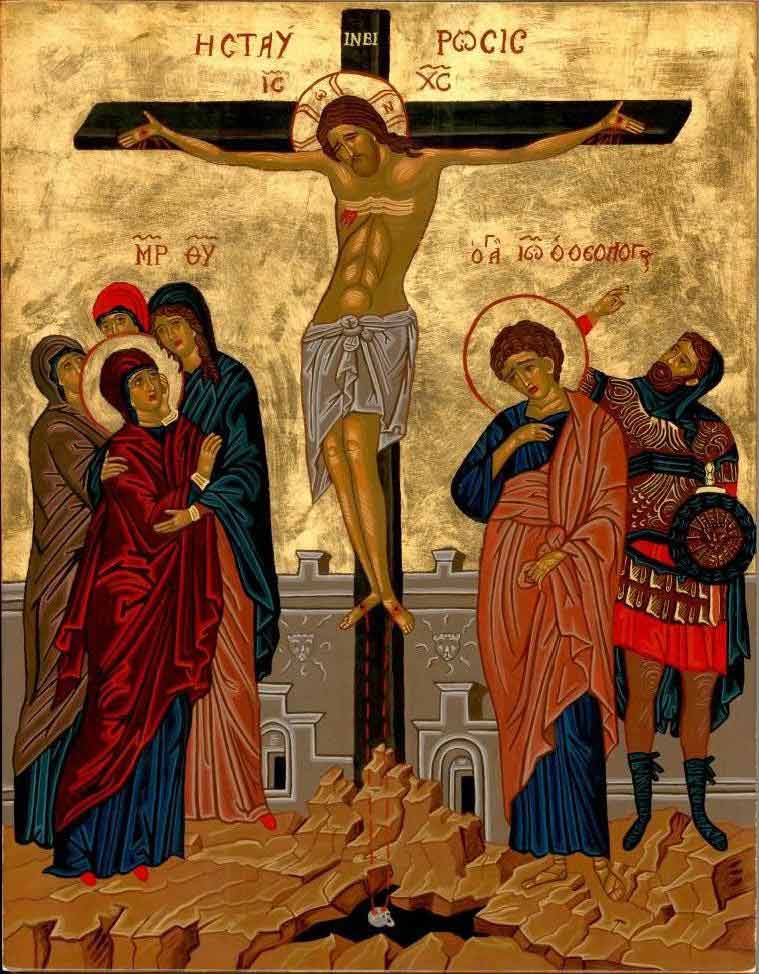
We find the text you reference in Matthew, as well as in Mark 15:34, but it is also clear that Christ is quoting from Psalm 21:1 (which is Psalm 22:1 in Protestant Bibles). The entirety of Psalm 21[22] is seen as a prophecy of the death and Resurrection of Christ by the Fathers, as is either clearly suggested or made explicit in the crucifixion accounts in all four Gospels. Psalm 21[22]:16-17 ("they have pierced my hands and my feet. They have numbered all my bones, and they themselves have looked and stared upon me") which is alluded to in John 19:37, and Psalm 21[22]:18 ("They have parted my garments amongst themselves, and for my vesture have they cast lots") is directly quoted by Matthew 27:35 and John 19:23-24, and clearly alluded to in Mark 15:24 and Luke 23:34.

And so to find the answer to this question we need to see what the Fathers say about these passages.

St. Gregory the Theologian (329-390) emphasizes that these words are spoken by Christ on our behalf, because He suffered on our behalf, but that there was no separation between the Father and the Son, and that Christ's humanity was never separated from His divinity: 

"It was not He who was forsaken either by the Father, or by His own Godhead, as some have thought, as if It were afraid of the Passion, and therefore withdrew Itself from Him in His Sufferings (for who compelled Him either to be born on earth at all, or to be lifted up on the Cross?) But as I said, He was in His own Person representing us. For we were the forsaken and despised before, but now by the Sufferings of Him Who could not suffer, we were taken up and saved. Similarly, He makes His own our folly and our transgressions; and says what follows in the Psalm, for it is very evident that the Twenty-first Psalm refers to Christ.

The same consideration applies to another passage, “He learnt obedience by the things which He suffered,” and to His “strong crying and tears,” and His “Entreaties,” and His “being heard,” and His” Reverence,” all of which He wonderfully wrought out, like a drama whose plot was devised on our behalf. For in His character of the Word He was neither obedient nor disobedient. For such expressions belong to servants, and inferiors, and the one applies to the better sort of them, while the other belongs to those who deserve punishment. But, in the character of the Form of a Servant, He condescends to His fellow servants, nay, to His servants, and takes upon Him a strange form, bearing all me and mine in Himself, that in Himself He may exhaust the bad, as fire does wax, or as the sun does the mists of earth; and that I may partake of His nature by the blending. Thus He honours obedience by His action, and proves it experimentally by His Passion. For to possess the disposition is not enough, just as it would not be enough for us, unless we also proved it by our acts; for action is the proof of disposition.

And perhaps it would not be wrong to assume this also, that by the art of His love for man He gauges our obedience, and measures all by comparison with His own Sufferings, so that He may know our condition by His own, and how much is demanded of us, and how much we yield, taking into the account, along with our environment, our weakness also" (Fourth Theological Oration 5-6).

St. John Chrysostom (347-407) adds that Christ, by citing this Old Testament prophecy, bore witness to the Old Testament, and showed that He was not in opposition to it, but that it bore witness to Him: 

"And for this reason, even after this He speaks, that they might learn that He was still alive, and that He Himself did this, and that they might become by this also more gentle, and He saith, “Eli, Eli, lama sabachthani?” that unto His last breath they might see that He honors His Father, and is no adversary of God. Wherefore also He uttered a certain cry from the prophet, even to His last hour bearing witness to the Old Testament, and not simply a cry from the prophet, but also in Hebrew, so as to be plain and intelligible to them, and by all things He shows how He is of one mind with Him that begat Him" (Homily 88 on the Gospel of Matthew).

St. Jerome (347-420) in his commentary on Matthew, emphasizes the fact that Psalm 21 is clearly about Christ and no one else, and that the humility of the words cited point us to the scandal of the Cross (which St. Paul speaks of in 1 Corinthians 1:18-2:5):

"He has used the beginning of the twenty-first Psalm. Moreover, he leaves out what is read in the middle of the first verse: "Look upon me." For the Hebrew it reads: "My God, my God, why have you forsaken me?" Therefore, they are impious who think that this Psalm was spoken under the persona of David, or of Esther and Mordecai. For the evangelists understood the testimonies taken from it of the Savior, as for example: "They divided my garments among themselves and cast lots for my clothing"; and elsewhere: "They have pierced my hands and my feet." Do not marvel at the humility of the words and the complaint of the forsaken one. For by knowing the "form of a servant," you see the scandal of the cross" (The Fathers of the Church: St. Jerome, Commentary on Matthew, 4:27:46, trans. Thomas P. Scheck (Washington, D.C.: Catholic University of America Press, 2008), p. 319).

Blessed Theophylact (1050-1107) expands on St. John Chrysostom's commentary, and then adds some additional insights:

"Jesus speaks prophetically in the Hebrew tongue to show that He does not contend with the Old Testament. He said, "Why hast Thou forsaken Me?" to show that He was truly man, and not just in appearance. For man avidly desires life and has a physical appetite for it.  Just as Christ agonized and was sorely troubled before the cross, showing the fear that is ours by nature, so now He says, "Why hast Thou forsaken Me?" displaying our natural thirst for life. For He was truly man and like us in all respects, but without sins. Some have understood it in this manner: the Savior spoke on behalf of the Jews and said, "Why hast Thou forsaken the Jewish race, O Father, that it should commit such a sin and be handed over to destruction?" For as Christ was one of the Jews, He said "forsaken Me," meaning, "Why hast Thou forsaken My kinsmen, My people, that they should bring such a great evil upon themselves?" (The Explanation of the Holy Gospel According to Matthew. Fr. Christopher Stade, Trans. (House Springs, MO: Chrysostom  Press, 1992), p. 247f).

Blessed Theodoret (393-458), in his commentary on Psalm 21[22] emphasizes the prophetic focus of the Psalm as a whole:

"This Psalm foretells the events of Christ the Lord's Passion and Resurrection, the calling of the nations and the salvation of the world" (The Fathers of the Church: Theodoret of Cyrus, Commentary on the Psalms, 1-72, trans. Robert C. Hill (Washington, D.C.: Catholic University of America Press, 2000), p. 145).

And on the specific verse in question, he writes very much along the lines of St. Gregory the Theologian: 

"Now, it was while fixed to the wood that the Lord uttered this cry, using the very language of the Hebrews, "Eli, Eli, lema sachthani?" So how could the testimony of truth itself be found inadmissible? He says he has been abandoned, however, since, despite no sin having been committed by him, death prevailed after receiving authority against sinners. So he calls abandonment not any separation from the divinity to which he was united, as some suspected, but the permission given for the Passion: the divinity was present to the form of a slave in his suffering and permitted him to suffer so as to procure salvation for the whole of nature. Of course, it was not affected by suffering from that source: how could the impassible nature suffer? It is Christ the Lord as a man, on the contrary, who speaks these words..." (The Fathers of the Church: Theodoret of Cyrus, Commentary on the Psalms, 1-72, trans. Robert C. Hill (Washington, D.C.: Catholic University of America Press, 2000), p. 146).

Cassiodorus (485-585), in his commentary on Psalm 21[22] echoes the other Fathers, and cites St. Cyril of Alexandria to reinforce them:

"He asks the Father why he has been abandoned by Him. These and similar expressions seek to express His humanity, but we must not believe that divinity was absent to Him even at the passion, since the apostle says: If they had known, thy would never have crucified the Lord of glory [1 Corinthians 2:8]. Though He was impassible, He suffered through the humanity which He assumed, and which could suffer. He was immortal, but He died; He never dies, but He rose again. On this topic Father Cyril expressed this beautiful thought: Through the grace of God He tasted death for all, surrendering His body though by nature He was life and the resurrection of the dead" [Cyril of Alexandria, Ep. 17 (MG 77.113B)]... He broadcasts the experiences of the humanity which He assumed, repelling words of blasphemy and impious mouthings, for He says that words begotten by sins are far from Him. The salvation of His sacred soul was not to embrace the speech of sinners, but gladly to endure by the virtue of patience what He suffered through God's dispensation" (Cassiodorus: Explanation of the Psalms, Vol. 1, trans. P. G. Walsh, (New York: Paulist Press,1990), p. 217).

So in summary, Christ Himself, by quoting the first words of Psalm 21 from the Cross, pointed us to the words of this prophetic Psalm, so that we would understand the meaning of His death, which He suffered for our sakes and in our place. There is no sense in which Christ was separated from the Father while on the Cross, but He voluntarily suffered the abandonment of the penalty for our sins in His humanity. And though this Psalm begins with words that speak of abandonment, and speak of cruel suffering, they end with words that speak of Christ's resurrection, his victory over death, and the salvation of the Church, which would be drawn from all nations:

"I will declare Thy name unto my brethren, in the midst of the church will I hymn Thee. Ye that fear the Lord, praise Him; all ye that are of the seed of Jacob, glorify Him; let all fear Him that are of the seed of Israel. For He hath not set at naught nor abhorred the supplications of the pauper, nor hath He turned His face from me; and when I cried unto Him, He hearkened unto me. From Thee is my praise; in the great church will I confess Thee; my vows will I pay before them that fear Thee. The poor shall eat and be filled, and they that seek the Lord shall praise Him; their hearts shall live for ever and ever. All the ends of the earth shall remember and shall turn unto the Lord, and all the kindreds of the nations shall worship before Him. For the kingdom is the Lord's and He Himself is sovereign of the nations. All they that be fat upon the earth have eaten and worshipped; all they that go down into the earth shall fall down before Him. Yea, my soul liveth for Him, and my seed shall serve Him. The generation that cometh shall be told of the Lord, and they shall proclaim His righteousness to a people that shall be born, which the Lord hath made" (Psalm 21:22-31).


Thursday, May 12, 2016

Stump the Priest: "The Handwriting Against Us"


Question: "What is the “handwriting against us” in Colossians 2:11-15? Is it our sins or the Law or both or neither?" 

The text, as we have it in the King James Version is as follows:
"In whom also ye are circumcised with the circumcision made without hands, in putting off the body of the sins of the flesh by the circumcision of Christ: buried with him in baptism, wherein also ye are risen with him through the faith of the operation of God, who hath raised him from the dead. And you, being dead in your sins and the uncircumcision of your flesh, hath he quickened together with him, having forgiven you all trespasses; blotting out the handwriting of ordinances that was against us, which was contrary to us, and took it out of the way, nailing it to his cross; and having spoiled principalities and powers, he made a shew of them openly, triumphing over them in it."
The key word to consider here is the word translated as "ordinances." Some have tried to use this text as if this word refered to the Old Testament Law, and then to suggest that Christ blotted out the Law, however the word in question in Greek is "δογμασιν" (the dative plural of δογμα (dogma)) from which the English word "dogma" is derived -- however, that connection with the word "dogma" is somewhat misleading. The word is used by both Philo and Josephus in reference to both philosophical principles and imperial decrees (Theological Dictionary of the New Testament, 2:231). The sense of "decree" is the sense we find this verse taken in both the Fathers and the Services of the Church. It is the handwriting of the decree that was against us, i.e. the righteous sentence of God due to us for our sins which are blotted out, and nailed to the Cross. By extrapolation, some texts speak of it more generally as the debt of our sin, but this is focusing on the penalty of the sentence against us.

St. Irenaeus: “He destroyed the handwriting of our debt and fastened it to the Cross, so that as by means of a tree we were made debtors to God, so also by means of a tree we may obtain remission of the debt.” (Against Heresies, 5:17:3).

St. John Chrysostom: "See to it that we do not again become debtors to the old contract. Christ came once; he found the certificate of our ancestral indebtedness which Adam wrote and signed. Adam contracted the debt; by our subsequent sins we increased the amount owed. In this contract are written a curse, and sin, and death and the condemnation of the law. Christ took all these away and pardoned them. St. Paul cries out and says: "The decree of our sins which was against us, he has taken it completely away, nailing it to the cross." He did not say "erasing the decree,' nor did he say "blotting it out," but "nailing it to the cross," so that no trace of it might remain. This is why he did not erase it, but tore it to pieces" (Baptismal Instructions 3:21, quoted in Ancient Christian Commentary on Scripture: New Testament, Vol. IX, Peter Gorday, ed. (Downers Grove, IL: Intervasity Press, 2000) p. 33

St. Ambrose of Milan: "But Christ was sold because he took our condition upon himself, not our sins themselves; he is not held to the price of sin, because he himself did not commit sin. And so he made a contract at a price for our debt, not for money for himself; he took away the debtor's bond, set aside the moneylender, freed the debtor. He alone paid what was owed by all. We ourselves were not permitted to escape from bondage. He undertook this on our behalf, so that he might drive away the slavery of the world, restore the liberty of paradise and grant new grace through the honor we received by his sharing of our nature. This by way of a mystery" (Joseph 4:19, quoted in Ancient Christian Commentary on Scripture: New Testament, Vol. IX, Peter Gorday, ed. (Downers Grove, IL: Intervasity Press, 2000) p. 34).

Ambrosiaster: "Having defeated the princes and powers by the death of Christ, God annulled the sentence which had been decreed against us by the sin of Adam, for just as the names of those who act well are in the book of life, so also the names of sinners are in the book of death. Therefore God annulled the sentence by which we were guilty of death both by our own sin and by that of our ancestor, having conquered death in Christ and triumphed over the devil and his puppets in his own flesh" (Ancient Christian Texts: Commentaries on Galatians -- Philemon, Ambrosiaster, translated and edited by Gerald L. Bray (Downers Grove, IL: Intervasity Press, 2009) p. 89).

St. Ephrem the Syrian: “At the birth of the Son the King was enrolling all men for the tribute money, that they might be debtors to Him; the King came forth to us Who blotted out our bills and wrote another bill in His own Name that He might be our debtor” (Hymns on the Nativity, 4).

St. John Cassian: "At the sixth hour the spotless victim, our Lord and Savior, was offered to the Father, and mounting the cross for the salvation of the whole world he destroyed the sins of the human race. "Despoiling principalities and powers, he delivered them over publicly [Colossians 2:15]," and he freed all of us who were subject to and burdened by the record of our unpayable debt, removing it from our midst and fixing it to the trophy of his cross [Colossians 2:14] (The Institutes, 3:3:3, trans. Boniface Ramsey, O.P. (New York, NY: The Newman Press, 2000), p. 60).

St. Gregory Palamas: "For this reason the Lord patiently endured for our sake a death He was not obliged to undergo, to redeem us, who were obliged to suffer death, from servitude to the devil and death, by which I mean death both of the soul and of the body, temporary and eternal. Since He gave His blood, which was sinless and therefore guiltless, as a ransom for us who were liable to punishment because of our sins, He redeemed us from our guilt. He forgave us our sins, tore up the record of them on the Cross and delivered us from the Devil's tyranny (cf. Col 2:14-15)" (Christopher Veniamin, trans. Saint Gregory Palamas: The Homilies (Waymart, PA: Mount Thabor Publishing, 2009) p. 128f)."

"Thou hast not imitated the Harlot, O my wretched soul, who took the alabaster jar of myrrh and with tears anointed the feet of the Savior and wiped them with her hair. For this, He tore up the handwriting of her sins" (from the 9th Ode of the Great Canon).

"O God and Lord of Hosts, and Maker of all Creation, Who by the tender compassion of Thy mercy which transcendeth comprehension, didst send down Thine only-begotten Son, our Lord Jesus Christ, for the salvation of our race, and by His precious Cross didst tear asunder the handwriting of our sins, and thereby didst triumph over the principalities and powers of darkness: Do Thou Thyself, O Master, Lover of mankind, accept also from us sinners these prayers of thanksgiving and entreaty, and deliver us from every destructive and dark transgression, and from all enemies, both visible and invisible, that seek to do us evil. Nail down our flesh with the fear of Thee, and incline not our hearts unto words or thoughts of evil, but pierce our souls with longing for Thee, so that ever looking to Thee, and being guided by Thy Light as we behold Thee, the unapproachable and everlasting Light, we may send up unceasing praise and thanksgiving unto Thee, the Unoriginate Father, with Thine Only-begotten Son, and Thine All-holy and good and life-creating Spirit, now and ever, and unto the ages of ages" (The prayer at the Sixth Hour).

"O Thou who on the sixth day and in the sixth hour didst nail to the Cross Adam’s daring sin in Paradise, tear asunder also the handwriting of our sins, O Christ God, and save us" (Troparion at the Sixth Lenten Hour).

Thursday, January 21, 2016

Stump the Priest: "Against me is Thine anger made strong"


Question: "How do we understand Psalm 87[88]:7 ["Against me is Thine anger made strong, and all Thy billows hast Thou brought upon me"] that we do in the Six Psalms of Matins? This Psalm is about Christ, yes? And if so, how do we understand that in regards to Him?"

I am sure that there are patristic commentaries that I do not have access to, but of those that I do, it seems most of the Fathers do interpret this Psalm as referring to Christ. This would include St. Cyril of Jerusalem, St. Ambrose of Milan, St. John Chrysostom, St. Augustine, and Cassiodorus. Of these fathers, only St. Augustine and Cassiodorus comment on this specific verse, at least so far as I have seen. Cassiodorus used St. Augustine's commentary when writing his own, and so it is not an entirely independent witness on this.

Blessed Theodoret also comments on this verse, but he interprets this Psalm as referring to the Jews in the Babylonian Captivity. Since there are often multiple levels of meanings to any given passage, Blessed Theodoret's interpretation is not mutually exclusive with those Fathers who see this in reference to Christ.

But here is what St. Augustine says about this passage, which is interesting to me primarily because of what he does not say:

""Thy indignation lieth hard upon Me" (ver. 7), or, as other copies have it, "Thy anger;" or, as others, "Thy fury:" the Greek word θυμὸς having undergone different interpretations. For where the Greek copies have ὀργὴ, no translator hesitated to express it by the Latin ira; but where the word is θυμὸς, most object to rendering it by ira, although many of the authors of the best Latin style, in their translations from Greek philosophy, have thus rendered the word in Latin. But I shall not discuss this matter further: only if I also were to suggest another term, I should think "indignation" more tolerable than "fury," this word in Latin not being applied to persons in their senses. What then does this mean, "Thy indignation lieth hard upon Me," except the belief of those, who knew not the Lord of Glory? who imagined that the anger of God was not merely roused, but lay hard upon Him, whom they dared to bring to death, and not only death, but that kind, which they regarded as the most execrable of all, namely, the death of the Cross: whence saith the Apostle, "Christ hath redeemed us from the curse of the Law, being made a curse for us: for it is written, Cursed is every one that hangeth upon a tree [Galatians 3:13]" (Exposition on the Psalms, Psalm 87).

Likewise, Cassiodorus says of this verse "This was the belief of those permitted to prevail for their own destruction, that through God's anger Jesus Christ had confronted the hazards of the of the passion" (Explanation of the Psalms, Vol. 2, trans. P. G. Walsh, (New York: Paulist Press,1991), p. 345).

What is interesting here to me is that if St. Augustine or Cassiodorus believed that at the crucifixion, the wrath of God the Father was poured out on the Son, this would have been a perfect occasion for him to expound upon it, but instead he says that this verse only alludes to the false opinion of those who rejected Christ. This goes to show that this distortion of the doctrine of the Atonement was unknown to these Fathers.

For more information, see:

Stump the Priest: The Atonement

Stump the Priest: Allegorical Interpretations of Scripture?

Thursday, August 27, 2015

Stump the Priest: The Atonement


Question: "Do the Orthodox believe in the Atonement?"

The concept of atonement is found throughout Scripture, and so of course we Orthodox do believe in it. There was in fact a feast in the Old Testament called " The Day of Atonement," which in Hebrew is called Yom Kippur. This was the only fast day specifically called for in the Law of Moses, and was "a most holy sabbath [Shabbat Shabbaton]" (Leviticus 16:31). This is the fast that was alluded to in Acts 27:9, which states that "sailing was now dangerous, because the fast was now already past..."

The English word "atonement" was coined by William Tyndale, and means "to make one" or literally "at one-ment" (taking the two words "at" and "one" and adding the suffix "-ment." This well translated the meaning of the Hebrew word "Kippur,"  which means "reconciliation" -- specifically reconciling sinful men with a Holy God.

Another term which William Tyndale brought into English is "Mercy Seat". William Tyndale based his translation on Luther's translation into German: "Gnadenstuhl," which literally means the seat of grace or mercy. However, there is nothing in the Hebrew term, Kapporet, which suggests "mercy" or "seat." "Kapporet" is a form of the word "Kippur", and literally means "the place of reconciliation". This was the lid of the Ark of the Covenant, and the Mercy Seat was the place upon which the blood of the sacrifice on the day of Atonement was sprinkled, and by which reconciliation between God and men was brought about. The Greek translation for Mercy Seat was "ἱλαστήριον, hilasterion." And we find this word used in Romans 3:24-25: "Being justified freely by his grace through the redemption that is in Christ Jesus: Whom God hath set forth to be a propitiation through faith in his blood, to declare his righteousness for the remission of sins that are past, through the forbearance of God." Interestingly we find in that text the word "redemption", which could be translated as "ransom", and the Hebrew word for "ransom" (Koper) is from the same root word as Kippur -- a word used in reference to the Old Testament sacrifices, and which clearly has the connotation of "payment."

Church Tradition directly connects the Cross wih the Ark of the Covenant, because the Ark and the Mercy Seat was the place of atonement, and the Ark is referred to as "the place where His feet have stood" (Psalm 131:7 lxx) and the Cross is the place were Christ's feet stood, when he made atonement for our sins (see Christopher Veniamin, trans. Saint Gregory Palamas: The Homilies (Waymart, PA: Mount Thabor Publishing, 2009) p. 86).

There are many contemporary Orthodox writers who wish to deny or downplay a number of concepts that relate to our redemption. They will argue we don't believe Christ had to die in our place, or that His blood needed to be shed to pay the penalty for our sins. They will deny the legitimacy of legal terms, in favor of the idea that the Church is a spiritual hospital. The problem is not that the Church is not a spiritual hospital, but rather that in emphasizing one set of images used to explain our salvation, they deny a whole set of equally valid images that are clearly Biblical. It is true that in the west there was an over emphasis on legal imagery, but the solution to such an imbalance is not a new imbalance in the opposite direction. We can and should speak of sin as an illness, but when we die, we do not go before the final medical exam -- we face the final judgment, which is a legal image if ever there was one. And so we can also speak of sin as a transgression of the Law of God, and of our need to be justified by God, even as we speak of sin in terms of an illness that we need to be healed of.

We reject the idea that Christ's death was a ransom paid to the devil, but that it was a ransom in some sense is confirmed by the Lord Himself, and elsewhere in Scripture (Matthew 20:28Mark 10:451 Timothy 2:6). So we simply have to understand that verbal images point to a reality, but are not the reality itself, and we get a better idea of that reality by considering all the Biblical images that point to it -- not by focusing on one or two to the exclusion of the rest, and certainly not by pressing those images beyond the point that they are intended to make.

St. Gregory Palamas, in his Sixteenth Homily (delivered on Holy Saturday: "About the Dispensation According to the flesh of our Lord Jesus Christ and the Gifts of Grace Granted to Those Who Truly Believe in Him"), speaks quite a bit about the need for Christ to die in our place. The entire homily is well worth reading, but here are some excerpts:
"Man was led into his captivity when he experienced God's wrath, this wrath being the good God's just abandonment of man. God had to be reconciled with the human race, for otherwise mankind could not be set free from the servitude. A sacrifice was needed to reconcile the Father on high with us and to sanctify us, since we had been soiled by fellowship with the evil one. There had to be a sacrifice which both cleansed and was clean, and a purified and sinless priest" (Christopher Veniamin, trans. Saint Gregory Palamas: The Homilies (Waymart, PA: Mount Thabor Publishing, 2009) p. 124).
"Christ overturned the devil through suffering and His flesh which He offered as a sacrifice to God the Father, as a pure and altogether holy victim -- how great is His gift! -- and reconciled God to our human race" (p.125).
"For this reason the lord patiently endured for our sake a death He was not obliged to undergo, to redeem us, who were obliged to suffer death, from servitude to the devil and death, by which I mean death both of the soul and of the body, temporary and eternal. Since He gave His blood, which was sinless and therefore guiltless, as a ransom for us who were liable to punishment because of our sins, He redeemed us from our guilt. He forgave us our sins, tore up the record of them on the Cross and delivered us from the Devil's tyranny (cf. Col 2:14-15)"( p. 128f)."
As is often the case, the proper Orthodox perspective on this question is one of balance. We should proclaim the whole counsel of God (Acts 20:27), and not just the parts that we find most appealing. Nor should we overreact to the imbalances of heterodox theologians, and thus fall into a new error, by rejecting important aspects of our Tradition.

Update: 

The following quote from St. John Chrysostom is also of interest:
"God allowed his Son to suffer as if a condemned sinner, so that we might be delivered from the penalty of our sins. This is God's righteousness, that we are not justified by works (for then they would have to be perfect, which is impossible), but by grace, in which case all our sin is removed" (Commentary on 2 Corinthians 5:21, quoted in Ancient Christian Commentary on Scripture: New Testament, Vol. VII, Gerald Bray, ed. (Downers Grove, IL: Intervasity Press, 1999) p. 252).
Update 2:

St. Justin Popovich had this to say when commenting on 1 John 2:2:
"The Lord Christ is the propitiation of the Father for our sins, because praying to the Father for us sinful bearers of flesh, He points out His wounds for our sake, on His Body, the human body, which was sinless on earth, and forever remained that way. He is the propitiation of the Father for the sins of the whole world, because for the sake of all, and in the place of all, and in the name of all, He bore countless sufferings from the cradle all the way to the death on the Cross, the ultimate sacrifice, and He bore it in His infinite love of man. If it were not for the salvific propitiation for the sin of mankind, the world, by God’s righteousness, would have been destroyed many times because of its sins" (Archimandrite Justin Popovich, Commentary on the Epistles of St. John the Theologian, trans. Radomir M. Plavsic (Alhambra, CA: Sebastian Press, 2009) p. 21).
See also:

Worship at the Footstool of His Feet (Homily on Psalm 98)

Stump the Priest: The Veneration of the Cross

Tuesday, March 25, 2014

St. Gregory Palamas on Christ's Sacrifice for our Sins


The following quotes are from St. Gregory Palamas' Sixteenth Homily, which was delivered on Holy Saturday: "About the Dispensation According to the flesh of our Lord Jesus Christ and the Gifts of Grace Granted to Those Who Truly Believe in Him." The entire homily is well worth reading, but here are some excerpts:

"Man was led into his captivity when he experienced God's wrath, this wrath being the good God's just abandonment of man. God had to be reconciled with the human race, for otherwise mankind could not be set free from the servitude. A sacrifice was needed to reconcile the Father on high with us and to sanctify us, since we had been soiled by fellowship with the evil one. There had to be a sacrifice which both cleansed and was clean, and a purified and sinless priest" (Christopher Veniamin, trans. Saint Gregory Palamas: The Homilies (Waymart, PA: Mount Thabor Publishing, 2009) p. 124).

"Christ overturned the devil through suffering and His flesh which He offered as a sacrifice to God the Father, as a pure and altogether holy victim -- how great is His gift! -- and reconciled God to our human race" (p.125).

"For this reason the lord patiently endured for our sake a death He was not obliged to undergo, to redeem us, who were obliged to suffer death, from servitude to the devil and death, by which I mean death both of the soul and of the body, temporary and eternal. Since He gave His blood, which was sinless and therefore guiltless, as a ransom for us who were liable to punishment because of our sins, He redeemed us from our guilt. He forgave us our sins, tore up the record of them on the Cross and delivered us from the Devil's tyranny (cf. Col 2:14-15)"( p. 128f)."

Thursday, December 19, 2013

Stump the Priest: Why do we sing "Holy is the Lord our God" after the Canon at Matins?


Question: Why does the priest or deacon say "Holy is the Lord our God" (and the accompanying verses) at the end of the 9th Ode at Matins? What is the significance of its placement at the end of the Canon at Saturday Vigil?

To give a definitive answer to this question I would want to base it on some commentaries on the meaning of the Vigil. However, I have not seen any commentaries on the Vigil that have been translated into English that discuss the significance of singing this hymn at the point in the service that it is sung. I would think that there probably are such commentaries in Greek or Russian. Perhaps someone who is familiar with them will fill me in on what they say in response to posting this question, and if they do, I will post an update. There may also be something that is in English which I have simply not read yet. What I will do is point out a few facts about this hymn, and then give you my thoughts on why it may be that it is sung when it is, but I could be off the mark on it, and so don't take it as a final answer.

The way "Holy is the Lord, our God" is sung at Sunday Matins is the Deacon intones it is a way similar to a prokimenon, and the Choir repeated sings the verse, as follows:

Deacon:  Holy is the Lord our God.

Choir:  Holy is the Lord our God.
   
Deacon:  For holy is the Lord our God.

Choir:  Holy is the Lord our God.

Deacon:   Above all peoples is our God.

Choir:  Holy is the Lord our God.

"Holy is the Lord, our God" is only sung during Sunday Matins, with two exceptions: It is sung at the Matins of Lazarus Saturday, and it is also sung on Holy Saturday. So there is something about the significance of Sunday that calls for this to be sung, and so the obvious link would be with the Resurrection. And in fact, both Lazarus Saturday and Holy Saturday are services that anticipate the celebration of the Resurrection of Christ, and both services have a number of elements that are usually associated with the Sunday Services -- for example, on Lazarus Saturday, we sing "Having beheld the Resurrection," and on Holy Saturday we sing the Evlogitaria of the Resurrection. Another instance in which it is sung is at the Matins of Palm Sunday, when it is sung -- not prior to the Exapostilarion, as on Sundays -- but as the Exapostilarion. And while Palm Sunday is of course a Sunday, we do not sing any of the usual hymns of the resurrection on Palm Sunday.

So what is an Exapostilarion? According to the Festal Menaion, an exapostilarion takes its name from the Greek exapostello, "dismiss"), and so it is a hymn that we are dismissed with at Matins. And so has some special significance and is given a place of prominence during that service. The fact that this hymn functions as an exapostilarion on Palm Sunday (and also on Holy Saturday) probably indicates that when it is used just before the exapostilarion on Lazarus Saturday, and on normal Sunday services, that it is sort of a exta-exapostilarion. I also think that the fact it is the exapostilarion of Palm Sunday indicates that it is not just pointing to the Resurrection, but also to Christ's death on the Cross.

This is further indicated, in my opinion, by the Psalm from whence these verses are taken. Psalm 98 in the Septuagint (Psalm 99 in the KJV and most English versions of the Bible) focuses on the Ark of the Covenant, and the Mercy Seat, which I talk about in a sermon that you can listen to by clicking here. As I discuss in that sermon, this Psalm has verses that are used on the feast of the Exaltation of the Holy Cross, and so its use on that feast connect it with the Cross of Christ, and St. Gregory Palamas likewise associates the Ark of the Covenant and the Mercy Seat with the Cross, as is mentioned in that sermon.

And so it seems to me that this hymn is sung to remind us of the awesome mystery of Christ's death and resurrection, and to emphasize the sacredness of that mystery which we celebrate especially as we enter into Passion week on Palm Sunday, when we anticipate the celebration of Pascha on Lazarus Saturday and Holy Saturday, and when we celebrate Pascha each Sunday throughout the rest of the year.