Showing posts with label Salvation. Show all posts

Thursday, January 21, 2016

Stump the Priest: "Against me is Thine anger made strong"


Question: "How do we understand Psalm 87[88]:7 ["Against me is Thine anger made strong, and all Thy billows hast Thou brought upon me"] that we do in the Six Psalms of Matins? This Psalm is about Christ, yes? And if so, how do we understand that in regards to Him?"

I am sure that there are patristic commentaries that I do not have access to, but of those that I do, it seems most of the Fathers do interpret this Psalm as referring to Christ. This would include St. Cyril of Jerusalem, St. Ambrose of Milan, St. John Chrysostom, St. Augustine, and Cassiodorus. Of these fathers, only St. Augustine and Cassiodorus comment on this specific verse, at least so far as I have seen. Cassiodorus used St. Augustine's commentary when writing his own, and so it is not an entirely independent witness on this.

Blessed Theodoret also comments on this verse, but he interprets this Psalm as referring to the Jews in the Babylonian Captivity. Since there are often multiple levels of meanings to any given passage, Blessed Theodoret's interpretation is not mutually exclusive with those Fathers who see this in reference to Christ.

But here is what St. Augustine says about this passage, which is interesting to me primarily because of what he does not say:

""Thy indignation lieth hard upon Me" (ver. 7), or, as other copies have it, "Thy anger;" or, as others, "Thy fury:" the Greek word θυμὸς having undergone different interpretations. For where the Greek copies have ὀργὴ, no translator hesitated to express it by the Latin ira; but where the word is θυμὸς, most object to rendering it by ira, although many of the authors of the best Latin style, in their translations from Greek philosophy, have thus rendered the word in Latin. But I shall not discuss this matter further: only if I also were to suggest another term, I should think "indignation" more tolerable than "fury," this word in Latin not being applied to persons in their senses. What then does this mean, "Thy indignation lieth hard upon Me," except the belief of those, who knew not the Lord of Glory? who imagined that the anger of God was not merely roused, but lay hard upon Him, whom they dared to bring to death, and not only death, but that kind, which they regarded as the most execrable of all, namely, the death of the Cross: whence saith the Apostle, "Christ hath redeemed us from the curse of the Law, being made a curse for us: for it is written, Cursed is every one that hangeth upon a tree [Galatians 3:13]" (Exposition on the Psalms, Psalm 87).

Likewise, Cassiodorus says of this verse "This was the belief of those permitted to prevail for their own destruction, that through God's anger Jesus Christ had confronted the hazards of the of the passion" (Explanation of the Psalms, Vol. 2, trans. P. G. Walsh, (New York: Paulist Press,1991), p. 345).

What is interesting here to me is that if St. Augustine or Cassiodorus believed that at the crucifixion, the wrath of God the Father was poured out on the Son, this would have been a perfect occasion for him to expound upon it, but instead he says that this verse only alludes to the false opinion of those who rejected Christ. This goes to show that this distortion of the doctrine of the Atonement was unknown to these Fathers.

For more information, see:

Stump the Priest: The Atonement

Stump the Priest: Allegorical Interpretations of Scripture?

Saturday, December 05, 2015

Stump the Priest: Assurance of Salvation

Question: "Often in Protestant circles and Bible studies one will reference 1 John 5:13, “These things I have written to you who believe in the name of the Son of God, that you may know that you have eternal life." This is a verse that they claim as a basis for having complete assurance of their salvation. What is the Orthodox teaching on this passage?"

The question here is what does it mean to know that you have eternal life? Do we have to know that there is nothing we could possibly do to lose our salvation in order to know that we have eternal life?

This sort of thinking is something that has emerged from a strange Protestant mix of Arminianism and Calvinism. Calvinism teaches that God has decreed before all eternity who will be saved and who will be damned, and so obviously, if you are among the elect, there is nothing you could possibly do to become unelected. But a Calvinist would say that those who are elect will show the fruits of their election at some point before they die, and begin to live like Christians. Arminians, on the other hand deny that God determines who will be saved, and that the offer of salvation is open to everyone, and that furthermore, one can fall away from God and lose their salvation. Most Baptists are partially Calvinistic and partially Arminian -- they believe that salvation is open to all, but that once who are saved, you cannot lose your salvation. You could "steal a horse and ride it into heaven." And for those who have bought into this perspective, the idea of eternal security is something they believe in very strongly. And in fact, they seem to have a hard time understanding how anyone could have any confidence in their salvation if they did not have the absolute assurance that they could not possibly lose their salvation.

I have known my wife since I was 17, and we have been married for more than 27 years. I feel very secure in our relationship, but I am quite certain that there are things I could do to destroy that relationship. I am not in fear of that happening, however, because I have no intention of doing any of those things. So I know that my wife loves me, but I also respect her, and make sure that I treat her with love and respect so as to maintain that relationship. Our relationship with God is similar. We know God loves us, but we also know that if we turn our back on Him, we will not remain in a right relationship with Him. All we need to do, however, is to not do that.

St. Nicholas Cabasilas explains how we are saved in our cooperation with God this way:

"There is an element which derives from God, and another which derives from our own zeal. The one is entirely His work, the other involves striving on our part. However, the latter is our contribution only to the extent that we submit to His grace and do not surrender the treasure nor extinguish the torch when it has been lighted. By this I mean that we contribute nothing which is either hostile to the life or produces death. It is to this that all human good and every virtue leads, that no one should draw the sword against himself, nor flee from happiness, nor toss the crowns of victory from off his head" (The Life in Christ, trans. by Carmino J. DeCatanzaro, (Crestwood, NY: St. Vladimir’s Seminary Press, 1974), pp. 48-49).

Countless passages of Scripture could be cited to demonstrate that it is possible for us to lose our salvation, but the following words of the Prophet Ezekiel are a fairly clear example:

"The soul that sinneth, it shall die. The son shall not bear the iniquity of the father, neither shall the father bear the iniquity of the son: the righteousness of the righteous shall be upon him, and the wickedness of the wicked shall be upon him. But if the wicked will turn from all his sins that he hath committed, and keep all my statutes, and do that which is lawful and right, he shall surely live, he shall not die. All his transgressions that he hath committed, they shall not be mentioned unto him: in his righteousness that he hath done he shall live. Have I any pleasure at all that the wicked should die? saith the Lord God: and not that he should return from his ways, and live? But when the righteous turneth away from his righteousness, and committeth iniquity, and doeth according to all the abominations that the wicked man doeth, shall he live? All his righteousness that he hath done shall not be mentioned: in his trespass that he hath trespassed, and in his sin that he hath sinned, in them shall he die" (Ezekiel 18:20-24).

Thursday, August 27, 2015

Stump the Priest: The Atonement


Question: "Do the Orthodox believe in the Atonement?"

The concept of atonement is found throughout Scripture, and so of course we Orthodox do believe in it. There was in fact a feast in the Old Testament called " The Day of Atonement," which in Hebrew is called Yom Kippur. This was the only fast day specifically called for in the Law of Moses, and was "a most holy sabbath [Shabbat Shabbaton]" (Leviticus 16:31). This is the fast that was alluded to in Acts 27:9, which states that "sailing was now dangerous, because the fast was now already past..."

The English word "atonement" was coined by William Tyndale, and means "to make one" or literally "at one-ment" (taking the two words "at" and "one" and adding the suffix "-ment." This well translated the meaning of the Hebrew word "Kippur,"  which means "reconciliation" -- specifically reconciling sinful men with a Holy God.

Another term which William Tyndale brought into English is "Mercy Seat". William Tyndale based his translation on Luther's translation into German: "Gnadenstuhl," which literally means the seat of grace or mercy. However, there is nothing in the Hebrew term, Kapporet, which suggests "mercy" or "seat." "Kapporet" is a form of the word "Kippur", and literally means "the place of reconciliation". This was the lid of the Ark of the Covenant, and the Mercy Seat was the place upon which the blood of the sacrifice on the day of Atonement was sprinkled, and by which reconciliation between God and men was brought about. The Greek translation for Mercy Seat was "ἱλαστήριον, hilasterion." And we find this word used in Romans 3:24-25: "Being justified freely by his grace through the redemption that is in Christ Jesus: Whom God hath set forth to be a propitiation through faith in his blood, to declare his righteousness for the remission of sins that are past, through the forbearance of God." Interestingly we find in that text the word "redemption", which could be translated as "ransom", and the Hebrew word for "ransom" (Koper) is from the same root word as Kippur -- a word used in reference to the Old Testament sacrifices, and which clearly has the connotation of "payment."

Church Tradition directly connects the Cross wih the Ark of the Covenant, because the Ark and the Mercy Seat was the place of atonement, and the Ark is referred to as "the place where His feet have stood" (Psalm 131:7 lxx) and the Cross is the place were Christ's feet stood, when he made atonement for our sins (see Christopher Veniamin, trans. Saint Gregory Palamas: The Homilies (Waymart, PA: Mount Thabor Publishing, 2009) p. 86).

There are many contemporary Orthodox writers who wish to deny or downplay a number of concepts that relate to our redemption. They will argue we don't believe Christ had to die in our place, or that His blood needed to be shed to pay the penalty for our sins. They will deny the legitimacy of legal terms, in favor of the idea that the Church is a spiritual hospital. The problem is not that the Church is not a spiritual hospital, but rather that in emphasizing one set of images used to explain our salvation, they deny a whole set of equally valid images that are clearly Biblical. It is true that in the west there was an over emphasis on legal imagery, but the solution to such an imbalance is not a new imbalance in the opposite direction. We can and should speak of sin as an illness, but when we die, we do not go before the final medical exam -- we face the final judgment, which is a legal image if ever there was one. And so we can also speak of sin as a transgression of the Law of God, and of our need to be justified by God, even as we speak of sin in terms of an illness that we need to be healed of.

We reject the idea that Christ's death was a ransom paid to the devil, but that it was a ransom in some sense is confirmed by the Lord Himself, and elsewhere in Scripture (Matthew 20:28Mark 10:451 Timothy 2:6). So we simply have to understand that verbal images point to a reality, but are not the reality itself, and we get a better idea of that reality by considering all the Biblical images that point to it -- not by focusing on one or two to the exclusion of the rest, and certainly not by pressing those images beyond the point that they are intended to make.

St. Gregory Palamas, in his Sixteenth Homily (delivered on Holy Saturday: "About the Dispensation According to the flesh of our Lord Jesus Christ and the Gifts of Grace Granted to Those Who Truly Believe in Him"), speaks quite a bit about the need for Christ to die in our place. The entire homily is well worth reading, but here are some excerpts:
"Man was led into his captivity when he experienced God's wrath, this wrath being the good God's just abandonment of man. God had to be reconciled with the human race, for otherwise mankind could not be set free from the servitude. A sacrifice was needed to reconcile the Father on high with us and to sanctify us, since we had been soiled by fellowship with the evil one. There had to be a sacrifice which both cleansed and was clean, and a purified and sinless priest" (Christopher Veniamin, trans. Saint Gregory Palamas: The Homilies (Waymart, PA: Mount Thabor Publishing, 2009) p. 124).
"Christ overturned the devil through suffering and His flesh which He offered as a sacrifice to God the Father, as a pure and altogether holy victim -- how great is His gift! -- and reconciled God to our human race" (p.125).
"For this reason the lord patiently endured for our sake a death He was not obliged to undergo, to redeem us, who were obliged to suffer death, from servitude to the devil and death, by which I mean death both of the soul and of the body, temporary and eternal. Since He gave His blood, which was sinless and therefore guiltless, as a ransom for us who were liable to punishment because of our sins, He redeemed us from our guilt. He forgave us our sins, tore up the record of them on the Cross and delivered us from the Devil's tyranny (cf. Col 2:14-15)"( p. 128f)."
As is often the case, the proper Orthodox perspective on this question is one of balance. We should proclaim the whole counsel of God (Acts 20:27), and not just the parts that we find most appealing. Nor should we overreact to the imbalances of heterodox theologians, and thus fall into a new error, by rejecting important aspects of our Tradition.

Update: 

The following quote from St. John Chrysostom is also of interest:
"God allowed his Son to suffer as if a condemned sinner, so that we might be delivered from the penalty of our sins. This is God's righteousness, that we are not justified by works (for then they would have to be perfect, which is impossible), but by grace, in which case all our sin is removed" (Commentary on 2 Corinthians 5:21, quoted in Ancient Christian Commentary on Scripture: New Testament, Vol. VII, Gerald Bray, ed. (Downers Grove, IL: Intervasity Press, 1999) p. 252).
Update 2:

St. Justin Popovich had this to say when commenting on 1 John 2:2:
"The Lord Christ is the propitiation of the Father for our sins, because praying to the Father for us sinful bearers of flesh, He points out His wounds for our sake, on His Body, the human body, which was sinless on earth, and forever remained that way. He is the propitiation of the Father for the sins of the whole world, because for the sake of all, and in the place of all, and in the name of all, He bore countless sufferings from the cradle all the way to the death on the Cross, the ultimate sacrifice, and He bore it in His infinite love of man. If it were not for the salvific propitiation for the sin of mankind, the world, by God’s righteousness, would have been destroyed many times because of its sins" (Archimandrite Justin Popovich, Commentary on the Epistles of St. John the Theologian, trans. Radomir M. Plavsic (Alhambra, CA: Sebastian Press, 2009) p. 21).
See also:

Worship at the Footstool of His Feet (Homily on Psalm 98)

Stump the Priest: The Veneration of the Cross

Friday, July 10, 2015

Stump the Priest: What must I do to be saved?

The Philippian Jailer, before the Apostles Paul and Silas

Question: "What is needed to attain salvation? Verses such as Matthew 7:21-23 concern me greatly, and to help me along the Path, and to put my mind at ease, it would be wonderful to have a concise teaching on the subject that I could study and teach to others."

In Acts 16:25-34, we have the story of the Philippian Jailer. After the Apostles Paul and Silas, who had been imprisoned and prayed all night, there was an earthquake, the doors of the jail were opened, and their chains were loosed. The Jailer, thinking that the prisoners had escaped, and knowing that he would be put to death if that were found to be the case, drew his own sword, and was about to kill himself, when St. Paul called out to him: "Do thyself no harm: for we are all here." Then we are told that "he called for a light, and sprang in, and came trembling, and fell down before Paul and Silas, and brought them out, and said, "Sirs, what must I do to be saved?" And they said, "Believe on the Lord Jesus Christ, and thou shalt be saved, and thy house." So belief was the beginning, but it did not end there, because we are then told that the Apostles "spake unto him the word of the Lord, and to all that were in his house. And he took them the same hour of the night, and washed their stripes [the Apostles had been beaten, before being jailed]; and was baptized, he and all his, straightway." So he believed, and was baptized. At the beginning of Christ's preaching, immediately after He was baptized by St. John the Baptist, we are told "Jesus came into Galilee, preaching the gospel of the kingdom of God, and saying, "The time is fulfilled, and the kingdom of God is at hand: repent ye, and believe the gospel" (Mark 1:14-15). And so while repentance is not explicitly mentioned in the case of the Philippian Jailer, it is certainly implied as well.

However, we cannot simply say that there is a three step process to salvation (repent, believe, be baptized). In the case of the thief on the Cross, he repented and believed, but was not baptized, and yet was most certainly saved. But the Church would also never say simply repent, believe, and be baptized, and that is all that we need to do. For one thing, true faith... works (Galatians 5:6; James 2:22-24). This is not to say that we earn our salvation, but working out our salvation does not end with baptism, that is merely the beginning. As St. Paul said, "work out your own salvation with fear and trembling" (Philippians 2:12). So we never come to a point at which we can say we are done, and can coast along from here on.

But this also does not mean that we have to be in terror that God may send us to hell because He catches us failing to perfectly meet His standards of holiness. This means we should not take our salvation lightly or for granted, but if we live a life of repentance, and are sincerely seeking to please God, we should believe that He will give us the grace and mercy to finish the race of salvation. God desires that all be saved, He is not looking for reasons to send us to hell, but rather is looking for reasons to not send us to hell.

The entire Gospel is summed up in the Jesus Prayer: "O Lord, Jesus Christ, Son of God, have mercy on me, a sinner." If we keep this on our lips, and constantly repent, we know that God will forgive us our sins, and so in this prayer we find great hope and consolation.

See also:

Stump the Priest: Imputed Righteousness

Tuesday, March 25, 2014

St. Gregory Palamas on Christ's Sacrifice for our Sins


The following quotes are from St. Gregory Palamas' Sixteenth Homily, which was delivered on Holy Saturday: "About the Dispensation According to the flesh of our Lord Jesus Christ and the Gifts of Grace Granted to Those Who Truly Believe in Him." The entire homily is well worth reading, but here are some excerpts:

"Man was led into his captivity when he experienced God's wrath, this wrath being the good God's just abandonment of man. God had to be reconciled with the human race, for otherwise mankind could not be set free from the servitude. A sacrifice was needed to reconcile the Father on high with us and to sanctify us, since we had been soiled by fellowship with the evil one. There had to be a sacrifice which both cleansed and was clean, and a purified and sinless priest" (Christopher Veniamin, trans. Saint Gregory Palamas: The Homilies (Waymart, PA: Mount Thabor Publishing, 2009) p. 124).

"Christ overturned the devil through suffering and His flesh which He offered as a sacrifice to God the Father, as a pure and altogether holy victim -- how great is His gift! -- and reconciled God to our human race" (p.125).

"For this reason the lord patiently endured for our sake a death He was not obliged to undergo, to redeem us, who were obliged to suffer death, from servitude to the devil and death, by which I mean death both of the soul and of the body, temporary and eternal. Since He gave His blood, which was sinless and therefore guiltless, as a ransom for us who were liable to punishment because of our sins, He redeemed us from our guilt. He forgave us our sins, tore up the record of them on the Cross and delivered us from the Devil's tyranny (cf. Col 2:14-15)"( p. 128f)."

Thursday, October 31, 2013

Stump the Priest: Imputed Righteousness


Question: What is the Orthodox understanding of "imputed righteousness" in contrast with the Calvinist view?

The Protestant reformers made much of their doctrine of justification by faith alone. We agree that justification is by faith... just not that it is by faith alone.

What do we mean by "justification"? When Christians speak of being justified by God, we mean that we, who were once sinners, are made righteous by God. One important way that we differ from these Reformers (though not all Protestants) is that we believe that we are not simply declared to be righteous in a purely legal manner, but we are made righteous, and are then to work out our salvation in fear and trembling. We believe that if we become unrighteous, by living in unrepentant sin, we cease to be just in the sight of God. To remain justified, we must live a life of repentance, and a life in which the righteousness of God is lived out in our lives.

The Reformers often quote St. Paul's statements from the Epistle to the Romans:

"For what saith the scripture? Abraham believed God, and it was counted unto him for righteousness. Now to him that worketh is the reward not reckoned of grace, but of debt. But to him that worketh not, but believeth on him that justifieth the ungodly, his faith is counted for righteousness" (Romans 4:3-5).

And so, we are told, the Patriarch Abraham's faith was credited to him for righteousness, and so they argue we are saved by faith alone.

However, St. Paul goes on to cite specific examples of Abraham's faith

"Who against hope believed in hope, that he might become the father of many nations, according to that which was spoken, So shall thy seed be. And being not weak in faith, he considered not his own body now dead, when he was about an hundred years old, neither yet the deadness of Sarah's womb: He staggered not at the promise of God through unbelief; but was strong in faith, giving glory to God; And being fully persuaded that, what he had promised, he was able also to perform. And therefore it was imputed to him for righteousness. Now it was not written for his sake alone, that it was imputed to him; But for us also, to whom it shall be imputed, if we believe on him that raised up Jesus our Lord from the dead; Who was delivered for our offenses, and was raised again for our justification" (Romans 4:18-25).

In his Epistle to the Hebrews, St. Paul also says:

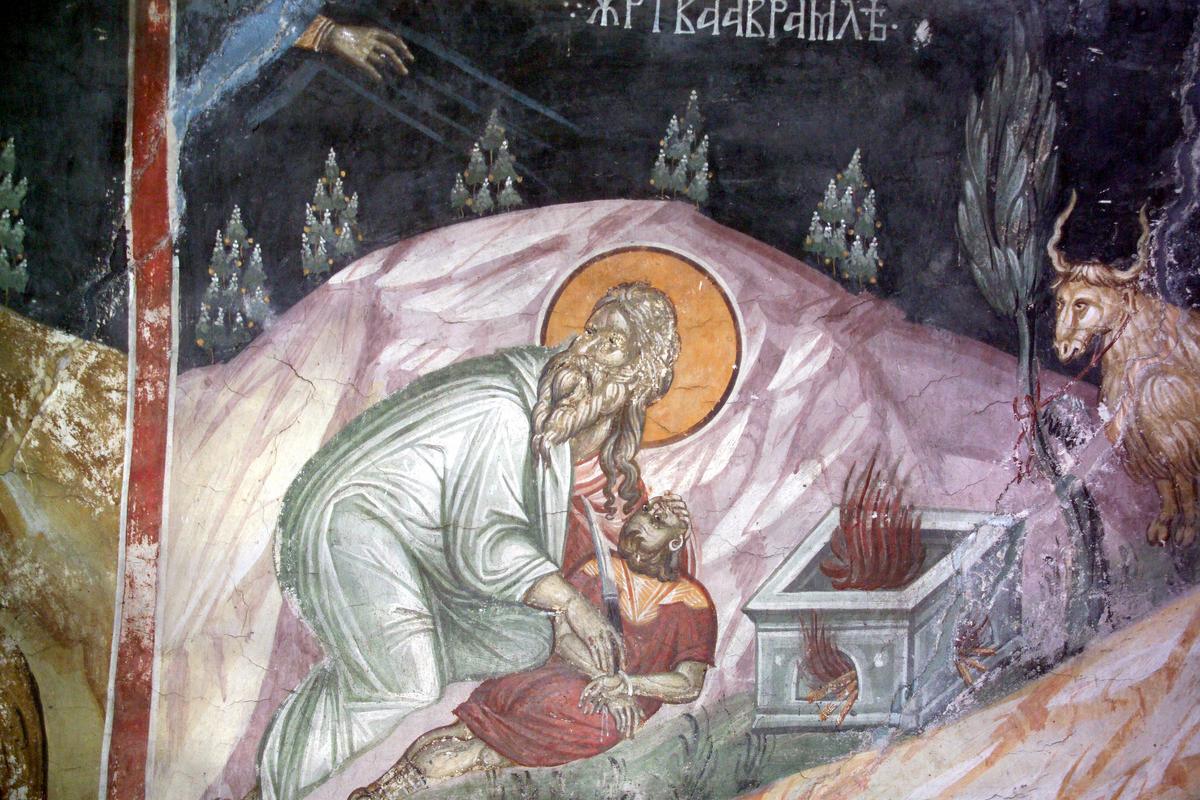
"By faith Abraham, when he was tried, offered up Isaac: and he that had received the promises offered up his only begotten son, of whom it was said, That in Isaac shall thy seed be called: accounting that God was able to raise him up, even from the dead; from whence also he received him in a figure" (Hebrews 11:17-19).

And St. James wrote in his Epistle:

"But wilt thou know, O vain man, that faith without works is dead? Was not Abraham our father justified by works, when he had offered Isaac his son upon the altar? Seest thou how faith wrought with his works, and by works was faith made perfect? And the scripture was fulfilled which saith, Abraham believed God, and it was imputed unto him for righteousness: and he was called the Friend of God. Ye see then how that by works a man is justified, and not by faith only [or, "alone," Greek "monon"] (James 2:20-24).

St. James cites the same example of Abraham's faith regard the promise that by his son Isaac, the promise that God made to him would be fulfilled, and he uses the very same quotation from Genesis 15:6 ("And he believed in the Lord; and He counted it to him for righteousness"), and says that we are justified by works. So did St. Paul and St. James contradict one another? No, St. Paul does not argue that we are saved by "faith alone", and St. James does not argue that we are saved by works alone. It is interesting to note that in the entirety of Scripture, the words "faith" and "alone" appear together in only in the passage from St. James. In fact, St. James says that Faith and works, work together: "Do you see that faith was working together [synergei] with his works, and by works faith was made perfect [or completed]" (James 2:22). St. Paul does not contradict this, but in fact confirms it when he commands us to "work out your own salvation with fear and trembling" (Phil. 2:12).

And the Scriptures make it abundantly clearly that we cannot simply be declared righteous, but live as sinners:

"But when the righteous turneth away from his righteousness, and committeth iniquity, and doeth according to all the abominations that the wicked man doeth, shall he live? All his righteousness that he hath done shall not be mentioned: in his trespass that he hath trespassed, and in his sin that he hath sinned, in them shall he die" (Ezekiel 18:24).

"Therefore, thou son of man, say unto the children of thy people, The righteousness of the righteous shall not deliver him in the day of his transgression: as for the wickedness of the wicked, he shall not fall thereby in the day that he turneth from his wickedness; neither shall the righteous be able to live for his righteousness in the day that he sinneth. When I shall say to the righteous, that he shall surely live; if he trust to his own righteousness, and commit iniquity, all his righteousnesses shall not be remembered; but for his iniquity that he hath committed, he shall die for it" (Ezekiel 33:12-13)

St. Nicholas Cabasilas wrote:

"There is an element which derives from God, and another which derives from our own zeal. The one is entirely His work, the other involves striving on our part. However, the latter is our contribution only to the extent that we submit to His grace and do not surrender the treasure nor extinguish the torch when it has been lighted. By this I mean that we contribute nothing which is either hostile to the life or produces death. It is to this that all human good and every virtue leads, that no one should draw the sword against himself, nor flee from happiness, nor toss the crowns of victory from off his head" (The Life in Christ, trans. by Carmino J. DeCatanzaro, (Crestwood, NY: St. Vladimir’s Seminary Press, 1974), pp. 48-49).

In the Morning Prayers found in the Jordanville Prayer Book, we find in 8th prayer:

"O my plenteously-merciful and all-merciful God, Lord Jesus Christ, through Thy great love Thou didst come down and become incarnate so that Thou mightest save all. And again, O Saviour, save me by Thy grace, I pray Thee. For if Thou shouldst save me for my works, this would not be grace or a gift, but rather a duty; yea, Thou who art great in compassion and ineffable in mercy. "For he that believeth in me," Thou hast said, O my Christ, "shall live and never see death." If then, faith in Thee saveth the desperate, behold, I believe, save me, for Thou art my God and Creator. Let faith instead of works be imputed to me, O my God, for Thou wilt find no works which could justify me. But may my faith suffice instead of all works..."

But note carefully: this faith is not separated from works, for the prayer concludes:

"...Vouchsafe me, O Lord, to love Thee now as fervently as I once loved sin itself, and also to work for Thee without idleness, diligently, as I worked before for deceptive Satan. But supremely shall I work for Thee, my Lord and God, Jesus Christ, all the days of my life, now and ever, and unto the ages of ages. Amen" (Prayer Book, 4th ed., (Jordanville, NY: Holy Trinity Monastery, 2011), pp. p. 23f.).

In short, the Orthodox Church strongly affirms that which is clearly taught in Holy Scripture: that we are saved by grace through faith—but not by faith alone.