Thursday, May 07, 2015

Stump the Priest: The Woman with an Issue of Blood


Question: "I have heard conflicting interpretations about the woman with an issue of blood. On the one hand, I have heard it said that by touching the hem of Christ's garment, she was showing her obedience to the traditions regarding her ritual uncleanness. On the other hand, I have heard it said that she was boldly stepping beyond those same traditions. Which interpretation is correct?"

Most of the Church Fathers whose commentaries I have do not focus on this question, but focus on other elements of the story, but there are two Fathers who cite the example of this woman in ways that would seem to give support to both of the options presented in this question. Both of them were commenting on issues related to menstruating women -- and rather than repeat what I have said previously about what is at issue in their comments, see "A Response to "Holy Communion and Menstruation,"" as well as the references mentioned at the end of that article, for more detail.

St. Gregory the Great, in a letter to St. Augustine of Canterbury, says:

"Yet still a woman, while suffering from her accustomed sickness, ought not to be prohibited from entering the church, since the superfluity of nature cannot be imputed to her for guilt, and it is not just that she should be deprived of entrance into the church on account of what she suffers unwillingly. For we know that the woman who suffered from an issue of blood, coming humbly behind the Lord, touched the hem of his garment, and immediately her infirmity departed from her. If then one who had an issue of blood could laudably touch the Lord's garment, why should it be unlawful for one who suffers from a menstruum of blood to enter in the Lord's Church?

...Further, she ought not to be prohibited during these same days from receiving the mystery of holy communion. If, however, out of great reverence, she does not presume to receive, she is to be commended; but, if she should receive, she is not to be judged. For it is the part of good dispositions in some way to acknowledge their sins, even where there is no sin, since often without sin a thing is done which comes of sin."

On the other hand St. Dionysius of Alexandria, in his Second Canon, which was affirmed by the Sixth and Seventh Ecumenical Councils, says:

"Concerning menstruous women, whether they ought to enter the temple of God while in such a state, I think it superfluous even to put the question. For, I opine, not even they themselves, being faithful and pious, would dare when in this state either to approach the Holy Table or to touch the body and blood of Christ. For not even the woman with a twelve years’ issue would come into actual contact with Him, but only with the edge of His garment, to be cured."

St. Nicodemus of the Holy Mountain commenting on this canon, says:

"For they can recall that woman who had an issue of blood and who on account of the flux of her blood did not dare, because of her great reverence, to touch the body of Christ, but only the hem of His garment. None of them is forbidden to pray, whatever be her predicament (whether she be at home or in the narthex of the church), by imploring God and asking Him for help and salvation. One is forbidden, however, to go near the Holies of Holies, which is the same as saying to partake of the sanctified portions (i.e., the Eucharistic species) when he is not clean in soul and body, like women who are taken with their menses."

In the ancient discipline of the Church, those who were to commune stood in the nave, whereas those who were not to commune stood in the narthex. Without getting into all the details, suffice it to say that as circumstances changed, the discipline of who could stand in the nave and who was confined to the narthex (or to the outside of the Church) has changed, and so the line beyond which such people could pass has moved to the iconostasis from the doors of the nave, or the narthex.

So while these two fathers do not directly contradict each other on the interpretation of the healing of the woman with an issue of blood, they certainly do not come to all of the same conclusions. Of these two, St. Dionysius's interpretation would have to be considered the more authoritative, since it has the endorsement of the Sixth and Seventh Ecumenical Councils.

But looking at the accounts in the synoptic Gospels (Matthew 9:20-22; Mark 5:25-34; and Luke 8:43-48); and also looking at the Old Testament law, and Jewish customs, there is some basis for saying she boldly went beyond the letter of the ceremonial law of Moses, and some basis for saying she only went so far out of reverence for the law. According to the letter of the law, she should not have been out of her home while in this state, and so on that point she stepped beyond the law, but several fathers point out that she dared only "touch the hem of His garment" and wished to remain hidden because she felt constrained not to go any further than that. She also did not merely have the hope that she might be healed, and thus be made clean, but was absolutely convinced of it, so she was not lightly stepping beyond the law, but because she saw taking this action as the only way she could finally be healed, and after twelve years in this state, begin to live a normal life again.

So I think the point to take away here is that we cannot always strictly adhere to the letter of the law, but we also should not step beyond it lightly. And of course for us, it is not the ceremonial law of the Old Testament that should concern us, but the pious Traditions of the Church. However, when it comes to the moral law of God, we never have license to violate it.

Three points of interest here: 

1. The "hem" of Christ's garment would likely have been one of the four tassels (Hebrew: tsitsit) which the law of Moses required Israelites to wear (Deuteronomy 22:12). You can read what Alfred Edersheim has to say about in his classic "The Life and Times of Jesus the Messiah" by clicking here).

2. Eusebius (who reposed about 340 a.d.) records in his Ecclesiastical History (7:18:1-4) that there was a bronze statue of Christ healing the woman with an issue of blood that was erected on the spot that the miracle occurred, which he himself had seen when he was there, and that the tradition was that this woman had commissioned this herself. This statue remained until it was removed during the time of Julian the Apostate.

3. According to Tradition, the woman with an issue of blood was St. Veronica, who also was the one who wiped the blood from Christ's face as he carried his Cross, and that the miraculous icon "Not-made-by-hands" appeared on the cloth.

St. Veronica

Sunday, May 03, 2015

Marriage, Plan B


If, as seems likely, the Supreme Court will shred the Constitution and impose Gay "Marriage" on all 50 states, here is what states could do to nullify that decision.

I have often argued that the state can't "get out of the marriage business" because the state has an interest in it, but I think I have come up with a way that the state could deal with what it has as a legitimate interest, change some labels, legally, and not have to deal with the question of gay marriage, all in one fell swoop.

Granted, it is ridiculous that the Supreme Court would force us into this position, but if they want to pretend that there is no difference between a gay relationship and a marriage, we can break it down in the law in a way that they would not be able to call discriminatory:

1. Pass a law that says that going forward, marriage will be treated as a private religious matter, that the state will no longer either license or concern itself with.

2. Create a state-wide "potential birth registry,"* that would have the same restrictions that current laws have regarding who can get married: which would include prohibited relationship (incest), age requirements, and limit this to one man and one woman. Children born from a woman in this registry would  be presumed to be the children of the man registered with her, just as it works now in a real marriage. Those registering in this registry would be affirming that they were entering into an exclusive, monogamous relationship, that is likely to produce children (i.e. is heterosexual).

3. Create a state-wide "community property partnership registry," that any 2 people, regardless of their sex, or regardless of whether or not they are in any sexual relationship can enter into.

4. When people register for the potential birth registry, give them the option of also checking a box to be included in the community property partnership registry.

5. Instead of divorce, you would terminate your registration from from the above registries; but if you could not agree on the division of property, you would have a court case to decide that matter. And if you had any children, you would have to get a child support order (which would address custody, visitation, etc.).

6. Any heterosexual marriages prior to these new laws going into effect would automatically be listed in both registries. Any homosexual "marriages" that might have happened because the courts forced the state to allow them prior to this law would automatically be added to the community property registry.

* Another name that could be used for this would be "Presumed Paternity Registry."

Wednesday, April 29, 2015

Stump the Priest: What is the Nous and how is it distinct from the Soul?


Question: "What do we mean by the "nous," how is it distinct from the soul, and are the Orthodox the only ones who speak about the "nous"?"

This question is complicated by the fact that the word "nous" (which is usually translated into English as "mind" has been used in different senses, at different times. The best discussion on this topic I have come across is found in Metropolitan Hierotheos (Vlachos)'s book "Orthodox Psychotherapy: The science of the Fathers" (pp. 118-156 (the title might lead you to think that this is a book about psychiatry, but it is about the healing of the soul, which is what "psychotherapy" literally means)). A shorter summary of the question can be found in an excerpt from the book "Patristic Theology," by Fr. John Romanides, which is available online: "What is the Human Nous?" Fr. John Romanides says in part:

"The chief concern of the Orthodox Church is the healing of the human soul. The Church has always considered the soul as the part of the human being that needs healing because She has seen from Hebrew tradition, from Christ Himself, and from the Apostles that in the region of the physical heart there functions something that the Fathers called the nous. In other words, the Fathers took the traditional term nous, which means both intellect (dianoia) and speech or reason (logos), and gave it a different meaning. They used nous to refer to this noetic energy that functions in the heart of every spiritually healthy person. We do not know when this change in meaning took place, because we know that some Fathers used the same word nous to refer to reason as well as to this noetic energy that descends and functions in the region of the heart.

So from this perspective, noetic activity is an activity essential to the soul. It functions in the brain as the reason; it simultaneously functions in the heart as the nous. In other words, the same organ, the nous, prays ceaselessly in the heart and simultaneously thinks about mathematical problems, for example, or anything else in the brain.

We should point out that there is a difference in terminology between St. Paul and the Fathers. What St. Paul calls the nous is the same as what the Fathers call dianoia. When the Apostle Paul says, "I will pray with the spirit,"[1 Corinthians 14:5.] he means what the Fathers mean when they say, "I will pray with the nous." And when he says, "I will pray with the nous," he means "I will pray with the intellect (dianoia)." When the Fathers use the word nous, the Apostle Paul uses the word "spirit." When he says "I will pray with the nous, I will pray with the spirit" or when he says "I will chant with the nous, I will chant with the spirit," and when he says "the Spirit of God bears witness to our spirit,"[Romans 8:16] he uses the word "spirit" to mean what the Fathers refer to as the nous. And by the word nous, he means the intellect or reason."

A few other points that Metropolitan Hierotheos makes on this subject:

  • Many Fathers use the words "nous" and "soul" interchangeably.

  • St. John of Damascus says that the nous is the purest part of the soul.

  • St. Gregory Palamas uses the word "nous" in two senses: as the whole soul, and also as the power of the soul.

  • In Scripture and in many of the Fathers there is an identification of the nous with the heart, and the terms are used interchangeably. 

  • Other Fathers use the term "nous" to refer to refer to "attention" as opposed to reasoning. And so for example, when we pray, we may be reading our prayers with our intellect, but our attention wanders. And so when one achieves the prayer of the heart, our attention (the nous) returns to the heart, and we truly pray.

Contemporary Protestants will typically only talk about the "nous" to the extent that they find references to it in in Scripture, and they generally would not spend a lot of time (if any) trying to understand what the Fathers had to say about those passages. Being influence by American pragmatism, they would also tend to see spending time focusing on the nuances of the mind, heart, and soul of a person to be of little use to the bottom line questions of how one is saved, and how we should live our lives, which they tend to see in far more simple terms, and look for far more simple answers.

If you were an Eskimo, you would speak about various forms of frozen water with subtle distinctions that would be lost on tribesmen who live near the equator, because those people don't often encounter frozen water, and so hail, snow, sleet, etc, would be seen as being pretty much the same thing. Whereas for you, ice, snow, sleet, and all the subtle variations one encounters of those things would be a pervasive reality that would never be far from your thoughts. The saints of the Church spent their lives waging spiritual warfare, and so speak about the aspects of the soul in very subtle ways, compared to those who think that if you say a prayer and ask Christ into your heart, that you are saved, and couldn't lose your salvation if you tried.

Thursday, April 23, 2015

Stump the Priest: Is Universalism a Heresy?


Question: "Is the teaching that ultimately all men will be saved (the apokatastasis) a heresy, or is it an acceptable theological opinion within the bounds of Orthodoxy?"

Origen taught the heretical doctrine of the apokatastasis, that ultimately everyone, even the devil, would be saved. The Church condemned this teaching at the Fifth Ecumenical Council. The Church has ever taught this as a fact since that time. However, in recent times we have had a rebirth of this heresy, and have many who try to argue that the Fifth Ecumenical Council did not condemn this teaching.

Did the Fifth Ecumenical Council Anathematize this Heresy?

To cite some examples of trustworthy theologians who state this in no uncertain terms, Fr. Michael Pomazansky wrote:

"The Church, basing itself on the word of God, acknowledges the torments of gehenna to be eternal and unending, and therefore it condemned at the Fifth Ecumenical Council the false teaching of the Origenists that the demons and impious people would suffer in hell only for a certain definite time, and then would be restored to their original condition of innocence (apokatastasis in Greek). The condemnation at the Universal Judgment is called in the Apocalypse of St. John the Theologian the "second death" (Apoc. 20:14).

An attempt to understand the torments of gehenna in a relative sense, to understand eternity as some kind of age or period — perhaps a long one, but one still having an end — was made in antiquity, just as it is made today; this view in general denies the reality of these torments. In this attempt there are brought forward conceptions of a logical kind: the disharmony between such torments and the goodness of God is pointed out, as is the seeming disproportion between crimes that are temporal and the eternity of the punishments for sin, as well as the disharmony between these eternal punishments and the final aim of the creation of man, which is blessedness in God.

But it is not for us to define the boundaries between the unutterable mercy of God and His justice or righteousness. We know that the Lord "will have all men to be saved, and to come unto the knowledge of the truth" (1 Tim. 2:4); but man is capable, through his own evil will, of rejecting the mercy of God and the means of salvation. Chrysostom, in interpreting the depiction of the Last Judgment, remarks: "When He (the Lord) spoke about the Kingdom, after saying, ‘Come, ye blessed of My Father, inherit the Kingdom,’ He added, ‘which is prepared for you from the foundation of the world’ (Matt. 25:34), but when speaking about the fire, He did not speak thus, but He added: which is ‘prepared for the devil and his angels’ (Matt. 25:41). For I have prepared for you a Kingdom, but the fire I have prepared not for you but for the devil and his angels. But since you have cast your own selves into the fire, therefore accuse yourself for this" (Homily 70 on Matthew).

We have no right to understand the words of the Lord only conditionally, as a threat or as a certain pedagogical means applied by the Saviour. If we understand it this way we err, since the Saviour does not instill in us any such understanding, and we subject ourselves to God’s wrath according to the word of the Psalmist: "Why hath the ungodly one provoked God? For he hath said in his heart: He will not make enquiry" (Ps. 9:34) (Orthodox Dogmatic Theology (Platina, CA: St. Herman Press, 1984, p. 349f).

Metropolitan Hierotheos (Vlachos) devotes an entire chapter to this subject in his book "Life After Death (Chapter 8 The restoration of all things, pp. 273-312), affirms that this heresy was condemned by the Fifth Ecumenical Council, and goes to great lengths to make the case that St. Gregory of Nyssa did not in fact teach it, but rather taught that hell (gehenna) and its punishments are unending, and that those who attribute this teaching to him are simply failing to understand them in the context of his complete teachings on the subject. If one rejects the argument that St. Gregory of Nyssa did not teach this doctrine, that would only prove St. Gregory to be in error, because Ecumenical Councils are infallible, whereas no Church Father, as an individual, is. However, it certainly is interesting that in the one instance in which, if he was a universalist, you would expect him to put that on display, St. Gregory of Nyssa not only does not affirm universalism in his treatise on the death of unbaptized infants, but directly refutes it when speaking of Judas as an example of one who died in his sins:

"Certainly, in comparison with one who has lived all his life in sin, not only the innocent babe but even one who has never come into the world at all will be blessed. We learn as much too in the case of Judas, from the sentence pronounced upon him in the Gospels; namely, that when we think of such men, that which never existed is to be preferred to that which has existed in such sin. For, as to the latter, on account of the depth of the ingrained evil, the chastisement in the way of purgation will be extended into infinity..." (On Infants' Early Deaths).

Anathemas? What Anathemas?

The advocates of Universalism try to argue that, despite the fact that the Church has consistently stated that the Fifth Ecumenical Council anathematized this heresy, that there are reasons to doubt whether the council formally issued the anathemas ascribed to it.

St. Justinian issued his anathemas against Origen before the Council, which he convoked, and the last of those anathemas is as follows:

"If anyone says or thinks that the punishment of demons and of impious men is only temporary, and will one day have an end, and that a restoration (ἀποκατάστασις) will take place of demons and of impious men, let him be anathema."

The first of the Council's anathemas states:

"If anyone asserts the fabulous pre-existence of souls, and shall assert the monstrous restoration (ἀποκατάστασις) which follows from it: let him be anathema."

Now, for the sake of argument, let's assume that there is some ambiguity about whether or not these anathemas were endorsed by that council. All one has to do to settle the question is to consider the Synodikon of Orthodoxy which is recited every year, throughout the Orthodox Church, on the Sunday of Orthodox (the first Sunday of Lent):

"To them who accept and transmit the vain Greek teachings that there is a pre-existence of souls and teach that all things were not produced and did not come into existence out of non-being, that there is an end to the torment or a restoration again of creation and of human affairs, meaning by such teachings that the Kingdom of Heaven is entirely perishable and fleeting, whereas the Kingdom of Heaven is eternal and indissoluble as Christ our God Himself taught and delivered to us, and as we have ascertained from the entire Old and New Testaments, that the torment is unending and the Kingdom everlasting, to them who by such teachings both destroy themselves and become agents of eternal condemnation to others, Anathema! Anathema! Anathema!"

Those who advocate for universalism argue that this is only a condemnation of Origen's universalism, not the universalism supposedly expressed by other Fathers, because they had different theological and philosophical reasons for their universalism. But that is a bit like arguing that the Church hasn't anathematized Jehovah's Witness Christology, because they have different theological reasons for denying the divinity of Christ than the Arians did. This anathema states, without equivocation, that "we have ascertained from the entire Old and New Testaments, that the torment is unending and the Kingdom everlasting..." and there is no indication that we would ascertain anything differently if people were universalists because they saw a documentary on the history channel, read pseudo-Isaac's writings, and agreed with it, or agreed with Origen.

Anyone who has ever had an Orthodox thought in their life knows that we believe what we say in the services of the Church (lex orandi lex credendi), and when what we say ends with "Anathema!", we mean it in no uncertain terms.

What Saith the Scriptures?

If one believes Christ's teachings carry any weight, He affirms the unending character of the torments of hell repeatedly:

In Mark Chapter Nine, he states that the fires of hell (gehenna) will not be quenched five times, and speaks of the worm that will not die three times:

"And if thy hand offend thee, cut it off: it is better for thee to enter into life maimed, than having two hands to go into hell [gehenna], into the fire that never shall be quenched: where their worm dieth not, and the fire is not quenched. And if thy foot offend thee, cut it off: it is better for thee to enter halt into life, than having two feet to be cast into hell, into the fire that never shall be quenched: Where their worm dieth not, and the fire is not quenched. And if thine eye offend thee, pluck it out: it is better for thee to enter into the kingdom of God with one eye, than having two eyes to be cast into hell fire: where their worm dieth not, and the fire is not quenched (Mark 9:43-48).

When Christ speaks of gehenna in these terms, he is probably alluding to Isaiah 66:24: "And they shall go forth, and look upon the carcasses of the men that have transgressed against me: for their worm shall not die, neither shall their fire be quenched; and they shall be an abhorring unto all flesh"; and Judith 16:17: "Woe to the nations that rise up against my people! The Lord Almighty will take vengeance on them in the day of judgment; he will send fire and worms into their flesh; they shall weep in pain forever."

In the parable of the Sheep and the Goats, Christ addresses the wicked (the goats) and said: "Depart from me, ye cursed, into everlasting fire, prepared for the devil and his angels" (Matthew 25:26); and he concludes the parable by saying: "And these shall go away into everlasting punishment: but the righteous into life eternal (Matthew 25:46).

St. Paul wrote: "since it is a righteous thing with God to repay with tribulation those who trouble you, and to give you who are troubled rest with us when the Lord Jesus is revealed from heaven with His mighty angels, in flaming fire taking vengeance on those who do not know God, and on those who do not obey the gospel of our Lord Jesus Christ. These shall be punished with everlasting destruction from the presence of the Lord and from the glory of His power" (2 Thessalonians 1:6-9).

Commenting on these verses, St. John Chrysostom wrote:

"There are many men, who form good hopes not by abstaining from their sins, but by thinking that hell is not so terrible as it is said to be, but milder than what is threatened, and temporary, not eternal; and about this they philosophize much. But I could show from many reasons, and conclude from the very expressions concerning hell, that it is not only not milder, but much more terrible than is threatened. But I do not now intend to discourse concerning these things. For the fear even from bare words is sufficient, though we do not fully unfold their meaning. But that it is not temporary, hear Paul now saying, concerning those who know not God, and who do not believe in the Gospel, that “they shall suffer punishment, even eternal destruction.” How then is that temporary which is everlasting? “From the face of the Lord,” he says. What is this? He here wishes to say how easily it might be. For since they were then much puffed up, there is no need, he says, of much trouble; it is enough that God comes and is seen, and all are involved in punishment and vengeance. His coming only to some indeed will be Light, but to others vengeance" (Homily 3, 2nd Thessalonians).

Conclusion

Those who advocate for this heresy are forced to place all their weight on the supposed advocacy of a few saints of the Church, while ignoring the clear and unambiguous teachings of all the other Fathers, the Councils, the Apostles, and even Christ Himself. This is not how Orthodox Christians approach such matters. We affirm that which the Church has consistently taught -- we do not go hunting for theological exotica. And if it happens that God has a surprise for us in eternity, and that despite all the talk of the unquenchable fire and the undying worm, He will ultimately save even the devil, then we have nothing to worry about. However, if Christ, the Apostles, the vast majority of the Fathers and saints of Church, the Councils, and the Synodikon of Orthodoxy are correct, then it is a very dangerous thing to give unrepentant sinners false hope -- because those who teach such a heresy will "both destroy themselves and become agents of eternal condemnation to others" (the Synodikon of Orthodoxy). This is not a question of what we may wish to be true -- it is a question of what Christ, who is Himself the Truth, assures us to be true, in the most emphatic terms.

Update: Here is an interesting comment from St. Cyril of Alexandria, on 1 Peter 3:19:

"Here Peter answers the question which some objectors have raised, namely, if the incarnation was so beneficial, why was Christ not incarnated for such a long time, given that he went to the spirits which were in prison and preached to them also? In order to deliver all those who would believe, Christ taught those who were alive on earth at the time of his incarnation, and these others acknowledged him when he appeared to them in the lower regions, and thus they too benefited from his coming. Going in his soul, he preached to those who were in hell, appearing to them as one soul to other souls. When the gatekeepers of hell saw him, they fled; the bronze gates were broken open, and the iron chains were undone. And the only-begotten Son shouted with authority to the suffering souls, according to the word of the new covenant, saying to those in chains: "Come out!" and to those in darkness: "Be enlightened." In other words, he preached to those who were in hell also, so that he might save all those who would believe in him. For both those who were alive on earth during the time of his incarnation and those who were in hell had a chance to acknowledge him. The greater part of the new covenant is beyond nature and tradition, so that while Christ was able to preach to all those who were alive at the time of his appearing and those who believed in him were blessed, so too he was able to liberate those in hell who believed and acknowledged him, by his descent there. However, the souls of those who practiced idolatry and outrageous ungodliness, as well as those who were blinded by fleshly lusts, did not have the power to see him, and they were not delivered." (Ancient Christian Commentary on Scripture, New Testament, Vol. XI, James, 1-2 Peter, 1-3 John, Jude, Gerald Bray, ed. (Downers Grove, IL: Intervasity Press, 2000) p. 107f).


Thursday, April 16, 2015

Stump the Priest: Prayers for the Dead in the Bible and in Tradition


Question: "Where do we find any evidence that praying for the dead is a biblical? From what I have read it appears that the Bible almost says the opposite of this in Ezekiel Chapter 18. Sure, Ezekiel was talking to Israel prior to the New Covenant that we have in Christ, but it says at the start of the chapter that this came from the word of the LORD and it seems consistent with Romans 2:3-9."

What does the Bible Say?

First, let me point out that neither of the passages cited address the question of praying for the dead.

The point of Ezekiel 18 is that a son is neither saved nor condemned because of the righteousness or the sins of his father, and neither is a father saved or condemned because of his son. Also, past righteous will not save a man who falls into sin, nor will past sin condemn a man who turns from his sin. The passage is not about prayers for the dead.

The point of Romans 2:3-9 is that everyone will be judged according to his works, This has nothing to do with prayers for the dead either, unless you assume that we believe that by praying for the dead we could pray an impenitent sinner into heaven, but we do not believe that.

There are, however, passages of Scripture that do address this question. 2nd Maccabees is not in most Protestant Bibles, but it was included in the 1611 King James Bible, and has been considered to be part of Scripture by the Church since the time of the Apostles (see Canon 85 of the Holy Apostles) -- and in 2nd Maccabees 12:38-45 we find a very clear example of prayer for the dead.

In the Wisdom of Sirach (which is also listed among Scripture by the Canon 85 of the Apostles), it says: "Give graciously to all the living; do not withhold kindness even from the dead" (Sirach 7:33).

And in 2 Timothy 1:16-18, St. Paul is praying for Onesiphorus, who obviously is no longer among the living:

"The Lord grant mercy to the household of Onesiphorus, for he often refreshed me, and was not ashamed of my chain; but when he arrived in Rome, he sought me out very zealously and found me. The Lord grant to him that he may find mercy from the Lord in that Day—and you know very well how many ways he ministered to me at Ephesus."

Jewish Tradition

The text from Second Maccabees that has already been cited is clear evidence that this was the Jewish custom well before the time of Christ, but is also a fact that the Jews continue to pray for the dead. So if prayers for the dead were some pagan corruption that crept into the Church, one has to wonder how it also crept into Judaism... especially when this would have to have happened before the the time of Christ.

Christian Tradition

When I first began to seriously consider becoming Orthodox, prayers for the dead were on my list of about 5 issues that had to be resolved, but it was also one of the first issues to be scratched off that list, because the evidence that the early Church prayed for the dead is far too ubiquitous to allow one to doubt it. You find it in the earliest texts of the Liturgy. You find it passing comments made by the earliest writers of the Church. You also find them in the catacombs. For example, we have the Epitaph of Abercius, Bishop of Hieropolis, who reposed in 167 A.D., in which he asks for those who read the epitaph to pray for him. When St. Augustine's pious mother was departing this life, her last request was: "Lay this body anywhere, let not the care for it trouble you at all. This only I ask, that you will remember me at the Lord’s altar, wherever you be" (Confessions 9:27). And quotation upon quotation could be multiplied along these lines.

Prior to the Protestant Reformation, there weren't any Christians, anywhere, who did not have the custom of praying for the dead.

Conclusion

I remember hearing the story of an Anglican priest who had adamantly opposed prayers for the dead any time the issue was raised, and then after his wife's death he ceased to speak up on the matter, and was asked about it. He said that he had prayed for his wife every day, since he had met her, and could not bring himself to stop after her death. Prayer for the dead is a way the living show their love for dead. We also believe that prayers the dead are of some benefit to them, but exactly how these prayers benefit them is not something that the Church has precisely defined. If someone dies in a state of repentance, but without having had a chance to bring forth all the fruits of repentance, we believe that they are not ready to enter immediately into the presence of God, but that at some point, through the prayers of the Church, they will be. If someone dies in a state of impenitence, while our prayers are of some benefit to them, those prayers cannot make them worthy of the Kingdom of Heaven. But in either case, by praying for the dead, we strengthen our own faith, and come to better entrust our loved ones to God's mercy.

Update:

For those who want further proof that the Church does not believe that those who die in a state of unrepentance can be prayed out of hell, consider the following:

St. John of Damascus wrote that those who have departed, unrepentant, and with "an evil life" cannot change their destination from hell to heaven by the prayers of anyone ("On Those Who Have Fallen Asleep in Faith, 21 PG 95,268BC, referenced in "The Mystery of Death," by Nikolaos P. Vassiliadis, p. 432. St. John Chrysostom likewise speaks of those who are where it is not possible to receive cleansing, and who are outside of the Kingdom of God, but who may receive some consolation by our prayers (Homily "On Not Mourning Bitterly Over the Dead", PG 60,888-889, referenced in "The Mystery of Death, p. 432-434),

And St. Mark of Ephesus states in his "First Homily, Refuting the Latin Chapters Concerning Purgatorial Fire":

"But we have received that even the souls which are held in hell are already given over to eternal torments, whether in actual fact and experience or in hopeless expectation of such, as can be aided and given a certain small help, although not in the sense of completely loosing them from torment or giving hope for a final deliverance. And this is shown from the words of the great Macarius the Egyptian ascetic who, finding a skull in the desert, was instructed by it concerning this by the action of Diving Power. And Basil the Great, in the prayers read at Pentecost, writes literally the following: "Who also, on this all-perfect and saving feast, art graciously pleased to accept propitiatory prayers for those who are imprisoned in hades, granting us a great hope of improvement for those who are imprisoned from the defilements which have imprisoned them, and that Thou wilt send down Thy consolation" (Third Kneeling Prayer at Vespers). But if souls have departed this life in faith and love, while nevertheless carrying away with themselves certain faults, whether small ones over which they have not repented at all, or great ones for which -- even though they have repented over them -- they did not undertake to show fruits of repentance: such souls, we believe, must be cleansed from this kind of sins, but not by means of some purgatorial fire or a definite punishment in some place (for this, as we have aid, has not at all been handed down to us). But some must be cleansed in the very departure from the body, thanks only to fear, as St. Gregory the Dialogist literally shows; while others must be cleansed after the departure from the body, either while remaining in the same earthly place, before they come to worship God and are honored with the lot of the blessed, or -- if their sins were more serious and bind them for a longer duration -- they are kept in hades, but not in order to remain forever in fire and torment, but as it were in prison and confinement under guard. All such ones, we affirm, are helped by the prayers and Liturgies performed for them, with the cooperation of the Divine Goodness and Love for mankind. This Divine cooperation immediately disdains and remits some sins, those committed out of human weakness, as Dionysius the Great (the Areopagite) says in the "Reflections of the Mystery of those Reposed in Faith" (in The Ecclesiastical Hierarchy, VII, 7); while other sins, after a certain time, by righteous judgments it either likewise releases and forgives -- and that completely -- or lightens the responsibility for them until that final Judgment" (see "The Soul After Death", Appendix I, p. 208f).

Here also is a quote from St. Symeon of Thessalonika's Liturgical commentary, about commemorations at the Proskomedia: "And there is no place here [in commemorations at the proskomedia] for unbelievers, let alone for the heterodox. "For what communion does light have with darkness?" since, scripture says, the angels will separate out the evil from the midst of the just. Therefore it is also not at all right for a priest to make a commemoration of him; neither for a heterodox, or make a commemoration of him neither for those openly sinning and unrepentant. For the offering is to their condemnation, just as it is also for the unrepentant who receive communion of the awe-inspiring mysteries, as the divine Paul says" (St. Symeon of Thessonika, The Liturgical Commentaries, edited and translated by Steven Hawkes-Teeples, (Toronto: Pontifical Institute of Mediaeval Studies, 2001), p. 232f). 

Tuesday, April 14, 2015

The Paschal Hours (How to do them)


During Bright Week, the Paschal Hours are done in place of the usual order for Small Compline and the Midnight Office, in addition to the First, Third, Sixth, and Ninth Hours. It is also a pious practice to do them in place of our usual morning and evening prayers (which are based on the Midnight Office, and Small Compline). If you have a Jordanville Prayer Book, you have the text of the Paschal Matins, followed by the text for the Paschal Hours (in the 4th edition, it begin on page 206). You can also find the text, arranged for use by a laymen here. And you can also listen to this audio file to learn how to sing the Paschal Hours, if you don't know how to sing the tones: http://www.saintjonah.org/podcasts/paschalhours.mp3

Singing the Paschal Hours during bright week make for an easy and joyful prayer rule, and help keep us connected with the celebration of Bright Week, if we are unable to attend services this week.

Friday, April 10, 2015

Homily for Holy Saturday by St. Epiphanius of Cyprus


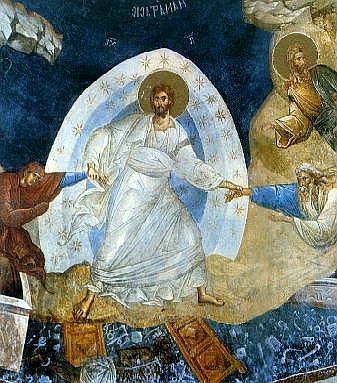
Homily on Holy Saturday: The Lord Descends into Hades

St. Epiphanius, Bishop of Cyprus (403 A.D.)

Something strange is happening - there is a great silence on earth today, a great silence and stillness. The whole earth keeps silence because the King is asleep. The earth trembled and is still because God has fallen asleep in the flesh and He has raised up all who have slept ever since the world began. God has died in the flesh and Hell trembles with fear.

He has gone to search for our first parent, as for a lost sheep. Greatly desiring to visit those who live in darkness and in the shadow of death, He has gone to free from sorrow the captives Adam and Eve, He who is both God and the Son of Eve. The Lord approached them bearing the Cross, the weapon that had won Him the victory. At the sight of Him Adam, the first man He had created, struck his breast in terror and cried out to everyone, “My Lord be with you all.” Christ answered him, “And with your spirit.” He took him by the hand and raised him up, saying, “Awake, O sleeper, and rise from the dead, and Christ will give you light.

“I am your God, who for your sake have become your son. Out of love for you and for your descendants I now by My own authority command all who are held in bondage to come forth, all who are in darkness to be enlightened, all who are sleeping to arise. I order you, O sleeper, to awake. I did not create you to be held a prisoner in Hell. Rise from the dead, for I am the Life of the dead. Rise up, work of My hands, you who were created in My image. Rise, let us leave this place, for you are in Me and I am in you; together we form only one person and we cannot be separated.

“For your sake I, your God, became your son; I, the Lord, took the form of a slave; I, whose home is above the heavens, descended to the earth and beneath the earth. For your sake, for the sake of man, I became like a man without help, free among the dead. For the sake of you, who left a garden, I was betrayed to the Jews in a garden, and I was crucified in a garden.

“See on my face the spittle I received in order to restore to you the life I once breathed into you. See there the marks of the blows I received in order to refashion your warped nature in My image. On My back see the marks of the scourging I endured to remove the burden of sin that weighs upon your back. See My hands, nailed firmly to a tree, for you who once wickedly stretched out your hand to a tree.

“I slept on the Cross and a sword pierced My side for you who slept in Paradise and brought forth Eve from your side. My side has healed the pain in yours. My sleep will rouse you from your sleep in Hell. The sword that pierced Me has sheathed the sword that was turned against you.

“Rise, let us leave this place. The enemy led you out of the earthly Paradise. I will not restore you to that Paradise, but I will enthrone you in Heaven. I forbade you the tree that was only a symbol of life, but see, I who am Life itself am now one with you. I appointed cherubim to guard you as slaves are guarded, but now I make them worship you as God. The throne formed by cherubim awaits you, its bearers swift and eager. The Bridal Chamber is adorned, the banquet is ready, the eternal dwelling places are prepared, the treasure houses of all good things lie open. The Kingdom of Heaven has been prepared for you from all eternity. “

From the Synaxarion of the Lenten Triondion and Pentecostarion, Fr. David and Mother Gabriela, eds., HDM Press, Rives Junction, MI, 1999 pp. 160-161.

Tuesday, April 07, 2015

For those who might be wondering why my Facebook account has suddenly disappeared


It's because Facebook thinks drag queens should be able to use stage names like "Lil' Miss Hot Mess," but doesn't think Christian Clergy should be allowed to use anything but their legal names.

See "Stories from the Culture War Trenches" by Rod Dreher.

Update: They have done the same thing to Fr. Tryphon, who if he used his legal name (which I don't even know) would not be recognized by anyone who hasn't known him since he was kid.

Facebook has gotten too big for its britches. It's time for the users they depend on to whittle them back down to size. Refuse to advertise on Facebook until this policy is reversed.

Thursday, April 02, 2015

Stump the Priest: Holy Week Without a Parish

Golgotha, inside the Church of the Holy Sepulchre

Question: "What should someone do during Holy Week if they have no parish nearby, and so cannot attend the services?"

We should of course plan ahead, and if at all possible make a way for us to be at the services of Holy Week, but of course there are many circumstances beyond one's control that might prevent them from attending some or all of these services. But as for what to do when one is in this situation, let me give the ideal answer, and then an answer for those who cannot yet deal with it in the ideal way.

Ideally...

If you learn how to do reader services, you can actually do most of the Holy Week services in a fairly full way. You can't do the sacraments without a priest or a bishop, but you can do pretty much everything else. This requires investing the time to learn how to sing the services, and also to acquire the texts, but it is time and money well spent.

For more on that, see:

The Reader Service Horologion

Practical Questions on How To Do Reader Services

Tone Tutor

Practical Tips on Building a Liturgical Library

There is also a summer course on liturgics that is offered by the Orthodox Pastoral School.

However...

If you don't know how to do reader services, here are some things you can do that are not very difficult to pull off:

For Lazarus Saturday, Palm Sunday, and Pascha, you can do Typika, which is relatively short service that has many of the elements of the Liturgy. You can get the text for Typika as well as the variable portions for those services by clicking here.

For the other days of Holy Week, you can do Akathists, which are found in the Book of Akathists from Holy Trinity Publications. Akathists are not complicated, and so you don't have to know a lot of rubrics to do them. It also doesn't take too much to learn how to sing them. For Holy Monday, Tuesday, and Wednesday, you could do the Akathist to the Divine Passion of Christ. For Holy Thursday, you could do the Akathist for Holy Communion. For Holy Friday, you could do the Akathist to the Precious Cross. For Holy Saturday you could do the Akathist to the Tomb and the Resurrection of the Lord. And for Pascha (in addition to the Typika) you could do the Akathist to the Resurrection of Christ.

One of the Traditions of Holy Week is to read all for Gospels in their entirety on Holy Monday, Tuesday, and Wednesday. If one is working during Holy Week, that might be difficult to pull off, but you could try to read at least one Gospel completely. And in addition to that, you can read the other appointed Scripture readings for the days of Holy Week.

For these readings, you can download Menologion 3.0 which provides the appointed readings for each day.

Saturday, March 28, 2015

A Response to "Holy Communion and Menstruation"

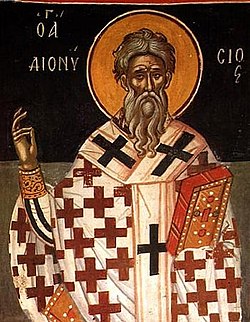
St. Dionysius of Alexandria

Fr. Ted Bobosh has written an article on a topic that comes up from time to time -- whether or not we should observe the custom of women refraining from Communion during their menstrual cycle. Curiously, Fr. Ted appeals to Apostolic Constitutions as his primary basis for rejecting this custom, but makes no mention of the Ecumenical Canons that endorse the same custom. This is curious because Canon 2 of the Quinisext Council specifically rejects the Apostolic Constitutions because it contains many impious and heretical interpolations. And in that same canon, the Holy Fathers affirmed the canons of St. Dionysius of Alexandria (who reposed in 264 AD.) as well as those of St. Timothy of Alexandria (who reposed in 384, and was one of the Fathers of the Second Ecumenical Council), and in those canons, this custom is affirmed (see Canon 2 of St. Dionysius and Canon 7 of St. Timothy).

Contrary to the suggestion of the quote from the Apostolic Constitutions that Fr. Ted cited, no one believes that a women is separated from God during her menstrual cycle, cannot pray, or is deprived of the Holy Spirit. Nor does anyone teach that having a menstrual cycle is in any way sinful. Nor is the custom of women refraining from communion during this time an absolute prohibition. We do, however, have customs of ritual purity in the Orthodox Church. For example, when clergy are vesting for the liturgy, we ritually wash our hands -- not because they are physically dirty. Any clergyman with any sense has washed his hands before he comes into the Church. However, this action does remind us of our need for spiritual cleansing. If a priest cuts himself when serving the proskomedia, he must leave the altar, and not return until the bleeding has stopped. If a priest is driving and a young child runs out in front of his car, and is killed, that priest will never be allowed to serve the Liturgy again -- not because he killed the child intentionally, but because he has blood on his hands, and so can no longer offer the unbloody sacrifice of the Eucharist.

With the New Testament, the Old Testament worship has been replaced by a new Liturgy (Hebrews 8:6), but this does not mean that there is no continuity between the Old and the New Covenants. Some things have been set aside completely, and other things have been retained to one degree or another. In the Old Testament we see that there was quite a bit of concern about blood, and we see that even in the New Testament this concern has not been set aside (see, for example Acts 15:23-29).

The customs that we retain have a symbolic and didactic significance, but they are not absolute. If a woman was in danger of death during her menstrual period, she would of course be communed without any hesitation, because then the didactic value of this custom would be superseded by the more immediate need to prepare the woman for her death.

Fr. Ted did not mention the oft quote epistle of St. Gregory the Great in which he said that this custom should not be obligatory, but it should be noted that he also says that if a woman wishes to observe this custom it is praiseworthy -- which is very much in contrast to the position usually taken by those who cite St. Gregory on this subject. It should also be noted that St. Gregory the Great reposed in 604 AD., and the Quinisext Council was held in 692 AD. -- and so we do not know what he would have written had he lived after the time of that Council.

If someone wishes to argue that the canons of Ss. Dionysius and Timothy of Alexandria were due to the historical conditions of the times in which they lived, and that modern sanitation has made this practice no longer necessary, at least they are attempting to take the canons seriously rather than merely dismissing them. But those who take the position that the practice has never had any justification have a serious problem in explaining how these canons could have been affirmed by an Ecumenical Council -- and beyond that, they have the problem in dealing with the Old Testament laws regarding menstruation. Do they not believe that the Mosaic Law was inspired by God? Regardless of whether one thinks we should observe the custom in question today or not, if "All Scripture is given by inspiration of God, and is profitable for doctrine, for reproof, for correction, for instruction in righteousness" (2 Timothy 2:15-17), then these laws could not be just a matter of ancient superstition, ignorance, or misogyny.

It should also be noted that the Russian Church has recently reaffirmed this practice, in the document: On the Patricipation of the Faithful in the Eucharist, which was approved at the Synod meeting held on February 2nd - 3rd, 2015 in Christ the Savior Cathedral in Moscow.

See also:

On "Ritual Impurity": In Response to Sister Vassa (Larin), by Fr. Sergei Sveshnikov

More to the Point: Should Nuns Light Their Icon Lamps?, By Fr. Sergei Sveshnikov

Churching and the Feast of the Meeting of the Lord

Thursday, March 26, 2015

Stump the Priest: Making the Sign of the Cross


Question: "Making the sign of the cross became a practice in the 4th century. The apostles, Christ and nobody in the ancient Church practiced it, so why should we?"

This question is based on a false premise. The earliest reference to the practice of making the sign of the Cross comes from Tertullian (who lived between c. 160 – c. 225 AD):

"And how long shall we draw the saw to and fro through this line, when we have an ancient practice, which by anticipation has made for us the state, i.e., of the question? If no passage of Scripture has prescribed it, assuredly custom, which without doubt flowed from tradition, has confirmed it. For how can anything come into use, if it has not first been handed down?  Even in pleading tradition, written authority, you say, must be demanded. Let us inquire, therefore, whether tradition, unless it be written, should not be admitted. Certainly we shall say that it ought not to be admitted, if no cases of other practices which, without any written instrument, we maintain on the ground of tradition alone, and the countenance thereafter of custom, affords us any precedent.  To deal with this matter briefly, I shall begin with baptism. When we are going to enter the water, but a little before, in the presence of the congregation and under the hand of the president, we solemnly profess that we disown the devil, and his pomp, and his angels. Hereupon we are thrice immersed, making a somewhat ampler pledge than the Lord has appointed in the Gospel. Then when we are taken up (as new-born children), we taste first of all a mixture of milk and honey, and from that day we refrain from the daily bath for a whole week. We take also, in congregations before daybreak, and from the hand of none but the presidents, the sacrament of the Eucharist, which the Lord both commanded to be eaten at meal-times, and enjoined to be taken by all alike. As often as the anniversary comes round, we make offerings for the dead as birthday honours. We count fasting or kneeling in worship on the Lord’s day to be unlawful. We rejoice in the same privilege also from Easter to Whitsunday. We feel pained should any wine or bread, even though our own, be cast upon the ground.  At every forward step and movement, at every going in and out, when we put on our clothes and shoes, when we bathe, when we sit at table, when we light the lamps, on couch, on seat, in all the ordinary actions of daily life, we trace upon the forehead the sign [of the Cross]" (De Corona, Chapter 3).

Tertullian was not trying to defend the traditions he mentioned in this passage. He was appealing to these unwritten traditions to defend a Christian soldier who had refused to wear a laurel wreath crown in a ceremony in which the soldiers were receiving a bonus from the Emperor, which sparked a local persecution of Christians. Tertullian's point was that this soldier was following the tradition of the Church, though many argued he should have gone along with the ceremony, and spared others the persecution that followed his refusal -- and one of their arguments was that there was nothing in Scripture that dictated this soldier's actions.

Tertullian appealed to these other traditions because they were uncontroversial, and ancient. This treatise was written in 201 AD, by a man born in 160 AD. Would such a man consider something to be an ancient tradition if it were less than a century old? I don't think so.

Even in our time, we pass along oral histories that go back at least 100 years, and Tertullian lived in a culture in which preserving oral history was a much bigger part of the culture, and change happened far more slowly. I was born in 1966, and my grandfather on my father's side was born in 1878. He died a year before I was born, but I was told a lot about him by my father. He was born in Iowa, but went to Texas as a young man, and for awhile he worked as a cowboy, before settling down and becoming a farmer. He lived to see the invention of the car, the airplane, radio, television, the atom bomb, and space flight. That is an incredible amount of change for one to see in a single lifetime. When my grandfather first heard about the invention of the radio, he thought someone was pulling his leg. "What do you mean? Sound flies through the air for miles, and then you hear it through an electric box?" This story of my grandfather's reaction to news of the invention of the radio is just about 100 old. There are a great many oral histories that I have heard that go back a hundred years or more. And anyone who listens to old people tell their stories will likewise hear a whole lot of oral history that covers the better part of a century.

If making the sign of the Cross was something that originated even 50 years before Tertullian made mention of the practice, there would have still been people alive in the Church who would have remembered its introduction, and it is unlikely that there would not still be some discussion of this change in piety as long such people were still around. So it stands to reason that the practice could not have originated very much after the end of the first century... if it did not originate well before then. After all, this would not have been a minor change in Christian piety, because as Tertullian says, the sign of the Cross is something we do "At every forward step and movement, at every going in and out, when we put on our clothes and shoes, when we bathe, when we sit at table, when we light the lamps, on couch, on seat, in all the ordinary actions of daily life."

One other argument in favor of the antiquity of making the sign of the Cross is the fact that it undoubtedly was the universal practice of the Church when Tertullian wrote this treatise. How would that have come about, if it was a relatively recent change? There is no record in the early Church of there ever having been a controversy about making the sign of the Cross.

The oldest record of the content of Christian catechisms is the catechetical lectures of St. Cyril of Jerusalem, and here is what he says about making the sign of the Cross:

"Let us, therefore, not be ashamed of the Cross of Christ; but though another hide it, do thou openly seal it upon thy forehead, that the devils may behold the royal sign and flee trembling far away.  Make then this sign at eating and drinking, at sitting, at lying down, at rising up, at speaking, at walking:  in a word, at every act (Catechetical Lectures 4:14).

St. Basil the Great made a very similar argument to Tertullian in his Treatise on the Holy Spirit (66-67), though he used it to defend the teaching that the Holy Spirit was a person. He made the argument that the ancient doxology "Glory to the Father, and to the Son, and to the Holy Spirit" was evidence that the Holy Spirit was a person, as are the Father and the Son. But in response to the argument that this doxology was not found in the Bible, but only in the liturgical tradition of the Church, he responded:

"Of the beliefs and practices whether generally accepted or publicly enjoined which are preserved in the Church some we possess derived from written teaching; others we have received delivered to us “in a mystery” by the tradition of the apostles; and both of these in relation to true religion have the same force.  And these no one will gainsay;—no one, at all events, who is even moderately versed in the institutions of the Church.  For were we to attempt to reject such customs as have no written authority, on the ground that the importance they possess is small, we should unintentionally injure the Gospel in its very vitals; or, rather, should make our public definition a mere phrase and nothing more. For instance, to take the first and most general example, who is thence who has taught us in writing to sign with the sign of the cross those who have trusted in the name of our Lord Jesus Christ?  What writing has taught us to turn to the East at the prayer?  Which of the saints has left us in writing the words of the invocation at the displaying of the bread of the Eucharist and the cup of blessing?  For we are not, as is well known, content with what the apostle or the Gospel has recorded, but both in preface and conclusion we add other words as being of great importance to the validity of the ministry, and these we derive from unwritten teaching. Moreover we bless the water of baptism and the oil of the chrism, and besides this the catechumen who is being baptized. On what written authority do we do this?  Is not our authority silent and mystical tradition?  Nay, by what written word is the anointing of oil itself taught?  And whence comes the custom of baptizing thrice? And as to the other customs of baptism from what Scripture do we derive the renunciation of Satan and his angels?  Does not this come from that unpublished and secret teaching which our fathers guarded in a silence out of the reach of curious meddling and inquisitive investigation?  Well had they learnt the lesson that the awful dignity of the mysteries is best preserved by silence. What the uninitiated are not even allowed to look at was hardly likely to be publicly paraded about in written documents"

And again, he was not defending the practice of making the sign of the Cross, he was appealing to it as a tradition that even the heretics would not deny.

Interestingly, Christians making the sign of the Cross played a role in the beginning of the last great persecution of the Church prior to the time Constantine:

"Diocletian, as being of a timorous disposition, was a searcher into fortune-telling, and during his abode in the East he began to slay victims, that from their livers he might obtain a prognostication of events; and while he sacrificed, some attendants of his, who were Christians, stood by, and they put the immortal sign [of the Cross] on their foreheads. At this the demons were chased away, and the holy rites interrupted. The soothsayers trembled, unable to investigate the wonted marks on the entrails of the victims. They frequently repeated the sacrifices, as if the former had been unpropitious; but the victims, slain from time to time, afforded no tokens for divination. At length Tages, the chief of the soothsayers, either from guess or from his own observation, said, “There are profane persons here, who obstruct the rites.” Then Diocletian, in furious passion, ordered not only all who were assisting at the holy ceremonies, but also all who resided within the palace, to sacrifice, and, in case of their refusal, to be scourged. And further, by letters to the commanding officers, he enjoined that all soldiers should be forced to the like impiety, under pain of being dismissed the service. Thus far his rage proceeded; but at that season he did nothing more against the law and religion of God. After an interval of some time he went to winter in Bithynia; and presently Galerius Cæsar came thither, inflamed with furious resentment, and purposing to excite the inconsiderate old man to carry on that persecution which he had begun against the Christians" (Lactantius: "Of the Manner in Which the Persecutors Died," chapter 10).

While we have no record of exactly when the practice begin, the evidence suggest it either began with the apostles, or very soon after their departure from this life. But without any doubt, the entire Christian Church embraced the practice, and prior to the Protestant Reformation, we have no record that anyone naming the name of Christ ever objected to the practice.

See also:

Christianity Today: Why do liturgical Christians make the sign of the cross?


Wednesday, March 18, 2015

Stump the Priest: Sacraments in the Bible


Question: "Why does the Orthodox Church teach many sacraments, and that they bestow grace, when the New Testament only speaks of two sacraments as only memorials: Communion and Baptism?"

Your question is based on three false premises. Contrary to your assumptions, the New Testament does not only speak of two Sacraments, and neither does it teach that Baptism and Communion are "only memorials". Furthermore, your question assumes that if something is not explicitly taught in Scripture that we should reject it, but this doctrine of Sola Scriptura is itself not only not taught in Scripture, but is in fact directly contradicted by Scripture (e.g., 2 Thessalonians 2:15). See my article on Sola Scriptura for more on that subject.

How many Sacraments are there?

In the service for the reception of converts from heterodox confessions, one of the affirmations that a convert is asked to affirm is: "Dost thou believe and confess that there are seven Sacraments of the New Testament, to wit: Baptism, Chrismation, the Eucharist, Confession, the Priesthood, Marriage, and Anointing with Oil, instituted by the Lord Christ and his Church, to the end that, through their operation and reception, we may obtain blessings from on high?"

Do we find them in the Bible?

Yes, we do. Let's consider each of the Sacraments aside from Baptism and the Eucharist:

1. Chrismation: One place we find Chrismation mentioned in Scripture is in 2 Corinthians 1:21-22: "Now he who establisheth us with you in Christ, and hath anointed us, is God; Who hath also sealed us, and given the earnest of the Spirit in our hearts." And 1 John 2:20: "But ye have an anointing from the Holy One, and ye know all things." We also see in the book of Acts that the Holy Spirit was imparted by the laying on of hands of the Apostles (Acts 8:14-17; Acts 19:1-7). And not only that, but we find Chrismation affirmed as a sacrament in the earliest writings of the Church (e.g., Tertullian's Treatise on Baptism (ca. 200 A.D.), 7:1; The Apostolic Tradition (ca. 215 A.D.) of St. Hippolytus 21:19-22; St. Cyril of Jerusalem's Catechetical Lecture 21 (on Chrism)).

2. Confession: When Christ appeared to the Disciples after the Resurrection, we are told: "And when he had said this, he breathed on them, and saith unto them, Receive ye the Holy Spirit: Whose soever sins ye remit, they are remitted unto them; and whose soever sins ye retain, they are retained" (John 20:22-23). Obviously for this to have meaning, there would have to be some occasion in which the apostles, or their successors would either confer forgiveness, or choose not to confer it. And this clearly was not merely a "memorial", because Christ clearly says that Heaven will confirm their decision.

3. Ordination: It is clear from Scripture that there were offices in the Church (deacon, presbyter, bishop), and so there was some way that the Church appointed people to these offices. We see, for example, in Act 6:6, when the Apostles had selected the first deacons the seven men chosen were "set before the apostles: and when they had prayed, they laid their hands on them." St. Paul admonished St. Timothy that he "Lay hands suddenly on no man" (1 Timothy 5:22) -- in other words, he was to be careful about who he ordained, lest he "be partaker of other men's sins..." There is such an abundance of testimony from the early Church on this that it hardly needs to be cited. But we see these three ranks of clergy in the Epistles of St. Ignatius of Antioch (who was a disciple of the Apostle John, and martyred in 112 A.D.): “Similarly, let everyone respect the deacons as Jesus Christ, just as they should respect the bishop, who is a model of the Father, and the presbyters as God’s council and as the band of the Apostles. Without these no group can be called a church” (Trallians 3:13). 

4. Marriage is called a "covenant" in Scripture which has God Himself as a witness (Malachi 2:14): "Yet ye say, Wherefore? Because the Lord hath been witness between thee and the wife of thy youth, against whom thou hast dealt treacherously: yet is she thy companion, and the wife of thy covenant." St. Ignatius of Antioch, in his letter to St. Polycarp said that: " It becometh men and women too, when they marry, to unite themselves with the consent of the bishop, that the marriage may be after the Lord and not after concupiscence. Let all things be done to the honour of God" (Epistle to Polycarp 5:1). And Tertullian speaks of the sacrament of marriage in his treatise "To My Wife" (ca. 200 A.D.): "Whence are we to find (words) enough fully to tell the happiness of that marriage which the Church cements, and the oblation confirms, and the benediction signs and seals; (which) angels carry back the news of (to heaven), (which) the Father holds for ratified? For even on earth children do not rightly and lawfully wed without their fathers' consent" (To My Wife 2:8:4).

5: Holy Unction: We find this sacrament clearly described in James 5:14-15: "Is any sick among you? let him call for the elders of the church; and let them pray over him, anointing him with oil in the name of the Lord: And the prayer of faith shall save the sick, and the Lord shall raise him up; and if he have committed sins, they shall be forgiven him."

Are the Eucharist and Baptism merely "memorials"?

Christ taught his disciples that if they did not eat His Flesh and drink His Blood, they had no life in them (John 4:48-69), and even Martin Luther took Christ's words "this is My Body... this is My Blood" (Matthew 26:26-28) to mean that the Eucharist is literally, not merely figuratively, the Body and Blood of Christ.

St. Paul speaks of the Eucharist in two places in First Corinthians. In 1 Corinthians 10:16-17, he says:

"The cup of blessing which we bless, is it not the communion of the blood of Christ? The bread which we break, is it not the communion of the body of Christ? For we being many are one bread, and one body: for we are all partakers of that one bread."

And then in 11:23-30, he says:

"For I have received of the Lord that which also I delivered unto you, that the Lord Jesus the same night in which he was betrayed took bread: and when he had given thanks, he brake it, and said, Take, eat: this is my body, which is broken for you: this do in remembrance of me. After the same manner also he took the cup, when he had supped, saying, this cup is the new testament in my blood: this do ye, as oft as ye drink it, in remembrance of me. For as often as ye eat this bread, and drink this cup, ye do shew the Lord's death till he come. Wherefore whosoever shall eat this bread, and drink this cup of the Lord, unworthily, shall be guilty of the body and blood of the Lord. But let a man examine himself, and so let him eat of that bread, and drink of that cup. For he that eateth and drinketh unworthily, eateth and drinketh damnation to himself, not discerning the Lord's body. For this cause many are weak and sickly among you, and many sleep."

St. Paul says that the Eucharist is the communion of the Body and Blood of Christ, and that if we partake of it unworthily, we eat and drink damnation unto ourselves, because we have not discerned the Lord's Body, and so we are are "guilty of the Body and Blood of the Lord." That all seems awfully extreme if we are talking about a mere "memorial."

St. Ignatius of Antioch, who, once again, was a disciple of the Apostle John himself, and bishop of one of the most important centers of the early Church said of the Eucharist:

“Be zealous, then, in the observance of one Eucharist. For there is one flesh of our Lord Jesus Christ, and one chalice that brings union in His blood. There is one altar, as there is one bishop, with the priest and the deacons, who are my fellow workers” (Philadelphians 4:1).

“But consider those who are of a different opinion with respect to the grace of Christ which has come unto us, how they oppose the will of God…. They abstain from the Eucharist and from prayer, because they confess not the Eucharist to be the flesh of our Saviour Jesus Christ, which suffered for our sins, and which the Father, of His goodness raised up again. Those, therefore, who speak against the gift of God, incur death in the midst of their disputes. But it were better for them to treat it with respect, that they also might rise again” (Smyrneaens 6:2-7:1).

“Flee from divisions, as the beginning of evils. You must all follow the bishop, as Jesus Christ followed the Father, and follow the presbyters as you would the apostles; and respect the deacons as the commandment of God. Let no one do anything that has to do with the Church without the bishop. Only that Eucharist which is under the authority of the bishop (or whomever he himself designates) is to be considered valid. Wherever the bishop appears, there let the congregation be; just as wherever Jesus Christ is, there is the Catholic Church. It is not permissible either to baptize or to hold a love feast without the bishop. But whatever he approves is also pleasing to God, in order that everything you may do may be trustworthy and valid” (Smyrneans 8:1-2).

“Assemble yourselves together in common, every one of you severally, man by man, in grace, in one faith and one Jesus Christ, who after the flesh was of David's race, who is Son of Man and Son of God, to the end that ye may obey the bishop and presbytery without distraction of mind; breaking one bread, which is the medicine of immortality and the antidote that we should not die but live for ever in Jesus Christ" (Ephesians 20:2).

It doesn't sound like St. Ignatius thought the Eucharist was a mere "memorial."

As for Baptism, Christ said that those who believe and are baptized will be saved (Mark 16:16). St. Paul says that we are buried with Christ in Baptism so that we can be raised with Him (Romans 6:4), and that Baptism is the "circumcision made without hands" (Colossians 2:11). St. Peter said  that the Ark of Noah was a type of Baptism, and that Baptism is "the antitype [that which was foreshadowed by the Type], which now save us" (1 Peter 3:20-21).

Only if you ignore what Christians have always taught about these sacraments could you reach the conclusions you assume in your question.

Wednesday, March 11, 2015

Stump the Priest: What is going on in Exodus 4:24-26?


Question: "What is going on in Exodus 4:24-26?"

The passage as it is found in most translations is fairly obscure. This is how it reads in the New King James Version:

"And it came to pass on the way, at the encampment, that the Lord met him and sought to kill him. Then Zipporah took a sharp stone and cut off the foreskin of her son and cast it at Moses’ feet, and said, “Surely you are a husband of blood to me!” So He let him go. Then she said, “You are a husband of blood!”—because of the circumcision."

The wider context of this passage does not offer a lot of help. It is not entirely clear even who it is that the Lord was seeking to kill, though most commentators see this as being Moses. Though why the Lord was seeking to kill him is not entirely clear, though it clearly has something to do with his son not having been circumcised. Zipporah, who performs the circumcision, was Moses' Midianite wife. This is considered to be one of the most obscure passages in Scripture.

However, the Septuagint text is a bit easier to decipher:

"Thus it came to pass on the way at the inn, that the Angel of the Lord met him and sought to kill him. Then Zipphorah took a sharp stone and cut off the foreskin of her son, and fell at his feet and said, "The flow of blood from my son's circumcision is stopped." So He departed from him, because she said, "The flow of blood from my son's circumcision is stopped" (Exodus 4:24-26, Orthodox Study Bible).

Rather than the Lord Himself seeking to kill Moses, here it is the Angel of the Lord. And rather than flinging her son's foreskin at her husband, here Zipporah falls to the feet of the Angel of the Lord, and because of her having circumcised her son, and her plea, the Angel of the Lord departs.

The Angel of the Lord speaks and acts for the Lord, and is usually spoken to as if He were the Lord. The Fathers usually see the Angel of the Lord as the pre-incarnate Christ.

St. Ephrem the Syrian explains the meaning of this text as follows:

     "At the place where they were spending the night, the Lord came upon Moses and wanted to kill him, because he had discontinued circumcision in Midian for one of his sons who had not been circumcised. From the day that [the Lord] spoke with him on Horeb, he had not been united to his wife, who was distressed; and she was under judgment because she had not put full faith in his word. [Moses] blamed her for keeping his son from being circumcised. They spent the night [preoccupied] with these thoughts. Suddenly an angel appeared for both of these reasons, while seeming to appear only because of circumcision.
     [The angel] appeared to Moses in anger so that his departure [from Midian] would not be ridiculed because he had discontinued circumcision without necessity, while the Hebrews had not interrupted it in spite of the death of their children. Now whom should he have feared, God, who prescribed circumcision, or his wife, who had stood in the way of circumcision?
     When Moses' wife saw that he was about to die because she stood in the way of circumcision, about which and on account of which he had argued with her that evening, "she took a piece of flint" and, still trembling from the vision of the angel, "circumcised her son," letting him be splattered with his [own] blood. Then she held the angel's feet and said, "I have a husband of blood. Do not cause suffering on the day of the celebration of circumcision." Because there was great joy on the day Abraham circumcised Isaac, she said, "I too have a husband of blood. If you do not [refrain from harm] on account of me, who circumcised my son with my own hands, or on account of Moses, refrain on account of the commandment of circumcision itself which has been observed" (St. Ephrem the Syrian, Commentary on Exodus 4:4:1-3, quoted in Ancient Christian Commentary on Scripture: Old Testament, Vol. III, Joseph T. Lienhard, ed. (Downers Grove, IL: Intervasity Press, 2001) p. 32).

So Moses had up to this time given in to his wife's objections to circumcising their son, and God was prepared to take his life, had she not yielded, and performed the circumcision, which was the sign of the Old Covenant. The reference to Moses being a husband of blood means that she had redeemed his life by the blood of her son's circumcision.

What this should tell us is how seriously parents ought to take the baptizing of their own children. They should not put it off out of laziness, indifference, or frivolous reasons. And if God would have killed his own prophet Moses for failing to perform such a rite, how seriously ought we take the sacrament of Baptism, of which circumcision was a type and shadow?


Friday, March 06, 2015

Stump the Priest: Spiritual Wickedness in Heavenly Places


Question: "What does Ephesians 6:12 mean when it says that we struggle against evil powers in high places?"

When you are trying to understand a passage, if you don't know the original language of the text well enough to examine it in that way, a good way to get a better feel for the range of meaning of the text is to compare several good translations.

King James Version: "For we wrestle not against flesh and blood, but against principalities, against powers, against the rulers of the darkness of this world, against spiritual wickedness in high places."

Young's Literal Translation: "because we have not the wrestling with blood and flesh, but with the principalities, with the authorities, with the world-rulers of the darkness of this age, with the spiritual things of the evil in the heavenly places."

New King James Version: "For we do not wrestle against flesh and blood, but against principalities, against powers, against the rulers of the darkness of this age, against spiritual hosts of wickedness in the heavenly places."

Revised Standard Version: "For we are not contending against flesh and blood, but against the principalities, against the powers, against the world rulers of this present darkness, against the spiritual hosts of wickedness in the heavenly places."

English Standard Version: "For we do not wrestle against flesh and blood, but against the rulers, against the authorities, against the cosmic powers over this present darkness, against the spiritual forces of evil in the heavenly places."

Taking the best elements of the above, I would say the best way to translate this text would be:

"For we wrestle not against flesh and blood, but against principalities, against powers, against the cosmic-rulers (κοσμοκρατορας, or "world-rulers") of the darkness of this age, against spiritual wickedness in heavenly places."

This is speaking about the demons, who war against us, and who are the powers behind the evil of this age, and who reside in the aerial realm.

In Ephesians 2:2, St. Paul spoke of "the prince of the power of the air, the spirit who now works in the sons of disobedience". Commenting on this, St. John Chrysostom says:

"Here again he means, that Satan occupies the space under Heaven, and that the incorporeal powers are spirits of the air, under his operation. For that his kingdom is of this age, i.e., will cease with the present age, hear what he says at the end of the Epistle; “Our wrestling is not against flesh and blood, but against the principalities, against powers, against the world rulers of this darkness;” (Eph. 6:12) where, lest when you hear of world-rulers yo`u should therefore say that the Devil is uncreated, he elsewhere (Gal. 1:4) calls a perverse time, “an evil world,” not of the creatures. For he seems to me, having had dominion beneath the sky, not to have fallen from his dominion, even after his transgression" (Homily 4 on Ephesians).

One of the most important books on the spiritual life that every Orthodox Christian should read, and re-read, is "The Arena: Guidelines for Spiritual and Monastic Life," by St. Ignatius (Brianchaninov), which was recently re-published by Holy Trinity Publications in a revised translation. St. Ignatius discusses the meaning of this passage in chapter 43 of the Arena, and then talks about how we should wage the war against what this verse speaks of in chapter 44, and 45. I would recommend the entire book, but these chapters deal with this passage in great detail.