Wednesday, June 26, 2013

Stump the Priest: "What About the Violence in the Old Testament?"


 The Destruction of the city of Ai

Question: "What are we to make of passages of Scripture in the Old Testament in which God commanded  the Israelites to slaughter entire cities or tribes, including the women and children? How do we square such a vengeful God with the merciful God we find in the New Testament?"

This is a question that is often raised by atheists to attack the Christian Faith, but it is also raised by sincere laymen who are unsure of how we should understand these passages. To answer the question requires that we consider several issues, and not look at the question in a superficial way.

What is interesting is that people do not generally raise moral objections to the flood in the days of Noah, even though every man, woman, and child, except Noah's family, was drowned. Nor do they raise moral objections to the fact that God destroyed Sodom and Gomorrah, even though women and children were no doubt killed. And no one raises moral objections when the Scriptures talk about God sending other nations to destroy the Israelites, even though men, women, and children were killed as a result.

The problem we have with God telling the Israelites to kill women and children is that we live in a rationalistic age, and people are not so sure God really talked to people like Joshua. Also, we don't want folks to go around killing people because they claim God told them to do it. But if God could wipe out a city with fire and brimstone, there's no reason why He couldn't do it via the Israelites if that was indeed His choice. And so if He did indeed tell the Israelites to utterly destroy a city, He had the sovereign right to do so, and the people of Israel, who had seen so many miracles worked by God had every reason to believe that God was speaking to them through, Joshua, and later through their Judges. The Church has not taken this as a precedence, but has seen it as something of literal application only to that specific time and place. The applications we can make from these passages today would be primarily of an allegorical nature, from a patristic perspective.

Another thing that we should keep in mind is that, if you really believe in God and in the afterlife, death is not the worst fate that could befall someone. Far worse than physical death is spiritual death, and it was for the salvation of future generations that these things were commanded. Death is a punishment for sin, but it is also a mercy in that it puts limits on the evil men may do, and also gives them cause to repent and turn to God. God sometimes allows people to die young in order that they might be spared worse things that would come their way. For example, the wicked king Jeroboam’s son was allowed to die at a very early age, “because in him there is found something good toward the Lord God of Israel in the house of Jeroboam,” and so of the house of Jeroboam, only this child died in peace, and was properly buried. And no doubt, in his early death he was also spared the evil influence of his family (1 Kings 14:13).

God judges nations in history. Nations do not have an afterlife in which they can receive punishment or reward. God dispenses His justice upon nations in history, and so this justice by its very nature is dispensed collectively. If a nation is wicked, it will suffer the fruits of that wickedness, and unfortunately that means even the youngest children in that nation reap the bitter harvest sown by their parents. Our culture is very individualistic, but in Scripture, we find a view of the human race that sees us as having a corporate personality as well as being individuals. We are ultimately judged as individuals in eternity, but in this life we are not just individuals... we are part of families, tribes, and nations. If our forefathers make wise decisions, we reap benefits that are not due to our individual choices or merit. If our forefathers make wicked decisions, we also reap what they have sown. This is why you find people in Scripture not only repenting of their own sins, but of those of their forefathers. Of course if we come from a line of unbelievers, we can make the decision to embrace the Gospel and change the future for our descendants for the better. Is it “fair” that a child who is born in a Christian home hears the Gospel, and is more likely to grow up as a Christian than a child born to an unbeliever? Is it fair that a child born to a drug addict will grow up facing challenges that other children do not? If you look at this with a purely individualistic mindset, it might seem unfair, but the Biblical worldview is that we are not islands unto ourselves. We are not just souls who had the misfortune or fortune to be born to a particular set of parents, but we are their offspring, and are connected to them on a deeper level. Adam and Eve’s choice to sin has affected all of their offspring – we were not consulted before they made their decision, and yet we have suffered the effects of their decision. However we have been given the option of placing ourselves under a new head, and aligning ourselves with a new Adam – Jesus Christ (1 Corinthians 15:20-49), and so we can change the future for our offspring for the better, though they have not been consulted either.

The other thing that has to be kept in mind is that the level of civilization at the time, made things like internment camps impossible. If the Israelites were going to spare the children, they would have had to have spared the mothers, and unless they were going to marry the mothers or keep them as slaves, they would have needed to spare the men also. But the Canaanites were an incredibly evil people who engaged in ritual prostitution and child sacrifice, and so leaving Canaanite culture in their midst would prove to be a snare to the Israelites, who were like children spiritually, and more likely to be influenced by the Canaanites than to be able to convert them to a better way of living and thinking. It was God’s intention that the Canaanite culture be wiped out, and that could not be accomplished if the adults of the Canaanites were spared. Even the pagan Romans were shocked by the evils of the Carthaginian culture, which was Phoenician colony, that shared the same religion as that of the Canaanites – which is why their battle cry was "Carthago delenda est!" (Carthage must be destroyed!).

But the fact is, the Israelites did not obey God. They did not kill all the Canaanites, and in fact the Canaanites and their culture were a thorn in their side that continually led them astray up until the time that God finally sent the Babylonians to destroy Jerusalem, and to take the people into exile. When Israelite farmers had Canaanites telling them that if they wanted their crops to grow, they had to make Baal happy, they repeatedly gave in to the temptation to cover all the bases, and engage in the ritual prostitution and child sacrifice that the Canaanites believed were the only sure way to ensure good harvests. As it says in Psalm 105 (106):34-39: "They did not destroy the heathen, concerning which the Lord had spoken to them. They mingled among the nations and learned their works; and they served their graven things, and it became for them a stumbling-block. And they sacrificed their sons and their daughters unto demons. And they poured out innocent blood, the blood of their sons and daughters, whom they sacrificed to the graven things of Canaan. And the land was befouled with the blood of murder, and it was defiled with their works; and they went a whoring with their own inventions."

It was only after this experience of the exile that the Jews matured spiritually enough that they would never again be tempted into idolatry by their neighbors, though they often lived in a diaspora, in which they were a small minority surrounded by a pagan majority. Having the fullness of Gospel, we are better able to resist the temptations that come with being surrounded by evil people, and in fact, we are called to bring the Gospel to those wicked people, and to change the spiritual climate by the power of the Gospel, and not by the sword, as before, in the Old Testament.

What is perhaps most ironic about this issue is that the atheists that point to these passages to argue against Christianity are appealing to a Christian sense of morality, love, and mercy, in order to be outraged. But the fact is, as Dostoyevsky pointed out, if there is no God, all things are lawful. If there is no God, the slaughter of innocent children is of no more moral significance than when a colony of ants is washed away in a flood. There is no moral standard that one can appeal to. There is only power, and those who have the will to use it. And in fact, if you want to see the worst and most monstrous examples of the brutal slaughter of innocents by the millions, no one has surpassed brutality of militant atheism in the Soviet Union, Communist China, Cambodia, Laos, Vietnam, etc.

The only moral standard that can have any real meaning is one based on what God has revealed. God has revealed the most excellent way of the Gospel to us, and that is the standard we live by now. God, who is the giver of life, does not have to answer to us when He chooses to take it. We know that He is Love, and we know that He is Holy. We know that He always seeks the salvation of men, but we also know that He punishes the wicked, and places limits on their wickedness by His judgments, and that “the judgments of the Lord are true and righteous altogether” (Psalm 18(19):9).

None of this means that we should read these accounts and feel no sense of grief over what happened. In fact, we have an entire book of the Bible that is called "Lamentations", and it was written by the Prophet Jeremiah, who prophesied that the judgment of God would fall on the Kingdom of Judah, and he lived to see it come to pass. And this book is a lament over the fulfillment of Jeremiah's prophesy, because the people did not listen before it was too late. Obviously, he knew that the judgment of God was just, but he nevertheless wrote:

"Oh, that my head were waters, and my eyes a fountain of tears, that I might weep day and night for the slain of the daughter of my people!" (Jeremiah 9:1).

"My eyes fail with tears, my heart is troubled; my bile is poured on the ground because of the destruction of the daughter of my people, because the children and the infants faint in the streets of the city" (Lamentations 2:11).

"The young and the old lie on the ground in the streets: my virgins and my young men are fallen by the sword; Thou hast slain them in the day of Thine anger; Thou hast killed, and not pitied" (Lamentations 2:21).

But even in the midst of the Prophet Jeremiah's lament over the destruction of his people, he also confesses:

"But though He cause grief, yet will He have compassion according to the multitude of His mercies. For He doth not afflict willingly nor grieve the children of men" (Lamentations 3:32-33).

We should grieve over such destruction, but we should grieve for the right reason – not because God wished to destroy the Canaanites for some arbitrary reason, and that this was unjust of Him; but rather because sin and rebellion against God inevitably lead to such horrible ends as this.

It should also be pointed out that one finds a great deal of God's mercy revealed in the Old Testament, and one finds a great deal of God's wrath revealed in the New Testament. There was a heresy in the early Church called "Marcionism" and this heresy taught that the God of the Old Testament was not the same as the God of the New Testament, and so Marcion, the heresy's founder, rejected all of the Old Testament, but also much of the New Testament – he only accepted the Gospel of Luke and 10 of St. Paul's epistles, but he also edited those books he did accept in order to come up with a version of Scripture that matched his views. But the Church decisively condemned Marcionism as a heresy, and so the God of the Old Testament is the same God that we find in the New. He find God more fully revealed in the New Testament, but rejecting what we find in the Old is heretical.

Finally, it is a tempting approach to this problem to simply say “Those Israelites were primitive people, and God wouldn’t have really said those things.” However, if you say that about the passages in which God commanded the Israelites to kill all of the Canaanites, there is no reason why someone else could not come along and apply the same logic to the question of sodomy, for example, and say “Those Israelites were primitive people, and God wouldn’t have really said those things.” In fact, once you go down that road, there’s no reason why you couldn’t dismiss just about anything in Scripture that you may happen to not like. However, if we believe, as the Church always has, that the Scriptures are fully inspired, this solution to this question is unacceptable.

Additional Reference:

You can listen to a podcast on this question by Dr. Eugenia Constantinou by clicking here.

Blessed Theodoret writes in his "Questions on Joshua", in Question 12: "There are those who accuse the prophet [Joshua] of cruelty for slaying everyone without exception and crucifying the kings.

    Whoever accuses the prophet accuses him who gave the order: It was he who, through Moses, the lawgiver, enjoined the slaying of every single inhabitant of that land for reaching the limit of lawlessness and committing crimes deserving of extermination. For this reason, in ancient times he brought on the flood and wiped out Sodom and Gomorrah with Fire.

    The prophet also ordered the officers to place their feet on the necks of the kings so that they would grow in confidence and go into battle with greater enthusiasm. And this is just what Jesus our Lord told us to do: "Lo, I have given you power to walk on snakes, and scorpions, and on all the might of the foe." So, may we too put our feet on the necks of hostile spirits!" (Theodoret of Cyrus,trans. Robert C. Hill, The Questions on the Octateuch, vol. 2, On Leviticus, Numbers, Deuteronomy, Joshua, Judges, and Ruth, (Washington, D.C.: Catholic University of America Press, 2007), pp. 285-287).

Tuesday, June 25, 2013

The Truth About Illegal Aliens, Amnesty Aliens, and Food Stamps

With the current discussion about "immigration reform", on the one hand, you have people like Marco Rubio, saying these those given amnesty will not be about to get "welfare", but others saying that they already do. So can they get Food Stamps (now known as SNAP) or not? The answer is "yes and no", but mostly "yes".

I have not worked in the Food Stamp, Medicaid, or TANF programs directly since 2005, but I checked the online policy handbook for Texas Health and Human Services Commission, and the policies are basically the same in this regard. Most illegal aliens tend to have intact families, and so usually they would not be on TANF (cash assistance), but their children, if born in the United States, are usually eligible for Medicaid, and their children are eligible for Food Stamps. Not only that, the fact that the parents are "not eligible" for Food Stamps, often results in them getting more Food Stamps for their household than they would have if they were eligible -- because instead of counting their income fully, their income is prorated.

I remember when the Amnesty Aliens under the Reagan Amnesty completed their five years of "ineligibility" in the early 1990's. Back in those days my Spanish was better than it is now, but still limited, however, I could usually get through most of an eligibility interview before calling in a translator to make sure that something wasn't confused. And if I was dealing with someone who could speak some English, usually I could get through the whole interview. On one occasion I was interview a man who was a blue collar worker, making decent money, who was married, and had about 5 kids. He had been getting several hundreds of dollars each month in Food Stamps, despite him and his wife being "ineligible". I made it through almost the entire interview, but when I ran the budget on the case, now that he was "eligible" and his income was counted fully, his case was denied. So I tried to explain to him that now that he was "eligible" he was ineligible for anything. He was understandably confused. Finally he said, "Somebody speaka da Spanish?" So I brought in an interpreter, but it didn't make any more sense in proper Spanish. Welcome to the United States of America!

It makes no sense that a household should end up with more benefits because the wage earner is "ineligible" than they would get if he was "eligible". What should be the policy is that the benefits should be calculated for the household the same way as they are for a fully eligible household, but then the benefits should be divided by the number of people in the household, and multiplied by the number of "eligible" people. And so, for example, if the whole household would otherwise be eligible for $400.00 per month, and there are two ineligible adults and 5 eligible children, it should be calculated thus: $400/7*5=$286. But in the case that I mentioned above, since his whole household would have been ineligible, it should have been calculated as $0/7*5=$0 all along.


Thursday, June 20, 2013

Stump the Priest: What about "closed communion"?


Question: "What is a considerate response to the question as to why we have "closed" communion, especially since none of us are really worthy?"

First we should talk about the reasons why we do not allow the non-Orthodox to commune, and then we can talk about how to explain them to people whom we do not want to unnecessarily offend.

The word "communion" in Greek is Koinonia, and that word can be translated as "communion" or "fellowship". When we receive communion, we are not just expressing our communion and fellowship with God, but also our communion and fellowship with one another. We are proclaiming our oneness of mind and our unity of Faith every time we commune. So if we commune with those who are not Orthodox, we would be proclaiming a lie, because we do not share a oneness of mind or a unity of Faith. If we did, they would be Orthodox. We do not judge them, or condemn them, but we cannot pretend that we have a unity that we do not. For more on this, see "What should Orthodox Christians do, when there is no parish nearby?"

Now as to how to present this without causing unnecessary offense, it would depend on who you were dealing with. If you are dealing with a typical Evangelical who denies that the Eucharist is really the Body and Blood of Christ, I would begin by asking them what they believe about communion, and when they express their belief that communion is simply a memorial of Christ's death, I would explain what we believe, and then point out that we cannot share communion when we do not agree on what communion is.

If you get into a more involved discussion about the meaning of Communion, you can point out what St. Paul says in 1st Corinthians:

"The cup of blessing which we bless, is it not the communion of the blood of Christ? The bread which we break, is it not the communion of the body of Christ?" (1 Corinthians 10:16).

"Wherefore whosoever shall eat this bread, and drink this cup of the Lord, unworthily, shall be guilty of the body and blood of the Lord. But let a man examine himself, and so let him eat of that bread, and drink of that cup. For he that eateth and drinketh unworthily, eateth and drinketh damnation to himself, not discerning the Lord's body. For this cause many are weak and sickly among you, and many sleep (1 Corinthians 11:27-30).

What he is saying is that if we do not recognize that the Eucharist is truly the Body and Blood of Christ, and approach it with repentance, and awe, we are eating and drinking to our own damnation. And if someone does not even believe the Eucharist is the Body and Blood of Christ, they are clearly "not discerning the Lord's body." And so it is the priest's responsibility to ensure that people who are not prepared for communion do not harm themselves by communing unworthily.

It is true that none of us is worthy of communion, but we can prepare ourselves to partake of communion in a worthy manner, as St. Paul teaches... and being a member of the Orthodox Church, and sharing in the unity of our Faith is a basic prerequisite to that.

Now if the person does believe that the Eucharist is the Body and Blood of Christ, then they come from a tradition that also understands closed communion, even if they have relaxed it to some extent in recent years. No group that I am aware of affirms the Eucharist to be the true Body and Blood of Christ, and does not have some measure of closed communion. Roman Catholics are told that they may receive communion from the Orthodox, and would be willing to commune the Orthodox; but the reverse is not true, and this is a very recent change on their part. The historic position of the Church is that only those that you are officially in communion with may share communion. Being in communion with someone or some group is synonymous with saying that we are in the same Church. If we are not in the same Church, we are by definition not in communion.

And after explaining that we cannot share communion so long as we are not of oneness of mind and faith, and members of  the same Church, be sure to point out that we would be happy to fix that for them if they would like, and refer them to your priest, if they are interested.

Thursday, June 13, 2013

Stump the Priest: Corrective Baptism?


Question: "I am/was a Baptist convert to Orthodoxy, and though it's been many years (about 20) that I was accepted into Orthodoxy through Chrismation, I have read things in the Rudder, and Canons which state that this was an anathema to the faith of the Church. I still, after all these years, feel that I should have been Baptized, and yet I have done other Sacraments in the Church. I have a certificate of Chrismation, but I still feel very uncomfortable! Should I be baptized in the Orthodox Church now?"

The short answer is "no". But to get to the longer answer, there are several things to consider here:

If the question is should a Baptist, who has been baptized by a single immersion, be received by chrismation? -- my answer would be that I do not believe that they should. The reason for this is that being baptized by triple immersion (or pouring, in cases of necessity) in the name of the Trinity is the canonical standard of a baptism that is valid in outward form. Canon 7 of the Second Ecumenical Council lists various groups that would either be received by confession of faith, or by chrismation, but specifically mentions that the Eunomians "who are baptized with a single immersion" are to be received by baptism. Of course there are bishops and jurisdictions that take the position that anyone who is baptized in the name of the Trinity should be received by chrismation, even when only baptized by a single immersion, and that is why you were received the way that you were.

The historic practice of the Russian Church has been to receive Monophysites, Roman Catholics, Reformed (Episcopalians, Presbyterians), and Lutherans by economia. Since the 70's, the practice of the Russian Church Outside of Russia has been to baptize all converts as a rule, unless the bishop gives a specific blessing to receive someone by economia.

Another question we should consider is how does the Church view the baptisms of those outside of the Church? True baptism unites one to the Church, and obviously, those who are baptized outside of the Church are not united to the Church by their baptism. We pass no judgment on the souls of those outside of the Church, and leave that question in the hands of God, but we can say that at least in this life, they remain outside of the Church until and unless they are received into the Orthodox Church.

In the early Church there was a dispute about whether converts who had been baptized by heretics or schismatics should be baptized or not. St. Cyprian of Carthage took the position that they should, and he presided over a council in Carthage that declared there is no true baptism outside of the Church. And this canon was affirmed by the Sixth Ecumenical Council in its second canon. However, that same canon also affirmed the canons of St. Basil, and his first canon, provides a bit more nuance. He agreed that the Church is under no obligation to recognize baptisms that take place outside of the Church, but states that for the sake of "economia" the Church may do so, though he also noted that in different regions, different practices prevailed when it came to how certain heretics or schismatics were received.

So what happens when the Church accepts a baptism that was done outside of the Church, by economia? St. Augustine compared baptism to the "military mark" which was a tattoo a soldier was given when entered the Roman Army, and it showed what commander he belonged to. St. Augustine said that such a mark could be retained by deserters (schismatics), and it could illicitly be given to those who had never been in the army, and yet unless and until such men actually joined (or rejoined) the army, those marks did not have the real significance that they should have... however if they did rejoin or join the army, the mark would not need to be redone. And so what happens when someone is received by economia is they are finally united to the Church, and their baptism is then given the real meaning of what true baptism is.

But getting back to the question of what to make of someone who had been baptized by a single immersion, and was received by economia -- even though, as I said, I do not agree that this should have been done; the fact is that it has been done. Bishops, as successors of the Apostles have the power to bind and to loose (Matthew 18:18), and so when the bishop over the parish that you were received in made the decision that this is how you should be received, you were truly received into the Church. If anyone will have to answer for that, it will be the bishop, and not you. And so I would not allow yourself to be troubled by this question any further.

Fr. Seraphim (Rose) was a Methodist who was received by Chrismation, and St. John of Shanghai received people in this manner, and never suggested corrective baptism.

The New Martyr Elizabeth Fyodorovna was a Lutheran, who was received by Chrismation prior to the revolution, and is now a highly venerated saint of the Church.

Thursday, June 06, 2013

Stump the Priest: Does Hades still Exist?


“I recently heard a priest who said that hades no longer exists, because in our hymns, we say that Christ destroyed hades by his resurrection. Is that true?”

It is true that in the Paschal Matins, we sing: “We celebrate the death of death, the destruction of hades, the beginning of another life eternal, and leaping for joy, we hymn the Cause, the only blessed and most glorious God of our fathers” (Ode 7), but it is also true that we have hymns that say things like “… by Thy death, Thou hast destroyed the devil…” (Bright Wednesday, Praises), and yet we know that the devil has not ceased to exist as a result of the resurrection, because we are told by St. Peter “Be sober, be vigilant; because your adversary the devil, as a roaring lion, walketh about, seeking whom he may devour” (1 Peter 5:8). Hades and the devil have been destroyed in that their power over mankind has been broken by the Cross and Resurrection of Christ. This does not mean that they have ceased to exist. Today is the 69th anniversary of D-Day, and we could say that Hitler's realm was destroyed on D-Day, but it wasn't ultimately destroyed until VE-Day (Victory in Europe Day).

Another problem we have in English is that the word “hell” is used to translate the Greek word “Hades” as well as “Gehenna”. Hades in the New Testament means what Sheol in the Old Testament meant, which is "the abode of the dead." "Gehenna" refers to the lake of fire, or the final place where the wicked are condemned -- which is what most people have in mind when they think of "hell." Even before the resurrection, the wicked were receiving a foretaste of punishment, and the righteous we receiving a foretaste of blessedness. But prior to the Resurrection of Christ, even the souls of the saints of the Old Testament abode in Hades. At the resurrection, the righteous were set at liberty, and taken into paradise, but this is still not the final state of blessedness that will only be accomplished after the general resurrection. The wicked in Hades likewise will only experience the fullness of their punishment, after they are resurrected unto damnation, which is called the “second death”. At present, there are in Hades the souls of those who have died in a state of repentance, but who have not brought forth the fruits of repentance, and are not yet ready to enter into the presence of God. Many of those souls will enter in heaven before the final judgment, through the prayers of the Church, but some will await the final judgment there, and yet be saved. We do not believe that these souls suffer for their sins, but we do believe that our prayers are of some benefit to them. In the Kneeling Vespers of Pentecost, we pray: “[God] Who also on this most perfect and saving feast hast deigned to receive propitiatory prayers for those who are kept in hades, giving us great hope that through Thee release and consolation may be sent down to those held there in bondage and vileness." We even believe that our prayers are of some benefit to those who will not ultimately enter into heaven, though we cannot speak of these things with precision, because these things have not been fully revealed to us.

There is an excellent three part talk on this subject by Clark Carlton that you can listen to here:

http://www.ancientfaith.com/specials/heaven_and_hell_the_view_of_the_early_church

Saturday, June 01, 2013

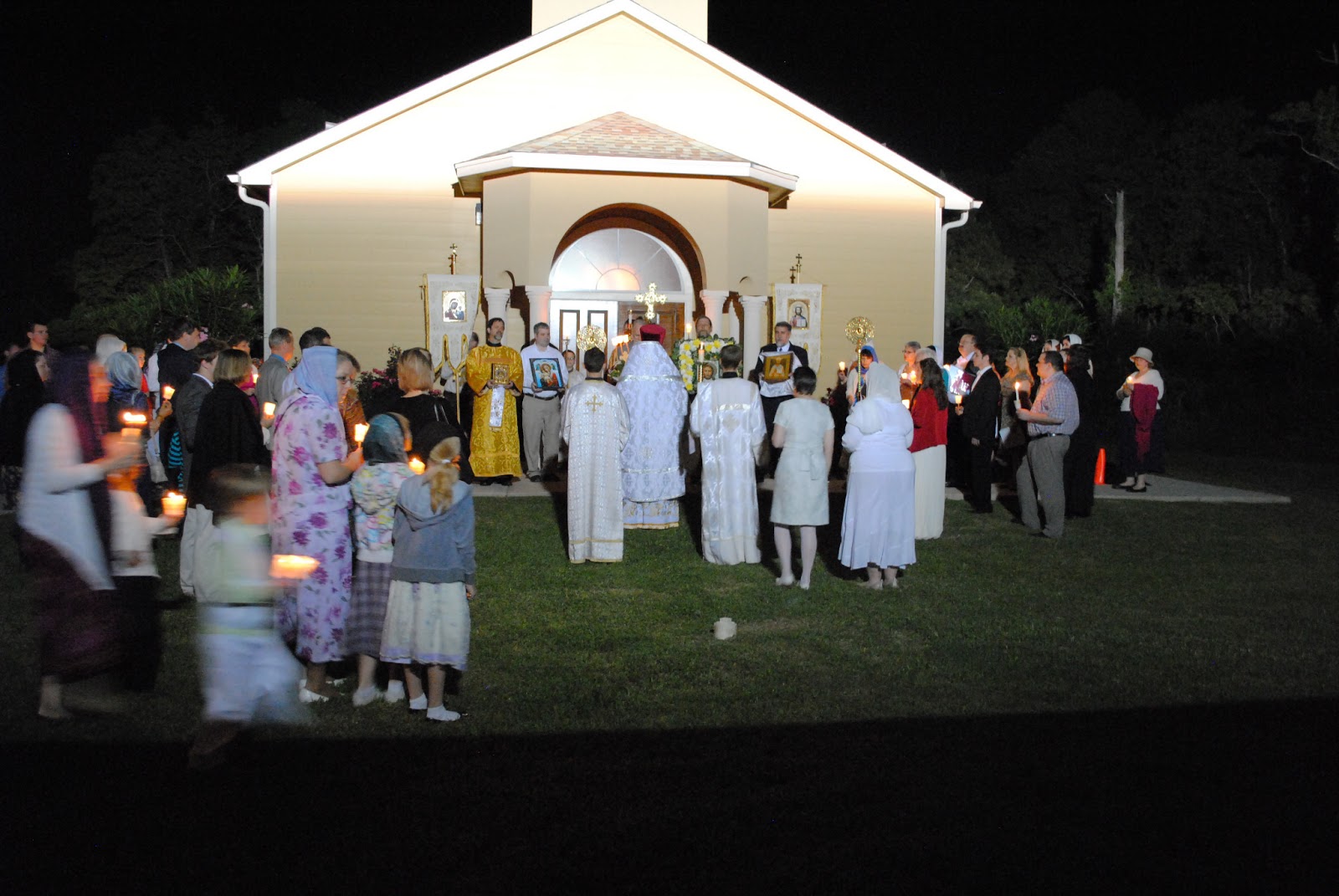
Pictures from Pascha at St. Jonah 2013


The Midnight Office


The beginning of the Paschal Matins


The blessing of Paschal Baskets


After the Agape Vespers

The Paschal Piñata

Thursday, May 30, 2013

Prayer to the Holy Pious Prince Peter and Princess Febronia of Murom


The following is a prayer to Ss. Peter and Febronia of Murom recently approved by the Synod of the Russian Orthodox Church for their commemoration (and for the emphasizing of the importance of Christian marriage) that was previously approved for the Sunday prior to September 19th n.s., which was previously approved in December 2012 (along with petitions for the augmented litany).

The original text of this prayer is posted here: http://www.patriarchia.ru/db/text/3005167.html

This translation was graciously provided by Fr. Alexander Lebedeff, with a minor tweak from Fr. German Ciuba.

Prayer to the Holy Pious Prince Peter and Princess Febronia of Murom

O ye who have greatly pleased God as all-wondrous miracleworkers, pious Prince Peter and Princess Febronia, intercessors of Murom, protectors of honorable marriage and zealous prayerful intermediaries for all of us to the Lord!

During the days of your lives you showed an example of piety, Christian love and faithfulness to one another even to the grave, and thus you glorified lawful and blessed marriage.

For this we turn to you and we pray with firm zeal: lift up for us sinners, your holy prayers to the Lord our God, and beseech for us all that is good and profitable for our souls and bodies: true faith, good hope, unhypocritical love, unshakeable piety, success in good deeds*, and, especially, through your prayers grant to those who have been joined in the bond of marriage chastity, love for one another in the bond of peace, oneness of mind and body, a bed undefiled, a blameless life, long-lived seed, the blessing of children, homes filled with all good things, and, in eternal life the unfading crown of Heavenly glory.

Yea, O holy wonder-workers! Disdain not our prayers, which we raise up to you with compunction, but be our eternal intercessors before the Lord and grant unto us through your intercessions to receive eternal salvation and to inherit the Heavenly Kingdom, that we may glorify the inexpressible love for mankind of the Father, and the Son, and the Holy Spirit, God, worshiped in the Holy Trinity, unto the ages of ages. Amen.

*if the Moleben is served for those who are about to enter into matrimony, then the prayer is read in the following redaction:

especially to those who wish to be joined in the bond of marriage grant, through your prayers, chastity, faithfulness to one another and love in the bond of peace, oneness of mind and body, a blameless life and, in eternal life the unfading crown of Heavenly glory.

Stump the Priest: Commemorations


Question: "How exactly do the commemoration lists work? I know I write the names of Orthodox or non-orthodox people I’m praying for, and then eat the Prosphora bread afterwords… But how do I get the commemorations read out during liturgy? I’m praying for a deceased friend of a friend… Also, for commemorations of the living, are those typically just the sick? Or do we do list those we’re praying for “in general”? For instance, my parents, God Parents, friends that I’m trying to introduce to the church, etc…"

Commemorations can be submitted during the liturgy by either writing out the names of those who are to be commemorated, on the sheets of paper that are placed near the prosphora, or by getting a commemoration book and putting their names in it. If you are using the sheets of paper, there are sheets with read ink that are for the living, and sheets with black ink that are for the dead. In commemoration books, the living are listed in the front section, and the section for the dead follows that.

You simply place your commemoration list with a prosphora into the appropriate basket. Only Orthodox Christians can be commemorated by name during the services. You can include the names of the non-Orthodox in your commemoration book, but they should be labeled as such, and it is best to have them listed in a separate section. For more on how one could set up a commemoration book, see "How to Set Up a Personal Commemoration Book."

It is very important that we not just submit names to be prayed for by the priest, but that when we submit those names, we first pray for them ourselves. As Archbishop Vitaly (Maximenko) of blessed memory used to say, we should not be like cuckoo birds that lay eggs in the nests of other birds, and leave the job of hatching those eggs to others. If we ask others to pray for someone, we should also be praying for them. By submitting a prosphora with a list of commemorations, you are participating in the proskomedia, and you are praying with the priest for those people that you have listed.

In our parish,  these commemorations should be submitted before the end of the first litany at the beginning of the liturgy.

If you have a commemoration book, you can also pray for those you have listed during the week as part of your morning and/or evening prayers. In the Jordanville Prayer Book there is a section at the end of the morning prayers in which these commemorations could be done.

It is a pious practice to take the prosphora from your commemorations, cut it up and let it dry out, and to eat a little bit each morning, after your morning prayers, and to take a sip of holy water. Prosphora should be eaten before you eat anything else that day. For those who cannot attend a daily liturgy, this is a way of participating in the liturgy to a lesser extent throughout the week (see also: Sanctified Bread, by Fr. Victor Potapov).

There are generally three places in the Liturgy in which Orthodox Christians can be commemorated aloud:

1. The Augmented Litany, at which time we can pray for people who are celebrating a special occasion, such as a names day; we can pray for those who are ill; and we can pray for those who are traveling.

2. Commemorations  are also done at the Great Entrance. In our parish, aside from the fixed commemorations, we usually only pray for the departed, but some parish also do other commemorations at this point.

3. At weekday Liturgies, apart from Great Feasts, a litany can be done for the departed. There are several Soul Saturdays during the year in which we especially pray for the departed.

If there is someone that you would like to have commemorated aloud during the Liturgy, it is best to let the priest know before the Liturgy begins. In a pinch, you could have a note sent into the altar, but again, only the Orthodox can be commemorated aloud by name during the services.

You can also ask the priest to serve a pannikhida for any Orthodox reposed you may wish to pray for. This is especially done on or near the anniversary of their repose. For the recently departed, a pannikhida is usually done on the first, third, ninth, and fortieth day of their repose. For the non-Orthodox, I would recommend that you use the Akathist for the Repose of the Departed, which is in the Book of Akathists from Jordanville. For the living, you can request a moleben to pray for any pious purpose, which would certainly include prayers for the salvation of a relative. You can also do a reader's moleben for those purposes as well.

Thursday, May 23, 2013

Stump the Priest: The Prayer of the Heart


This is the first post in a new series I will be doing: Questions and answers about the Orthodox Faith. If you have a question, you can e-mail me.

Question: Often we read in the Fathers that, when we are practicing the Jesus Prayer, we should "let our mind descend into our heart." What does this mean and how do we do it? Maybe that's an easy one, but I've never understood it. 

Answer: I cannot speak to this question from personal experience, but I would recommend two books on the subject, and then will quote some excerpts from one of them, which in turn quotes from the other in answer to your question.

1. "On the Prayer of Jesus", by St. Ignatius (Brianchaninov).

2. "The Power of the Name", by Metropolitan Kallistos (Ware).

Metropolitan Kallistos writes:

"The repeated Invocation of the Name, by making our prayer more unified, makes it at the same time more inward, more a part of ourselves — not something that we do at particular moments, but something that we are all the time; not an occasional act but a continuing state. Such praying becomes truly prayer of the whole person... In Orthodoxy, as in other traditions, prayer is commonly distinguished under three headings, which are to be regarded as interpenetrating levels rather than successive stages: prayer of the lips (oral prayer); prayer of the nous, the mind or intellect (mental prayer); prayer of the heart (or of the intellect in the heart). The Invocation of the Name begins, like any other prayer, as an oral prayer, in which words are spoken by the tongue through a deliberate effort of will. At the same time, once more by a deliberate effort, we concentrate our mind upon the meaning of what the tongue says. ...In more technical terms, this means that we are called to advance from the second level to the third: from "prayer of the intellect’ to ‘prayer of the intellect in heart’. ‘Heart’ in this context is to be understood in the Semitic and biblical rather than the modern Western sense, as signifying not just the emotions and affections but the totality of the human person. The heart is the primary organ of our identity, it is our innermost being, ‘the very deepest and truest self, not attained except through sacrifice, through death’. According to Boris Vysheslavtsev, it is ‘the centre not only of consciousness but of the unconscious, not only of the soul but of the spirit, not only of the spirit but of the body, not only of the comprehensible but of the incomprehensible; in one word, it is the absolute centre’. Interpreted in this way, the heart is far more a material organ in the body; the physical heart is an outward symbol of the boundless spiritual potentialities of the human creature, made in the image of God, called to attain his likeness.

To accomplish the journey inwards and to attain true prayer, it is required of us to enter into this ‘absolute centre’, that is ,to descend from the intellect into the heart. More exactly, we are called to descend not from but with the intellect. The aim is not just ‘prayer of the heart’ but ‘prayer of the intellect in the heart’, for our varied forms of understanding, including our reason, are a gift from God and are to be used in his service, not rejected. This ‘union of the intellect with the heart’ signifies the reintegration of our fallen and fragmented nature, our restoration to original wholeness. Prayer of the heart is a return to Paradise, a reversal of the Fall, a recovery of the status ante peccatum. This means that it is an eschatological reality, a pledge and anticipation of the Age to Come — something which, in this present age, is never fully and entirely realized.

... Orthodox writers in the last 150 years have in general laid little emphasis upon the physical techniques. The counsel given by Bishop Ignatii Brianchaninov (1807-67) is typical:

"We advise our beloved brethren not to try to establish this technique within them, if it does not reveal itself of its own accord. Many, wishing to learn it by experience, have damaged their lungs and gained nothing. The essence of the matter consists in the union of the mind with the heart during prayer, and this is achieved by the grace of God in its own time, determined by God. The breathing technique is fully replaced by the unhurried enunciation of the Prayer, by a short rest or pause at the end, each time it is said, by gentle and unhurried breathing, and by the enclosure of the mind in the words of the Prayer. By means of these aids we can easily attain to a certain degree of attention."

As regards the speed of recitation, Bishop Ignatii suggests:

"To say the Jesus Prayer a hundred time attentively and without haste, about half an hour is needed, but some ascetics require even longer. Do not say the prayers hurriedly, one immediately after another. Make a short pause after each prayer, and so help the mind to concentrate. Saying the Prayer without pauses distracts the mind. Breathe with care, gently and slowly.""

Wednesday, April 17, 2013

Starting a Mission and Building a Parish


This is an article I put together on lessons learned from starting a mission. For those of you who have gone through that as well, if you have some insights that you would like to add, I would appreciate the feedback:


http://www.saintjonah.org/articles/parish_building.html

Thursday, April 04, 2013

Sermons now podcasted on Ancient Faith Radio


My sermons on now being podcasted on Ancient Faith Radio, in a series entitled "From the Amvon". First sermon: Does Doctrine Matter. And for those who may ask, what is an "Amvon"? See Orthodoxwiki: http://orthodoxwiki.org/Amvon

Thursday, March 28, 2013

Why Gay "Marriage" Will Affect Everyone Else

It has become trendy for even many conservatives to argue that the government should either get out of the "marriage business" entirely, or else to argue that gay "marriage" won't hurt us, and so we shouldn't care about it. Such people do not understand what a fundamental revision of family law will be required to accommodate gay marriage. For example, in my secular job, I work for the state child support agency, and so deal with questions of paternity and marriage regularly. In our current legal system, the law presumes that any child born within a marriage is the child of the married couple -- that presumption can be rebutted with evidence to the contrary, if the husband wishes to make that case in court (usually in a divorce), but that is the presumption. When I was born, I did not have a DNA test to prove who my father was, and when my children were born, they did not have a DNA test. We also did not need to go to court to establish that I was the father, because by law, that was presumed to be the case. If you have two lesbians that are married, can we presume that the other woman is the father of the child if their “spouse” has a child? And if they later divorce, and the other spouse wanted to rebut the presumption that they were the parent with DNA (which obviously would not be hard to do), should they be let off the hook when it comes to child support? Does the actual biological father have no rights in such a case? Should such a child have two parents on their birth certificate, or three? These are the kinds of questions that will rewrite our family law if we throw this monkey wrench into the works.

Suppose the government did get out of the "marriage business". Do you really think that in the case of a religiously married couple who live together and raise their children together, but who fail to execute a will, and then one of the spouses dies unexpectedly, the religious spouse should have no unique claim to the property of her husband without having to go through a probate court? Should she have no more claim than his fishing buddy to his car, retirement accounts, or other property? Well, if the government was out of the marriage business, the fishing buddy would have just as much a claim, and the government would be who decided the matter.

And should his children have to have a court order or DNA evidence in order to claim any life insurance or Social Security survivor benefits from a deceased parent? Should they have to have a court order order or DNA evidence to make any inheritance claims?

The fact is that if the government gets out of "the marriage business" it will result in the government becoming more involved in our personal lives rather than less, because the government will have to set up new laws and new mechanisms to deal with issues that we have always dealt with by basic principles of family law that automatically come into play when a man and a woman are married.

The government has no such interests in the case of gay marriage. First of all, the reality of the gay lifestyle is that they do not generally have relationships that are lifelong and monogamous. They also do not produce children, and so children born during such a marriage could not be presumed to be the children of that couple.

Another thing that most people are not considering is that legal gay marriage will result in homosexuality being taught as normal to your children in school, even very young children. This has already happened in Massachusetts.

If the people, through their elected representatives wants to set up some mechanism so that when two people share a residence and have common property, that they would not have inheritance problems when one of them dies, they could do so, and they wouldn't have to endorse homosexuality to do it, because sometimes two people who have no romantic involvement may choose to live together for any number of reasons.

But that really is the issue for homosexual activists. They are not so much interested in adopting lifelong monogamy, as they are in forcing society to endorse their lifestyle... and this is born of a deep unhappiness that they have with themselves. And unfortunately, if they get their wish on this issue, and gay marriage becomes the law of the land, they will still be unhappy with themselves, and so will move on to some other attempt to force society to affirm them, in the vain hope that they themselves will feel affirmed and happy.


Thursday, March 14, 2013

Daniel and the Three Youths in a Non-Kosher Cafeteria


A sermon on how the Prophet Daniel (1:1-21) and the Three Youths learned to tame lions, and walk around in fiery furnaces by standing for God in small ways first: Click here to listen.

Wednesday, March 06, 2013

Photo Report: Sacred Art, Sacred Music 2013


St. Jonah Orthodox Church

Fr. Luke Murianka.

Click here to listen to his First lecture. Click here to listen to the Second Lecture (same lecture, but some differences, particularly in the questions)


Kurt Sander and Fr. John Whiteford


Fr. Luke (Murianka), Fr. John Whiteford, Matushka Patricia Whiteford, and Hieromonk John (Anderson), who is the new priest of St. Cyril Orthodox Church (OCA) in the Woodlands


Kurt Sander, giving his presentation. Click here to Listen.


Top Row: Reader Jason McLaughlin, Reader James Hall, Deacon David Companik, Fr. Alexander Petrovsky.
Bottom Row: Kurt Sander, Hieromonk Innokenty (Reichert), Priest John Whiteford, Archimandrite Luke (Murianka).


The Choral Performance. Click here to listen. It was amazing, in person.


Bobby Maddex of Ancient Faith Radio, Fr. John Whiteford, Matushka Patricia Whiteford

Wednesday, February 27, 2013

Icon Exhibit this Weekend

Sacred Art, Sacred Music

March 1–3, 2013

An Exhibition of Russian Orthodox Icons From the 18th and 19th Centuries
and a Celebration of Orthodox Christian Liturgical Music


Click above to view an event brochure in PDF format containing a detailed schedule, speaker bios, and more.
Print it out and share it with your friends!

What

Come see more than 50 icons depicting Christ, the Virgin Mary, saints, and other subjects:
exquisite examples of Orthodox Christian art in the traditional style of the Russian schools.
These will include new icons not displayed previously.
Each day, we will offer several presentations, including lectures from special guests
Archimandrite Luke Murianka, abbot of Holy Trinity Monastery in Jordanville, NY,
and Northern Kentucky University music department chair, composer Kurt Sander.
Please also join us for an extended choral performance on Sunday afternoon.
Our book and icon store will be open for business all weekend.
In addition, ethnic foods, pastries, and beverages will be offered for sale.

Where

St. Jonah Orthodox Church
2910 Spring Cypress Rd.
Spring, TX 77388
(281) 467-0264
Admission is open to the public and free of charge.

When

Friday, March 1, 2013 3:00 PM – 9:00 PM
Archimandrite Luke Murianka 7:30 PM
"The Knowledge of Icons that Leads to God - Part I"
Saturday, March 2, 2013 11:00 AM – 5:00 PM
Archimandrite Luke Murianka 11:00 AM
"The Knowledge of Icons that Leads to God - Part II"
Followed by Q&A
Kurt Sander 2:00 PM
"Ineffable Beauty: An Introduction to the Aesthetics of Orthodox Liturgical Art and Music"
Sunday, March 3, 2013 12:00 PM – 5:00 PM
Choral Performance 3:30 PM
With commentary by Kurt Sander and John Lickwar 

Download a detailed schedule of presentations
with information about our speakers.

Past Exhibitions


Wednesday, February 20, 2013

An Orthodox Look at English Translations of the Bible


I posted an article on English Translations of the Bible some time back, but the HTML formatting of it was messed up. I had been using Word for web pages, which usually works well enough, but what I have discovered is that if you have too many links, it is prone to these sort of formatting problems. So here is the cleaned up, and slightly revised text:

 http://www.saintjonah.org/articles/translations.html

Wednesday, February 13, 2013

A Pilgrim's Podvig


Someone suggested I write about why I became Orthodox in 750 words or less. Well, this is just about 18,000 words over that limit:

A Pilgrim's Podvig

I had made a few attempts at this in the past, but I always felt like those attempts only told part of the story, so this time I went big, and began David Copperfield style with "I am born", and went from there.

This article is peppered with hyperlinks, because unless someone followed a very similar path to mine, there would be too many references that would not be understood.

Saturday, February 02, 2013

The Westboro Baptist Chipmunks


Teaching theology by making fun of stupidity...

Watch till the end.

Saturday, January 12, 2013

An Ode to Thomas Oden


I was raised in the Nazarene Church, and so when I felt a "call" to the ministry, I went to study theology at the nearest Nazarene University, which was Southern Nazarene University, in Bethany, Oklahoma, and attended there from 1986 to 1990. While, at that time, the Nazarene Church was still a very conservative evangelical denomination, the professors who taught in their Religion and Philosophy Department were not so much. My elder brother had attended the same school earlier in the 80's and the liberal professors he had were the conservative professors that I had... and they hadn't really changed. However the conservative professors had generally been replaced by professors who were even more liberal than the previous liberals. Much of the material I studied during that time was a labor to be endured -- authors that had little that inspired or edified -- but there were a few exceptions, and prominently among those exceptions were the books by the Methodist theologian Thomas Oden. Oden had been a student of the extremely liberal German biblical scholar Rudolph Bultmann, and so was very much a part of the skeptical intellectual environment that I found so unattractive. However, at some point in the 70's he began to apply the skeptical criteria of liberal scholarship back upon liberal scholarship, and ended up affirming that the "Ecumenical Consensus" of the first millennium of Christian history was "normative". I was introduced to his work in my systematic Theology class. He had at that time written the first two volumes of a systematic theology that followed the outline of the Nicene Creed. In that class, we used volume 2, "The Word of Life", which focused on those parts of the Creed that related to Christ. That book was so refreshing that I got me a copy of Volume 1, "The Living God", and read it as well. And I found that our library had his book "Agenda for Theology", which was I think then out of print, but was his theological manifesto, and explained how he had moved from being a Bultmanian to one who affirmed the authority of the Tradition of the Church. That book was later reprinted in a significantly revised form, under the title "After Modernity... What?" In my pastoral theology class, they also used his "Pastoral Theology" as a textbook, which went to the Tradition of the Church for guidance on how to deal with the practical issues of pastoral theology. Reading his works were not the only reason I eventually became Orthodox, but they were a part of a convergence of things that pointed me in that direction.

The third volume of his systematic theology was not published until 1992, and by that time I had been Orthodox awhile, and so was less eager to purchase a copy, though I always had the intention of eventually doing so, in order to complete the set. Just recently, I finally got around to it, and reading it has been a walk down memory lane. Reading the preface reminded me of what a radically different spirit I found in his writings in comparison with most of the material I had studied at SNU.

In the second paragraph of his preface, he wrote:

"At the end of this journey I reaffirm solemn commitments made at its beginning:
  • To make no new contribution to theology
  • to resist the temptation to quote modern writers less schooled in the whole counsel of God than the best ancient classic exegetes
  • To seek quite simply to express the one mind of the believing church that has been ever attentive to the apostolic teaching to which consent has been given by Christian believers everywhere, always, and by all -- this what I mean by the Vincentian method (Vincent of Lerins, comm., LCC [Library of Christian Classics] VII, pp. 37-39,65-74; for an accounting of this method see LG [The Living God (volume 1 of his systematic theology)], pp. 322-25,341-51)
     I am dedicated to unoriginality. I am pledged to irrelevance if relevance means indebtedness to corrupt modernity. What is deemed relevant in theology is likely to be moldy in a few days. I take to heart Paul's admonition: "But even if we or an angel from heaven should preach a gospel other than the one we preached to you, let him be eternally condemned! As we [from the earliest apostolic kerygma] had already said, so now I say again: If anybody is preaching to you a gospel other than what you accepted [par o parelabete, other than what you received from the apostles], let him be eternally condemned [anathema esto]!" (Gal. 1:8, 9, NIV, italics added) (Life in the Spirit, p vii).

I can't remember in which of his books he said this, but I remember him echoing the above sentiments, and saying that he wanted the epitaph on his tombstone to say "He added nothing new to theology."

Thomas Oden is still a Protestant, and so one should not assume that I would agree with him entirely, but his devastating critique of Protestant liberalism and modernity in general, combined with his affirmation of the Tradition of the Church was an oasis in a spiritual and intellectual desert, and it pointed me in the direction of the Orthodox Church.

Tuesday, January 01, 2013

Tone Tutor


For those who are unable to go to the Summer Liturgical School in Jordanville, the Tone Tutor is an excellent set of CDs that will teach you the 8 tones according to the common usage of the Russian Church, and uses the methods taught at Jordanville. There are 10 CDs: one for each of the 8 tones. One for "mid term" and "final" tests, and one for refreshing your memory. This tone teaches each variation of the 8 tones: the troparion, sticheron, sticheron refrains, prokimenon, and irmos melodies. The program is completely audio based... you need only pop in the first CD, and follow the instructions from there.

This fills an important need. In the 90's there was a cassette tape available, but it was not nearly as user friendly, and the translation used for the text was not the most commonly used ones in ROCOR.

Choir members who have not yet memorized the tones will greatly benefit from this, and especially those who are thrust into the position of manning the cliros, and have no one else to prompt them when a particular tone is called for, and they have no one to get them started. Many years ago, I was in that situation, and I used some cassette tapes that were available, and worked on the tone of the week each week, until I had them all down. But this is a much more thorough program. I highly recommend it.

It can be purchased by clicking here.

Friday, December 28, 2012

The Russian Church establishes a new commemoration of Ss. Peter and Febronia of Murom


What follows is a Google translation that I have cleaned up as best as I could, but there may be some minor errors. Fr. Michael van Opstall kindly provided a translation of the petitions.

JOURNAL № 129

CONSIDERED the establishment of an additional day to commemorate the wonder workers Holy Prince Peter (in monasticism, David) and Princess Fevronia (in monasticism, Euphrosyne), of Murom.

Information:

The celebration of the Holy Prince Peter and Princess Fevronia of Murom on July 8 (June 25 by the Julian calendar), falls during the Fast of Ss. Peter and Paul . In this regard, the Council of Bishops on February 4th, 2011, instructed the liturgical commission "to consider an additional date for the commemoration of the Holy Prince Peter and Princess Fevronia of Murom, referring to the desire of many Christians to be married on the day honoring these patrons of marriage" (paragraph 17, of the "On matters of internal life and external activities of the Russian Orthodox Church").In examining the issue, it was noted that an additional day of commemoration of Saints Peter and Fevronia could be installed on the 20th of January (the transfer of the relics of the saints from the Murom Museum of the Annunciation Monastery in Murom) or September 19th (transfer of the relics from the Annunciation Monastery to the Holy Trinity convent Murom.). The Commission of the Inter-Council on worship and religious art, with the blessing of His Holiness Patriarch Kirill, discussed the issue, and recommended that in conjunction with the celebration of the memory of St. Peter and Fevronia, there also be additional petitions to be done at the augmented litany of Divine Liturgy, and that preaching on this day be devoted to the Christian doctrine of family and marriage.

RESOLVED:

1. To establish an additional day for the commemoration of the Holy wonder workers Prince Peter (in monasticism, David) and Princess Fevronia (in monasticism Euphrosyne) of Murom on the Sunday preceding the September 19 (September 6 by the Julian calendar), in remembrance of transferring their fair bodies in the year 1992.

2. In conjunction with the commemoration of Saints Peter and Fevronia, clergy preach on the subject of pious Christian family values.

3. Also on this occasion, to add to the augmented litany of the Divine Liturgy the following petitions:

Again we pray that Thy people would keep this commandment: what God has joined, let not man put asunder, and that He would give their home churches indestructible strength and increase in love unfeigned;

Again we pray for the preservation of the marriages of Thy servants, in peace and concord, piety and purity;

Again we pray that Thy people may rejoice to see sons and daughters, and that our people would multiply and inherit Thy blessing from generation to generation.

4. That the Synodal liturgical commission submit to the Holy Synod by April 1, 2013 a prayer to be read at the end of the Divine Liturgy in memory of the days of Ss. Peter and Fevronia, for the multiplication of love, strengthening of families, and the faithful preservation of the gift of chastity in those not married and to help them prepare for their entry into family life.

Saturday, December 22, 2012

Hammer Control?


Many are arguing that Wayne LaPierre argued that violent movies and violent video games share some of the blame for the recent school shooting in Connecticut, that he was undercutting the traditional argument that "Gun's don't kill people, people kill people". The problem with that observation is that guns are tools, just like hammers are tools. Movies and Video Games are mediums, and mediums communicate information. If we have lots of video games in which people went around cracking people's skulls with hammers, and we had movies that glorified killing people with hammers, we would probably see a rise in murders committed with hammers. If we did, hammers would not share equal blame with those movies and video games.... hammers are tools, which can be put to either good or bad uses. The answer is not hammer control, or limiting the size and weight of hammers.

Human beings have a natural aversion to killing other human beings. You have to train a person to kill another person. Guns cannot train anyone, and neither can hammers. Movies and video games can train people.

As Lt. Col. Dave Grossman observed in his article "Trained to Kill", without training, human beings are very ineffective killers:

"In more modern times, the average firing rate was incredibly low in Civil War battles. Paddy Griffith demonstrates that the killing potential of the average Civil War regiment was anywhere from five hundred to a thousand men per minute. The actual killing rate was only one or two men per minute per regiment (The Battle Tactics of the American Civil War). At the Battle of Gettysburg, of the 27,000 muskets picked up from the dead and dying after the battle, 90 percent were loaded. This is an anomaly, because it took 95 percent of their time to load muskets and only 5 percent to fire. But even more amazingly, of the thousands of loaded muskets, over half had multiple loads in the barrel--one with 23 loads in the barrel. In reality, the average man would load his musket and bring it to his shoulder, but he could not bring himself to kill. He would be brave, he would stand shoulder to shoulder, he would do what he was trained to do; but at the moment of truth, he could not bring himself to pull the trigger. So, he lowered the weapon and loaded it again. Of those who did fire, only a tiny percentage fired to hit. The vast majority fired over the enemy's head."

However, with training, people can become killing machines:

The Japanese were masters at using classical conditioning with their soldiers. Early in World War II, Chinese prisoners were placed in a ditch on their knees with their hands bound behind them. And one by one, a select few Japanese soldiers would go into the ditch and bayonet "their" prisoner to death. This is a horrific way to kill another human being. Up on the bank, countless other young soldiers would cheer them on in their violence. Comparatively few soldiers actually killed in these situations, but by making the others watch and cheer, the Japanese were able to use these kinds of atrocities to classically condition a very large audience to associate pleasure with human death and suffering. Immediately afterwards, the soldiers who had been spectators were treated to sake, the best meal they had had in months, and to so-called comfort girls. The result? They learned to associate committing violent acts with pleasure. The Japanese found these kinds of techniques to be extraordinarily effective at quickly enabling very large numbers of soldiers to commit atrocities in the years to come. Operant conditioning (which we will look at shortly) teaches you to kill, but classical conditioning is a subtle but powerful mechanism that teaches you to like it.

Violent movies and video games train people to kill. That doesn't mean that everyone who watches violent movies or plays Halo is going to kille 20 little kids, but those things do make you capable of shooting another human being in a way that people in the Civil War were not, even though they all had access to guns.